

What Is A Forex Exit Strategy?
A forex exit strategy is a written rule for closing a trade. It decides what happens when the trade idea is wrong, when the planned target is reached, when open profit needs protection, or when the market condition no longer supports staying in the position.
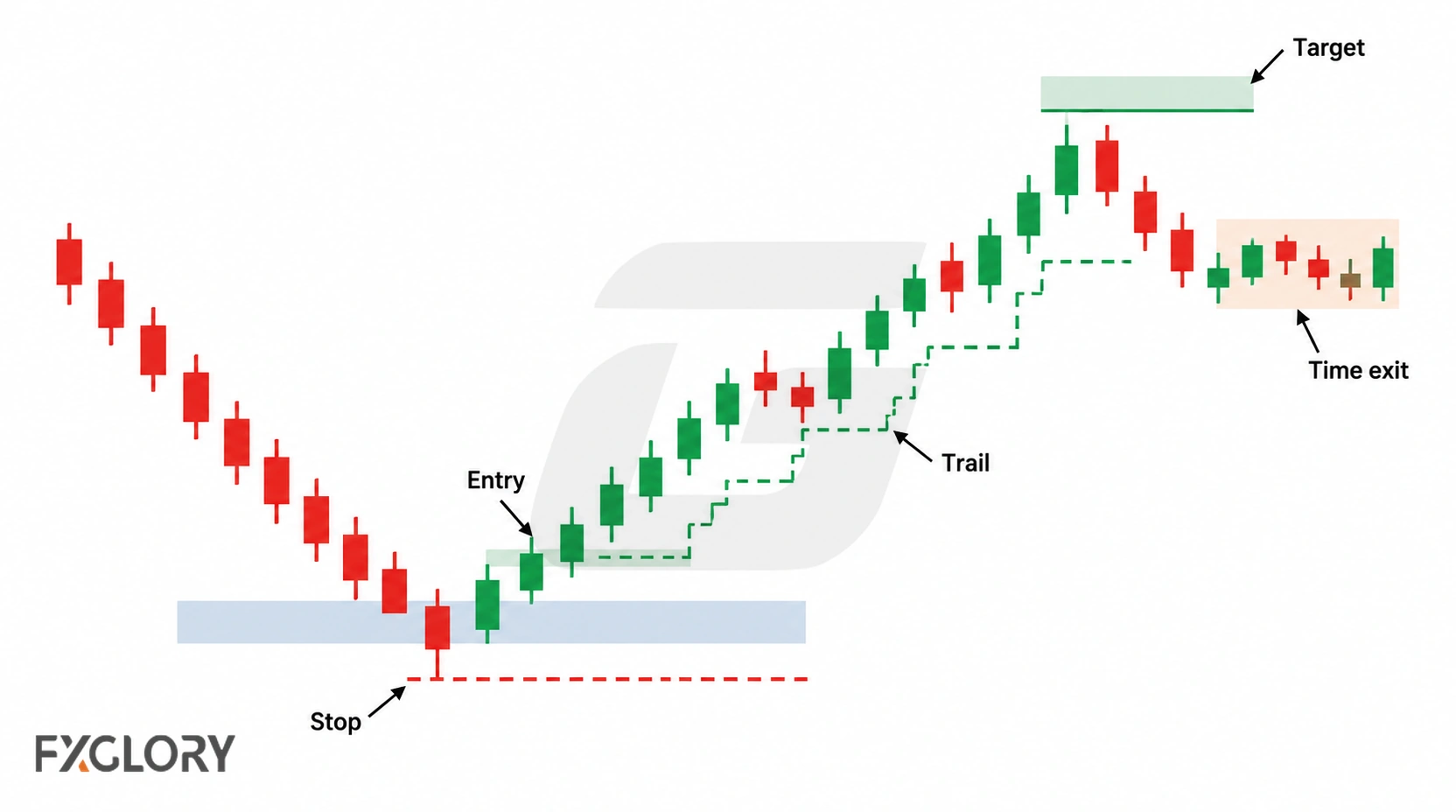
An exit is not only a stop loss. It can also be a take-profit rule, trailing stop, partial close, time stop, session close, news-risk exit, technical invalidation exit, or review rule after price fails to progress.
This page is the broad exit-method framework. For setup structure before entry, use the setup rule framework. For a specific ATR initial stop page, use ATR stop-loss rules. For post-entry ATR trailing logic, use ATR trailing-stop rules.
| Exit Problem | Exit Rule To Consider | Use When |
|---|---|---|
| The trade idea is wrong | Initial stop-loss or invalidation exit | Price breaks the structure that supported the setup |
| The planned target is reached | Take-profit exit | Price reaches the level or target area defined before entry |
| The trade is moving in favor | Trailing stop or partial exit | The plan allows profit management after progress |
| The trade stops progressing | Time-based or no-progress exit | The setup depends on timely movement |
| Conditions change suddenly | News, volatility, spread, or session exit | The trade no longer matches the planned environment |
Why Exits Should Be Planned Before Entry
An entry without an exit plan makes the risk unclear. The trader may know why the trade looks interesting, but not where the idea is invalid, what profit area is realistic, or what should happen if price moves sideways after entry.
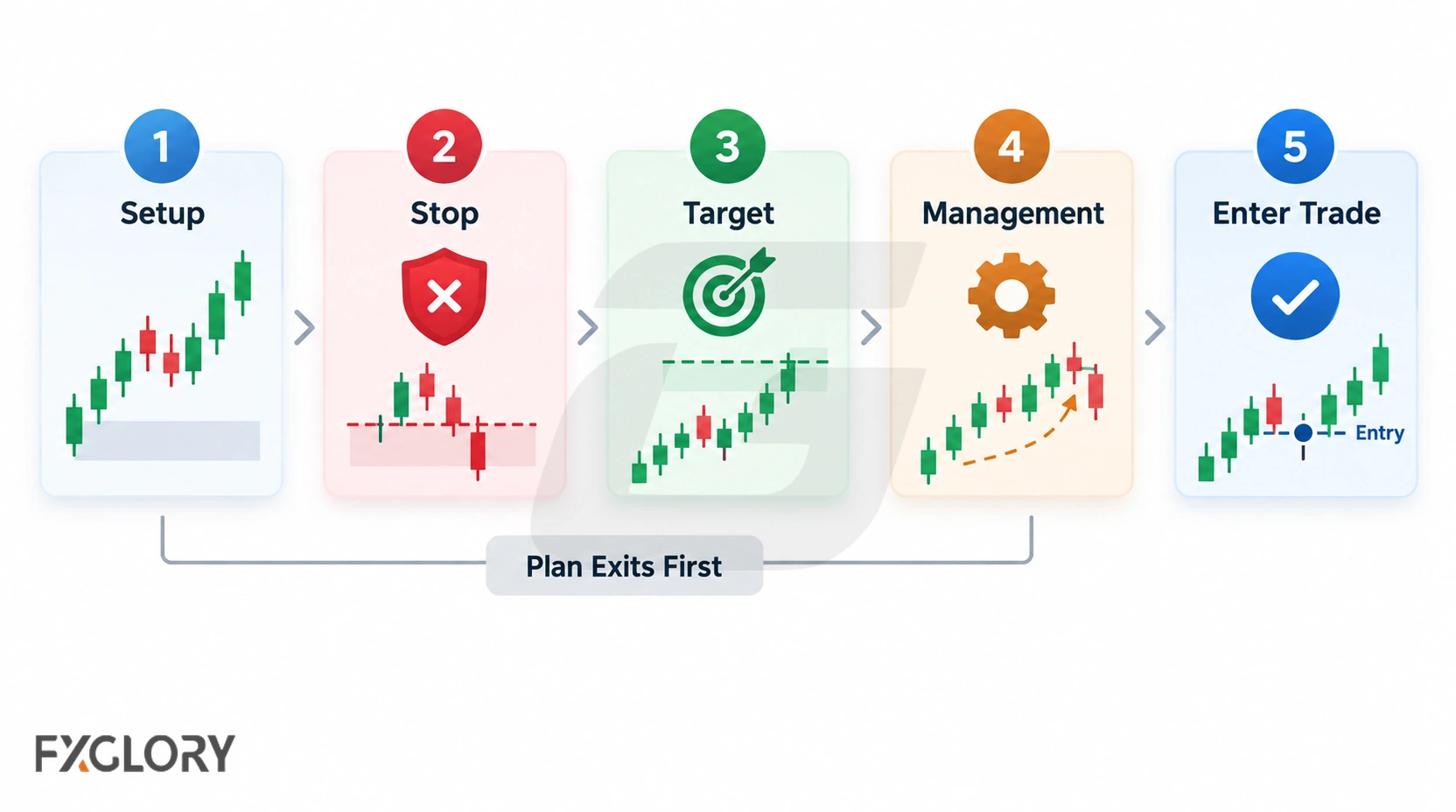
The exit should be connected to the reason for the trade. A breakout trade may need a failed-breakout exit. A trend pullback may need a structure-based stop or trailing rule. A range trade may need an exit near the opposite side of the range or a skip rule if price reaches the entry area too late.
| Before Entry Question | Why It Matters | Weak Version | Better Version |
|---|---|---|---|
| Where is the trade idea wrong? | Defines the planned loss point | Exit if it feels bad | Exit if price breaks the structure that supported the setup |
| Where can profit reasonably be taken? | Prevents target selection after emotion appears | Take profit when it looks enough | Use a planned level, target area, or management rule |
| Will the stop move after entry? | Controls trailing and break-even decisions | Move the stop whenever nervous | Move the stop only after the written condition occurs |
| What if price goes nowhere? | Prevents holding a dead setup | Wait and hope | Use a candle-count, session, or no-progress review rule |
| What if volatility changes? | Controls abnormal movement risk | Ignore it | Review spread, ATR, news timing, and stop distance |
Exit Strategy vs Stop Loss vs Take Profit vs Trailing Stop
Different exit rules solve different problems. Combining them without role separation can create confusion. A protective stop is not the same as a profit target. A trailing stop is not the same as an initial stop. A time exit is not a price signal.
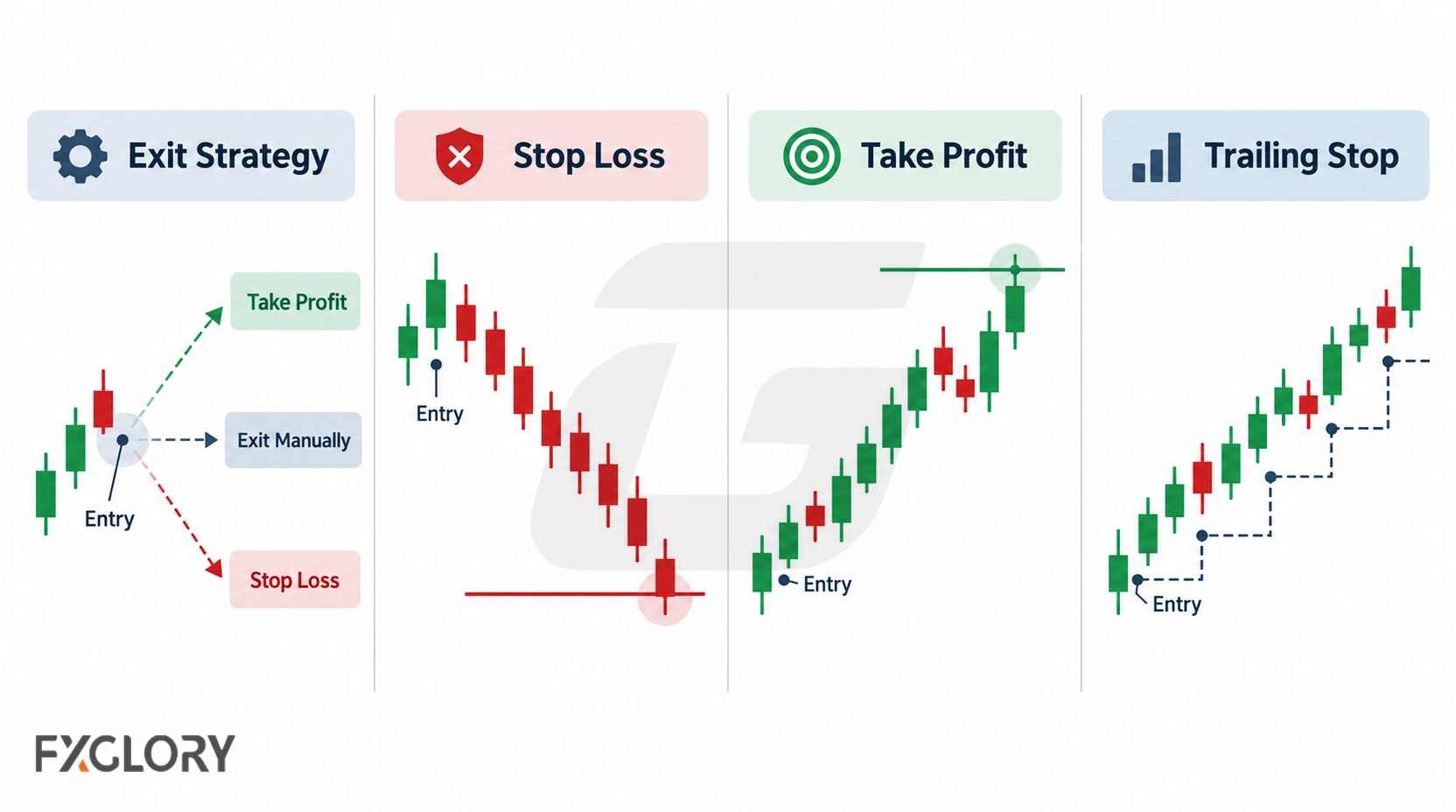
| Exit Rule | Main Job | Useful When | Main Risk |
|---|---|---|---|
| Initial stop loss | Defines the planned loss point | The setup has a clear invalidation area | Placed randomly or widened after entry |
| Take profit | Closes at a planned target or area | The target is realistic after spread and volatility | Target is chosen without market structure |
| Trailing stop | Moves the exit as the trade develops | The trade can continue beyond the first target area | Too tight in active markets or too wide for account risk |
| Partial exit | Closes part of the position and manages the rest | The plan has more than one profit-management objective | Used randomly after fear or greed appears |
| Time-based exit | Closes or reviews the trade after time passes | The setup depends on session, intraday timing, or progress | Used to avoid price-based invalidation |
| News or event exit | Reduces exposure before abnormal conditions | A scheduled event can change spread, volatility, or slippage risk | Ignored because the trade is already open |
When the exit rule is part of a wider method, compare it with the broader forex strategy hub before treating one close rule as the whole strategy.
Exit Rule vs Exit Order
An exit rule explains why the trade should be closed. An exit order is the practical instruction used to close or manage the position. The rule should come first. The order workflow should follow the rule, the platform, the account conditions, and the trade-management plan.
For example, exit if the breakout fails and price closes back inside the old range is a rule. The order placement and management process should be checked inside the trader’s platform workflow before live trading.
Fixed Target And Fixed Risk-Reward Exits
A fixed target exit uses a planned profit distance or a planned reward-to-risk relationship. For example, a trader may test whether a setup works better when the target is placed at a fixed multiple of the initial risk or at a nearby market structure level.
A fixed risk-reward exit is easy to review because the rule is clear. Its weakness is that the market may not respect the chosen ratio. A 2R or 3R target can look organized on paper, but price still needs enough structure, volatility, and time to reach it.
| Fixed Exit Choice | When It Can Help | What To Check | Skip If |
|---|---|---|---|
| Fixed pip target | Short-term testing with repeatable conditions | Spread, average movement, session activity, and stop distance | The target is too small after spread |
| Fixed R target | Clean review of reward-to-risk behavior | Whether the market has a realistic path to the target | The target ignores nearby resistance or support |
| Structure target | The chart has clear levels | Nearest opposing level, reaction area, or range boundary | The target is placed beyond a major obstacle without a reason |
| Hybrid target | The trader wants structure plus risk control | Whether the structure target gives acceptable reward after spread | The hybrid rule changes after entry |
Support And Resistance Exit Strategies
Support and resistance exits close or review a trade near a chart area where price may react. A long trade may use resistance, a previous swing high, or a range high as a profit area. A short trade may use support, a previous swing low, or a range low.
This exit type fits range trades, breakout retests, pullbacks, and price-action setups because the exit is tied to the chart. It becomes weaker when levels are drawn after entry only to justify staying in a trade.
| Setup Type | Possible Exit Area | Invalidation Review | Main Risk |
|---|---|---|---|
| Range long | Mid-range or range resistance | Exit or review if price breaks the range support idea | Holding after price rejects the target area |
| Range short | Mid-range or range support | Exit or review if price breaks the range resistance idea | Ignoring a strong breakout from the range |
| Breakout long | Next resistance or measured move area | Exit if price returns inside the old structure | Chasing after the breakout is extended |
| Breakout short | Next support or measured move area | Exit if price returns above the broken structure | ATR or spread makes the stop too wide |
| Pullback trade | Previous swing extreme or continuation area | Exit if the pullback structure fails | Taking profit too early without a rule |
When the exit depends on chart levels, use support and resistance context before choosing the target or invalidation area.
ATR And Volatility-Based Exit Strategies
ATR belongs in an exit plan only when the exit question is about volatility, stop distance, target realism, or trailing distance.
When volatility is high, a narrow stop may be too sensitive to normal movement. When volatility is low, a large target may need more time or a stronger catalyst. ATR should support the exit rule; it should not choose direction or replace price structure.
| ATR Exit Use | What It Helps Review | Dedicated Page | Main Risk |
|---|---|---|---|
| Initial ATR stop | Whether the first stop distance fits volatility | ATR Stop Loss Strategy Forex | Stop is placed from ATR alone without structure |
| ATR trailing stop | How the stop may move after price develops | ATR Trailing Stop Forex Strategy | Trailing rule is changed emotionally after entry |
| Chandelier-style exit | ATR trailing logic from recent highs or lows | Chandelier Exit Forex Strategy | Used as an entry signal instead of an exit framework |
| ATR target review | Whether the profit target fits recent movement | ATR Forex Strategy | Target is too large for current movement |
| ATR no-trade filter | Whether volatility is too low, too high, or abnormal | ATR Forex Strategy | Filter is ignored when the trader wants action |
For broader volatility logic, review ATR as movement-size support. For initial stop placement, use ATR stop-loss rules. For post-entry management, use ATR trailing-stop rules. For a specific ATR exit framework, use the Chandelier Exit framework.
Trailing Stop Exit Strategies
A trailing stop adjusts the exit as the trade moves. The purpose is not to guarantee profit. The purpose is to define how much room the trade has before the open idea should be closed or reviewed.
A trailing stop should usually move in favor of the trade. Moving a stop farther away from the entry to avoid a planned loss is not trade management; it changes the risk after entry and makes the trade harder to review.
| Trailing Method | How It Works | Useful When | Main Risk |
|---|---|---|---|
| Structure trailing | Stop moves behind swing lows for longs or swing highs for shorts | Price forms clean structure while trending | Structure is unclear or too wide |
| ATR trailing | Stop distance changes with volatility | Movement size changes during the trade | Multiplier is not tested |
| Moving-average trailing | Exit follows an average or price reaction around it | The trade depends on trend continuation | Flat or choppy averages cause repeated exits |
| Break-even rule | Stop moves to reduce open risk after a condition | The plan defines when risk should be reduced | Moved too early and stopped before the setup develops |
| Step trailing | Stop moves after each planned target or structure event | The trader wants fewer stop changes | Steps are random or emotional |
Moving Average And Trend-Based Exit Strategies
A moving average can support exits when the trade depends on trend behavior. A trader may test exiting after price closes beyond a selected average, after the average slope changes, or after price fails to hold the average during a pullback.
Moving-average exits should not be used as automatic close rules in every condition. In ranges, price may cross the average repeatedly. In fast trends, a slower average may react late. In choppy markets, a faster average may exit too often.
| Trend Exit Tool | Possible Rule | Better Use | Main Risk |
|---|---|---|---|
| Moving average | Exit after price closes beyond the chosen average | Trend continuation or pullback setups | Whipsaws in sideways conditions |
| MA slope | Review the trade when slope flattens or turns | Trend-strength context | Late reaction after price already moves |
| Trendline | Exit or review after a trendline break | Clear directional structure | Trendline is redrawn after entry |
| Higher low or lower high | Exit when structure no longer supports the trend | Price-action trend trades | Structure is too small or too subjective |
For moving-average roles, use moving-average strategy context. For broader trend behavior, use forex trend behavior.
Indicator-Supported Forex Exits
Indicators can support exit decisions when each indicator has a defined role. The mistake is using a new indicator after entry because the original exit feels uncomfortable.
ADX, RSI, ATR, Bollinger Bands, and moving averages can all support exit review, but they should not replace invalidation. The chart still needs to show why the trade idea is no longer valid or why the planned management rule has been reached.
| Indicator | Exit-Support Role | What It Should Not Do |
|---|---|---|
| RSI | Review momentum exhaustion, divergence, or failed continuation | Force an exit every time RSI reaches a level |
| ADX | Review trend strength or fading strength | Show direction by itself |
| ATR | Review volatility, stop distance, and target realism | Choose direction or guarantee a target |
| Bollinger Bands | Review price location, band walk, squeeze, or range reaction | Turn every band touch into an exit |
| Moving average | Review trend structure and price position | Replace the original trade plan |
For indicator-based methods, use the indicator-strategy framework. For RSI-specific momentum rules, use RSI strategy context. For ADX-specific trend-strength rules, use ADX trend-strength context.
Partial Exit And Scale-Out Rules
A partial exit closes part of the position while leaving the rest open under another rule. This can be useful when the trader wants to reduce open exposure at one area but still allow part of the trade to continue.
Before using partial exits, check whether the account, platform, position size, and trade-management workflow allow the position to be managed exactly as written in the plan.
Partial exits should be planned before entry. If the trader decides to close part of the trade only because price has paused or fear has appeared, the partial exit cannot be reviewed properly.
| Partial Exit Plan | Example Rule | Useful When | Main Risk |
|---|---|---|---|
| First target plus runner | Close part at the first planned area and trail the rest | Trend may continue after the first target | Runner has no clear exit rule |
| Level-based scale-out | Close portions at planned support or resistance areas | The chart has multiple visible reaction zones | Too many exits make review messy |
| Risk-reduction scale-out | Close part after a defined move and adjust remaining risk | The plan wants exposure reduced after progress | Used to hide poor initial position sizing |
| No partial exit | Close full position using one rule | The strategy needs clean testing | Misses extended moves if the fixed target is close |
Time-Based, Session-Based, And News-Based Exits
Some exits are based on time or market conditions instead of a price level. A day trader may close before the session ends. A short-term trader may close before a scheduled event. A trader may also close when price fails to move after a planned number of candles.
Time exits help when the strategy depends on active conditions. They can also prevent a short-term trade from becoming an unplanned longer-term position.
| Exit Type | Possible Rule | Useful When | Main Risk |
|---|---|---|---|
| Session close exit | Close before the planned trading window ends | The trade is built for one session | Holding after liquidity changes |
| End-of-day exit | Close or review before the day ends | The strategy is intraday only | Turning a day trade into a swing trade without a plan |
| No-progress exit | Exit after a set number of candles without progress | The setup should move soon after entry | Exiting too early in slower timeframes |
| News-risk exit | Close or reduce exposure before a scheduled event | Spread, slippage, or volatility may change quickly | Ignoring event risk because the trade is open |
| Weekend or rollover review | Review whether the trade should remain open | Exposure may continue outside the original plan | Carrying risk without a reason |
For session timing, review trading-window selection. For intraday workflow, use day-trading strategy rules.
Exit Rules By Setup Type
The exit should match the reason for entry. A range trade, breakout trade, pullback trade, and indicator-confirmed trade should not automatically use the same exit.
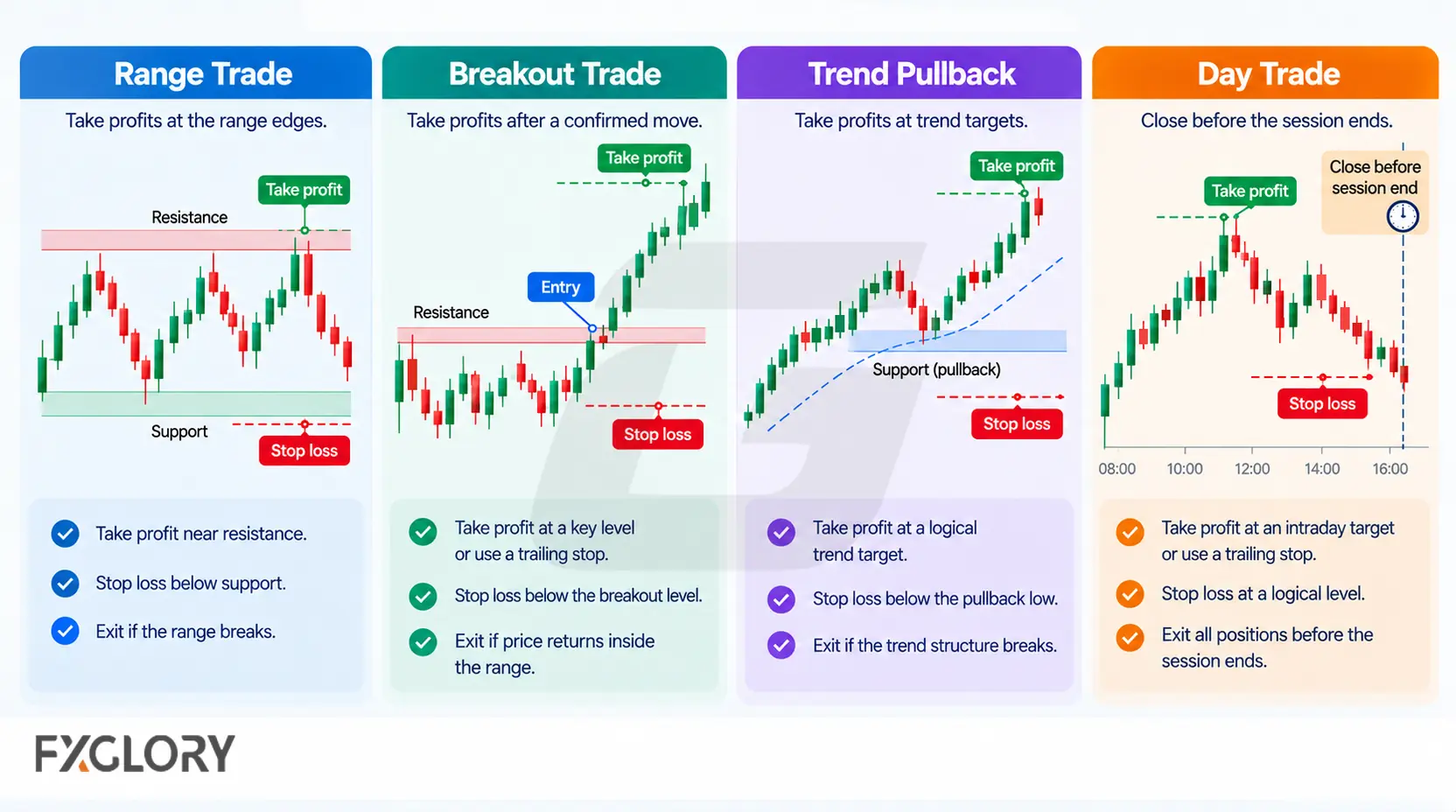
| Setup Type | Exit Focus | Possible Rule | Skip Or Review If |
|---|---|---|---|
| Range setup | Opposite side of the range, midpoint, or failed range reaction | Take profit near planned range area or exit if range support/resistance fails | Price breaks the range strongly instead of reacting |
| Breakout setup | Failed breakout, retest failure, next level, or trailing rule | Exit if price returns inside the old range or fails the retest | The breakout happens during abnormal spread or event volatility |
| Trend pullback | Structure stop, moving-average context, or trailing rule | Exit if pullback structure breaks or trend context fails | Price is too extended before entry |
| Indicator setup | Original indicator role plus price invalidation | Exit when the trade plan condition fails, not just because one line changes | Indicators conflict and price context is unclear |
| Day-trading setup | Session target, time stop, spread, and end-of-session rule | Close before the planned window ends if the setup is intraday only | The trade becomes an unplanned overnight position |
For setup construction, use context, trigger, invalidation, exit, and review rules.
Exit Rules By Trading Style
Trading style affects exit design. A scalping exit may be sensitive to spread and fast timing. A day-trading exit may depend on the session. A swing-trading exit may need wider stop distance and more patience. A position-style exit may require broader structure and larger exposure review.
| Trading Style | Exit Priority | What To Check | Main Risk |
|---|---|---|---|
| Scalping | Fast target, tight invalidation, spread control | Spread, execution, target size, and active session | Expected move too small after cost |
| Day trading | Session-based target, time stop, no overnight drift | Session, pair, news, spread, and intraday structure | Holding past the planned window |
| Swing trading | Structure target, wider stop, multi-day management | Higher timeframe levels and margin exposure | Stop distance too wide for account risk |
| Position trading | Broad structure, trend review, event and rollover exposure | Larger market context and risk capacity | Exit rule too small for the timeframe |
When comparing trading styles, review method selection by style and risk. When the exit depends on timeframe speed, use timeframe selection rules.
When Not To Move An Exit
Some exit changes are part of a plan. Others are signs that the original plan is being abandoned. The difference is whether the rule was written before entry.
- Do not widen a stop because price is close to hitting it. That changes the planned loss after risk has already been accepted.
- Do not remove a take-profit target because the trade feels strong. A runner rule should be written before entry.
- Do not move a trailing stop backward. A trailing stop should not give a losing trade more room after the fact.
- Do not switch from a day trade to a swing trade because the intraday exit failed. That is a new strategy, not management.
- Do not add a new indicator after entry just to avoid the original exit. Exit support should be part of the plan before the trade is opened.
- Do not ignore spread, slippage, or event risk because the trade is already open. Those conditions can change the exit quality.
Common Forex Exit Strategy Mistakes
Exit mistakes are often review mistakes. If the rule is unclear, the trader cannot know whether the exit method failed or whether the plan was not followed.
- No exit before entry: The trade is opened before invalidation, target, and management rules are defined.
- Exit based on emotion: Profit is taken because of fear or loss is delayed because of hope.
- Stop widened after entry: The loss scenario is changed without a new tested rule.
- Target ignores structure: The target is placed beyond an obvious barrier without a reason.
- Trailing stop too tight: Normal movement closes the trade before the setup has room to develop.
- Trailing stop too wide: The trade gives back more than the account or plan can tolerate.
- Partial exit is random: The trader closes part of the position without a repeatable rule.
- Same exit for every market: Range, breakout, trend, and event conditions are treated the same.
- Spread ignored: A small-target exit does not leave enough room after trading cost.
- No review notes: The trader cannot compare exits because trade-management decisions are not recorded.
Before testing short-target exits, review FXGlory spreads. When stop distance and position size need to be checked together, use the FXGlory margin calculator. For platform workflow, review FXGlory trading platforms.
Testing A Forex Exit Strategy
A forex exit strategy should be tested as part of a complete trade plan. Testing only the entry or only the target does not show whether the full method can be followed.
- What setup type is being traded?
- Where is the trade idea invalid?
- Is the initial stop based on structure, volatility, or both?
- What is the planned target or profit-management rule?
- Will the stop trail, move to break-even, or stay fixed?
- Will the strategy use partial exits or full exits only?
- What time, session, or news condition forces a review?
- Does the target still make sense after spread?
- Does stop distance fit position size, leverage exposure, and margin?
- Can the same exit rule be reviewed across enough examples?
- Are skipped trades, early exits, late exits, and rule changes recorded?
Forex Exit Strategy Checklist
Before using a forex exit strategy, answer these questions.
- What exact condition makes the trade wrong?
- What exact condition takes profit or starts profit management?
- Is the stop loss, target, trailing rule, or partial exit written before entry?
- Does the exit match the setup type?
- Does the exit match the trading style and timeframe?
- Is spread small enough relative to the expected move?
- Does volatility support the planned stop and target?
- Does position size fit the stop distance and margin requirement?
- What happens if price does not move after entry?
- What happens near session close or scheduled news?
- What rule prevents the stop from being widened emotionally?
A forex exit strategy is useful only when it is part of a full trade plan. The exit should protect the account from unclear risk, close trades that no longer match the setup, and give each trade a rule that can be reviewed later.