

What Is An ATR Stop Loss Strategy In Forex?
An ATR stop loss strategy in forex uses Average True Range to review whether the initial stop distance fits current market movement before or at entry. ATR helps measure volatility and movement size, then that reading can be used as a distance check around the stop-loss area.
This page does not cover every ATR strategy or trailing-stop rule. It focuses only on using ATR to review the initial stop-loss distance before or at entry. For the broader indicator-strategy framework, review forex indicator strategies. For the broader ATR strategy framework, review ATR as volatility and risk support. For indicator mechanics, use the dedicated ATR Indicator Forex guide.
An ATR stop loss is not a trade entry method. It does not choose direction, find the setup, or replace the original invalidation point. The setup still needs price structure, trigger, stop placement, position size, spread review, margin review, and a risk rule.
ATR Stop Loss vs Full Trade Strategy
The common mistake is to treat an ATR stop loss as a complete strategy. It is not. ATR only helps review distance. The trade still needs direction, setup logic, invalidation, position size, and management rules.
| Part Of The Plan | What It Decides | ATR Stop-Loss Role | Main Risk |
|---|---|---|---|
| Trade direction | Whether the setup is bullish, bearish, or unclear | No direct role | ATR is mistaken for direction |
| Entry trigger | What confirms the trade idea | No direct role | The stop formula is used as an entry reason |
| Original invalidation | Where the trade idea is wrong | ATR can review whether the stop has enough movement room | The chart's invalidation area is ignored |
| Stop distance | How far the stop sits from entry or anchor | Main role | The multiplier is too tight or too wide |
| Position size | How much exposure the stop distance creates | Indirect role through stop distance | A wider stop is used without reducing exposure |
| Trade acceptance | Whether the setup still fits after cost and risk | Supports accept, reduce, or skip decision | The trade is forced even when the stop does not fit |
When the original trade idea needs context, trigger, invalidation, and review rules, use the forex trading setups framework before choosing any ATR stop-loss distance.
ATR Stop Loss Workflow Before Entry
An ATR stop loss should follow a written sequence. The sequence matters because the stop distance affects position size, margin exposure, and whether the trade still fits the account plan.
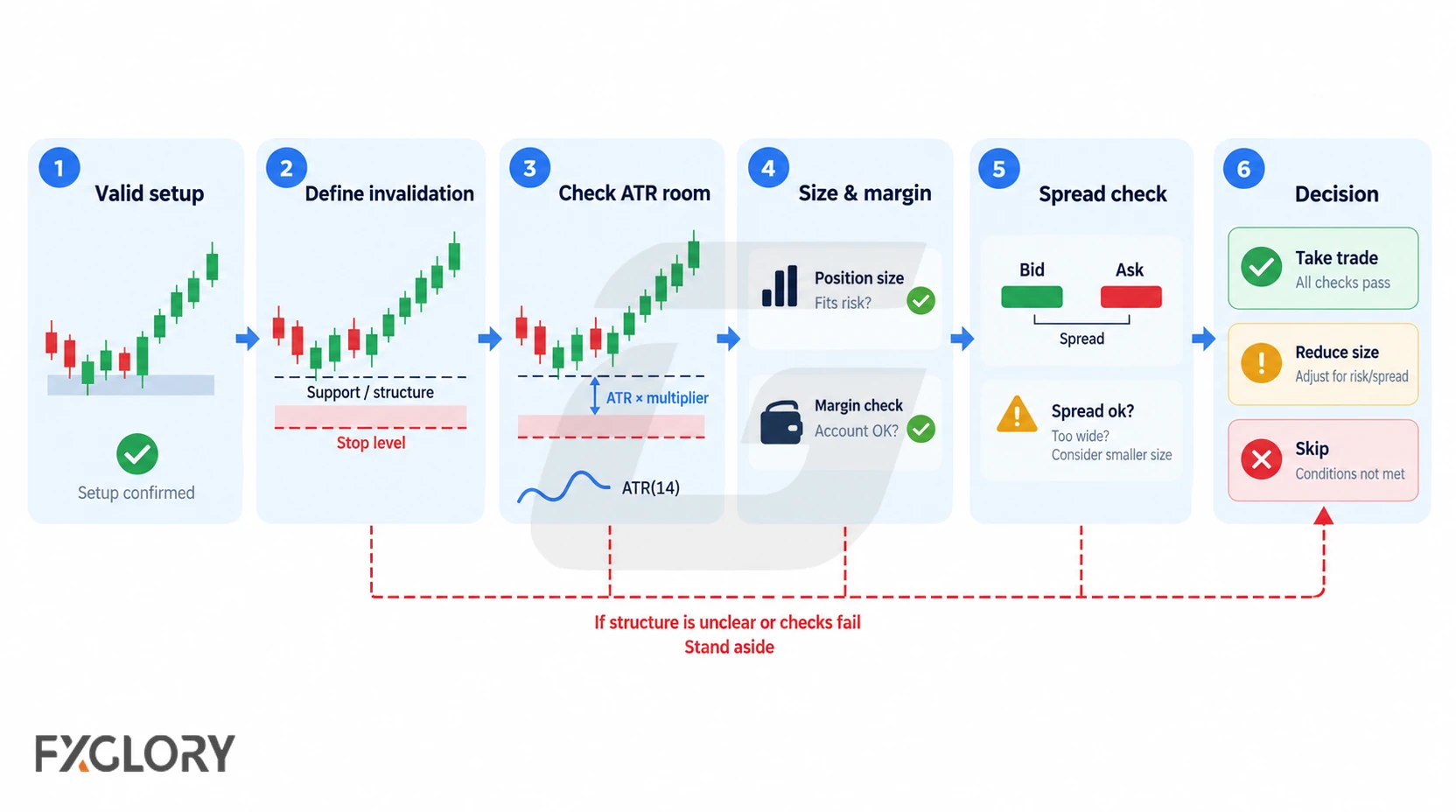
| Step | Question | Tool Or Context | Decision |
|---|---|---|---|
| 1 | Does a trade setup already exist? | Price structure, trend, range, trigger | Do not use ATR as the entry reason |
| 2 | Where is the idea wrong? | Support, resistance, swing high/low, trend structure | Define original invalidation |
| 3 | Does current volatility need extra room? | ATR value and chosen multiplier | Review stop distance around the invalidation area |
| 4 | Can the stop fit the account plan? | Stop distance, position size, margin | Accept, reduce size, delay, or skip |
| 5 | Does trading cost affect the setup? | Spread and execution conditions | Reject tight stops that do not leave enough room |
After entry, widening the original stop to avoid an exit changes the risk plan. If the stop needs to move after entry, that should belong to a separate written management rule, not an emotional adjustment to the initial ATR stop.
Long And Short ATR Stop Loss Formula
A basic ATR stop-loss calculation usually starts with an anchor, then adds or subtracts an ATR multiple depending on trade direction. These examples are calculation references, not universal settings.
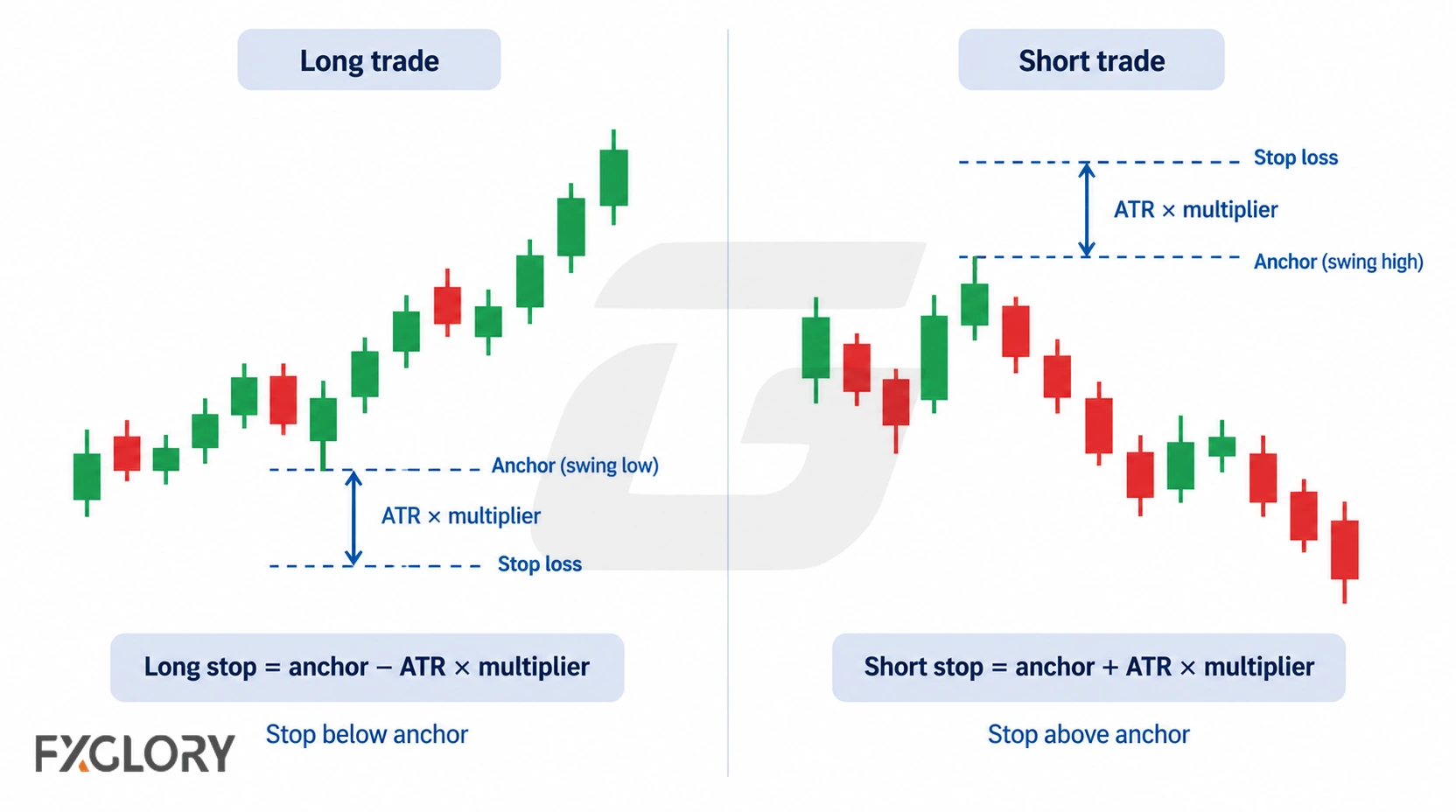
| Trade Direction | Example Calculation | Meaning | Still Needs |
|---|---|---|---|
| Long trade | Anchor price − ATR × multiplier | Stop is reviewed below the anchor | Setup, invalidation, spread, position size, and margin check |
| Short trade | Anchor price + ATR × multiplier | Stop is reviewed above the anchor | Setup, invalidation, spread, position size, and margin check |
The anchor can be entry price, a swing high or swing low, support, resistance, or another written structure point. The formula should not be used without a chart reason for the stop.
| Anchor Choice | How It Works | Main Risk |
|---|---|---|
| Entry-price anchor | Stop distance is calculated from the entry price | May ignore the chart area where the idea is actually wrong |
| Structure anchor | Stop is reviewed around support, resistance, swing, or invalidation area | Can become subjective if structure is not defined before entry |
Price Structure vs ATR Distance
ATR and price structure should not compete. Price structure defines where the trade idea is wrong. ATR helps review whether the stop has enough room for current movement.
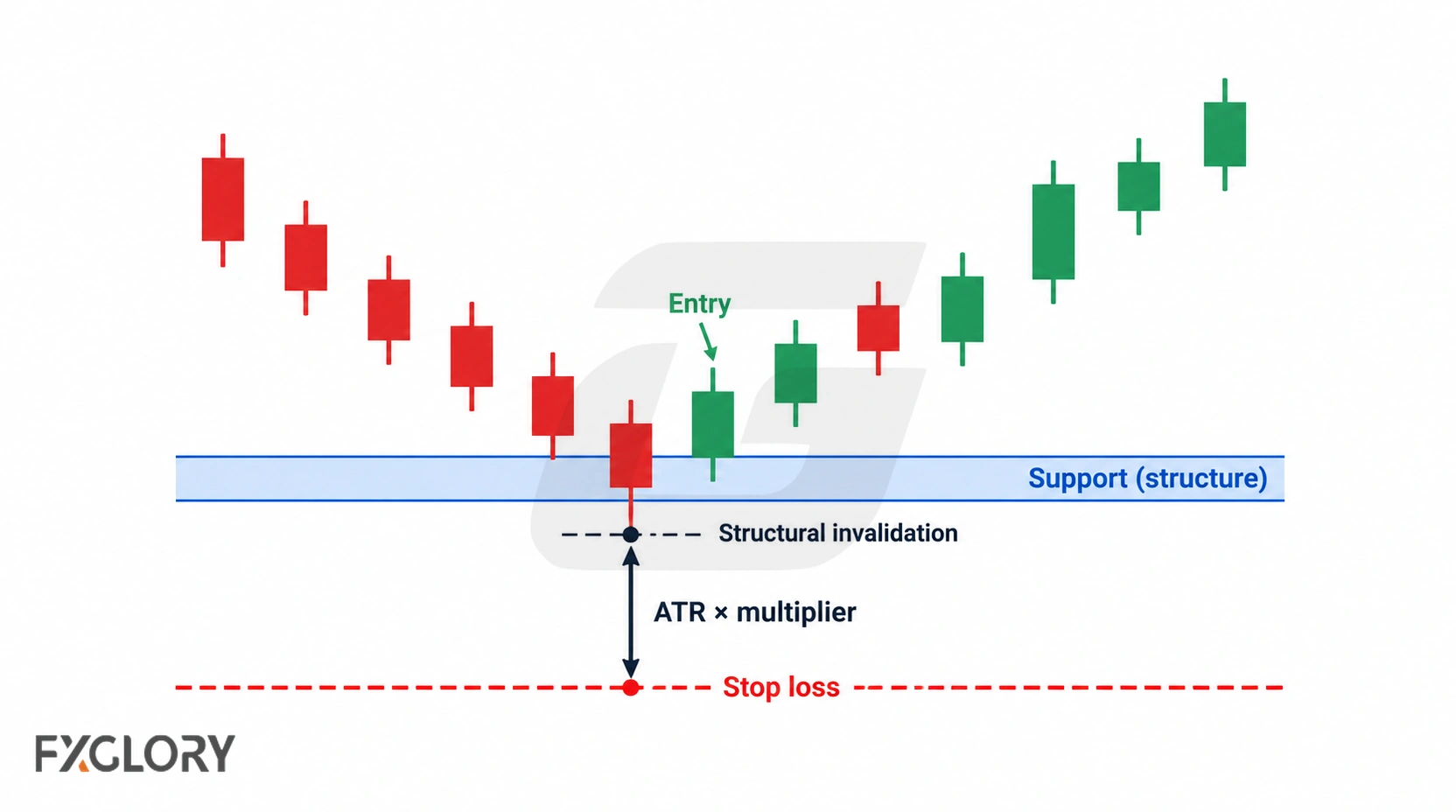
For example, if a long setup is built around a support area, the stop should not be placed only because the formula gives a number. The trader should first define the support or invalidation area, then use ATR to review whether the stop needs a volatility buffer beyond that area.
| Stop Reference | What It Adds | ATR Role | Main Risk |
|---|---|---|---|
| Support area | Potential invalidation area for long setups | Reviews whether the stop needs a volatility buffer below the area | Support is treated as an exact price |
| Resistance area | Potential invalidation area for short setups | Reviews whether the stop needs a volatility buffer above the area | Resistance is treated as an exact price |
| Swing low | Possible long-trade structure point | Checks whether stop distance is too tight for current movement | The swing point is too close to normal volatility |
| Swing high | Possible short-trade structure point | Checks whether stop distance is too tight for current movement | The swing point is too close to normal volatility |
| Trend structure | Shows whether the setup still has directional context | Reviews volatility around the structure | ATR is used while trend context is unclear |
When the stop depends on a market level, review support and resistance in forex. When the stop depends on trend structure, review forex trend behavior.
ATR Stop Loss vs Other Stop Methods
ATR is one way to review stop distance. It should be compared with other stop methods during testing, not assumed to fit every setup.
| Stop Method | How It Works | May Fit | Main Risk |
|---|---|---|---|
| Fixed-pip stop | Uses the same pip distance each time | Simple testing rules or stable conditions | May ignore current volatility |
| Percentage stop | Uses a fixed account or price percentage | Risk frameworks that need consistent percentage logic | May not match chart structure |
| Structure stop | Uses support, resistance, swings, or invalidation areas | Setups built around price action | May be too tight or too wide without volatility review |
| ATR stop loss | Uses ATR and multiplier to review volatility-based distance | Setups that need movement-size context before entry | Can still fail if structure, spread, or size is ignored |
| ATR trailing stop | Moves the stop after entry by rule | Post-entry trade management | Can cannibalize initial-stop logic if used too early |
For stop movement after entry, use ATR trailing stop rules. This page focuses on the initial stop-loss decision before or at entry.
Testing ATR Multipliers And Settings
Common references include 14-period ATR and ATR multipliers such as 1x, 1.5x, 2x, or 3x. These are testing references, not universal settings.
| Reference | Stop-Loss Use | Main Risk |
|---|---|---|
| ATR 14 | Common baseline for volatility review | Not automatically suitable for every pair or timeframe |
| 1x ATR | Tighter initial stop-distance test | May be too sensitive to normal movement |
| 1.5x ATR | Moderate stop-distance test | Still needs structure and position-size review |
| 2x ATR | Wider volatility-buffer test | Can increase loss distance if position size is not adjusted |
| 3x ATR or wider | More room for larger movement | May make the setup impractical for the account plan |
| Shorter ATR setting | Faster reaction to recent movement | More noise and tighter stop changes |
| Longer ATR setting | Smoother volatility reading | May react late to sudden changes |
A tighter ATR stop may reduce stop distance but can be more sensitive to whipsaw. A wider ATR stop may give price more room, but it can also require smaller position size or make the target less practical.
Position Size, Spread, And Margin Check
ATR stop distance affects more than the stop level. A wider stop can increase potential loss per lot. That means position size, spread, and margin exposure should be reviewed before the trade is accepted.
| Check | Why It Matters | Decision |
|---|---|---|
| Stop distance | Defines how far price can move before the stop area | Confirm whether the setup still fits the account plan |
| Position size | Turns stop distance into exposure | Reduce size if the ATR stop is wider than planned |
| Spread | Affects tight stops and lower-timeframe entries | Skip if the stop is too close after cost |
| Margin | Shows whether the planned exposure can be supported | Check before placing the trade |
| Target realism | Compares stop distance with the available move | Skip if the target does not justify the stop distance |
A stop-loss rule defines the planned exit area, but fast movement, gaps, spread changes, or slippage can affect execution. The stop distance should be reviewed as part of the loss scenario, not treated as a guaranteed fixed outcome.
Before using tight ATR stop rules, review FXGlory spreads. When ATR-based stop distance affects exposure, use the FXGlory margin calculator.
Day Trading And Scalping Considerations
Lower-timeframe ATR stop-loss rules can react quickly because ATR changes with recent movement. That can make the stop distance sensitive to spread, fast volatility changes, whipsaw, and execution pressure.
| Short-Term Issue | Why It Matters | What To Check |
|---|---|---|
| Spread sensitivity | Tight ATR stops can be affected by trading cost | Check whether the stop still leaves enough room after spread |
| Fast volatility changes | ATR can change quickly around active candles | Check whether the stop distance remains usable |
| Whipsaw | Price may hit the stop and return to the original direction | Test tighter and wider multipliers separately |
| News volatility | Event movement can distort ATR and stop placement | Skip if spread, slippage, or loss scenario is unclear |
| Platform workflow | Indicators, alerts, and order tools affect execution discipline | Know the ATR period, multiplier, anchor, and stop rule |
Review FXGlory trading platforms when the stop-loss rule depends on charting tools, ATR settings, alerts, or order workflow.
Worked Example: One Setup, Four ATR Stop Decisions
Assume a long setup exists near a support area. The trader reviews a 14-period ATR stop with a written multiplier. The same setup can lead to different decisions depending on stop distance and risk.
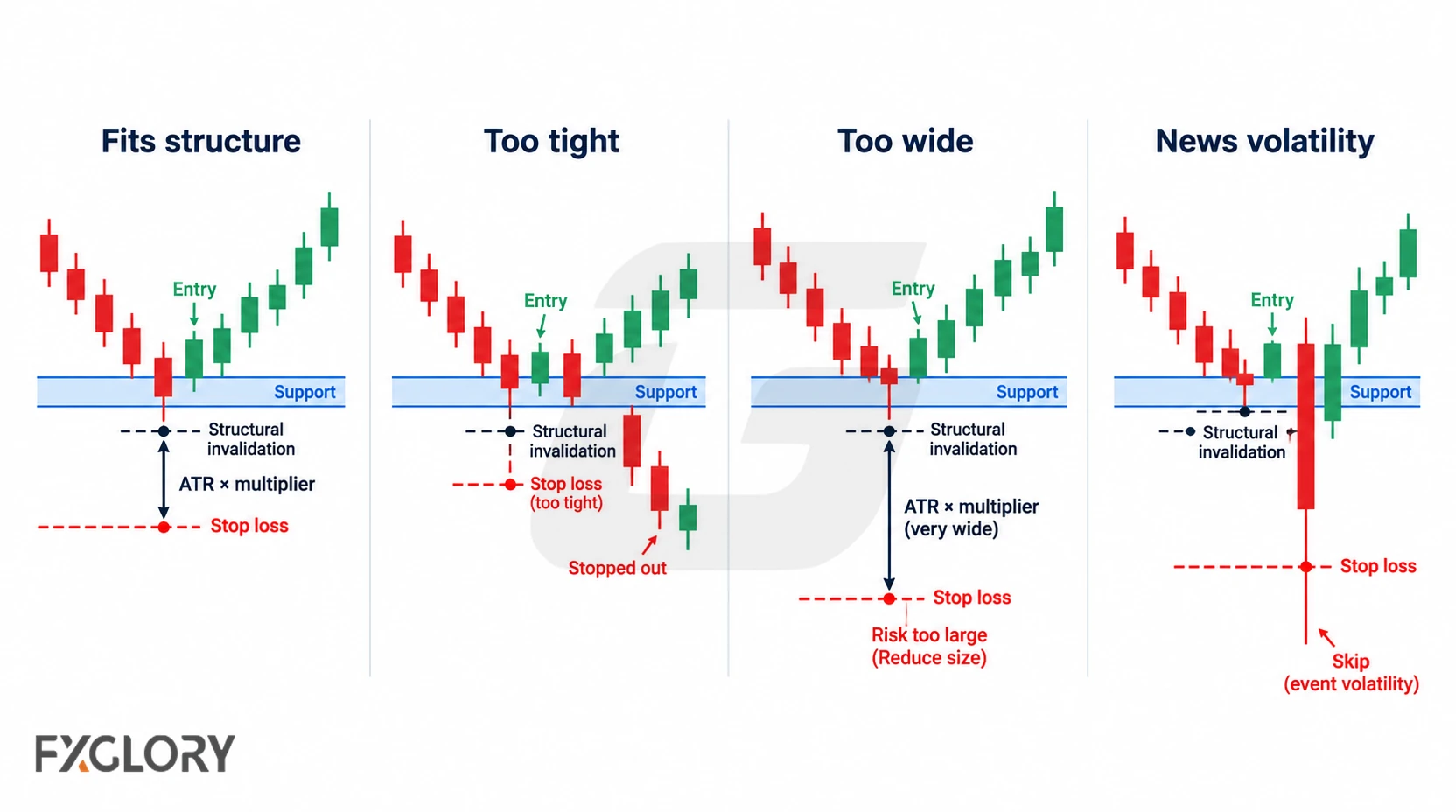
| Observation | Possible Meaning | Next Check | Decision Risk |
|---|---|---|---|
| ATR stop sits below support with manageable distance | The stop may fit the setup and volatility condition | Check position size, spread, and margin | Accept only if the full plan fits |
| ATR stop sits inside normal price noise | The stop may be too tight for current movement | Review multiplier, structure, or skip rule | Whipsaw risk increases |
| ATR stop is far below the setup | The stop may be too wide for the account plan | Reduce position size or skip | Exposure may be larger than planned |
| ATR expands during news volatility | The stop distance may be unstable | Review event-risk and no-trade rules | The setup may not be manageable |
When ATR Stop Loss Strategies Fail
ATR stop loss strategies often fail when the stop formula is treated as a complete trade plan. The most common problem is not ATR itself; it is using ATR distance without structure and exposure control.
- ATR used as an entry signal: The trader enters because the stop distance looks manageable, not because a setup exists.
- Structure ignored: The stop is placed from a formula without checking support, resistance, swings, or invalidation.
- Multiplier too tight: Normal movement triggers frequent stop-outs.
- Multiplier too wide: The stop creates more exposure than the account plan allows.
- Position size ignored: Wider ATR distance is used without reducing exposure.
- Spread ignored: A tight lower-timeframe stop has too little room after trading cost.
- Target ignored: The stop distance is large, but the available target is small.
- Settings changed too often: ATR period or multiplier is adjusted after each result.
- Stop widened after entry: The original risk plan is changed because price moves against the position.
- Event volatility ignored: Sudden movement changes ATR, spread, and loss conditions before the trade can be managed.
Testing An ATR Stop Loss Strategy Forex
An ATR stop loss strategy should be tested as an initial stop-placement rule, not as an entry signal. Testing should include clean trends, ranges, failed breakouts, support/resistance setups, tight-stop examples, wide-stop examples, volatile periods, lower-timeframe examples, and skipped setups.
- What trade setup must exist before the ATR stop is used?
- What chart area defines invalidation?
- What ATR period will be tested?
- What multiplier will be tested?
- What anchor will be used: entry price, swing point, support, resistance, or another structure?
- Does the ATR stop sit beyond the invalidation area or inside normal movement?
- Does the stop distance still make sense after spread?
- Does stop distance fit position size and margin exposure?
- Is the target realistic compared with the stop distance?
- Are stop-widening mistakes recorded separately?
- Are event-volatility examples recorded separately?
- Does the result change across selected currency pairs or timeframes?
Review available currency pairs before applying the same ATR stop rule everywhere.
ATR Stop Loss Strategy Forex Checklist
Before using an ATR stop-loss rule, answer these questions.
- Does a trade setup already exist?
- Where is the original invalidation point?
- What ATR period is being used?
- What multiplier is being tested?
- What anchor controls the stop?
- Does the stop sit beyond structure or inside normal noise?
- Does the stop still make sense after spread?
- Does stop distance fit position size and margin?
- Is the target realistic compared with the stop distance?
- What condition makes the setup a no-trade?
- Is this an initial stop rule, not a trailing-stop rule?
- What rule prevents widening the stop after entry?
An ATR stop loss strategy is useful only when it is treated as an initial stop-placement rule. ATR helps review volatility-based distance; the original setup, price structure, invalidation, spread, position size, margin, and risk rules decide whether the trade can be used.