

What Is An ATR Trailing Stop Forex Strategy?
An ATR trailing stop forex strategy uses Average True Range to review trailing-stop distance after a trade setup already exists. ATR helps measure movement size and volatility, then that volatility reading can be used to adjust how far a trailing stop sits from price.
This page does not cover every ATR strategy. It focuses only on using ATR to trail a stop after a trade setup already exists. For the broader indicator-strategy framework, review forex indicator strategies. For the broader ATR strategy framework, review ATR as volatility and risk support. For indicator mechanics, use the dedicated ATR Indicator Forex guide.
An ATR trailing stop is not a trade entry method. It does not choose direction, find the setup, or define the original reason for the trade. The setup still needs price structure, trigger, invalidation, position size, spread review, margin review, and an exit rule.
ATR Trailing Stop vs Full Trade Strategy
The common mistake is to treat an ATR trailing stop as a complete strategy. It is not. An ATR trail only manages where the stop may move after a trade is already open or already planned.
| Part Of The Plan | What It Decides | ATR Trailing Stop Role | Main Risk |
|---|---|---|---|
| Trade direction | Whether the setup is bullish, bearish, or unclear | No direct role | ATR is mistaken for direction |
| Entry trigger | What confirms the trade idea | No direct role | The trail is used as an entry signal |
| Original invalidation | Where the trade idea is wrong | May help review stop distance | The original risk area is ignored |
| Trailing distance | How far the stop trails after entry | Main role | The multiplier is too tight or too wide |
| Position size | How much exposure fits the planned monetary risk | Relevant when ATR sets the initial protective stop before entry | Confusing a wider post-entry ATR candidate with a need to resize the open position |
| Exit discipline | When the trade is closed or reviewed | Supports the written stop movement rule | The stop is moved emotionally |
When the original trade idea needs structure, use the forex trading setups framework before choosing any ATR trailing rule.
Fixed Trailing Stop vs ATR Trailing Stop
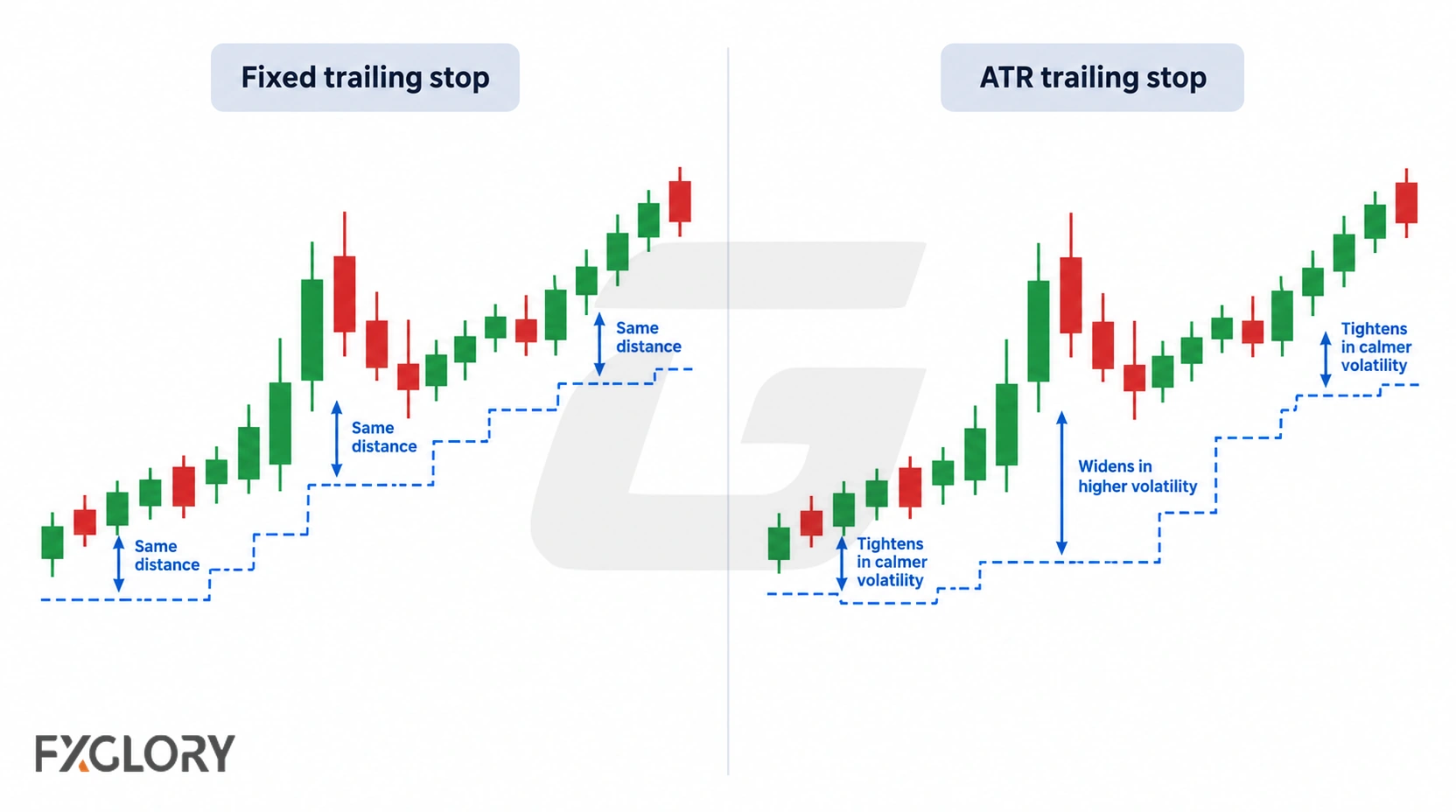
A fixed-distance trail uses a preset offset, while an ATR trail calculates a candidate offset from recent movement size. A change in the calculated ATR distance does not automatically move the active stop backward: a conventional one-way trailing rule allows the active level to tighten or hold. Neither method is automatically safer or better.
| Stop Type | How Distance Is Set | May Fit | Main Risk |
|---|---|---|---|
| Fixed trailing stop | Same distance each time | Simple rules with stable movement conditions | May be too tight in high volatility or too wide in quiet markets |
| ATR trailing stop | Distance based on ATR and multiplier | Rules that need volatility-adjusted trailing distance | Can still be too tight, too wide, or poorly anchored |
ATR Trailing Stop Workflow
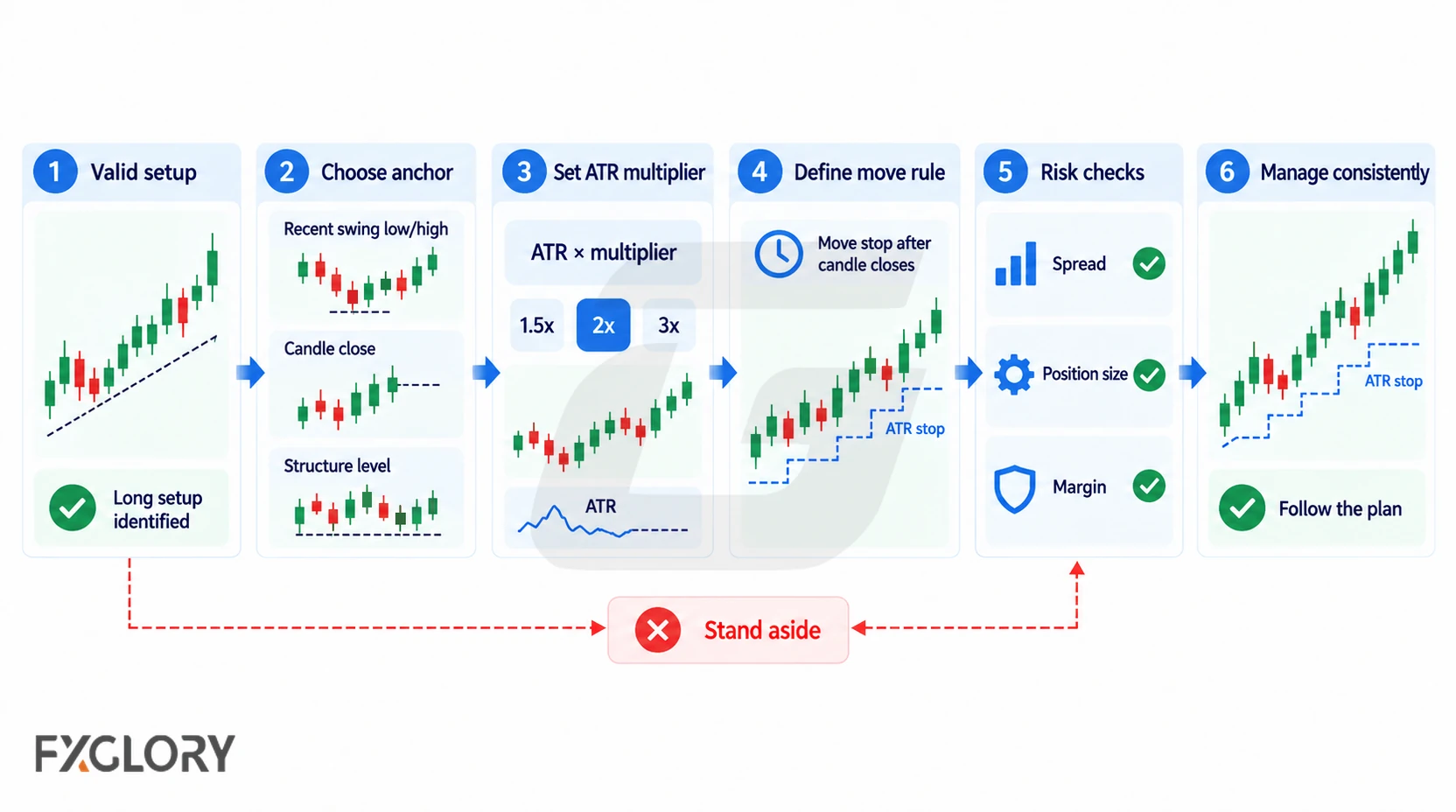
An ATR trailing stop should follow a written sequence. The sequence matters because trailing stop errors often happen after entry, when the trader starts adjusting the stop without a rule.
| Step | Question | Tool Or Context | Decision |
|---|---|---|---|
| 1 | Does a trade setup already exist? | Price structure, trigger, invalidation | Do not use ATR trail as the entry reason |
| 2 | What is the trailing anchor? | Close, high/low, recent high/low, or structure | Choose the calculation base before entry |
| 3 | What ATR multiplier will be tested? | 1x, 1.5x, 2x, 3x, or another written value | Define trailing distance |
| 4 | When can the stop move? | New high/low, candle close, structure shift, or platform rule | Move only by the written condition |
| 5 | Do the initial risk and margin checks fit? | Initial protective stop, planned monetary loss, position size, required and free margin | Size an initial position to its risk plan; review margin separately rather than resizing merely because a post-entry ATR candidate changes |
| 6 | Has the trailing update condition occurred? | Latest ATR candidate, previous active stop, and predefined one-way rule | For a long, raise or hold the active stop; for a short, lower or hold it. Record the resulting active level |
Long And Short ATR Trailing Stop Rules
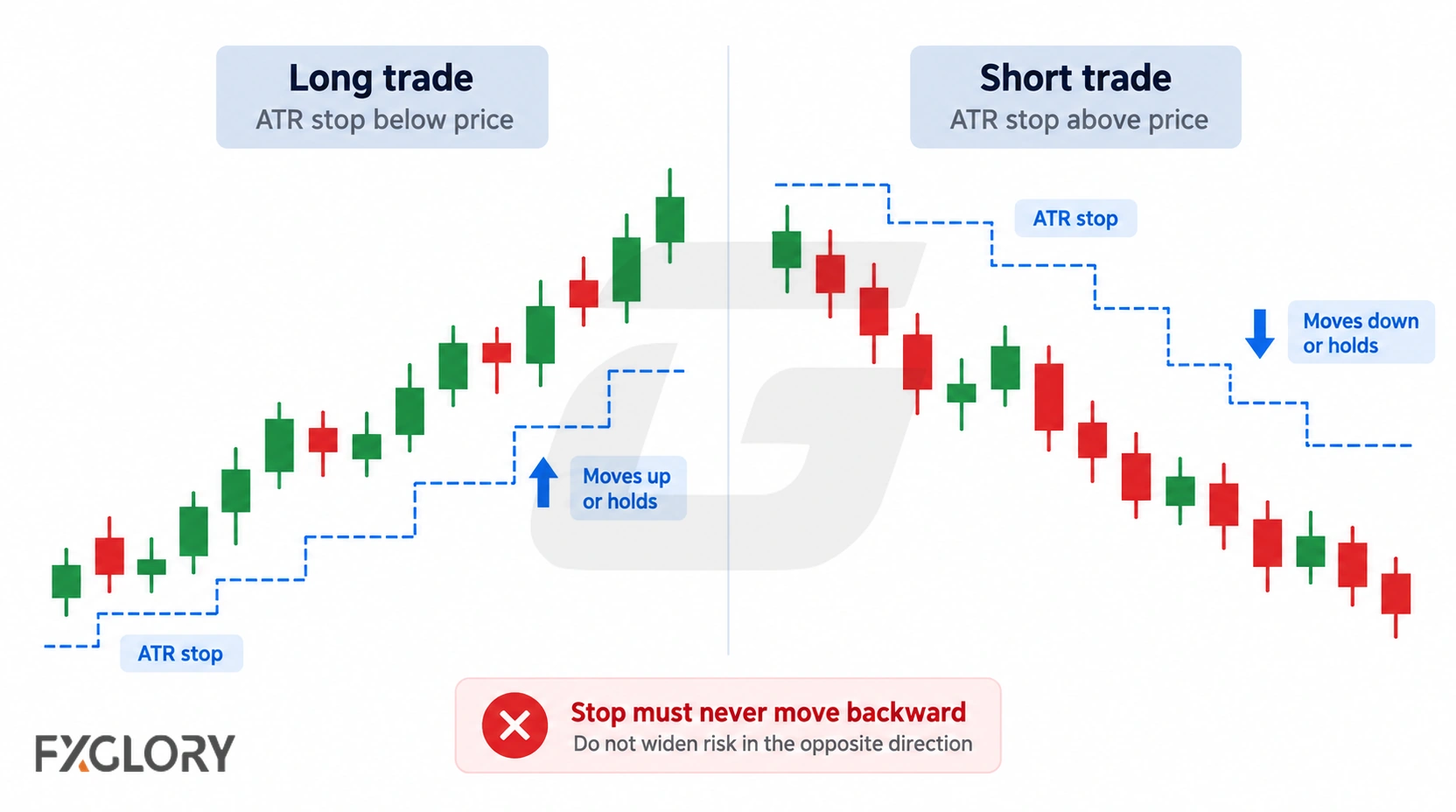
ATR trailing stops behave differently depending on trade direction. The important point is that the stop should not move backward against the risk-control plan.
| Trade Direction | Typical Stop Location | How The Stop Usually Moves | What To Avoid |
|---|---|---|---|
| Long trade | Below price | Trails upward or holds when the rule allows it | Lowering the stop simply to keep the trade open |
| Short trade | Above price | Trails downward or holds when the rule allows it | Raising the stop simply to avoid an exit |
| No clear direction | No trailing rule should be active yet | Wait for the original setup to exist | Using ATR as direction |
A basic ATR trailing-stop calculation usually starts with an anchor, then adds or subtracts an ATR multiple depending on trade direction. These examples are calculation references, not universal settings.
| Trade Direction | Candidate Calculation | Meaning | One-Way Active Stop Update |
|---|---|---|---|
| Long trade | Anchor price − ATR × multiplier | Calculates a candidate below the anchor | New active stop = maximum of previous active stop and candidate, when the update condition is met |
| Short trade | Anchor price + ATR × multiplier | Calculates a candidate above the anchor | New active stop = minimum of previous active stop and candidate, when the update condition is met |
These are candidate calculations, not instructions to widen an existing stop. For example, if a long trade has an active stop at 1.1030 and an updated ATR calculation yields 1.1010, its active stop remains at 1.1030 under the one-way rule. The new candidate does not by itself require resizing the open position.
When direction and trend context are part of the trade, review forex trend behavior. When the stop depends on a reaction zone or broken level, review support and resistance in forex.
ATR Trailing Stop Anchors
The anchor is the price reference used to build the trailing stop. Different anchors can create different stop behavior even with the same ATR period and multiplier.
| Anchor Type | How It Is Used | May Fit | Main Risk |
|---|---|---|---|
| Close-based ATR trail | Uses closing price as the reference | Rules that require candle-close confirmation | Can react late during fast movement |
| High/low ATR trail | Uses candle high or low as the reference | Rules that track recent price extremes | Can move faster and create earlier exits |
| Highest-high / lowest-low trail | Uses recent highest high for long exits or lowest low for short exits | Chandelier-style trailing rules | Can become wide when volatility expands |
| Structure-assisted ATR trail | Combines ATR distance with support, resistance, swing highs, or swing lows | Trades where structure still matters after entry | Can become inconsistent if structure is not defined clearly |
The anchor should be selected before testing. Changing the anchor after each result makes the trailing rule harder to review.
Testing ATR Multipliers And Settings
Common references include 14-period ATR, 21-period ATR, and ATR multipliers such as 1x, 1.5x, 2x, or 3x. Chandelier-style examples often use a recent high or low with an ATR multiple. These are testing references, not universal settings.
| Reference | Strategy Use | Main Risk |
|---|---|---|
| ATR 14 | Common baseline for volatility review | Not automatically suitable for every pair or timeframe |
| ATR 21 or 22 | Longer lookback used in some trailing or Chandelier-style rules | May react more slowly |
| 1x ATR | Tighter trailing distance | More early exits and whipsaw sensitivity |
| 1.5x ATR | Moderate trailing-distance test | Still may be tight during volatile movement |
| 2x ATR | Wider candidate trailing-distance test | Can delay trailing exits or allow more giveback if chosen from the outset |
| 3x ATR or wider | More room for larger movement | If used to place an initial stop, a wider distance may exceed the planned risk allowance without smaller position size |
| Different smoothing or calculation methods | Can change how quickly ATR reacts | Results become hard to compare if changed too often |
A tighter multiplier may bring a candidate stop closer to the anchor and cause earlier exits. A wider multiplier may delay exits. If the multiplier determines the initial stop before entry, a wider distance may require a smaller position to maintain the same planned monetary risk. After entry, recalculating a wider ATR distance must not loosen a conventional one-way active stop and does not automatically change the margin required for an unchanged position.
Chandelier Exit vs ATR Trailing Stop
Chandelier Exit is a specific ATR-based trailing method. A common long-side version uses a recent highest high minus an ATR multiple. A common short-side version uses a recent lowest low plus an ATR multiple. The idea is to trail below price in long trades and above price in short trades while allowing room for volatility.
Some Chandelier-style examples use a 22-period lookback and a 3x ATR multiplier. That reference should be treated as a testing example, not a best setting for every currency pair or timeframe.
| Method | Typical Anchor | ATR Role | What Still Needs Rules |
|---|---|---|---|
| General ATR trailing stop | Close, high/low, platform rule, or structure | Defines trailing distance | Entry setup, anchor, stop movement, and exit discipline |
| Chandelier-style exit | Recent highest high or lowest low | Offsets the trail from the recent extreme | Lookback, multiplier, trend context, one-way updates, and initial-stop risk if used before entry |
This page mentions Chandelier Exit as an ATR-based trailing variation. It does not replace a dedicated Chandelier Exit forex strategy page, where lookback rules, multiplier behavior, trend context, exits, and false-exit filters would need deeper treatment.
When Should An ATR Trailing Stop Move?
The stop movement rule should be written before the trade is managed. Without a rule, the trader may move the stop too often, too late, or in the wrong direction.
| Movement Rule | How It Works | Main Risk |
|---|---|---|
| New high or new low | The stop updates only after price creates a new favorable extreme | Can lag during quick reversals |
| Candle close | The stop updates only after a candle closes and confirms the condition | May delay adjustment |
| Structure shift | The stop updates after price forms a new swing area or breaks a structure | Structure can be subjective if not defined |
| Platform indicator rule | The stop follows a prebuilt ATR trailing line or alert condition | The trader may follow the tool without understanding the calculation |
| Manual review rule | The stop is reviewed at planned intervals or after specific price events | Emotional decisions can override the written plan |
Some platforms or scripts display ATR trailing-stop flips as possible entry-style signals. This page treats those flips only as trade-management or review conditions. A new entry still needs its own setup, direction context, trigger, invalidation, spread check, and risk rule.
Day Trading And Scalping Considerations
Lower-timeframe ATR trailing stops can react quickly because ATR changes with recent movement. That can create more stop adjustments, more whipsaw, and more sensitivity to trading cost.
| Short-Term Issue | Why It Matters | What To Check |
|---|---|---|
| Spread sensitivity | A tight trailing rule can be affected by trading cost | Check whether the trail still leaves enough room after spread |
| Whipsaw | Price can trigger the trail and then continue in the original direction | Test tighter and wider multipliers separately |
| Fast volatility change | The new ATR candidate can move farther from the anchor after entry | Retain the previous active stop if the new candidate would loosen it; check open exposure and free margin independently |
| Event volatility | News can distort stop distance and execution conditions | Skip if spread, slippage, or loss scenario is unclear |
| Platform workflow | Alerts and trailing tools can help monitor the rule | Know the anchor, ATR period, multiplier, and update condition |
Before testing lower-timeframe trailing rules, review FXGlory spreads. When ATR-based stop distance affects position size or leverage exposure, use the FXGlory margin calculator. Review FXGlory trading platforms when the rule depends on charting tools, ATR settings, alerts, or trade-management workflow.
Worked Example: One Trade, Four ATR Trailing Outcomes
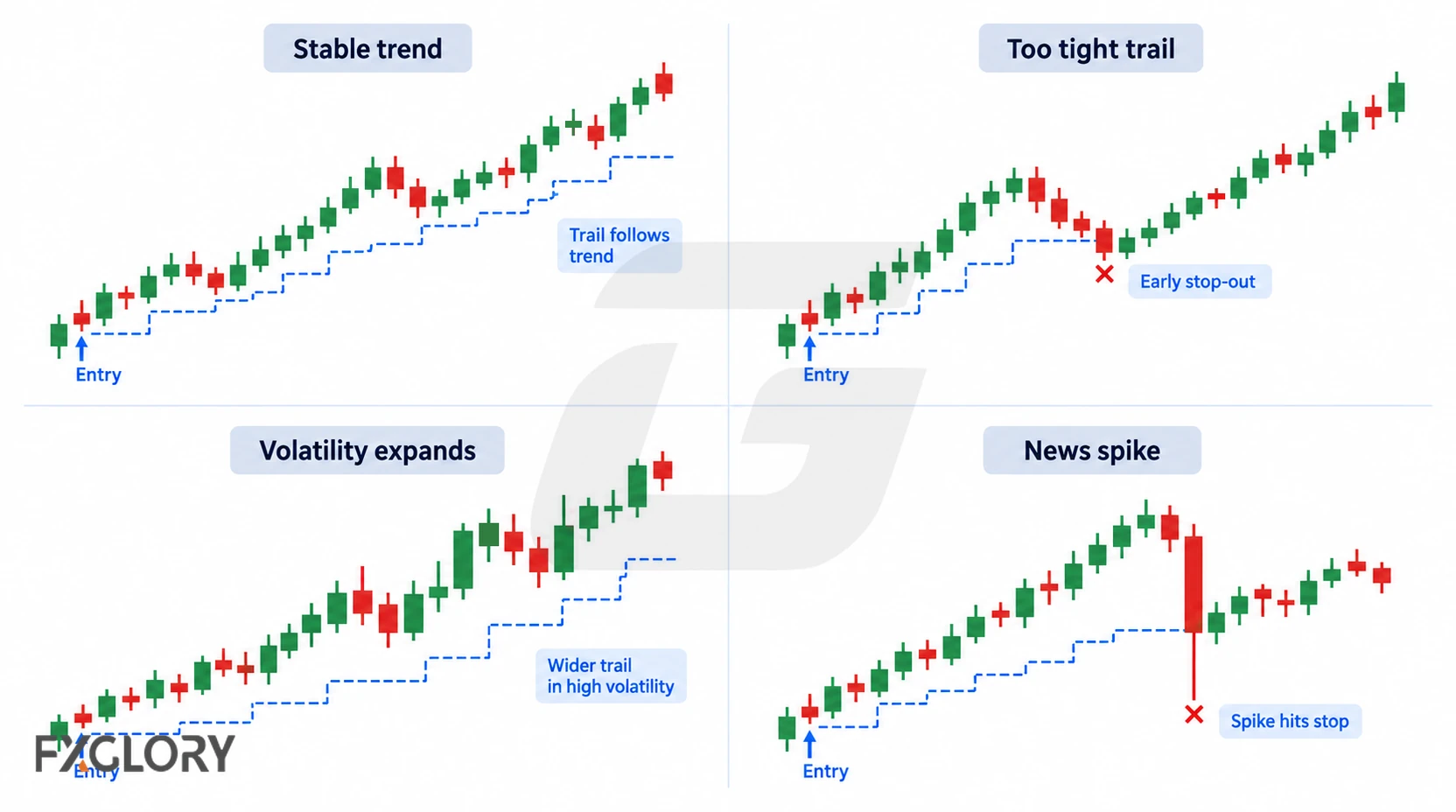
Assume a long trade already exists from a defined breakout setup. The trader chooses a 14-period ATR trail with a written multiplier and a rule that the stop can only trail upward after a candle close. The same trade-management idea can lead to different outcomes.
| Observation | Possible Meaning | Next Check | Risk |
|---|---|---|---|
| Price trends upward and ATR remains stable | The trail may follow the move in a controlled way | Move stop only by the written rule | Exiting early if the rule is changed emotionally |
| Price pulls back and hits a tight ATR trail | The multiplier may be too tight for the tested setup | Record the result without changing the live rule mid-trade | Whipsaw exits become frequent |
| ATR expands and the candidate trail moves farther away | Measured volatility has increased, but the active one-way stop need not move backward | Hold the previous active stop if the new candidate would loosen it; review open exposure and free margin separately | Confusing a wider candidate with permission to increase loss exposure |
| Price spikes during news volatility | Execution and stop behavior may become less predictable | Review event-risk and skipped-trade rules | The trade may not be manageable with the original trail |
When ATR Trailing Stop Strategies Fail
ATR trailing stop strategies often fail when the trailing rule is treated as a complete trade plan or adjusted emotionally after entry. The most common problem is not ATR itself; it is unclear stop movement.
- ATR used as an entry signal: The trader enters because the trail appears, not because a setup exists.
- Stop moved backward: The trader increases risk after entry to avoid being stopped out.
- Multiplier too tight: Normal movement triggers frequent exits.
- Multiplier too wide: A trail chosen too far away may allow greater profit giveback; if it also sets the initial stop, planned loss may exceed the risk budget.
- Anchor unclear: The trader changes between close, high/low, and structure after each result.
- Original invalidation ignored: The ATR trail replaces the reason the trade was valid or invalid.
- Spread ignored: A short-term trail is too tight after trading cost.
- Initial position size ignored: The position is opened without checking monetary risk at its original protective stop.
- Event volatility ignored: Sudden movement changes ATR, spread, and stop behavior faster than the plan allows.
Testing An ATR Trailing Stop Forex Strategy
An ATR trailing stop forex strategy should be tested as a post-entry trade-management rule, not as an entry signal. Testing should include clean trends, sideways pullbacks, sudden volatility expansion, whipsaw exits, delayed exits, wider-stop examples, tighter-stop examples, news periods, and skipped setups.
- What trade setup must exist before the ATR trailing stop is used?
- What ATR period will be tested?
- What multiplier will be tested?
- What anchor will be used: close, high/low, recent high/low, Chandelier-style, or structure-assisted?
- When is the stop allowed to move?
- Can the stop move backward, or only hold and trail in the planned direction?
- Does the trailing distance still make sense after spread?
- If ATR is used for the initial stop, does position size keep planned loss within the risk limit?
- Are required margin and free margin acceptable for the chosen exposure, separately from stop distance?
- Are event-volatility examples recorded separately?
- Are early exits, late exits, whipsaws, and skipped setups recorded?
- Does the result change across selected currency pairs or timeframes?
Review available currency pairs before applying the same ATR trailing rule everywhere. When ATR trailing is used with trend-strength review, use ATR and ADX strategy rules to keep volatility and trend-strength roles separate.
ATR Trailing Stop Forex Strategy Checklist
Before using an ATR trailing stop rule, answer these questions.
- Does a trade setup already exist?
- What is the original invalidation point?
- What ATR period is being used?
- What multiplier is being tested?
- What anchor controls the trailing stop?
- When is the stop allowed to move?
- Does the one-way rule hold the previous active stop when a new candidate would loosen it?
- Does the trail still make sense after spread?
- If ATR sets the initial protective stop, does the planned loss at that stop fit the account risk limit?
- Are required and available free margin adequate for the chosen position size?
- What condition exits the trade?
- What condition makes the trailing rule a no-trade or no-adjustment rule?
For each review, record the candidate stop, previous active stop, whether the update condition occurred, and the resulting active stop. This makes it possible to distinguish volatility changes from actual stop adjustments when evaluating the trailing rule.