

What Makes A Forex Strategy Advanced?
A forex strategy becomes advanced when the trader must control more than a simple entry and exit. The plan may include exposure across several pairs, event timing, higher and lower timeframes, spread behavior, position-size adjustment, margin usage, swap impact, and a written review process.
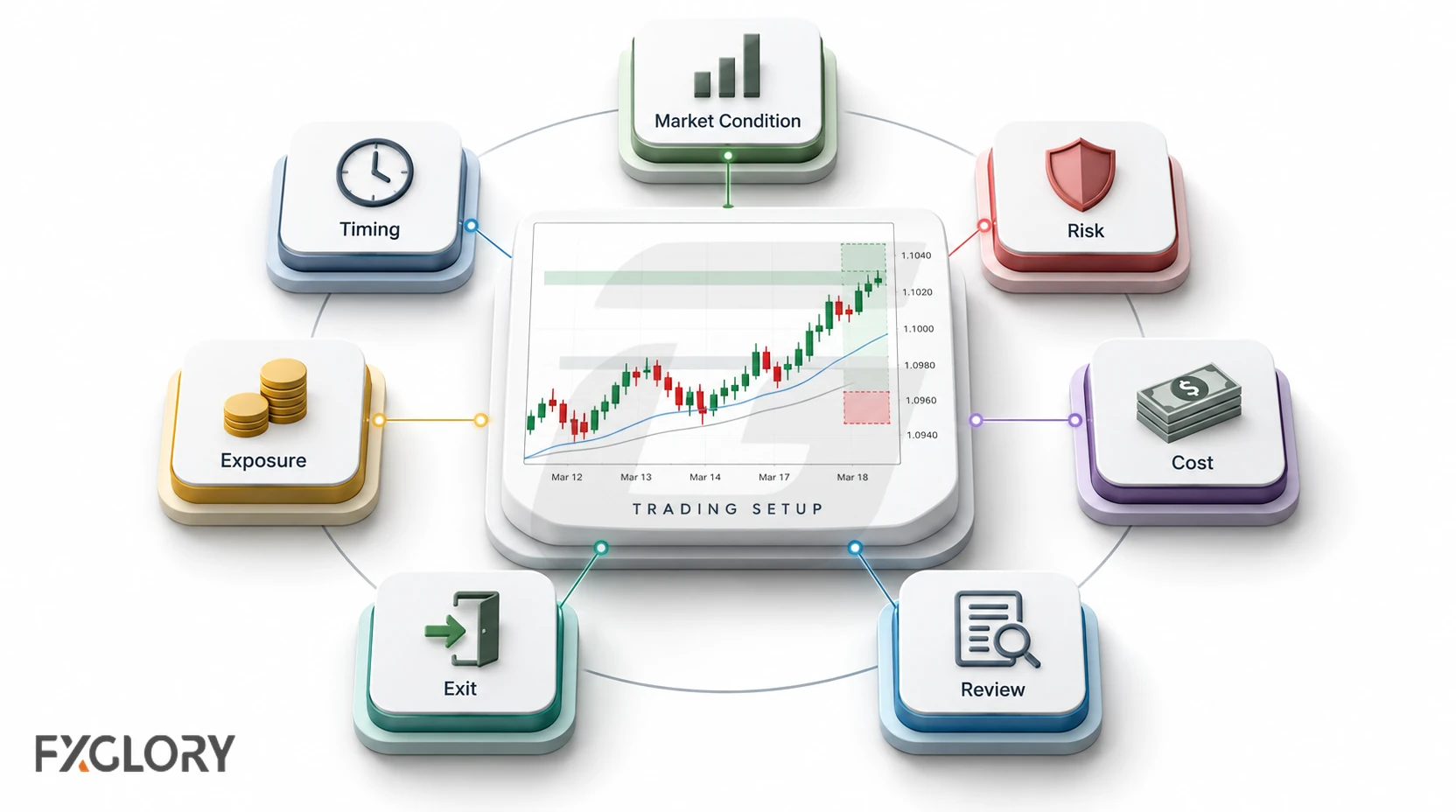
More indicators do not make a strategy advanced. A chart can be crowded and still have no usable rule. Any added rule should change one of five things: direction, timing, risk, exposure, or exit. If it does not change one of those decisions, it should not be part of the strategy.
An advanced forex strategy should answer these questions before the order is placed:
- What market condition is required?
- Which timeframe defines context, and which timeframe defines execution?
- Where is the idea invalid?
- How much account exposure exists after this trade is added?
- How do spread, slippage, swap, leverage, and margin affect the idea?
- What makes the trader cancel the setup before entry?
- How will the result be reviewed after the trade?
For the wider strategy structure, start with the forex strategies hub. This page focuses only on the advanced layer: exposure complexity, execution sensitivity, multi-factor confirmation, event risk, and testing discipline.
Basic Strategy vs Advanced Strategy vs Advanced Technique
Many traders mix the terms strategy, technique, setup, and system. Clear terms reduce duplicated rules and lower the chance of forcing a trade.
| Term | Meaning | Example | Main Risk If Misused |
|---|---|---|---|
| Basic strategy | A rule-based method with a simple condition, entry, invalidation, and exit | Trend pullback with a fixed stop and target | The trader uses it outside the condition it was designed for |
| Advanced technique | A specialized method or tool inside a wider plan | Hedging, Ichimoku, multi-timeframe confirmation, correlation review | The trader treats the tool as a full trade plan |
| Advanced strategy | A complete rule set that combines technique, risk, cost, exposure, and review | News-volatility plan with trigger, cancellation, spread rule, stop, and post-event review | The trader adds complexity without controlling exposure |
| Trading system | The complete operating process for market selection, entry, exit, risk, schedule, and review | A written plan that defines what to trade, when to trade, when to stop, and how to record results | The trader changes rules after each outcome |
A technique can support a strategy, but it cannot replace one. A hedge still needs a purpose and exit. Ichimoku still needs invalidation. A news setup still needs a rule for spread widening. A correlation check still needs pair direction and position-size control.
When the full rule sequence is not written yet, use a forex trading system framework before testing live exposure.
Advanced Strategy Groups By Risk Type
The cleanest way to compare advanced forex strategies is by risk type. This prevents the page from becoming another general list of strategy names and keeps each method tied to the problem it is supposed to control.

| Risk Type | Strategy Group | Methods To Review | What Must Be Controlled |
|---|---|---|---|
| Exposure risk | Exposure-control strategies | Hedging, correlation, multi-pair exposure review | Duplicate currency risk, hedge cost, margin, exit complexity |
| Execution risk | Execution-sensitive strategies | Scalping, arbitrage, triangular arbitrage, short-term breakouts | Spread, slippage, latency, liquidity, order rules |
| Event risk | Event-volatility strategies | News trading, NFP, central bank events, straddles | Whipsaws, widened spreads, fast movement, unclear invalidation |
| Holding risk | Macro and carry strategies | Position trading, long-term trading, carry trade, swap review | Swap changes, trend reversal, drawdown, overnight exposure |
| Signal risk | Technical-confluence strategies | Ichimoku, multiple timeframes, indicator combinations | Over-confirmation, late entries, duplicated signals |
| Theme risk | Currency strength and sentiment review | Currency-strength comparison, broad USD risk, risk-on/risk-off review | False confirmation, crowded bias, ignoring pair-specific levels |
| Model risk | Systematic and algorithmic logic | Backtested rules, forward testing, demo review, automation concepts | Overfitting, ignored costs, poor live execution, weak sample size |
Exposure-Control Strategies: Hedging, Correlation, And Multi-Pair Risk
Exposure-control strategies are advanced because the trader is no longer judging one isolated trade. The account may hold several positions, several currency drivers, or a hedge that changes the shape of open risk.
Hedging means using another position to offset or reduce part of an existing exposure. It can help define risk during unstable conditions, but it can also add spread cost, swap cost, margin use, and exit confusion. A hedge without a purpose is usually a delayed decision, not a risk plan.
A hedge should answer four questions:
- What exposure is being reduced?
- What cost is accepted while the hedge is open?
- What event or price condition removes the need for the hedge?
- Which side is closed first if the market moves quickly?
For dedicated hedge rules, use the forex hedging strategy guide.
Correlation strategies review how related currency pairs may move together or in opposite directions. Correlation can expose false diversification. A trader who buys EUR/USD, GBP/USD, and NZD/USD may think they have three different trades, while the account may be heavily exposed to one broad USD theme.
Correlation can also help with confirmation, but confirmation is not permission to increase size. If several pairs confirm the same view, total exposure may need to fall, not rise. Review forex correlation strategy before adding multi-pair exposure.
Execution-Sensitive Strategies: Scalping, Arbitrage, And Triangular Arbitrage
Execution-sensitive strategies depend on small timing windows. The setup may look valid on a chart, but the result can change after spread, slippage, liquidity, order delay, and market execution are included.
Scalping is execution-sensitive because targets are usually smaller than higher-timeframe methods. Spread becomes a larger part of the trade. A scalp that looks acceptable before cost may become weak after the spread is included. A scalping plan should define the pair, session, maximum spread condition, stop distance, exit rule, and no-trade conditions before entry. For the dedicated method, use forex scalping.
Arbitrage is advanced because it depends on price differences that may disappear quickly. It is not risk-free. Spread, latency, fill quality, slippage, liquidity, and account rules can change the result before the trader can act. Use forex arbitrage for the wider concept.
Triangular arbitrage compares three related currency pairs to check whether their quoted relationship is temporarily inconsistent. The calculation may look precise, but the practical risk is execution. If one leg fills differently, fills late, or becomes costly after spread, the theoretical difference may vanish. Use triangular arbitrage forex for the detailed structure.
- Do not test execution-sensitive strategies without spread and slippage assumptions.
- Do not use a fixed target if the spread changes enough to weaken the reward.
- Do not treat a short-lived price difference as usable unless the order sequence is realistic.
- Do not add size only because a setup appears frequently.
Event-Volatility Strategies: News, NFP, Central Banks, And Straddles
Event-volatility strategies are advanced because price can move faster than normal technical conditions. The issue is not only direction. Execution conditions can change, spreads can widen, and the first move can reverse.
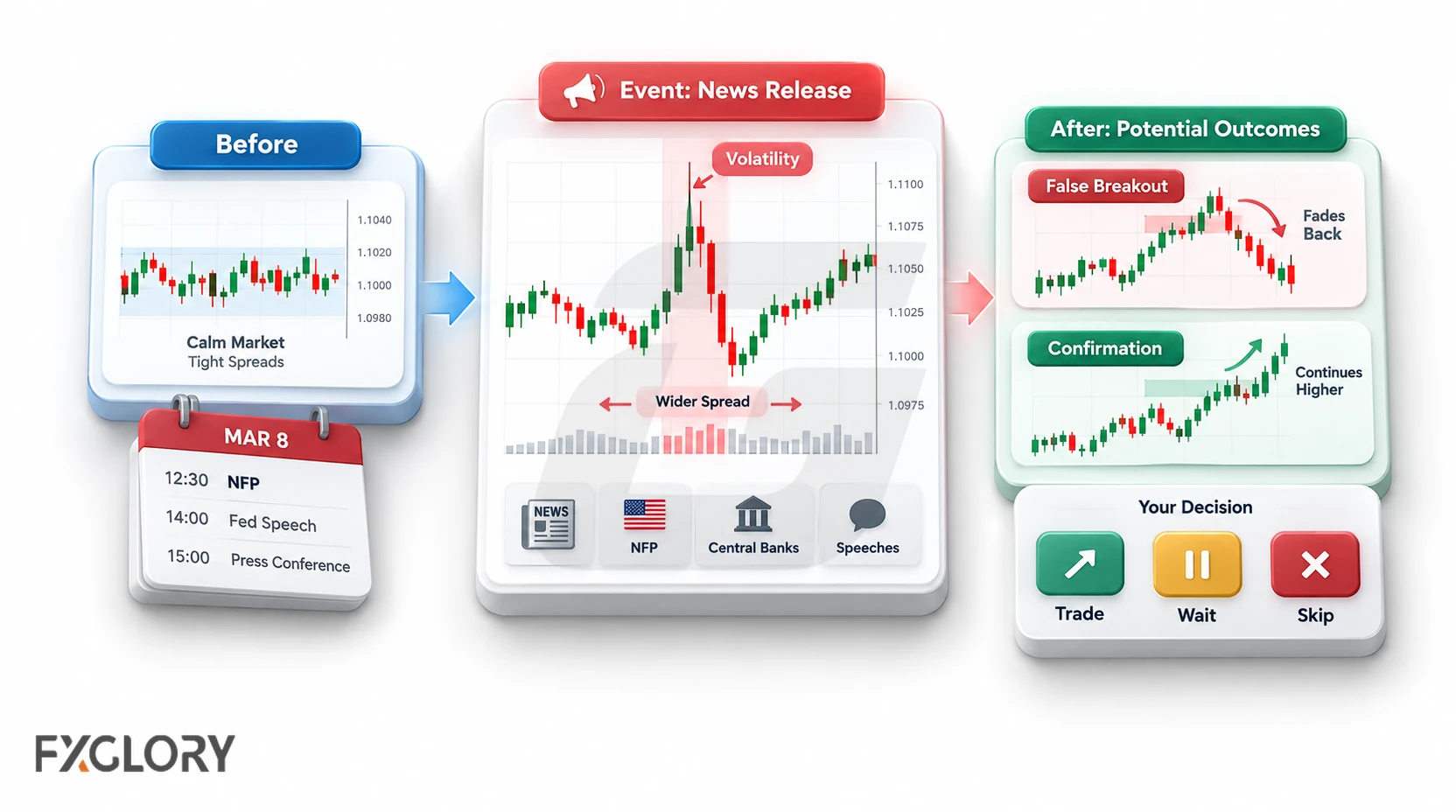
News trading should start before the release. The trader should know which currency is affected, whether the event is scheduled, what the market expected, and whether the pair has enough room for a controlled setup. Use forex news trading strategy for execution rules around event reactions.
NFP trading is one common example of event-volatility trading because the U.S. employment report can affect USD pairs. A plan around NFP should not be based only on whether the headline number is strong or weak. The reaction may depend on forecasts, revisions, wages, unemployment, prior positioning, and central-bank expectations. A trader should define whether the plan is to avoid the release, wait for confirmation, reduce exposure, or use a strict volatility setup.
Central bank strategies focus on policy decisions, rate expectations, statements, press conferences, and forward guidance. Price may move more on wording and future expectations than on the rate decision itself. Use central bank forex strategy for a dedicated policy framework.
Straddle strategies plan around possible volatility without needing a fixed direction before the event. They still need strict rules for order placement, spread widening, cancellation, slippage, and false breaks. Use forex straddle strategy when the plan involves pending orders around an event or breakout zone.
- Check the economic calendar strategy before the event.
- Define which pair is directly exposed to the release.
- Decide whether the safest strategy is to avoid, wait, reduce exposure, or trade after confirmation.
- Set maximum risk before volatility expands.
- Cancel the setup if spread, slippage, or invalidation becomes unclear.
Macro And Holding Strategies: Position Trading, Carry Trade, And Swaps
Macro and holding strategies are advanced because the trade result may depend on more than the entry candle. Interest-rate expectations, central bank direction, inflation data, growth data, risk sentiment, swap values, and holding time can all affect the position.
Position trading uses a longer holding period and usually depends on fundamental context as well as price structure. It requires enough account tolerance for pullbacks, overnight exposure, and changes in the market story. Use position trading forex and forex long-term trading for dedicated holding-period rules.
Carry trade reviews interest-rate differentials and platform swap or rollover. Positive carry does not guarantee a good trade. Exchange-rate movement can outweigh accumulated swap, and swap conditions can change. Use carry trade forex for the full framework.
Swap review matters whenever a position is held past rollover. A trader should check the exact symbol, position direction, account type, holding period, triple-rollover timing, and whether price risk is larger than any expected overnight credit.
- Do not hold a position only because the swap looks attractive.
- Do not ignore exchange-rate risk when reviewing carry.
- Do not use a macro idea without a price invalidation level.
- Do not keep holding after the original central-bank or rate-difference reason changes.
For wider currency-bias logic, use fundamental strategy forex.
Technical-Confluence Strategies: Ichimoku, MTF, And Indicator Combinations
Technical confluence becomes advanced when each tool has a separate job. If every indicator repeats the same signal, the chart may look confirmed while the strategy is only duplicating one idea.
Ichimoku can be used as an advanced framework because it combines trend, momentum, support, resistance, and timing information. Price relative to the cloud may define trend context. Tenkan-sen and Kijun-sen may support timing. The cloud can act as a structure zone. Chikou span can add context. None of those components should be used as a standalone trade by default.
An Ichimoku-based plan still needs:
- Market condition: trending, ranging, or transition.
- Timeframe: context chart and execution chart.
- Entry trigger: the exact condition that allows the trade.
- Invalidation: the price or structure that cancels the idea.
- Stop logic: technical level, volatility-adjusted level, or written exit condition.
- Cost check: spread and slippage relative to the planned target.
Multiple time frame analysis separates context from execution. A higher timeframe may define trend, range, or major levels. A lower timeframe may provide entry timing. Use forex multiple time frame analysis when the strategy depends on higher-timeframe confirmation.
Indicator combinations can help if each indicator has a different role. A moving average may define trend. ATR may define volatility. RSI may review momentum or divergence. A support or resistance level may define invalidation. Use forex indicator strategies and forex indicator combinations for indicator-role planning.
| Tool | Possible Role | Weak Use |
|---|---|---|
| Ichimoku cloud | Trend context, structure, support/resistance zone | Entering only because price touches the cloud |
| Moving average | Trend filter or dynamic reference | Treating every crossover as a complete strategy |
| RSI or oscillator | Momentum, divergence, or exhaustion review | Buying or selling only because of overbought or oversold readings |
| ATR | Volatility review and stop-distance planning | Using the same stop distance in every volatility condition |
| Higher timeframe | Context and major structure | Ignoring it after a lower-timeframe signal appears |
Currency Strength, Sentiment, And Positioning Review
Currency-strength and sentiment review can support advanced forex strategies when a trader compares which currencies are broadly strong or weak across several pairs. This is different from looking at one chart in isolation. It asks whether the same currency theme appears across the market.
For example, if USD strength appears across several major pairs, a trader may use that as context before reviewing a USD-related setup. That still does not make every USD trade valid. A single pair may be near support, resistance, a news event, a stretched move, or a poor reward-to-risk area.
Sentiment review can also help during risk-on and risk-off conditions, when traders may favor or reduce exposure to certain currencies. The risk is that sentiment can change quickly. A broad theme should support the setup; it should not replace the setup.
- Do not use currency strength as a standalone entry signal.
- Do not assume broad strength means the next pair has enough room to move.
- Do not ignore support, resistance, volatility, or spread because the theme looks strong.
- Do not add several positions that all depend on the same sentiment theme without reducing total exposure.
Counter-Trend And Reversal Methods
Counter-trend methods look for a move against the current direction after momentum weakens, price rejects an area, or a reversal pattern forms. They are advanced because the trader is acting against the recent direction, so timing, size, and invalidation must be tighter.
A counter-trend setup should not be taken only because price looks high or low. The plan needs a reason that the current move is losing strength, such as a failed breakout, divergence, rejection at a major level, or a clear change in structure. It also needs a smaller risk profile than a trade aligned with a strong trend.
- Do not fade a strong trend without a defined reversal trigger.
- Do not widen the stop because the trader wants to be right about the top or bottom.
- Do not use counter-trend entries during high-impact news without event rules.
- Do not treat divergence as a trade until price confirms the idea.
Counter-trend logic should be reviewed with support and resistance, price action, candle behavior, and the wider market condition before any live exposure is considered.
Systematic Strategy Testing: Backtesting, Forward Testing, Demo, And Journal
Advanced forex trading needs a testing process that records more than profit or loss. The trader should be able to see whether the strategy worked because the rules were valid, because the market condition fit, or because a few trades happened to be favorable.
- Write the hypothesis: define what the strategy should exploit, such as trend continuation, event volatility, correlation exposure, sentiment shift, or volatility expansion.
- Backtest the written rules: review historical examples without changing the rules after seeing the result.
- Add realistic costs: include spread, slippage, swap, stop distance, and any execution limitation.
- Use walk-forward review: test the rules on unseen periods instead of only the period where they looked strongest.
- Forward observe: track new setups in real time without taking live risk.
- Demo test execution: check whether orders, stops, exits, and cancellations can be followed under live-market movement.
- Journal the result: record rule quality, not only account outcome.
A useful trading journal for advanced strategies should include the pair, timeframe, market condition, entry reason, invalidation, stop distance, target or exit method, spread at entry, slippage, position size, margin requirement, correlated exposure, event risk, rule breaks, emotional state, and post-trade review.
Expectancy, Drawdown, And Why Win Rate Is Not Enough
Win rate can mislead traders. A strategy can win often and still lose money if the average loss is much larger than the average win. A strategy can also have fewer winning trades but remain reviewable if losses are controlled and average wins are large enough after cost.
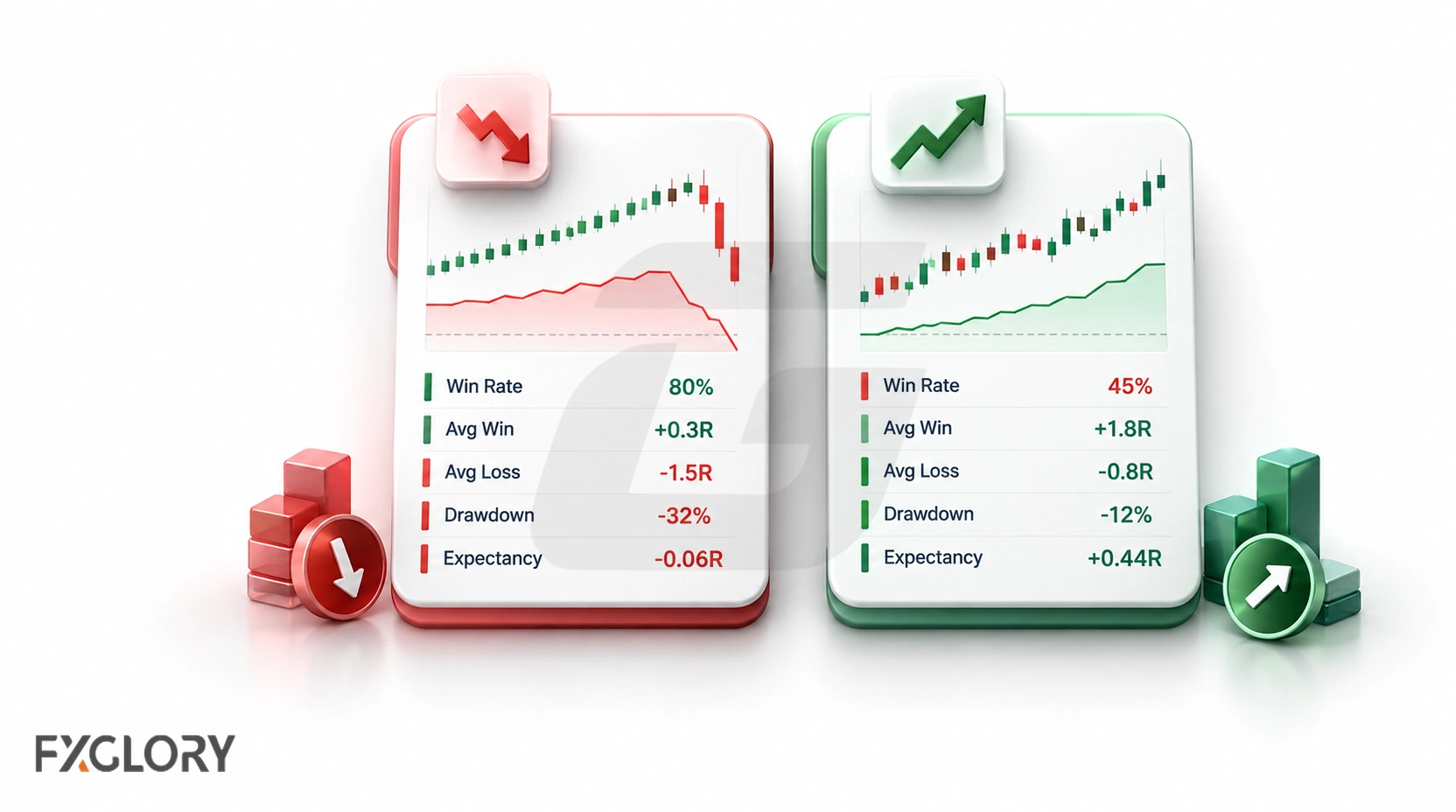
Expectancy is one way to review whether the average trade result is positive or negative after enough examples:
This formula should not be used with a tiny sample or perfect historical conditions. Spread, slippage, swap, missed trades, early exits, emotional mistakes, and drawdown periods can all change the live result.
| Metric | Why It Matters | Common Misread |
|---|---|---|
| Win rate | Shows how often trades close positive | Assuming a high win rate means low risk |
| Average win | Shows whether winning trades are large enough after costs | Ignoring spread and slippage |
| Average loss | Shows whether losing trades are controlled | Letting one loss erase many wins |
| Maximum drawdown | Shows account stress during bad periods | Reviewing only final profit or loss |
| Rule adherence | Shows whether the strategy can actually be followed | Blaming the market when the rules were broken |
Before increasing size or moving to live conditions, compare expectancy with the risk rules in forex risk management strategy.
Broker-Condition Checks: Spread, Margin, Leverage, And Account Rules
Advanced strategies can fail when account conditions are ignored. A strategy that depends on fast execution, multiple orders, larger exposure, overnight holding, or small targets should be checked against the account environment before live use.
Spread matters most for scalping, arbitrage, news, and short-term breakout methods. Review FXGlory spreads before assuming a small target has enough room after cost.
Leverage changes how much exposure can be opened relative to account balance. It can also increase the speed of losses when price moves against the position. Review leverage conditions before increasing position size or using multiple trades.
Margin should be checked before using hedges, correlated positions, carry trades, or scaled exposure. The FXGlory margin calculator can help estimate required margin before exposure is added.
Trading account conditions should be reviewed before a strategy is tested live, especially when the method depends on order handling, position size, execution type, or account-specific rules. Use trading account conditions for this review.
- Do not test a spread-sensitive strategy without checking the spread table.
- Do not increase size without checking required margin.
- Do not rely on leverage as a substitute for risk control.
- Do not hold overnight without reviewing swap or rollover impact.
- Do not use multiple positions without checking total exposure.
Advanced Concepts This Page Treats Carefully
Some advanced forex concepts appear in competitor articles and trading education resources, but they need careful handling because they may not match every broker offering or every trader's account access.
| Concept | How This Page Handles It | Reason |
|---|---|---|
| Forex options | Not treated as a strategy section here | This page focuses on forex strategy concepts aligned with FXGlory's forex education and trading-condition context. Options should not be promoted unless they match the broker's available products. |
| Automated or algorithmic trading | Covered as systematic rule testing, backtesting, forward testing, and execution review | Automation should not be presented as a product claim or a guarantee of better results. |
| High-frequency trading | Not taught as a retail strategy | It requires infrastructure, latency control, and market access that are not suitable for a general educational page. |
| Machine learning | Mentioned only as model-risk context | It requires data, validation, infrastructure, and expertise beyond ordinary strategy selection. |
| Swaps and carry | Covered through carry trade and holding-cost review | Swap impact is relevant when positions remain open past rollover. |
No-Trade Conditions
An advanced strategy should make it easier to reject bad trades. If the method creates reasons to trade more often without clearer risk, it is not improving the process.
- Skip the trade if the market condition is unclear.
- Skip if the strategy name is clear but the invalidation point is not.
- Skip if spread or slippage can erase the planned reward.
- Skip if several open trades depend on the same currency driver.
- Skip if margin pressure would force an early decision.
- Skip if a hedge is being used to avoid closing a trade that no longer has a valid reason.
- Skip if a news setup has no rule for whipsaws, cancellation, or post-release confirmation.
- Skip if the trader cannot record the reason for entry in one clear sentence.
- Skip if the strategy has not been tested with realistic costs and losing streaks.
Advanced Forex Strategy Checklist
Use this checklist before an advanced forex strategy is reviewed for live trading. Missing answers mean the strategy needs more work.
- The market condition is defined before the strategy is selected.
- The strategy group matches the main risk type: exposure, execution, event, holding, signal, theme, or model risk.
- The entry trigger is written clearly.
- The invalidation point is known before entry.
- The stop, target, trailing rule, time stop, or manual exit rule is written.
- Position size is based on risk, not confidence.
- Spread, slippage, swap, leverage, and margin are included in the review.
- Correlated exposure is checked before adding another trade.
- Currency-strength or sentiment context is not used as a standalone signal.
- Higher-timeframe context and lower-timeframe execution are separated.
- No-trade conditions are written and respected.
- The strategy has been tested with realistic costs.
- The trader records rule quality, drawdown, and emotional errors after each trade.