

What Is Position Trading Forex?
The central task in position trading is to choose a market view that can be assessed over a longer observation period. The trader uses price structure, currency-specific developments, or both to decide when the view remains supported and when it needs reassessment.
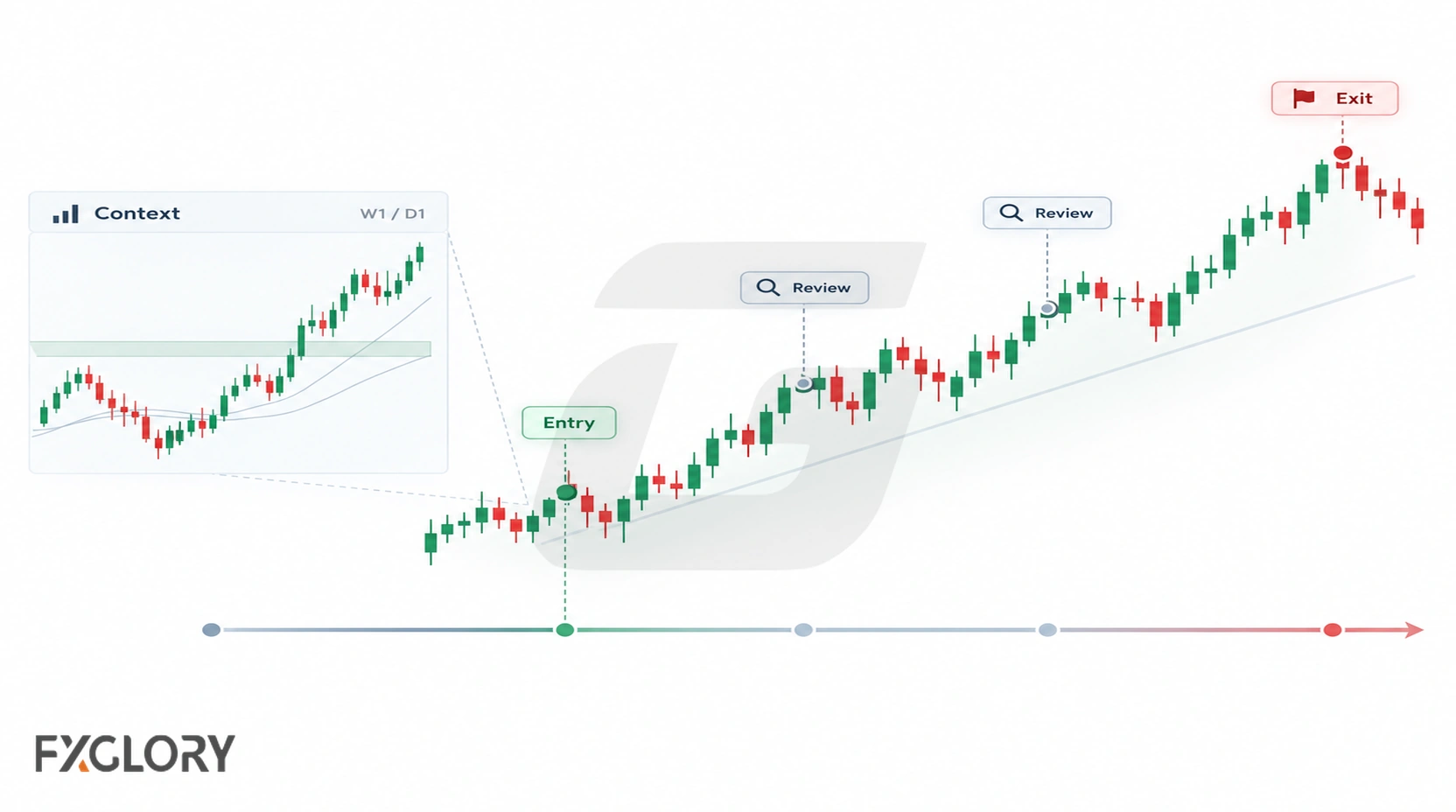
Possible inputs include a weekly trend, a premarked support or resistance zone, a central-bank policy divergence, or changing economic expectations between two currencies. These inputs are observations or hypotheses, not automatic entry signals; an actual trade requires a separately defined trigger and risk limit.
For example, a trader who initially planned an intraday breakout cannot retroactively turn a failed setup into a long-term position simply by postponing the exit.
For the broader holding-period framework, review how long-term forex trading is structured before a position style is chosen.
Position Trading vs Long-Term Trading
Long-term forex trading describes a broad holding horizon; position trading names a particular style of planning and managing exposure within that horizon. Other long-term approaches can also have detailed rules, so structure is not exclusive to position trading.
| Item | Long-Term Trading | Position Trading |
|---|---|---|
| Main idea | A broad approach based on longer holding periods and higher-timeframe context | A longer-horizon style organized around a defined thesis and managed trade |
| Timeframe use | Often daily, weekly, or monthly | Usually uses higher timeframe for context and a lower trading timeframe only for timing |
| Trade reason | May come from trend, macro, support/resistance, carry, or broader market view | Thesis specifies conditions for reassessment or cancellation |
| Main danger | Assuming long holding periods are safer | Holding a failed thesis because the trader calls it a position trade |
Position Trading vs Swing Trading vs Day Trading
These styles differ in intended holding horizon and the price movements they seek to capture. A position trader may enter less frequently than a day trader, but the number of monitoring or adjustment decisions depends on the actual method. Longer exposure can span more scheduled economic events and overnight periods.
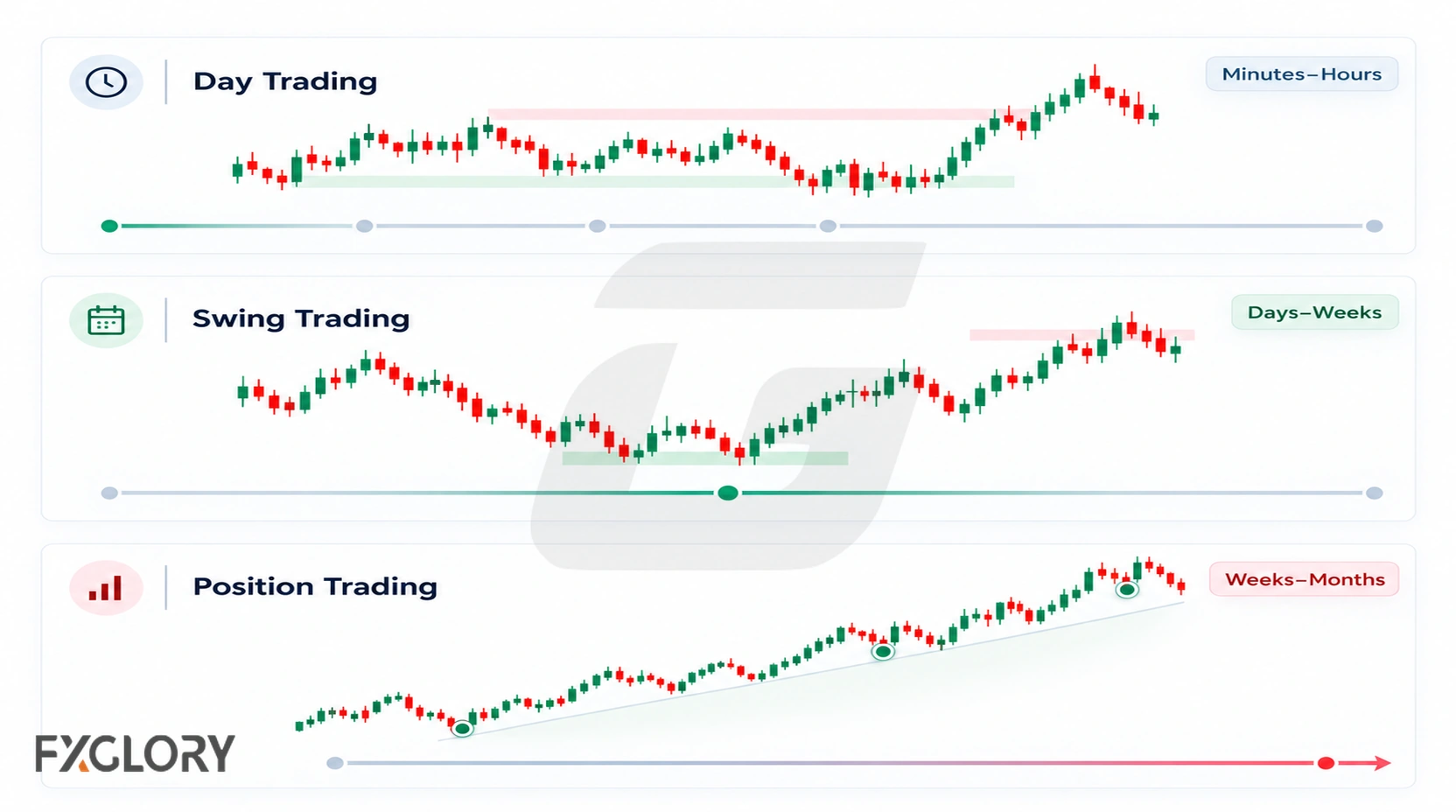
| Trading Style | Typical Focus | Common Review Window | Main Risk Shift |
|---|---|---|---|
| Day trading | Intraday movement and session behavior | Minutes to hours | Spread sensitivity, fast execution, overtrading, session volatility |
| Swing trading | Multi-day moves, pullbacks, and swing points | Several days to a few weeks | Overnight risk, event exposure, stop distance, holding discipline |
| Position trading | Higher-timeframe direction, macro context, long-range structure | Days, weeks, or longer | Setup-dependent stop distances, swap, margin pressure, drawdowns, thesis drift |
For a closer comparison of short, medium, and longer chart roles, use the timeframe guide before choosing a holding style.
Position Trading Is Not Buy-And-Hold Investing
Position trading forex should not be confused with buy-and-hold investing. A forex position is still a leveraged market exposure unless the account and product structure say otherwise. The position can be affected by margin requirements, swap, spread, slippage, liquidity changes, central-bank repricing, and unexpected events.
A buy-and-hold investor may own an asset over an investment horizon, while a forex position trader generally manages leveraged or margined currency exposure subject to trading-account terms. Ownership, margin and financing mechanics therefore differ by product and account.
Holding Period vs Position Plan
The plan-versus-duration distinction is easiest to test with questions answered before entry. The table contrasts documented choices with reasons that are reconstructed only after price moves.
| Question | Position Plan Answer | Weak Answer |
|---|---|---|
| Why this pair? | The trader can explain the currency, structure, or macro reason for choosing the pair | The pair moved recently or looks familiar |
| Why this direction? | The direction fits the higher-timeframe thesis and chart structure | The trader hopes the position will recover |
| Where is the idea wrong? | Invalidation is known before entry | The stop is decided after price moves against the trade |
| How often is it reviewed? | The review schedule is written before entry | The trader checks emotionally after every move |
| What ends the trade? | Target, trail, invalidation, time review, thesis change, or cost rule | The position is held until it feels better |
Choosing Timeframes for Forex Position Trading
Choose chart periods according to the condition being measured, not a universal best timeframe. For example, a monthly chart may show multi-year levels, a weekly chart may frame the main trend thesis, a daily chart may establish the setup and its invalidation, and a four-hour chart may help time execution. These roles can be combined differently; a move is relevant when it meets a condition defined in the plan, not because it is labeled short-term noise.
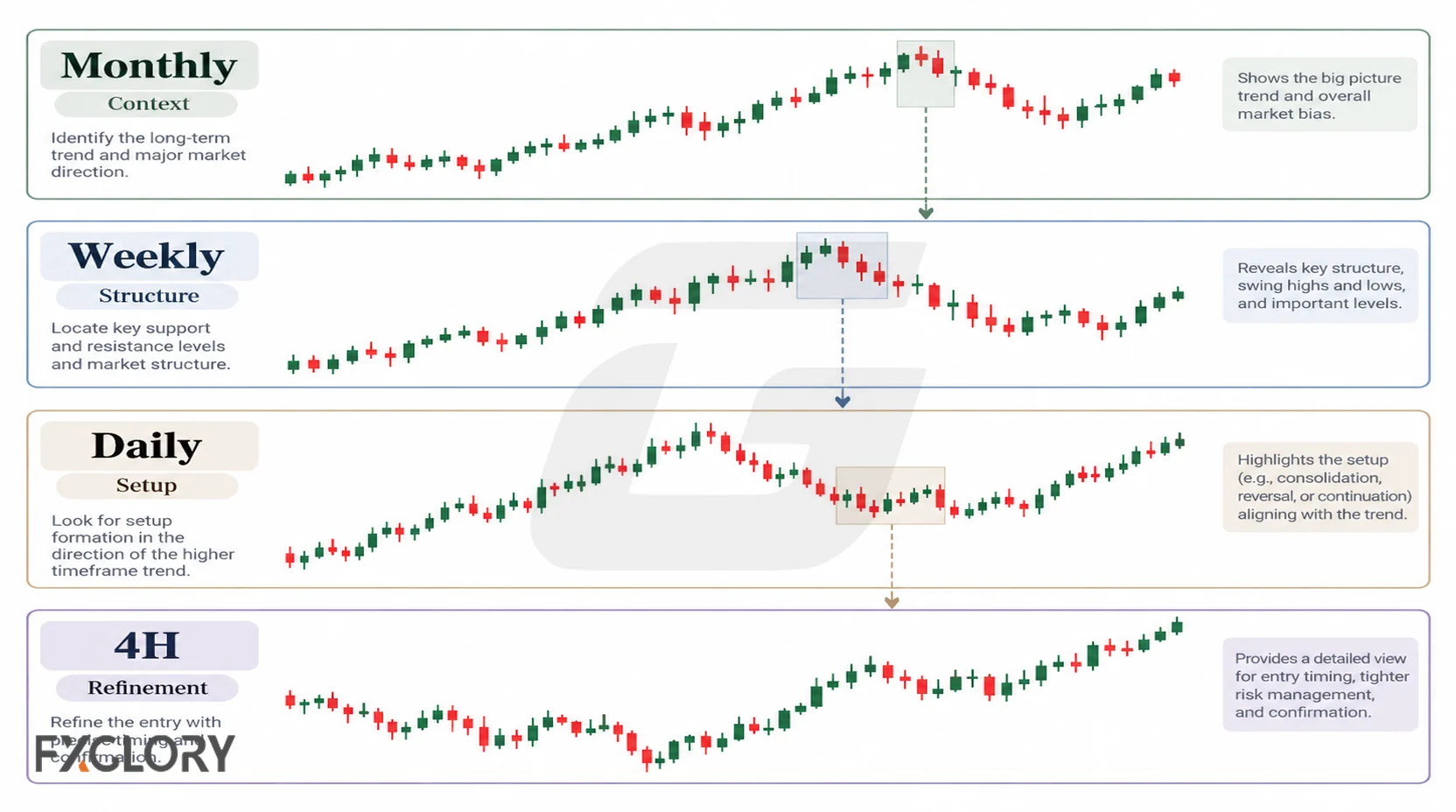
| Timeframe | Possible Role | Common Mistake |
|---|---|---|
| Monthly | Broad market structure, major zones, long-term context | Using it as an excuse to ignore invalidation |
| Weekly | Trend direction, large support/resistance, major swing behavior | Forcing a trade when weekly structure is unclear |
| Daily | Setup structure, pullback behavior, breakout review, trailing decisions | Calling every daily signal a position trade without higher context |
| 4-hour | Timing refinement after the higher-timeframe plan exists | Using intraday movement to change a weekly thesis without a predefined trigger |
For cleaner timeframe separation, use multiple time frame analysis to define context, setup, and timing roles.
What Position Traders Analyze
Technical structure and economic information can support or contradict one another. For each input, identify what is observable, what is a trading hypothesis, and what change would require reassessment.
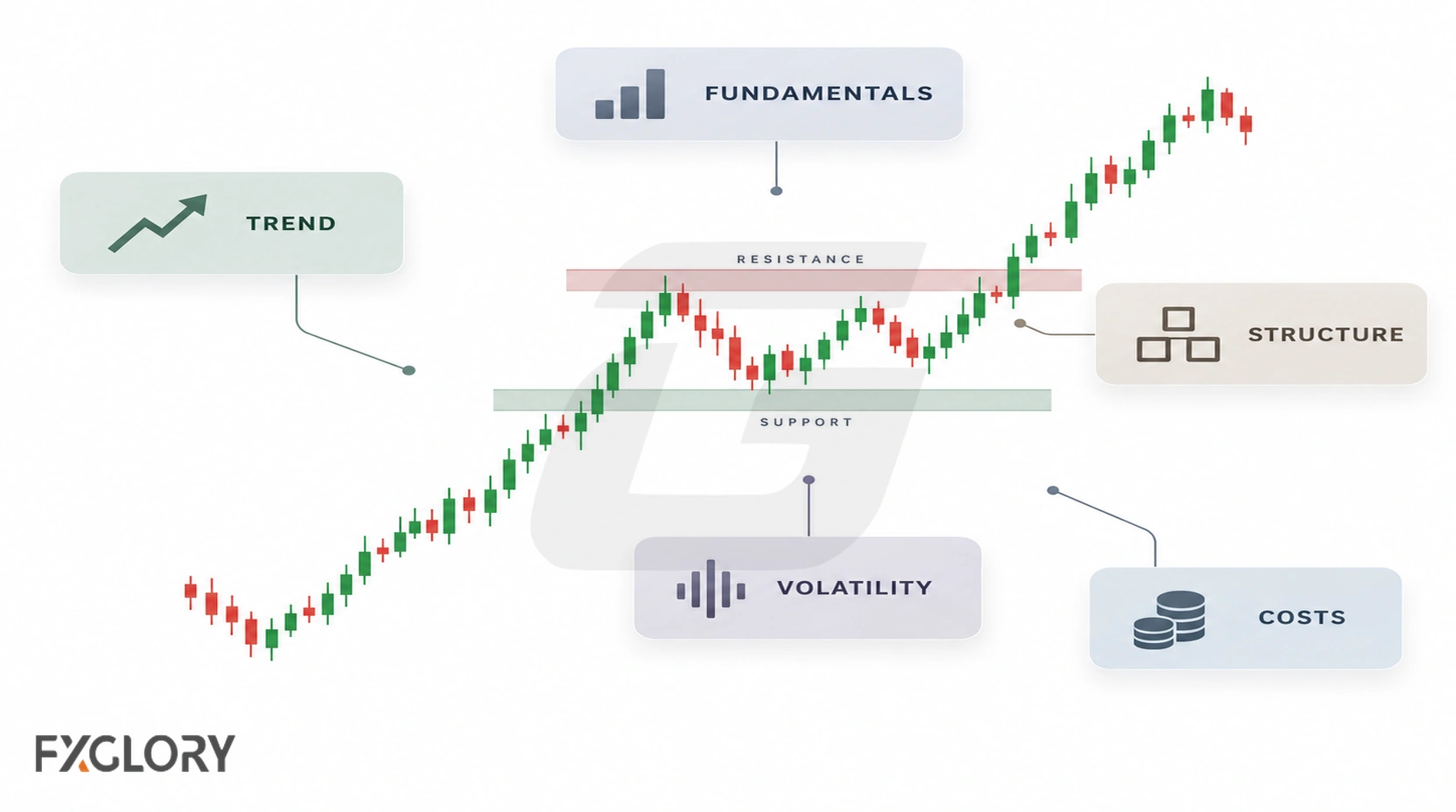
| Analysis Layer | What It Reviews | Position-Trading Use |
|---|---|---|
| Trend structure | Higher highs, lower lows, moving-average structure, major swing direction | Checks whether the position idea follows or challenges the broader direction |
| Support and resistance | Major levels, range boundaries, old breakout zones, role reversal | Helps define entry areas, invalidation, target zones, and stop placement |
| Fundamental context | Interest rates, inflation, employment, central-bank expectations, growth, risk sentiment | Checks whether the currency bias supports or conflicts with the chart idea |
| Volatility | Range expansion, event risk, average movement, abnormal candles | Helps decide whether stop distance and target room are realistic |
| Costs and conditions | Spread, swap, margin, leverage exposure, holding period | Checks whether the position can be held without breaking account rules |
For macro and currency-bias review, use a fundamental strategy framework before turning economic context into trade exposure.
Pair Selection For Forex Position Trading
Pair selection is a two-currency comparison: buying one currency means selling the other. Compare each side's economic and policy exposure alongside the available chart structure, rather than choosing solely because a recent candle was large.
The choice of which pair and the thesis for which direction are distinct. Review spread, swap, session liquidity, and exposure overlap before defining the entry setup; the subsequent trade stop is a separate price or risk-management rule.
| Pair-Selection Check | Why It Matters For Position Trading | Weak Version |
|---|---|---|
| Currency reason | The trader knows why one currency is preferred against the other | The pair is chosen because it moved strongly last week |
| Higher-timeframe structure | The daily, weekly, or monthly chart supports a planned position idea | The pair is selected from a lower-timeframe spike only |
| Spread and entry cost | A wider-position trade still needs realistic entry cost and target room | Cost is ignored because the trade is not short term |
| Swap and rollover | Holding for many nights can create repeated credits or charges | The trader checks swap only after the position is already open |
| Event exposure | Central-bank, inflation, employment, and growth events can change the thesis | The trade is held through major events without a review rule |
| Correlation overlap | Several open positions may duplicate the same currency exposure | Different pair names are treated as automatic diversification |
For available forex instruments, review the currency-pair markets before choosing a long-horizon example. For cost checks, compare spread conditions that affect entry and exit planning and review account conditions before holding a position across multiple sessions.
Common Forex Position Trading Methods
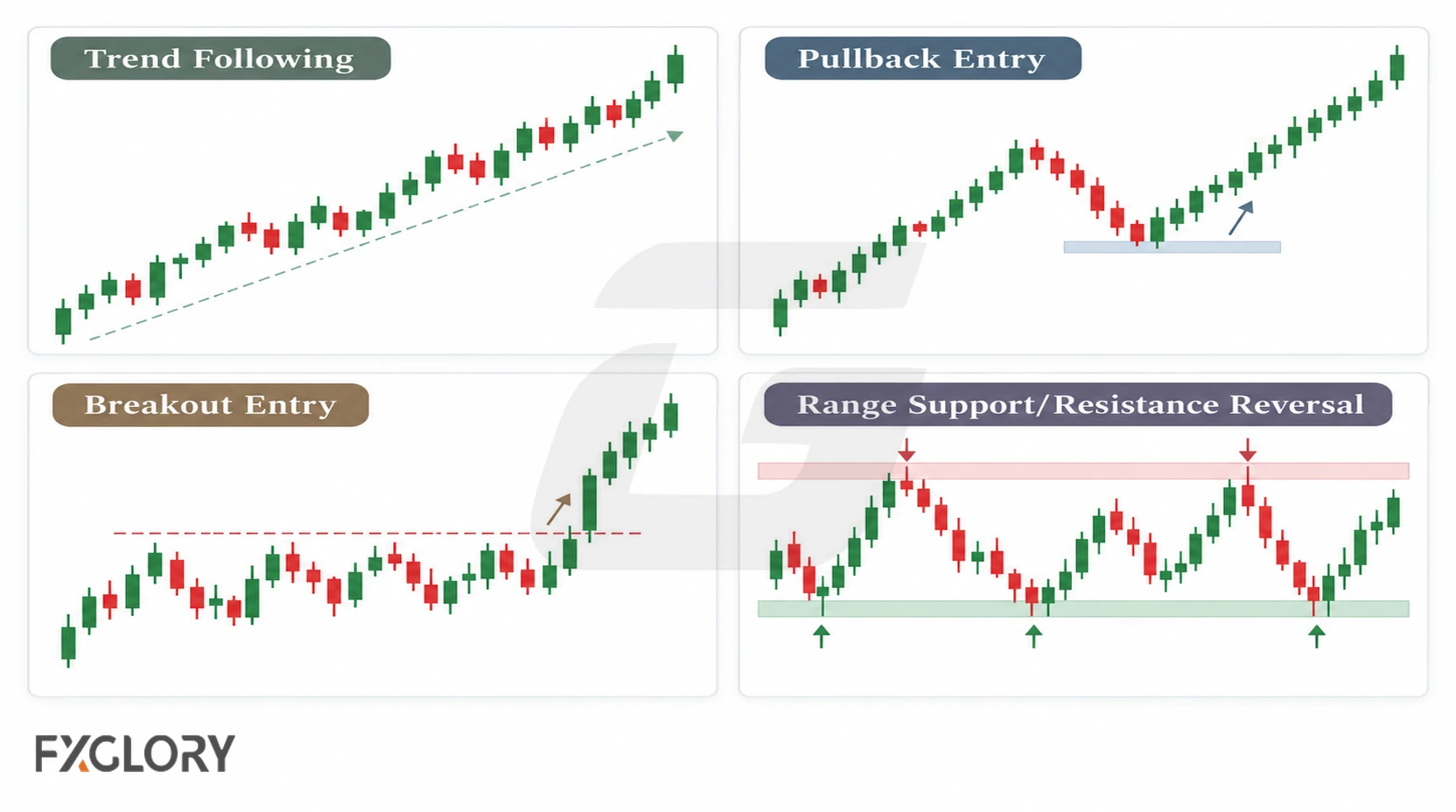
Position traders can employ different methods, but the rule for continuation, reversal, or breakout confirmation depends on the method. A trend-following thesis should not silently switch to range-trading rules after entry.
| Method | Position-Trading Use | Main Risk |
|---|---|---|
| Trend-following position | Uses higher-timeframe direction and tries to stay with the broader move | Late entry, trend exhaustion, oversized stop, refusing to exit after trend failure |
| Pullback continuation | Reviews corrections inside a larger trend before rejoining the direction | Pullback becomes reversal and the trader keeps calling it a correction |
| Breakout position | Reviews whether a major level break starts a larger move | False breakout, poor retest, no target room, news-driven spike |
| Support/resistance position | Uses major zones for entry, invalidation, or target planning | Level is drawn after the trade idea, not before |
| Range-to-break transition | Reviews a larger range and prepares for a confirmed break or failed break | Trader switches between range and trend logic without rules |
| Moving-average structure | Uses slower averages to review broad direction or trailing logic | Moving average is used as a signal without market context |
| Carry-aware position | Checks whether swap and rate context support or damage a longer-held trade | Trader focuses on carry and ignores price movement or margin risk |
For deeper method-specific rules, review the separate guides on longer-horizon trend structure, pullback entries inside a trend, breakout planning around major levels, and support and resistance invalidation zones. For a separately specified system and its historical test assumptions, see forex position trading strategy rules and backtesting.
Entry Rules For Position Trades
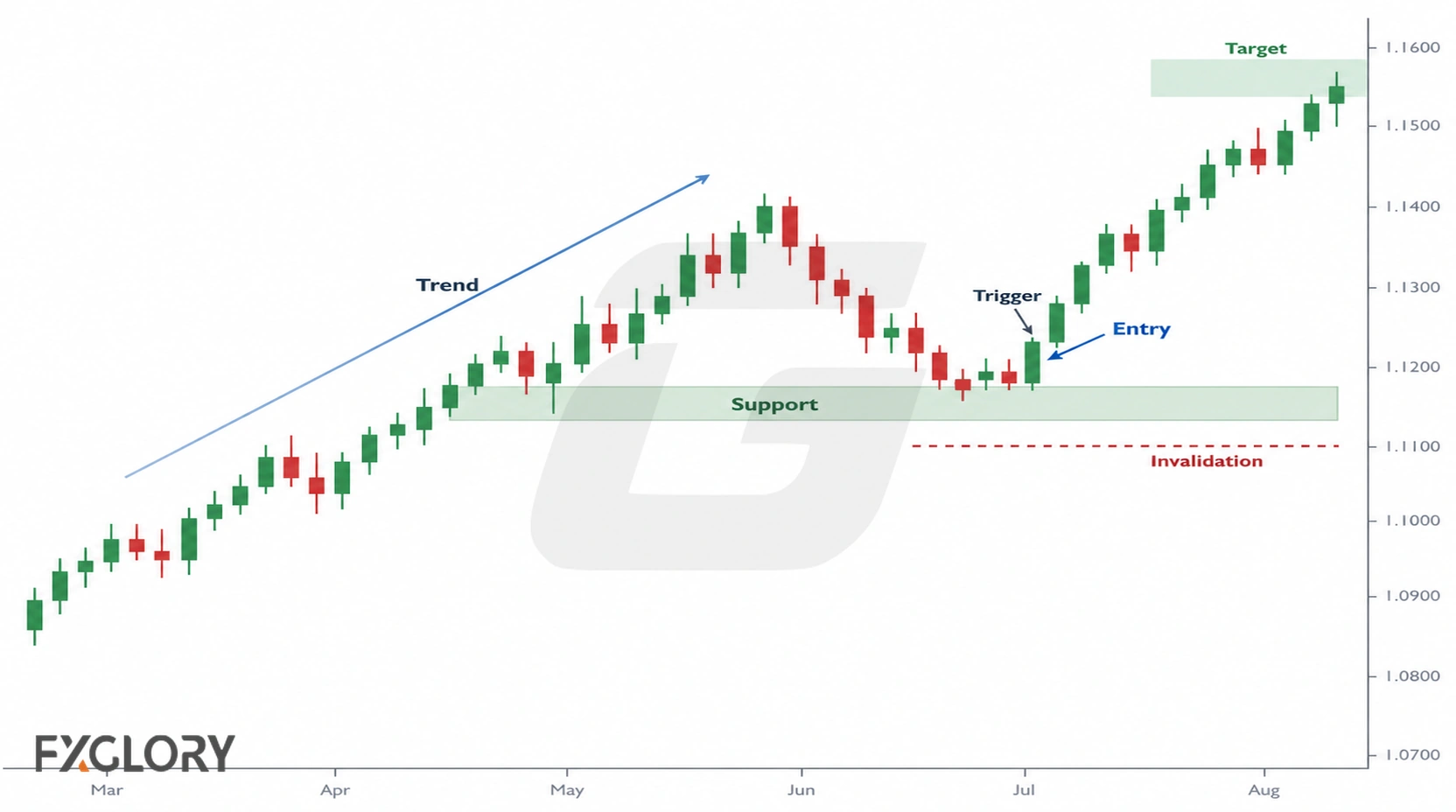
An economic view or higher-timeframe trend can motivate a setup, but neither specifies an order by itself. Define whether the entry requires a completed-candle close, a retest, or a particular price reaction, and decide separately where that setup is invalidated.
| Entry Type | Possible Use | Weak Version |
|---|---|---|
| Breakout entry | Entry after a major level breaks and closes according to the plan | Trader buys or sells the first spike without checking false-break risk |
| Retest entry | Entry after price returns to a broken level or structure area | Trader assumes every retest will hold |
| Pullback entry | Entry during a correction inside a broader trend | Trader enters before the pullback shows structure |
| Support/resistance reaction | Entry after price reacts around a pre-marked zone | The level is created after the trader wants the trade |
| Fundamental confirmation | Entry after macro view and chart structure align | Trader enters only because an economic story sounds convincing |
| No-entry rule | Skip if the trigger does not happen | Trader enters because waiting feels uncomfortable |
For a fuller framework, use entry and exit rules that define trigger, invalidation, target, trail, and cancellation before the order.
Exit And Review Rules
A review event calls for reassessment; it need not itself close a trade. A trade stop limits a particular position, while a thesis invalidation describes when the wider market premise is no longer supported. These may occur at different levels or times and should be distinguished in advance.
| Exit Or Review Rule | How It Works | Why It Matters |
|---|---|---|
| Invalidation exit | Exit when the market breaks the condition that supported the position | Stops a trade from becoming an unplanned hold |
| Structure target | Target uses higher-timeframe support, resistance, swing, or range boundary | Keeps target planning tied to the chart |
| Trailing rule | Trail follows structure, moving average, volatility, or written rule | Prevents emotional changes after every pullback |
| Time review | Review the trade after a planned number of candles or calendar period | Stops stale positions from staying open without reason |
| Fundamental review | Review if central-bank expectations, rates, inflation, jobs, or risk sentiment change | Checks whether the original currency thesis still exists |
| Cost review | Review swap, spread, margin pressure, and opportunity cost | Prevents holding costs from quietly weakening the plan |
Swap, Rollover, And Holding Costs
Position trades can remain open across many rollover periods. That means swap can become more relevant than it is for many short-term trades. Depending on pair direction, account conditions, position size, and holding period, swap may credit or charge the account.
Estimate holding costs using the intended direction, size, account conditions, and dates. Rates and rollover conventions can change; a hypothetical swap credit does not offset unbounded price risk. Revisit the estimates if the holding horizon changes.
| Holding-Cost Item | Why It Matters | Better Rule |
|---|---|---|
| Swap or rollover | Can credit or charge during overnight holding | Check pair direction and account conditions before holding |
| Spread | Still affects entry and exit, even if less central than scalping | Include cost in the expected target and stop logic |
| Margin | A long-held trade can tie up free margin through changing conditions | Review margin before entry and during the holding period |
| Event exposure | Central banks, inflation, employment, elections, and shocks can change the thesis | Schedule reviews around important events |
For swap mechanics, use the swap guide before holding a trade through multiple rollover periods. For rate-differential logic, compare the idea with carry trade rules before treating interest-rate context as a position reason.
Position Size, Leverage, And Margin
Position trading describes how an idea is managed over time; position sizing determines the order volume allowed by a particular entry, stop, and risk budget. First locate the setup-specific invalidation or stop, then measure the entry-to-stop distance before choosing the volume.
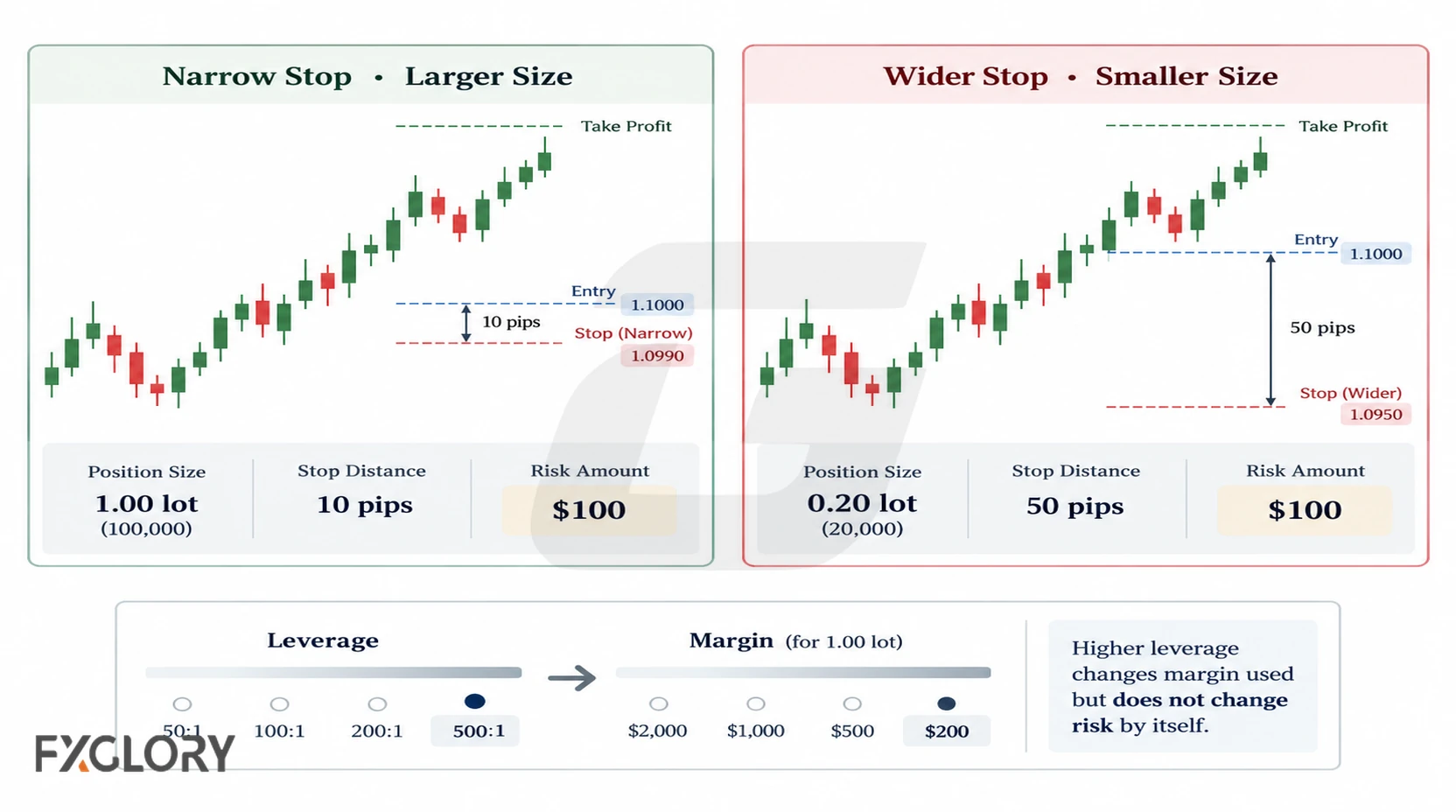
Stop distance is not fixed by the label "position trade." It depends on the entry, invalidation level, chosen timeframe, prevailing movement, and execution assumptions. For the same risk budget and pip value, a greater stop distance requires a smaller position; changing leverage or margin does not change the stop-loss arithmetic.
Hypothetical EUR/USD example: With a USD-denominated account, a 200-pip entry-to-stop distance, an illustrative $10 pip value per standard lot, and a planned $100 risk budget, position size is $100 ÷ (200 × $10) = 0.05 standard lots. The planned stop movement would be about $0.50 per pip, or $100 before extra costs or adverse execution. These are illustrative inputs, not recommended account-risk limits or historical trade results.
Pip value depends on pair, trade size, exchange-rate conversion, and account currency. Check the broker's minimum lot size and volume step. If rounding to an allowed volume would exceed the risk budget, skip or revise the setup rather than automatically rounding up. Margin, leverage, spread, slippage, weekend gaps, and correlated positions need separate checks; actual losses can exceed the estimated stop risk.
| Risk Item | Position-Trading Problem | Better Rule |
|---|---|---|
| Stop distance and trade volume | Using a fixed lot size across different stop distances changes planned monetary risk | Calculate volume from risk, pips, and pip value; check permitted volume steps |
| Leverage exposure | Small adverse movement can become larger account pressure | Review leverage before accepting longer exposure |
| Margin pressure | Open position may reduce flexibility during drawdown | Check margin before entry and after major price movement |
| Correlation | Multiple positions can duplicate the same currency exposure | Review pair overlap before adding another long-horizon trade |
| Event risk | Position may pass through central-bank or economic releases | Plan event reviews before the holding period begins |
Use the margin calculator before a position is opened, review leverage conditions before accepting longer exposure, and apply risk-management rules for stop distance, position size, drawdown, and account limits.
Why Forex Position Trades Fail
The failure examples below focus on decisions that can turn a planned position into uncontrolled exposure. Diagnose the broken rule, rather than assuming the trade failed solely because a market prediction was wrong.
| Failure Reason | What Happens | Better Rule |
|---|---|---|
| No invalidation | The trader cannot say where the position idea is wrong | Do not open the position without invalidation |
| Size incompatible with stop | Selected lot volume breaches risk limits at the planned invalidation | Reduce volume if permitted, or skip the trade |
| Macro story attachment | The trader keeps holding after the chart and data change | Review the thesis on a written schedule |
| Swap ignored | Holding costs weaken the plan over time | Check swap before entry and during review |
| Pullback becomes reversal | The trader keeps using continuation language after structure fails | Exit or reassess when invalidation is reached |
| Correlation crowding | Several trades duplicate the same currency exposure | Review exposure before adding positions |
| Short-term trade becomes position trade | A failed intraday or swing trade is renamed as long-term | Do not change the trade type after entry to avoid taking a planned loss |
Position Trading Decision Sequence
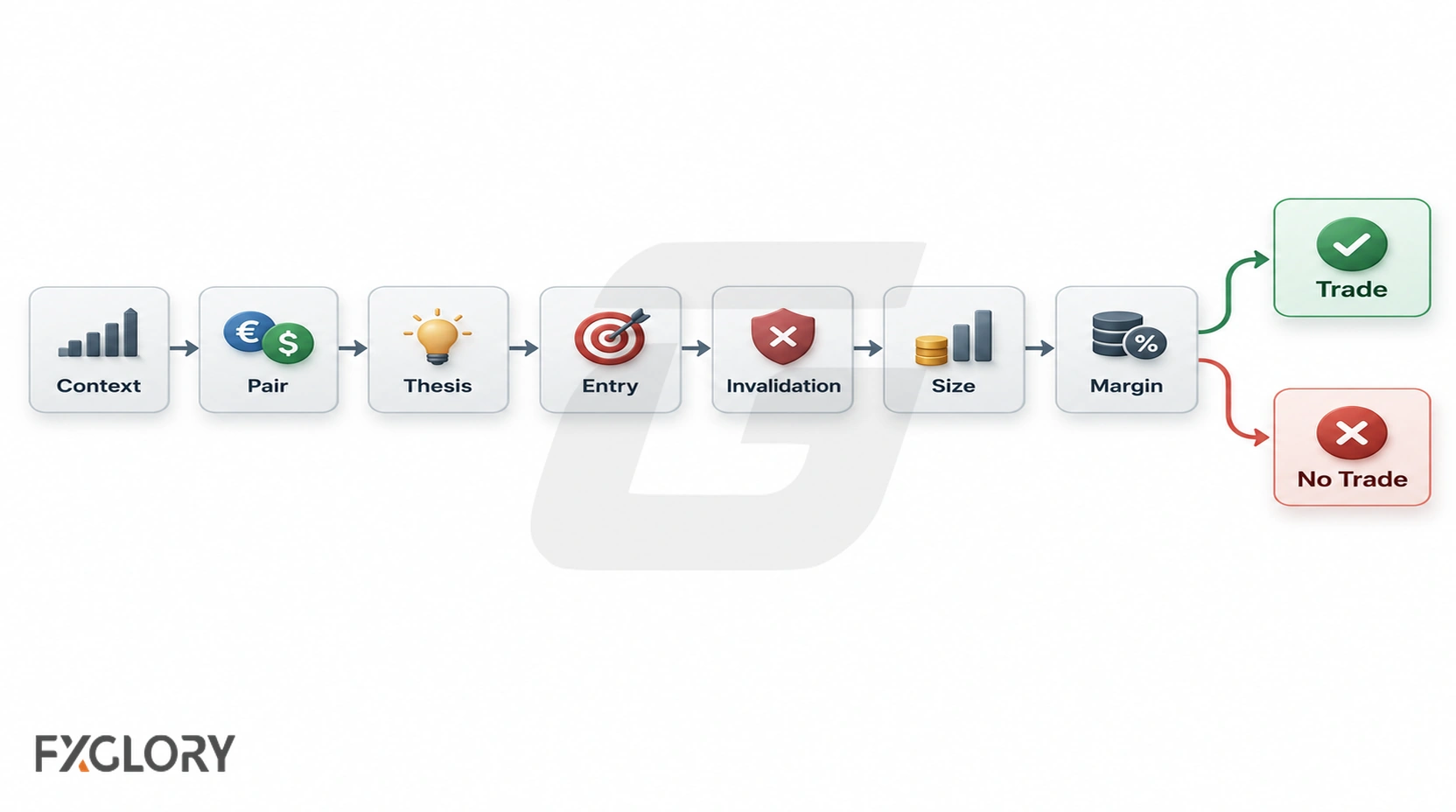
Use the table as a practical pre-entry sequence. Each stage should have a recorded answer rather than an assumption inferred after the trade.
| Step | Decision | Continue Only If |
|---|---|---|
| 1. Higher-timeframe context | Weekly, monthly, or daily structure is reviewed | The market condition is clear enough to plan |
| 2. Pair reason | The trader can explain why this pair is being reviewed | The pair choice is not random or based only on recent movement |
| 3. Trade thesis | Trend, breakout, pullback, support/resistance, fundamental, or carry-aware reason is defined | The reason can be written in one clear statement |
| 4. Entry trigger | The condition for opening the trade is known | The trade is not opened before the trigger |
| 5. Invalidation | The trade stop and broader thesis-failure conditions are specified separately | The planned exit can be evaluated before exposure |
| 6. Position size | Lots are derived from account risk, stop pips, and monetary pip value | Permitted lot increments and expected costs fit the risk budget |
| 7. Margin and leverage | Free margin and leverage exposure are reviewed | The account can handle planned exposure and possible drawdown |
| 8. Holding costs | Swap, spread, and rollover implications are checked | Costs do not contradict the plan |
| 9. Review schedule | Time-based and event-based review points are written | The trade will not be ignored after entry |
| 10. Exit rule | Target, trail, invalidation, time review, or thesis change is defined | The trader knows how the position ends |
For system-level structure, use a trading system framework that connects setup, execution, risk, and review rules.
No-Trade Conditions
These are concrete pre-entry rejection conditions. The decision sequence explains what to prepare; this list identifies circumstances in which proceeding would violate the plan.
- Skip if the higher-timeframe structure is unclear.
- Skip if the pair reason cannot be explained before entry.
- Skip if the trade exists only because a short-term position failed.
- Skip if the calculated volume is below the allowed minimum or rounding to an available volume step would exceed the planned account-risk budget.
- Skip if margin cannot support the planned holding period and possible drawdown.
- Skip if swap or holding cost contradicts the expected trade logic.
- Skip if major event risk is near and the plan has no event review rule.
- Skip if several open positions already duplicate the same currency exposure.
- Skip if the exit rule is missing.
- Skip if the trader is emotionally attached to the thesis before the trade begins.
Testing And Review Before Live Trading
Assess completed and skipped setups using rules recorded before each observation. Review multiple market conditions, including pullbacks, scheduled releases, rollover changes, and prolonged drawdowns. Keep historical and simulated results distinct from live fills.
- Record the higher-timeframe context before entry.
- Record the pair reason and trade thesis in one sentence.
- Record the trading timeframe and the timing trigger.
- Record the invalidation point before entry.
- Record stop distance, position size, leverage exposure, and margin requirement.
- Record swap and expected holding-cost behavior.
- Record the review schedule and the events that require reassessment.
- Record whether the exit happened by target, trail, invalidation, time review, cost rule, or thesis change.
- Record maximum drawdown while the position was open.
- Compare trades that followed the plan with trades that were only held because closing was uncomfortable.