
What Is Forex Long-Term Trading?
Forex long-term trading is a trading approach that reviews currency pairs through broader market context instead of reacting to every short-term candle. A long-term forex trader may use daily, weekly, or monthly charts to understand direction, structure, macro pressure, support and resistance, volatility, and holding risk.
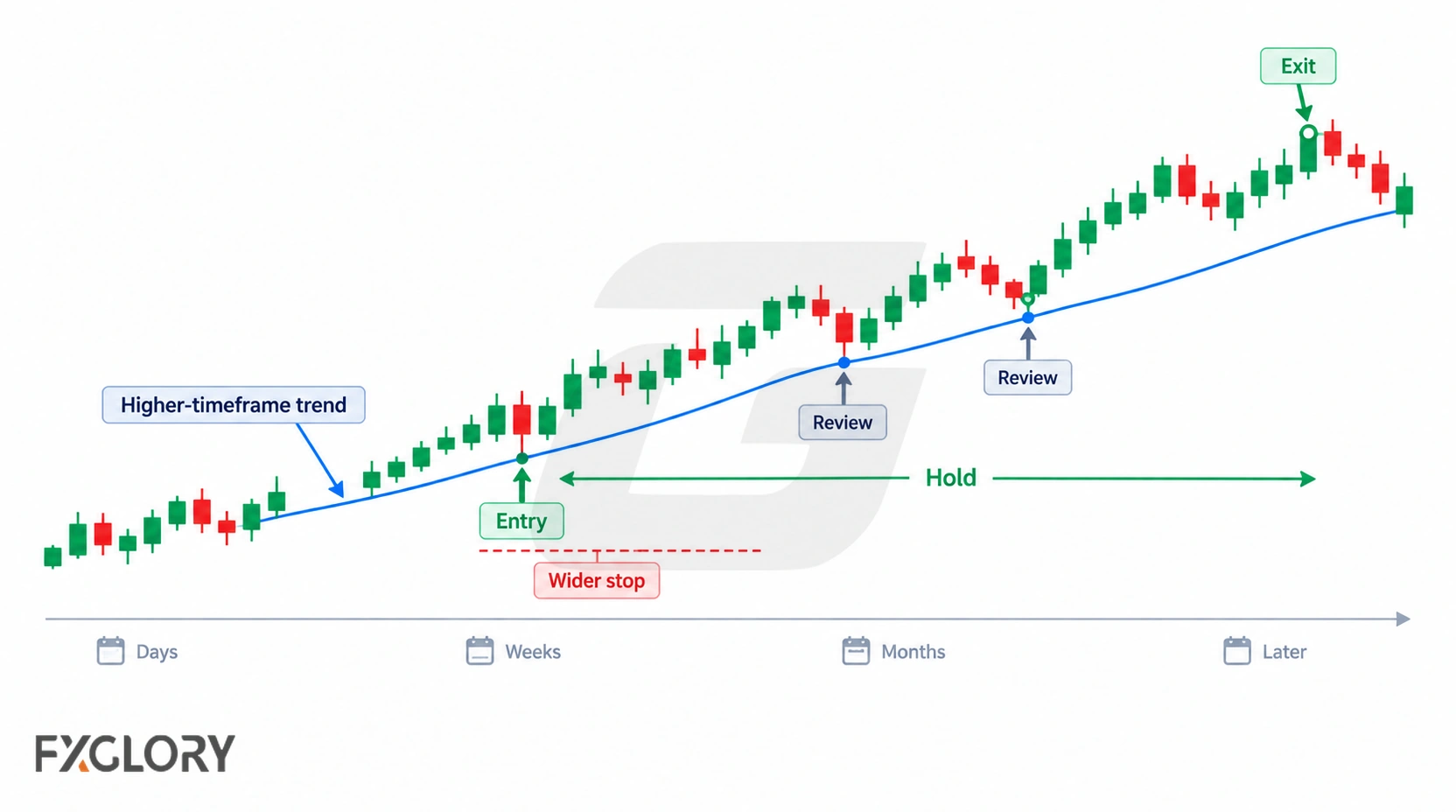
This approach changes which market developments matter most to the trade. Minor intraday fluctuations may be irrelevant to a weekly thesis, while a central-bank shift or a break of the planned weekly structure may require reassessment.
For timeframe selection across different trading styles, review how FXGlory explains the difference between short-term, swing, and position-style chart use.
Holding Period vs Chart Timeframe
The holding period and the chart timeframe are connected, but they are not the same thing. A position can remain open for several days because it was planned from a daily or weekly structure. A different position can remain open for several days only because the trader refused to close a failed intraday idea. Those are not the same process.
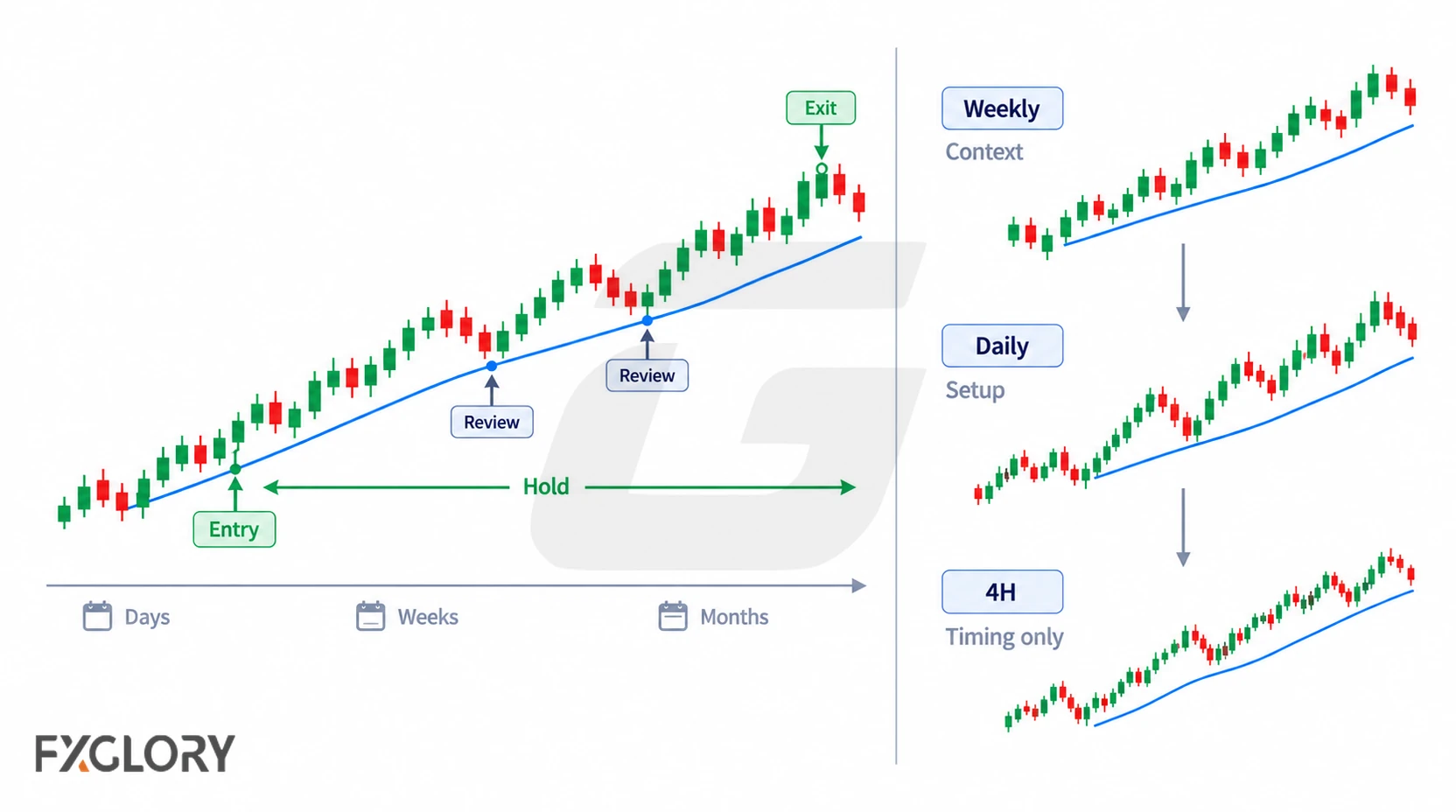
For long-term forex trading, the controlling timeframe should be identified before the trade is opened. If the weekly chart defines the idea, a small intraday candle should not cancel the trade unless the plan says it does. If a lower chart is used only for timing, it should not become the new reason for holding.
| Question | Long-Term Planning Answer | Weak Version |
|---|---|---|
| What controls the idea? | A daily, weekly, or monthly structure is named before entry. | The trader changes the controlling chart after price moves. |
| How long might it be held? | The expected holding period matches the timeframe and review schedule. | No expected holding window or scheduled review was considered before entry. |
| Can a lower chart help? | It may refine timing after the higher-timeframe idea is already clear. | Lower-timeframe noise becomes the reason to enter, exit, or re-enter. |
| What cancels the idea? | A written technical, macro, cost, or risk condition invalidates the trade. | The trader waits for recovery without a defined invalidation point. |
Long-Term vs Short-Term Forex Trading
Long-term trading changes the type of decisions a trader must make. A scalper may focus on spread, speed, and small intraday movement. A long-term trader must focus more on higher-timeframe direction, larger stop distance, swap, news exposure, margin, and whether the trade idea remains valid after several market sessions.
| Trading Style | Typical Focus | Main Pressure | Weak Use |
|---|---|---|---|
| Scalping | Small movements, fast execution, low spread, short holding time | Cost sensitivity and execution speed | Trying to use scalping logic for a trade that needs days or weeks to develop |
| Day trading | Intraday movement and same-day decisions | Session timing, news, intraday volatility, and emotional overtrading | Holding a day trade overnight without a long-term plan |
| Swing trading | Multi-day market swings, pullbacks, and structure shifts | Overnight exposure, stop distance, and trend changes | Calling every multi-day trade long-term without higher-timeframe context |
| Long-term trading | Daily, weekly, or monthly context and fewer trade decisions | Wider stops, holding costs, macro changes, margin pressure, and patience | Ignoring multi-session holding costs and event exposure |
| Position trading | A specific longer-term style built around a broader directional thesis | Thesis quality, major-event risk, and extended drawdown | Confusing a vague opinion with a planned position trade |
For shorter multi-day market swings, use the forex swing trading strategy guide. For broader direction-following rules, use the forex trend trading strategy guide.
Long-Term Forex Trading vs Investing Or Buy-And-Hold
Long-term forex trading should not be confused with long-term stock investing. A forex trade is normally a leveraged position in one currency against another. The value of the position can change from exchange-rate movement, swap or rollover, spread, margin requirements, and account conditions.
Buy-and-hold investing usually refers to holding assets such as shares, funds, or long-term investments with a different risk structure. A long-term forex trade is different. It may use a longer holding period, but it still remains a trade that needs active risk control.
| Item | Long-Term Forex Trading | Buy-And-Hold Investing |
|---|---|---|
| Instrument logic | One currency is traded against another currency | An asset is usually owned or held for investment exposure |
| Risk source | Exchange-rate movement, leverage, margin, swap, spread, and event exposure | Asset-price movement, business risk, market risk, and investment horizon |
| Holding reason | A trade plan based on market context, trend, macro conditions, or structure | An investment thesis, allocation plan, or long-term portfolio objective |
| Exit need | Needs invalidation, review, and exit rules | May use different portfolio or allocation rules |
| Main mistake | Assuming leveraged currency exposure can be held indefinitely without funding and margin reviews | Assuming trading and investing use the same risk rules |
Long-Term Trading vs Position Trading
Position trading is one form of long-term forex trading, but the terms are not always identical. Long-term forex trading is the broader idea of using higher-timeframe conditions and longer holding periods. Position trading is a more specific style where the trader builds a directional view and holds while that view remains valid.
For the specialist process of building and maintaining a directional thesis, see position trading forex.
| Question | Long-Term Forex Trading | Position Trading |
|---|---|---|
| Scope | Broad longer-holding approach | Specific longer-term trading style |
| Common tools | Higher timeframes, trend, support and resistance, cost checks, review rules | Directional thesis, macro context, weekly/monthly structure, extended management |
Best Timeframes For Long-Term Forex Trading
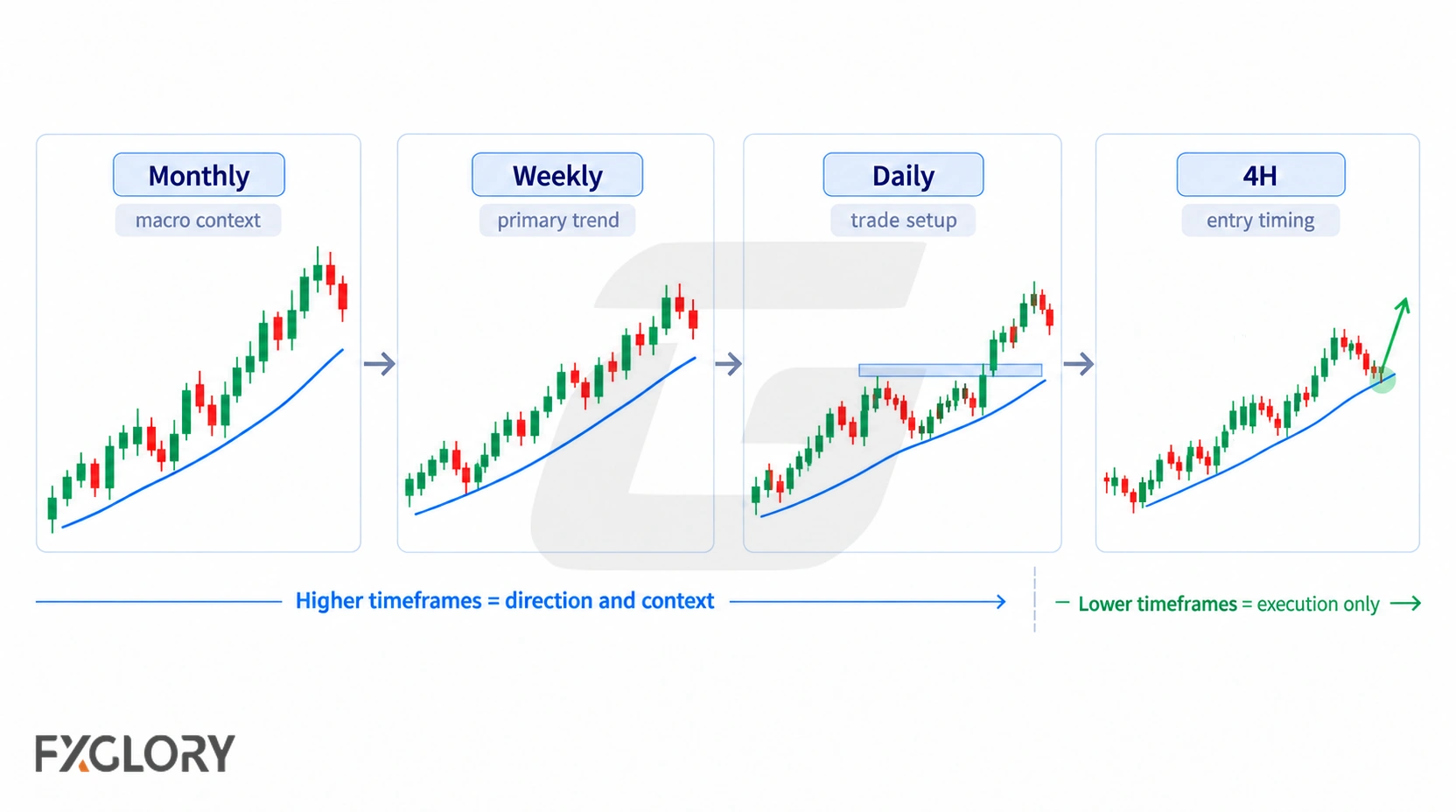
Long-term forex traders usually start with daily, weekly, or monthly charts. These timeframes can reduce the pressure to react to every small intraday movement, but they also create larger stop distances and longer exposure to market events.
| Timeframe | Possible Role | Main Risk |
|---|---|---|
| Monthly chart | Review broad direction, major levels, and long market cycles | Signals are rare and stop distance can be very large |
| Weekly chart | Review trend structure, major pullbacks, and long-term support or resistance | Price can move far before the setup changes clearly |
| Daily chart | Plan trade structure, entry zones, invalidation, and review cadence | Daily candles can still be volatile around news and session changes |
| 4-hour chart | Refine timing after higher-timeframe context is already defined | Can pull the trader into short-term noise if used alone |
| Intraday chart | May help with execution details only | Can cause early exits from a valid higher-timeframe idea |
For separating higher-timeframe context from lower-timeframe execution, use the multiple time frame analysis guide.
What Long-Term Forex Traders Usually Analyze
Long-term forex trading needs more than a large chart. The trader should understand why a pair is being reviewed, what would support the idea, and what would cancel it.
| Analysis Area | What It Reviews | Why It Matters |
|---|---|---|
| Higher-timeframe trend | Whether price is making broader directional progress, range movement, or unclear structure | Long-term trades often need room to develop |
| Support and resistance | Major zones where price previously reacted | Stops and targets should not ignore visible market structure |
| Central-bank context | Rate expectations, policy tone, inflation pressure, and economic outlook | Longer holding periods increase exposure to policy changes |
| Economic releases | Employment, inflation, GDP, retail sales, PMI, trade balance, and speeches | Important releases can change the original reason for holding |
| Swap and rollover | Whether holding the trade overnight adds a credit or charge under current conditions | Long-term trades cross many rollover periods |
| Volatility | How far the pair normally moves and how large stops may need to be | Position size should be based on realistic movement, not comfort |
| Correlation | Whether several open trades depend on the same currency or macro idea | Multiple positions can create one hidden exposure |
When long-term direction depends partly on interest-rate differences or overnight holding costs, use the carry trade forex guide to separate swap-aware holding from a normal directional trade.
Long-Term Forex Trading Methods
Long-term forex trading can use different methods. The method should be named before the trade is opened, because each method has a different invalidation rule.
| Method | How It Is Reviewed | What Can Go Wrong |
|---|---|---|
| Higher-timeframe trend following | Trader looks for a broad trend and uses pullbacks, breaks, or retests to plan entry | Trend weakens while the trader keeps holding the old direction |
| Pullback continuation | Trader waits for price to correct toward a zone before reviewing continuation | Correction becomes a reversal and invalidation is ignored |
| Range-to-break transition | Trader watches whether a long range begins to expand beyond a major boundary | Break fails and price returns inside the range |
| Macro-bias holding | Trader uses broader economic and central-bank context to frame direction | Macro story changes or was already priced in |
| Carry-aware holding | Trader checks whether swap or rollover supports or hurts the holding plan | Positive carry is treated as protection against price loss |
| Major level response | Trader reviews behavior around weekly or monthly support and resistance | Level is too wide or unclear to support precise risk control |
For level quality around major chart areas, use the support and resistance strategy guide. For full rule-building, use the forex trading system guide.
Choosing Currency Pairs For Long-Term Forex Trading
A long-term forex trade should match the pair to the reason for holding. A trader should know which currency is driving the idea, whether the pair has enough liquidity for the chosen approach, and whether the pair is already affected by another open position.
| Pair-Selection Check | Useful Question | Weak Decision |
|---|---|---|
| Currency driver | Which side of the pair is expected to drive the move? | Choosing a pair only because it has been moving recently |
| Liquidity | Can the pair be reviewed without unstable spread behavior for the planned holding style? | Ignoring liquidity because the chart looks clean after the fact |
| Volatility | Does normal movement fit the account's stop and margin limits? | Using the same position size on pairs with very different movement |
| Swap and cost | Does overnight holding support or damage the plan? | Checking swap only after the position is already open |
| Correlation | Does this position duplicate exposure from another currency pair? | Opening several trades that all depend on the same currency view |
| Major event calendar | Are central-bank events or major releases likely to change the idea soon? | Holding through major events without a review rule |
For instrument review, start from FXGlory's currency pairs page and then check the pair, spread, and trading conditions that apply to the planned position.
Swap, Rollover, And Holding Costs
Long-term forex trades cross many rollover periods. That makes swap and holding cost part of the trading plan. Depending on the pair, direction, account conditions, position size, and rollover rules, a position may receive a swap credit or pay a swap charge.
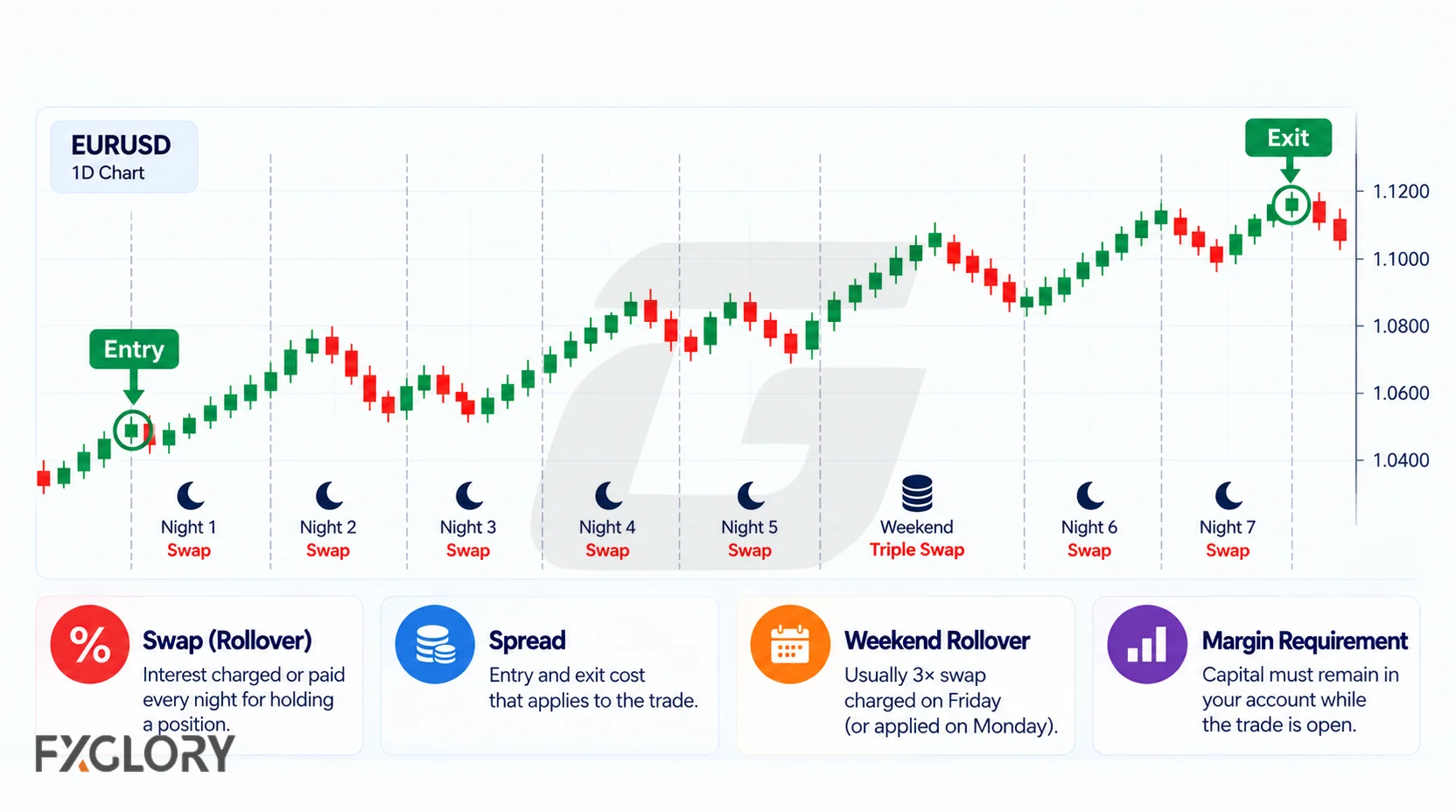
Swap should not be treated as a substitute for risk control. A favorable overnight credit can be overwhelmed by exchange-rate movement. An unfavorable swap charge can slowly damage a trade that already has weak price progress.
| Holding-Cost Item | Why It Matters | Planning Rule |
|---|---|---|
| Swap credit | May add to the account while the trade is open | Do not assume it protects against price loss |
| Swap charge | Can reduce the trade result over time | Estimate the effect before holding through many nights |
| Spread | Opening and closing costs still matter, especially in wider or less liquid pairs | Check costs before accepting a long-term entry |
| Weekend exposure | Price can reopen away from the prior close after weekend risk | Use a weekend review rule |
| Margin requirement | Long-held positions still consume margin while open | Review margin before holding through volatility |
For swap mechanics, review how overnight swap can become a credit or cost. For trade-size and margin review, use the margin calculator before deciding whether a wide-stop trade fits the account.
Entry And Exit Rules For Long-Term Trades
A long-term bias does not create an entry by itself. A trader can be correct about broad direction and still enter at a weak location, use too much size, hold through invalidation, or exit without a rule.
| Rule | Long-Term Use | Weak Version |
|---|---|---|
| Entry trigger | Break, retest, pullback, close beyond a level, or confirmed response at a zone | Entering only because the higher-timeframe chart looks interesting |
| Invalidation | A level, close, structure break, thesis change, or volatility condition that cancels the idea | Moving the invalidation point farther away after price moves against the trade |
| Target | Next major structure, measured range, swing zone, trailing rule, or staged management rule | Using an arbitrary target without checking higher-timeframe obstacles |
| Review schedule | Daily, weekly, or event-based review depending on the trade plan | Watching constantly and reacting to small candles |
| Exit rule | Exit when the technical or macro reason no longer supports the trade | Holding because the trade was originally meant to be long term |
For execution structure, use the entry and exit strategy guide.
Risk Rules For Long-Term Forex Trading
Long-term trading often uses wider stops than scalping or intraday trading. That does not mean the account should carry more risk. Position size should be adjusted after the stop distance is known.
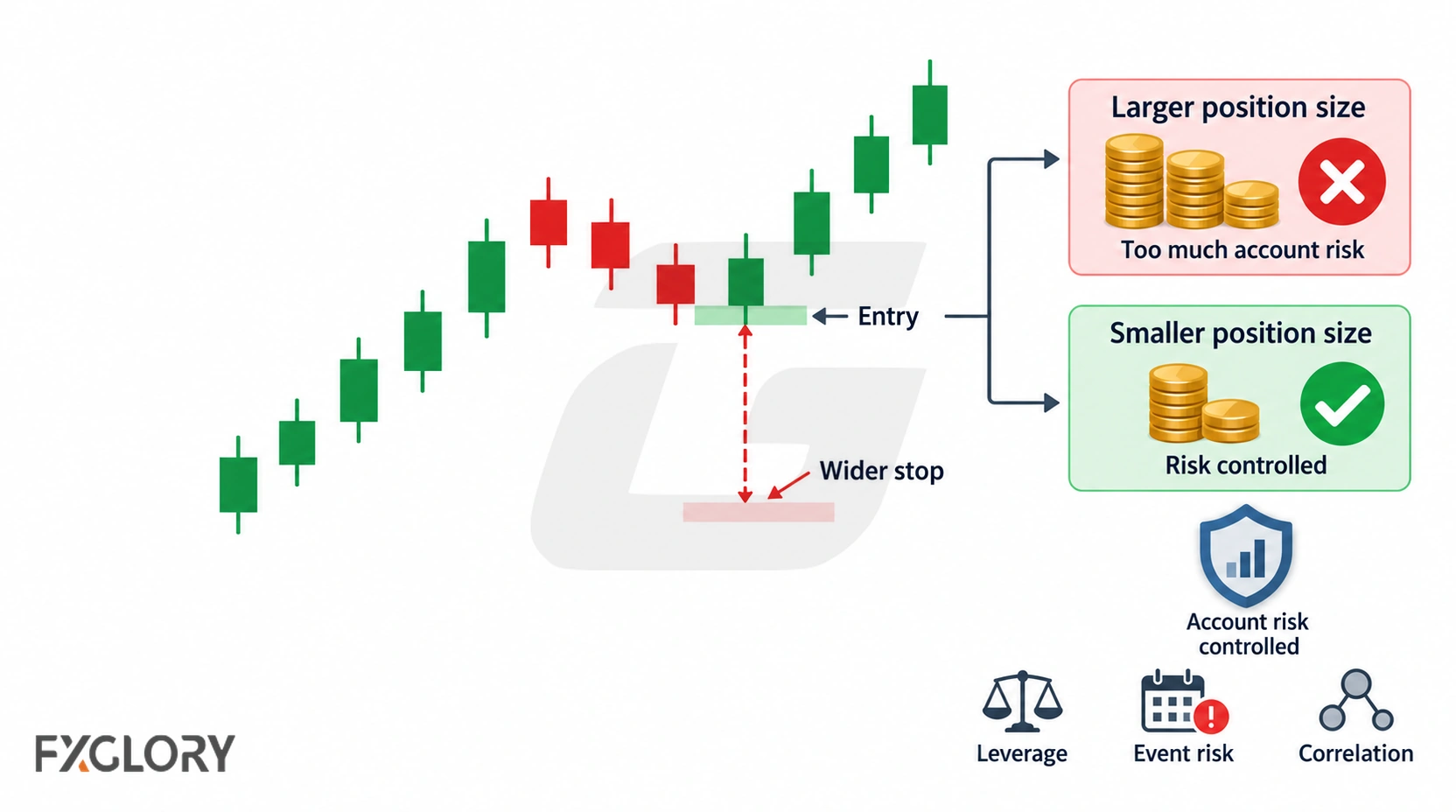
A trader should review leverage, available margin, maximum account risk, correlated exposure, and the effect of holding through news or weekends before treating a long-term idea as tradeable.
Fewer entries do not make this approach easier. A trader who cannot define stop distance, margin impact, swap effect, and review rules may face a larger problem on a slow chart because the mistake can stay open for longer.
| Risk Area | Long-Term Issue | Better Rule |
|---|---|---|
| Wider stop distance | Higher timeframes often need more room | Reduce position size instead of forcing a tighter stop |
| Leverage | A long-held leveraged trade can face large floating loss before the idea resolves | Review leverage exposure before entry |
| Margin pressure | Positions consume margin while open | Check margin before and during the trade |
| Drawdown | Long-term trades may move against the entry for a long period | Define maximum acceptable account impact before entry |
| Event risk | Central-bank decisions, inflation, employment, GDP, and political events can change the trade | Use an event review rule |
| Correlation | Several pairs can expose the account to the same currency or theme | Review total exposure, not only each single trade |
| Weekend gap risk | Price can reopen away from the previous close | Review whether the position should remain open into the weekend |
For account-level controls, use the forex risk management strategy guide. When leverage is part of the plan, review FXGlory's leverage conditions and check account exposure before opening a long-held position.
Review Schedule And Trade Maintenance
Long-term trading should have a review schedule. Constant chart watching can turn a higher-timeframe trade into emotional short-term management. Ignoring the trade completely can miss a change in conditions.
| Review Type | What To Check | Action If It Changes |
|---|---|---|
| Daily review | Price location, spread conditions, open risk, and upcoming events | Confirm whether the trade still fits the written plan |
| Weekly review | Higher-timeframe structure, trend quality, and major level behavior | Reassess whether the trade reason is still intact |
| Event review | Central-bank decisions, inflation, employment, GDP, and policy tone | Reduce, exit, or keep the position only if the rule allows it |
| Cost review | Swap, spread, and holding cost impact | Check whether cost is damaging the original plan |
| Risk review | Margin, drawdown, correlation, and account exposure | Stop adding risk if the account limit is reached |
Why Long-Term Forex Trades Fail
Long-term forex trades often fail when traders confuse patience with refusal to exit. A valid long-term trade can require time, but time alone does not improve a weak plan.
| Failure Reason | What Happens | Better Rule |
|---|---|---|
| Holding a losing trade and calling it long term | The trade has no valid thesis left | Define invalidation before entry |
| Overleveraging a wide stop | Normal higher-timeframe movement becomes account-threatening | Size the trade after stop distance is known |
| Ignoring swap | Holding costs reduce the result over time | Check swap before and during the position |
| Ignoring macro changes | Central-bank or economic conditions change while the trader keeps the old view | Use event-based reassessment |
| Entering too late in the move | The trade has little target room left | Check location and remaining room before entry |
| Exiting too early from noise | Small candles override the higher-timeframe plan | Use the planned review timeframe |
| Adding correlated positions | Several trades depend on one currency or risk theme | Review portfolio exposure before adding trades |
| No review schedule | The trade is either watched emotionally or ignored completely | Set daily, weekly, and event-based checks |
Forex Long-Term Trading Decision Sequence
A long-term forex trade should pass through the same decision order each time. If the trader starts with a preferred direction and then searches for reasons afterward, the plan becomes difficult to review.
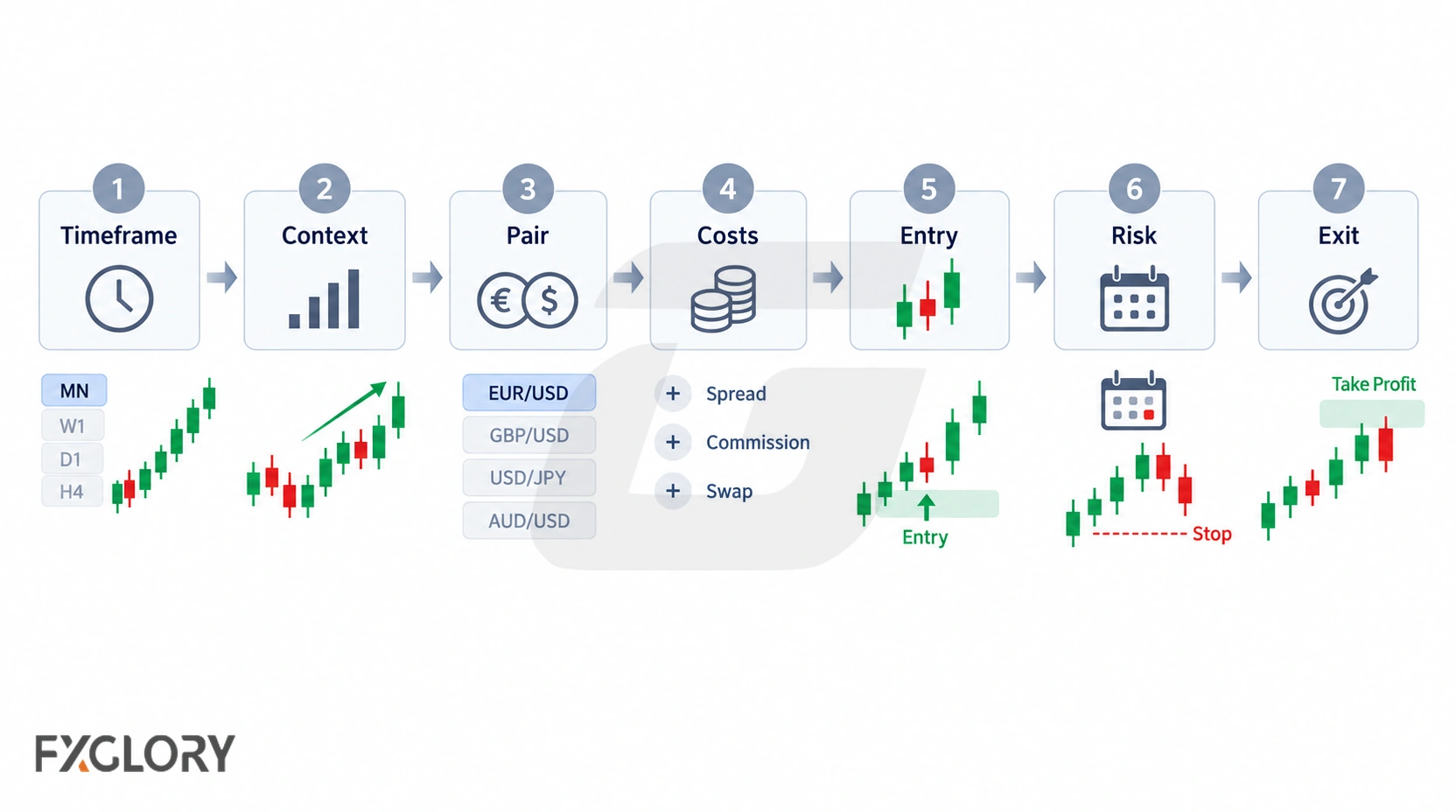
| Step | Decision | Continue Only If |
|---|---|---|
| 1. Timeframe role | Monthly, weekly, daily, and lower timeframe roles are defined | The trader knows which timeframe controls the idea |
| 2. Market condition | Trend, range, pullback, reversal, or unclear structure is identified | The condition supports a longer holding plan |
| 3. Pair reason | The currency driver and pair selection are explained | The pair matches the trade reason |
| 4. Cost check | Swap, spread, and holding cost are reviewed | The cost does not damage the plan |
| 5. Entry trigger | Entry is based on a written rule | The trader is not entering from impatience |
| 6. Invalidation | The level or condition that cancels the trade is known | The stop is not guessed after entry |
| 7. Position size | Size is chosen after stop distance and margin are reviewed | The trade fits account-level limits |
| 8. Event plan | Major news, central-bank events, and weekends are reviewed | The trader knows what requires reassessment |
| 9. Exit rule | Target, trail, time review, thesis break, or invalidation exit is defined | The trade is not open-ended |
| 10. Review log | The trade can be reviewed later against the original plan | The result is judged by process, not only the outcome |
No-Trade Conditions For Long-Term Forex Trading
A long-term setup should be skipped when the trade cannot be explained with clear structure, risk, cost, and review rules.
- Skip if the planned stop and minimum executable position size would exceed the account-risk limit or leave inadequate free margin.
- Skip if the trader cannot explain which timeframe controls the idea.
- Skip if swap or rollover costs damage the holding plan.
- Skip if margin would become stressed during normal volatility.
- Skip if the position duplicates existing exposure to the same currency or macro theme.
- Skip if a major event can change the trade and no event rule exists.
- Skip if the trade has no written invalidation point.
- Skip if the target is blocked by nearby higher-timeframe structure.
- Skip if a completed trade plan cannot specify how losses are bounded and how the idea will be reassessed.
Testing And Review Before Live Trading
A long-term forex trading plan should be reviewed on historical examples or demo conditions before being used with real funds. The goal is to test whether the trader can follow the same timeframe rules, entry rules, holding-cost checks, event reviews, risk limits, and exit rules repeatedly.
- Record the monthly, weekly, and daily context before entry.
- Record whether the setup was trend-following, pullback continuation, range transition, macro-bias, carry-aware, or level-based.
- Record the planned entry trigger, invalidation point, position size, and margin condition.
- Record expected holding period, swap effect, spread condition, and major event dates.
- Record maximum floating drawdown and whether it stayed within the plan.
- Record whether the trade was reviewed by schedule or managed emotionally.
- Record whether exit came from target, trail, invalidation, thesis change, time review, or risk limit.
- Compare trades that followed the plan with trades that became unplanned holds.
Forex Long-Term Trading Checklist
- Define whether the trade uses daily, weekly, or monthly context.
- Identify the market condition before deciding direction.
- Explain why this currency pair fits the long-term idea.
- Check whether the trade is trend, pullback, range transition, macro-bias, carry-aware, or level-based.
- Review support, resistance, and nearby higher-timeframe obstacles.
- Check swap, rollover, spread, margin, and leverage exposure.
- Write the entry trigger before entry.
- Define invalidation before entry.
- Choose position size only after stop distance is known.
- Review upcoming central-bank events, economic releases, and weekend exposure.
- Set a daily, weekly, or event-based review schedule.
- Write the exit rule before the position is opened.
- Reject the setup if it depends on hope, recovery, or an undefined holding period.