

What Is A Forex Swing Trading Strategy?
A forex swing trading strategy is a trading method that looks for planned entries and exits around a price swing. A swing trade may last longer than one session, often from several hours to several days or more, depending on the timeframe, setup, and exit rule.
Swing trading is not one specific setup. A swing trade can come from a trend, pullback, breakout, range, or reversal-style condition. The trading style describes the holding approach; the setup defines the reason for entry.
This page focuses on swing-specific decisions: how to use swing highs and lows, how to choose timeframe roles, how to connect setup type with entry and stop placement, and how to manage overnight, weekend, news, and account-condition risks.
Swing Trading vs Day Trading vs Position Trading
Swing trading sits between fast intraday trading and longer-term position trading. The difference is not only the chart timeframe; it also affects screen time, decision pressure, overnight exposure, trade frequency, and risk management.
| Trading Style | Typical Focus | Main Pressure | Main Risk To Review |
|---|---|---|---|
| Day trading | Trades opened and closed inside the same trading day | Fast decisions and frequent chart monitoring | Spread, speed, overtrading, and intraday volatility |
| Swing trading | Trades held across one or more sessions to capture part of a price swing | Patience, overnight exposure, and planned exits | News, gaps, account conditions, stop distance, and margin |
| Position trading | Longer-term trades based on broader market direction | Large stop distances and long holding periods | Macro shifts, account conditions, and extended drawdown |
Swing trading can reduce some screen-time pressure compared with very short-term trading, but it does not remove risk. Holding a trade through several sessions can add news, weekend, spread, margin, and account-condition considerations.
Who Forex Swing Trading May Fit
Forex swing trading may fit traders who prefer planned levels, slower decisions, and fewer trade decisions than very short-term trading. It may not fit traders who need fast feedback, panic during multi-session pullbacks, or cannot accept overnight and weekend exposure.
| May Fit Traders Who | May Not Fit Traders Who |
|---|---|
| Can wait for planned swing levels instead of reacting to every candle | Need constant action or fast results from every setup |
| Cannot monitor charts all day but can review trades at planned times | Become uncomfortable when a trade is open across sessions |
| Can accept wider stops when the structure requires them | Move stops because normal swing movement feels stressful |
| Can check news, margin, spread, and account conditions before holding | Ignore weekend, news, and account-condition risks |
| Can follow a written exit rule even when price moves slowly | Exit randomly from fear or keep holding because of hope |
Swing Trading vs Swing Trade
Swing trading is the style, a swing setup is a candidate trade idea, and a swing trade is a position actually opened from that plan. Distinguishing the three prevents every visible price move from becoming a trade.
| Item | What It Means | Why It Is Not Enough Alone |
|---|---|---|
| Swing trading | A style that looks for tradable portions of price swings over more than one session | The style does not define entry, stop, or exit by itself |
| Swing setup | The reason for the trade, such as trend, pullback, breakout, range, or reversal-style structure | The setup can still be late, unclear, or risky |
| Swing trade | An opened position based on defined timeframe context, setup, entry, stop, exit, holding-risk rules, and risk limit | Having a plan does not prevent a loss; price movement, execution, or account conditions may undermine the trade |
For the complete entry-and-exit chain behind a swing trade, use the entry and exit strategy guide. A swing entry should already have a stop, target or trailing method, time rule, and invalidation point.
Swing Highs And Swing Lows
Swing highs and swing lows are the practical structure points of swing trading. A swing high is an area where price moves up, pauses, and turns lower. A swing low is an area where price moves down, pauses, and turns higher.
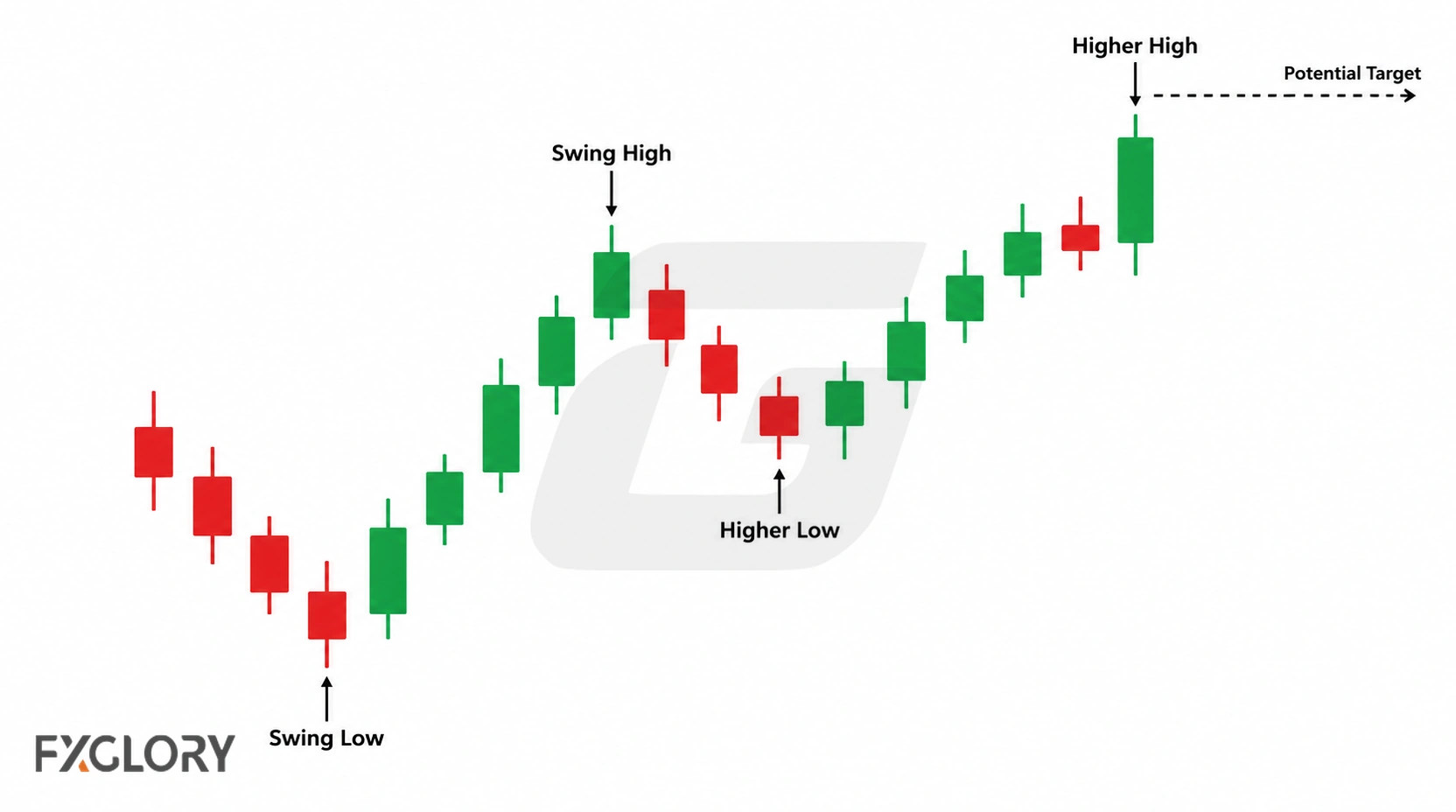
These levels help a trader define structure. A long swing setup may use a prior swing low as invalidation or a prior swing high as a target area. A short swing setup may use a prior swing high as invalidation or a prior swing low as a target area.
| Swing Structure | Useful Role | Weak Use |
|---|---|---|
| Swing high | Reviews resistance, target area, breakout point, or short-trade invalidation | Every recent high is treated as meaningful resistance |
| Swing low | Reviews support, target area, breakdown point, or long-trade invalidation | Every recent low is treated as meaningful support |
| Higher swing high | May support an uptrend or continuation context | One higher high is treated as a complete trend |
| Lower swing low | May support a downtrend or continuation context | One lower low is traded without setup confirmation |
| Failed swing level | May show structure weakness or breakout behavior | Trader ignores the failed level because the original idea looked strong |
How To Judge A Swing Level
A swing high or swing low should be useful before the trade is planned. If the level only becomes important after price has already reacted, the trader may be fitting the chart around the trade instead of trading a planned structure.
| Swing-Level Check | Better Version | Weak Version |
|---|---|---|
| Visible before entry | The swing high or low is marked before price reaches it | The level is chosen after the candle reacts |
| Meaningful timeframe | The level matters on the context timeframe, not only on a noisy entry chart | One small lower-timeframe wick becomes the whole trade reason |
| Not one random wick | The level has structure, reaction, or context behind it | A single spike is treated as major support or resistance |
| Room remains | There is space before the next swing obstacle or target area | Entry happens directly into nearby support or resistance |
| Stop distance fits | The stop beyond the swing level still fits account risk | The stop is too wide but the trade is forced anyway |
| Not buried in chop | The level is clear enough to define invalidation | The level sits inside messy consolidation with no clean stop |
| No redraw after price moves | The level remains consistent after entry | The level is adjusted to keep the trade alive |
Best Timeframes For Forex Swing Trading
There is no single best timeframe for every forex swing trading strategy. The timeframe should match the holding period, stop distance, target logic, spread sensitivity, news exposure, and account rules.
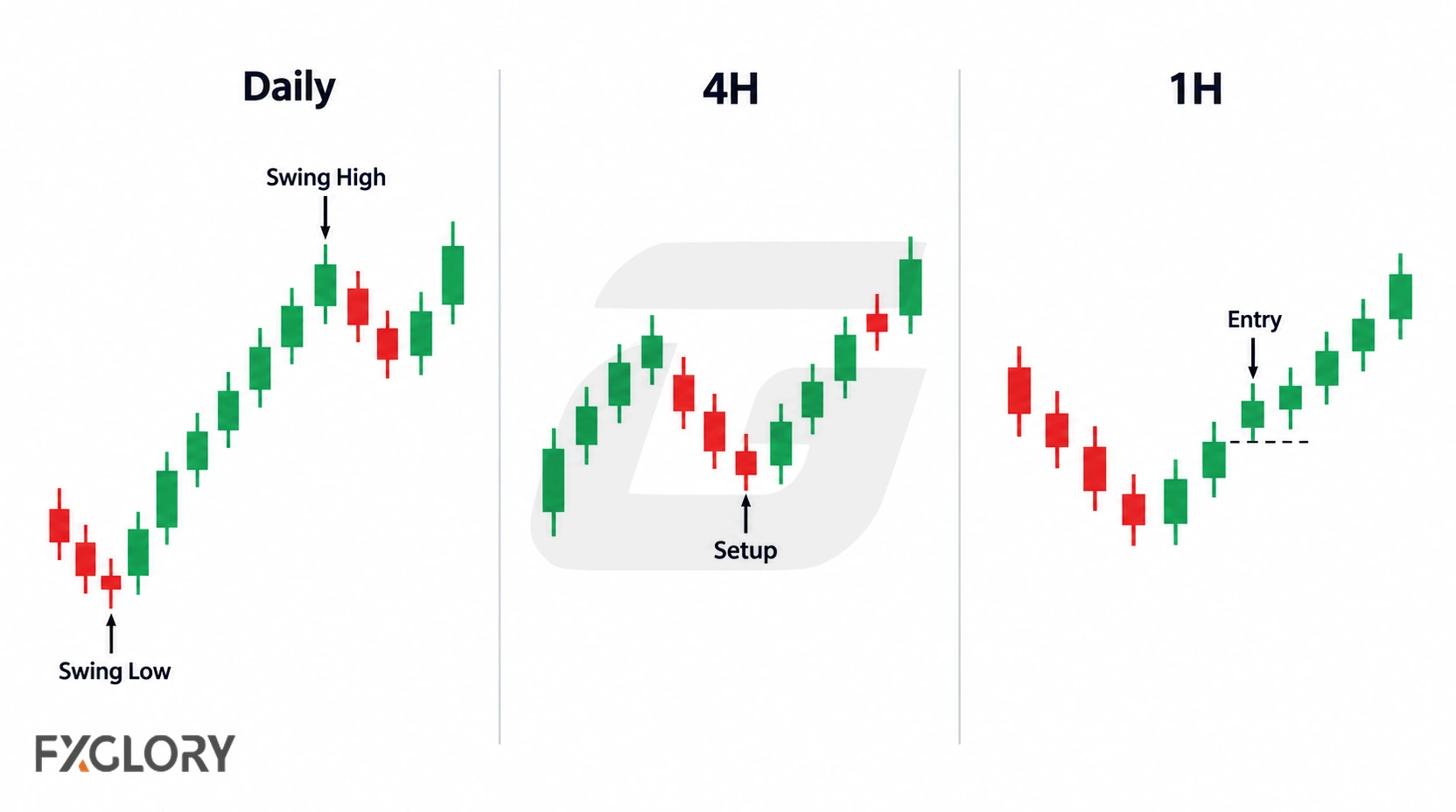
Many swing traders separate timeframe roles. A higher timeframe can help define market condition and major structure. A middle timeframe can help refine the setup. A lower timeframe can help with entry detail, but it should not override the wider swing idea.
| Timeframe Role | Possible Use | Weak Use |
|---|---|---|
| Daily chart | Reviews broader swing structure, major levels, and market condition | Entry is taken without checking stop distance or event risk |
| 4-hour chart | Reviews swing setup structure, pullbacks, ranges, and continuation areas | Every 4H candle becomes a trade idea |
| 1-hour chart | Reviews entry detail, reaction, or short-term confirmation | Lower-timeframe noise overrides higher-timeframe context |
| Lower intraday charts | May refine entries after the swing plan is already defined | The trade turns into scalping without a swing plan |
For a deeper framework on separating higher-timeframe context from lower-timeframe execution, use the multiple time frame analysis guide.
Forex Swing Trading Decision Sequence
A forex swing trading strategy should follow the same order each time. If the trader starts with a moving candle and chooses the setup type afterward, the trade cannot be reviewed clearly.
| Step | Decision | Continue Only If |
|---|---|---|
| 1. Market condition | The broader market is trending, ranging, transitioning between conditions, or unclear | The regime is defined independently of the entry setup |
| 2. Timeframe role | Higher timeframe gives context and lower timeframe gives entry detail | The roles are defined before entry |
| 3. Setup type | Trend, pullback, breakout, range, or reversal-style swing setup is chosen | The setup type is not invented after price moves |
| 4. Swing level | Swing high, swing low, support, resistance, or structure level is marked | The level is visible before entry |
| 5. Entry | Price confirms under a written trigger | The entry is not early, late, or forced |
| 6. Stop | The invalidation point is known before entry | The stop is based on structure or volatility |
| 7. Exit | The trade has a target, trailing rule, partial exit, time rule, or invalidation exit | The exit is planned before stress appears |
| 8. Holding risk | Overnight, weekend, news, spread, margin, and account-condition risk are checked | The trade can be held under the account rules |
Trend Swing Strategy
A trend swing strategy looks for a swing trade in the direction of a defined trend. The trader first decides whether the market is trending, then reviews whether the setup gives a clean entry and invalidation point.
For a deeper discussion of defining and trading directional trends, see the forex trend trading strategy guide. This section focuses on swing-specific entries, invalidation, and exits within a defined trend.
| Trend Swing Part | Better Version | Weak Version |
|---|---|---|
| Trend context | Higher highs and higher lows, or lower highs and lower lows, are visible before entry | One strong candle is treated as a swing trend |
| Entry area | Trade is planned near structure, pullback, retest, or continuation area | Entry happens after price is already extended |
| Stop | Stop is placed where the trend swing idea becomes invalid | Stop is placed where the loss feels comfortable |
| Exit | Exit uses swing target, trailing rule, time rule, or invalidation | Trader waits for the perfect top or bottom |
Pullback Swing Strategy
A pullback swing strategy waits for price to move against the trend into a planned area before considering entry in the trend direction. This can help avoid chasing a move after it has already traveled far from structure.
The key question is whether the pullback is still valid or whether it has become a reversal. For pullback quality, reversal warnings, and invalidation rules, use the forex pullback strategy guide.
| Pullback Swing Part | Better Version | Weak Version |
|---|---|---|
| Trend still valid | Pullback does not break the structure that supports the swing idea | Structure breaks but the trader still calls it a pullback |
| Pullback location | Price reaches support, resistance, moving average, trendline, channel, Fibonacci, or retest area | Entry happens in the middle of a correction |
| Confirmation | Price reacts in the planned direction before entry | Trader enters before the pullback shows reaction |
| Invalidation | Stop is placed where the pullback swing idea is wrong | Stop is widened after the pullback fails |
Breakout Swing Strategy
A breakout swing strategy looks for a trade when price breaks beyond a planned support, resistance, range, trendline, channel, or continuation pattern. The swing trader then reviews whether the breakout has enough structure and room to justify holding the trade beyond the immediate move.
For level quality, retest behavior, and false-breakout rules, use the forex breakout strategy guide.
| Breakout Swing Part | Better Version | Weak Version |
|---|---|---|
| Breakout level | Support, resistance, trendline, range, or pattern boundary is defined before the break | The level is drawn after the breakout candle appears |
| Breakout behavior | First identify the boundary break; use a completed-candle close, retest, or follow-through only when the predefined confirmation rule requires it | Every spike outside the level becomes a trade |
| Target room | There is enough room before the next swing obstacle | Entry happens directly into nearby support or resistance |
| Fakeout rule | Skip an unconfirmed entry or exit an open trade only when its predefined failure or invalidation condition occurs; a routine retest alone may not qualify | Trader keeps holding because the breakout almost worked |
A brief intrabar move back through a breakout level is not automatically the same as a completed-candle close inside the old structure. A retest and later follow-through are separate observations. Define in advance what confirms the breakout and what invalidates the trade.
Range Swing Strategy
A range swing strategy looks for planned swings between support and resistance while the market remains sideways. A trader may review long setups near support or short setups near resistance only if the range is valid and the target has enough room after spread.
For range quality, midpoint caution, indicators, and breakout-risk rules, use the forex range trading strategy guide.
| Range Swing Part | Better Version | Weak Version |
|---|---|---|
| Range boundaries | Support and resistance zones are visible before entry | Boundaries are forced after price reacts |
| Entry location | Trade begins near a range edge, not in the middle | Entry happens because the trader is impatient |
| Target | Target uses midpoint, opposite side, prior reaction, or time rule | Trader assumes price must travel the full range |
| Breakout risk | A range long is invalidated by the defined failure below support, while a range short is invalidated by failure above resistance; a move through the favorable edge follows the exit plan | Trader keeps fading a failed edge |
For example, a confirmed break below range support can invalidate a planned range long; a break above resistance may instead reach or exceed its target. Apply the opposite logic to range shorts, and define whether an intrabar break or completed close triggers the rule.
Reversal-Style Swing Strategy
A reversal-style swing strategy looks for a possible change in direction near a major swing high, swing low, support zone, resistance zone, failed breakout, or broken trend structure. This is not the same as guessing a top or bottom.
Reversal-style swing setups need stricter confirmation because the trade may be fighting the previous move. The trader should define what proves the old structure has weakened and where the reversal idea becomes invalid.
| Reversal-Swing Part | Better Version | Weak Version |
|---|---|---|
| Location | Setup forms near a meaningful swing high, swing low, support, resistance, or failed breakout area | Trader guesses a top or bottom because price looks extended |
| Structure change | Price shows a clear sign that the prior structure may be weakening | One opposite candle is treated as a full reversal |
| Confirmation | Entry waits for a predefined reversal signal, such as a completed close beyond local structure or a reaction followed by confirmation; invalidation remains a separate rule | Trader enters before the reversal idea is confirmed |
| Stop | Stop is placed where the reversal idea is wrong | Stop is widened because the old trend resumes |
| Cancel rule | Trade is skipped if the prior trend remains valid | Trader keeps fighting a trend because reversal was expected |
For entry and exit planning around reversal-style swing setups, use the entry and exit strategy guide. For account-level risk, use the forex risk-management strategy page.
Indicators For Forex Swing Trading
Indicators can help review swing conditions, but they should not replace market structure. A swing indicator should answer one question: direction, momentum, volatility, trend strength, pullback timing, range behavior, or exit management.
| Indicator | Swing Role | Weak Use |
|---|---|---|
| Moving averages | Review direction, slope, pullbacks, and dynamic structure | Every crossover becomes a swing trade |
| RSI | Reviews momentum, pullback timing, divergence, or overbought and oversold context | RSI is used without swing structure or invalidation |
| MACD | Reviews momentum shift, trend continuation, or weakening | MACD confirms after the entry is already late |
| Bollinger Bands | Reviews volatility, range behavior, squeeze, or expansion context | Every band touch is treated as a trade |
| ATR | Measures recent price-range volatility to help assess stop distance, target scenarios, and trailing logic; does not predict future range or direction | ATR is used to justify oversized risk |
| ADX | Measures trend strength regardless of direction; price structure or +DI/-DI may help assess direction separately | ADX is used as a standalone buy or sell signal |
| Stochastic | Reviews pullback timing or range timing in context | Every oscillator cross becomes a trade |
For moving-average-specific structure, use the moving average forex strategy guide. For volatility and stop-distance review, use the ATR forex strategy framework. For trend-strength confirmation, use the ADX forex trading strategy page.
Stop, Target, And Exit Rules
A swing trade should define stop, target, and exit logic before entry. Holding a trade longer does not give the trader permission to widen the stop after price moves against the plan.
| Rule Area | Possible Swing Rule | Weak Version |
|---|---|---|
| Swing low stop | Long trade stop is placed beyond the swing low or failed support area | Stop is placed too close inside normal swing noise |
| Swing high stop | Short trade stop is placed beyond the swing high or failed resistance area | Stop is widened after resistance breaks |
| Structure target | Target is planned near prior swing high, swing low, support, or resistance | Target is chosen without checking nearby obstacles |
| Measured or ATR target | Objective uses measured structure or ATR as historical volatility context, not a guaranteed future price range | ATR is used to justify an unrealistic target |
| Partial exit | Part of the trade is closed near a planned area and the rest is managed by rule | Partial exit is used randomly because the trader is nervous |
| Trailing exit | ATR trail, Chandelier-style exit, structure trail, or moving-average exit is used | Trailing rule is changed whenever price pulls back |
| Time rule | Trade is reviewed or closed if it does not develop within the planned window | A stalled swing trade becomes an unplanned hold |
| Invalidation exit | Exit when the swing reason disappears | Trader holds because the setup looked good earlier |
Hypothetical Swing Trade: Entry, Stop, Target, And Size
Suppose EUR/USD shows a broader uptrend, a four-hour pullback reaches planned support, and a one-hour close above a local reaction high is the written entry signal. For illustration only, assume a long entry filled at 1.1000, an invalidation stop at 1.0950 (50 pips below entry), and a target at 1.1100 (100 pips above entry) with no nearer obstacle. These prices are invented teaching inputs, not historical quotations or a backtest.
With a hypothetical USD 10,000 account and a planned risk limit of 1% (USD 100), 50 pips of stop distance permits approximately USD 2 per pip before costs. Under standard EUR/USD contract conventions, that is about 20,000 EUR or 0.20 standard lots; a 100-pip favorable move would produce USD 200 gross, or 2:1 planned reward to risk. Check the actual contract and account currency, spread, commission, swap, margin, and order rules separately. Gaps and slippage can make the realized loss larger than the planned USD 100, and a valid setup can still lose.
When swing management uses a volatility-based trail, review the ATR trailing stop forex strategy. For Chandelier-style swing exits, use the Chandelier Exit forex strategy.
Overnight, Weekend, News, And Account-Condition Risks
Swing trading often involves holding a position beyond one session. That creates risks that do not matter as much for trades closed quickly. A swing trader should review these risks before entry, not after the trade is already open.
Holding-risk checks include overnight price movement, weekend gaps, scheduled news, changing spreads, leverage exposure, margin requirements, and any instrument-specific account restrictions. Ordinary overnight financing may create overnight swap and rollover costs; swap-free eligibility, charges, and exceptions depend on the actual account and instrument terms. A stop level is a planned exit threshold, not a guaranteed execution price: gaps, thin liquidity, or fast markets may cause slippage and a larger realized loss. Verify the applicable order and account conditions before holding.
Before holding a swing trade across sessions, review FXGlory trading account conditions for account rules, margin call, stop-out, leverage, execution, and swap-free/account-condition details.
| Holding Risk | Why It Matters | Pre-Trade Rule |
|---|---|---|
| Overnight risk | Price may move while the trader is absent, and rollover can affect cost | Check planned stop, size, financing, and applicable account terms |
| Weekend risk | Gaps and fast reopening conditions may produce stop execution away from the specified level | Decide before entry whether to hold and account for slippage risk |
| News-event risk | Data releases can change spread, speed, and volatility | Check the event calendar and define hold-or-close rules |
| Account conditions | Account rules and instrument conditions may affect multi-session trades | Check account and instrument conditions before holding |
| Margin pressure | Longer holding periods can expose the account to wider movement | Review margin and leverage exposure before sizing |
| Emotional pressure | Multi-session trades can tempt early exits or stop widening | Use written exit and invalidation rules |
Short-term swing entries still need cost awareness. Check the spread conditions that affect trade planning before accepting a small target. When stop distance, position size, leverage exposure, and margin need to be reviewed together, use the margin calculator before the order is placed.
Why Forex Swing Trading Strategies Fail
Review completed and skipped trades to distinguish a weak setup from poor execution of a reasonable plan. This section diagnoses what went wrong after the decision; the next section lists conditions for rejecting a new trade before entry.
| Failure Pattern | Evidence To Review | Lesson For The Next Test |
|---|---|---|
| Setup type was unclear | Journal describes a trade but cannot identify the setup or its expected market conditions | Record setup category and eligible regime before measuring outcomes |
| Entry was late | Entry-to-target room was already small relative to the stop at the actual fill | Compare planned entry location with the execution price and skipped alternatives |
| Timeframes conflicted | A lower-timeframe entry opposed mapped higher-timeframe swing structure | Review whether context and entry roles were followed consistently |
| Invalidation was undefined | Stop was moved after entry or no objective failure point was documented | Separate structural failure from the size of loss the account can accept |
| Holding event was overlooked | News, rollover, or weekend exposure occurred outside the written plan | Compare event calendar and holding decisions against the original rules |
| Exposure was excessive | Realized or marked-to-market account loss exceeded the intended risk tolerance | Recalculate stop-distance sizing, costs, margin, and correlated positions |
| Indicator rules changed | Signals or indicator settings were added or changed after a losing trade | Keep a stable test specification and log each deliberate revision |
| Exit was discretionary | The recorded exit does not match the target, trail, time, or invalidation rule | Measure rule-following trades separately from rule deviations |
Risk Rules And No-Trade Conditions
Swing trades can feel calmer than fast intraday trades, but the slower pace can hide larger stop distances, longer exposure, and stronger emotional pressure. A swing setup should be rejected when the trade cannot be sized, held, or exited under written rules.
| No-Trade Condition | Why It Matters | Action |
|---|---|---|
| Market condition is unclear | The trader may be forcing a swing setup without structure | Skip until the market regime and proposed setup are independently clear |
| Setup type is not defined | The trade cannot be reviewed honestly | Choose the setup type before entry or skip |
| Entry is late | The target may be too close and the stop too wide | Wait for a new setup |
| Stop is too wide for the account | Position size may become unsuitable | Resize, wait, or skip |
| Holding risk is unacceptable | News, weekend, or overnight exposure may not fit the plan | Close before the event or avoid entry |
| Account conditions are not checked | Multi-session trades may be affected by account or instrument rules | Check account and instrument conditions first |
| Margin pressure is too high | Normal swing movement can pressure the account | Reduce exposure or skip |
| Correlated exposure builds | Several swing trades may create the same currency risk | Reduce or avoid overlapping exposure |
| Daily or weekly stop reached | More swing attempts can become recovery trades | Stop trading under the risk plan |
| Recovery motive appears | The trade exists because the trader wants to recover a prior loss | Step away and review the plan |
For account-level risk rules, use the forex risk-management strategy page. For charting, indicator layout, stop workflow, and trade management tools, review FXGlory trading platforms.
Testing And Review Before Live Trading
A forex swing trading strategy should be reviewed on historical examples or demo conditions before it is used with real funds. The purpose is not to find perfect swing trades. The purpose is to check whether the same market-condition rules, setup types, timeframe roles, stop rules, exit methods, and holding-risk checks can be followed repeatedly.
Record both taken and skipped trades. Skipped trades matter because many swing-trading mistakes come from late entries, unclear setup types, ignored event risk, oversized positions, and trades held after the original reason disappeared. Define the entry, confirmation, invalidation, and exit rules before examining outcomes to avoid choosing rules with hindsight.
- Record the broader market regime (trend, range, transition, or unclear) separately from the chosen pullback, breakout, range, trend, or reversal-style setup.
- Record the timeframe used for context and the timeframe used for entry.
- Record the setup type: trend, pullback, breakout, range, or reversal-style structure.
- Record the swing high, swing low, support, resistance, or structure level used in the plan.
- Record whether the stop and exit method were known before entry.
- Record whether spread, margin, account conditions, news risk, and position size were checked before entry.
- Record whether the trade exited by target, trail, partial exit, time rule, or invalidation.
- Compare trades that followed the plan with trades that broke it.
Evaluate a sufficiently varied sample across instruments, directions, market regimes, and holding periods. Calculate net results after realistic spread, commission, slippage, and overnight financing where relevant; examine win rate together with average win, average loss, expectancy, maximum drawdown, and risk per trade. Record assumptions and sample size rather than presenting a single successful chart as evidence of a durable edge.
Keep an untouched historical period for out-of-sample checks and then use demo or forward observation with the same written rules. Backtested results cannot guarantee live fills or future performance, especially around news, gaps, or changing account conditions.
Forex Swing Trading Checklist
Before a swing setup becomes a trade, each item below should already be clear.
- Define whether the broader market is trending, ranging, transitioning, or unclear; classify the proposed setup separately.
- Separate higher-timeframe context from lower-timeframe entry detail.
- Choose the setup type before entry.
- Mark the swing high, swing low, support, resistance, or structure level before price reaches it.
- Wait for written entry confirmation.
- Define the invalidation point before entry.
- Choose position size only after stop distance is known.
- Choose the exit method before entry: target, partial exit, trailing stop, time rule, or invalidation.
- Check overnight, weekend, news, account conditions, spread, margin, and leverage exposure.
- Skip the trade if the setup is late, unclear, oversized, or too exposed to holding risk.
- Stop trading when the daily or weekly loss, drawdown, or trade-count rule is reached.
- Review whether the trade followed the plan, not only whether it made or lost money.