
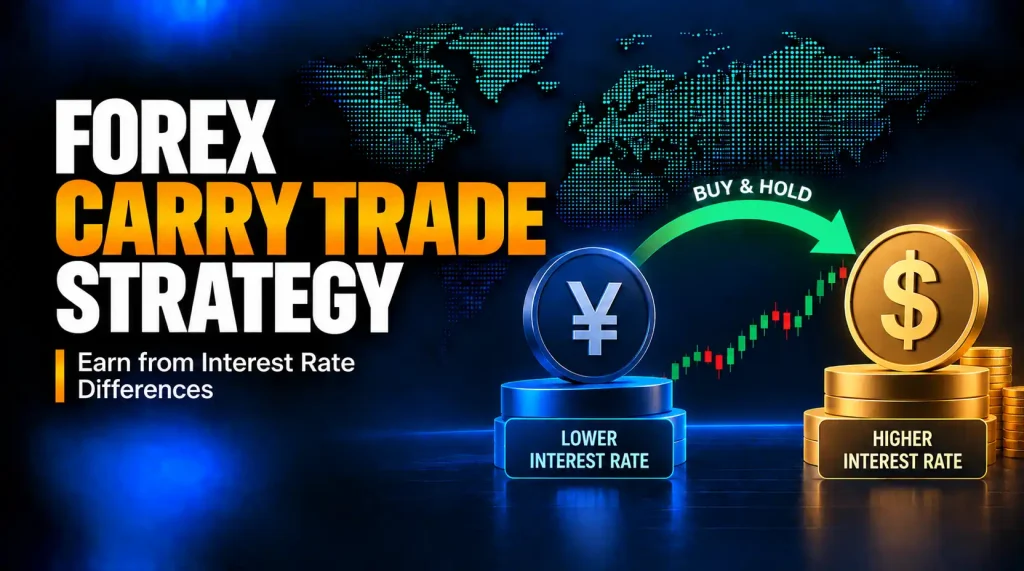
What Is Carry Trade In Forex?
A carry trade in forex is a strategy idea built around the interest-rate difference between two currencies. A trader usually looks to hold the higher-yielding currency while selling or funding the position with the lower-yielding currency.
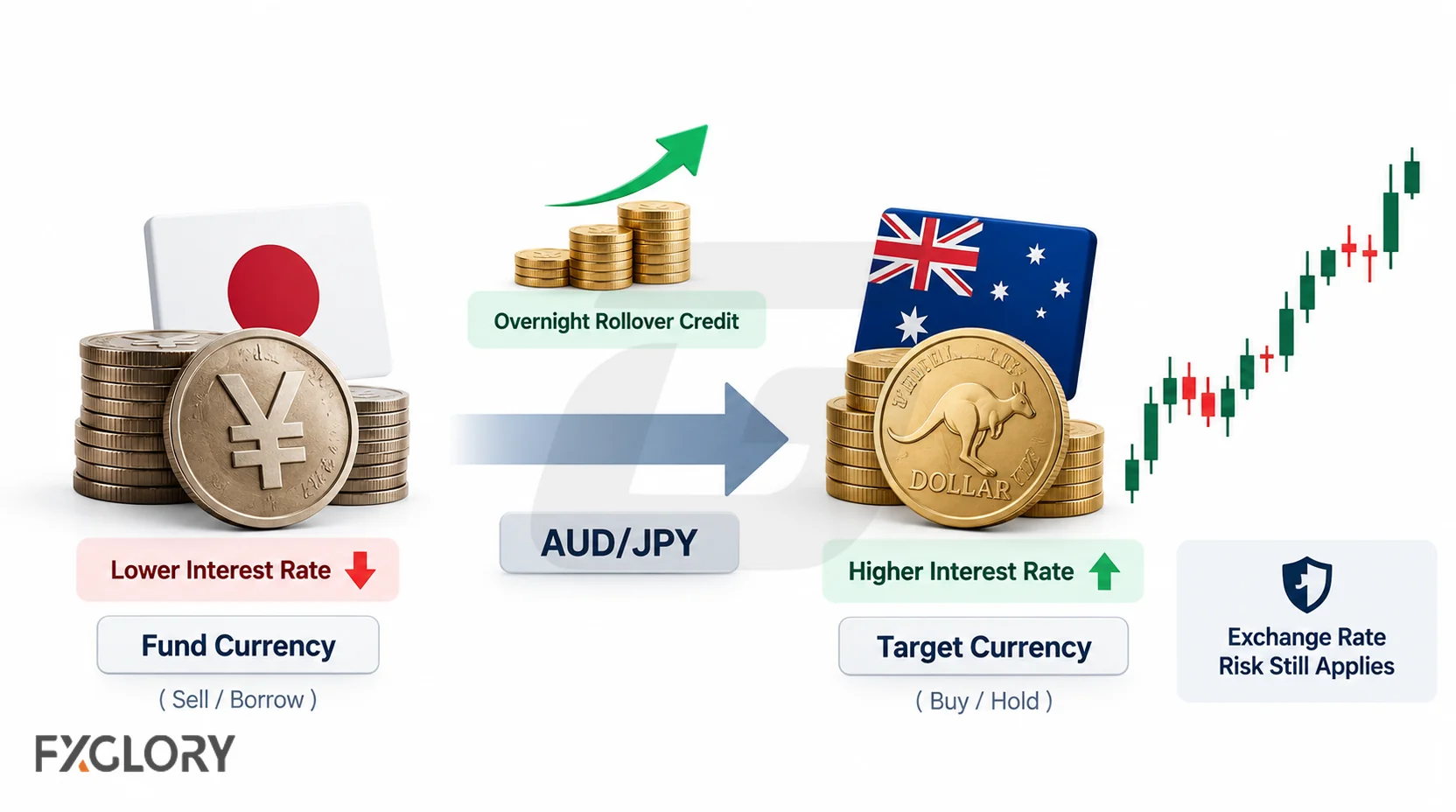
The carry part comes from the overnight interest-rate adjustment that can be credited or charged when a forex position is held after the rollover time. In retail forex, this is usually seen as swap or rollover on the trading account, not as a trader physically borrowing one currency from a bank and depositing another.
A carry trade is not only an interest-rate idea. It is still a currency position. If the exchange rate moves against the position, the price loss can be larger than the carry received. If swap conditions change, a trade that looked positive earlier may become less attractive or even costly to hold.
How Forex Carry Trades Work
A forex pair always contains two currencies. When a trader buys one side of the pair, the trader is also selling the other side. The carry trade reviews whether that position direction creates a favorable overnight interest-rate relationship.
In a basic carry-trade idea, the trader wants exposure to the higher-yielding currency and uses the lower-yielding currency as the funding side. The position is then held long enough for rollover to matter. This makes carry trading different from short-term entries that may be opened and closed before overnight costs apply.
| Carry Trade Component | What It Means | What Must Still Be Checked |
|---|---|---|
| Interest-rate differential | The gap between the two currencies' rate environments. | Whether the expected differential still exists and whether it is already priced into the market. |
| Swap or rollover | The account adjustment for holding a position overnight. | Whether the position direction receives a credit or pays a charge under current conditions. |
| Exchange-rate movement | The change in the currency pair price while the trade is open. | Whether price movement can offset or overwhelm the carry. |
| Holding period | The time the trader expects the position to stay open. | Whether the account can tolerate normal movement during that time. |
| Leverage and margin | The exposure and required account support for the position. | Whether a normal adverse move creates account-level pressure. |
For the overnight-fee mechanics behind this strategy, review how swap and rollover work before a position stays open past the broker's cutoff time.
Because carry trades usually depend on holding time, the trader should review costs and margin before the position is placed. Before a planned carry position is held overnight, check the spread cost that can reduce small carry, leverage conditions for held exposure, and margin requirements for the planned position size.
Retail Rollover Mechanics
Retail traders usually do not arrange a separate bank loan in one currency and a separate deposit in another currency. On a trading platform, the trader opens a long or short position in a currency pair. If the position remains open past the broker's rollover time, the platform may apply a swap or rollover adjustment.
This is why carry-trade review must use the actual platform conditions for the exact symbol and direction. A central-bank rate difference can suggest a carry idea, but the account result depends on swap long, swap short, position size, account currency, number of charged nights, triple-rollover treatment, and any broker-specific calculation rules.
| Retail Mechanic | What The Trader Sees | What Can Go Wrong |
|---|---|---|
| Pair position | The platform shows a long or short trade on one currency pair. | The trader may hold the wrong side of the pair for the intended carry. |
| Overnight rollover | The account may receive a credit or pay a charge after the rollover cutoff. | The rollover value can be smaller than expected or change during the holding period. |
| Triple rollover | One selected rollover can apply multiple days of swap to account for settlement timing. | A small holding decision can become more costly if the trader ignores the charged day. |
| Platform swap field | The symbol specification may show swap long and swap short values. | The unit, account conversion, and update timing can be misunderstood. |
| Price movement | Floating profit or loss changes while swap is applied separately. | Price loss can exceed accumulated swap credits. |
Funding Currency And Target Currency
Carry trade explanations often use two terms: funding currency and target currency. These terms help describe the logic of the position.
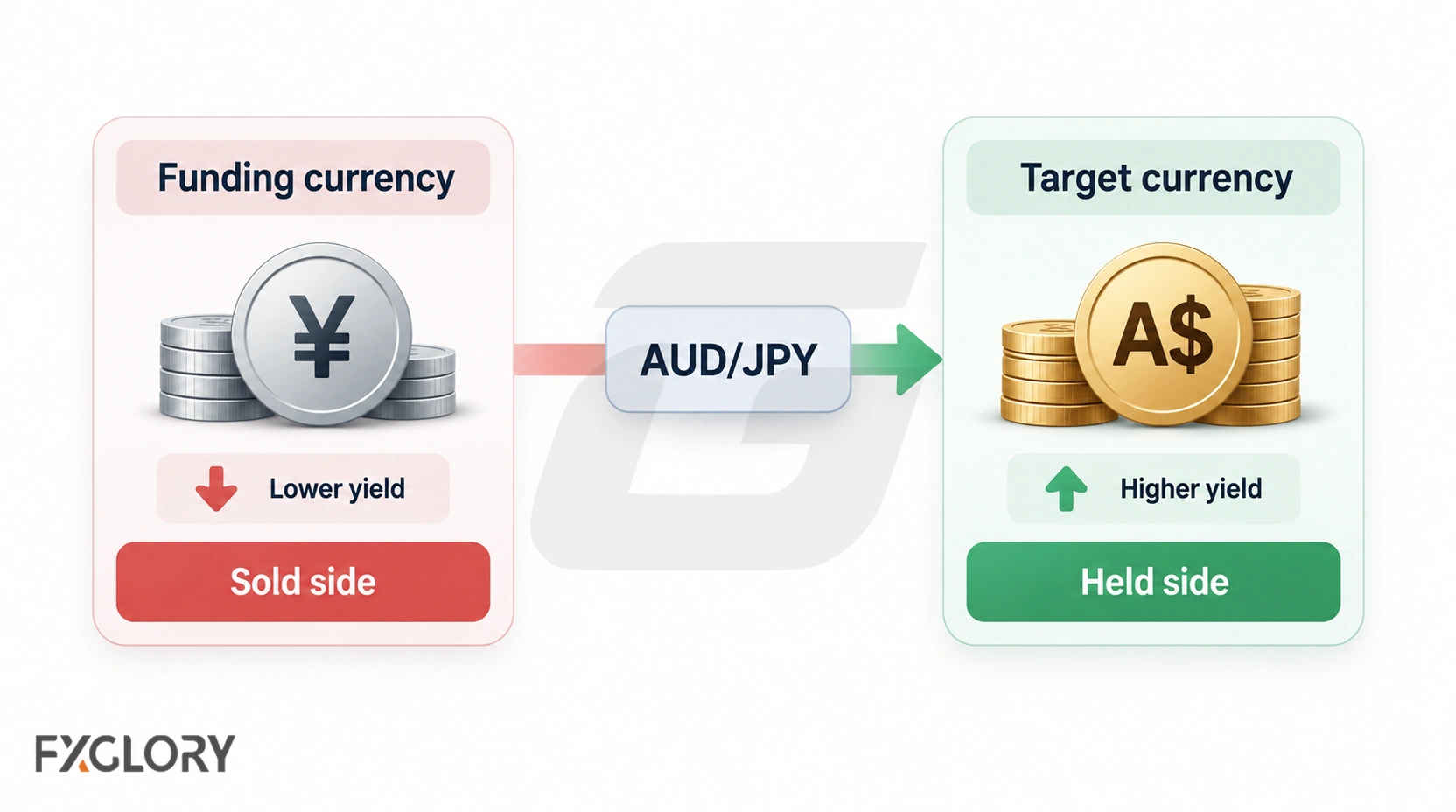
The funding currency is usually the lower-yielding currency. It is the side used to fund the trade. The target currency is usually the higher-yielding currency. It is the side the trader wants to hold for potential positive carry.
| Term | Meaning | Carry Trade Question |
|---|---|---|
| Funding currency | The lower-yielding currency on the sold or borrowed side of the idea. | Is this currency likely to stay lower-yielding during the planned holding period? |
| Target currency | The higher-yielding currency the trader wants to hold. | Is the higher yield enough to justify the exchange-rate, volatility, and margin risk? |
| Rate differential | The gap between the two currency rate environments. | Is the gap stable, widening, narrowing, or at risk of changing? |
| Carry direction | The position direction that may create positive rollover. | Does the actual long or short position match the intended carry side? |
Why Pair Direction Matters
Pair direction is one of the easiest places to make a carry-trade mistake. In forex, buying a pair means buying the base currency and selling the quote currency. Selling a pair means selling the base currency and buying the quote currency.
For example, if a pair is written as AAA/BBB, a long position buys AAA and sells BBB. A short position sells AAA and buys BBB. The carry result depends on which side has the higher yield and how the broker applies swap or rollover for that exact pair and direction.
| Position Direction | Currency Exposure | Carry Review |
|---|---|---|
| Long AAA/BBB | Buys AAA and sells BBB. | Review whether holding AAA against BBB creates positive or negative rollover. |
| Short AAA/BBB | Sells AAA and buys BBB. | Review whether holding BBB against AAA creates positive or negative rollover. |
| Wrong direction | The trader holds the lower-yielding side unintentionally. | The position may pay carry instead of receiving it. |
| Correct direction but weak price structure | The carry side is positive, but price moves against the position. | Swap credit may not cover exchange-rate losses. |
Before using a pair as an example, review the available FXGlory currency-pair pages for chart context and treat live price information as chart context, not as a reason to open a position by itself.
Positive Carry, Negative Carry, And Rollover
Positive carry means the position may receive a net overnight credit. Negative carry means the position may pay a net overnight charge. Both can change depending on rates, broker conditions, market conditions, and the position direction.
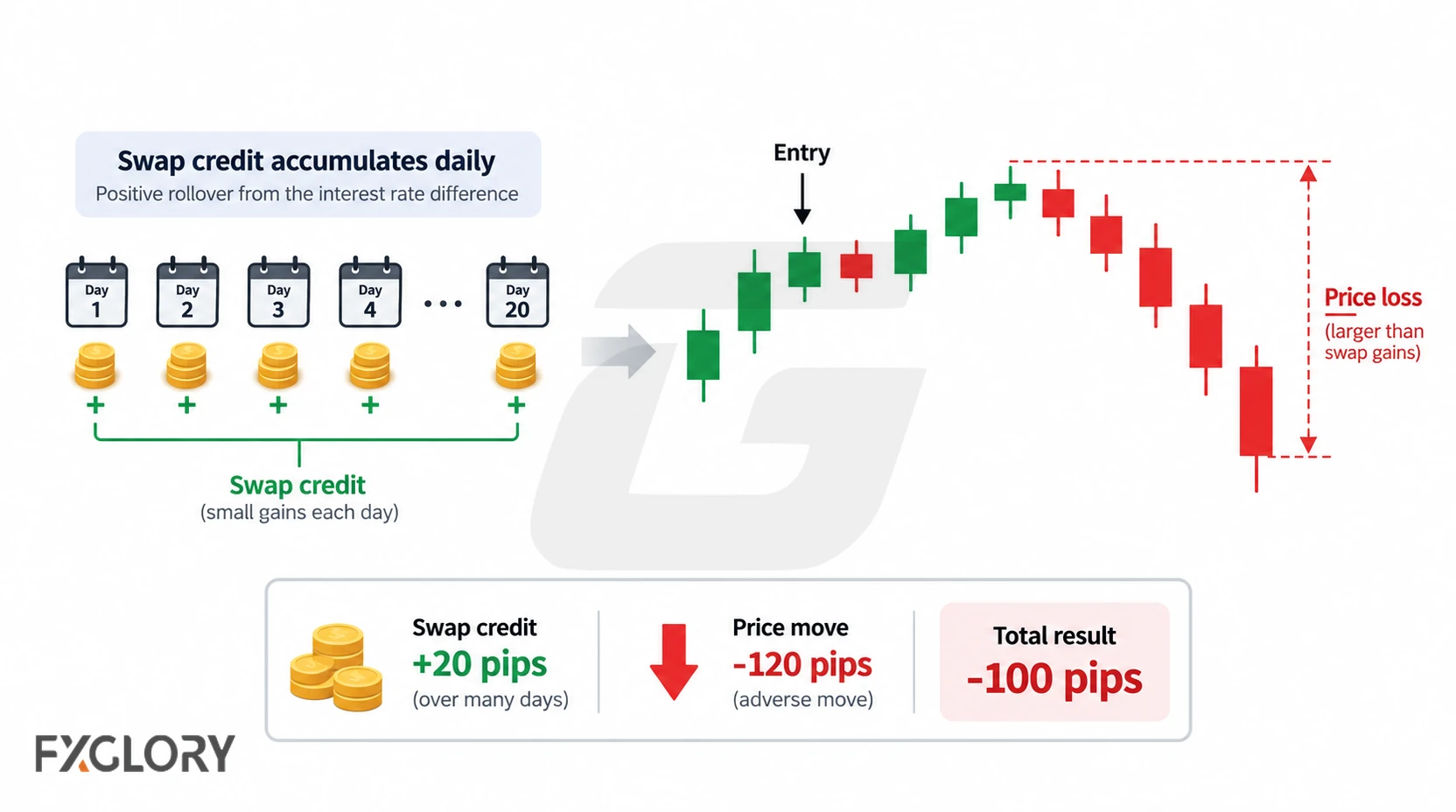
Positive carry is often the reason traders study carry trades, but it should not be treated as free income. The currency pair can move against the position, and a single adverse price movement can offset many days or weeks of overnight credits.
| Carry Type | What It Means | Important Caution |
|---|---|---|
| Positive carry | The position may receive a rollover credit when held overnight. | The credit does not protect the trade from price losses or margin pressure. |
| Negative carry | The position may pay a rollover charge when held overnight. | The charge can reduce the result even if price moves favorably. |
| Changing carry | The credit or charge changes as rates or broker conditions change. | A trade should be reviewed again if the carry reason weakens. |
| Triple rollover effect | Some markets apply multi-day rollover on a selected weekday. | The exact timing and treatment should be checked under current trading conditions. |
When trading conditions, position size, leverage, and margin need to be reviewed together, use account conditions that may affect held positions and account-level risk rules before the position is held overnight.
Carry Result vs Swap Credit
The swap credit is only one part of a carry trade result. The account result also depends on the currency pair's price movement, spread, possible slippage, holding time, margin pressure, and the exit price. A position can receive positive swap and still close at a loss.
| Result Component | How It Affects The Trade | Review Rule |
|---|---|---|
| Price movement | The pair can move for or against the position while the trade is open. | Do not let a small overnight credit replace price invalidation. |
| Swap credit or charge | Rollover can add to or subtract from the account result. | Check the actual long or short swap before holding overnight. |
| Spread and costs | Costs can reduce the value of small expected carry. | Compare expected carry with realistic trading costs. |
| Holding period | Carry matters more when the trade remains open long enough for rollover to accumulate. | Use a review schedule instead of holding blindly. |
| Margin pressure | Adverse movement can force a decision before carry has time to matter. | Size the position from drawdown tolerance, not from desired daily credit. |
Carry Trade Forex Example
The example below is hypothetical. It is designed to show the decision logic, not current market rates or a trade recommendation.
Suppose Currency A has a higher interest-rate environment than Currency B. A trader reviews a pair where buying Currency A and selling Currency B may create positive carry. The trader then checks whether the pair direction, swap condition, spread, margin, volatility, and chart context support holding that exposure.
| Example Step | Trader Review | Risk Question |
|---|---|---|
| Rate check | Currency A appears higher-yielding than Currency B. | Is the rate gap stable or likely to change? |
| Pair direction | The trader checks whether the planned long or short position actually holds Currency A. | Does the trade direction match the carry idea? |
| Swap check | The trader reviews whether rollover is positive after broker conditions. | Does the expected credit still matter after costs? |
| Chart check | The trader reviews whether price structure supports the planned direction. | Is the trade being held only for carry while price is moving against it? |
| Margin check | The trader reviews position size and possible drawdown. | Can the account tolerate normal movement without forced decisions? |
| Exit check | The trader defines the condition that cancels the carry idea. | Will the trade be closed if the original reason disappears? |
What Makes A Pair Suitable For Carry Trading?
A carry candidate needs more than a visible rate difference. The pair should be reviewed for the interest-rate relationship, swap after costs, trend or range behavior, liquidity, volatility, account margin, and the trader's planned holding period.
| Suitability Factor | Better Condition | Weak Condition |
|---|---|---|
| Rate differential | The higher-yielding side is clear and expected to remain supportive. | The rate gap is narrowing or uncertain. |
| Swap after costs | The rollover condition still matters after spread and holding costs. | The credit is too small or the position pays carry. |
| Trend or price structure | Price action does not strongly fight the carry direction. | The pair is trending against the carry side. |
| Volatility | Movement is stable enough for the planned holding period. | Large swings can erase carry and pressure margin. |
| Liquidity and spread | The pair can be traded with costs that fit the plan. | Wide or unstable spreads weaken the expected edge. |
| Central-bank outlook | Policy expectations support the rate difference. | A rate cut, rate hike, or guidance change may damage the idea. |
| Account fit | Position size remains controlled after stop, margin, and drawdown review. | The trade only works with excessive leverage. |
Carry trading often overlaps with broader fundamental thinking, but the carry idea still needs a trade plan. Use the trading-system framework for rule consistency instead of holding a position only because the rate difference looks attractive.
When Carry Trades Work Better Or Worse
Carry trades tend to be easier to review when market conditions are stable, volatility is controlled, and the interest-rate difference is supported by central-bank expectations. They become harder to manage when volatility rises, risk appetite changes, or markets begin to price a policy shift.
| Market Condition | Carry Trade Impact | Better Response |
|---|---|---|
| Low or stable volatility | Price movement may be easier to hold through. | Still define invalidation and margin limits. |
| Clear rate divergence | The carry reason may be easier to identify. | Check whether the market has already priced it in. |
| Supportive price trend | Carry and price direction may work together. | Use structure instead of assuming trend will continue. |
| Risk-off movement | High-yielding currencies may weaken as traders reduce risk. | Reduce or avoid exposure if the original reason is damaged. |
| Central-bank event | Rate expectations and volatility can change quickly. | Use a written event-risk rule or stand aside. |
| Crowded carry positioning | Many traders may exit at the same time if conditions change. | Do not treat carry as stable just because it worked recently. |
When To Reassess Or Exit A Carry Trade
A carry trade can weaken before the position reaches its planned end. The trader should know which changes require review, reduction, or exit before the position is opened. This keeps the trade from becoming a passive hold based only on expected overnight credit.
| Reassessment Trigger | Why It Matters | Possible Response |
|---|---|---|
| Swap value changes | The expected carry may shrink, disappear, or become a charge. | Review whether the original reason still exists. |
| Central-bank guidance changes | Future rate expectations can matter before the actual rate changes. | Reduce exposure or wait for post-event conditions to settle. |
| Price breaks the invalidation area | The exchange-rate side of the trade may now fight the carry idea. | Follow the written exit or reduction rule. |
| Volatility expands sharply | Spread, slippage, and margin pressure can rise. | Do not add exposure only because rollover is positive. |
| Correlation or crowding risk rises | Several positions may share the same funding-currency or risk-on exposure. | Review total account exposure, not only one pair. |
| Holding reason changes | The trader is holding to recover losses rather than because the carry plan remains valid. | Close, reduce, or pause according to the risk plan. |
Carry Trade With Trend And Entry Context
A carry bias is not the same as an entry signal. The interest-rate difference may explain why a trader is interested in a pair, but it does not decide the entry price, invalidation point, holding plan, or exit rule.
Many carry-trade reviews use higher-timeframe context for the rate and trend idea, then a lower or trading timeframe for execution. This separation can help prevent a trader from entering only because the swap looks positive.
| Planning Layer | What It Answers | Useful FXGlory Resource |
|---|---|---|
| Carry bias | Does the interest-rate relationship support one side? | Use this page as the carry framework. |
| Trend context | Is price structure supporting or fighting the carry direction? | Review trend structure before holding exposure. |
| Timeframe alignment | Does the higher-timeframe idea match the execution timeframe? | Separate higher-timeframe context from entry timing. |
| Entry and exit | Where does the position start, fail, or get closed? | Define entry, exit, and cancellation rules. |
| Setup quality | Is there a complete trade setup, or only a macro idea? | Separate interest-rate bias from a complete setup. |
Keeping those layers separate prevents a carry idea from becoming a vague reason to hold any long-running position. The carry rule explains the interest-rate and rollover reason; trend, entry, exit, and risk rules still need their own review before the position is opened.
Why Forex Carry Trades Lose Money
Carry trades often fail because the trader focuses on the credit and underestimates the open currency risk. A trade can receive positive carry and still lose money if the pair moves against the position.
| Failure Reason | What Happens | Better Rule |
|---|---|---|
| Exchange-rate reversal | Price moves against the carry direction. | Define invalidation before the position is opened. |
| Rate expectation changes | The market starts pricing cuts, hikes, or policy changes. | Review the carry reason after central-bank updates. |
| Swap condition changes | The expected credit is reduced or turns into a charge. | Recheck rollover conditions during the holding period. |
| Leverage is too high | Normal price movement creates large account pressure. | Size the trade from risk and margin, not from desired carry. |
| Spread and costs ignored | Small expected carry is weakened by trading costs. | Check costs before assuming the carry is meaningful. |
| Event risk ignored | News or policy events create fast repricing. | Use a written event-risk rule. |
| No exit rule | The trader keeps holding because the trade earns or once earned carry. | Close or reduce when the original carry plan is invalidated. |
For account-level rules around drawdown, position size, leverage exposure, and stopping conditions, use account-level risk rules before the carry idea is treated as tradable.
Carry Trade Unwind Risk
A carry trade unwind happens when traders who were holding similar carry positions start closing them. This can happen when risk appetite changes, volatility rises, central-bank expectations shift, or the high-yielding side starts falling.
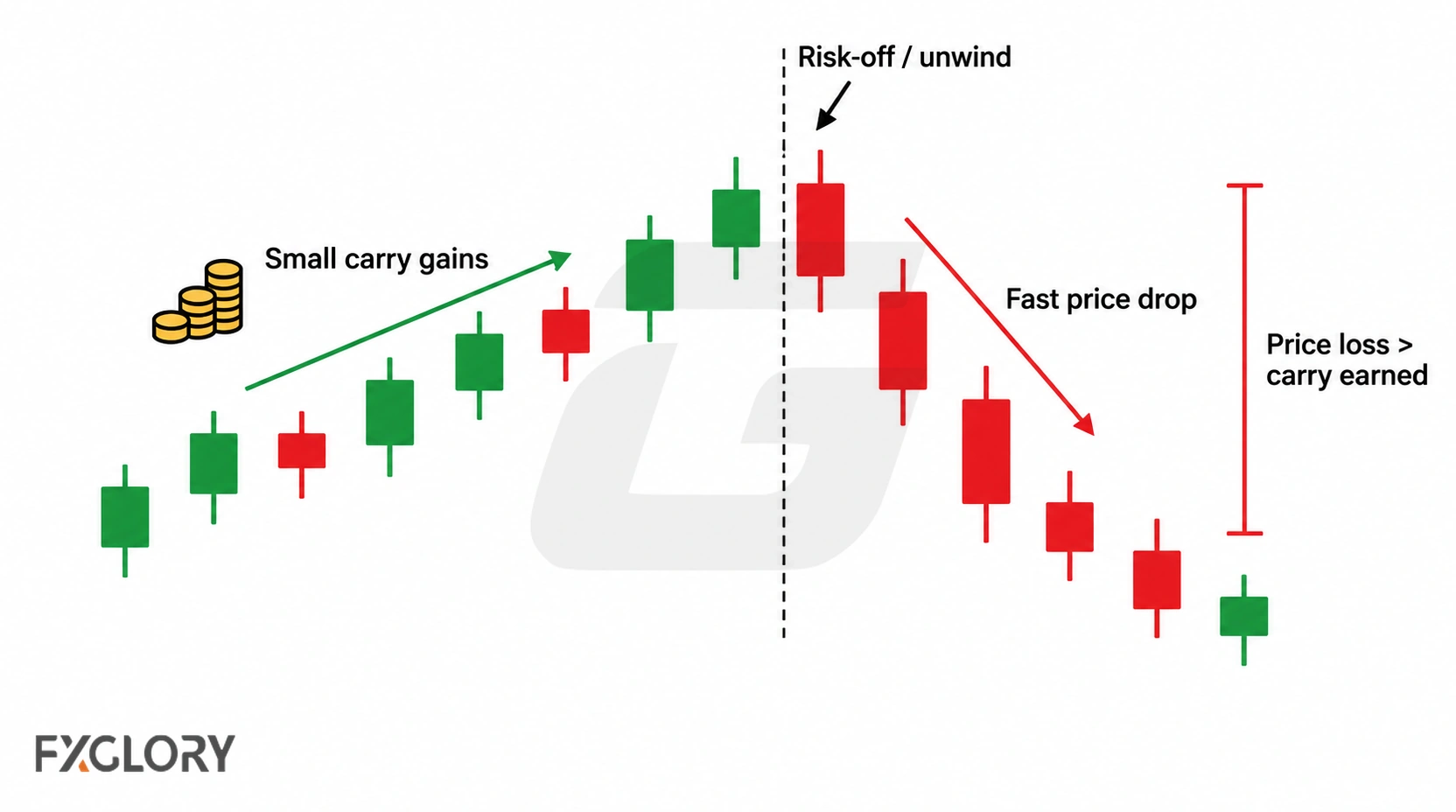
Unwind risk matters because carry trades can become crowded. If many traders hold similar exposure and then reduce it at the same time, price movement can become sharper than the daily carry credit would suggest.
| Unwind Trigger | Possible Effect | Risk-Control Response |
|---|---|---|
| Risk-off market shift | Higher-yielding or risk-sensitive currencies may weaken. | Do not hold only because of prior carry credits. |
| Policy surprise | Rate expectations change quickly. | Review the trade after central-bank decisions and guidance. |
| Volatility spike | Stops, spreads, and slippage risk can increase. | Reduce exposure or avoid new carry entries in unstable conditions. |
| Crowded positioning | Many exits can push the pair quickly. | Use predefined exit and margin rules. |
Retail vs Institutional Carry Trades
Retail and institutional carry trades can share the same basic idea, but the mechanics are not identical.
A retail forex trader usually experiences carry through the broker's overnight swap or rollover adjustment on a currency position. The trader should focus on pair direction, swap condition, spread, margin, leverage, account risk, and the exit rule.
An institutional or corporate participant may use broader funding markets, derivatives, cash-management structures, hedges, liquidity planning, or portfolio-level currency exposure. Those methods can be more complex than a retail forex position and may involve different objectives.
| Participant Type | Typical Carry Mechanic | Key Risk |
|---|---|---|
| Retail forex trader | Overnight swap or rollover on a currency pair position. | Exchange-rate movement, leverage, margin, spread, and swap changes. |
| Institutional trader | Portfolio, funding, derivatives, or systematic currency exposure. | Funding stress, liquidity, correlation, crowding, and policy changes. |
| Corporate or treasury user | Cash, hedging, funding, and currency exposure decisions. | Operational, liquidity, hedging, and accounting complexity. |
Retail forex carry-trade review is different from professional treasury, legal, tax, or investment planning. A trader should not use a retail carry setup as a substitute for advice in those areas.
Carry Trade vs Arbitrage
A carry trade is sometimes confused with arbitrage because it uses a price or rate difference. The difference is important. A carry trade does not lock in a risk-free return. It remains exposed to exchange-rate movement, changing rates, costs, liquidity, leverage, and margin.
| Concept | Main Idea | Why It Matters |
|---|---|---|
| Carry trade | Seeks to benefit from holding a higher-yielding currency against a lower-yielding one. | The exchange rate can move against the position. |
| Arbitrage | Seeks to exploit a pricing difference under defined conditions. | True arbitrage is not the same as taking open currency risk for carry. |
| Mislabeling risk | Trader treats carry as guaranteed because a credit appears possible. | The position may still lose more from price movement than it receives from carry. |
Forex Carry Trade Decision Sequence
A carry trade should follow a clear review order. Starting with the possible swap credit and ignoring the rest of the position can lead to poor decisions.
| Step | Decision | Continue Only If |
|---|---|---|
| 1. Rate relationship | Review which currency is higher-yielding and which is lower-yielding. | The difference is relevant to the planned holding period. |
| 2. Pair direction | Confirm whether long or short exposure holds the intended higher-yielding side. | The trade direction matches the carry idea. |
| 3. Swap condition | Check whether the position may receive or pay rollover under current conditions. | The carry result is acceptable after costs. |
| 4. Market context | Review volatility, trend, range, liquidity, and central-bank expectations. | The market context does not clearly damage the carry idea. |
| 5. Entry plan | Define how the position is opened. | The entry is not based only on the desire to receive carry. |
| 6. Invalidation | Define where the carry and price idea is wrong. | The trader knows when to exit or reduce exposure. |
| 7. Margin and leverage | Review position size, margin requirement, and possible drawdown. | The account can tolerate realistic adverse movement. |
| 8. Holding review | Schedule checks for swap changes, events, and price structure. | The trade will not be held blindly. |
| 9. Exit rule | Define exit by price, risk, time, policy change, swap change, or system rule. | The trade has a controlled end condition. |
| 10. No-trade rule | Define when the carry idea should be skipped. | The trader can reject the setup before risk is taken. |
No-Trade Conditions
A carry trade should be rejected when the position depends on carry while ignoring the risks that can remove the benefit.
| No-Trade Condition | Why It Matters | Action |
|---|---|---|
| Carry direction is unclear | The trader may accidentally hold the negative-carry side. | Do not trade until pair direction and swap condition are clear. |
| Swap credit is too small after costs | Spread and holding costs can weaken the idea. | Skip or keep the pair on watch only. |
| Price trend strongly fights the carry side | Exchange-rate losses can overwhelm carry. | Do not use carry as an excuse to hold a losing bias. |
| Major central-bank event is near | Rate expectations and volatility can change quickly. | Use event-risk rules or stand aside. |
| Volatility is unstable | Drawdown, spread, and slippage risk can rise. | Reduce exposure or avoid new carry positions. |
| Margin is stretched | Normal movement can become account-level pressure. | Lower position size or skip. |
| No invalidation point | The trader does not know when the idea is wrong. | Do not enter. |
| Trade exists only for daily credit | The trader may ignore price risk. | Require a full setup and risk plan. |
| Recovery motive appears | The trader uses carry to justify holding after losses. | Step away and review the plan. |
Testing And Review Before Live Trading
A carry trade forex strategy should be reviewed in historical examples or demo conditions before real funds are used. The goal is not to find a pair with the largest visible rate difference. The goal is to see whether the same rate, swap, trend, entry, margin, and exit rules can be followed under changing conditions.
- Record the pair, direction, and reason it was considered a carry candidate.
- Record whether the trade direction matched the intended higher-yielding side.
- Record the expected swap credit or charge at the time of review.
- Record spread, margin requirement, leverage exposure, and planned position size.
- Record the market context before entry, including trend, range, volatility, liquidity, and central-bank risk.
- Record the entry trigger and invalidation point before the trade is opened.
- Record the holding period and every rollover credit or charge.
- Record whether price movement helped or outweighed the carry.
- Record whether swap conditions, rate expectations, or market structure changed during the trade.
- Compare trades that followed the plan with trades held only because they earned or were expected to earn carry.
Carry Trade Forex Checklist
Before a carry trade becomes a position, each item below should already be clear.
- Define the higher-yielding and lower-yielding currencies.
- Confirm whether the planned long or short direction holds the intended higher-yielding side.
- Check whether the position may receive or pay rollover under current conditions.
- Review whether the expected carry still matters after spread and holding costs.
- Check whether price structure supports, weakens, or directly fights the carry side.
- Review volatility, liquidity, session conditions, and event risk.
- Define entry rules before opening the position.
- Define invalidation before the position is opened.
- Choose position size only after margin, leverage, stop distance, and drawdown risk are known.
- Write the condition that cancels the carry idea, including swap change, rate outlook change, or price invalidation.
- Plan how often the trade will be reviewed while open.
- Reject the trade if it only makes sense because of expected daily carry.
- Stop trading or reduce exposure when the account-level risk rule is reached.