

What Is A Forex Hedging Strategy?
A forex hedging strategy is a plan for reducing or reshaping currency exposure by using another position that offsets part of the original risk. The hedge may be on the same currency pair, a smaller opposite position, or another pair whose movement is expected to offset some of the first position.
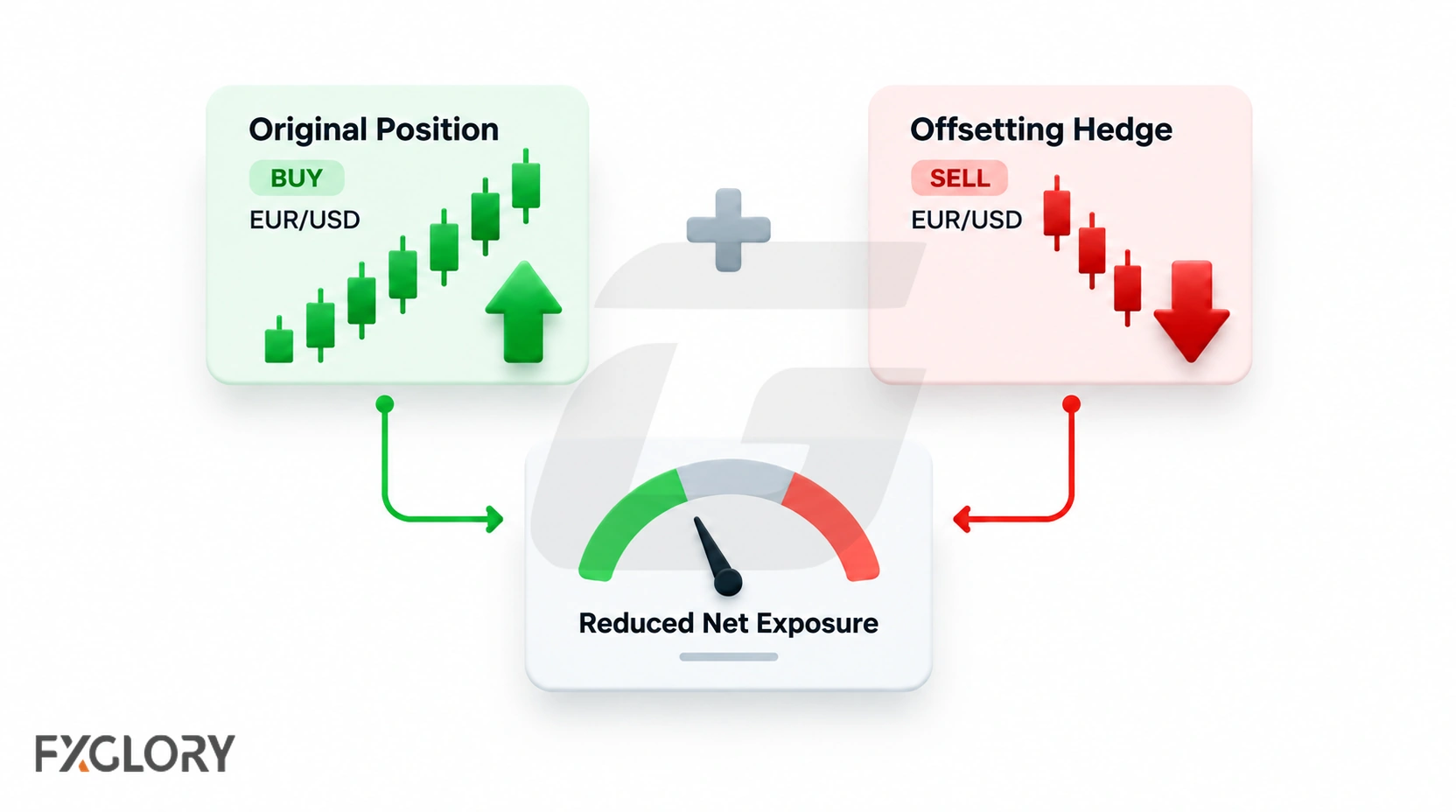
The purpose of a hedge is not to guarantee profit. It is usually reviewed when a trader wants to limit exposure during uncertainty, protect a longer-held position for a temporary period, reduce directional risk before an event, or control exposure while waiting for a planned confirmation or invalidation.
A hedge can also create new problems. It may add another spread, create swap cost, increase margin requirement, lock the trader into two decisions instead of one, or hide the fact that the original trade should have been reduced or closed.
Hedging Is Not The Same As Risk Management
Hedging is one possible risk-control tool, but it is not the whole risk plan. A trader still needs position size, invalidation, spread review, leverage exposure, margin review, account-level loss limits, and a written exit rule.
A hedge may reduce one risk while adding another. For example, a partial hedge can reduce directional exposure, but it may increase cost and leave the trader exposed to both legs if the market becomes unstable. A cross-pair hedge can reduce exposure to one currency but add exposure to another currency or correlation relationship.
Before a hedge is considered, the original trade should already pass the same account-level checks used in the risk framework for stops, size, margin, and drawdown. If the original trade no longer has a valid reason, closing or reducing it may be cleaner than adding a hedge.
| Decision | What It Controls | Common Mistake |
|---|---|---|
| Risk management | Whether the trade should be accepted, sized, held, reduced, or closed | Trader treats a hedge as a replacement for risk limits |
| Hedging | How part of an existing exposure may be offset or reshaped | Trader opens another position without knowing what exposure remains |
| Closing | Removes the position instead of adding another decision | Trader avoids closing because the hedge feels less final |
| Reducing | Cuts the original position size without creating a second leg | Trader uses a full hedge when a smaller size would be simpler |
When Traders Use Forex Hedges
Forex hedges are usually reviewed when the trader wants temporary exposure control, not when the trade has no plan. A hedge may be considered around uncertain events, during temporary volatility, after a large move, while protecting a longer-term idea, or when several positions have overlapping currency exposure.
| Hedge Reason | What The Trader Is Trying To Control | What Must Still Be Defined |
|---|---|---|
| Short-term uncertainty | Directional exposure during a temporary unknown | When the uncertainty is considered over |
| Event risk | Volatility around data, central-bank decisions, or market shocks | Whether the cost and execution risk justify the hedge |
| Longer-held position | A temporary drawdown or correction against a wider idea | The point where the wider idea is no longer valid |
| Correlation exposure | Multiple trades affected by the same currency or theme | What exposure remains after the hedge |
| Grid or basket exposure | Several open positions moving together | Maximum open exposure, drawdown limit, and basket exit |
For longer-held trades, hedging should be reviewed alongside holding cost, swap, margin, and thesis review. Use the long-term trading framework for holding-period risk and the carry-trade guide when interest-rate differential and rollover become part of the holding logic.
Direct Hedge, Partial Hedge, And Cross-Pair Hedge
Different hedging methods change exposure in different ways. The trader should know whether the hedge is trying to neutralize the original pair, reduce only part of the size, or offset exposure through another related currency pair.
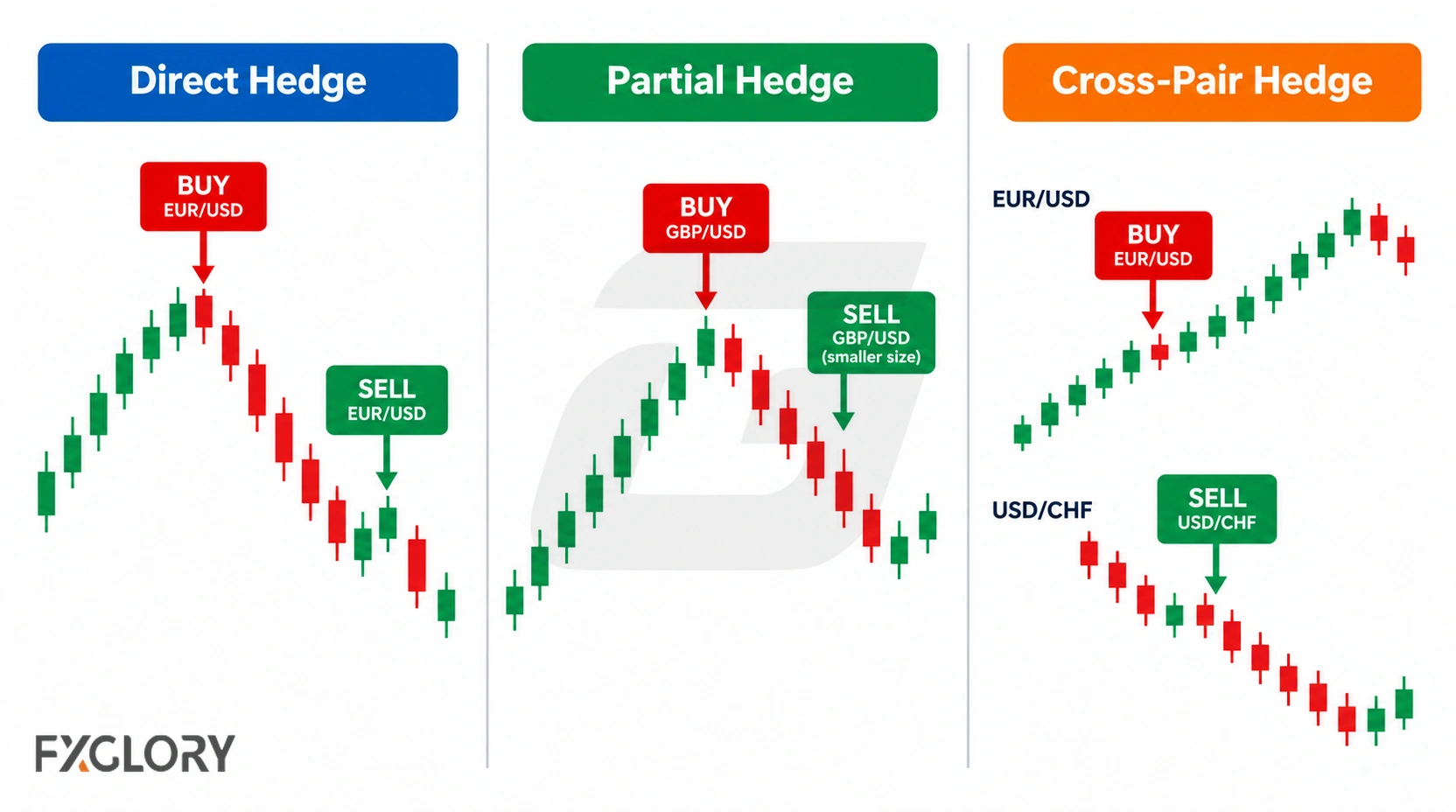
| Hedge Type | Basic Idea | Main Risk |
|---|---|---|
| Direct hedge | An opposite position is reviewed on the same currency pair | Some platforms or account types may net opposite positions instead of keeping both legs separate |
| Partial hedge | The hedge is smaller than the original position | Directional exposure remains and the trader may still underestimate the open risk |
| Cross-pair hedge | A different pair is used because it may offset part of the first position | Correlation can change and the second pair can add new currency exposure |
| Basket hedge | Several positions are reviewed together as one exposure group | The basket may hide which individual position is causing the risk |
| External derivative hedge | Some market participants use options, forwards, or futures outside ordinary spot-style trading | Do not assume those instruments are available in a retail forex account or through a specific broker |
Direct Same-Pair Hedge Reality
A direct same-pair hedge does not erase the original trade. If a trader holds a buy position and then opens a same-size sell position on the same pair, much of the new directional movement may be offset, but the account still has the earlier result, spread cost, possible swap, margin impact, and two exit decisions to manage.
This is why a direct hedge should not be treated as a reset button. It can pause part of the directional exposure, but it cannot make an invalid trade valid, remove the earlier drawdown, or guarantee that the trader will exit both legs well.
| Direct-Hedge Question | Why It Matters | Weak Assumption |
|---|---|---|
| Are opposite positions kept separate? | Platform and account rules can differ; account conditions should be checked before assuming opposite positions will behave as separate hedge legs. | The trader assumes every account handles direct hedges the same way. |
| What happened before the hedge? | The account still carries the result created before the hedge was opened. | The trader treats the hedge as if it removed the earlier loss or risk. |
| What costs remain? | Spread, possible swap, slippage, and margin can still affect the account. | The trader thinks neutral direction means neutral cost. |
| Which leg closes first? | Closing one leg restores directional exposure from the remaining leg. | The trader closes one side without knowing the new risk. |
| When does the hedge end? | A temporary hedge needs a condition that ends it. | Both legs stay open because the trader avoids the decision. |
Net Exposure: What Risk Remains After The Hedge?
The most important hedging question is not only whether two trades look opposite. The important question is what exposure remains after both positions are open.
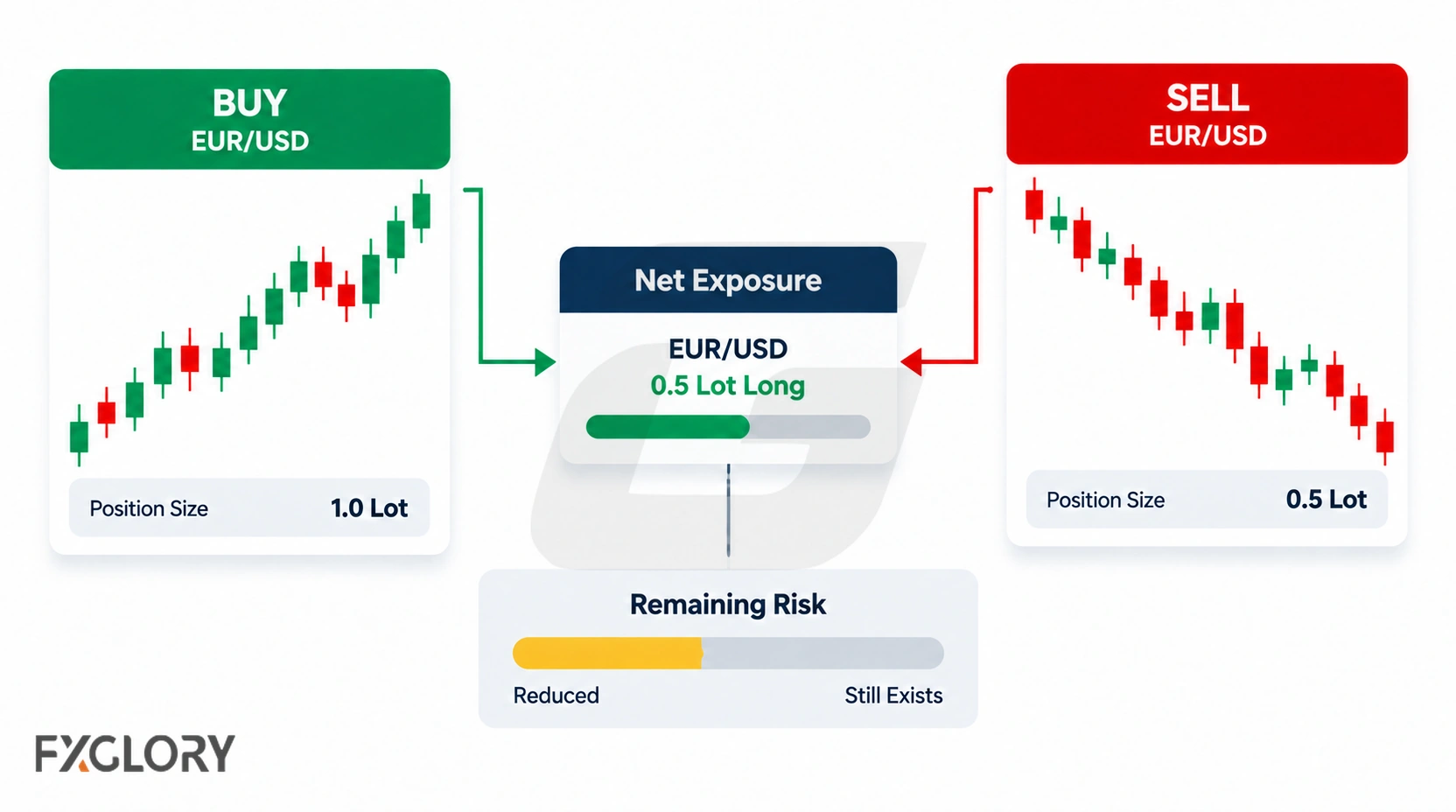
A hedge can reduce one currency exposure while adding another. A trader long GBP/USD and short EUR/USD may reduce part of the USD side, but the account now has GBP and EUR exposure as well. A hedge can also reduce directional movement while increasing margin use, swap cost, and decision complexity.
| Exposure Check | Question To Ask | Why It Matters |
|---|---|---|
| Pair direction | Which currency is being bought and which is being sold in each leg? | Two positions may not offset the way the trader expects |
| Hedge size | Is the hedge full, partial, or larger than the original exposure? | Incorrect sizing can over-hedge or leave too much risk open |
| Currency overlap | Does the hedge add exposure to another currency? | Cross-pair hedges can create new risk |
| Correlation stability | Has the relationship between the pairs changed? | Correlation can weaken when it is needed most |
| Margin impact | How much free margin remains after both legs are open? | Reduced direction risk does not always mean reduced margin pressure |
| Cost impact | How do spread, swap, and execution cost change the plan? | Costs can make a hedge less useful than closing or reducing |
When margin and leverage exposure need to be reviewed before adding a second leg, check the margin requirement before the hedge is placed and compare the plan with the leverage conditions that affect position exposure.
Hedging vs Closing The Trade
Opening a hedge can feel less final than closing the original trade, but that feeling can create poor decisions. If the original setup is invalid, closing it may be clearer than adding a hedge. If the original setup is still valid but the trader wants temporary exposure control, a hedge may be reviewed only if the exit rule is known.
| Situation | Cleaner Review | Weak Hedge Use |
|---|---|---|
| The original trade is invalid | Close or reduce the trade according to the plan | Open a hedge to avoid accepting the invalidation |
| The trade is valid but event risk is near | Review close, reduce, hold, or temporary hedge options | Hedge without checking spread, slippage, and margin |
| The trader missed the planned exit | Follow account-level damage control | Add a hedge because the loss feels uncomfortable |
| The position is too large | Reduce size or reassess risk | Add a hedge while leaving position size too aggressive |
| The trader has no hedge exit rule | Do not hedge | Open the hedge and decide later |
For the broader process of deciding when a trade is accepted, cancelled, managed, or exited, use the entry-and-exit rule framework.
Full Hedge vs Partial Hedge
A full hedge tries to offset most or all of the original directional exposure. A partial hedge offsets only part of it. Neither is automatically better. The correct review depends on the hedge reason, account size, margin, costs, and exit plan.
| Hedge Size | Possible Use | Main Caution |
|---|---|---|
| Full hedge | Attempts to neutralize most of the original directional movement | Can freeze the decision while costs and margin pressure remain |
| Partial hedge | Reduces part of the original exposure while leaving some directional position open | The remaining exposure may still be too large |
| Over-hedge | Hedge size is larger than the original position | The account may now be exposed in the opposite direction |
| No hedge | Trader closes, reduces, or keeps the original position based on the plan | May be better than adding complexity when the hedge logic is unclear |
Correlation-Based Forex Hedging
Correlation-based hedging uses another currency pair because the trader expects it to offset part of the original position. This is not the same as a direct hedge. It depends on how the two pairs usually move, how stable that relationship is, and which currencies remain exposed after both trades are open.
For example, a trader may review two USD-related pairs because both include the U.S. dollar, but the second pair also adds exposure to another currency. If the relationship changes, both positions can lose value or create unexpected drawdown.
| Correlation Issue | Why It Matters | Better Rule |
|---|---|---|
| Positive correlation | Pairs often move in a similar direction | Do not assume the relationship stays stable during stress |
| Negative correlation | Pairs often move in opposite directions | Check whether the offset is still present in current conditions |
| Currency overlap | Several pairs may share one currency | Review total exposure to that currency, not each chart alone |
| False correlation | A past relationship stops working | Use a cancellation rule when the relationship breaks |
| News shock | Correlation can change quickly during high-volatility events | Review whether the hedge should be avoided, reduced, or closed |
Use the currency-pairs overview when reviewing which currencies are involved in each pair. The full correlation framework should remain a separate strategy because hedging is only one use of correlation.
Hedging Costs: Spread, Swap, Margin, And Opportunity Cost
A hedge can reduce directional exposure while still increasing total cost. The trader may pay spread on the new position, face swap on one or both legs if positions stay open overnight, use more margin, and lose the opportunity to make a cleaner decision.
| Cost Or Constraint | How It Affects A Hedge | Check Before Hedging |
|---|---|---|
| Spread | Opening another position can add another transaction cost | Is the hedge still useful after the spread? |
| Swap | Overnight positions may receive or pay swap depending on pair, direction, and conditions | Can the hedge be held if swap is negative? |
| Margin | The hedge may require additional margin even if directional exposure is reduced | Does free margin remain acceptable after both legs? |
| Slippage | Fast movement can affect hedge entry and exit price | Is execution risk too high for the hedge reason? |
| Opportunity cost | The hedge can keep capital tied to a frozen decision | Would closing or reducing be simpler? |
| Decision cost | Two positions require two exit decisions | Are both exits defined before entry? |
Check the spread conditions that affect position cost before adding a hedge. For overnight exposure, review how swap can credit or charge a held position. Account-level conditions should also be checked through the trading account conditions page.
The Hedge Exit Problem
Many hedge plans fail because the trader knows why the hedge was opened but does not know when to close it. A hedge can become a trap when both legs remain open after the original reason has disappeared.
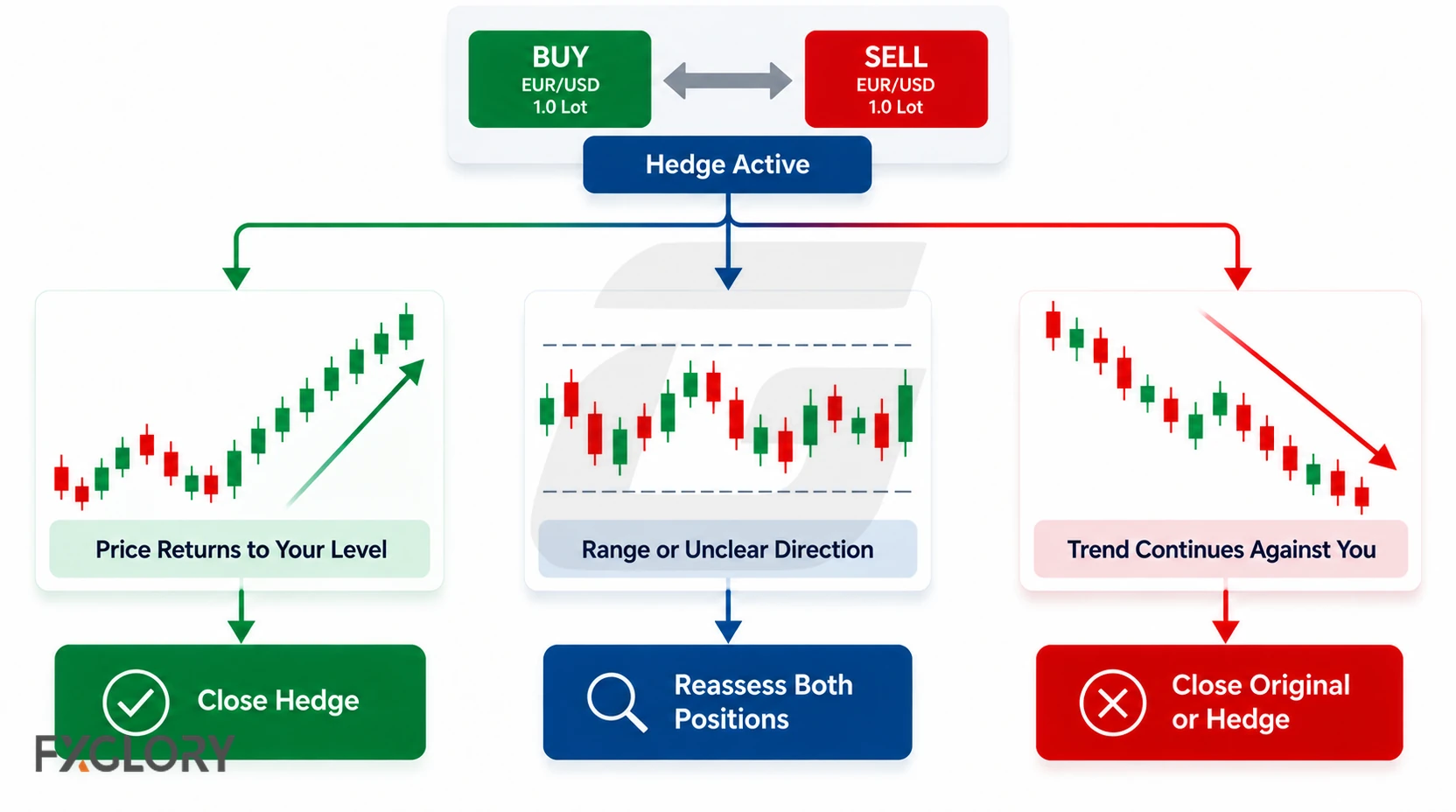
The hedge exit should be written before the hedge is opened. The exit may depend on a passed event, a confirmed break, a failed support or resistance level, a time limit, spread normalization, drawdown limit, swap cost, or the original trade closing.
| Hedge Exit Rule | Possible Use | Weak Version |
|---|---|---|
| Event passed | Hedge is reviewed after the data release, speech, or scheduled risk window | Hedge stays open because the trader is unsure what to do next |
| Level confirmed | Support, resistance, or structure confirms the next decision | Trader ignores the level after it breaks |
| Original trade invalidated | Original position is closed or reduced when the reason fails | Hedge is used to avoid the planned loss |
| Cost limit reached | Swap, spread, or margin makes the hedge no longer useful | Costs keep building without review |
| Time limit reached | The hedge is reviewed after a written number of candles, sessions, or days | Temporary hedge becomes an unplanned hold |
| Account limit reached | Drawdown or margin rule forces the position review | Trader waits for recovery without a rule |
When hedge decisions depend on market structure, use support and resistance rules for level quality instead of adding levels after the hedge is already open.
Hedging Around News And Volatility
Some traders consider hedging before high-volatility events, but this can be difficult in real trading conditions. Spreads can widen, price can move quickly, slippage can affect both entry and exit, and the first move can reverse after the market digests the news.
A hedge around an event should not be opened only because a release is near. The trader should know the event, affected currency, spread limit, hedge size, exit time, invalidation point, and what to do if both legs move poorly because of execution or correlation changes.
| Event-Hedge Issue | Risk | Better Rule |
|---|---|---|
| Spread expansion | Opening and closing both legs can become more expensive | Use a written spread limit or stand aside |
| Slippage | Entry or exit may happen away from the planned price | Avoid assuming normal execution during fast movement |
| Whipsaw | Both sides may be triggered or damaged by fast reversals | Wait for post-event structure if the hedge rule is unclear |
| Mixed data | The first reaction may not show the final market view | Review whether the event actually changed the trade reason |
| Emotional hedge | The trader adds a hedge because the market is moving quickly | Use only pre-written event rules |
Hedging And Grid Trading
Some grid structures use hedging logic, especially when multiple orders are open or when the trader tries to offset basket exposure. That does not make grid trading and hedging the same thing.
Grid trading is mainly an order-placement structure with levels, spacing, lot sizes, maximum orders, and basket exposure. Hedging is an exposure-control method. When they are combined, the trader must review the risks of both: multiple open positions, floating drawdown, margin pressure, spread, swap, and exit complexity.
For the full grid-specific framework, including spacing, basket logic, floating drawdown, and maximum open orders, use the forex grid trading guide.
Why Forex Hedging Strategies Fail
Hedging strategies often fail when the hedge is used to delay a difficult decision. The hedge may look like protection, but it can become a second trade with its own risk, cost, and exit problem.
| Failure Reason | What Happens | Better Rule |
|---|---|---|
| No exit rule | The trader opens the hedge but cannot decide which leg to close | Write the hedge exit before the hedge opens |
| Hedging instead of closing | An invalid trade stays open because the hedge hides the loss | Close or reduce when the trade reason fails |
| Cost stacking | Spread, swap, and margin pressure reduce the usefulness of the hedge | Review all costs before adding the second leg |
| False correlation | Cross-pair hedge stops offsetting the original exposure | Use correlation break rules |
| Overleverage | The hedge adds margin pressure instead of reducing account risk | Check margin and free margin before both legs are open |
| Late hedge | Hedge is added after most of the damage has already occurred | Use predefined hedge triggers, not panic triggers |
| Recovery motive | Trader uses hedging to avoid taking a planned loss | Stop when the account-level rule is reached |
| Martingale behavior | Trader increases size after losses to escape the hedge | Do not let hedge recovery become uncontrolled position scaling |
Forex Hedging Decision Sequence
A hedge should be reviewed through the same sequence every time. Starting with fear and then searching for a hedge reason usually creates weak decisions.
| Step | Decision | Continue Only If |
|---|---|---|
| 1. Original exposure | Identify pair, direction, size, stop, and reason for the original trade | The original trade reason is still known |
| 2. Hedge reason | Define the temporary risk the hedge is meant to control | The hedge reason is specific, not emotional |
| 3. Hedge type | Choose direct, partial, cross-pair, or no hedge | The method fits the exposure and platform rules |
| 4. Hedge size | Calculate full, partial, or smaller offset size | The remaining exposure is understood |
| 5. Cost review | Check spread, swap, slippage risk, and opportunity cost | The hedge remains useful after costs |
| 6. Margin review | Check margin requirement and free margin after both legs | Account pressure stays inside the plan |
| 7. Exit rule | Write how and when the hedge will be closed, reduced, or reviewed | The exit is known before entry |
| 8. No-hedge rule | Define when closing, reducing, or standing aside is better | The trader is not adding complexity to avoid a loss |
For a complete trade routine that includes setup, entry, exit, risk, and review rules, use the forex trading system framework.
No-Hedge Conditions
Not every uncertain trade deserves a hedge. A hedge should be skipped when it adds complexity without solving a defined exposure problem.
| No-Hedge Condition | Why It Matters | Action |
|---|---|---|
| The original trade is invalid | The hedge would delay the planned exit | Close or reduce according to the plan |
| No exit rule exists | The hedge may become an indefinite second position | Do not hedge |
| Costs exceed the benefit | Spread, swap, or slippage can damage the plan | Skip or reduce exposure instead |
| Margin is already strained | The hedge may increase account pressure | Do not add another position |
| Platform rules are unclear | Opposite trades may net or behave differently than expected | Check account and platform rules first |
| Correlation is unstable | Cross-pair hedge may not offset the exposure | Do not rely on the relationship |
| The hedge is emotional | The trader is reacting to fear, not following a rule | Step away and review the written plan |
| Recovery motive appears | The hedge is being used to avoid taking a loss | Stop trading when the risk rule is reached |
Testing And Review Before Live Trading
A forex hedging strategy should be reviewed before it is used with real funds. The review should focus on whether the hedge controlled the intended exposure, how much it cost, whether it increased margin pressure, and whether the trader followed the exit rule.
- Record the original pair, direction, size, entry, stop, and trade reason.
- Record the exact hedge trigger and whether it was planned before the hedge opened.
- Record the hedge type: direct, partial, cross-pair, basket, or no hedge.
- Record the hedge size and the exposure that remained after the hedge.
- Record spread, swap, slippage, and margin impact on both legs.
- Record whether the hedge was opened around an event, trend change, support/resistance break, or emotional pressure.
- Record the hedge exit rule before reviewing the outcome.
- Record which leg was closed first and why.
- Record whether closing or reducing would have been simpler than hedging.
- Review whether the hedge followed the plan, not only whether the account recovered.
Forex Hedging Strategy Checklist
Before a hedge is opened, each item below should already be clear.
- Define the original exposure by pair, direction, size, and trade reason.
- Confirm whether the original trade is still valid or should be closed.
- Write the specific reason for the hedge.
- Choose direct, partial, cross-pair, basket, or no-hedge review.
- Check whether platform, account, and regional rules allow the intended hedge structure.
- Calculate the remaining exposure after the hedge.
- Check spread, swap, slippage risk, and opportunity cost.
- Check margin requirement and free margin after both legs are open.
- Write the hedge exit rule before the hedge is opened.
- Define the maximum cost, drawdown, time, or event condition that cancels the hedge.
- Reject the hedge if it exists only to avoid closing an invalid trade.
- Review whether closing or reducing the original trade would be simpler.