

What Is Forex Arbitrage?
Forex arbitrage is the attempt to use a temporary price discrepancy between currency quotes, currency pairs, venues, or related instruments. The basic idea is simple: if the same or related currency exposure is priced differently in two places, a trader may review whether coordinated buying and selling can lock in the difference.
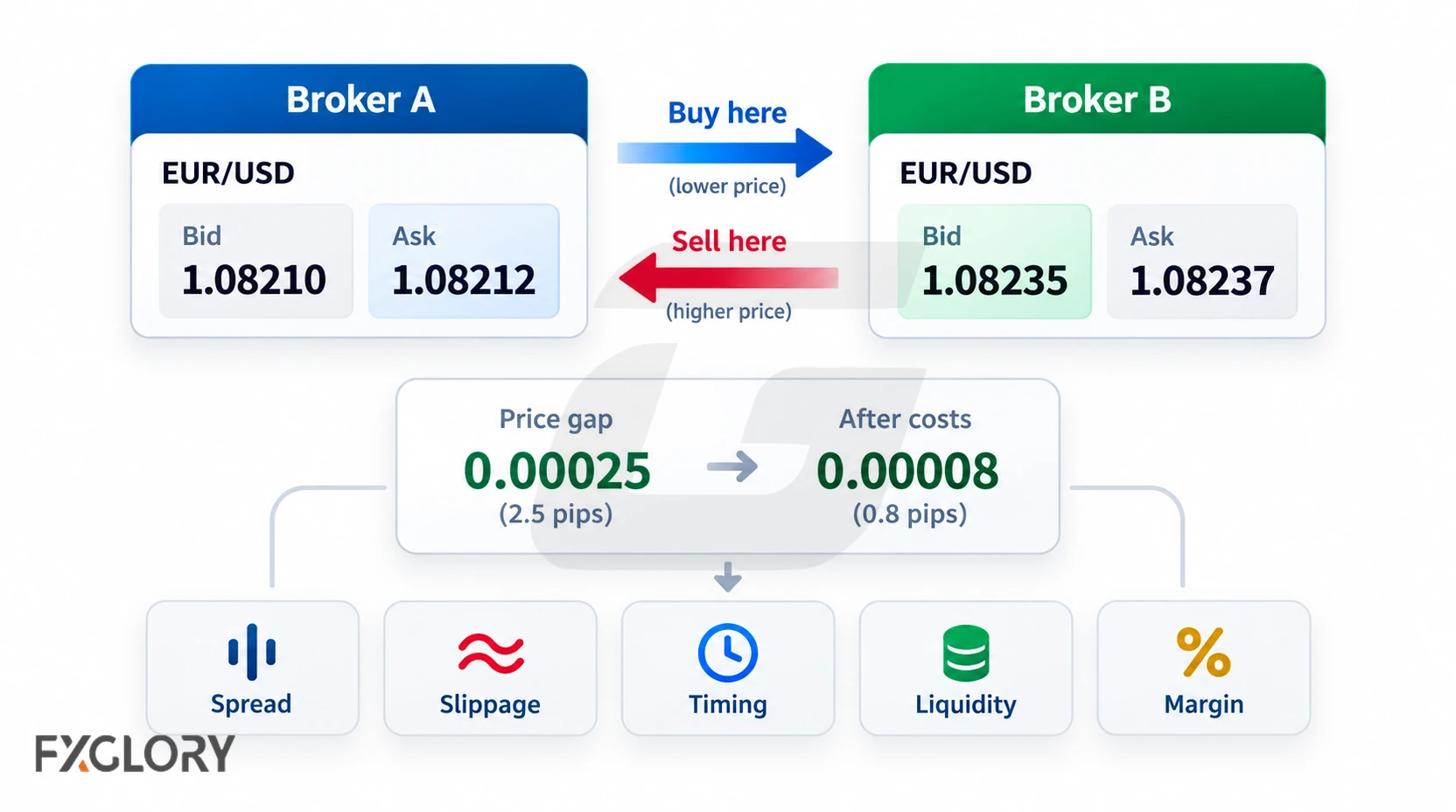
In real forex trading, the idea is much harder than the definition. The trader still needs accurate quotes, fast execution, enough liquidity, acceptable spread, limited slippage, margin capacity, account-rule clarity, and a way to complete all required legs. If the price gap is smaller than the total cost or disappears before the orders are completed, the arbitrage idea is no longer useful.
A useful forex arbitrage review starts with the question: is there a real price discrepancy after cost, timing, and execution risk? It should not start with the assumption that arbitrage is automatically safe.
Forex Arbitrage Is Not Risk-Free
Arbitrage is often described as risk-free in theory because the trader is trying to buy and sell related exposure at the same time. That theoretical wording can be misleading for retail forex traders. The trading result depends on what actually fills, where it fills, how fast it fills, and what costs are applied.
A price gap shown on a screen may not be tradeable. Quotes can update, spreads can widen, orders can be rejected, one leg can fill before another, and liquidity can change between the decision and the execution. If the execution does not match the assumption, the trader can be left with open market exposure.
| Risk Point | What Can Happen | Better Review |
|---|---|---|
| Spread | The visible difference is smaller than bid-ask cost. | Check the opportunity after current spread, not before it. |
| Slippage | The fill happens at a worse price than expected. | Review whether the gap survives realistic fill differences. |
| Latency | The quote changes before orders are completed. | Do not assume a delayed quote is still available. |
| Liquidity | There is not enough depth at the quoted price. | Review tradable size, not only displayed price. |
| Partial fill | One leg fills and another does not. | Define what to do if the structure becomes directional exposure. |
| Platform rules | The account, platform, or trading conditions do not allow the assumed workflow. | Check trading conditions before relying on a method. |
How Forex Arbitrage Works
A forex arbitrage review usually follows a strict sequence. The trader identifies a possible mismatch, checks whether the mismatch is real and current, subtracts all costs, reviews whether all legs can be executed, and defines what happens if execution fails.
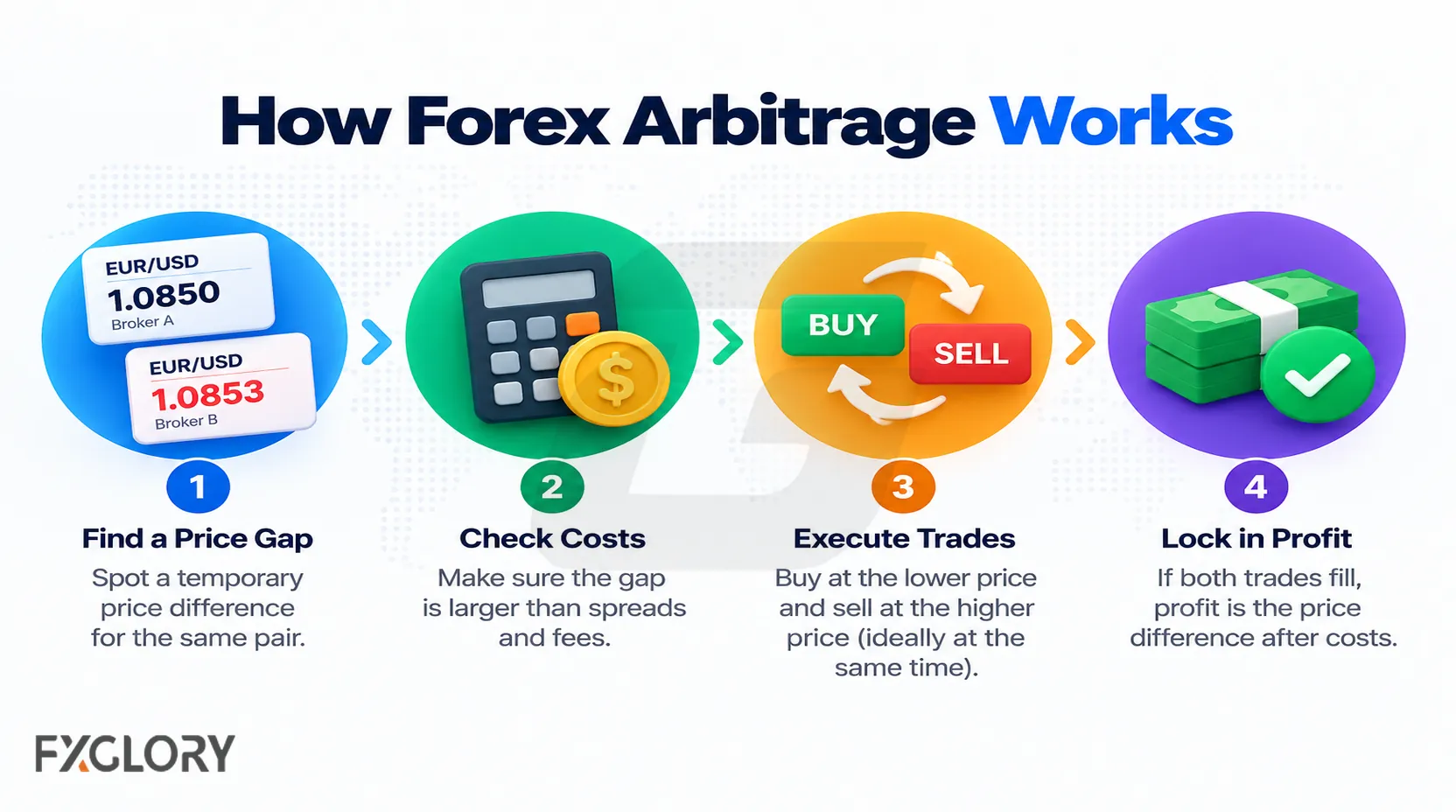
| Step | Question | Continue Only If |
|---|---|---|
| 1. Quote comparison | Is there a visible difference between related prices? | The quotes are current, comparable, and not stale. |
| 2. Cost check | Does the difference remain after spread, slippage, and applicable costs? | The net difference is still meaningful after cost. |
| 3. Execution check | Can all required orders be placed and completed fast enough? | The trader has a written plan for order handling. |
| 4. Liquidity check | Can the planned size be filled without damaging the price? | The tradable size fits available liquidity. |
| 5. Margin check | Can the account support all legs if the structure remains open? | Free margin and exposure remain inside account rules. |
| 6. Failed-leg rule | What happens if only one leg fills? | The exit or correction rule is known before entry. |
| 7. Review | Did the trade work because of a real mismatch or because of luck? | Fills, timestamps, spread, and slippage can be reviewed. |
A detected price gap is only the first observation. The full plan needs execution, cost, margin, and failure rules. For a broader structure that connects trade idea, trigger, risk, no-trade rules, and review, use a complete forex trading system framework.
A Cost-Check Example
A forex arbitrage example should be treated as a cost-check exercise, not as proof that a price gap can be captured. The numbers below are hypothetical and are only used to show the review sequence.
| Example Item | Hypothetical Review | Decision Meaning |
|---|---|---|
| Visible price difference | The trader sees a small mismatch between related currency quotes. | This is only the starting observation. |
| Spread on required legs | The bid-ask cost may reduce or remove the visible gap. | The mismatch must be reviewed after spread, not before it. |
| Possible slippage | One or more fills may occur at a worse price than expected. | A gap that survives on paper may fail in execution. |
| Execution timing | Prices can update between the first and final order. | The trader should not assume all legs will fill at the displayed prices. |
| Net result after cost | The final review may show no usable difference after trading costs and timing risk. | The setup should be skipped if the net edge is unclear. |
True Arbitrage vs Directional Trading
True arbitrage is not the same as buying a currency because it looks undervalued or selling a currency because it looks overvalued. A directional trade depends on the market moving in the expected direction later. A pure arbitrage review depends on a price relationship being out of line now and the trader being able to execute the required legs before the difference disappears.
Some traders use the word arbitrage loosely for strategies that are actually macro views, carry trades, hedges, grid systems, or statistical relationships. Those methods can still have their own logic, but they are not the same as a clean price-mismatch arbitrage.
| Approach | Main Idea | Key Risk |
|---|---|---|
| Forex arbitrage | Review a current price discrepancy between related currency prices. | The discrepancy may disappear before or during execution. |
| Directional trading | Trade a currency pair based on expected future movement. | The market may not move as expected. |
| Fundamental value view | Review whether one currency looks stronger or weaker than another. | The market may already price the view differently. |
| Carry trade | Review rate differential and rollover while holding a position. | Exchange-rate movement can overwhelm carry. |
| Hedging | Reduce or reshape existing exposure. | The hedge may add cost and exit complexity. |
Main Types Of Forex Arbitrage
Different arbitrage labels describe different sources of possible mismatch. The labels below should be treated as educational categories, not as automatic trading instructions.
| Type | Basic Meaning | Main Caution |
|---|---|---|
| Currency or cross-broker arbitrage | Comparing the same or similar currency price across venues or feeds. | Quotes may differ because of spread, timing, liquidity, or execution rules. |
| Triangular arbitrage | Comparing a three-currency loop with the quoted cross-rate. | All legs must be fast, cost-adjusted, and fillable. |
| Latency arbitrage | Trying to act on price-feed delays or stale quotes. | Operational, account-rule, and execution risks can be significant. |
| Interest-rate or carry-related arbitrage | Comparing interest-rate or forward/rollover relationships. | This can overlap with carry trade and may not be pure price arbitrage. |
| Spot-future or related-market arbitrage | Comparing spot currency exposure with related derivatives or futures. | Contract specifications, financing, fees, and access matter. |
| Statistical arbitrage | Using statistical relationships between related instruments. | Relationships can break, and model assumptions can fail. |
Triangular Arbitrage In Forex
Triangular arbitrage in forex compares three currency conversions. A trader reviews whether converting from one currency to a second, from the second to a third, and from the third back to the first would produce a different result than the quoted prices imply.
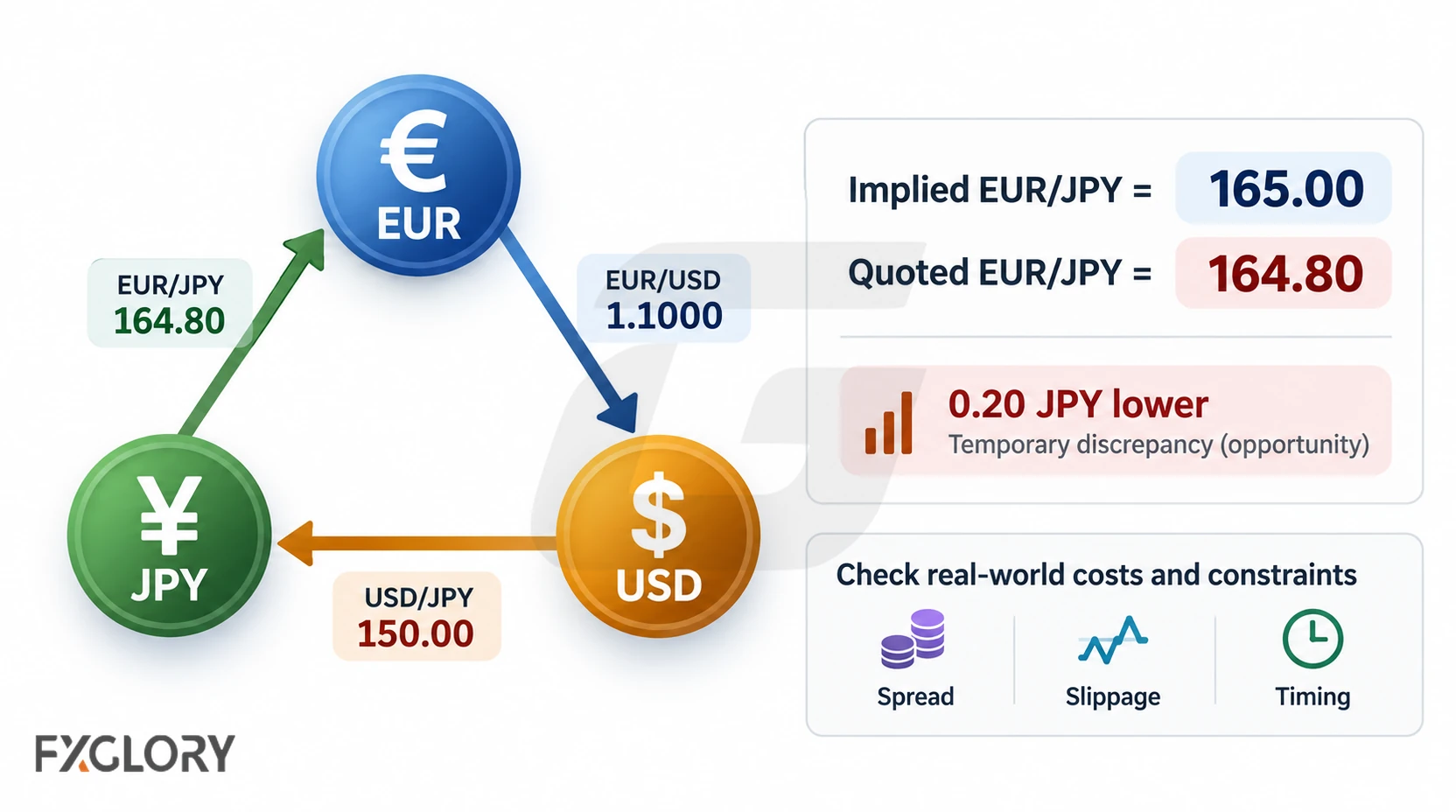
For example, a triangular review may compare EUR/USD, GBP/USD, and EUR/GBP relationships. The trader is not simply guessing whether the euro or pound will rise. The review checks whether the cross-rate implied by two pairs differs from the quoted cross-rate enough to matter after spread, slippage, timing, and execution risk.
| Triangular Step | Question | Failure Point |
|---|---|---|
| Start currency | Which currency starts the loop? | The starting amount may be too small after costs. |
| Second conversion | Does the second pair preserve the apparent advantage? | The spread or fill can remove the difference. |
| Third conversion | Does the loop return more than it started with after cost? | The final leg may not fill at the expected price. |
| Net result | Does the completed loop still show a positive difference? | The mismatch can disappear during execution. |
Quoted Cross Rate vs Implied Cross Rate
A triangular review compares the cross-rate shown on the chart with the cross-rate implied by two related pairs. For example, an EUR/GBP relationship can be reviewed against EUR/USD and GBP/USD pricing. If the quoted cross-rate and the implied cross-rate are too close after spread and execution cost, there is no usable arbitrage gap.
| Triangular Review Item | What It Checks | Why It Can Fail |
|---|---|---|
| Quoted cross-rate | The price directly shown for the cross pair. | The quote may change before execution. |
| Implied cross-rate | The price relationship suggested by the two related pairs. | Bid and ask prices may remove the apparent difference. |
| Execution sequence | Whether all legs can be completed quickly enough. | One leg may fill while another leg reprices or rejects. |
| Net result | Whether the completed loop remains useful after cost. | Spread, slippage, and delay can erase the mismatch. |
When reviewing pair relationships, use reliable quote comparison and remember that displayed prices do not guarantee fills. For broader pair selection and currency-pair context, use the FXGlory currency-pairs hub.
Why Retail Forex Arbitrage Is Difficult
Retail forex arbitrage is difficult because the opportunity is usually small, time-sensitive, and cost-sensitive. By the time a trader identifies the mismatch, calculates the net result, and places the orders, the gap may already be gone.
Manual execution is especially vulnerable. A trader may click one leg, wait for confirmation, and then find that the other price has changed. Automated execution can reduce some manual delay, but it does not remove spread changes, slippage, liquidity limits, rejected orders, margin pressure, or account-rule problems.
- Price discrepancies can be smaller than the spread.
- Quotes can update before the trader completes the order sequence.
- Liquidity may be insufficient at the displayed price.
- Execution can differ across platforms, feeds, and account conditions.
- Obvious opportunities are often watched by faster systems.
- A failed leg can turn the structure into a directional trade.
Account Rules, Stale Quotes, And Latency Caution
Some arbitrage descriptions focus on stale quotes, delayed price feeds, platform differences, or latency between venues. These ideas require extra caution. A trader should not assume that a displayed mismatch is available, permitted, or executable under the account and platform conditions being used.
If the method depends on a platform error, a stale quote, a delayed feed, or an order-handling assumption that is not supported by the account conditions, the setup should be rejected. A valid review should use current tradable prices, clear order handling, known margin requirements, and written failure rules.
| Issue | Why It Matters | Safer Review Rule |
|---|---|---|
| Stale quote | The price may no longer be available when the order is sent. | Reject if the quote cannot be verified as current and tradable. |
| Latency difference | A faster or slower feed can make a mismatch look larger than it is. | Do not treat delayed data as an executable price. |
| Platform rule | Order handling, netting, rejection, or execution rules may differ by account or platform. | Check the account conditions and platform workflow before relying on the method. |
| Unsupported workflow | The assumed sequence may not match real order handling. | Cancel the idea if the trade cannot be completed and reviewed cleanly. |
Costs That Can Erase Forex Arbitrage
Forex arbitrage margins can be very small. That makes cost review central to the strategy. If the spread, slippage, or delay is larger than the apparent mismatch, the opportunity is not usable.
| Cost Or Constraint | Why It Matters | Review Rule |
|---|---|---|
| Spread | Bid-ask cost can remove the apparent price difference. | Calculate the opportunity after spread. |
| Slippage | Actual fill price can differ from the expected price. | Review whether the gap survives realistic fill movement. |
| Execution delay | Prices can update between order decisions. | Do not treat delayed quotes as stable prices. |
| Liquidity | Not all displayed price levels can fill the planned size. | Match trade size with available market depth and conditions. |
| Margin | Multi-leg positions can require available margin during execution. | Review margin before the first order is placed. |
| Swap or rollover | If a position stays open, overnight cost or credit may affect the result. | Do not let a failed arbitrage become an unplanned hold. |
| Platform or account rules | Some workflows may be restricted, netted, rejected, or handled differently. | Check account conditions and platform workflow first. |
Cost-sensitive strategies should be checked against current trading conditions. Review spread conditions before assuming a small price gap is usable. When multiple legs, leverage, and margin are involved, use the margin calculator to review position requirements before trading.
One-Leg Fill Risk
One-leg fill risk is one of the most important dangers in forex arbitrage. The trader may plan several coordinated orders, but only one order may fill at the expected price. The remaining position may then behave like an ordinary directional trade.
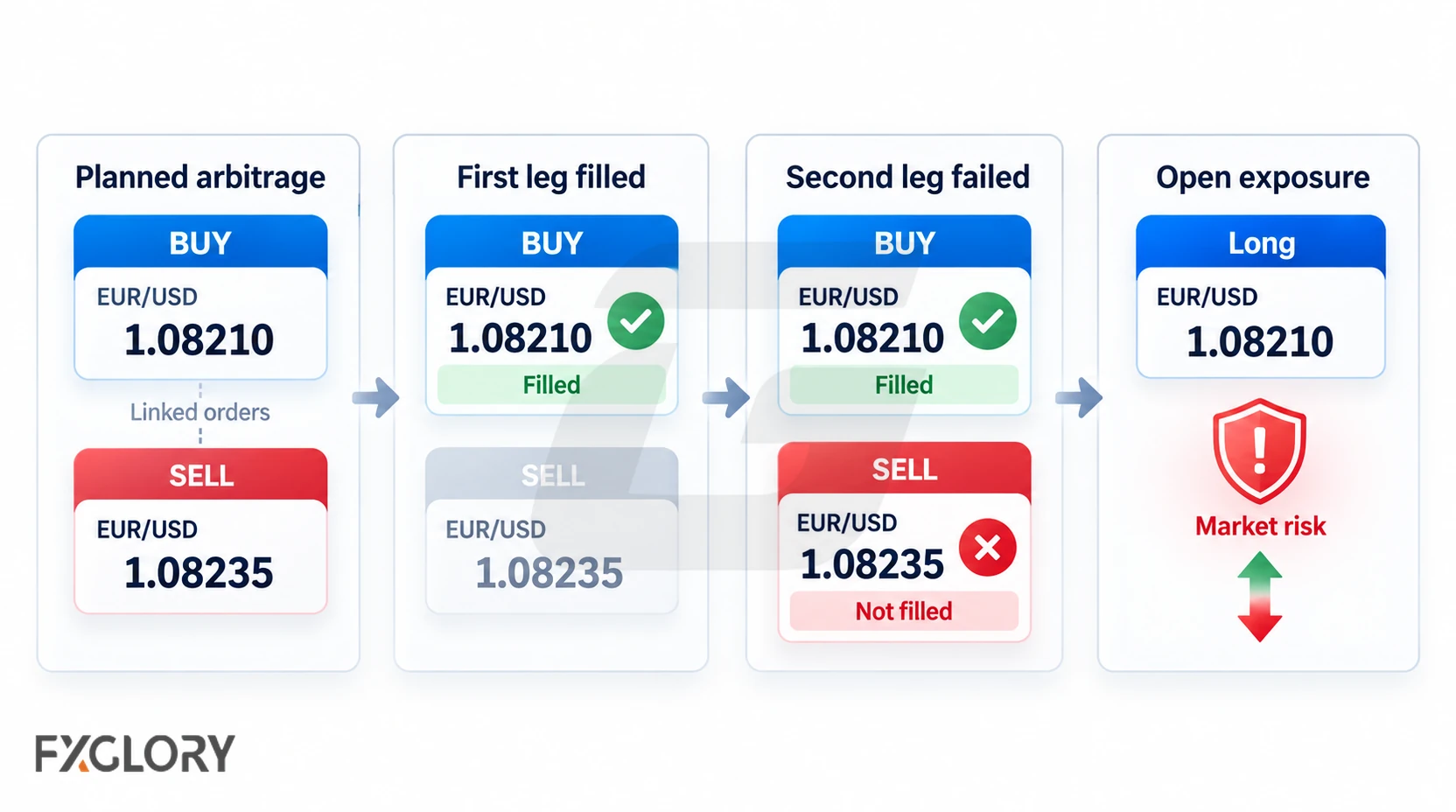
This matters because the trader entered with an arbitrage idea, not a directional view. If the full structure does not complete, the trader needs a rule for closing, adjusting, or cancelling the remaining exposure. Waiting and hoping that the missing leg becomes available can turn an execution problem into market risk.
| Problem | What It Means | Required Rule |
|---|---|---|
| One order fills | The trader has exposure without the balancing leg. | Know whether to close, retry, or cancel the structure. |
| Second leg slips | The net difference disappears after a worse fill. | Use a maximum slippage rule. |
| Third leg fails | A triangular loop remains incomplete. | Have an incomplete-loop exit rule. |
| Liquidity drops | Expected price is not available for the planned size. | Do not increase size to force the result. |
| Trader delays exit | The failed arbitrage becomes a directional position. | Exit or manage based on the written failed-leg rule. |
For account-level rules around exposure, drawdown, margin, and failed execution, use the forex risk-management strategy guide.
Forex Arbitrage vs Carry, Hedging, And Correlation Trading
Several forex methods can look similar because they use more than one quote, pair, or position. The difference is the reason for the trade.
| Method | Main Question | Use The Dedicated Guide When |
|---|---|---|
| Forex arbitrage | Is there a current price discrepancy after costs? | The main issue is simultaneous execution and price mismatch. |
| Carry trade | Does the interest-rate and swap/rollover logic support the holding idea? | The main issue is rate differential, rollover, and exchange-rate risk. |
| Hedging | How is existing exposure reduced or reshaped? | The main issue is direct, partial, or cross-pair exposure control. |
| Fundamental strategy | Does the macro outlook support a currency bias? | The main issue is economic drivers, central banks, and strong-vs-weak currency logic. |
| Grid trading | How are multiple orders placed around a price area? | The main issue is grid levels, spacing, floating drawdown, and margin. |
Use carry-trade rules for rate-differential and rollover questions, hedging rules for exposure-control decisions, and fundamental strategy rules for macro currency-bias decisions.
Forex Arbitrage Decision Sequence
A forex arbitrage review should be written before the trader acts. The sequence below helps prevent a visible quote difference from becoming an emotional entry.
| Step | Decision | Reject If |
|---|---|---|
| 1. Identify mismatch | Compare related currency quotes or cross-rates. | The quotes are stale, delayed, or not comparable. |
| 2. Confirm source | Check that the prices are tradable, not only displayed. | The price is unavailable at execution size. |
| 3. Subtract costs | Review spread, slippage, and applicable charges. | The mismatch disappears after costs. |
| 4. Check execution | Review whether all legs can be completed quickly. | The trader cannot handle failed or partial fills. |
| 5. Check platform rules | Review account and platform conditions. | The assumed workflow is unclear or unsupported. |
| 6. Check margin | Review whether the account can support temporary exposure. | Margin pressure becomes unacceptable. |
| 7. Define failure rule | Write what happens if the structure does not complete. | The trader would wait and hope after a failed leg. |
| 8. Record result | Log timestamps, fills, spread, slippage, and net outcome. | The trade cannot be reviewed after completion. |
Execution-sensitive methods should be reviewed with platform workflow in mind. Use FXGlory trading platforms information for platform access and workflow review, and check trading account conditions before relying on a specific order-handling assumption.
No-Trade Conditions
A forex arbitrage idea should be skipped when the execution problem is larger than the price difference. The trader should not use leverage, speed, or larger size to force a weak mismatch into a trade.
- Skip when the price difference is smaller than spread, slippage, and total execution cost.
- Skip when quotes are stale, delayed, or not tradable at the shown level.
- Skip when one or more legs may not fill at the expected price.
- Skip when liquidity is too thin for the planned size.
- Skip when account or platform rules are unclear.
- Skip when margin cannot support temporary multi-leg exposure.
- Skip when the trader has no rule for rejected, partial, or delayed orders.
- Skip when the opportunity depends on exploiting an error, a stale quote, or an assumption that cannot be verified.
- Skip when the trader would hold a failed arbitrage position as a directional trade without a separate plan.
Testing And Review Before Live Trading
Forex arbitrage should be reviewed carefully before real-money use. The goal is not to find a screenshot of a past price gap. The goal is to learn whether the same process can identify current prices, subtract costs, handle execution, control failed legs, and document the result.
- Record the quote source, timestamp, pair, bid, ask, and spread.
- Record whether the quote was tradable or only visible.
- Record expected cost before any order is placed.
- Record order time, fill time, fill price, and slippage for each leg.
- Record whether all legs completed as planned.
- Record free margin, used margin, and maximum temporary exposure.
- Record whether the result was positive only before costs or positive after all costs.
- Record how rejected, delayed, or partial orders were handled.
- Record whether the same rules could be repeated under similar conditions.
When leverage affects failed-leg or temporary exposure, review leverage conditions before increasing position size. If the plan requires holding exposure after the arbitrage reason disappears, it should be reviewed as a separate trade, not as arbitrage.