

What Is A 4 Hour Forex Strategy?
A 4 hour forex strategy uses the H4 chart as the main chart for trade decisions. Each candle represents four hours of price movement, so the trader can review intraday structure without reacting to every small lower-timeframe fluctuation.
The 4H chart is often used for swing trades and slower intraday trades because it sits between the daily chart and the 1H chart. It can show pullbacks, breakouts, retests, trend structure, support and resistance, and candlestick confirmation with more detail than the daily chart, but with less noise than very low timeframes.
This page only covers H4 as the controlling setup chart. Daily context and 1H refinement are supporting roles, not replacements for the H4 trade plan. For the wider multi-day framework, use forex swing trading strategy.
4H Strategy vs Daily, 1H, Day Trading, And Swing Trading
The 4H chart can support several trading styles, but this page focuses on the H4 chart as the controlling setup timeframe. It should not be treated as a general timeframe-selection guide or a full swing-trading guide.
| Topic | Main Role | How The 4H Chart Fits | Main Risk |
|---|---|---|---|
| 4H forex strategy | H4 chart controls the setup | Defines structure, trigger, invalidation, stop, and target plan | Trading every H4 candle instead of waiting for a setup |
| Daily strategy | Daily candle controls the trade idea | Daily can provide context above the H4 setup | Letting H4 noise override daily structure |
| 1H strategy | 1H chart controls the setup | 1H may refine entries below H4 | Forcing 1H triggers without a valid H4 setup |
| Day trading | Same-day execution and review | H4 may provide structure, but the trade may last beyond one session | Ignoring swap, rollover, or holding risk |
| Swing trading | Multi-day movement between structure points | H4 often helps time swing entries and manage pullbacks | Using H4 entries without a larger swing context |
Use timeframe selection by style and risk when deciding whether H4 fits the trader's schedule and decision pace.
Why The 4H Chart Is Useful
The 4H chart is useful because it shows more intraday structure than the daily chart without forcing the trader to react to every 5M, 15M, or 1H fluctuation. It can help traders see pullbacks, breakouts, retests, and level reactions with enough detail to plan a trade, while still requiring patience between candles.
The trade-off is speed. H4 signals form slowly, and a setup may take several candles to confirm or fail. The trader must manage the trade from H4 invalidation and planned review points, not from every lower-timeframe move.
Why The 4H Chart Matters In Forex
Because forex trades across global sessions, each H4 candle can contain a meaningful block of session activity. That makes the H4 close more useful than a random intraday snapshot when the strategy depends on completed-candle confirmation.
| 4H Feature | Practical Effect | Risk To Control |
|---|---|---|
| Fewer candles than 1H | Less frequent decision-making | Entering early before the 4H candle closes |
| More detail than daily | Pullbacks, retests, and intraday structure become clearer | Overriding daily context with small H4 fluctuations |
| Session-sized movement | One candle can reflect a meaningful trading block | News or session changes can distort the candle |
| Wider structure than lower charts | Stops may be more logical than very tight lower-timeframe stops | Position size must adjust to the wider stop |
| Possible multi-day holding | Targets may need several H4 candles to develop | Swap, rollover, weekend, and margin exposure |
4H Candle Close: When The Signal Is Valid
A 4H strategy should define whether a signal is valid during the candle or only after the candle closes. An unfinished H4 candle can look like a breakout, rejection, doji, inside bar, engulfing candle, or trendline break before closing differently.
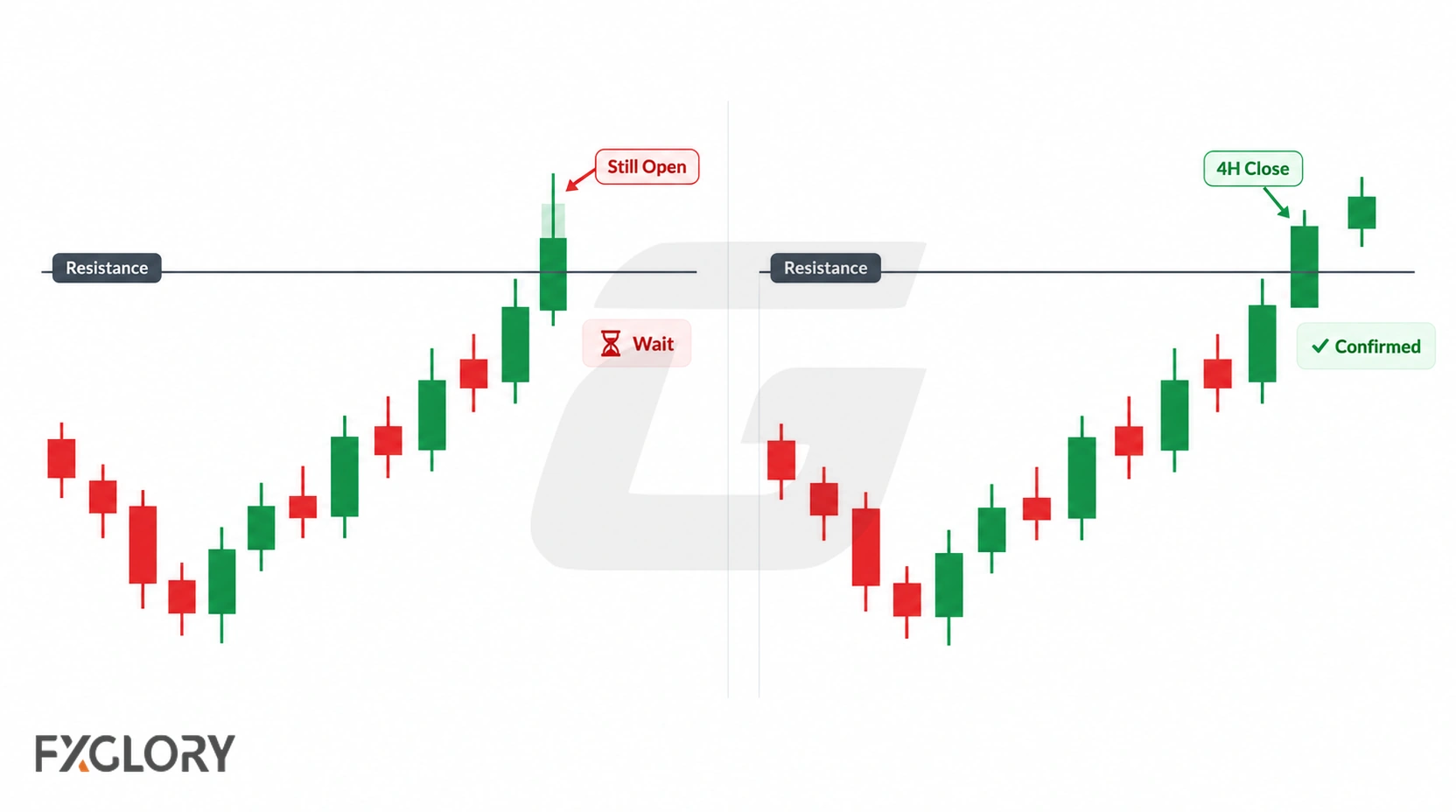
| Signal Type | What Can Go Wrong Before Close | Rule To Define |
|---|---|---|
| H4 breakout | Price breaks the level but closes back inside | Decide whether the strategy needs an H4 close beyond the level |
| H4 rejection wick | The wick may lose meaning before the candle closes | Use completed-candle confirmation if the setup depends on rejection |
| H4 engulfing candle | The body may shrink or fail before close | Do not treat the pattern as valid until the candle is complete |
| H4 inside bar | The candle may break the mother-bar range before close | Define whether inside-bar logic needs completed structure |
| 1H trigger under H4 | Lower-timeframe entry may appear before the H4 setup is valid | Use 1H only if the H4 structure still supports the trade |
Different platforms may form H4 candles at different server times. The trading plan should use one consistent chart source for testing, signal review, and trade management.
Daily Context, 4H Setup, Optional 1H Refinement
A strong 4H strategy separates chart roles. The daily chart can define major trend, range, support, resistance, and larger market condition. The 4H chart defines the setup. The 1H chart may refine the entry only if the H4 setup remains valid.
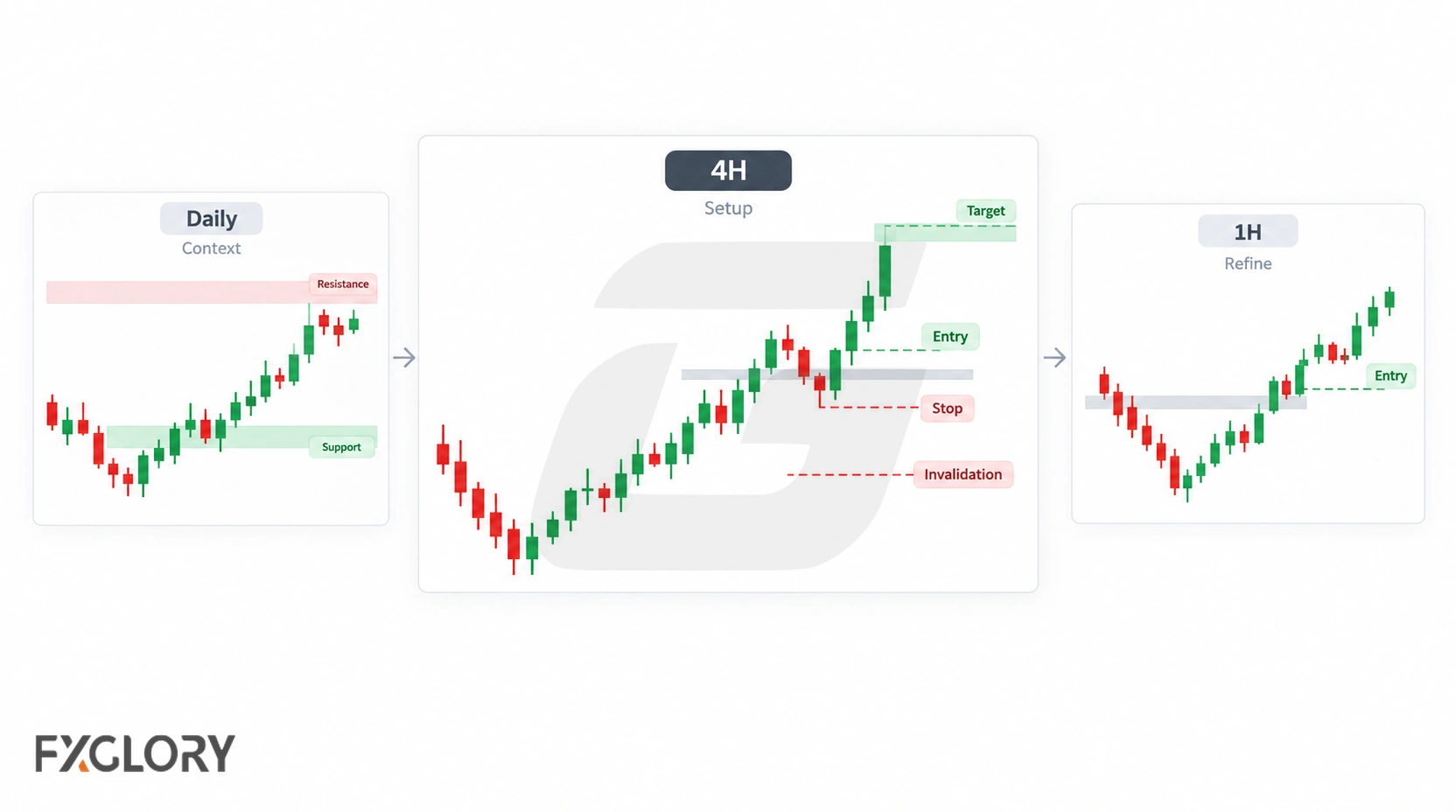
| Timeframe | Role | Rule |
|---|---|---|
| Daily | Major trend, larger support and resistance, broad market condition | Do not take H4 trades directly into a major daily barrier without a plan |
| 4H | Main setup, candle confirmation, invalidation, stop, and target planning | The 4H chart controls whether the trade idea exists |
| 1H | Optional entry refinement or tighter timing | Use only if the 4H setup is already valid |
| Conflict case | 1H gives a trigger but H4 structure has failed | Skip; the lower timeframe cannot repair a broken H4 setup |
Use daily, 4H, and 1H role separation when the strategy depends on more than one chart.
4H vs Daily vs 1H: Which Chart Controls What?
A 4H strategy becomes weaker when the trader changes the controlling chart after seeing a signal. The chart roles should be set before entry.
| Chart | Best Role In This Strategy | What It Should Not Do |
|---|---|---|
| Daily | Define larger context, major levels, and whether the H4 setup is trading into a stronger obstacle | Become a reason to ignore a broken H4 setup after entry |
| 4H | Control setup, signal, invalidation, stop zone, target planning, and review rhythm | Be ignored because a lower-timeframe candle looks attractive |
| 1H | Optionally refine timing below a valid H4 setup | Create a trade when the H4 setup is unclear or invalid |
| Lower than 1H | May show execution detail for advanced traders with written rules | Turn a slow H4 plan into reactive scalping |
Daily gives the broader map. H4 gives the setup. 1H may help timing. If those roles are mixed during a live trade, the strategy becomes difficult to test or manage.
4H Review Schedule: Which Candle Closes Matter?
A 4H strategy should have planned review times. The trader does not need to watch every tick, but should know which H4 candle closes matter for setup validation, stop review, target review, or cancellation.
| Review Point | What To Check | What To Avoid |
|---|---|---|
| Before the H4 close | Mark levels and prepare the possible decision | Entering early if the strategy requires candle-close confirmation |
| At the H4 close | Confirm whether the candle supports the setup or cancels it | Calling an unfinished move a valid signal |
| After entry | Review only at written management points unless risk rules require action | Changing the plan after every 1H fluctuation |
| Before major news | Decide whether to hold, reduce, avoid, or wait | Assuming the H4 setup will survive high-impact events |
| Before rollover or weekend | Review swap, gap risk, margin, and holding plan | Leaving exposure open without a weekend or rollover rule |
Use alerts around planned H4 levels and candle-close review points if the strategy cannot be monitored continuously. A missed review is not a reason to chase the next candle.
4 Hour Forex Strategy Rule Sequence
A 4H forex strategy should follow a fixed sequence. Starting with a candle pattern or indicator signal before checking daily context can create weak trades.
- Check daily context: review trend, range, major support, resistance, and upcoming event risk.
- Define the H4 market condition: trend, pullback, breakout, retest, range, consolidation, reversal attempt, or unclear.
- Mark the H4 decision area: support, resistance, trendline, range edge, moving-average area, breakout level, or retest zone.
- Wait for the H4 trigger: candle close, rejection, retest hold, structure shift, breakout confirmation, or price-action signal.
- Define invalidation: write where the H4 idea is wrong before entry.
- Measure stop distance: use the invalidation area to calculate stop and position size.
- Check target room: the next H4 or daily level should leave enough room after spread and slippage.
- Check holding conditions: review news, swap, rollover, weekend exposure, margin, and leverage.
- Record the plan: entry, stop, target, no-trade condition, and review candle should be written before live risk.
Use risk rules based on the H4 stop distance before testing any live setup.
Best 4H Strategy Types
The 4H chart can support several strategy types. The setup should come from market condition, not from a fixed belief that one H4 pattern or one indicator works in every market.
| 4H Strategy Type | Best Used When | Main Risk | Internal Guide |
|---|---|---|---|
| 4H trend pullback | Daily direction is clear and H4 pulls back into structure | Entering after the larger trend is exhausted | trend and pullback logic |
| 4H breakout and retest | Price breaks an H4 level and returns to test it | False breakout or failed retest | H4 retest decisions |
| 4H support or resistance rejection | H4 candle reacts at a major level | Trading a candle away from meaningful structure | level rejection rules |
| 4H range or consolidation setup | Price rotates between clear H4 boundaries | Range breaks during news or session change | range-bound rules |
| 4H candlestick confirmation | Completed H4 candle confirms rejection, continuation, or failure | Using one candle pattern without context | H4 price-action confirmation |
| 4H indicator filter | Trend, momentum, or volatility needs a defined filter | Letting an indicator replace invalidation | indicator role planning |
No H4 setup type should be used in every condition. A trend pullback, range reaction, breakout retest, and reversal attempt each need different invalidation and management rules.
4H Trend Pullback Strategy
A 4H trend pullback strategy looks for continuation after price retraces into a defined area inside a larger move. The daily chart can help decide whether the broader direction is still valid, while the H4 chart defines the pullback, trigger, stop, and target.
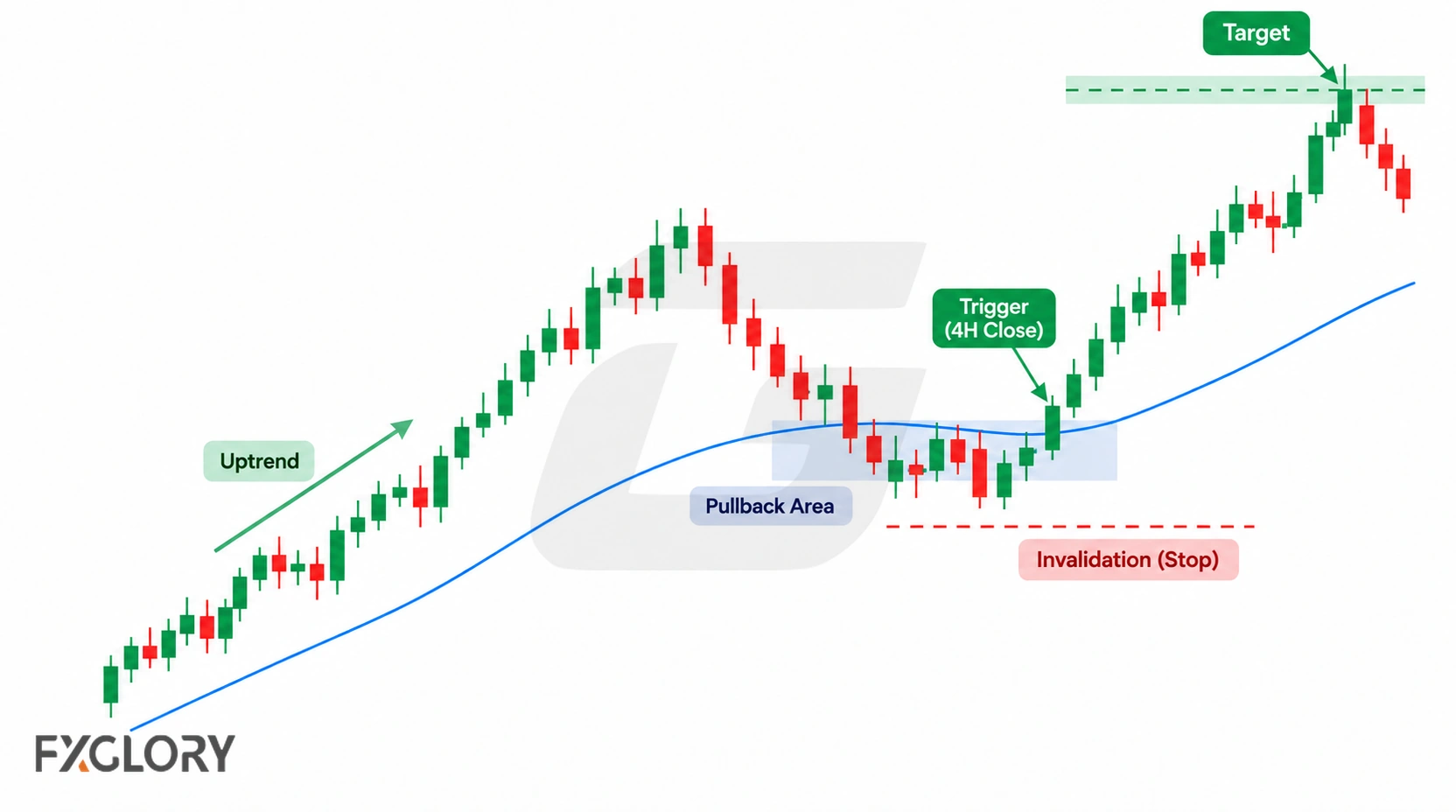
- Check whether daily direction supports the H4 idea.
- Wait for H4 price to pull back into a level, prior swing, trendline, moving-average area, or support and resistance zone.
- Check whether the pullback is controlled or whether it breaks the trend structure.
- Wait for a completed H4 trigger such as rejection, engulfing candle, structure shift, or breakout from the pullback.
- Place invalidation where the H4 continuation idea fails.
Use pullback planning when the setup depends mainly on retracement and continuation.
4H Breakout And Retest Strategy
A 4H breakout and retest strategy waits for price to break an H4 level, range edge, trendline, or structure area, then return to test the broken level. The retest helps decide whether the broken area is being accepted by the market.
The key risk is a false breakout. A 4H candle can break a level during one session and close back inside the prior structure later. A breakout should not be accepted only because price briefly moved beyond the level.
| Breakout Step | What To Check | Skip If |
|---|---|---|
| Break | Does the H4 candle close beyond the level with enough target room? | The candle closes directly into the next daily or H4 obstacle |
| Retest | Does price return to the broken level and hold the new side? | Price overlaps the level repeatedly without clarity |
| Trigger | Is there rejection, close behavior, or structure shift after the retest? | The entry depends only on touching the level |
| Invalidation | Where is the breakout idea wrong? | The stop has no logical structure behind it |
Use the wider breakout framework when the setup depends mainly on expansion outside a level or range.
4H Support And Resistance Rejection
A 4H support and resistance rejection setup reviews how a completed H4 candle behaves around a known level. The level may come from a daily area, H4 swing, range edge, retested breakout level, or visible supply and demand zone.
- Do not trade a rejection candle if the level was drawn after the candle formed.
- Do not enter at the middle of a range when the next obstacle is close.
- Do not use a long wick as confirmation if the H4 candle has not closed.
- Do not ignore a nearby daily level that blocks the target.
Use support and resistance around H4 decision areas when the setup depends on level rejection, breakout, or retest behavior.
4H Candlestick Confirmation And Pattern Risk
H4 candlestick confirmation can help with timing, but it should not replace context. A doji, inside bar, engulfing candle, pin bar, or multi-candle pattern only matters when it forms at a meaningful level and gives a clear invalidation point.
Some H4 systems use named patterns such as Doji Sandwich formations. Treat those as testable candle structures, not standalone signals. A named pattern may trigger review, but structure decides whether the trade exists.
| H4 Candle Pattern | Useful Role | Weak Use |
|---|---|---|
| Doji or indecision candle | Shows hesitation at a level | Trading every doji without structure |
| Inside bar | Shows compression before possible expansion | Using inside bars in messy price action |
| Engulfing candle | Can show a shift in control after a pullback or rejection | Entering after a large candle directly into the next obstacle |
| Pin bar or rejection candle | Can show failed continuation beyond a level | Using a wick away from support or resistance |
| Named pattern system | Can organize a repeatable test if rules are written | Treating one named pattern as a complete strategy |
Use forex candlestick strategy when the setup depends mainly on completed candle patterns.
4H No-Indicator Price Action Workflow
A 4H strategy can be built without indicators if the trader uses structure, levels, candle closes, invalidation, and risk rules. No-indicator trading does not mean no rules. It only means the chart decision comes from price behavior rather than indicator signals.
- Mark daily and H4 support and resistance before looking for entries.
- Identify whether H4 structure is trending, ranging, breaking out, pulling back, or unclear.
- Wait for a completed H4 candle that confirms the selected setup type.
- Define invalidation from structure, not from a random pip distance.
- Check target room before entry.
- Skip if the price action can be interpreted in several conflicting ways.
Use H4 price-action confirmation when candle behavior, rejection, and structure are the main tools.
4H Moving Average And Indicator Filters
Indicators can support a 4H strategy when each one has a defined role. They should not replace the H4 setup, invalidation, or stop logic.
| Tool | Useful Role On 4H | Weak Use |
|---|---|---|
| Moving average | Trend filter or dynamic reference area | Entering every touch without price confirmation |
| ATR | Volatility check for stop distance and target realism | Using the same stop size in every volatility condition |
| RSI or stochastic | Momentum or exhaustion review near structure | Buying or selling only because the reading looks high or low |
| Multiple moving averages | Directional filter if trend structure supports it | Treating a crossover as a complete strategy |
If an indicator becomes the main reason for the trade, use forex indicator strategies to define its role before testing.
4H Strategy Example Flow
The following example shows a decision sequence only. It is not a trading signal or a recommendation to trade a specific pair.
| Step | Example Flow | Decision |
|---|---|---|
| Daily context | The daily chart shows an uptrend and price is not directly into major resistance | Only bullish H4 setups are reviewed |
| H4 pullback | Price pulls back into a prior H4 support area or trend structure | Wait for a completed H4 trigger |
| H4 confirmation | A completed H4 rejection or engulfing candle forms at the level | Review only after the candle closes if the strategy requires confirmation |
| Invalidation | The idea fails if price accepts below the H4 support structure | Stop logic must be based on that invalidation |
| Target | The next H4 or daily resistance leaves enough room after spread | Skip if the target is too close |
| Risk check | News, spread, swap, margin, leverage, and weekend exposure are reviewed | Resize, wait, or skip if conditions weaken the plan |
| Review | The trade is reviewed after the next H4 close or written management point | Do not change the plan after every 1H fluctuation |
The same sequence can be adapted for bearish pullbacks, breakout retests, range reactions, or failed breaks. Direction changes; context, trigger, invalidation, and risk control do not.
Session, Pair, And Holding-Time Rules
The H4 chart is affected by session rhythm. A 4H candle may include part of one session, a full session block, or a transition into another active period depending on the platform's candle timing. This can affect candle shape, spread behavior, liquidity, and volatility.
| Factor | Why It Matters On 4H | Decision |
|---|---|---|
| Session rhythm | H4 candles may capture different market activity blocks | Test setups around the sessions relevant to the pair |
| Pair behavior | Some pairs trend, range, or spike differently across sessions | Test each pair instead of assuming one H4 setup fits all |
| Spread | Usually less dominant than scalping but still affects entries and targets | Skip if spread is large relative to the target |
| Holding time | Targets may take several H4 candles to reach | Plan for rollover, swap, news, and weekend exposure |
| Review schedule | H4 setups need scheduled candle-close review | Use alerts or choose a slower timeframe if H4 closes cannot be monitored |
Review FXGlory spreads when the planned H4 target is close, and use scheduled-event checks when a 4H setup forms before important data releases.
Entry, Stop, Target, And Trade Management On 4H Charts
A 4H trade should have its stop and target planned before entry. The stop should mark where the H4 idea is invalid, not where the loss feels comfortable.
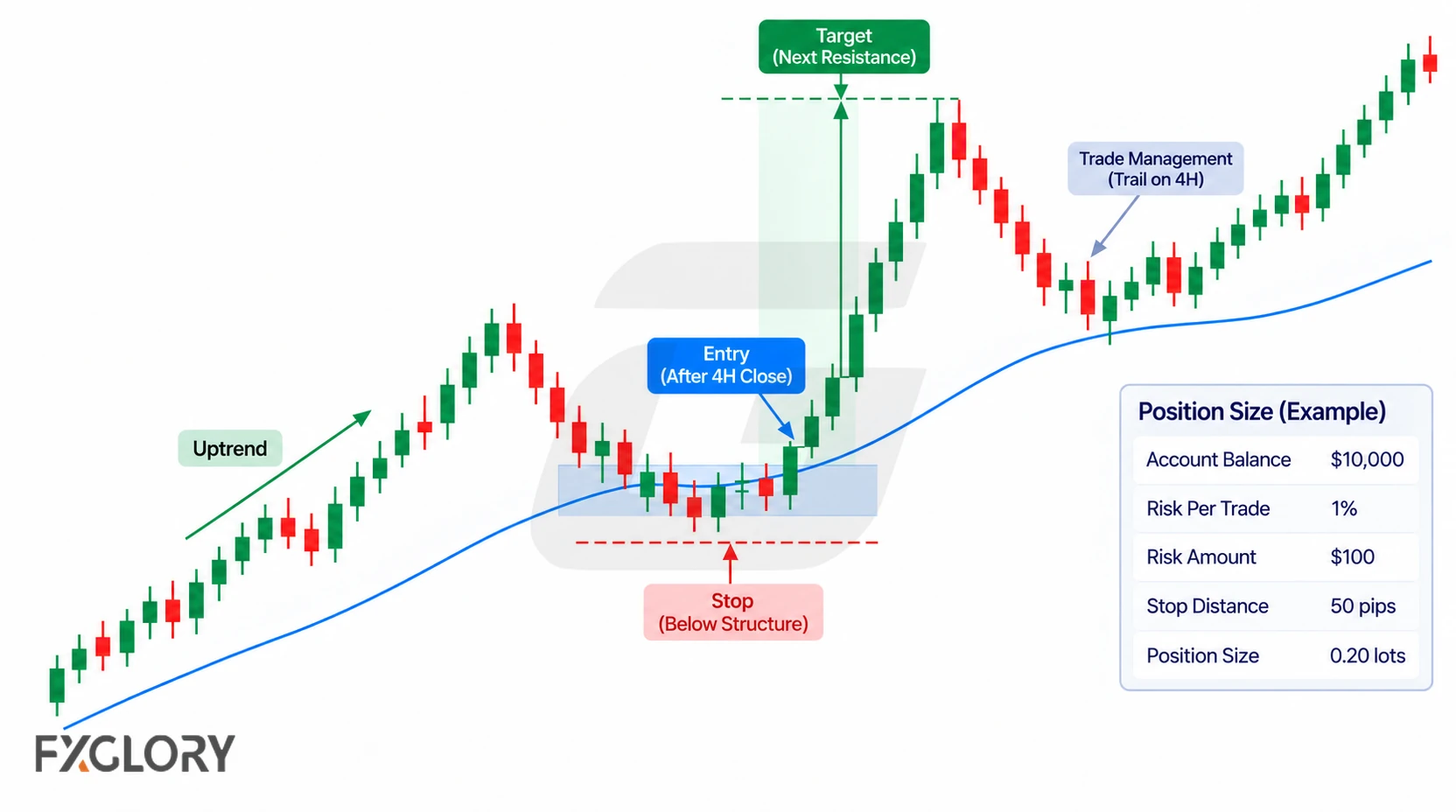
| Rule | 4H Example | Risk Check |
|---|---|---|
| Entry | H4 close, retest, rejection candle, or optional 1H refinement | Entry should follow the written setup, not fear of missing the candle |
| Stop | Beyond H4 swing, level, retest structure, or range boundary | Stop should mark invalidation, not a random tight distance |
| Target | Next H4 or daily level, prior swing, range edge, or measured move | Target should leave room after spread and slippage |
| Management | Review at the next H4 close or written management point | Do not react to every 1H fluctuation if H4 controls the trade |
| Position size | Calculated after stop distance is known | Do not increase size because the H4 setup looks clean |
Use the FXGlory margin calculator after the H4 stop distance is known, and review leverage conditions before increasing exposure.
News, Spread, Swap, Margin, Leverage, And Weekend Risk
Four-hour strategies can stay open across several market sessions. A setup that looks valid on the chart can become weak after news, swap, spread, slippage, margin, or weekend exposure is included.
| Condition | Why It Matters On 4H | Decision It Should Change |
|---|---|---|
| Spread | Can still reduce target room if the H4 target is close | Accept, wait, or skip if cost is too high |
| Slippage | Fast moves around news can change entry and stop quality | Avoid entering after sudden spikes without a plan |
| Swap or rollover | H4 trades may stay open overnight | Review holding cost before entry |
| News | High-impact events can invalidate clean H4 setups | Delay, reduce risk, or skip |
| Margin | Multi-session positions can tie up capital | Resize or skip if exposure is too large |
| Leverage | Losses can accelerate when stop distance and position size are mismatched | Reduce size or skip if margin pressure becomes excessive |
| Weekend exposure | Price can reopen away from the prior close | Decide before Friday close whether the trade should remain open |
What Makes A 4H Setup Weak?
A weak H4 setup usually fails before entry. The candle may look clear, but the surrounding structure or trading conditions do not support the trade.
- No daily context: the H4 signal appears directly against major daily structure.
- Unfinished candle: the trader enters before the H4 candle confirms the signal.
- No clear H4 level: the trigger appears in the middle of noise instead of near structure.
- Late entry: price has already moved far from the stop area.
- Poor target room: the next H4 or daily obstacle is too close.
- News nearby: the setup may be distorted before it can develop.
- 1H forcing: a lower-timeframe signal is used to justify a weak H4 setup.
- Indicator dependency: the trade exists only because an indicator flashed, not because structure supports it.
- Unplanned holding risk: the trade may cross rollover, major news, or the weekend without rules.
No-Trade Conditions
Most H4 candles should produce no trade because one completed candle is not a setup unless it appears at the planned level, in the planned context.
- Skip if daily context conflicts with the H4 setup.
- Skip if the H4 candle has not closed and the strategy requires candle confirmation.
- Skip if the H4 level is unclear or drawn after the signal appears.
- Skip if the entry is far from invalidation after a large candle.
- Skip if the next daily or H4 level is too close after spread and slippage.
- Skip if a high-impact news event can distort the setup.
- Skip if swap, rollover, weekend, or margin exposure changes the trade plan.
- Skip if the 1H chart is creating a trade that the H4 chart does not support.
- Skip if the stop is too tight for normal H4 movement.
- Skip if the trader cannot monitor the planned H4 close or management point.
Backtesting Notes For 4 Hour Forex Strategy
This numerical review uses one hypothetical educational rule model: an H4 EMA trend-pullback setup with previous completed daily trend context, H4 candle-close confirmation, ATR-based stop placement, a 2R target comparison, a trend-failure exit, and spread/slippage sensitivity. It does not test H4 breakout retests, range rejections, candlestick-only patterns, no-indicator workflows, lower-timeframe scalping entries, or discretionary 1H refinements.
The model reviews EURUSD, GBPUSD, USDJPY, AUDUSD, USDCAD, and USDCHF using public yfinance 60-minute OHLC data resampled into 4-hour candles where available. yfinance intraday history is usually shorter than daily history, so the actual available data span is recorded in the summary file for each pair.
| Rule Area | Educational Model Rule |
|---|---|
| Strategy type | H4 EMA trend pullback continuation |
| Daily context | Previous completed daily close, daily EMA(50), daily EMA(100), and daily EMA(50) slope must support the trade direction |
| Long H4 trend filter | H4 close above EMA(50), with EMA(50) rising over 3 completed H4 candles |
| Short H4 trend filter | H4 close below EMA(50), with EMA(50) falling over 3 completed H4 candles |
| Pullback window | Previous 6 H4 candles must include a pullback into the EMA(20) area |
| Long confirmation | Signal candle trades into the EMA(20) area, closes above EMA(20), closes above its open, and is not more than 0.75 ATR(14) above EMA(20) |
| Short confirmation | Signal candle trades into the EMA(20) area, closes below EMA(20), closes below its open, and is not more than 0.75 ATR(14) below EMA(20) |
| Entry | Next H4 open after the completed signal candle |
| Stop | Beyond the pullback-window extreme with a 0.25 ATR(14) buffer |
| Target comparison | Fixed 2R target from entry |
| Trend-failure exit | Exit at H4 close if price closes through H4 EMA(50) against the trade direction after entry |
| Maximum holding review | 18 H4 candles after entry |
The review records trade count, win rate, average win in R, average loss in R, expectancy in R, profit factor, maximum drawdown in R, worst losing streak, average holding period, pair-level behavior, direction-level behavior, exit reasons, and spread/slippage sensitivity.
| Cost Input | Assumptions Used |
|---|---|
| Spread | 0.5, 1.5, and 3.0 pips |
| Slippage | 0.1, 0.5, and 1.0 pips per side |
| Baseline comparison | 1.5-pip spread and 0.5-pip slippage per side |
| Swap and rollover | Not included |
Educational Sensitivity-Test Results
The hypothetical backtest used public yfinance 60-minute OHLC data resampled into 4-hour candles. The baseline cost assumption used a 1.5-pip spread and 0.5-pip slippage per side. The hourly data available across pairs began as early as 2023-09-11T23:00:00 and ended as late as 2026-06-29T09:00:00. The baseline result was negative, with expectancy of -0.0855R and total net result of -40.8902R.
| Metric | Baseline Result |
|---|---|
| Number of trades | 478 |
| Win rate | 30.75% |
| Average win | 1.5058R |
| Average loss | -0.7923R |
| Expectancy | -0.0855R |
| Profit factor | 0.8441 |
| Maximum drawdown | -53.3897R |
| Worst losing streak | 20 |
| Average holding period | 7.15 H4 candles |
| Median holding period | 5.0 H4 candles |
| Total net result | -40.8902R |
| Pair | Trades | Win Rate | Expectancy | Profit Factor | Max Drawdown | Total Net R |
|---|---|---|---|---|---|---|
| AUDUSD | 87 | 31.03% | -0.1052R | 0.8031 | -10.7748R | -9.1535R |
| EURUSD | 77 | 23.38% | -0.189R | 0.6823 | -16.3605R | -14.5496R |
| GBPUSD | 58 | 31.03% | -0.0382R | 0.9312 | -13.3663R | -2.2132R |
| USDCAD | 75 | 33.33% | -0.0594R | 0.8896 | -10.4752R | -4.4555R |
| USDCHF | 87 | 28.74% | -0.0988R | 0.8255 | -17.4862R | -8.5974R |
| USDJPY | 94 | 36.17% | -0.0204R | 0.9601 | -11.4856R | -1.921R |
| Direction | Trades | Win Rate | Expectancy | Profit Factor | Max Drawdown | Total Net R |
|---|---|---|---|---|---|---|
| Long | 289 | 30.45% | -0.1253R | 0.777 | -43.7082R | -36.2244R |
| Short | 189 | 31.22% | -0.0247R | 0.9532 | -26.0521R | -4.6658R |
| Spread (pips) | Slippage Per Side (pips) | Expectancy | Profit Factor | Max Drawdown | Total Net R |
|---|---|---|---|---|---|
| 0.5 | 0.1 | -0.0355R | 0.9311 | -45.6954R | -16.9593R |
| 0.5 | 0.5 | -0.0577R | 0.891 | -49.1151R | -27.5953R |
| 0.5 | 1.0 | -0.0855R | 0.8441 | -53.3897R | -40.8902R |
| 1.5 | 0.1 | -0.0633R | 0.8814 | -49.97R | -30.2543R |
| 1.5 | 0.5 | -0.0855R | 0.8441 | -53.3897R | -40.8902R |
| 1.5 | 1.0 | -0.1134R | 0.8002 | -64.5775R | -54.1852R |
| 3.0 | 0.1 | -0.105R | 0.8131 | -61.0638R | -50.1967R |
| 3.0 | 0.5 | -0.1273R | 0.7794 | -70.4336R | -60.8326R |
| 3.0 | 1.0 | -0.1551R | 0.7397 | -82.1459R | -74.1276R |
| Exit Reason | Count |
|---|---|
| h4 ema50 trend failure close | 148 |
| stop first same bar | 1 |
| stop loss | 171 |
| target 2r | 95 |
| time exit | 63 |
Testing And Review Checklist
Four-hour strategies should be tested by setup type. A 4H trend pullback, breakout retest, range reaction, candlestick setup, and indicator-filter setup should not be mixed into one result unless the rules are identical.
- Choose the setup type: trend pullback, breakout retest, support or resistance rejection, range setup, candlestick confirmation, no-indicator price action, or indicator filter.
- Define daily context: daily trend, daily level, range, or no-trade condition.
- Mark the H4 structure: support, resistance, trendline, range edge, moving-average area, or breakout level.
- Write the trigger: H4 close, rejection, retest hold, structure shift, or optional 1H refinement.
- Write invalidation: the price or structure that cancels the H4 idea.
- Measure stop and target: compare stop distance with target room after spread and slippage.
- Record trading conditions: session, pair, spread, swap, news, margin, leverage, weekend risk, and holding time.
- Record skipped setups: weak context, unfinished candles, poor target room, news risk, late entry, and lower-timeframe forcing should be reviewed too.
- Review enough examples: collect at least 30 to 50 examples per H4 setup type before drawing conclusions, without treating past samples as proof of future performance.
- Record mistake tags: early entry, ignored daily context, forced 1H entry, traded news, stop too tight, target too close, oversized position, or unplanned weekend hold.