

What Is A Daily Time Frame Forex Trading Strategy?
A daily time frame forex trading strategy uses the daily chart as the main chart for trade decisions. Each candle represents one trading day, so the trader reviews daily market structure, daily support and resistance, daily candle behavior, daily invalidation, and daily stop distance before considering an entry.
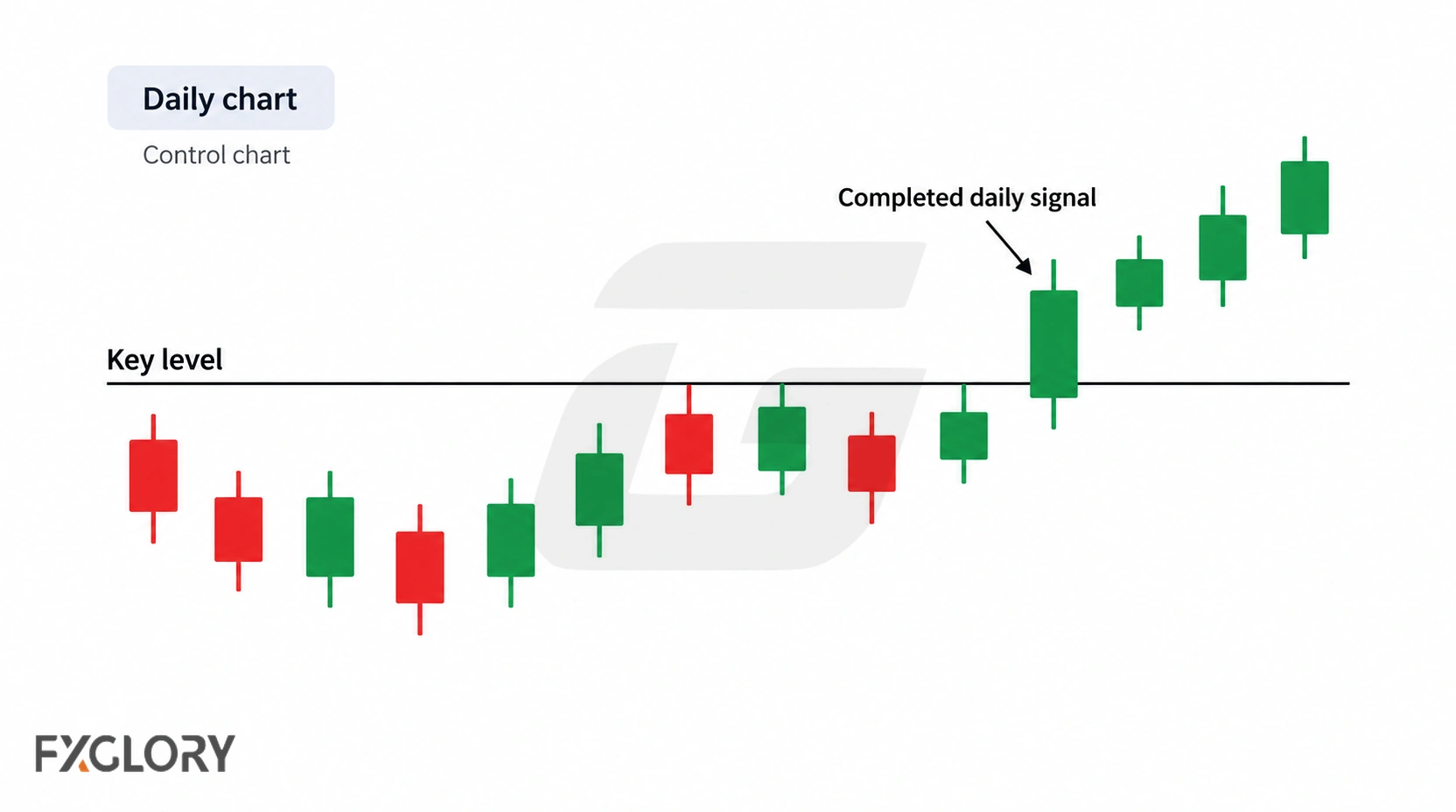
Unlike a strategy that uses daily levels only as background for intraday trades, this approach evaluates signals and failure conditions against daily structure. Lower timeframes may refine an entry when the written rules allow it, but cannot repair a daily setup that has failed.
Because a daily candle summarizes intraday movement, the chart does not reveal the order of every price move within that day. The trading plan must account for that visibility limit and the exposure that continues between scheduled reviews.
Daily Time Frame Strategy vs Best Time Frame vs Swing Trading
Trading from the daily chart differs from choosing a chart interval or following a particular holding style. A daily-chart setup is defined by its signal and invalidation rules; how long the trade remains open depends on its separate exit rules.
| Topic | Main Question | How This Page Treats It |
|---|---|---|
| Daily time frame strategy | How do I trade using the daily chart as the main decision chart? | Focuses on daily structure, daily signals, daily invalidation, and daily review |
| Best time frame to trade forex | Which timeframe fits my style, risk, and schedule? | Use the timeframe selection guide for that comparison |
| Swing trading | How do I trade multi-day swings between structure points? | Use the swing trading guide when the setup depends on swing highs and lows |
| Long-term trading | How do I hold positions for longer macro or trend moves? | Use the long-term trading guide for extended holding-period risk |
| Day trading | How do I open and close trades within the same day? | Daily chart context can help, but day trading needs separate intraday entry and exit rules |
Daily signals can support swing or longer-term plans, but a holding-period label does not specify the entry, invalidation, or exit method. Use the relevant specialist guide when those rules, rather than the daily-chart setup, are the main question.
Daily Candle Close: When The Signal Is Valid
A daily chart strategy usually depends on the completed daily candle. Before the candle closes, the shape can change. A candle that looks like rejection during the session can close weak. A breakout that looks clear intraday can close back inside the prior structure.
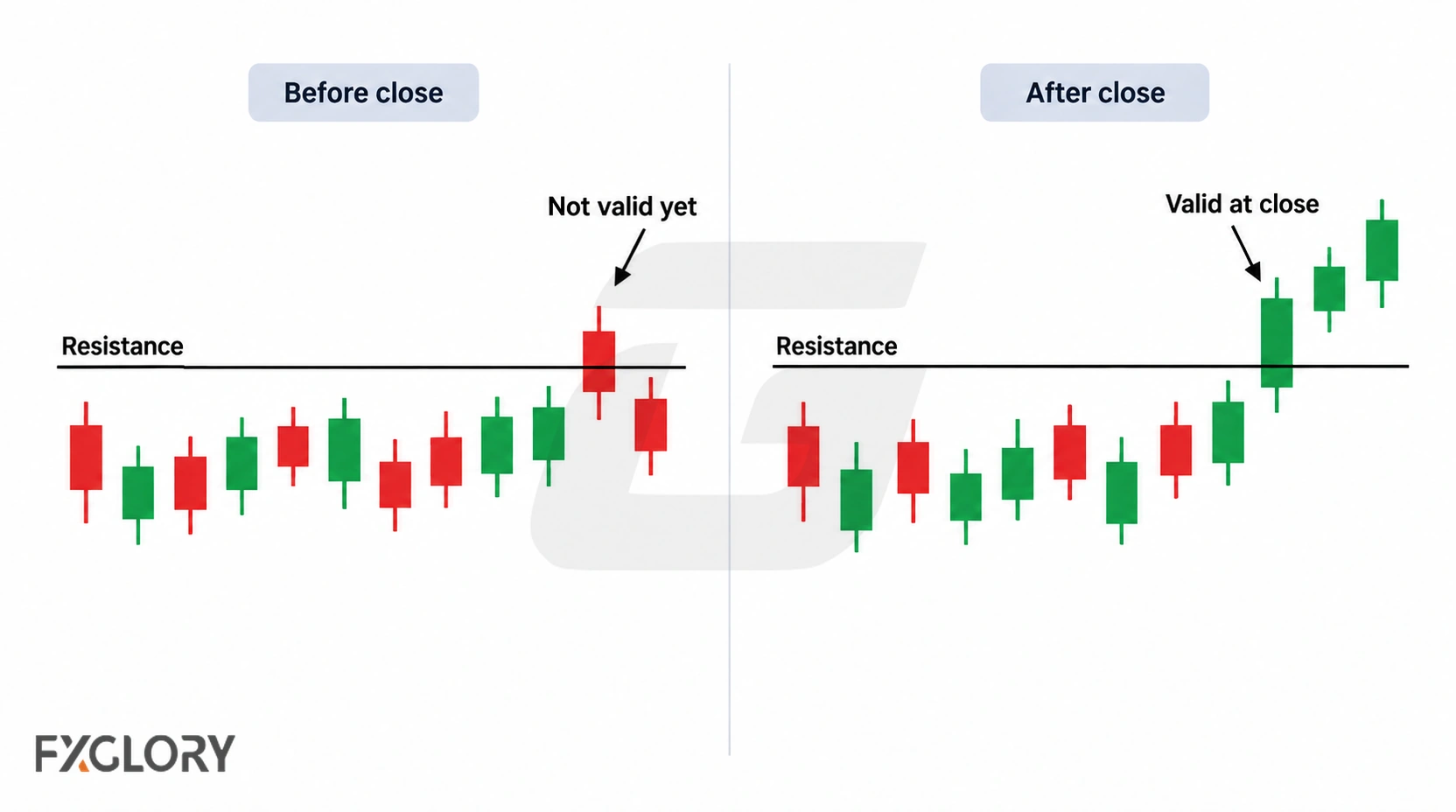
The daily candle close should be defined before testing. Some traders review the chart after the daily session close. Others use a specific platform server close. The important point is consistency: the same daily close logic should be used for marking signals, testing examples, and managing trades.
| Situation | What Can Go Wrong | Decision Rule |
|---|---|---|
| Unfinished rejection candle | The wick may disappear before the daily close | Wait if the strategy requires completed-candle confirmation |
| Intraday breakout | Price may close back inside the prior level | Use a daily close rule before calling it a daily breakout |
| Lower-timeframe signal before daily close | The 4H signal may conflict with the final daily candle | Use the lower timeframe only if the daily setup remains valid |
| Different platform close times | Daily candle shapes may differ between platforms | Test and manage the strategy with one consistent daily close source |
Why The Daily Chart Changes The Trade Plan
The daily chart changes the trade plan because every signal takes more time to form. A daily candle includes a full day of price movement, which can make levels and structure easier to review than lower-timeframe candles. The trade-off is that daily setups usually appear less often and can require wider invalidation.
| Daily Chart Feature | Practical Effect | Risk To Control |
|---|---|---|
| Fewer candles | Less frequent decisions and fewer setups | Boredom trades when no valid setup appears |
| Larger candle range | Stops may need more room behind structure | Oversized positions if stop distance is ignored |
| Cleaner structure | Major levels can be easier to identify | Ignoring intraday volatility around the level |
| Longer holding time | Trades may remain open for several days | Swap, rollover, news, and weekend exposure |
| Slower feedback | The trader has more time to plan | Changing the plan between candle closes |
Daily Chart Rule Sequence
Use this pre-entry sequence to separate market assessment, signal checks, risk calculation, and documentation. The practical sizing details appear later.
- Start with weekly context: review whether the pair is trending, ranging, reversing, or approaching a major higher-timeframe level.
- Mark daily structure: identify daily support, resistance, swing highs, swing lows, trendlines, range edges, or breakout zones.
- Wait for the daily candle close: avoid making a daily-chart decision before the candle has formed, unless the strategy specifically allows intraday refinement.
- Identify the setup type: continuation, rejection, breakout, retest, pullback, range trade, or no trade.
- Define invalidation: write the price or structure that cancels the daily idea.
- Measure stop distance: use the daily invalidation level to estimate the stop before position size is calculated.
- Check target room: the next daily or weekly level should leave enough room after spread and slippage.
- Check trading conditions: review swap, margin, news events, weekend exposure, and leverage before the position is opened.
- Record the plan: entry, stop, target, no-trade condition, and review date should be written before live risk.
Use risk rules based on the daily stop distance before testing any live setup.
End-Of-Day Daily Chart Routine
Schedule the watchlist scan, setup check, order planning, and journaling around one chosen chart closing time. This helps distinguish planned reviews from impulsive intraday adjustments.
| Routine Step | What To Do | What To Avoid |
|---|---|---|
| Weekly scan | Check higher-timeframe trend, range, major levels, and event risk | Taking a daily signal directly into a weekly obstacle |
| Daily close review | Review the completed daily candle and update levels | Entering from an unfinished candle that later changes shape |
| Watchlist pruning | Keep only pairs with clear daily structure, enough target room, and manageable event risk | Forcing setups on every pair |
| No-signal decision | Record why no trade is allowed today | Dropping to lower timeframes only to create activity |
| Trade plan | Write entry, invalidation, stop, target, position size, and no-trade rules | Moving the stop because the daily candle is slow |
| Journal note | Record setup type, daily level, signal, skipped reason, trade condition, and management rule | Only reviewing trades after the result is known |
The routine should include skipped setups. A no-trade day is useful when it proves that the strategy is filtering unclear markets instead of forcing trades.
Daily Time Frame Strategy Types
The daily chart can support different strategy types. The setup type should be chosen before the entry rule, because a daily range trade, breakout trade, and trend-continuation trade need different invalidation.
| Daily Strategy Type | What It Reviews | Internal Guide |
|---|---|---|
| Daily trend continuation | Trend structure, pullbacks, and continuation candles | trend continuation rules |
| Daily support or resistance rejection | Daily candle reaction at a major level | daily level rejection |
| Daily breakout and retest | Daily close outside a level and later return to it | daily breakout retest logic |
| Daily pullback strategy | Retracement into a defined area inside a larger move | pullback planning |
| Daily range strategy | Rotation between daily support and resistance | sideways-market rules |
| Daily candlestick confirmation | Daily pin bars, engulfing candles, inside bars, or rejection structures | daily price-action confirmation |
Track results separately by setup type: a rejection from support, a breakout, and a pullback may follow different entry and failure rules, so pooling them can obscure which rules were actually tested.
Weekly Context, Daily Setup, And Optional 4H Entry
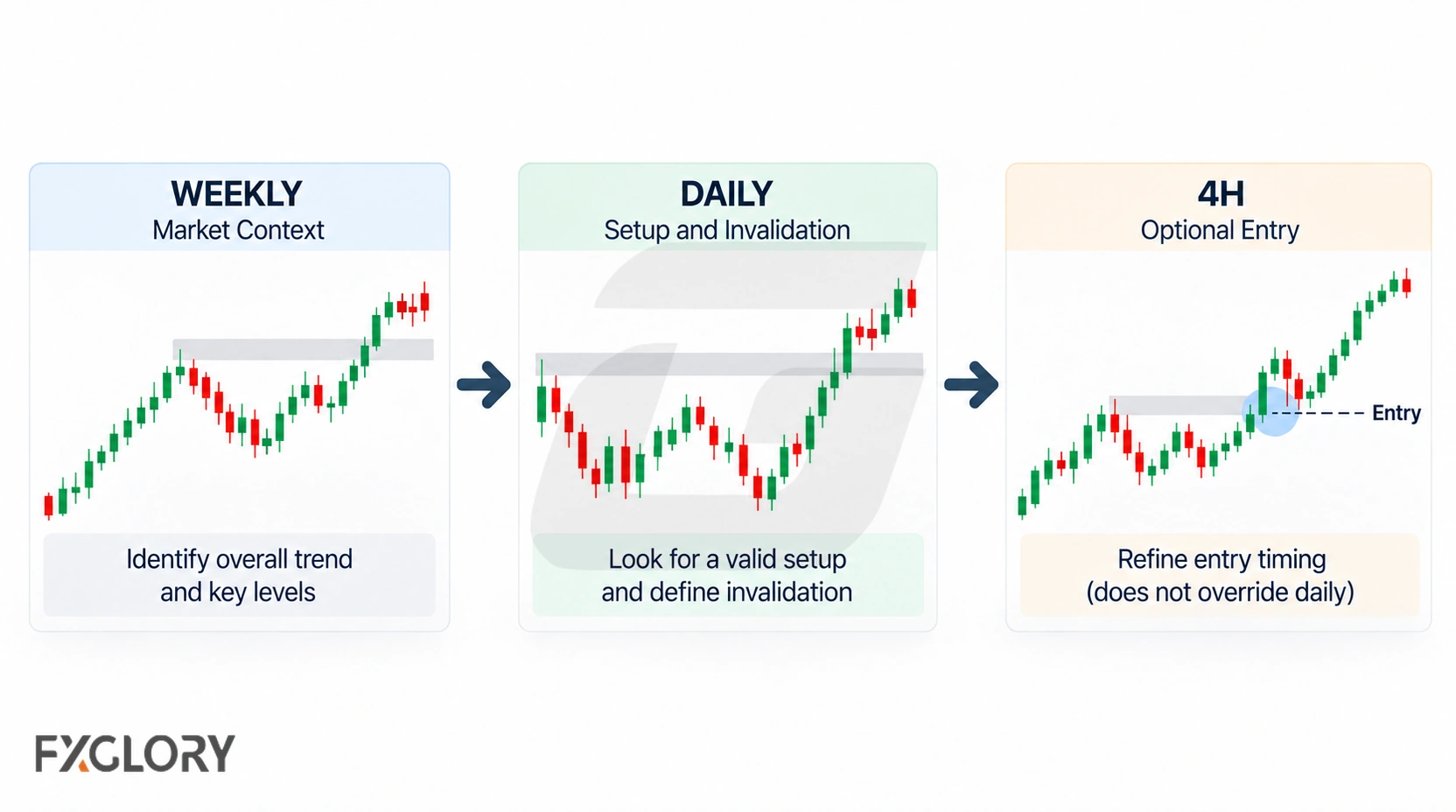
Many daily chart strategies become clearer when each timeframe has a specific role. The weekly chart can define context. The daily chart can define the setup. The 4H chart can be used only if the strategy allows entry refinement.
| Timeframe | Role | Rule |
|---|---|---|
| Weekly | Context, major trend, large support and resistance, macro-level structure | Do not take a daily setup directly into a major weekly barrier without a plan |
| Daily | Main setup, signal, invalidation, stop zone, trade thesis | Require a valid daily signal and a separately defined daily invalidation level |
| 4H | Optional entry refinement or timing | Do not let a 4H signal override daily invalidation |
| Conflict case | 4H gives an entry but the daily idea has failed | Skip; the lower timeframe cannot repair a broken daily setup |
Use weekly, daily, and 4H role separation when the strategy depends on more than one chart.
Daily Chart Workflow Example
The following example shows a decision sequence only. It is not a trading signal or a recommendation to trade a specific pair.
| Step | Daily Chart Workflow | Decision |
|---|---|---|
| Weekly context | The pair is approaching a major weekly resistance area | Do not take daily bullish continuation directly into that level without a plan |
| Daily level | The daily chart shows price reacting at a support area | Mark the level and wait for the daily candle close |
| Daily signal | The completed daily candle shows rejection from support | Review whether the signal has enough target room |
| Invalidation | The setup fails if price accepts below the support area | Stop logic must be based on that invalidation |
| Position size | The stop distance is measured from entry to invalidation | Reduce size if the daily stop is wide |
| Condition check | Upcoming news, swap, margin, and weekend exposure are reviewed | Delay, resize, or skip if conditions weaken the plan |
| Management | The trade is reviewed at the next daily close or written management point | Do not change the plan several times inside the same candle |
In this example, weekly resistance may limit the room available to an otherwise valid bullish daily rejection. A visible signal and an executable plan are not the same thing.
Entry, Stop, Target, And Position Size On Daily Charts
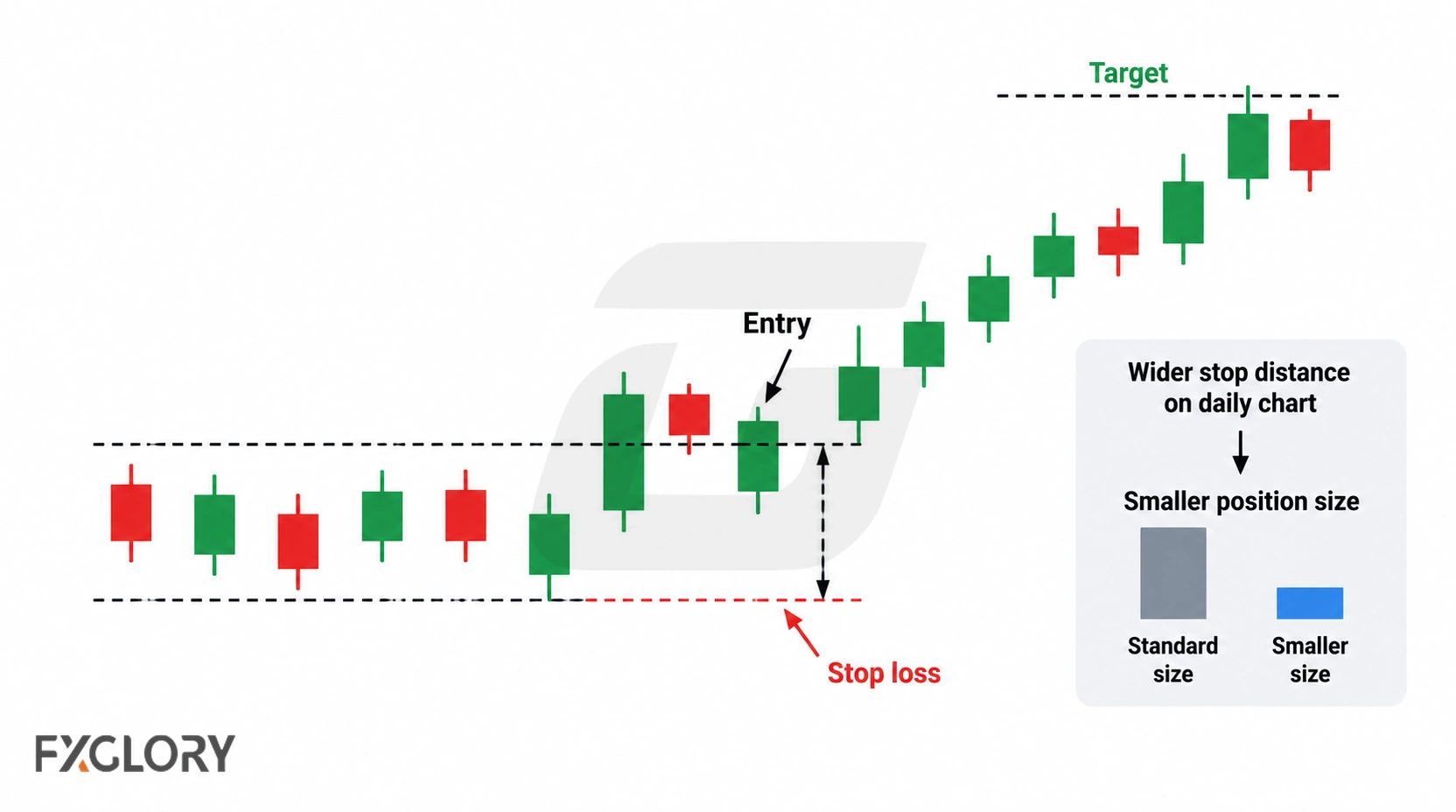
Daily chart entries should be planned after the invalidation is known. On daily charts, the stop can be wider than on lower timeframes, so position size must be calculated from the stop distance, not from confidence in the setup.
| Rule | Daily Chart Example | Risk Check |
|---|---|---|
| Entry | Daily close confirmation, retest, rejection candle, or planned lower-timeframe refinement | Entry should follow the written setup, not fear of missing the daily move |
| Stop | Beyond daily swing, support/resistance zone, rejection candle, or failed structure | Stop should mark invalidation, not a random smaller loss |
| Target | Next daily or weekly level, prior swing, measured range, or trailing structure | Target should leave enough room after spread and slippage |
| Position size | Calculated after stop distance is known | Wide daily stops require smaller size if risk is fixed |
| Trade review | Review after daily candle closes or at pre-defined management points | Avoid changing the plan several times inside the same daily candle |
First calculate the proposed position size from the amount of account currency at risk, stop distance, and pip value (converted into account currency when needed). Then estimate the margin needed for that position size under the applicable instrument and account rules. Margin is not the maximum loss at the stop. Use the FXGlory margin calculator for the separate margin check, and review leverage conditions before increasing exposure.
Swap, Spread, Margin, News, Leverage, And Weekend Risk
Daily time frame trades can remain open across rollover, news events, and weekends. These conditions should be reviewed before entry because they can affect cost, exposure, and trade management.
| Condition | Why It Matters On Daily Charts | Decision It Should Change |
|---|---|---|
| Spread | Usually less dominant than on scalping, but still affects entry and target room | Accept, wait, or skip if the target is too close |
| Swap or rollover | Daily trades may stay open for several nights | Review holding cost before entry |
| Margin | Required margin depends on the instrument, position size, and applicable account requirements | Check free and required margin for the proposed size separately from stop-loss risk |
| Leverage | Daily stops can be wide, and leveraged exposure can increase losses quickly | Reduce position size or skip if margin pressure becomes excessive |
| News | High-impact events can break daily structure quickly | Delay, reduce risk, or avoid the setup |
| Weekend exposure | Price can reopen away from the prior close | Decide before Friday close whether the trade should remain open |
Daily charts are not automatically safer than lower timeframes. Under leverage, a margin call or stop-out may occur before the chart-based invalidation level is reached; the planned stop does not replace a free-margin check.
Review FXGlory spreads before testing live entries, and use scheduled-event checks when a daily setup forms before major data, central-bank decisions, or policy speeches.
Pros And Cons Of Daily Time Frame Trading
The daily time frame can improve planning discipline for some traders, but it can also create waiting pressure and larger risk distances. The pros and cons should be judged against the trader's account size, risk rules, schedule, and patience.
| Potential Advantage | Practical Benefit | Trade-Off |
|---|---|---|
| Less chart noise | Daily levels and candles can be easier to interpret | Signals form slowly and may appear less often |
| More planning time | The trader can prepare after the daily close | Waiting can create boredom trades |
| Cleaner major structure | Support, resistance, and swings can be clearer | Stops can be wider than lower-timeframe setups |
| Less screen pressure | Fewer intraday decisions may reduce reactive trading | The position can stay exposed while the trader is away |
| Better routine discipline | Daily review can be structured and repeatable | The trader must accept skipped days without forcing trades |
What To Do When There Is No Daily Setup
No setup is a normal daily-chart outcome. Daily candles take time to form, and a strategy that trades every day is not necessarily following the daily chart.
- Keep the watchlist limited to pairs with clear daily structure.
- Mark the next daily support, resistance, breakout, or pullback area.
- Write the reason no trade is allowed today.
- Wait for the next daily close if the strategy requires candle confirmation.
- Do not drop to lower timeframes only to create a trade.
- Do not expand position size on the next setup because previous days were quiet.
- Review skipped setups later to confirm whether the no-trade rule helped avoid weak conditions.
When To Skip A Daily Forex Setup
A daily chart strategy should reject unclear setups. The trader should not enter only because the daily candle looks large or because several days have passed without a trade.
- Skip if the daily candle has not closed and the strategy requires a completed candle.
- Skip if the setup forms directly into a major weekly level.
- Skip if the stop distance is too large for the risk limit.
- Skip if the target is too close after spread and slippage.
- Skip if swap, margin, leverage, or weekend exposure changes the trade plan.
- Skip if high-impact news can distort the setup before confirmation.
- Skip if the daily chart is ranging but the trader is forcing a trend setup.
- Skip if the trader is using the 4H chart to justify a trade that the daily chart does not support.
- Skip if the only reason for entry is impatience after several quiet days.
Backtesting Notes For Daily Time Frame Forex Trading Strategy
This numerical review uses one hypothetical educational rule model: a daily inside-bar compression breakout with weekly trend context, completed daily candle confirmation, ATR-based stop placement, a 2R target comparison, a failure exit, and spread/slippage sensitivity. It does not test daily support and resistance rejection, daily breakout-retest, daily pullback, daily range, lower-timeframe refinement, or discretionary candle-pattern trading.
The model reviews EURUSD, GBPUSD, USDJPY, AUDUSD, USDCAD, and USDCHF using public yfinance daily OHLC data. The recorded review window is 29 June 2016 through 29 June 2026, with earlier data from 7 November 2014 used for indicator warmup. Weekly context is resampled from the same public daily data. The reported record specifies completed weekly observations and a weekly EMA(50) filter, but it does not document the exact weekly resampling boundaries, ATR smoothing convention, or all competing-exit evaluation priorities. Those implementation details require the original script before the test can be reproduced exactly.
| Rule Area | Educational Model Rule |
|---|---|
| Strategy type | Daily inside-bar compression breakout with weekly trend context |
| Long weekly context | Previous completed weekly close above weekly EMA(50), with weekly EMA(50) rising over 5 completed weekly candles |
| Short weekly context | Previous completed weekly close below weekly EMA(50), with weekly EMA(50) falling over 5 completed weekly candles |
| Inside-bar definition | Signal high below prior daily high and signal low above prior daily low |
| Compression filter | Prior candle range between 0.75 and 2.50 ATR(14), with inside-bar range no more than 0.80 of the prior candle range |
| Long break | Completed daily close above the inside-bar high within 3 candles, by at least 0.05 ATR(14) and no more than 1.00 ATR(14) |
| Short break | Completed daily close below the inside-bar low within 3 candles, by at least 0.05 ATR(14) and no more than 1.00 ATR(14) |
| Entry | Next daily open after the completed breakout candle |
| Stop | Beyond the inside-bar extreme with a 0.25 ATR(14) buffer |
| Target comparison | Fixed 2R target from entry |
| Failure exit | Exit at daily close if price closes back through the opposite side of the inside bar after entry |
| Maximum holding review | 25 daily candles after entry |
The review records trade count, win rate, average win in R, average loss in R, expectancy in R, profit factor, maximum drawdown in R, worst losing streak, average holding period, pair-level behavior, direction-level behavior, exit reasons, and spread/slippage sensitivity.
| Cost Input | Assumptions Used |
|---|---|
| Spread | 0.5, 1.5, and 3.0 pips |
| Slippage | 0.1, 0.5, and 1.0 pips per side |
| Baseline comparison | 1.5-pip spread and 0.5-pip slippage per side |
| Swap and rollover | Not included |
Educational Sensitivity-Test Results
The hypothetical backtest used public yfinance daily OHLC data. The baseline cost assumption used a 1.5-pip spread and 0.5-pip slippage per side. The review window ran from 2016-06-29 to 2026-06-29. The baseline result was negative, with expectancy of -0.1298R and total net result of -53.3541R.
| Metric | Baseline Result |
|---|---|
| Number of trades | 411 |
| Win rate | 32.60% |
| Average win | 1.6387R |
| Average loss | -0.9853R |
| Expectancy | -0.1298R |
| Profit factor | 0.8045 |
| Maximum drawdown | -60.5363R |
| Worst losing streak | 14 |
| Average holding period | 8.99 daily candles |
| Median holding period | 6.0 daily candles |
| Total net result | -53.3541R |
| Pair | Trades | Win Rate | Expectancy | Profit Factor | Max Drawdown | Total Net R |
|---|---|---|---|---|---|---|
| AUDUSD | 79 | 26.58% | -0.2943R | 0.6052 | -27.1613R | -23.2531R |
| EURUSD | 58 | 27.59% | -0.3034R | 0.5452 | -17.5324R | -17.5987R |
| GBPUSD | 73 | 43.84% | 0.2043R | 1.375 | -4.9467R | 14.9105R |
| USDCAD | 64 | 26.56% | -0.2828R | 0.6168 | -17.0791R | -18.1002R |
| USDCHF | 64 | 31.25% | -0.132R | 0.7999 | -13.9642R | -8.4459R |
| USDJPY | 73 | 38.36% | -0.0119R | 0.9812 | -13.8176R | -0.8667R |
| Direction | Trades | Win Rate | Expectancy | Profit Factor | Max Drawdown | Total Net R |
|---|---|---|---|---|---|---|
| Long | 220 | 30.00% | -0.1677R | 0.7543 | -40.1194R | -36.8989R |
| Short | 191 | 35.60% | -0.0862R | 0.866 | -30.3687R | -16.4552R |
| Spread (pips) | Slippage Per Side (pips) | Expectancy | Profit Factor | Max Drawdown | Total Net R |
|---|---|---|---|---|---|
| 0.5 | 0.1 | -0.1047R | 0.8378 | -51.3033R | -43.0441R |
| 0.5 | 0.5 | -0.1159R | 0.8228 | -55.4069R | -47.6263R |
| 0.5 | 1.0 | -0.1298R | 0.8045 | -60.5363R | -53.3541R |
| 1.5 | 0.1 | -0.1187R | 0.8191 | -56.4328R | -48.7719R |
| 1.5 | 0.5 | -0.1298R | 0.8045 | -60.5363R | -53.3541R |
| 1.5 | 1.0 | -0.1438R | 0.7868 | -65.6657R | -59.0819R |
| 3.0 | 0.1 | -0.1396R | 0.7921 | -64.1269R | -57.3635R |
| 3.0 | 0.5 | -0.1507R | 0.7782 | -68.2304R | -61.9458R |
| 3.0 | 1.0 | -0.1647R | 0.7613 | -73.3599R | -67.6735R |
| Exit Reason | Count |
|---|---|
| inside bar failure close | 9 |
| stop first same bar | 4 |
| stop loss | 245 |
| target 2r | 97 |
| time exit | 56 |
Testing And Review Checklist
Daily time frame strategies should be tested by setup type. A daily breakout, daily pullback, daily range trade, and daily candlestick setup should not be mixed into one result unless the rules are identical.
- Choose the daily setup type: trend continuation, pullback, support or resistance rejection, breakout, retest, range, or candle confirmation.
- Define the daily signal: candle close, rejection, breakout, inside bar, engulfing candle, retest, or structure shift.
- Mark the controlling level: daily support, daily resistance, swing point, trendline, or range boundary.
- Write invalidation: the price or structure that cancels the daily idea.
- Measure stop distance: calculate risk from the daily stop before sizing the trade.
- Record trading conditions: spread, swap, margin, leverage, news, and weekend exposure.
- Record skipped setups: unclear candles, poor target room, wide stops, and news-distorted setups should be reviewed too.
- Review a representative sample: gather documented examples for each daily setup type across different market conditions; 30 to 50 can be an initial practice sample, not a universal threshold for statistical reliability.
- Record mistake tags: early entry, stop moved, 4H override, ignored weekly level, boredom trade, oversized position, or missed news.