
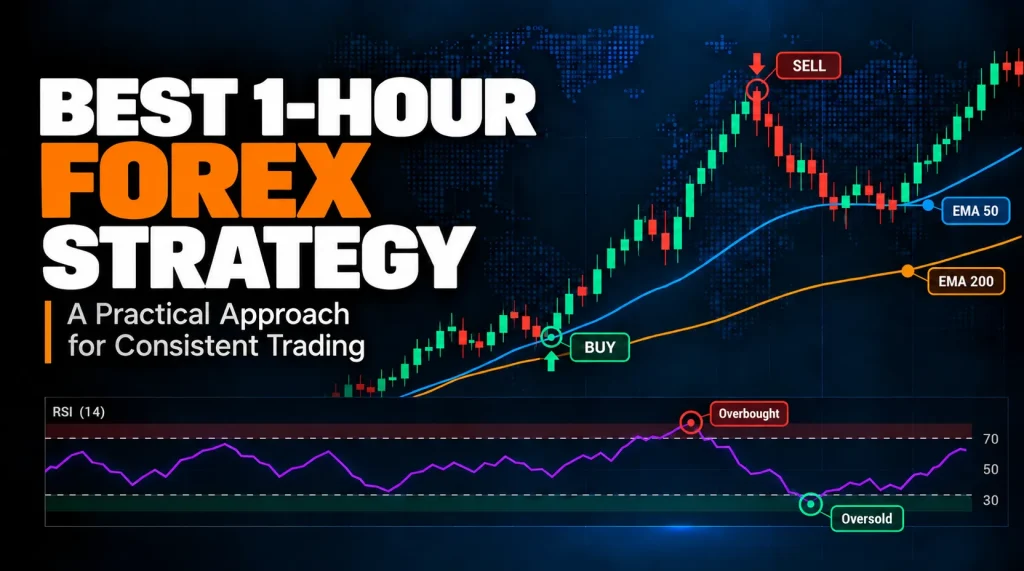
How a 1 Hour Forex Strategy Works
A 1 hour forex strategy uses completed hourly candles as the main setup framework. The rules should define the market condition, entry trigger, invalidation, stop placement, target, risk, and review point. Compared with very low timeframes, the 1H chart can make intraday structure easier to review while still providing several decision points during an active trading day.
A useful 1H strategy should not begin with a promise that one indicator setup works every day. A 1H candle can show trend continuation, breakout pressure, range rejection, or noise depending on where it forms. The strategy becomes valid only when the trader knows what the 1H setup is supposed to capture and where the idea is wrong.
For the wider same-day trading framework, use forex day trading strategy. This page focuses on the 1H chart as the controlling intraday setup timeframe.
1H Strategy vs Day Trading vs Scalping vs Swing Trading
The 1H chart can be used inside different trading styles, but the strategy must define what role the chart plays. A one-hour strategy is not automatically scalping, and it is not automatically swing trading.
| Method | Main Time Focus | How The 1H Chart Fits | Main Risk |
|---|---|---|---|
| 1H forex strategy | One-hour candles as the main setup chart | Defines structure, trigger, stop, and target planning | Trading every 1H candle instead of waiting for a setup |
| Day trading | Same-day decision-making | 1H can guide intraday setups and management points | Holding through news or session changes without a plan |
| Scalping | Very short holding periods | 1H may provide context, but entries often use lower charts | Treating 1H strategy as fast scalping without spread control |
| Swing trading | Multi-day moves | 1H may refine entries inside higher-timeframe swings | Letting small 1H fluctuations override larger structure |
| Timeframe selection | Choosing the chart that fits style and risk | Use 1H only if it fits schedule, patience, and risk rules | Choosing 1H because it feels active, not because it fits the plan |
1H Candle Close: When The Signal Is Valid
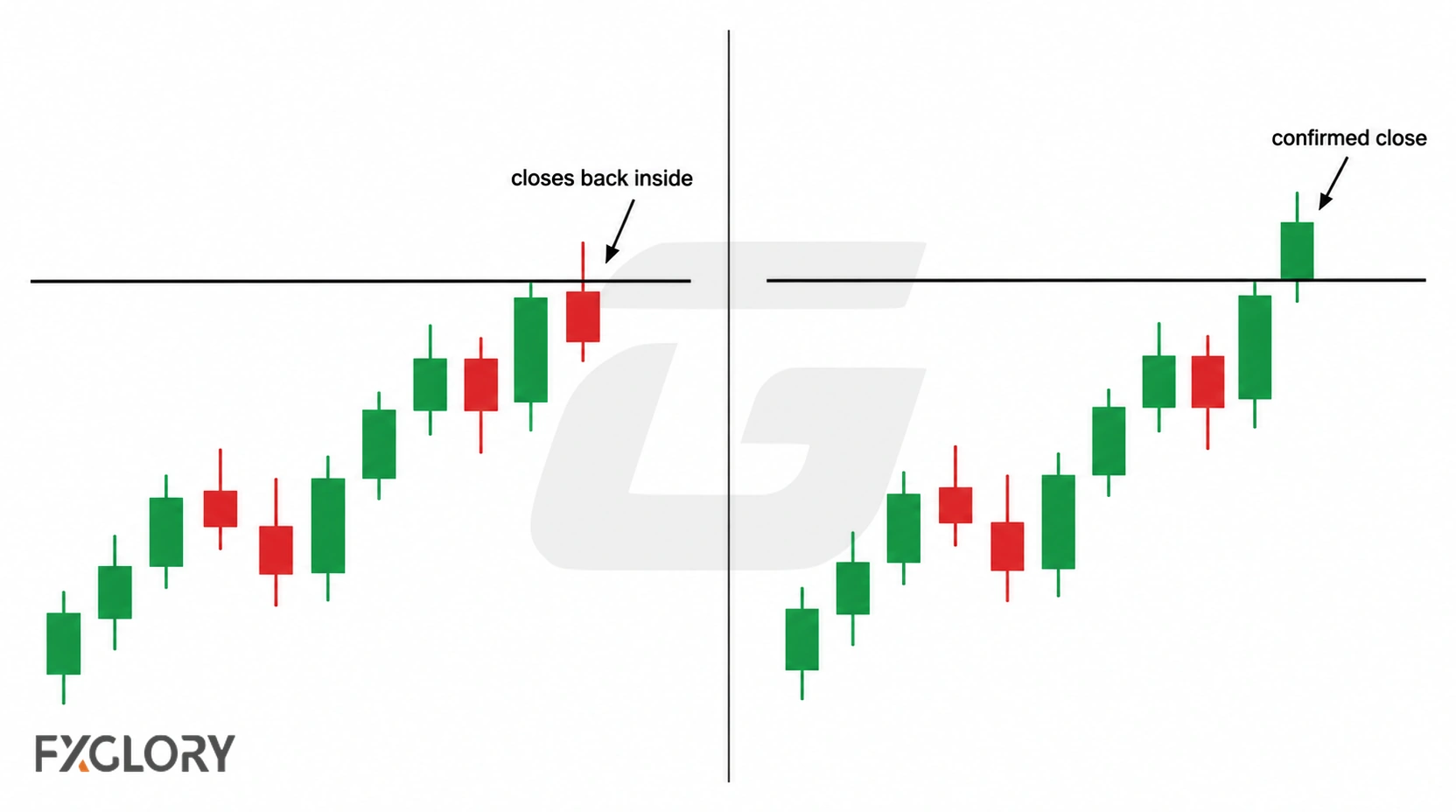
A 1H strategy should define whether a signal is valid during the candle or only after the candle closes. An intra-hour breakout, rejection wick, or engulfing move can change before the hour ends. A setup that looks clean after 35 minutes may close back inside the level.
| Signal Type | What Can Go Wrong | Rule To Define |
|---|---|---|
| Intra-hour breakout | Price breaks the level but closes back inside | Decide whether the strategy needs a 1H close beyond the level |
| Rejection wick | The wick may shrink or lose meaning before the close | Define whether wick rejection needs a completed 1H candle |
| 15M trigger | The lower-timeframe entry may appear before the 1H setup is valid | Use 15M only if the 1H structure still supports the trade |
| News candle | The hourly candle can expand quickly and distort stop distance | Apply news rules before treating the candle as tradable |
Why The 1H Chart Changes The Trade Plan
The 1H chart provides enough detail for intraday planning, but a trade may remain open for several hourly candles. That makes target distance, scheduled news, session changes, and possible overnight exposure part of the plan. The chart can show intraday swings, pullbacks, breakouts, and range edges with more detail than a daily chart, while still being affected by changing liquidity and event risk.
| 1H Feature | Practical Effect | Risk To Control |
|---|---|---|
| More candles than 4H or daily | More frequent setup review | Overtrading weak candles |
| Less noise than very low timeframes | Structure may be easier to read than 1M or 5M | Ignoring spread, slippage, and session volatility |
| Intraday structure | Useful for trend pullbacks, breakouts, and ranges | Forcing a trade when the higher timeframe conflicts |
| Several candles per session | Session activity can shape setup quality | Trading inactive hours with poor movement |
| Possible multi-session holding | Some 1H trades may last beyond one session | News, swap, rollover, and weekend exposure if held longer |
4H Context, 1H Setup, Optional 15M Trigger
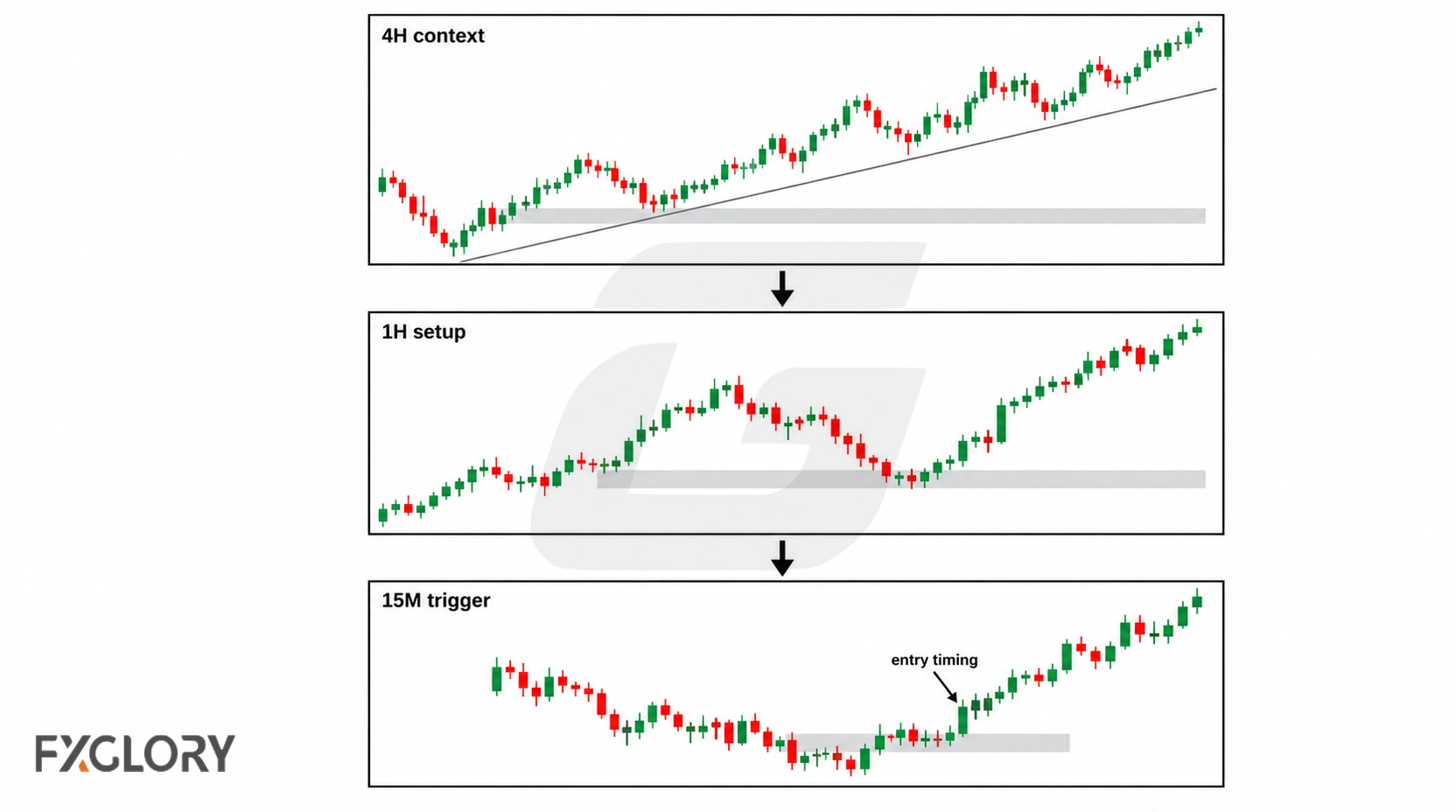
A strong 1H strategy often separates chart roles. The 4H chart can define broader context. The 1H chart can define the setup. The 15M chart can refine entry only if the 1H setup remains valid.
| Timeframe | Role | Rule |
|---|---|---|
| 4H | Trend direction, major structure, larger support and resistance | Do not take 1H trades directly against strong 4H structure without a written reason |
| 1H | Main setup, trigger zone, invalidation, stop, and target planning | The 1H chart controls whether the intraday setup exists |
| 15M | Optional entry refinement | Use only if the 1H setup is already valid |
| Conflict case | 15M gives a trigger but 1H structure is unclear or broken | Skip; the lower timeframe cannot repair a weak 1H setup |
Is 1H Suitable For Your Schedule?
The 1H chart can be too active for traders who cannot check the market around hourly closes or planned management points. A new candle forms every hour, and important decisions may occur during work, sleep, news releases, or session transitions.
| Schedule Situation | Problem On 1H | Possible Decision |
|---|---|---|
| Cannot check hourly closes | Signals may form and fail before review | Use alerts or choose a slower timeframe |
| Only available during inactive sessions | 1H candles may lack movement or target room | Test only pairs active during available hours |
| Can review around session opens | More activity, but also more volatility | Use stricter spread, slippage, and news rules |
| Needs low screen time | 1H may still require frequent management | Consider 4H or daily strategies instead |
A 1H strategy should fit the trader's actual schedule, not the other way around. If the strategy requires checks that the trader cannot make, the setup becomes unmanaged.
1 Hour Forex Strategy Rule Sequence
A 1H forex strategy should follow a fixed sequence. Starting with an indicator signal before checking context can create entries in weak market conditions.
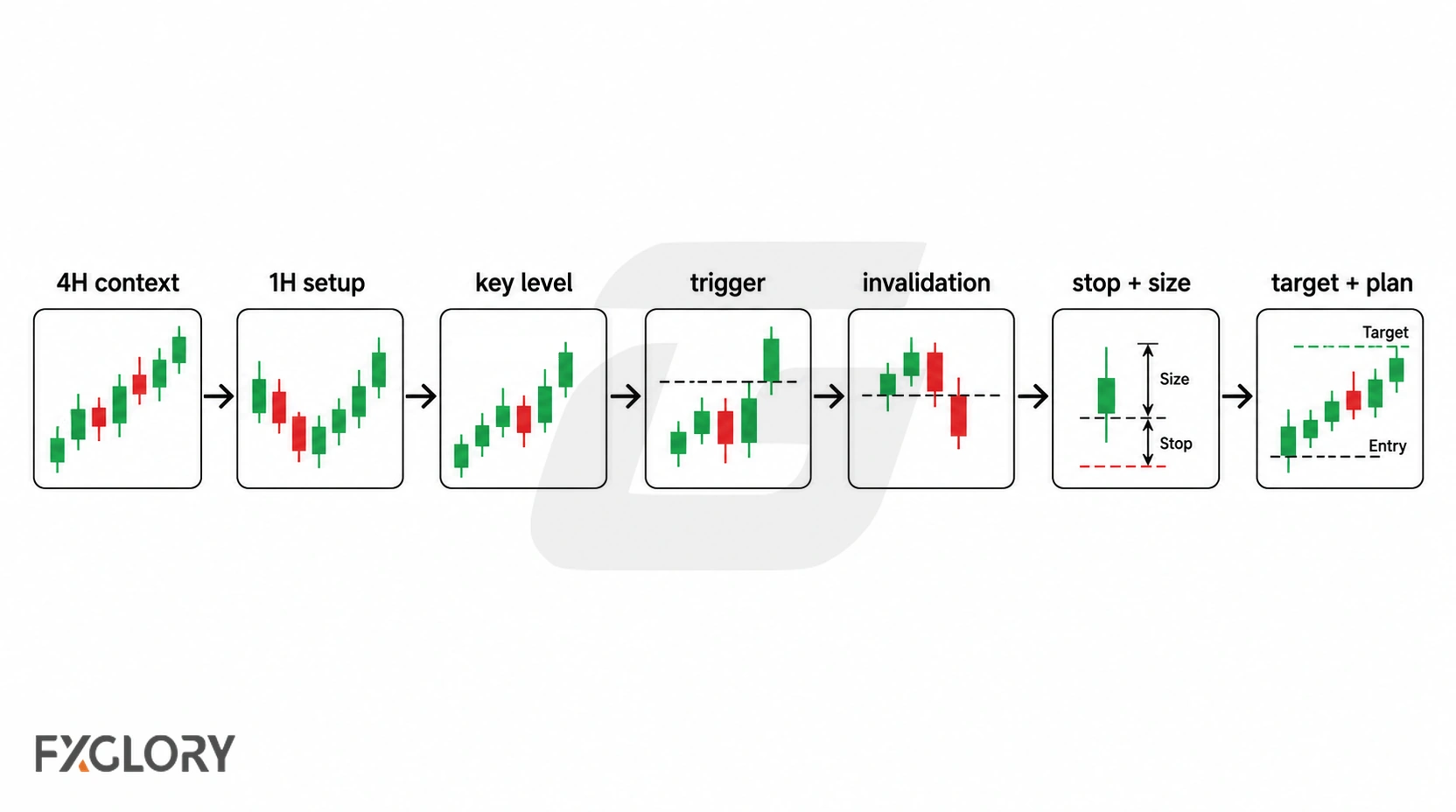
- Check higher-timeframe context: review 4H or daily trend, range, major support, resistance, and event risk.
- Define the 1H market condition: trend, pullback, breakout, retest, range, compression, or unclear.
- Mark the 1H level or zone: support, resistance, trendline, range edge, moving-average area, or breakout level.
- Wait for a trigger: 1H close, rejection candle, breakout close, retest hold, pullback shift, range reaction, or indicator-supported confirmation.
- Define invalidation: write where the 1H idea is wrong before entry.
- Measure stop distance: use the invalidation area to plan the stop and position size.
- Check target room: the next 1H, 4H, or session level should leave enough room after spread and slippage.
- Check trading conditions: review session, news, spread, margin, leverage, execution, and holding time.
- Record the plan: entry, stop, target, no-trade condition, and review point should be written before live risk.
Use stop distance, position size, and intraday drawdown rules before testing 1H setups live.
Common 1H Strategy Types
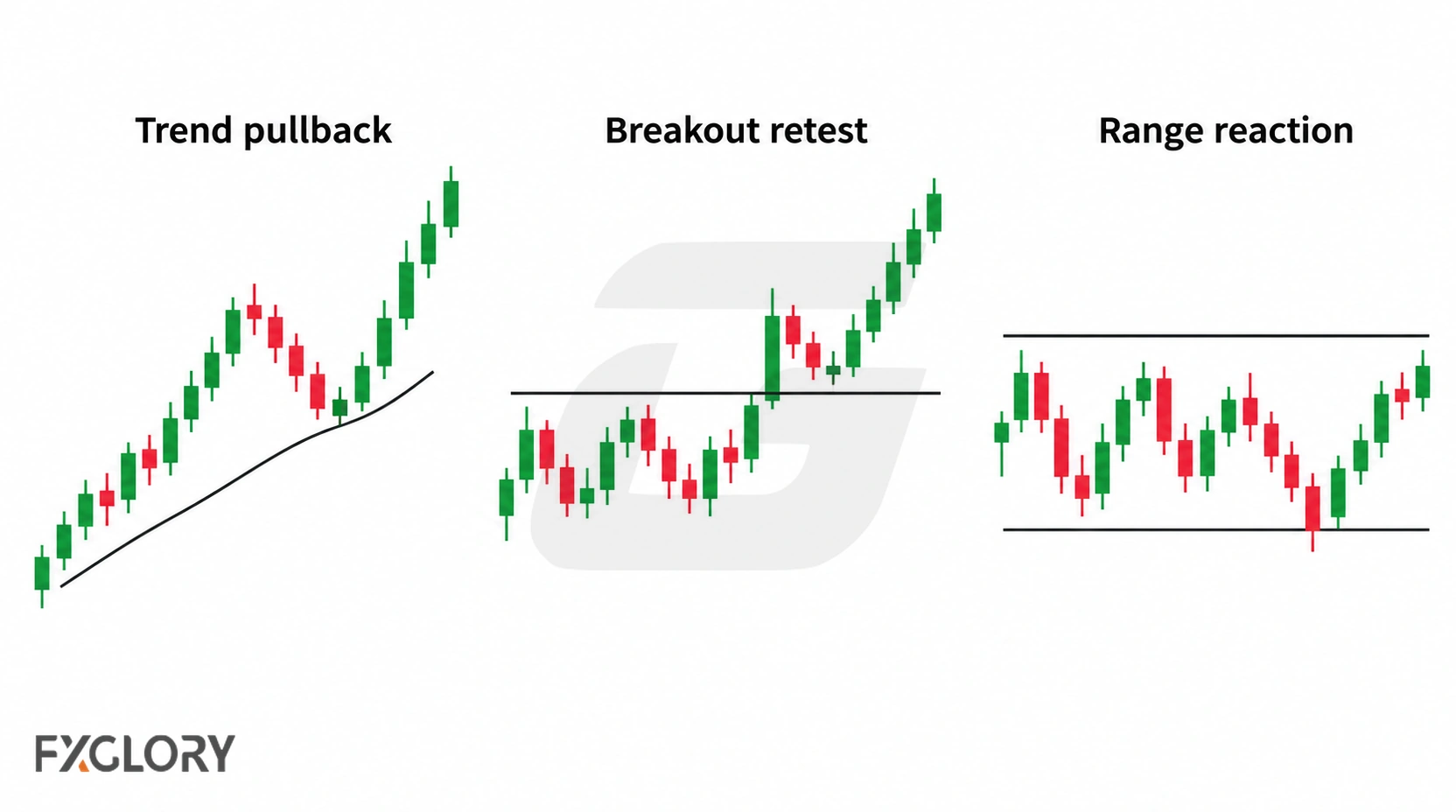
The 1H chart can support several strategy types. The setup should be chosen from market condition, not from a desire to trade more often.
| 1H Strategy Type | Best Used When | Main Risk | Internal Guide |
|---|---|---|---|
| Trend pullback | 4H trend is clear and 1H pulls back into structure | Buying or selling after the trend is exhausted | trend and pullback logic |
| Breakout and retest | 1H breaks a level, then returns to test it | False breakout or messy retest | 1H retest decisions |
| Range reaction | Price rotates between clear 1H support and resistance | Range fails during active session or news | range-bound rules |
| Moving-average filter | Trend structure needs a simple directional filter | Entering only because price touches an indicator | indicator role planning |
| Price-action confirmation | 1H candles react around levels or zones | Trading candles away from meaningful structure | 1H price-action confirmation |
| Mean reversion | 1H price is stretched inside a clear range or toward a known level | Fading a strong trend without confirmation | range context first |
No 1H strategy type should be used in every market condition. A pullback plan, breakout plan, and range plan need different invalidation and exit rules.
1H Trend Pullback Strategy
A 1H trend pullback strategy looks for a trade in the direction of the broader move after price retraces into a defined area. The 4H chart can help decide whether the trend is still valid, while the 1H chart defines the pullback, trigger, stop, and target.
- Check whether 4H direction supports the 1H idea.
- Wait for the 1H pullback into a level, moving-average area, prior swing, or support and resistance zone.
- Check whether the pullback is controlled or whether it breaks the trend structure.
- Wait for a 1H trigger such as rejection, structure shift, engulfing candle, or breakout from the pullback.
- Place invalidation where the pullback continuation idea fails.
Use pullback planning when the setup depends mainly on retracement and continuation.
1H Breakout And Retest Strategy
A 1H breakout and retest strategy waits for price to break a 1H level, range edge, trendline, or structure area, then return to test the broken level. The retest helps decide whether the broken level has changed role.
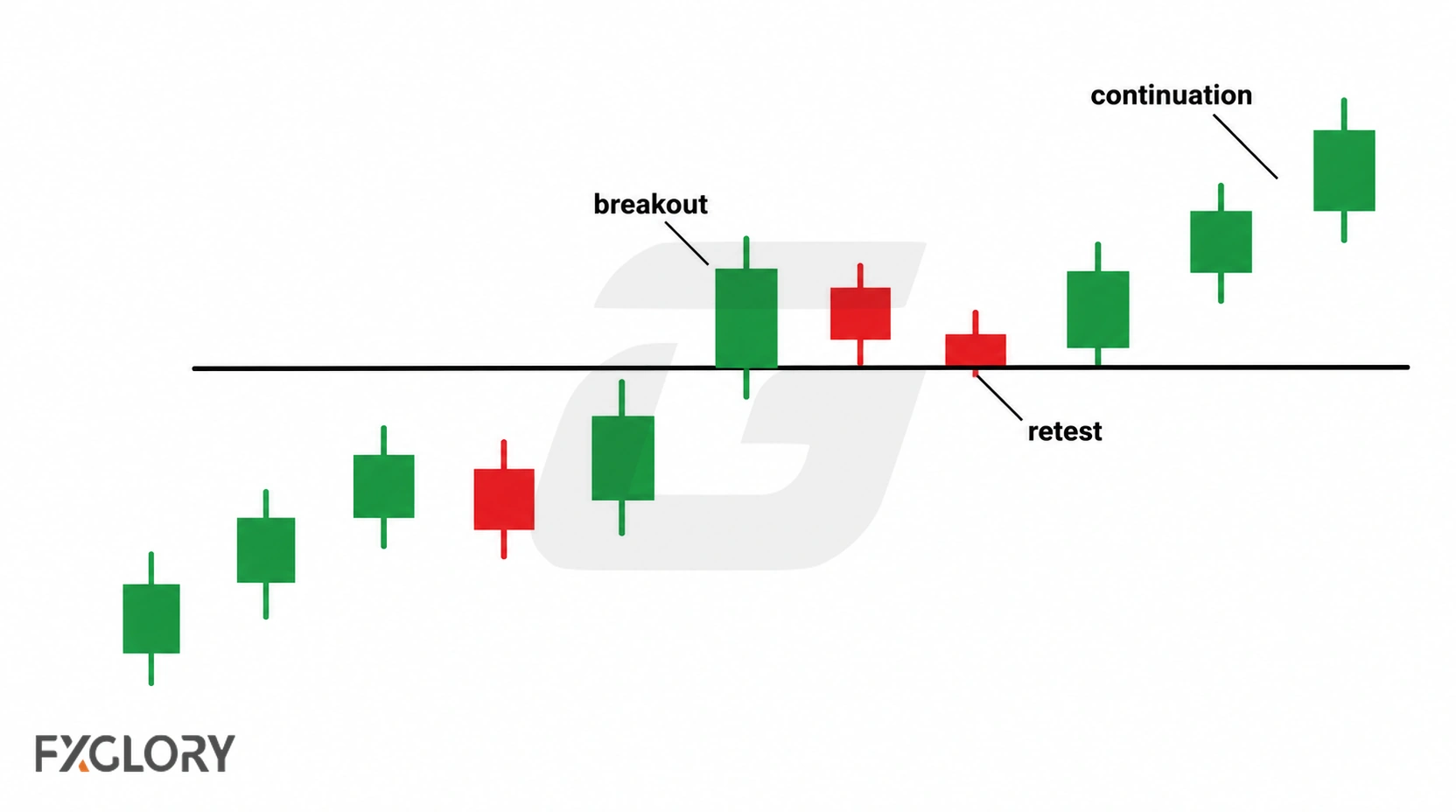
The key risk is a fakeout. A 1H candle may break a level during an active session, then return inside the prior range after liquidity changes or news passes. A breakout should not be accepted only because price moved beyond the level for one candle.
| Breakout Step | What To Check | Skip If |
|---|---|---|
| Break | Does price close beyond a level with enough target room? | The candle closes directly into the next obstacle |
| Retest | Does price return to the broken level and hold the new side? | Price overlaps the level repeatedly without clarity |
| Trigger | Is there rejection, close behavior, or structure shift after the retest? | The entry depends only on touching the level |
| Invalidation | Where is the breakout idea wrong? | The stop has no logical structure behind it |
Use the wider breakout framework when the trade depends on a level break rather than a pullback or range reaction.
1H Range Reaction Strategy
A 1H range reaction strategy reviews price behavior near clearly defined support and resistance. The idea is not to buy or sell anywhere inside the range. The useful areas are usually near the boundaries, where invalidation and target room can be defined.
- Do not trade the middle of the range if the target is too close.
- Do not fade a breakout candle with strong momentum unless the strategy has a failed-break rule.
- Do not ignore session changes that can break a quiet 1H range.
- Do not use range logic when 4H structure shows strong directional pressure.
Use support and resistance around 1H range edges when the setup depends on level rejection.
1H Moving Average And Indicator Filters
Indicators can support a 1H strategy when each tool has a defined job. They should not replace market structure, invalidation, or risk control.
| Tool | Useful Role On 1H | Weak Use |
|---|---|---|
| Moving average | Trend filter or dynamic reference area | Entering every touch without price confirmation |
| ATR | Volatility check for stop distance and target realism | Using the same stop in every volatility condition |
| RSI or oscillator | Momentum or exhaustion review near structure | Buying or selling only because a reading looks high or low |
| Session range | Intraday structure and breakout context | Treating every session break as a valid breakout |
If an indicator becomes the main reason for the trade, use forex indicator strategies to define its role before testing.
1H Strategy Example Flow
The following example shows a decision sequence only. It is not a trading signal or a recommendation to trade a specific pair.
| Step | Example Flow | Decision |
|---|---|---|
| 4H context | The 4H chart shows an uptrend but price is not directly into major resistance | Only bullish 1H setups are reviewed |
| 1H pullback | Price pulls back into a prior 1H support area or moving-average zone | Wait for a completed 1H trigger |
| 1H confirmation | A 1H rejection or engulfing candle forms at the level | Review only after the candle closes if the strategy requires candle confirmation |
| Invalidation | The idea fails if price accepts below the support structure | Stop logic must be based on that invalidation |
| Target | The next 1H or 4H resistance leaves enough room after spread | Skip if the target is too close |
| Risk check | News, spread, slippage, margin, and holding time are reviewed | Resize, wait, or skip if conditions weaken the plan |
| Review | The trade is reviewed after the next 1H close or written management point | Do not change the plan after every lower-timeframe fluctuation |
The same sequence can be adapted for bearish pullbacks, breakout retests, or range reactions. The direction changes; the need for context, trigger, invalidation, and risk control does not.
Session, Pair, And Instrument Selection For 1H Trading
The 1H chart is strongly affected by session behavior. A setup that forms during an inactive period may have poor movement, while a setup near a major session open or news release may move quickly and create slippage.
| Selection Factor | Why It Matters | Decision |
|---|---|---|
| Major currency pairs | Often have tighter spreads and more session activity than many less-liquid pairs | Still test each pair instead of assuming the setup fits all majors |
| Cross pairs | Can offer clean 1H structure but may have wider spreads than majors | Trade only if spread is small enough relative to the planned target |
| Exotic pairs | Spreads may be large relative to a 1H target | Avoid if spread consumes too much of the planned move |
| Metals or crypto instruments | Can move sharply and require wider stops | Use stricter volatility, spread, and position-size checks |
| Session activity | 1H candles need enough movement to reach targets | Prefer setups during relevant active sessions for the pair |
| News schedule | Events can distort 1H structure quickly | Delay, reduce risk, or avoid the setup if news is close |
Review FXGlory spreads when the planned 1H target is small, and use scheduled-event checks when a 1H setup forms near important data releases.
Platform And Execution Setup
A 1H strategy needs chart and order discipline because the setup can change within the hour, and execution mistakes can affect the entry, stop, or target.
| Setup Item | Why It Matters | Rule |
|---|---|---|
| 1H chart visibility | The trader must see candle close, structure, and levels clearly | Do not mix chart views that make the trigger unclear |
| Alerts near 1H levels | Helps avoid staring at every candle | Use alerts around planned levels, not random price movement |
| Spread visible before entry | 1H targets can be reduced by transaction cost | Check spread before the order, especially near news or rollover |
| Stop and target planned | Execution should follow the written setup | Do not click into a trade before invalidation is known |
| One-click trading caution | Immediate execution can create unwanted entries if used carelessly | Use order-entry settings only after understanding how they work |
| Platform stability | Connection or technical issues can affect order management | Avoid strategies that require constant rapid action if the setup cannot be managed reliably |
Review FXGlory trading platforms when charting, alerts, and order placement are part of the 1H workflow.
Entry, Stop, Target, And Holding Time On 1H Charts
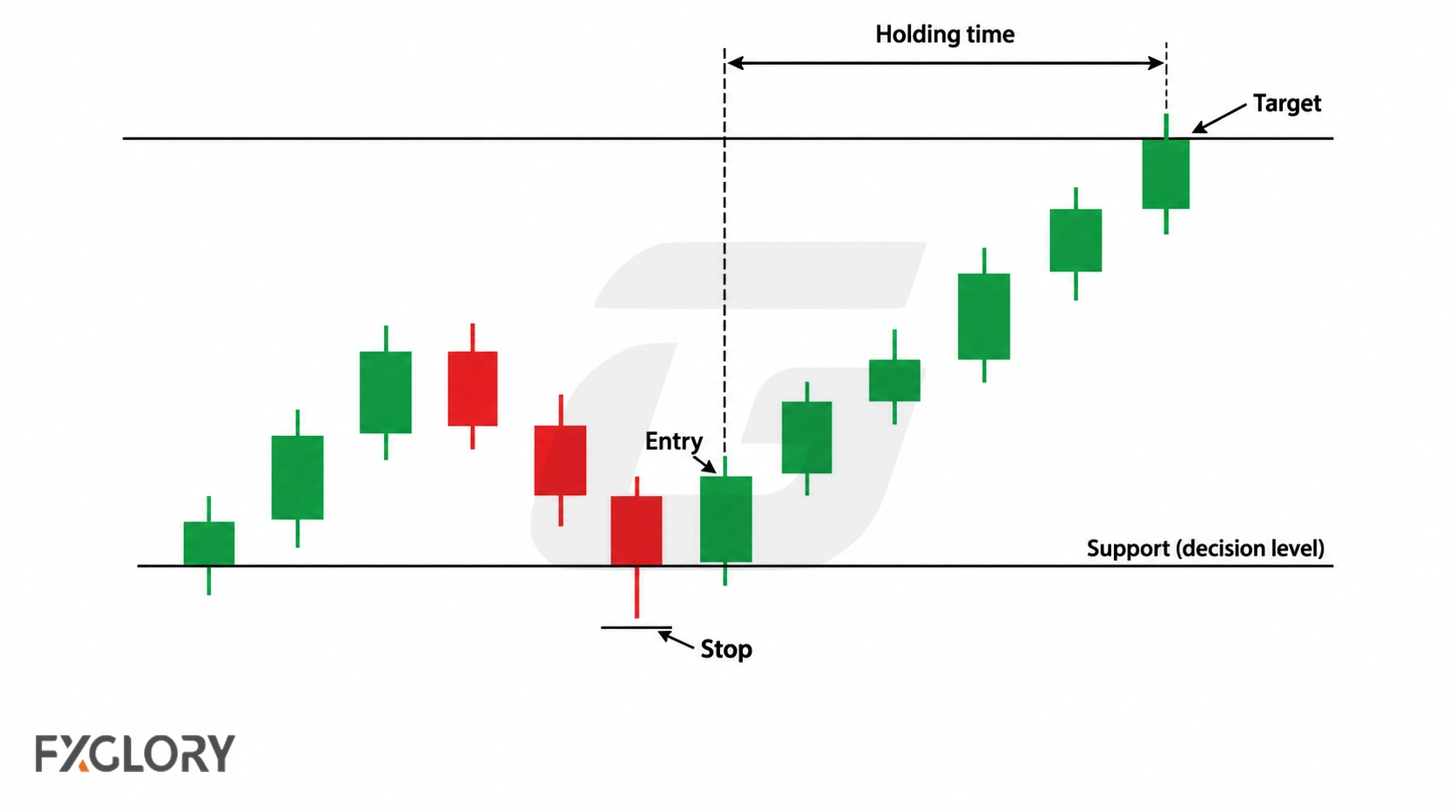
A 1H trade should have its stop and target planned before entry. Because 1H candles can move several times during a session, the trader should also decide when the setup will be reviewed.
| Rule | 1H Example | Risk Check |
|---|---|---|
| Entry | 1H close, retest, rejection candle, or optional 15M refinement | Entry should follow the written setup, not the fear of missing a candle |
| Stop | Beyond 1H swing, level, retest structure, or range boundary | Stop should mark invalidation, not a random tight distance |
| Target | Next 1H or 4H level, prior swing, range edge, or measured move | Target should leave room after spread and slippage |
| Holding time | Several candles, one session, overnight, or longer depending on the setup | News, rollover, and session close should be known before entry |
| Position size | Calculated after stop distance is known | Do not increase size because the setup looks active |
Use the FXGlory margin calculator after the 1H stop distance is known, and review leverage conditions before increasing exposure.
News, Spread, Slippage, Margin, And Leverage Checks
One-hour strategies can be more sensitive to execution conditions than daily strategies because targets and stops are often smaller. A 1H target can be small enough that spread and slippage change the reward-to-risk before the trade starts.
| Condition | Why It Matters On 1H | Decision It Should Change |
|---|---|---|
| Spread | Can reduce target room, especially on short intraday targets | Accept, wait, or skip if cost is too high |
| Slippage | Fast candles can change entry and stop quality | Avoid entering after sudden spikes without a plan |
| News | High-impact events can invalidate clean 1H setups | Delay, reduce risk, or skip |
| Margin | Several intraday positions can add exposure quickly | Limit total open risk before adding another trade |
| Leverage | Losses can accelerate when stop distance and size are mismatched | Resize the trade or skip if exposure is too high |
| Rollover | A 1H trade held longer than expected may cross rollover | Check holding plan if the trade may remain open overnight |
What Makes A 1H Setup Weak?
A weak 1H setup usually fails before the entry. The chart may show a signal, but the surrounding conditions do not support the trade.
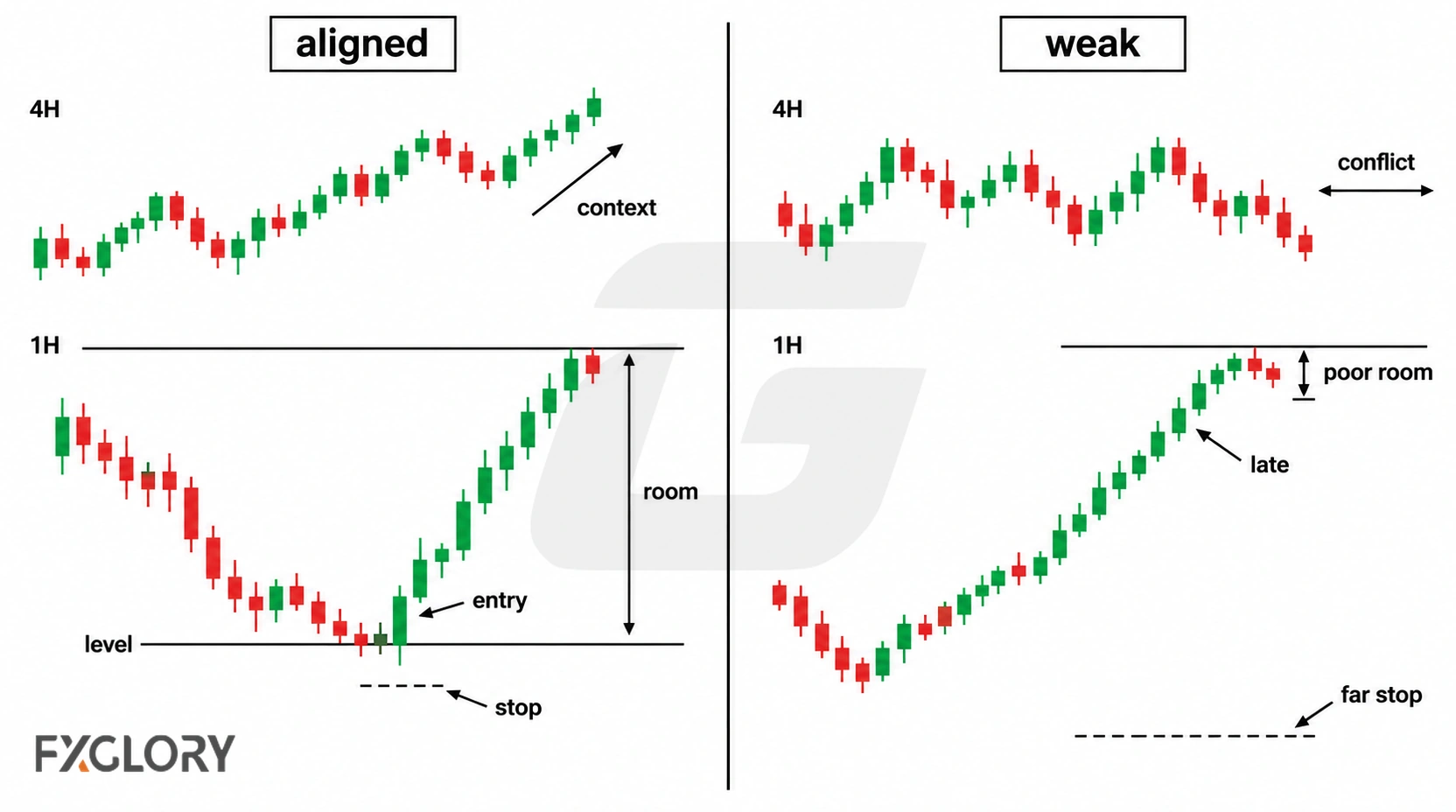
- No higher-timeframe context: the 1H signal appears directly against strong 4H or daily structure.
- No clear 1H level: the trigger appears in the middle of noise instead of near structure.
- Late candle entry: price has already moved far from the stop area.
- Poor target room: the next support or resistance is too close.
- Inactive session: the pair is not moving enough for the setup type.
- News nearby: the setup may be distorted before it can develop.
- Lower-timeframe forcing: a 15M signal is used to justify a weak 1H setup.
- Indicator dependency: the trade exists only because an indicator flashed, not because structure supports it.
No-Trade Conditions
A good 1H strategy should reject many candles. If every hour creates a possible setup, the rules are too loose.
- Skip if 4H or daily context conflicts with the 1H setup.
- Skip if the 1H structure is unclear or the level is forced.
- Skip if the entry is far from invalidation after a large candle.
- Skip if spread or slippage removes too much target room.
- Skip if a high-impact news event is close and the strategy has no event rule.
- Skip if the session is inactive for the selected pair.
- Skip if the 15M chart is creating a trade that the 1H chart does not support.
- Skip if the stop is too tight for normal 1H movement.
- Skip if the trader is entering only because the previous 1H candle was missed.
- Skip if the trader cannot monitor the planned hourly close or management point.
Backtesting Notes for the 1H Rule Model
This numerical review uses one hypothetical educational rule model: a 1H 07:00–09:00 UTC opening-window break-and-retest setup with 4H trend context, completed 1H retest confirmation, ATR-based stop placement, a 1.5R target comparison, a range-failure exit, and spread/slippage sensitivity. It does not test 1H trend pullbacks, range fades, indicator-only systems, discretionary price action, lower-timeframe scalping entries, or optional 15M refinements.
The model reviews EURUSD, GBPUSD, USDJPY, AUDUSD, USDCAD, and USDCHF using public yfinance 60-minute OHLC data where available. The range is defined from the 07:00, 08:00, and 09:00 UTC hourly candles. FXGlory’s forex market hours page lists London as opening at 08:00 GMT, so this article does not label all three candles as a London-session range. The underlying test inputs and numerical results are unchanged. The available data span is recorded in the backtest results because yfinance intraday history is shorter than long-term daily datasets.
| Rule Area | Educational Model Rule |
|---|---|
| Strategy type | 1H 07:00–09:00 UTC opening-window break-and-retest with 4H trend context |
| Range definition | Highest high and lowest low of the 07:00, 08:00, and 09:00 UTC hourly candles |
| Valid range width | At least 0.60 ATR(14) and no more than 2.50 ATR(14) |
| Long 4H context | 4H close above EMA(50), with EMA(50) rising over 3 completed 4H candles |
| Short 4H context | 4H close below EMA(50), with EMA(50) falling over 3 completed 4H candles |
| Long break | Later 1H close at least 0.10 ATR(14) above the range high and no more than 1.00 ATR(14) beyond it |
| Short break | Later 1H close at least 0.10 ATR(14) below the range low and no more than 1.00 ATR(14) beyond it |
| Retest window | Retest must occur within 4 hourly candles after the break candle |
| Long retest | Retest candle trades into the range-high retest zone, closes back above the range high, and closes above its open |
| Short retest | Retest candle trades into the range-low retest zone, closes back below the range low, and closes below its open |
| Entry | Next 1H open after the completed retest candle |
| Stop | Beyond the retest candle extreme with a 0.25 ATR(14) buffer |
| Target comparison | Fixed 1.5R target from entry |
| Failure exit | Exit at 1H close if price closes back inside the opening-window range after entry |
| Maximum holding review | 12 hourly candles after entry |
The review records trade count, win rate, average win in R, average loss in R, expectancy in R, profit factor, maximum drawdown in R, worst losing streak, average holding period, pair-level behavior, direction-level behavior, exit reasons, and spread/slippage sensitivity.
| Cost Input | Assumptions Used |
|---|---|
| Spread | 0.5, 1.5, and 3.0 pips |
| Slippage | 0.1, 0.5, and 1.0 pips per side |
| Baseline comparison | 1.5-pip spread and 0.5-pip slippage per side |
| Swap and rollover | Not included |
Educational Sensitivity-Test Results
The hypothetical backtest used public yfinance 60-minute OHLC data. The baseline cost assumption used a 1.5-pip spread and 0.5-pip slippage per side. The hourly data available across pairs began as early as 2023-09-11T23:00:00 and ended as late as 2026-06-29T09:00:00. The baseline result was negative, with expectancy of -0.201R and total net result of -167.6224R.
| Metric | Baseline Result |
|---|---|
| Number of trades | 834 |
| Win rate | 36.21% |
| Average win | 1.0379R |
| Average loss | -0.9042R |
| Expectancy | -0.201R |
| Profit factor | 0.6516 |
| Maximum drawdown | -169.5855R |
| Worst losing streak | 14 |
| Average holding period | 4.8 hourly candles |
| Median holding period | 3.0 hourly candles |
| Total net result | -167.6224R |
| Pair | Trades | Win Rate | Expectancy | Profit Factor | Max Drawdown | Total Net R |
|---|---|---|---|---|---|---|
| AUDUSD | 130 | 25.38% | -0.4967R | 0.3331 | -63.2788R | -64.565R |
| EURUSD | 95 | 41.05% | -0.2025R | 0.6495 | -21.5274R | -19.2392R |
| GBPUSD | 96 | 42.71% | -0.0641R | 0.8687 | -12.9783R | -6.155R |
| USDCAD | 225 | 41.33% | -0.0648R | 0.871 | -24.3733R | -14.5716R |
| USDCHF | 132 | 36.36% | -0.189R | 0.6681 | -27.5382R | -24.9541R |
| USDJPY | 156 | 30.77% | -0.2445R | 0.5956 | -38.6443R | -38.1376R |
| Direction | Trades | Win Rate | Expectancy | Profit Factor | Max Drawdown | Total Net R |
|---|---|---|---|---|---|---|
| Long | 465 | 35.91% | -0.2135R | 0.6269 | -101.2141R | -99.3005R |
| Short | 369 | 36.59% | -0.1852R | 0.6821 | -69.6195R | -68.3219R |
| Spread (pips) | Slippage Per Side (pips) | Expectancy | Profit Factor | Max Drawdown | Total Net R |
|---|---|---|---|---|---|
| 0.5 | 0.1 | -0.0792R | 0.8411 | -70.591R | -66.0378R |
| 0.5 | 0.5 | -0.1333R | 0.75 | -114.457R | -111.1865R |
| 0.5 | 1.0 | -0.201R | 0.6516 | -169.5855R | -167.6224R |
| 1.5 | 0.1 | -0.1469R | 0.729 | -125.4235R | -122.4737R |
| 1.5 | 0.5 | -0.201R | 0.6516 | -169.5855R | -167.6224R |
| 1.5 | 1.0 | -0.2687R | 0.5671 | -225.2749R | -224.0583R |
| 3.0 | 0.1 | -0.2484R | 0.5912 | -208.4187R | -207.1275R |
| 3.0 | 0.5 | -0.3025R | 0.5293 | -253.4524R | -252.2762R |
| 3.0 | 1.0 | -0.3702R | 0.4612 | -309.8073R | -308.7121R |
| Exit Reason | Count |
|---|---|
| range failure close | 206 |
| stop first same bar | 6 |
| stop loss | 265 |
| target 1 5r | 211 |
| time exit | 146 |
Testing And Review Checklist
One-hour strategies should be tested by setup type. A 1H trend pullback, breakout retest, range reaction, and indicator-filter setup should not be mixed into one result unless the rules are identical.
- Choose the setup type: trend pullback, breakout retest, range reaction, moving-average filter, price-action confirmation, or mean reversion.
- Define the higher-timeframe context: 4H trend, daily level, range, or no-trade condition.
- Mark the 1H structure: support, resistance, trendline, range edge, moving-average area, or breakout level.
- Write the trigger: 1H close, rejection, retest hold, structure shift, or optional 15M refinement.
- Write invalidation: the price or structure that cancels the 1H idea.
- Measure stop and target: compare stop distance with target room after spread and slippage.
- Record trading conditions: session, pair, spread, news, margin, leverage, execution risk, and holding time.
- Record skipped setups: weak context, poor target room, news risk, late entry, and lower-timeframe forcing should be reviewed too.
- Review enough examples: collect at least 30 to 50 examples per 1H setup type before drawing conclusions, without treating past samples as proof of future performance.
- Record mistake tags: chased candle, ignored 4H, forced 15M entry, traded news, stop too tight, target too close, or oversized position.