

What Is A 15 Min Forex Strategy?
A 15 min forex strategy is a short-term trading method that uses the 15 minute chart, also called the M15 chart, to identify setups, confirm entries, manage intraday trades, or filter lower-timeframe noise. It can be used for slower scalping, active intraday trading, opening range breakouts, pullbacks, or support and resistance reactions.
The 15 minute chart does not automatically make a trade safer. It gives more structure than the 1 minute chart, but the trader still needs a market filter, session rule, spread check, setup condition, entry confirmation, stop, target, cancel rule, and review process before the trade opens.
For the broader short-term framework, start with the forex scalping framework. When the trade is held for a larger intraday move, the M15 setup should also fit a day-trading structure with session and exit rules.
How The M15 Chart Changes The Trade
The 15 minute chart slows the decision compared with M1 and M5 charts. It can make market structure easier to see because each candle contains more price action. That can help traders wait for clearer closes, pullbacks, range boundaries, and breakout attempts.
The tradeoff is that M15 entries can require wider stops than M1 entries, and a late entry can still damage the setup. Fewer signals can help discipline, but they can also tempt the trader to force marginal trades because fewer opportunities appear.
| M15 Feature | How It Can Help | How It Can Hurt |
|---|---|---|
| Fewer candles | Less noise than M1 and more time to review the setup | Fewer signals can tempt forced entries |
| Candle close confirmation | Breakouts and reactions can be judged after a completed candle | Waiting for the close can create late entries |
| Clearer structure | Support, resistance, ranges, pullbacks, and trend structure may be easier to see | The stop may be wider than a lower-timeframe trigger |
| Intraday rhythm | Useful for session-based strategies and opening range logic | Weak sessions can produce flat ranges and false breaks |
| More planning time | The trader can prepare stop, target, and cancellation rules before entry | Overconfidence can still appear after one strong candle |
M15 Scalping vs Day Trading
A 15 minute strategy can sit between scalping and day trading. If the trade targets a short move and closes quickly after the setup develops, it behaves like slower scalping. If the trade is managed through a larger intraday move, it behaves more like day trading.
The difference matters because a trader should not enter as a scalper and then manage the trade like a day trader only because the first plan failed.
| Use Case | How M15 Is Used | Main Risk |
|---|---|---|
| M15 scalping | Uses the 15 minute chart for a short-term setup or confirmation, then exits on a defined short objective | Holding a failed scalp after the reason disappears |
| M15 day trading | Uses M15 for intraday structure, pullbacks, breakouts, and session movement | Entering without a session plan or end-of-day exit rule |
| M15 filter | Uses M15 to filter lower-timeframe entries | Using the filter after the lower-timeframe trade already happened |
If the main question is whether 1M, 5M, or 15M fits a scalping routine, use the scalping timeframe guide. If the setup is being planned for a full intraday session, keep it inside a day-trading rule set.
Before Using A 15 Minute Strategy
The M15 chart should be checked after the trader knows the session, instrument, spread condition, volatility, and higher-timeframe context. A clean M15 candle can still be a poor trade if it appears during a flat session, near a major obstacle, ahead of event risk, or after price has already moved too far.
Short-term targets still need cost control. Check the spread conditions that affect short-term trades before using small objectives. When stop distance, position size, leverage exposure, and margin need to be reviewed together, use the margin calculator before the order is placed.
| Pre-Trade Check | Question | Trade Only If |
|---|---|---|
| Session | Is this the planned trading window? | The session has enough movement for the method |
| Instrument | Does the pair or market fit the setup? | Spread, movement, and market behavior match the plan |
| Higher timeframe | Is the market trending, ranging, breaking out, or unclear? | The M15 setup matches the wider condition |
| Spread | Does the target remain realistic after cost? | The expected movement leaves enough room after spread |
| Volatility | Is the market active but manageable? | Stop and target can be placed logically |
| News risk | Could an event change spread, volatility, or execution conditions? | The plan allows trading under that risk condition |
For session planning, choose the trading window before choosing the M15 trigger. When EUR/USD is used as an example pair, review the EUR/USD live market page before deciding whether the current market still fits the setup.
15 Min Forex Strategy Decision Sequence
A 15 minute strategy should follow the same order each time. If the trader starts with one candle and creates the reason afterward, the setup cannot be reviewed clearly.
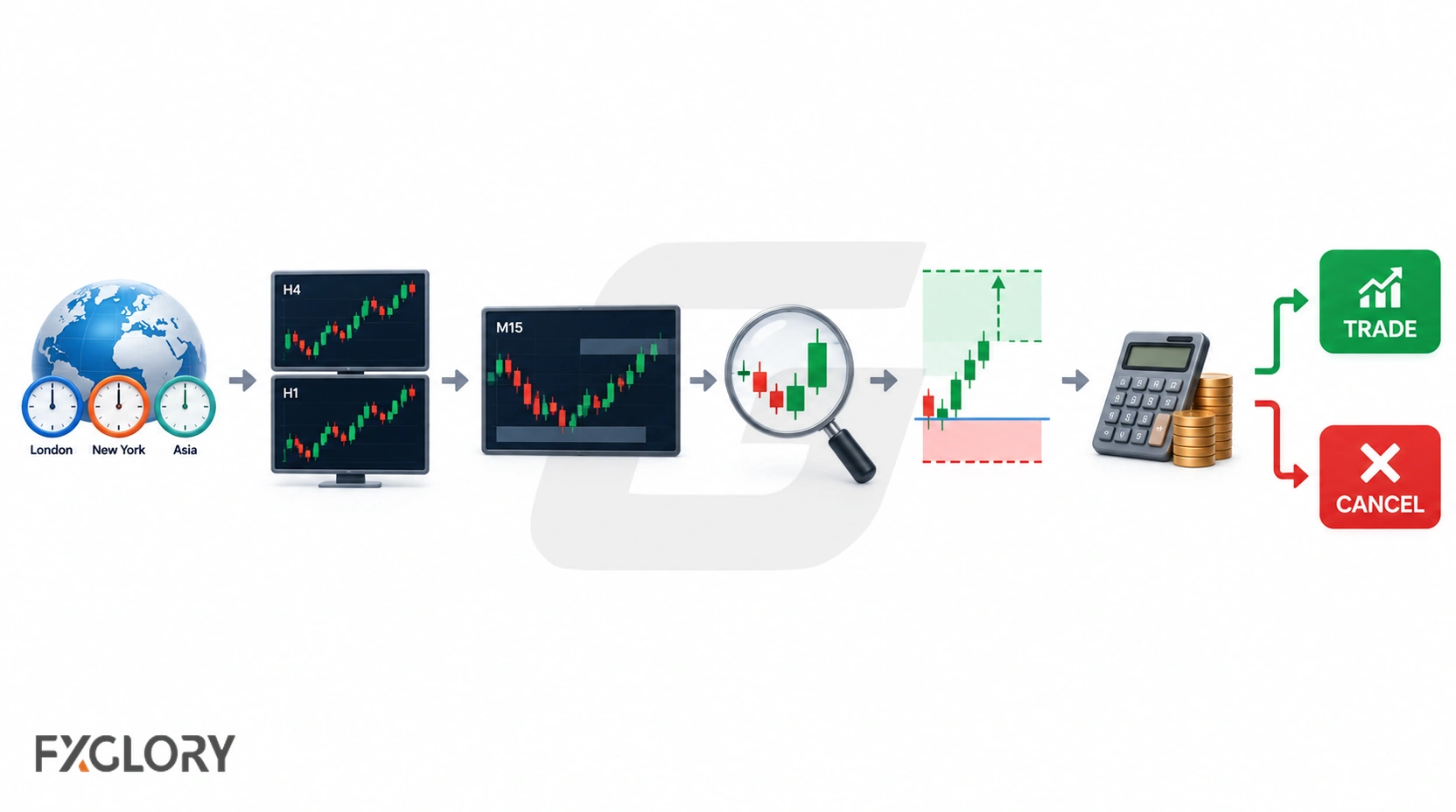
| Step | Decision | Continue Only If |
|---|---|---|
| 1. Market allowed? | The pair, session, spread, and volatility fit the method | The trade is allowed before the M15 candle closes |
| 2. Higher-timeframe context? | The wider chart shows trend, range, breakout, pullback, or unclear condition | The condition supports the M15 setup |
| 3. M15 setup? | The 15 minute chart shows the planned structure | The setup has location and invalidation |
| 4. Confirmation? | The M15 candle, retest, rejection, or continuation rule appears | The signal is not late or forced |
| 5. Stop? | The invalidation point is clear before entry | The stop is based on structure or volatility, not hope |
| 6. Target? | The objective is realistic after spread and nearby obstacles | The trade has room to develop |
| 7. Risk? | Position size, margin, and daily limit fit the account rules | The trade does not break risk limits |
| 8. Cancel rule? | The trade is canceled if price, spread, volatility, or context changes | The trader can skip a missed or weakened setup |
This sequence belongs inside a written trading system. A setup becomes reviewable only when context, trigger, invalidation, and review are separated.
M15 Long And Short Example Framework
The examples below show how a 15 minute long or short setup can be structured without turning the example into a prediction. The purpose is to define the decision path before the trade, not to claim that one pattern works in every market.
| Example | Valid Condition | Entry Confirmation | Stop Logic | Exit Logic |
|---|---|---|---|---|
| M15 long setup | Higher timeframe supports bullish continuation or a controlled pullback | M15 candle closes back above a pullback reaction area, retest level, or short-term structure | Stop goes below the failed pullback, reaction low, or invalidation area | Target near prior structure, measured intraday area, fixed risk multiple, time stop, or failed-momentum exit |
| M15 short setup | Higher timeframe supports bearish continuation or rejection from a planned area | M15 candle closes below a failed retest, rejection area, or short-term support break | Stop goes above the failed retest, reaction high, or invalidation area | Target near prior support, measured intraday area, fixed risk multiple, time stop, or failed-momentum exit |
| M15 range reaction | Price remains inside a defined range and reacts near planned support or resistance | M15 candle confirms rejection at the range edge without breaking the range rule | Stop goes beyond the failed range reaction | Target near the middle of the range, opposite range edge, or time-based review point |
| M15 breakout setup | Price builds a defined range, level, or opening window before breaking out | M15 candle closes beyond the level or retests it according to the written rule | Stop goes behind the range, retest failure, or breakout invalidation area | Target by measured range, nearby structure, fixed risk multiple, trail, or time stop |
Example M15 Trend Pullback Strategy
A 15 minute trend pullback strategy starts with direction, not with the entry candle. The trader first checks whether the wider market condition supports a trend idea, then waits for M15 price action to pull back without breaking the structure that made the trend valid.
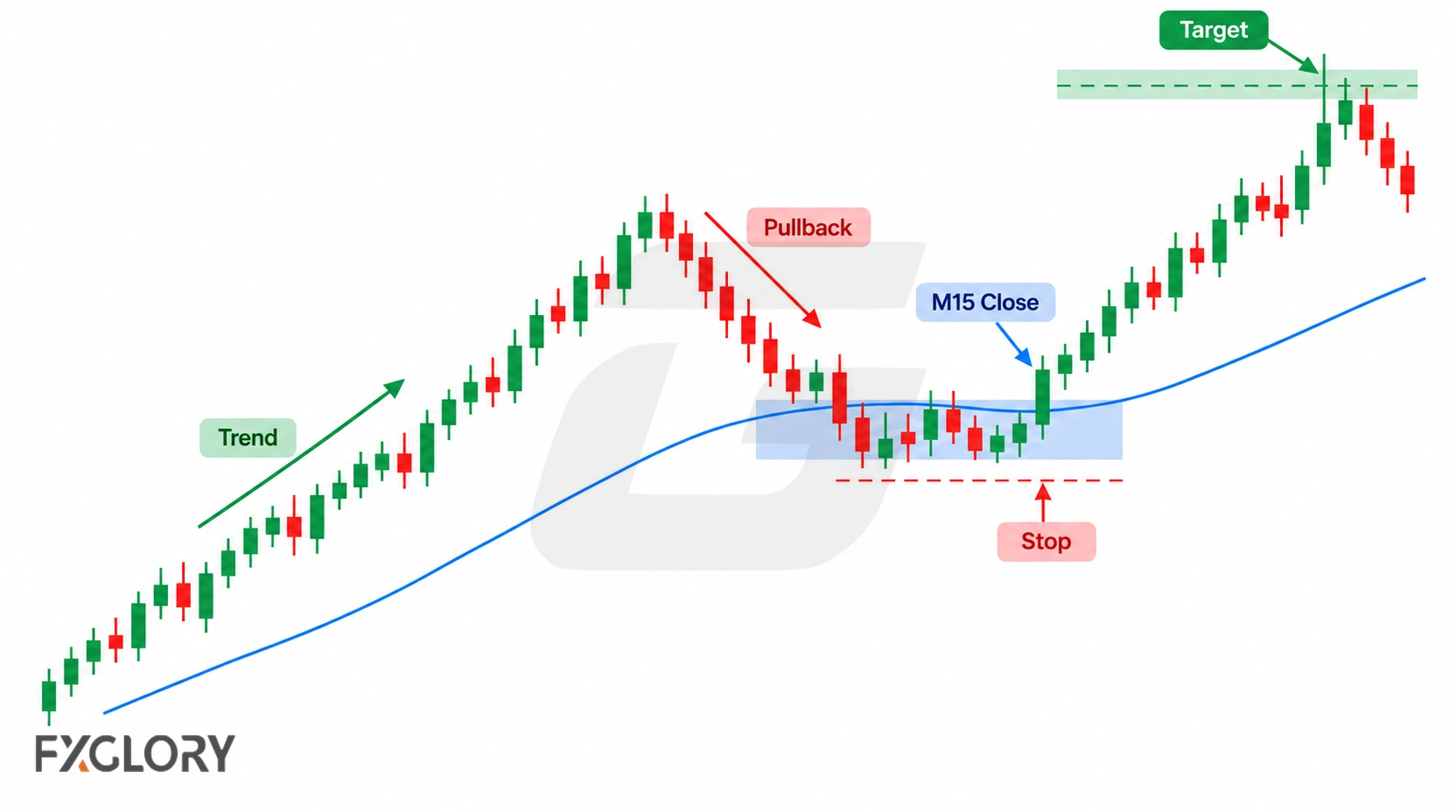
This is a framework, not a promise. It should be adjusted only after the trader defines the instrument, session, spread limit, stop rule, target rule, and review process.
| Rule Part | Example M15 Pullback Rule | Invalid Version |
|---|---|---|
| Context | Higher timeframe shows direction or active intraday bias | M15 candle is used without wider context |
| Setup | Price pulls back toward a planned area without breaking the trend structure | The pullback breaks the structure before entry |
| Confirmation | M15 candle reaction, retest, or continuation rule appears at the planned area | The trader enters after price has already moved away |
| Stop | Stop is placed where the pullback idea is invalid | Stop is moved wider after the trade starts negative |
| Target | Target is planned near structure, range objective, or a measured intraday area | Target is chosen after the trade opens |
| Cancel rule | Trade is skipped if spread widens, price extends, or the trend condition breaks | The trade is taken because the setup almost happened |
15 Minute Opening Range Breakout Strategy
A 15 minute opening range breakout strategy marks the high and low of a planned opening range, then waits to see whether price can break beyond that range with enough confirmation and room. The range can be useful because it gives a defined high, low, stop area, and invalidation point.
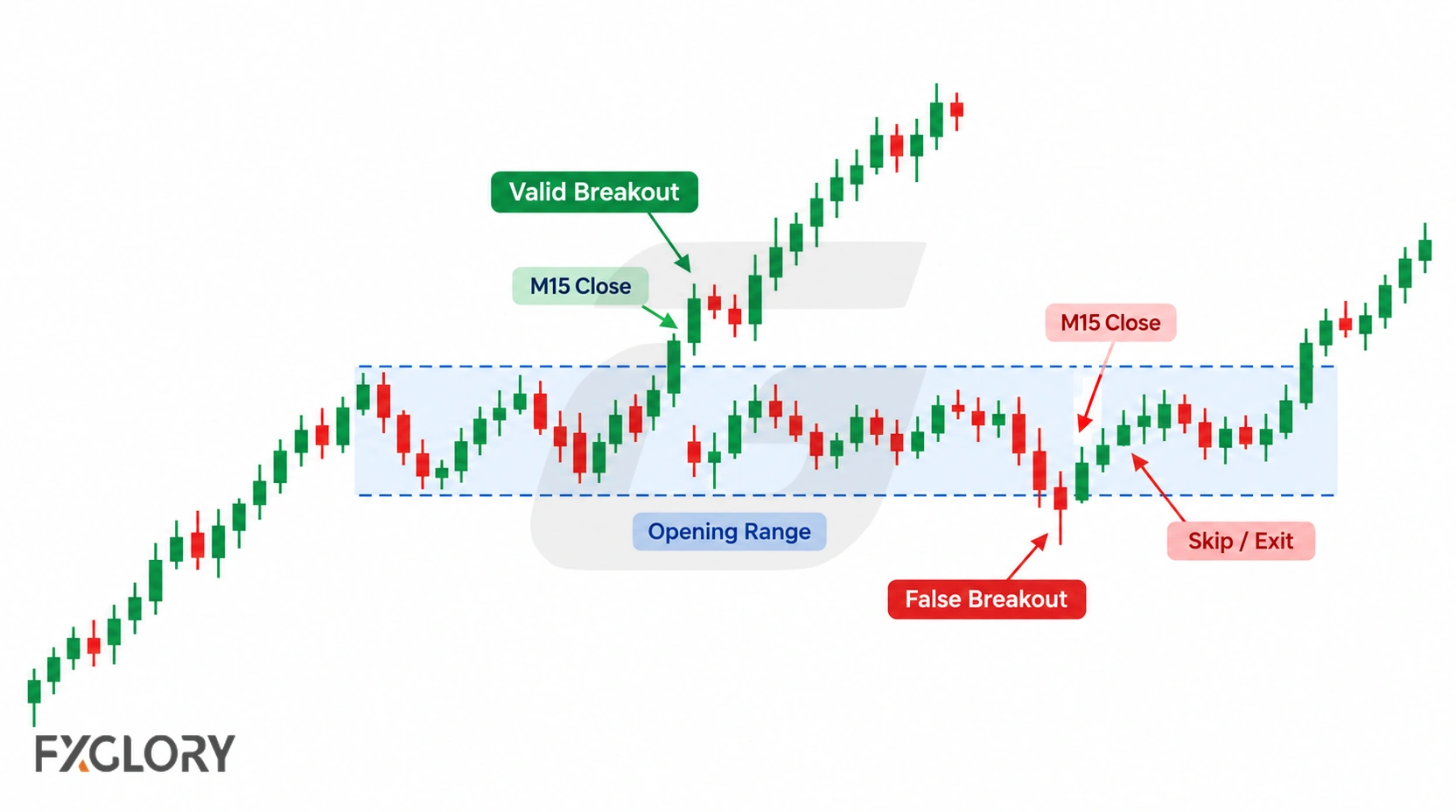
In forex, the opening range should be defined by the trader's planned session, such as a London or New York trading window, not by a random 15 minute candle. Forex does not have one universal exchange open, so the session, start time, and range rule must be written before the breakout appears.
The risk is that opening ranges often create false breakouts. A breakout that barely moves beyond the range, returns inside the range, appears during weak conditions, or cannot continue within the planned number of candles should not be treated as the same clean setup.
| ORB Rule | Better Version | Weak Version |
|---|---|---|
| Range definition | Mark the high and low of the planned opening 15 minute candle or opening window before the session begins | Change the range after the breakout begins |
| Breakout confirmation | Wait for a clean break, close, retest, or continuation rule defined before the session | Enter as soon as price touches the range edge |
| Stop placement | Use the range, retest failure, or volatility-based invalidation area | Place the stop randomly because the range looks small |
| Target logic | Use a structure target, measured range objective, fixed risk multiple, or time-based exit | Choose the target after the trade is already open |
| False-break filter | Skip or exit if price breaks the range and then returns inside it under the written rule | Re-enter repeatedly after failed breaks |
| Time stop | Close, reduce, or review the trade if the breakout does not develop within the planned number of candles | Hold a failed breakout as an unplanned longer trade |
Common 15 Minute Forex Strategy Variants
Many M15 strategies use indicators or chart tools to organize context, confirmation, volatility, or exit review. The tool should have one job. If the same indicator is used to explain direction, entry, exit, and risk at the same time, the rule set becomes hard to review.
If moving averages are part of the setup, review how moving averages smooth price before they lag. If VWAP is used for intraday location, review how VWAP behaves in forex chart analysis. If ATR, Bollinger Bands, or channel logic are used, check the volatility role before treating a band or range break as a signal.
| M15 Variant | Tool Roles | Entry Logic | Stop Or Exit Logic | Skip When |
|---|---|---|---|---|
| Moving-average pullback | Moving average reviews direction or dynamic area | Look for a pullback reaction only when the trend condition remains valid | Stop beyond pullback invalidation; exit near structure or changed trend condition | Price is flat around the average or the trend structure breaks |
| CCI and Stochastic timing | CCI reviews short-term momentum shift; Stochastic reviews overbought or oversold timing | Use oscillator timing only after higher-timeframe context and setup location are known | Stop beyond the failed reaction or invalidation area; exit if momentum fails or target is reached | Both oscillators are used to fight a strong trend without structure |
| RSI and MACD confirmation | RSI reviews momentum condition; MACD reviews momentum shift | Use momentum confirmation only after the setup location is defined | Exit if momentum fails, target is reached, or invalidation appears | Indicators conflict or appear after the move is already extended |
| Bollinger Band reaction | Bands review volatility and extremes | Look for a planned reaction only when the surrounding market condition supports it | Stop beyond failed reaction; exit near mean, structure, or planned target | The market is breaking out and the trader expects every band touch to reverse |
| VWAP intraday location | VWAP reviews whether price is extended or returning to an intraday reference | Use VWAP only as location context, not as a standalone entry signal | Exit if price rejects the planned area or momentum fails | Price is far from the planned area or session context is unclear |
| ATR stop strategy | ATR reviews volatility for stop distance and target realism | Enter only after setup and confirmation are present | Use volatility-based stop or review area | ATR is used to hide an oversized or unclear stop |
| Candlestick confirmation | Candle close reviews reaction, rejection, continuation, or indecision | Use the candle only after context and location are known | Stop beyond the failed candle structure; exit by target, trail, or invalidation | The candle pattern is the only reason for the trade |
M15 Exit Methods
A 15 minute strategy needs an exit before the trade opens. Because the chart moves slower than M1, traders may feel more comfortable holding, but comfort is not an exit rule.
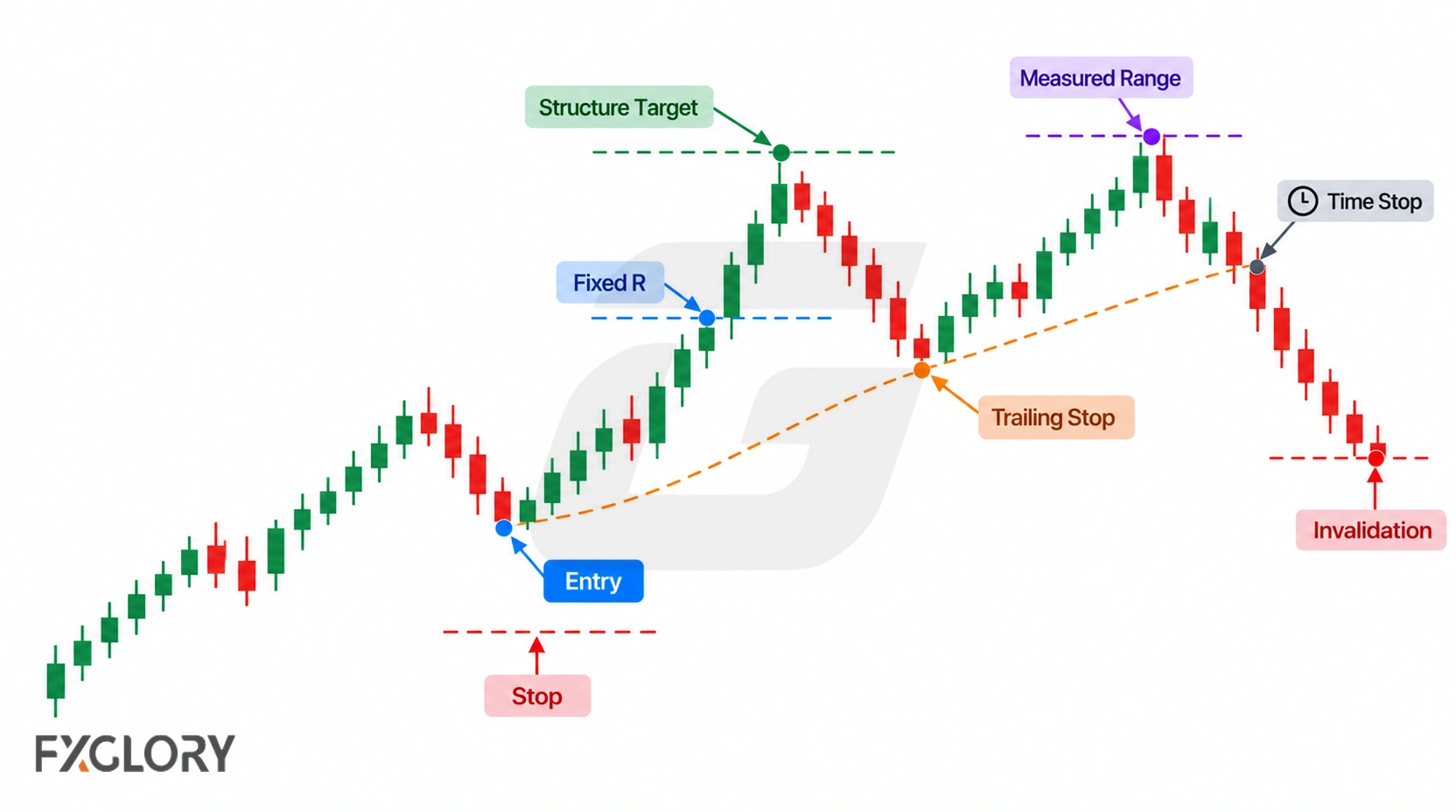
| Exit Method | How It Works On M15 | Weak Use |
|---|---|---|
| Structure target | Exit is planned near support, resistance, range edge, prior swing, or intraday objective | Target is placed inside congestion with little room |
| Fixed risk multiple | Target is set as a planned relationship to the stop distance | Risk multiple is used even when the chart has no room |
| Measured range target | Opening range or consolidation size helps estimate a breakout objective | Range is measured after entry to justify the trade |
| Trailing stop | Stop moves by a written rule after price develops | Stop is moved randomly after each candle |
| Time stop | Trade is closed or reviewed if it does not develop within the planned number of candles | A stalled M15 trade becomes an unplanned hold |
| Invalidation exit | Trade closes when the condition that supported entry disappears | The trader holds because the target has not been hit |
Every M15 confirmation should be paired with stop, target, and time logic before entry. Entry and exit rules should be built as one chain, not repaired after the trade opens.
Win Rate And Target Expectations
A 15 minute strategy should not be judged by a promised win rate. A high win rate can still be weak if losses are larger than gains, spreads reduce small targets, or the trader keeps taking poor setups after the daily limit is reached.
Targets should be judged against structure, stop distance, spread, volatility, and execution. If the target is close but the stop must be wide for the setup to remain logical, the trade may not fit the strategy.
| Expectation Check | Question | Warning Sign |
|---|---|---|
| Win rate | Does the method still work when losses are included? | Only winning examples are reviewed |
| Target distance | Is there room before the next obstacle? | Target sits inside nearby congestion |
| Stop distance | Is the stop logical for the setup? | Stop is wider than the plan allows |
| Spread | Does cost reduce the value of the target? | Spread takes too much of the planned move |
| Sample size | Can the method be reviewed across many trades? | One good trade is treated as proof |
Testing And Review Before Live Trading
A 15 minute strategy should be reviewed on historical examples or demo conditions before it is used with real funds. The purpose is not to find perfect examples. The purpose is to check whether the trader can follow the same setup, stop, target, time rule, and no-trade conditions without rewriting them after each result.
During testing, record both taken and skipped trades. Skipped trades matter because many M15 mistakes come from late entries, weak breakouts, unclear stops, and recovery trades that should not have been opened.
- Review whether the same session rule was used each time.
- Check whether the range, setup, or pullback was defined before entry.
- Record whether the stop and target were known before the trade opened.
- Record whether the time stop or cancellation rule was followed.
- Compare trades that followed the plan with trades that broke it.
Risk Rules For M15 Trading
Risk on M15 can feel easier than M1 because trades do not appear as quickly. That feeling can be misleading. A wider stop, larger position, repeated breakout attempts, or revenge trade after a false breakout can still create large exposure.
For account-level risk limits, use the forex risk-management strategy page.
- Stop before entry: The trade is not ready if the invalidation point is unknown.
- Position size after stop distance: Size should be chosen after the stop is visible.
- Spread before target: The target must still make sense after trading cost.
- Time stop before entry: The trade should have a review point if it does not move.
- No repeated failed breakouts: A failed ORB should not become several emotional re-entries.
- Daily stop before trading: The session loss or drawdown limit should be set before the first trade.
- Margin review: Check whether the position still fits margin and leverage exposure rules.
- Event risk control: Scheduled events can change spread, speed, and volatility beyond the setup rules.
No-Trade Rules For A 15 Min Forex Strategy
No-trade rules keep the M15 chart from becoming a reason to force trades. A completed candle can look convincing, but the trade should still be skipped when the condition is weak.
- Weak breakout: Price moves beyond a level but closes back inside the range.
- Late entry: The candle has already traveled too far from the planned area.
- No clear stop: The chart does not show where the trade idea is wrong.
- Flat session: The market is too quiet for the target and stop to make sense.
- Chaotic volatility: Movement is active but not manageable under the written rules.
- Spread problem: The planned target does not leave enough room after cost.
- News-event risk: A scheduled event may change spread, speed, or volatility beyond the plan.
- Overlapping exposure: Several positions create the same directional risk.
- Recovery trade: The entry exists because the trader wants to recover a previous loss.
15 Min Forex Strategy Review Checklist
Reviewing M15 trades only by profit or loss hides the reason behind the result. A winning trade can break rules, and a losing trade can still be correctly executed.
- Write the pair, session, spread, and higher-timeframe condition before entry.
- Record whether the M15 setup was trend pullback, opening range breakout, range reaction, indicator-supported confirmation, or another written method.
- Write the exact confirmation used: candle close, retest, rejection, continuation, or indicator-supported condition.
- Record whether the entry was planned, early, late, or emotional.
- Write the original stop and why that point invalidated the trade idea.
- Write the target method: structure, fixed risk multiple, range objective, trailing, time stop, or invalidation exit.
- Record whether spread, margin, and position size were checked before entry.
- Record whether the trade followed the time stop or became an unplanned hold.
- Record whether the daily stop or max-trade rule was followed.
- Review whether the result came from following the rules or breaking them.