
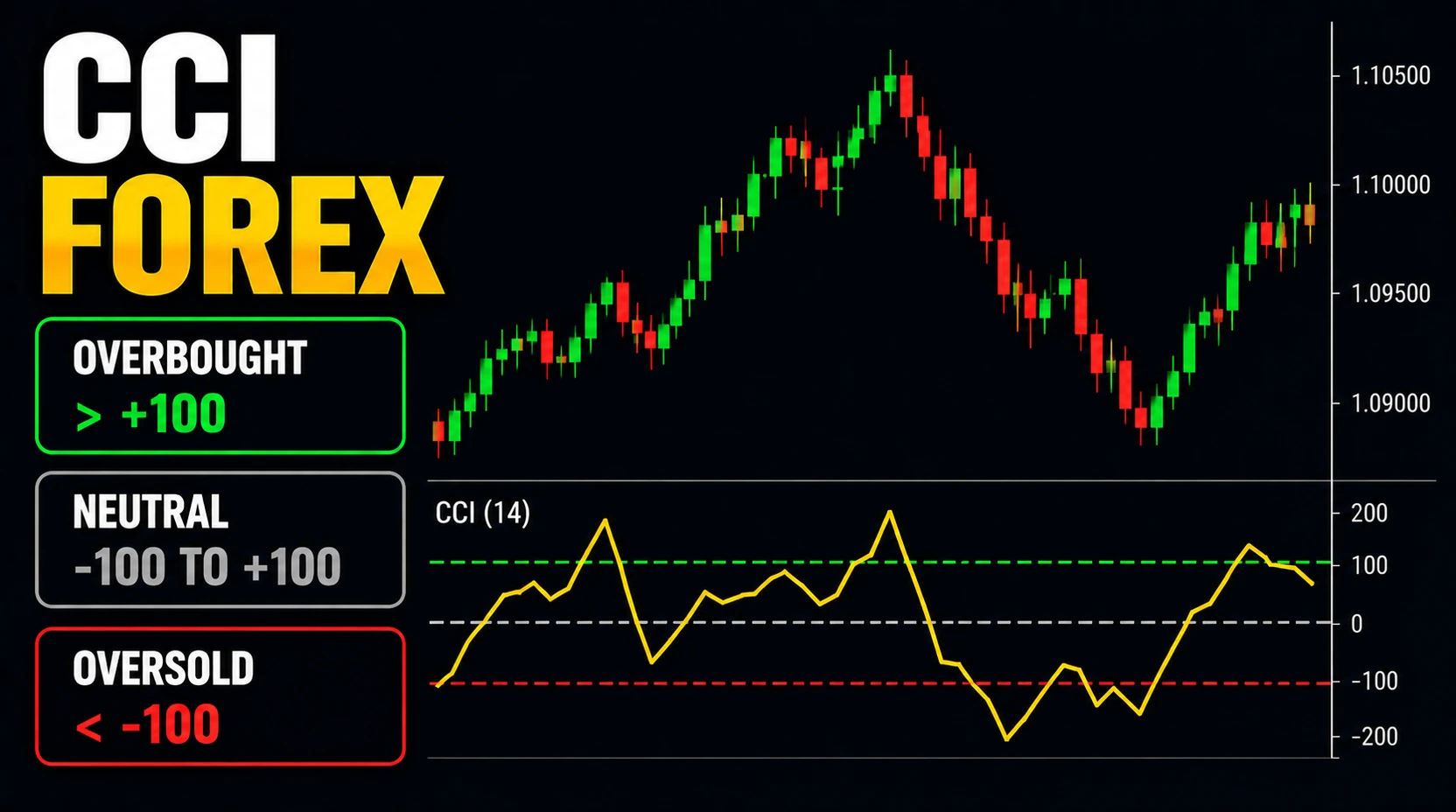
What Is CCI in Forex?
CCI stands for Commodity Channel Index. In forex trading, the CCI forex indicator is used to review how far current price has moved from a recent average.
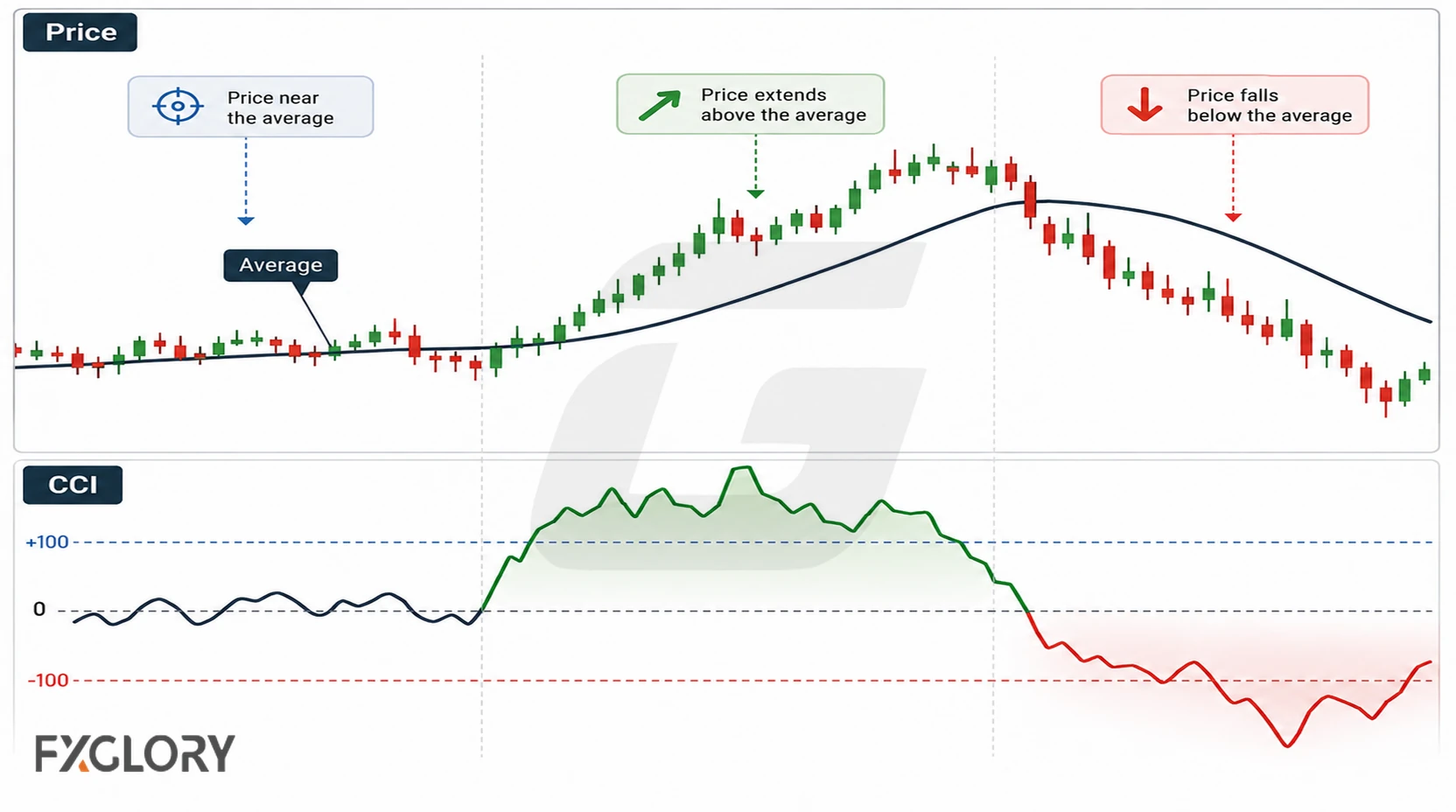
CCI was originally introduced by Donald Lambert for commodity-market analysis, but the same calculation is now used across markets, including forex. For FX pairs, CCI is best understood as a price-deviation oscillator: it shows whether current typical price is close to, above, or below its recent average.
For other early-warning tools and false-signal filters, review forex leading indicators.
How the CCI Forex Indicator Works
CCI moves above and below a zero line. When CCI is above zero, current typical price is generally above its recent average. When CCI is below zero, current typical price is generally below its recent average.
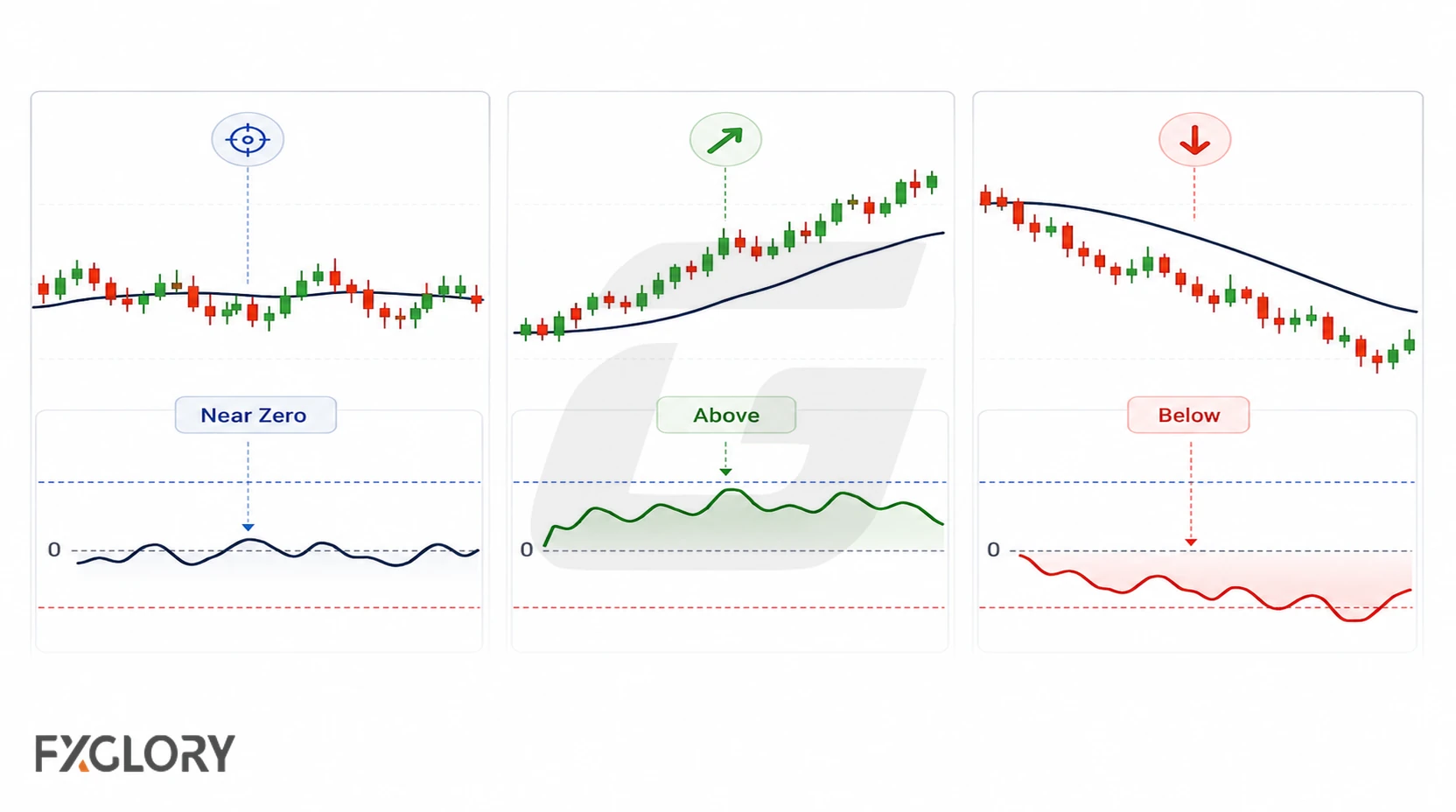
The further CCI moves away from zero, the stronger the deviation from the average becomes. That deviation can mean stretched movement, strong trend pressure, or noisy overextension depending on the market condition.
- CCI above zero: Price is generally above its recent average, but this does not confirm a trend by itself.
- CCI below zero: Price is generally below its recent average, but this does not confirm weakness by itself.
- CCI near zero: Price may be closer to its recent average or the condition may be unclear.
- CCI moving sharply: Price deviation may be changing quickly, but fast movement can also create false warnings.
CCI Formula in Plain English
CCI compares typical price with its simple moving average, then scales that distance by mean absolute deviation over the selected lookback.
CCI = (TP − SMA(TP, n)) / (0.015 × MD)
- TP (typical price): (high + low + close) / 3 for the current bar.
- SMA(TP, n): The simple average of typical prices over the last n bars.
- MD (mean deviation): The average of the absolute differences between each typical price in that lookback and the SMA for that same lookback.
- 0.015: Lambert's conventional scaling constant; it makes ±100 useful reference levels, not fixed statistical boundaries.
For example, if TP is 1.1050, its 20-bar average is 1.1030, and mean deviation is 0.0010, CCI is about +133: (0.0020) / (0.015 × 0.0010). This illustrates the calculation, not a trading signal. When MD is zero, the formula has an undefined denominator and a platform must handle that case.
CCI +100 and -100 Levels in Forex
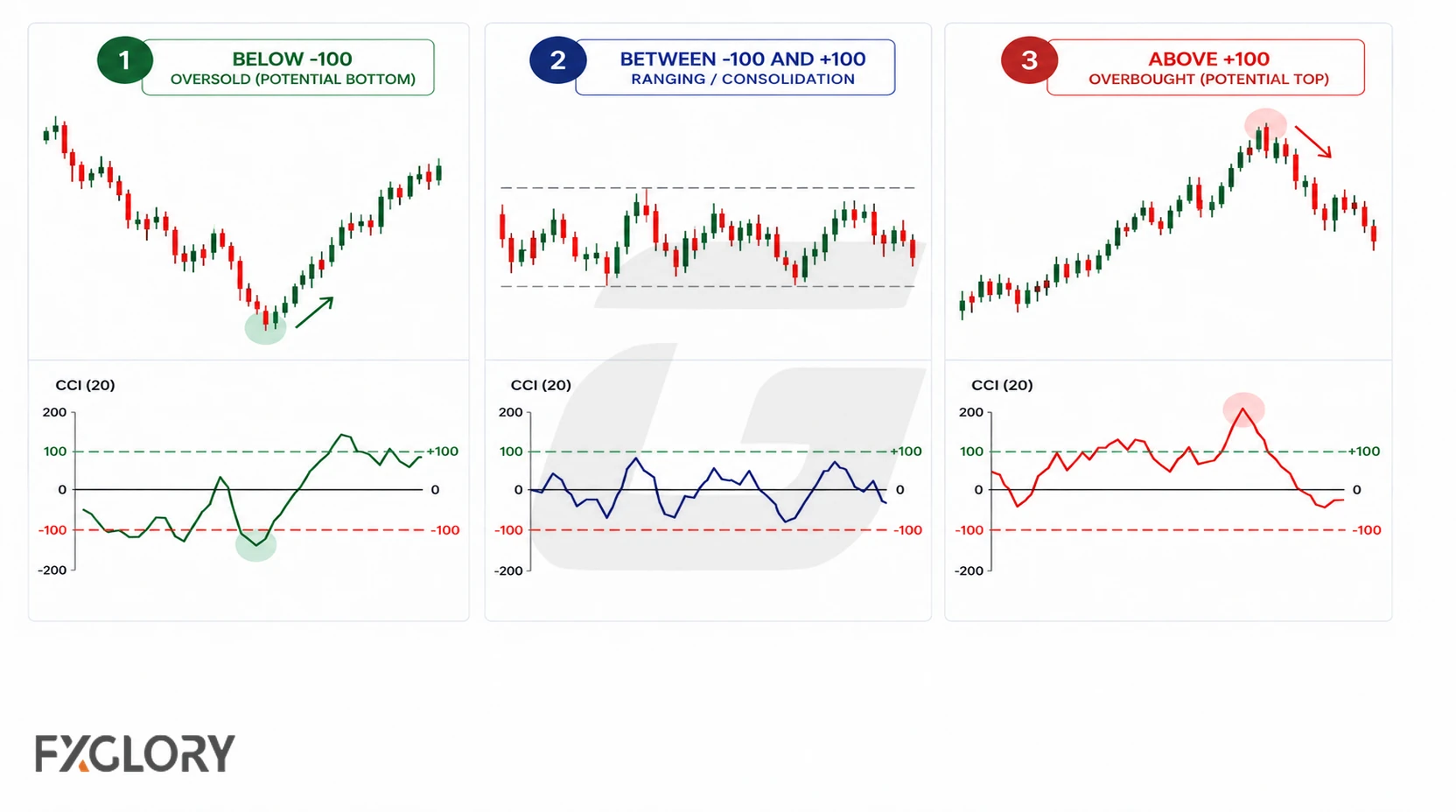
The +100 and -100 levels are common CCI reference zones. A reading above +100 means price is far above its recent average. A reading below -100 means price is far below its recent average.
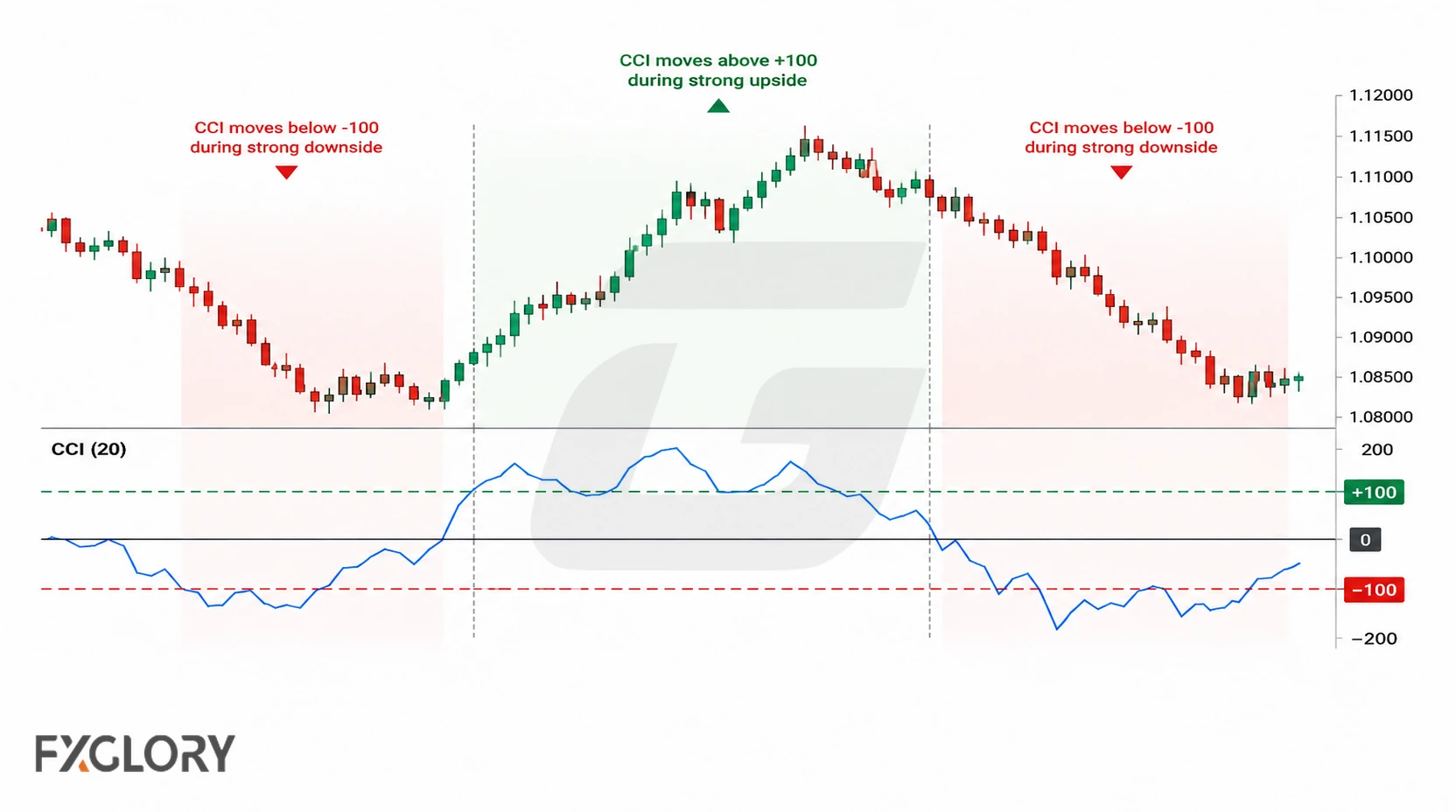
These levels can be read in different ways depending on market condition. In a range, a move beyond +100 or -100 may show stretched movement. In a trend, the same reading may show strong directional pressure.
- CCI above +100: Review whether price is showing strong positive deviation, stretched movement, or trend pressure.
- CCI below -100: Review whether price is showing strong negative deviation, stretched movement, or trend pressure.
- CCI near zero: Review whether price is closer to its average or whether momentum is unclear.
- CCI crossing a level: Treat the move as a context change, not a trade command.
Why CCI Is Not Like RSI or Stochastic
CCI is unbounded. This means it is not limited to a fixed 0 to 100 scale. It can move far above +100 or far below -100 when price deviation becomes unusually large.
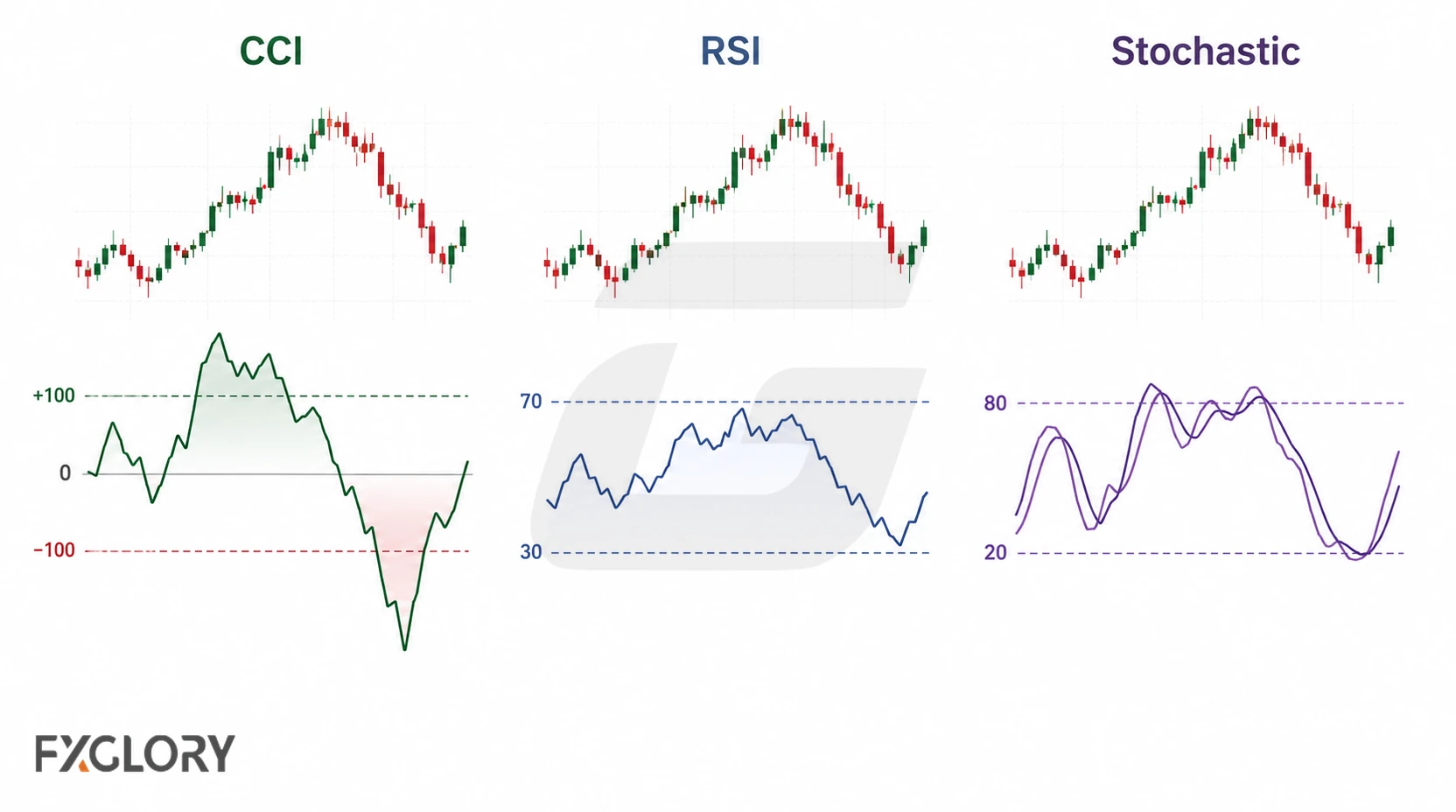
This is one reason CCI can be misread. An extreme CCI reading does not automatically mean price is ready to reverse. It may also show that a strong move is still active.
- RSI: Bounded between 0 and 100.
- Stochastic: Bounded between 0 and 100.
- CCI: Unbounded, so extreme readings can extend during strong movement.
- Level mistake: Do not treat +100 and -100 as hard limits.
CCI in Ranging Markets vs Trending Markets
CCI behavior changes with market condition. The same +100 or -100 reading can mean different things in a quiet range, a pullback, or a strong trend.
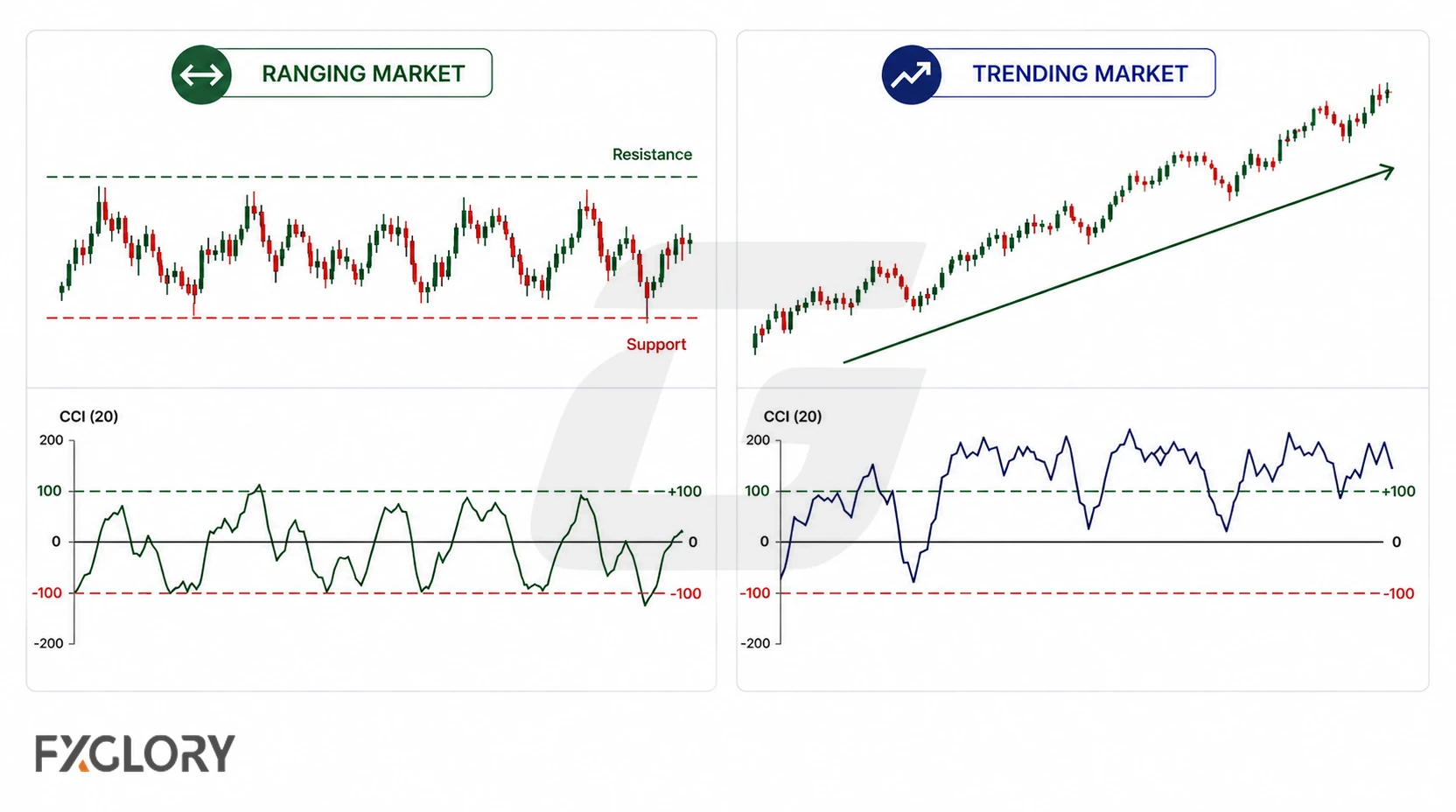
- Ranging market: CCI above +100 or below -100 can help review stretched movement near a range edge, especially when price is also near support or resistance.
- Pullback in a trend: CCI can help review whether price has moved far enough from its average to deserve a closer structure check.
- Strong uptrend: CCI can stay above +100 while price continues higher.
- Strong downtrend: CCI can stay below -100 while price continues lower.
- High-volatility market: CCI can swing quickly and create warnings that fail before confirmation appears.
When CCI is stretched but price structure still supports the trend, review forex trend structure before treating the CCI reading as a reversal warning.
CCI Divergence in Forex
CCI divergence appears when price and CCI stop confirming each other. This can warn that pressure behind a move is changing, but it is not a reversal signal by itself.
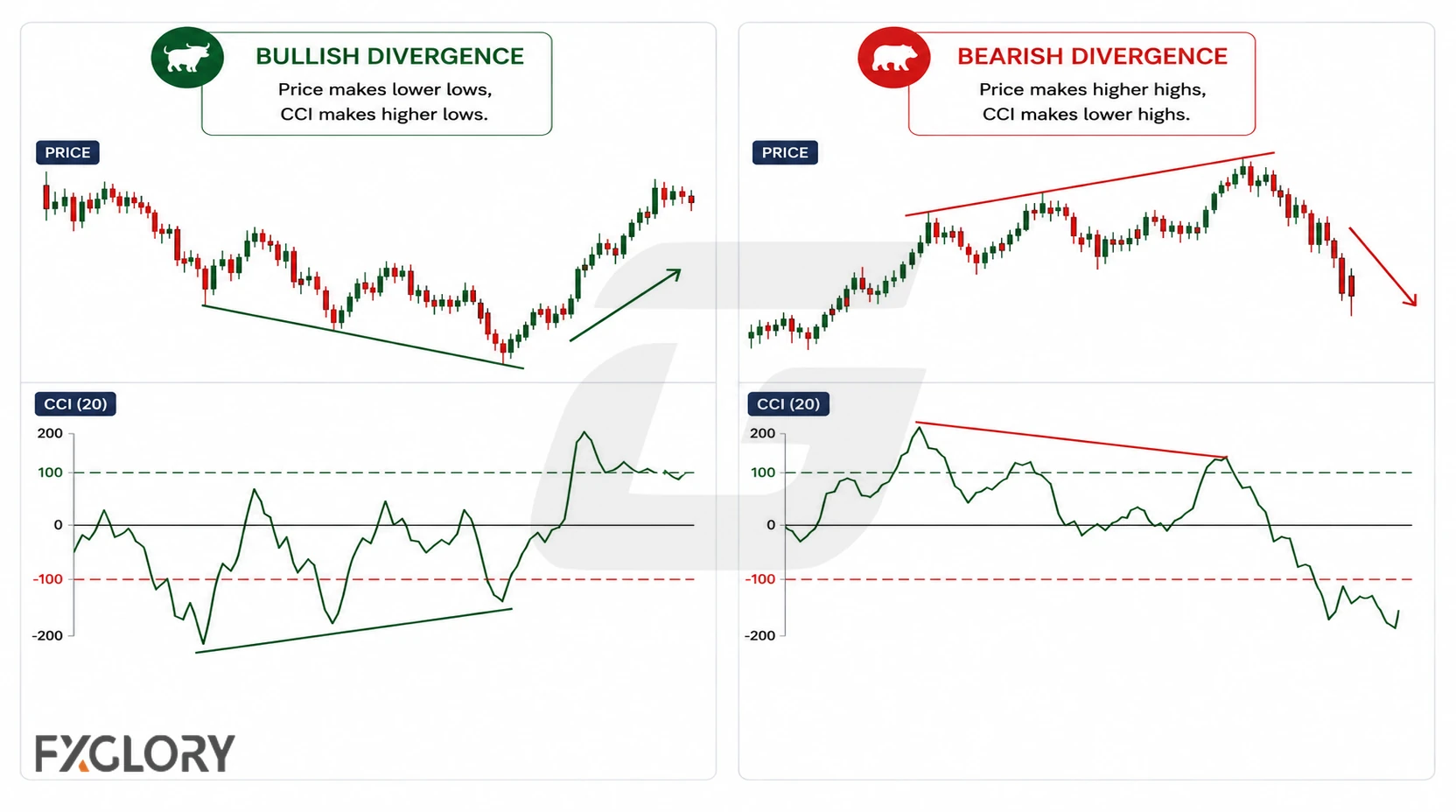
- Bullish CCI divergence: Price makes a lower low while CCI makes a higher low. This can warn that downside pressure is weakening.
- Bearish CCI divergence: Price makes a higher high while CCI makes a lower high. This can warn that upside pressure is weakening.
- Hidden divergence: Some traders use it to review possible continuation, but it needs clean structure and should not be forced onto every chart.
- Weak divergence: Divergence away from support, resistance, or structure can be easier to misuse.
For the full topic, use the price-and-momentum divergence guide.
CCI Settings in Forex
The common starting lookback is 20 periods, though platform defaults can differ. A shorter lookback reacts faster and may cross reference levels more frequently; a longer one typically reacts more slowly and smooths short-term fluctuations.
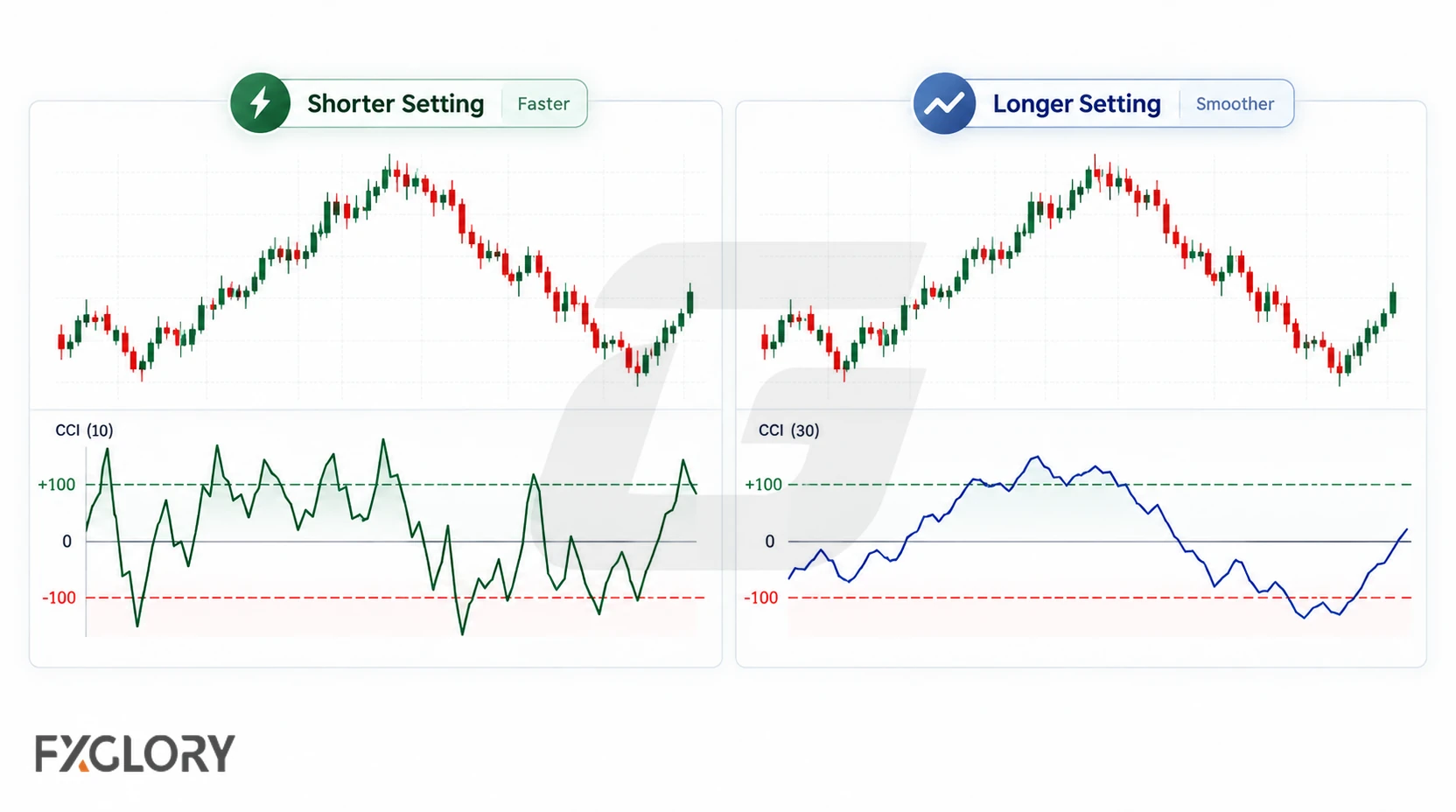
A 20-period setting on a 5-minute chart uses a different span of market activity than 20 periods on a daily chart. Compare readings on the same pair and timeframe before judging whether a setting helps identify the intended market condition.
- Shorter lookback: Faster response but potentially more noisy crossings.
- Longer lookback: Smoother response but potentially later warnings.
- Overfitting risk: Repeatedly changing periods to fit past charts does not establish future reliability.
CCI vs RSI, Stochastic, and MACD
CCI, RSI, Stochastic, and MACD can all support momentum or pressure review, but they do not measure the same thing.
- CCI: Reviews price deviation from a recent average.
- RSI: Reviews momentum pressure by comparing recent gains and losses.
- Stochastic: Reviews where price closes compared with the recent high-low range.
- MACD: Reviews the relationship between moving averages and momentum shifts.
- Stacking risk: Adding several oscillators without separate jobs can make the chart look confirmed while repeating similar information.
For related oscillator context, use the RSI momentum-pressure guide and the Stochastic range-position guide. For moving-average momentum context, use the MACD momentum guide.
How to Use CCI in Forex Without Treating It as a Signal
CCI is most useful when it answers a specific chart question. Read it alongside price rather than treating an indicator crossing as a complete trade setup.
- Identify the market: Is price ranging, trending, pulling back, or breaking out?
- Read CCI: Compare the zero line, ±100 zones, and whether the reading is strengthening or returning toward zero.
- Check price location: Look for nearby support, resistance, range edges, or meaningful price swings.
- Check confirmation: Is price showing a higher low, lower high, break, retest, or failed continuation that supports the interpretation?
- Check conditions and invalidation: Consider volatility and costs, and specify what price behavior would disprove the idea before using it in a plan.
To assess the chart beyond the oscillator, review support and resistance and forex market structure.
Chart-Reading Examples: CCI in Context
These are hypothetical chart-reading exercises, not recorded CCI signals or live trading results.
- EUR/CHF market chart: If price is near the top of a defined range and CCI rises above +100, check whether price actually rejects resistance. An extreme reading alone does not establish a reversal.
- GBP/USD market chart: If price is trending upward and CCI stays above +100, check trend structure before treating the reading as overbought. A sustained extreme can accompany continuation.
Current charts may not display either scenario. Apply the questions to the conditions actually present.
Custom CCI Indicators and Script Caution
Some traders use custom CCI indicators, adaptive CCI tools, divergence scripts, color changes, arrows, or multi-timeframe CCI filters. These tools can make the chart easier to scan, but the signal logic should be understandable before it is used.
A custom CCI tool can look clean in old examples and still fail when market condition changes. Adaptive settings can also create overfitting risk when the tool is adjusted too closely to past price behavior.
- Calculation check: Can the trader explain what was changed from standard CCI?
- Signal-stability check: Does the warning stay fixed after the candle closes?
- Timeframe check: Does the tool behave differently on faster or slower charts?
- Failure-mode check: Does the tool fail during news, high volatility, or strong trends?
- Overfitting check: Does the tool need constant setting changes to look useful?
Before relying on visual warnings, review non-repainting signal checks.
CCI False-Signal Filters
CCI can produce readings that appear compelling but have little use in the prevailing condition. Common failure modes include:
- Trend persistence: CCI remains beyond ±100 while price continues in the same direction, undermining a premature reversal interpretation.
- Choppy zero-line crossings: Frequent moves above and below zero provide little directional information.
- Level whipsaws: Repeated ±100 crossings without a clear price reaction create conflicting warnings.
- Divergence without price response: Opposing price and CCI swings persist without structural confirmation.
- Cost or event disruptions: News, widened spreads, low liquidity, or rapid volatility can make an otherwise clear chart idea impractical.
A filter may reduce some poor readings, but no filter eliminates false signals.
How to Test the CCI Indicator in Forex
To evaluate CCI fairly, define the indicator's purpose before reviewing charts. Separate ranges from trends and record the pair, timeframe, lookback, market condition, reference-level behavior, and whether the reading helped explain price action.
- Define the observation: For example, a CCI move above +100 during a range or a higher CCI low during a price decline.
- Record context: Mark support/resistance, trend structure, volatility, and any major news event.
- Classify the result: Did the reading precede a meaningful price reaction, remain extreme through continuation, or repeatedly reverse without useful context?
- Check consistency: Review both successful and unsuccessful examples without changing the lookback to fit each result.
This checks whether CCI is useful as an interpretive tool; it does not establish a profitable trading system. For defined entries, exits, risk rules and hypothetical testing, see the CCI forex strategy guide.