
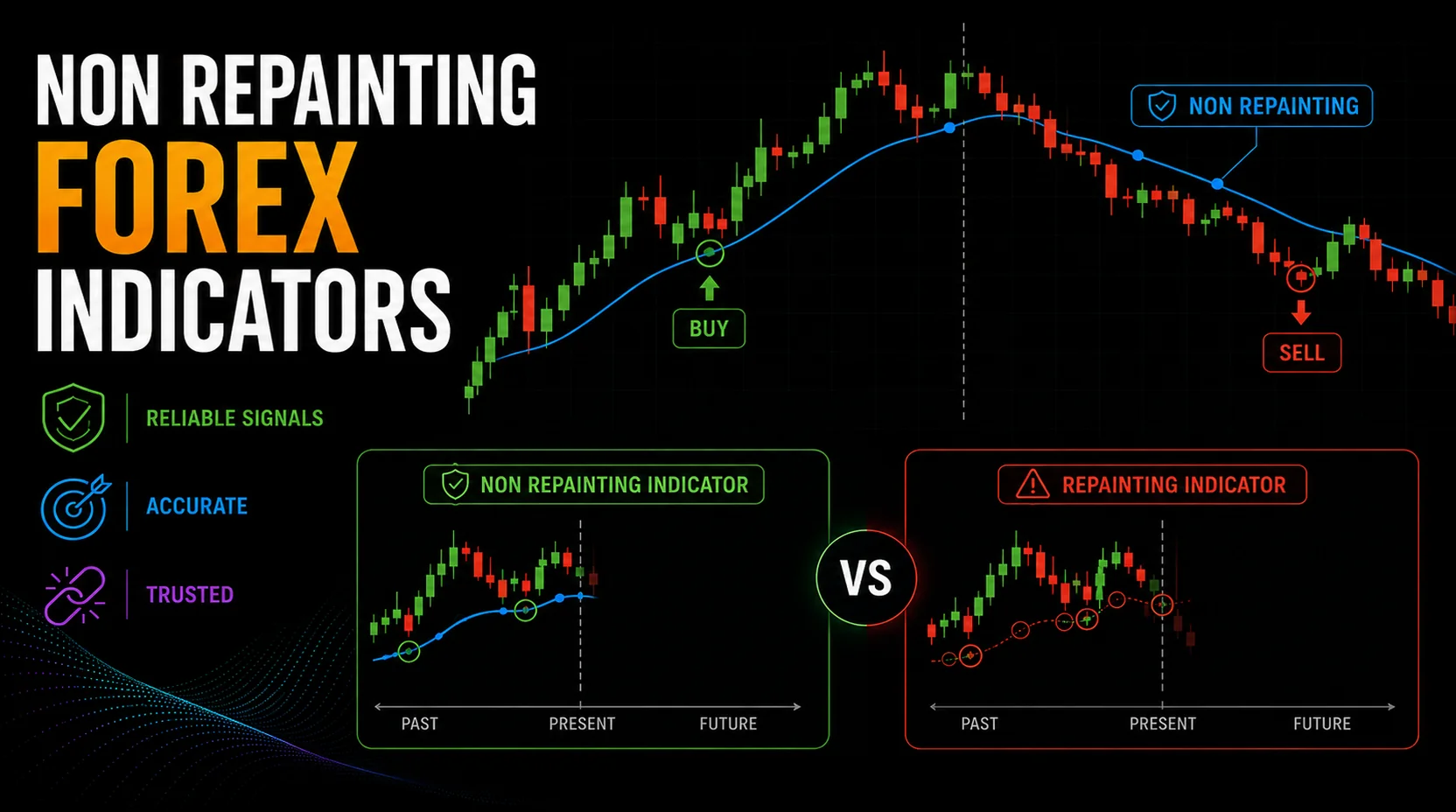
What Is a Non-Repaint Indicator?
A non-repaint indicator is designed to keep a confirmed signal or value fixed after the relevant candle has closed. If a marker appears on a completed candle, it should not later move to another candle, disappear, or change simply because new price data arrives.
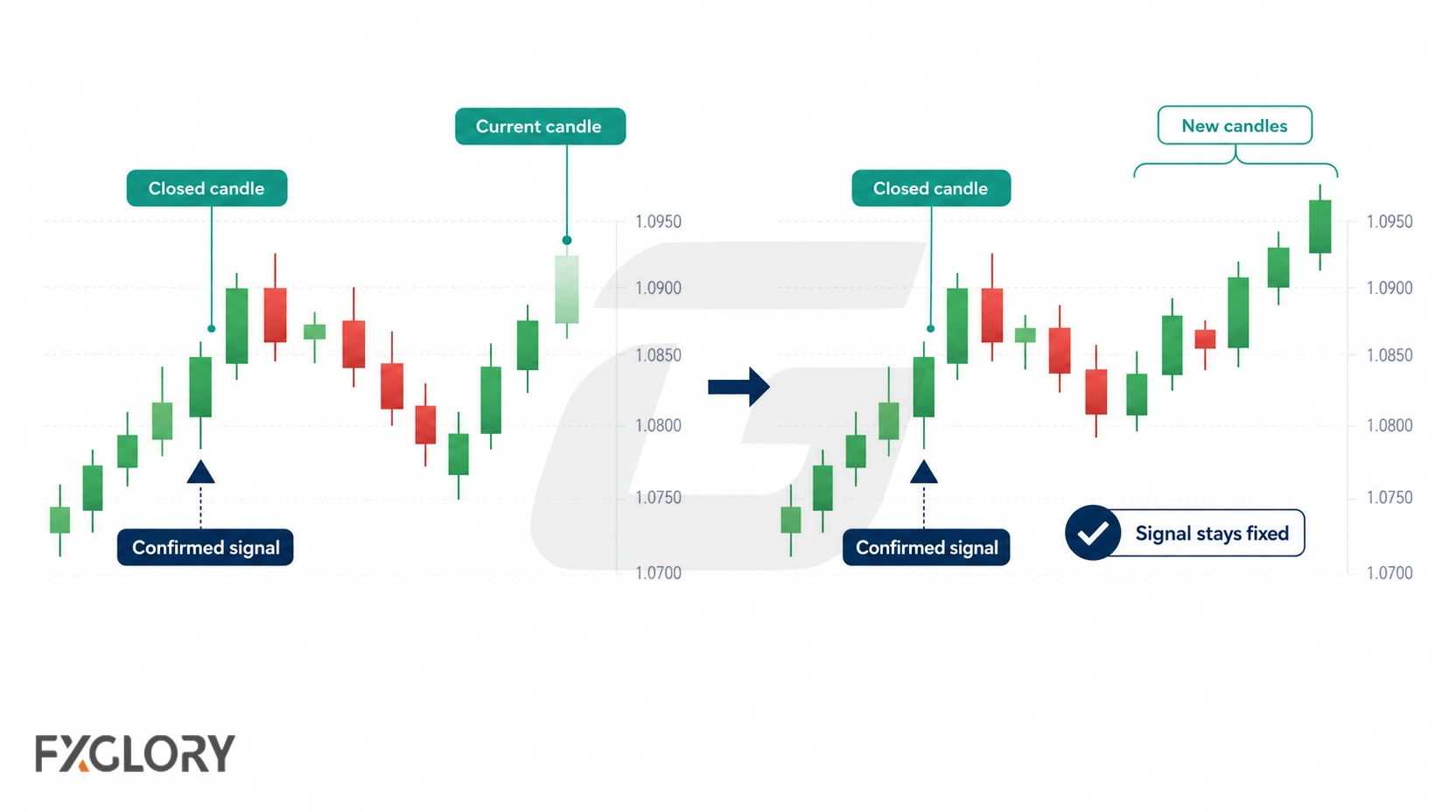
This matters because historical charts are often used to judge an indicator. If old markers are rewritten after the fact, the chart can look cleaner than the signals that were actually available in real time.
The term describes signal stability, not trading performance. For broader context, see how forex technical indicators are used.
Repainting vs Non-Repainting Indicators
A repainting indicator changes a signal or value that had already appeared on historical chart data. A non-repainting indicator keeps confirmed closed-candle output stable under the same settings.
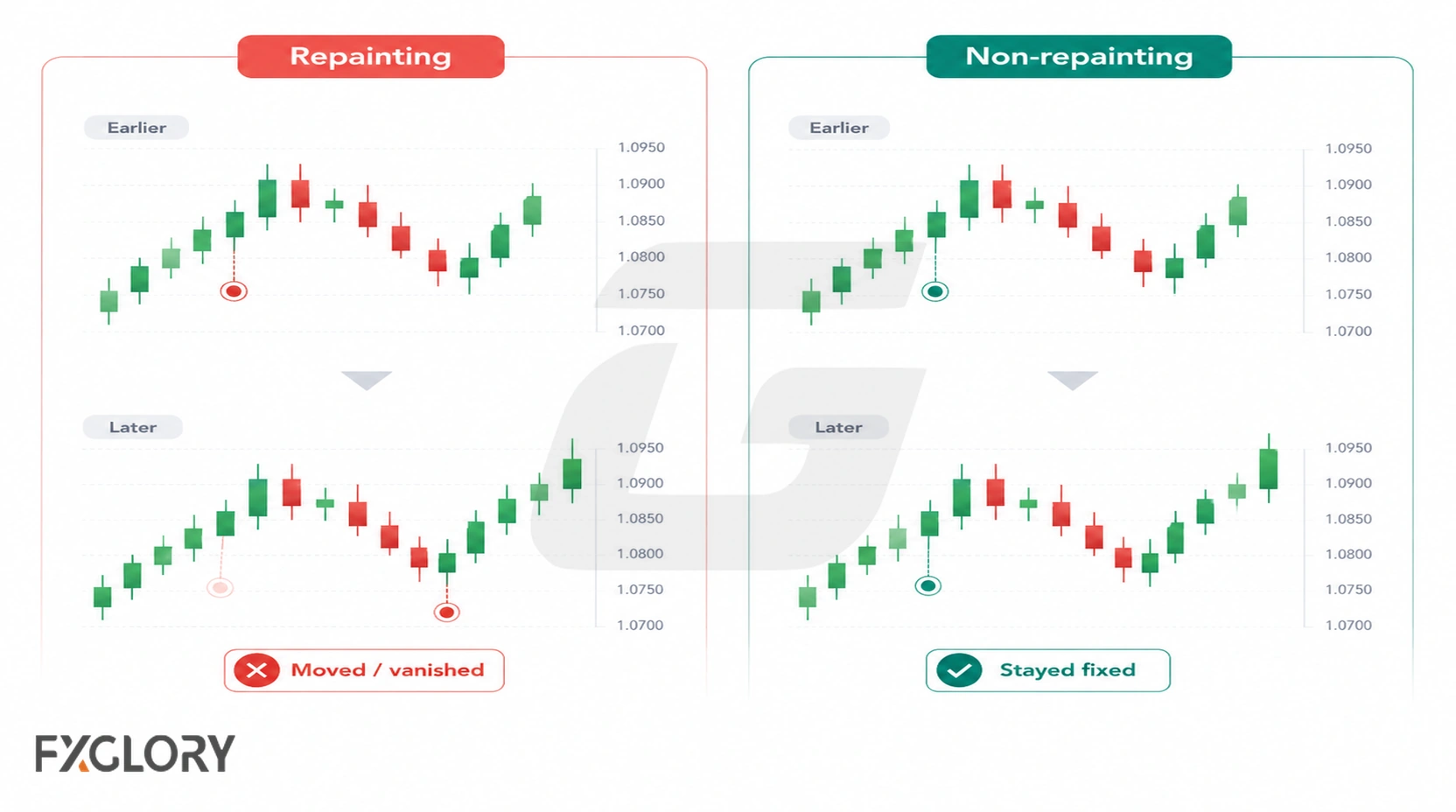
Not every tool that redraws is deceptive. Some indicators are intentionally designed to refine an unfinished swing or pattern as new data arrives. The key question is whether the trader understands which values are provisional and which are confirmed.
| Behavior | Repainting | Non-repainting |
|---|---|---|
| Closed-candle signal | May later move, vanish, or change | Remains fixed after confirmation |
| Current-candle value | May update | May also update before close |
| Historical chart review | Can differ from what appeared live | Should preserve confirmed signals |
| Live testing needed? | Yes | Yes |
Closed Candles vs Current-Candle Movement
The active candle is still receiving new prices, so indicator values based on that candle can change until it closes. A temporary arrow, momentum reading, or moving-average value may therefore shift during the candle without rewriting completed history.
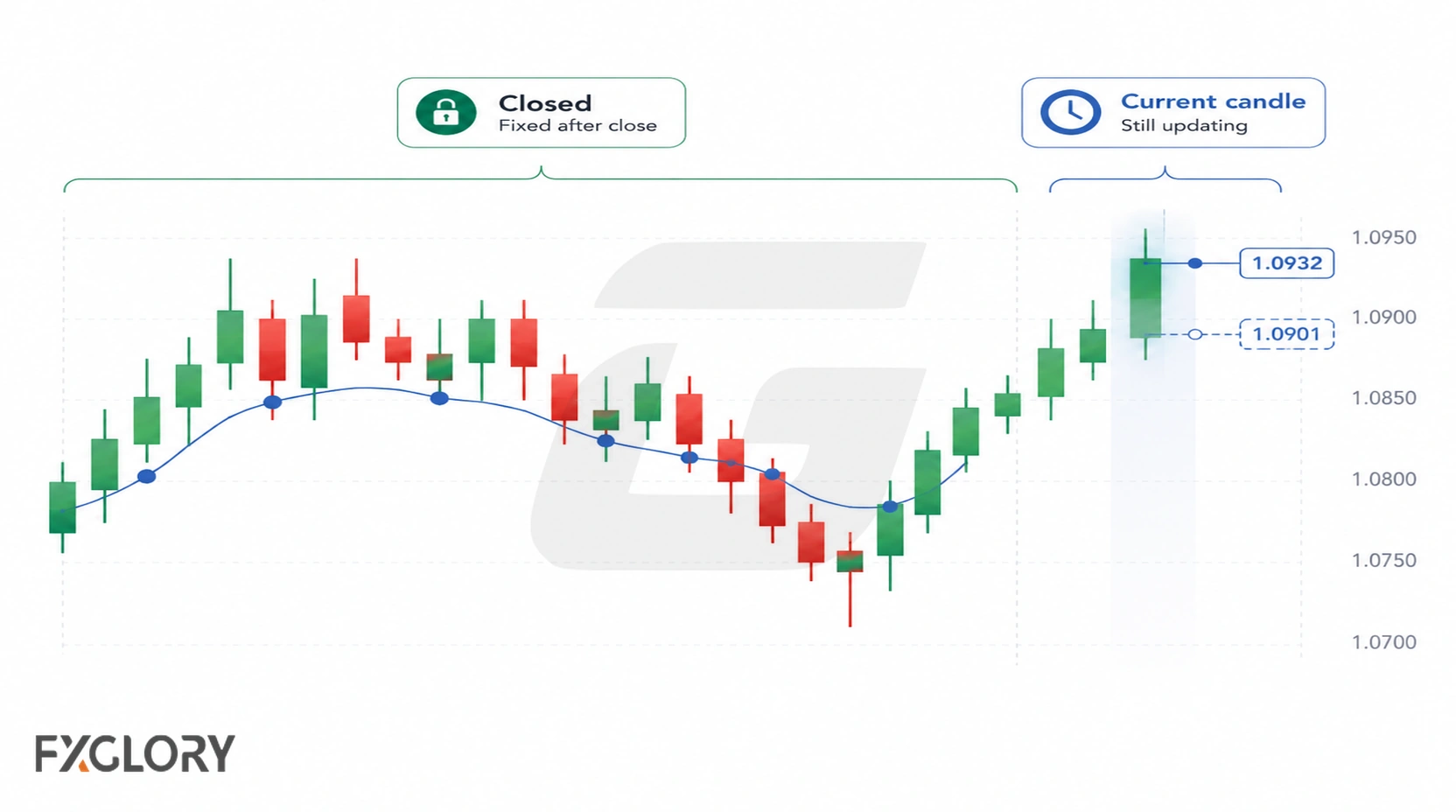
The practical test is simple: note what happens after the candle closes. Multi-timeframe tools require extra care because a higher-timeframe value displayed on a lower-timeframe chart can remain provisional until the higher-timeframe candle itself closes.
Repainting vs Recalculating
Indicators recalculate because market data changes. Normal recalculation can update the active candle, a still-forming higher-timeframe bar, or another value explicitly defined as provisional.
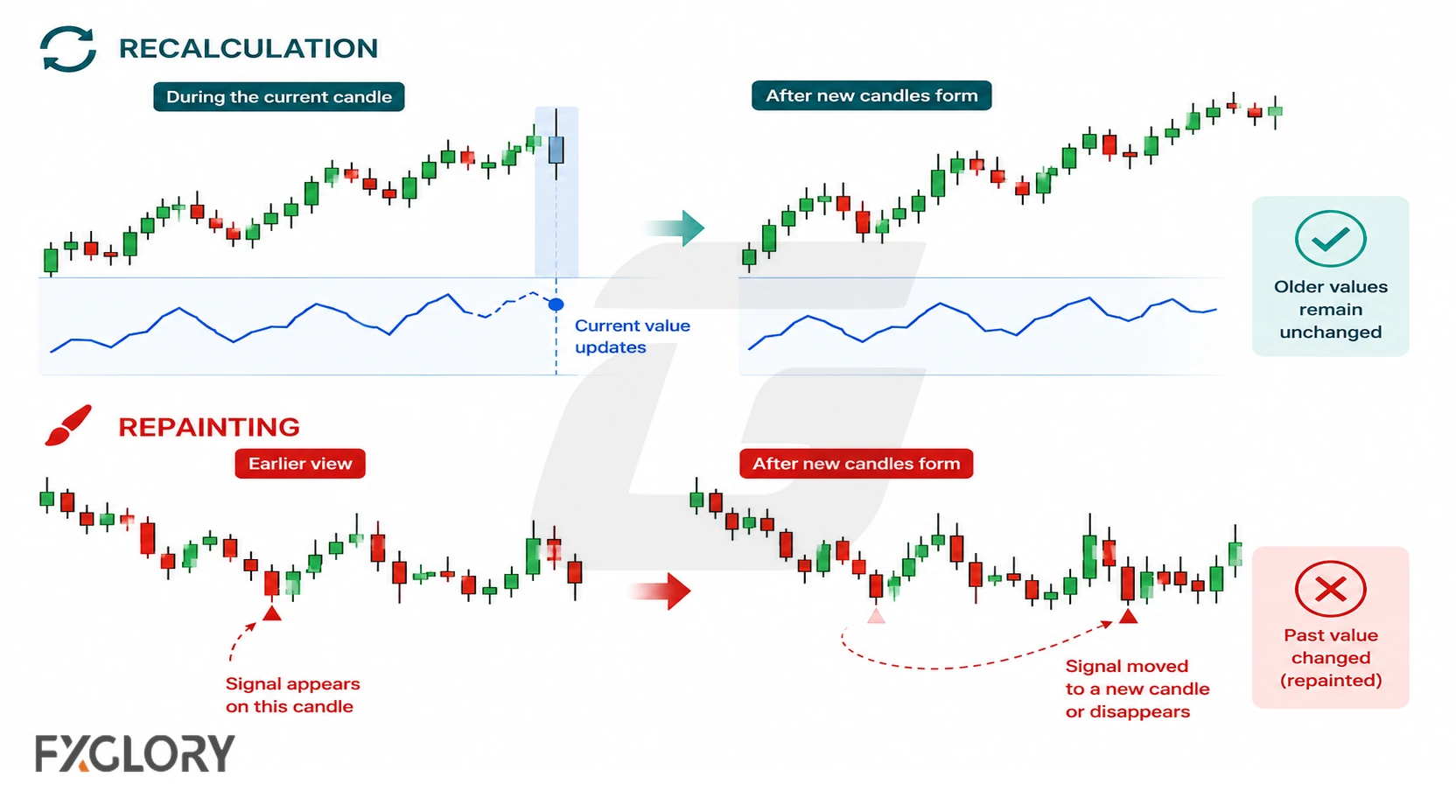
This distinction is why an indicator should be evaluated according to its confirmation rules rather than judged only from movement on the live bar.
Does No-Repaint Mean the Indicator Is Accurate?
No. A signal can remain permanently fixed and still be late, poorly timed, or followed by an adverse price move. Stability answers one question—whether the historical output changes—not whether the underlying method has an edge.
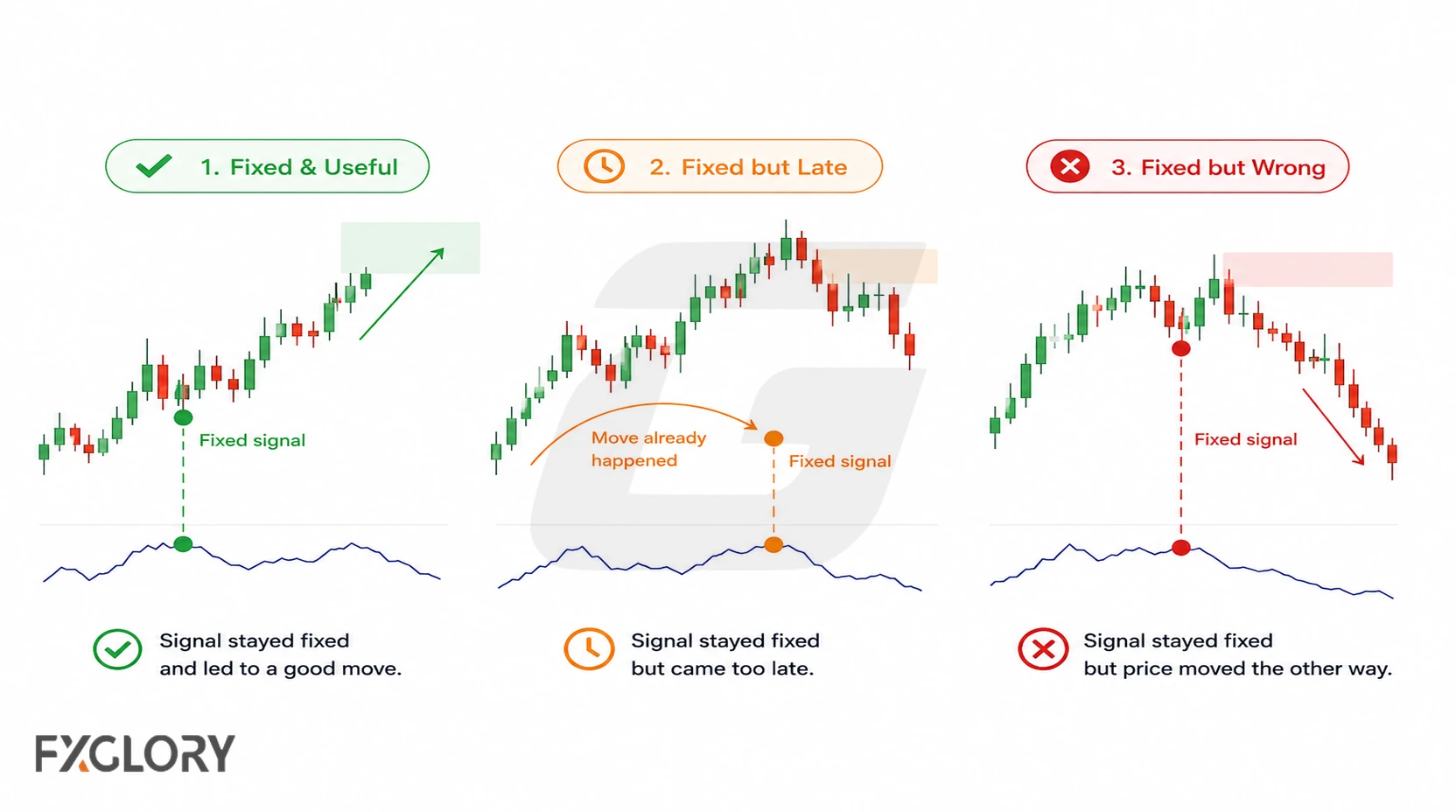
When comparing tools, review how to choose indicators by trading purpose rather than marketing claims.
Examples of Indicators That Usually Keep Closed-Candle Values Fixed
Standard versions of several widely used indicators normally preserve completed-candle readings, even though their active-candle values can move in real time.
- Moving average: Completed values normally stay fixed under standard price-input settings. See how forex moving averages update.
- RSI: Standard completed-candle readings normally remain fixed after close.
- MACD: Historical completed-bar values normally remain stable in standard implementations.
- ATR: Completed-bar readings normally stay fixed and measure volatility rather than direction.
| Indicator | Typical closed-candle behavior | Main purpose |
|---|---|---|
| Moving Average | Normally fixed | Trend smoothing |
| RSI | Normally fixed | Momentum |
| MACD | Normally fixed | Momentum and trend |
| ATR | Normally fixed | Volatility |
| Fractals | Fixed after confirmation | Swing points |
| ZigZag | Recent swing can redraw | Structure review |
Custom, multi-timeframe, alert-based, or modified versions can use different logic, so the behavior of a standard indicator should not automatically be assumed for every downloaded script.
Fractals, ZigZag, and Forming Patterns
Fractals and ZigZag illustrate why confirmation rules matter. A standard Bill Williams fractal is provisional until the candles needed to confirm the swing have formed; after confirmation, the marker should remain fixed under standard logic. See how forming and confirmed fractals work.
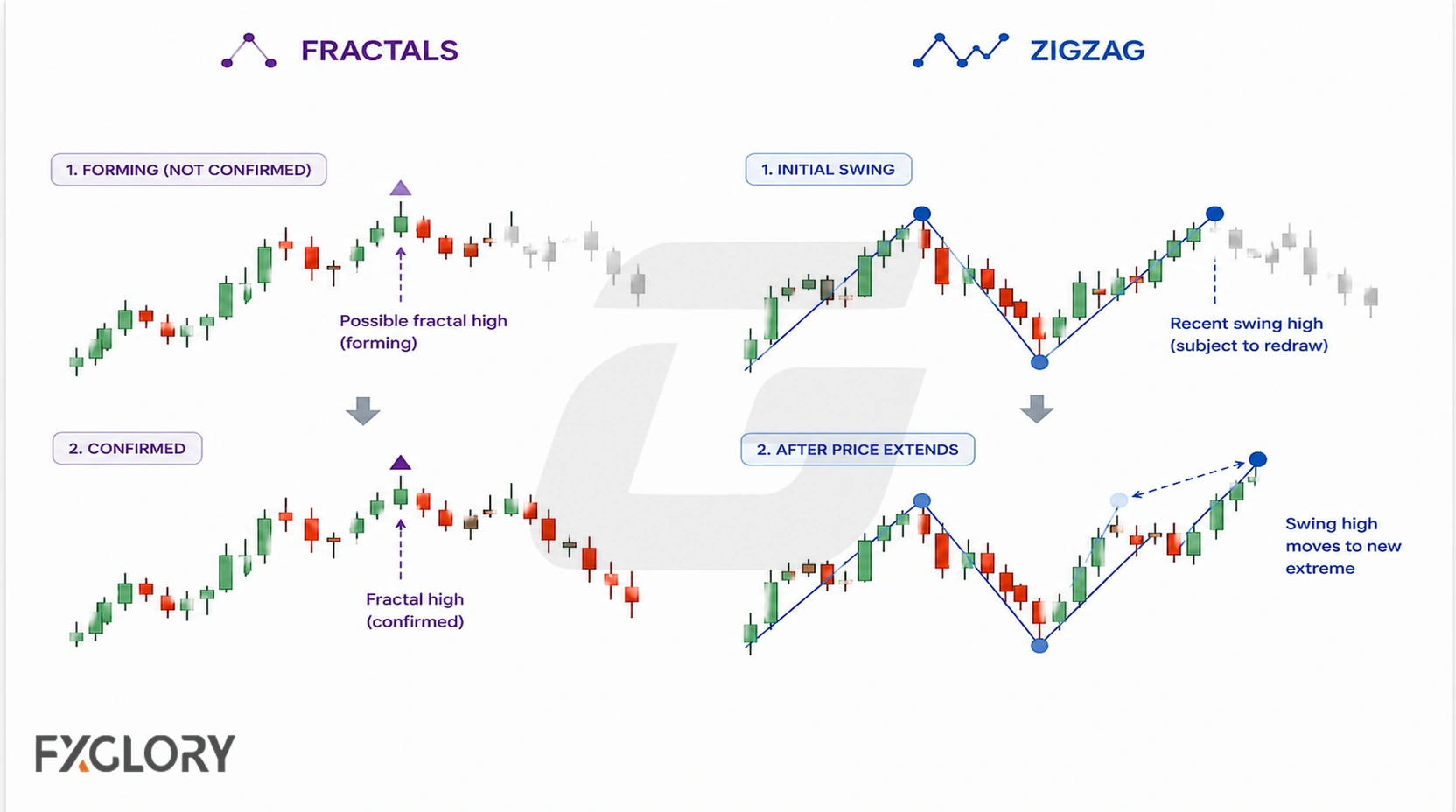
ZigZag-style tools are different: the newest swing can be redrawn as price reaches a new high or low. That makes ZigZag useful for summarizing structure, but its latest endpoint should be treated as unfinished until the swing is no longer being extended.
Free No-Repaint Indicators for MT4 and MT5
Searches for non-repaint indicators often include MT4, MT5, free downloads, arrows, or trading systems. A download page calling a tool “no repaint” does not verify how the code behaves.
Before using a custom indicator, check whether it relies on the current candle, higher-timeframe data, future bars, lookback-based swing logic, or settings that change when alerts are generated.
- Test the file away from a live account first: Unknown custom files can introduce both trading and software risk.
- Inspect the settings: Look for current-bar alerts, candle-close alerts, lookback rules, and multi-timeframe options.
- Record the signals: Compare what appeared live with what remains after later candles form.
- Keep the exact version: Different revisions of the same named indicator can behave differently.
For installation steps, see how to add indicators to MT4 charts.
How to Check If an Indicator Repaints
A clean historical chart is not enough to verify a no-repaint claim. Test the indicator while signals are developing and then compare those observations with the completed history.
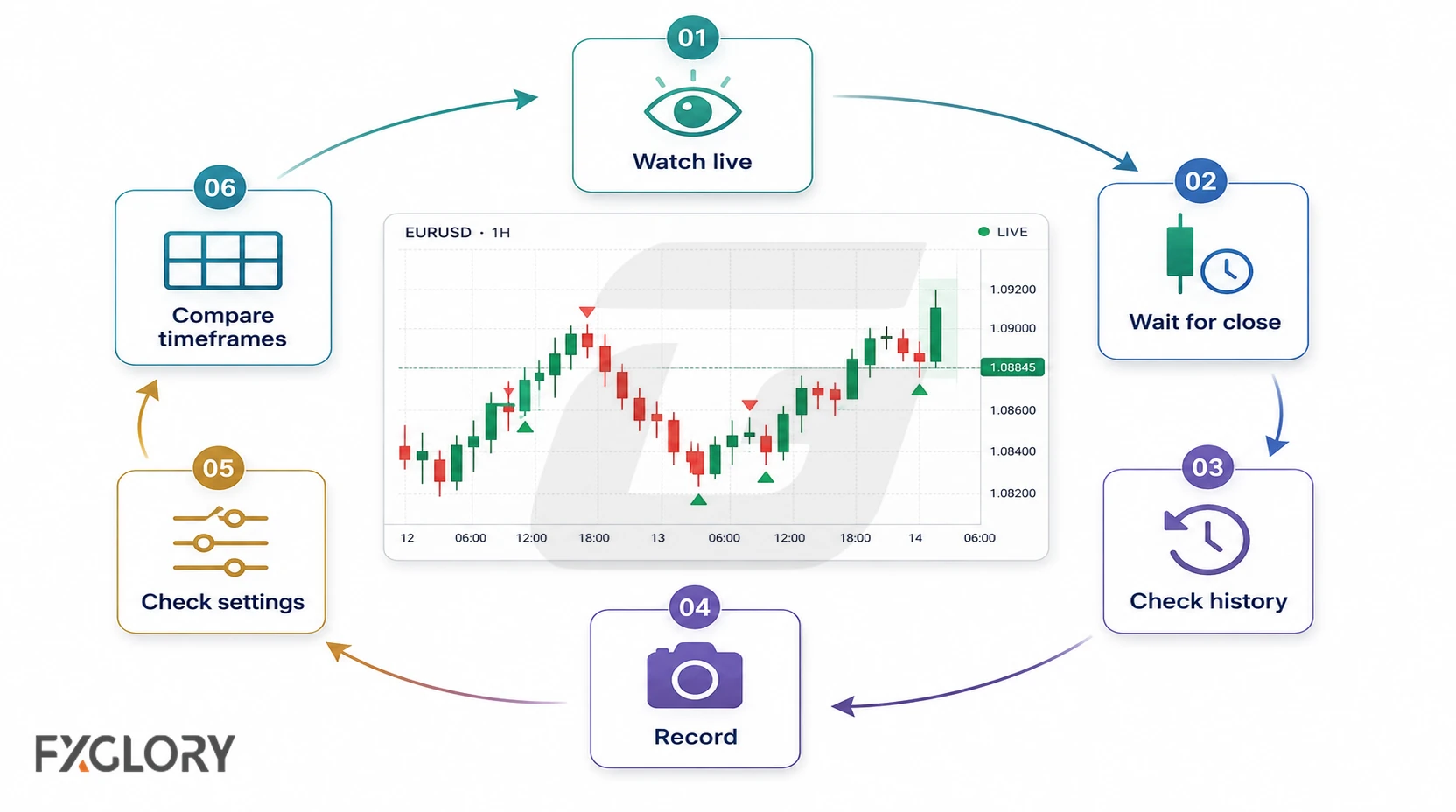
- Record the first appearance: Note the candle, time, price area, and indicator settings when a signal appears.
- Wait for candle close: Separate an intrabar signal from one that is confirmed only at close.
- Check later history: After several new candles, confirm whether the old signal stayed in the same place.
- Repeat across many signals: One stable marker does not prove the tool never rewrites others.
- Test multi-timeframe behavior: Wait for the source timeframe candle to close before judging stability.
- Compare under identical settings: Timeframe, symbol, inputs, and indicator version should stay the same.
Red Flags in No-Repaint Indicator Claims
The strongest warning signs are not the words “non repaint” themselves, but claims that extend far beyond signal stability.
- Perfect historical arrows with no live examples: The chart may not show what was visible in real time.
- Guaranteed win-rate or profit claims: Fixed historical markers do not guarantee future outcomes.
- No explanation of confirmation timing: Traders should know whether the signal is intrabar, candle-close, or delayed.
- No settings or version information: Reproducing the behavior becomes difficult.
- “No lag” paired with confirmed signals: Confirmation usually requires some data to exist before the signal can be fixed.
How to Use a Non-Repaint Indicator
Give the indicator one defined job—for example trend filtering, momentum measurement, volatility context, or marking a confirmed setup—and judge it on that job rather than on the no-repaint label.
- Know the confirmation point: Decide whether your method uses the live bar or waits for candle close.
- Measure results separately from stability: Track whether the signal remains fixed and whether the trading rule built around it actually performs.
- Avoid duplicate indicators: Several tools derived from the same price data can create the appearance of confirmation without adding independent information.
- Document the exact settings: A test is only comparable when the inputs and timeframe are unchanged.
Final Thoughts on Non-Repaint Indicators
The useful distinction is straightforward: a non-repaint indicator preserves confirmed historical output, while a repainting tool can rewrite past signals as new data arrives. Current-candle updates and delayed confirmation need to be judged according to the indicator’s rules rather than automatically classified as repainting.
For any custom MT4 or MT5 tool, the decisive evidence comes from recording signals live and checking what remains after candle close and subsequent price data.