
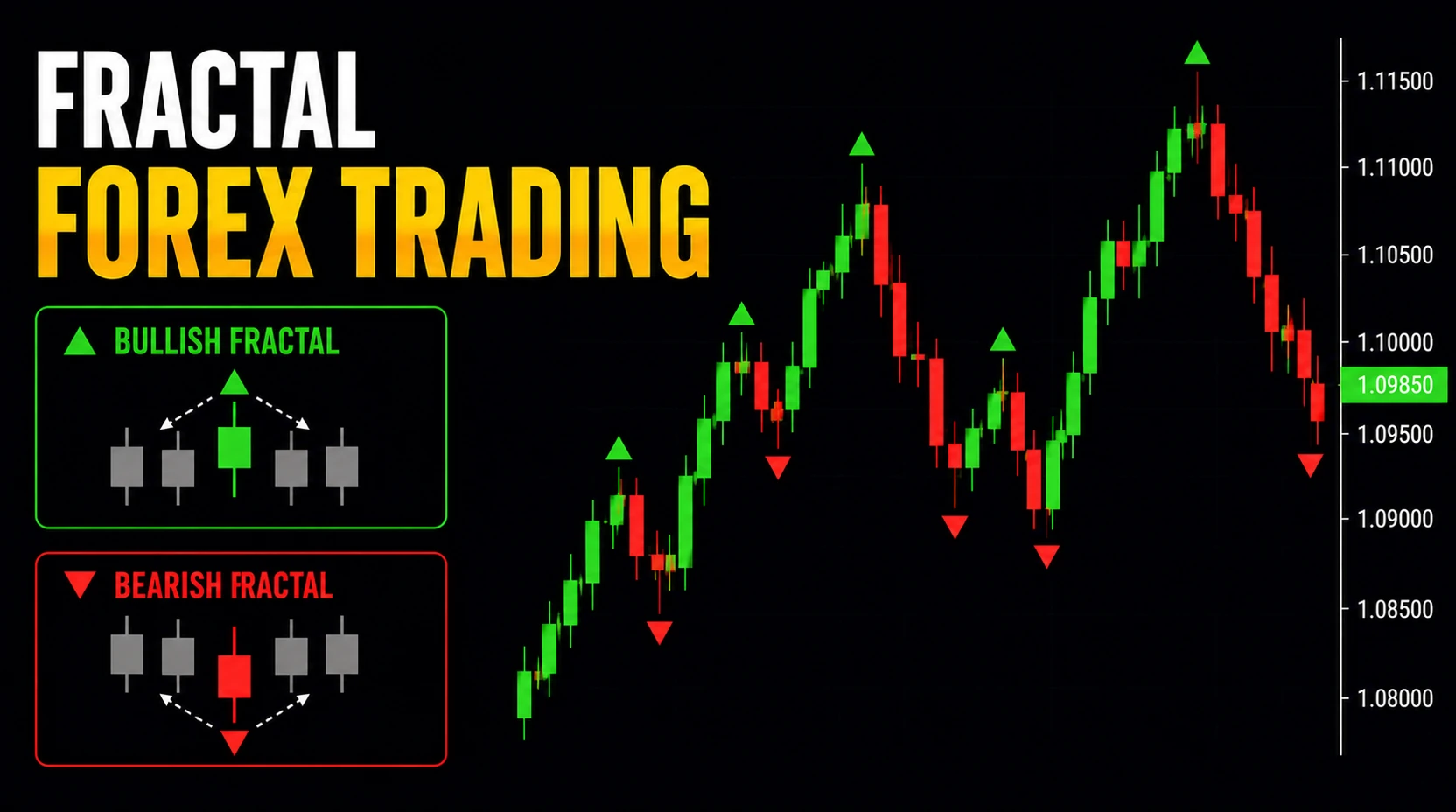
Bill Williams Fractals Indicator Definition
In forex trading, “fractals” usually refers to the Bill Williams Fractals indicator. It marks confirmed local highs and local lows so traders can see recent swing structure more clearly.
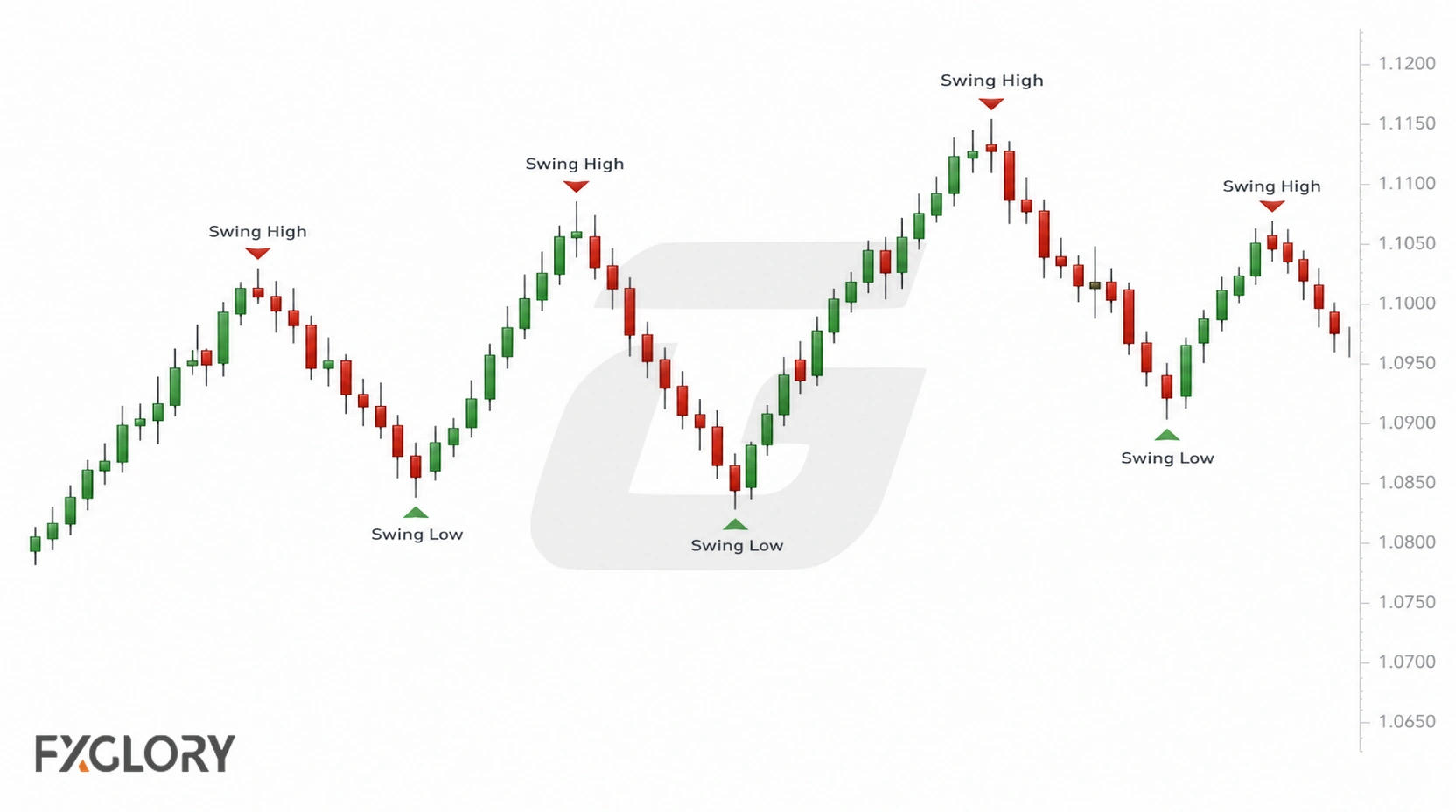
Because the two bars to the right must form before confirmation, the marker appears after the swing point itself. That makes fractals primarily a structure tool rather than an early-turning-point indicator.
Fractals belong with technical indicators used to mark price behavior. They can help traders study pullbacks, breakout levels, recent highs and lows, and possible areas where price may react.
Bill Williams Fractals vs General Market Fractals
The word fractal can be used in two ways. In a broad market sense, it describes patterns that can appear across different scales or timeframes. A pullback on a higher timeframe may contain smaller trends, ranges, and reversals on lower timeframes.
In platform-based forex analysis, fractals usually mean the Bill Williams indicator described above. Its purpose is narrower: identify confirmed local swing points on the chart.
Bill Williams Fractals are not the same as Fibonacci retracement or every broad use of fractal geometry in markets. In this article, “fractal indicator” means the platform tool that marks confirmed swing highs and swing lows.
- General market fractals: Repeating or similar price structures across timeframes.
- Bill Williams Fractals: A specific chart indicator for confirmed local highs and local lows.
- Trading use: Fractals can help organize swing levels, but they need context before they become useful in a plan.
This page focuses mainly on the Bill Williams Fractals indicator because that is what most traders mean when they search for forex fractals or the forex fractal indicator.
How the Five-Bar Fractal Pattern Works
The key mechanic is the position of the middle bar. For a local high, its high must stand above the highs of the two bars on each side. For a local low, its low must sit below the lows of the two bars on each side.
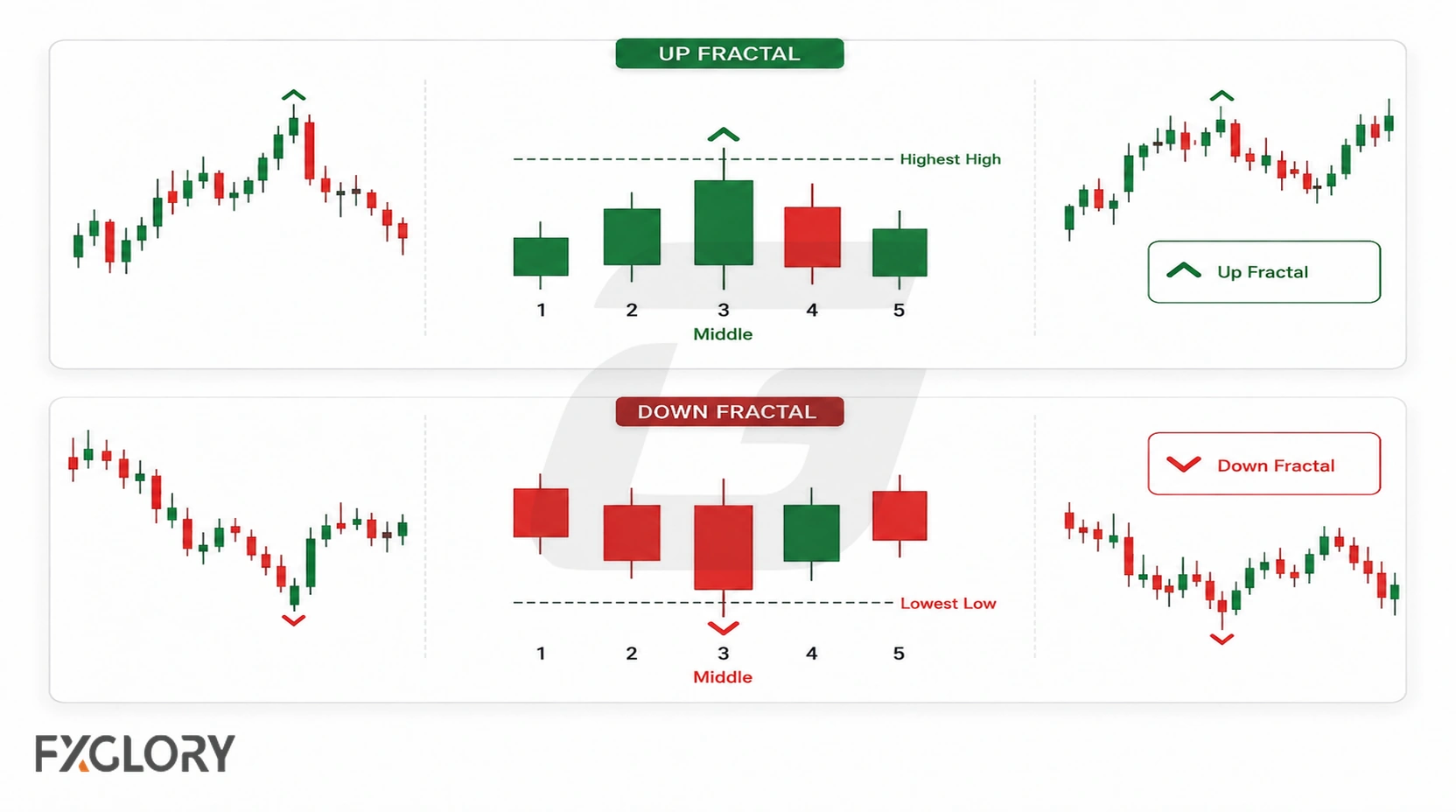
- Confirmed swing high: The middle candle has the highest high compared with the two candles on each side.
- Confirmed swing low: The middle candle has the lowest low compared with the two candles on each side.
- Delayed marker: The fractal cannot be confirmed until the candles after the middle candle have formed.
In Bill Williams' terminology, the local peak is the up fractal and the local trough is the down fractal. The names describe the swing formation, not an automatic trade instruction.
| Fractal type | Five-bar definition | What it marks |
|---|---|---|
| Up fractal | A local high (highest high) flanked by two lower highs on each side. | A confirmed swing high, usually marked above price. |
| Down fractal | A local low (lowest low) flanked by two higher lows on each side. | A confirmed swing low, usually marked below price. |
Some platforms may display markers differently, but the logic is the same: the indicator waits for a small swing structure to be confirmed before placing the marker.
Bullish and Bearish Fractals Explained
Forex fractals are often described as bullish or bearish, but the marker direction can confuse beginners.
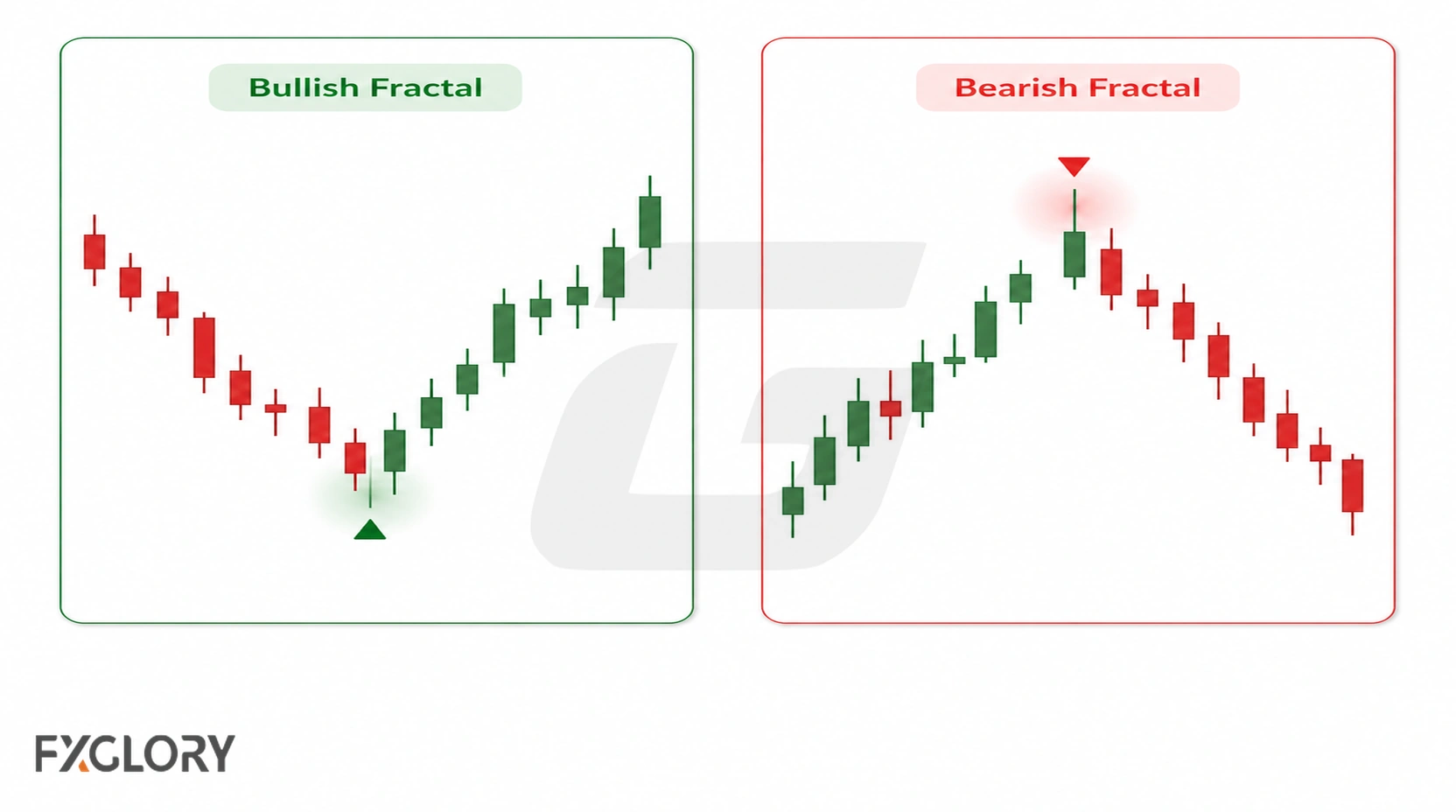
Bullish Fractal (Down Fractal)
A bullish fractal, also called a down fractal, usually marks a swing low. The middle candle has the lowest low, and the nearby candles have higher lows. It appears below price on many charts and can show where sellers failed to push price lower during that small structure.
Price may bounce from that swing low, retest it, or trade through it later; the label describes the swing location rather than the next price move.
Bearish Fractal (Up Fractal)
A bearish fractal, also called an up fractal, usually marks a swing high. The middle candle has the highest high, and the nearby candles have lower highs. It appears above price on many charts and can show where buyers failed to push price higher during that small structure.
Price may reject from that swing high, retest it, or trade through it later; again, the label describes structure rather than the next price move.
Why Fractals Are Lagging Signals
Fractals are lagging by design. The indicator needs candles after the middle candle before it can confirm the swing. This delay is not a platform error; it is part of how the pattern is defined.
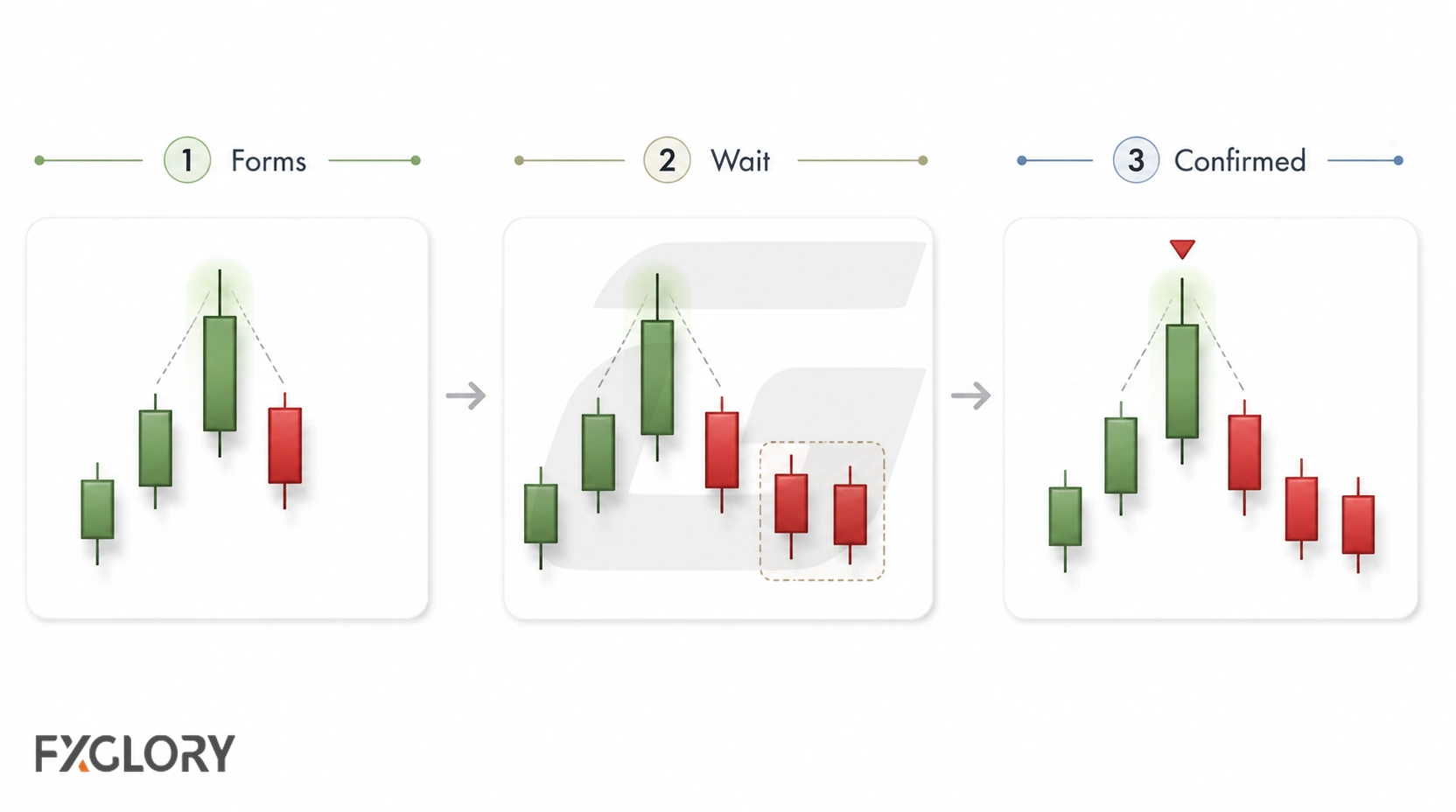
The lag matters because price may already have moved away from the swing point when the marker appears. Traders therefore tend to use the confirmed level as a structural reference rather than assuming the original turning price is still available.
A confirmed fractal should not change under standard five-candle logic. A forming fractal can disappear before confirmation because the required candles have not finished forming or because later candles invalidate the potential swing.
- The marker appears late: It needs later candles to confirm the pattern.
- Signals can be frequent: Choppy markets may print many fractals close together.
- False breaks can happen: Price can move beyond a fractal level and quickly return.
- Context matters: A fractal in a strong trend may behave differently from a fractal in a range.
How Traders Use Fractals in Forex
Traders use fractals mainly to organize swing structure. A fractal can show a recent high, recent low, possible breakout level, pullback point, or area where price previously reacted.
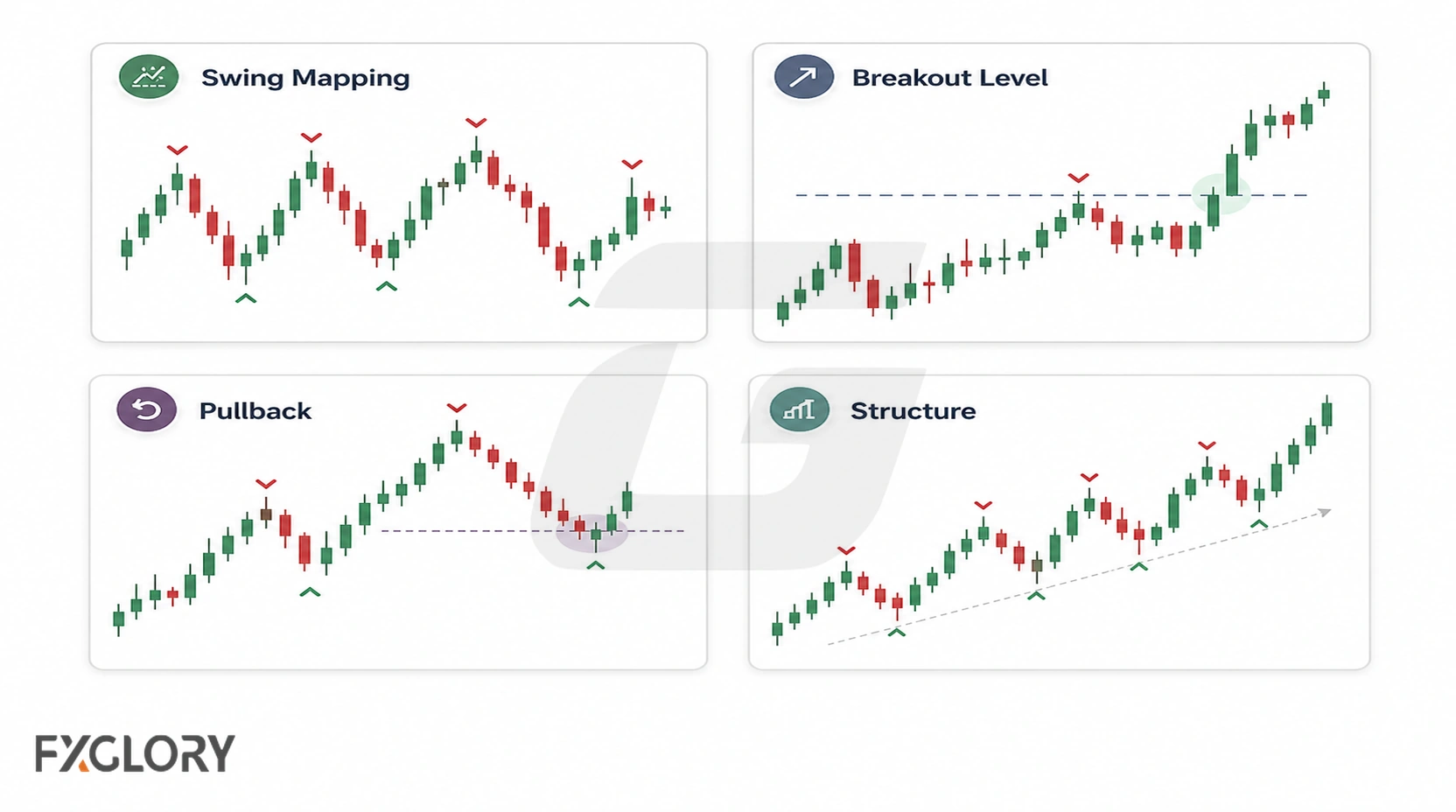
Fractals can be useful when they answer a specific chart question. For example: where is the most recent confirmed swing high? Where is the nearest confirmed swing low? Has price broken a recent fractal level? Is a pullback forming higher lows or lower highs?
- Swing mapping: Fractals can help mark recent highs and lows.
- Breakout levels: Traders may watch price moving beyond a recent fractal high or low.
- Pullback reading: Fractals can show whether pullbacks are forming higher lows or lower highs.
- Stop-reference areas: A fractal high or low can be reviewed near an invalidation area, but position size and stop distance still need volatility, spread, and account-risk context.
- Chart cleanup: Fractals can make swing structure easier to see, especially when price action is busy.
Fractal Breakout Levels
One common fractal use is breakout watching. A recent bearish fractal can mark a swing high. A recent bullish fractal can mark a swing low. Traders may watch whether price breaks above the fractal high or below the fractal low.
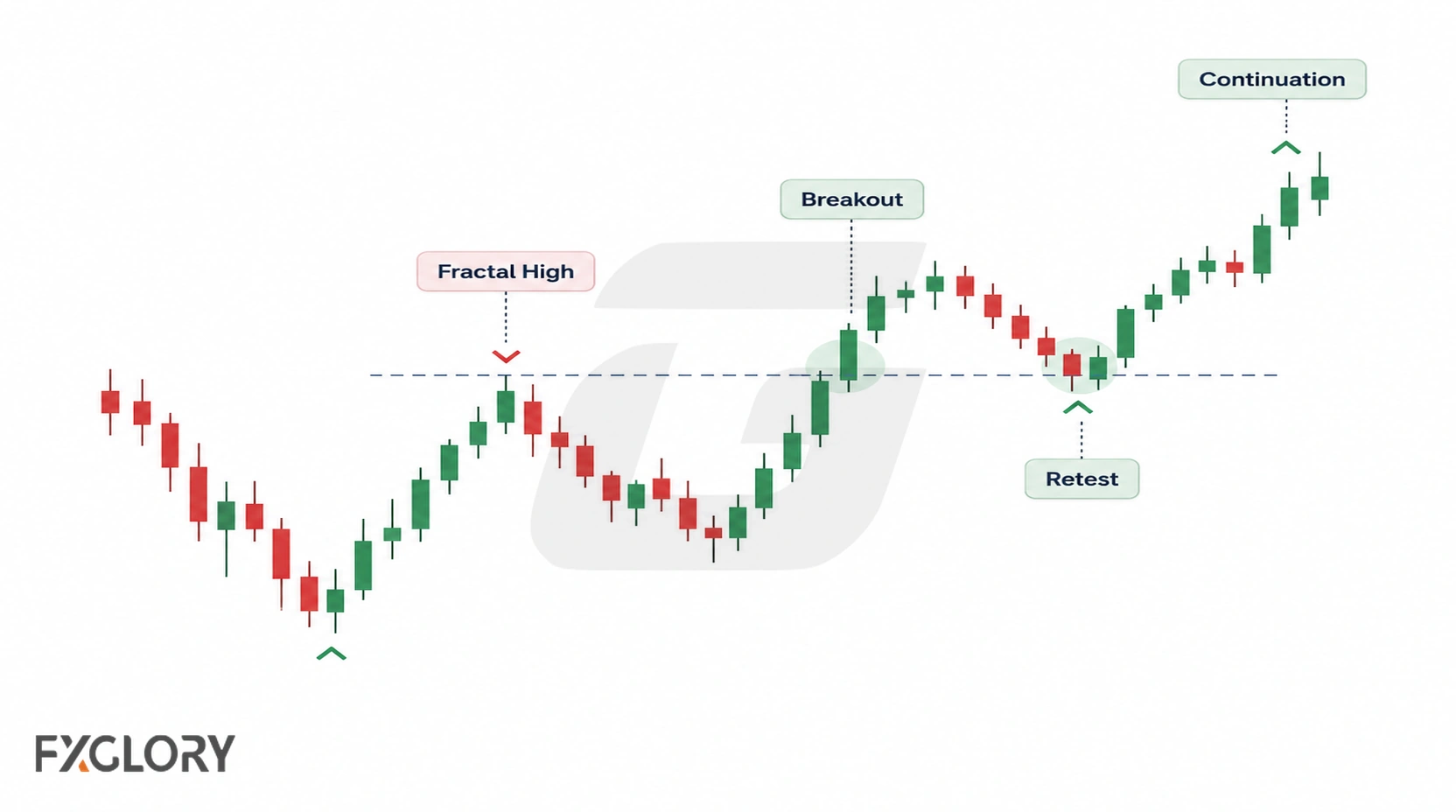
Price can break a fractal level, pause, retest it, or quickly return through it. The usefulness of the break therefore depends on surrounding structure, price behavior, room to the next opposing area, and a clear invalidation point.
In spot forex, traders should be careful with volume-style confirmation because there is no single centralized exchange volume feed. Tick activity or platform volume may add context on some charts, but it should not be treated the same as centralized exchange volume.
- Mark the recent fractal high or low: Use the latest meaningful swing point, not every small marker.
- Check the broader trend: Breakouts that align with higher-timeframe structure may be easier to read.
- Watch price behavior at the level: A close beyond the level may give more context than a quick wick.
- Look for retest behavior: A broken fractal level may become a reference area if price returns.
- Define invalidation: Decide what would make the breakout idea wrong before using it in a plan.
Fractals as Support and Resistance
Because fractals mark swing highs and swing lows, they can also help traders identify possible support and resistance areas. A cluster of fractal lows may show where price has repeatedly reacted from below. A cluster of fractal highs may show where price has repeatedly reacted from above.
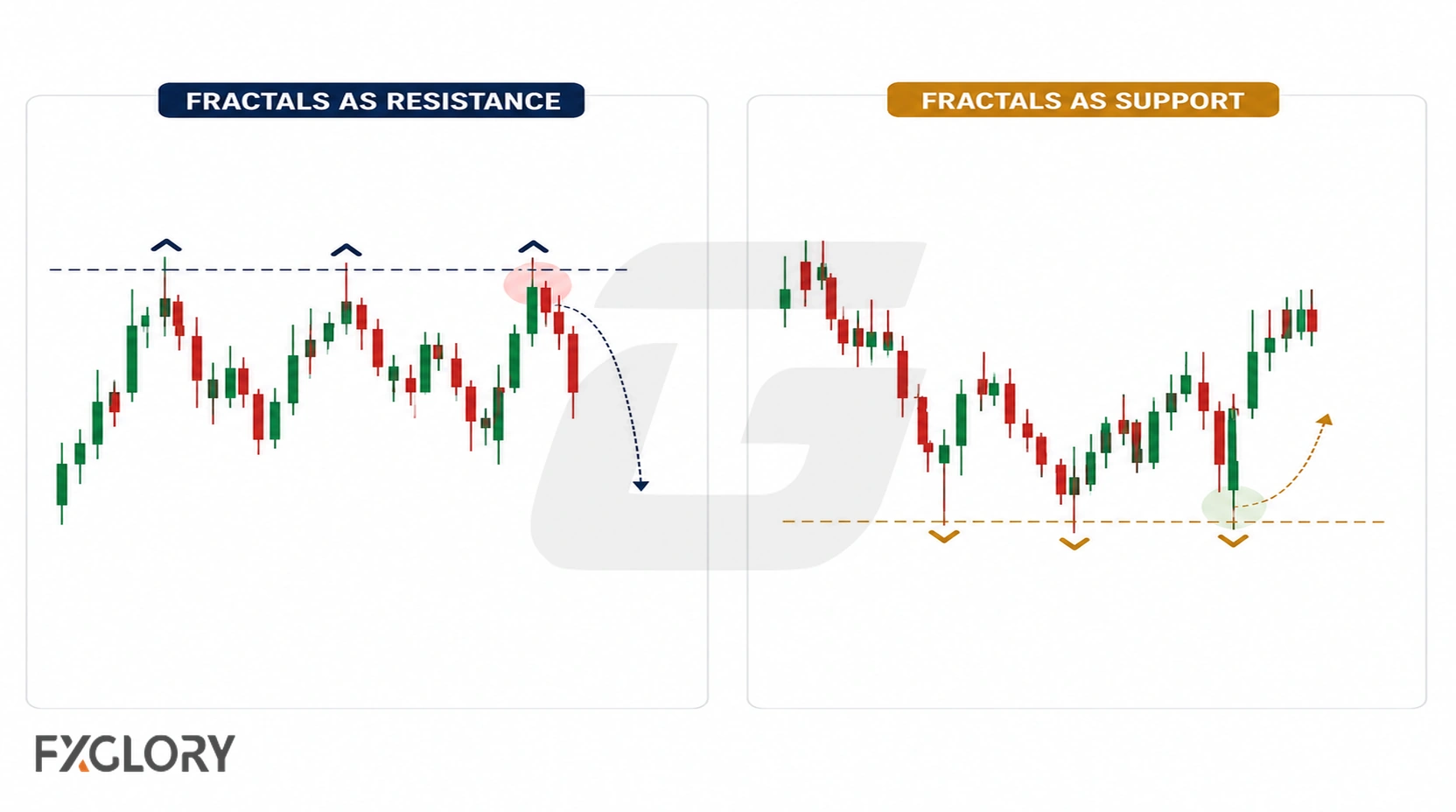
This connects fractals with swing levels that may act as support or resistance. A fractal level becomes more useful when it overlaps with other visible structure, such as a previous high or low, a retest area, a trendline, or a higher-timeframe level.
Fractal swing points can also help traders choose anchor points when studying connecting fractal swing points with trend lines. The trend line still needs clean touches, slope control, and invalidation.
- Fractal high: May become a resistance reference if price reacts there again.
- Fractal low: May become a support reference if price reacts there again.
- Fractal cluster: Multiple nearby fractals may show a broader zone instead of one exact price.
- Broken fractal level: May become a retest area if price returns and reacts.
Fractals With the Alligator Indicator
Bill Williams Fractals are often paired with the Alligator indicator. The Alligator can help describe whether the market is trending, opening into movement, or staying tangled in a quieter state. Fractals can then mark swing levels inside that context.
This does not mean the Alligator confirms every fractal. It only gives another layer of trend-state context. A fractal that appears during a messy, sideways Alligator structure may carry less clarity than a fractal that appears after cleaner trend alignment.
Traders who need the full Bill Williams trend-state tool can review Alligator as a trend-state filter for fractal signals.
- Do not use the Alligator as a guarantee: It can lag and can be unclear in ranges.
- Do not take every fractal near the Alligator: Choppy price can create repeated false signals.
- Use a clear question: Is the fractal forming with trend context, against trend context, or inside noise?
Multi-Timeframe Fractal Analysis
Fractals can appear on every timeframe, but not every fractal carries the same weight. Lower-timeframe fractals may form frequently and can be noisy. Higher-timeframe fractals may show broader swing structure, but they also take longer to confirm.
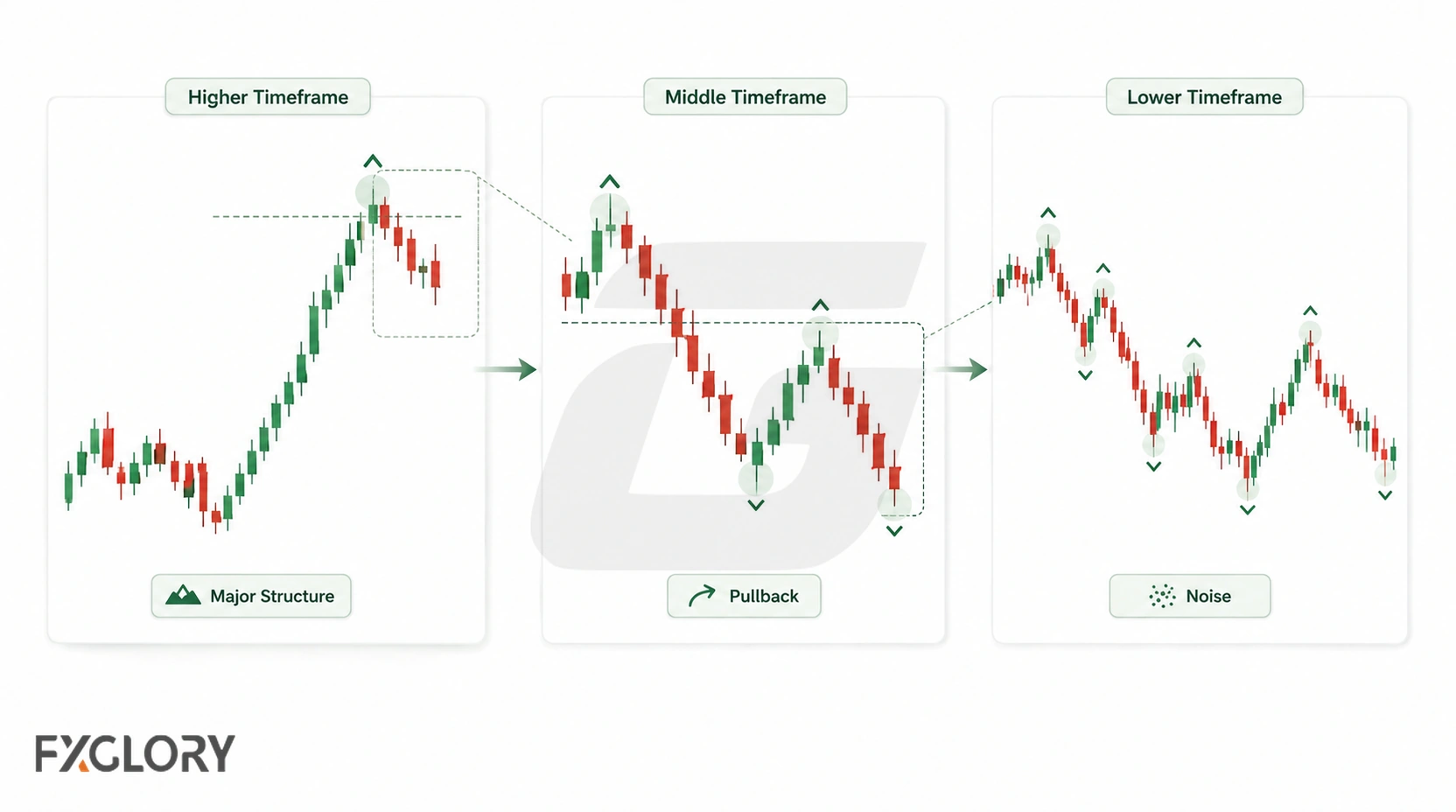
A practical workflow starts with the higher timeframe, then moves lower only for detail. The higher timeframe can show whether price is trending, ranging, or approaching a major swing level. The lower timeframe can show smaller fractals forming inside that broader structure.
This connects fractals with higher-timeframe trend context. A lower-timeframe bullish fractal against a strong higher-timeframe downtrend may need more caution than one that forms with broader support.
- Start broad: Identify higher-timeframe trend or range structure.
- Mark major fractals: Focus on clearer swing highs and lows, not every small marker.
- Move lower for detail: Use lower-timeframe fractals to study pullback or breakout behavior.
- Check volatility: Wider movement can change stop and invalidation planning.
- Avoid conflict: Do not let a tiny lower-timeframe fractal override a much larger structure.
Fractals on MT4, MT5, and TradingView
The Fractals indicator may appear differently depending on the platform, symbol, timeframe, and settings. In MetaTrader-style platforms, Fractals are commonly grouped with Bill Williams indicators. On other platforms, traders may use built-in indicators, community scripts, or custom fractal tools.
- MT4 and MT5: Fractals may appear under the Bill Williams indicator group, depending on platform version and setup.
- TradingView: Fractal tools may appear as built-in indicators, public scripts, or custom swing-point tools.
- Custom indicators: Some tools may use modified fractal logic, different lookback rules, alerts, or multi-timeframe labels.
- Settings check: Confirm how the tool defines a fractal before comparing signals across platforms.
For platform setup, traders can review adding indicators to MT4 charts.
Common Fractal Trading Mistakes and Limits
Fractals are easy to see, which makes them easy to misuse. The biggest mistake is treating every marker as a trade signal instead of a confirmed swing point.
- Trading every arrow: Fractals can appear often, especially in choppy markets.
- Ignoring the lag: The marker confirms after later candles, not at the exact swing moment.
- Ignoring trend context: A fractal against the broader trend may need more confirmation.
- Using fixed-pip rules blindly: Different pairs, sessions, and volatility conditions need different risk context.
- Ignoring volatility: Wider movement can make fractal levels easier to overshoot.
- Overcrowding the chart: Too many fractal markers can make every small swing look important.
For stop and volatility context, traders may compare fractal levels with volatility-based stop-distance context. ATR does not validate a fractal signal, but it can help traders understand whether movement is wider or quieter than usual.
When Fractals Are Less Useful
Fractals are less useful in very choppy markets, during sudden news movement, when the trader cannot define invalidation, or when every small marker is treated as equally important. They can also be less useful when lower-timeframe noise conflicts with higher-timeframe structure.
- Do not assume a marked high or low must hold on a retest.
- Do not ignore spread, volatility, position size, or platform execution when turning chart structure into a trade plan.
Final Thoughts on Fractal Forex Trading
Fractal forex trading is most useful when fractals are treated as swing-structure markers. They can help traders identify confirmed highs and lows, breakout areas, pullback points, and possible support or resistance references.
The strongest use of fractals is organization. They help answer where the last confirmed swing formed, whether price is breaking a recent level, and whether lower-timeframe movement fits the broader chart.
Their value comes from making swing structure easier to reference. Whether a particular fractal matters depends on trend context, price reaction, timeframe alignment, volatility, and the trader’s invalidation and risk rules.