Forex Chart Patterns: Beginner Guide to Market Structure

Learn what forex chart patterns are, how reversal, continuation, and neutral patterns are read, why patterns can fail, and how confirmation, invalidation, timeframe, and risk control fit into forex chart analysis.
 
Written byHenry Green
Published
Last updated

Key Take Aways

  • Forex chart patterns are price structures formed by repeated swings, levels, trendlines, and consolidation areas.
  • Most chart patterns are grouped as reversal, continuation, or neutral patterns, but the group describes a scenario rather than a guaranteed outcome.
  • A chart pattern should be read with market context, confirmation, invalidation, timeframe, spread, slippage, and risk control.
  • False breakouts, news volatility, weak structure, and forced pattern recognition are common reasons chart patterns fail.
  • Beginners should use chart patterns as a way to organize market scenarios, not as automatic trade signals.
Risk note: Forex trading involves risk of loss. Chart patterns can help organize market scenarios, but they do not guarantee that price will break, reverse, continue, or reach a target.

What Are Forex Chart Patterns?

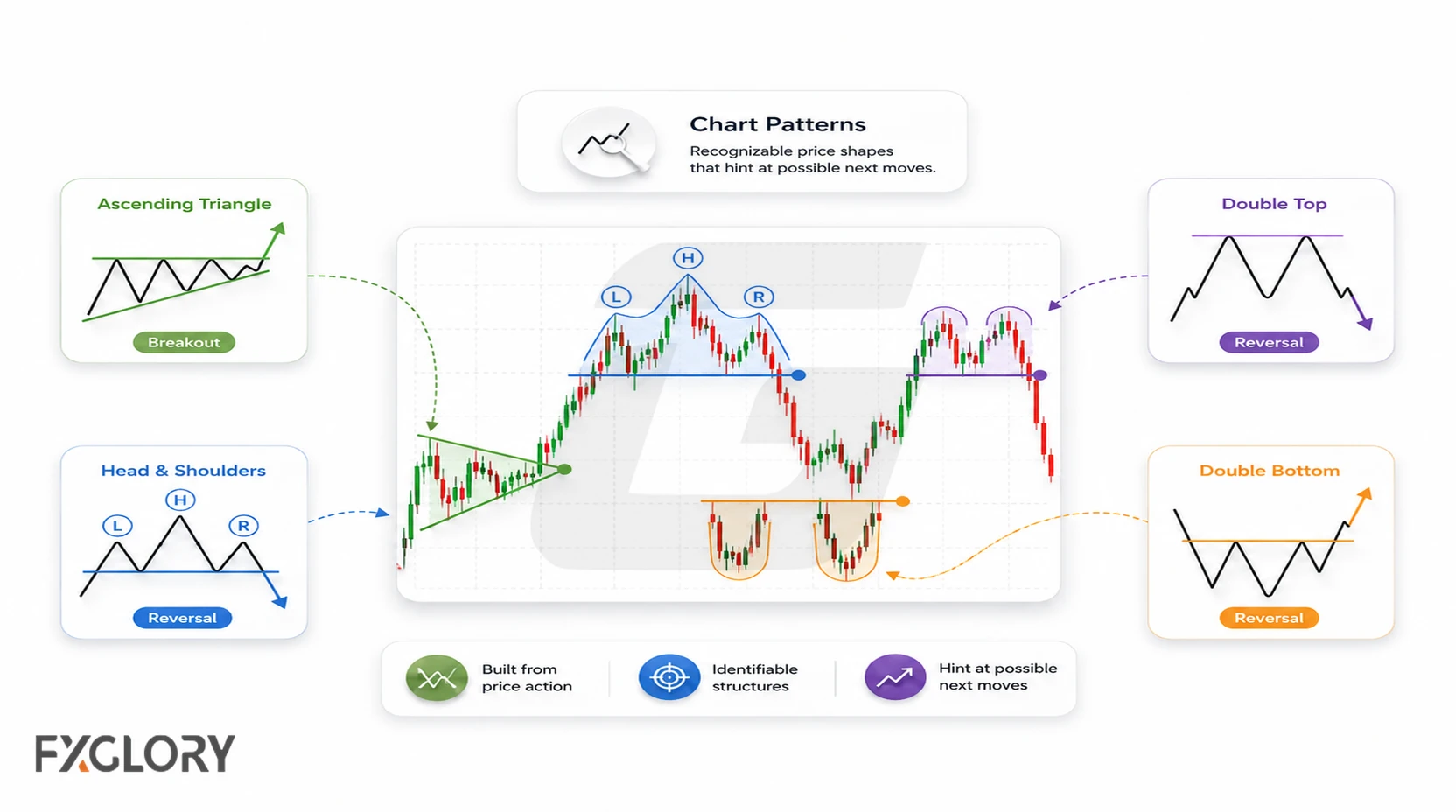
Forex chart patterns are structures formed by price movement on a currency-pair chart. They usually develop across multiple candles, swings, highs, lows, trendlines, support zones, resistance zones, or consolidation areas.

A chart pattern helps a trader describe what price is doing. It may show that a trend is pausing, a range is forming, pressure is building, or a previous move is losing strength. The pattern organizes the scenario, but it does not decide the trade.

In forex trading, patterns should be read as part of the wider chart. A trader needs to understand the market condition, the pattern boundary, the confirmation idea, the invalidation point, and the risk attached to the scenario. For the broader chart-reading framework, start with the technical-analysis foundation.

Plain-English idea: Chart patterns are structures to read, not shapes that must produce a specific result.

How Forex Market Patterns Form

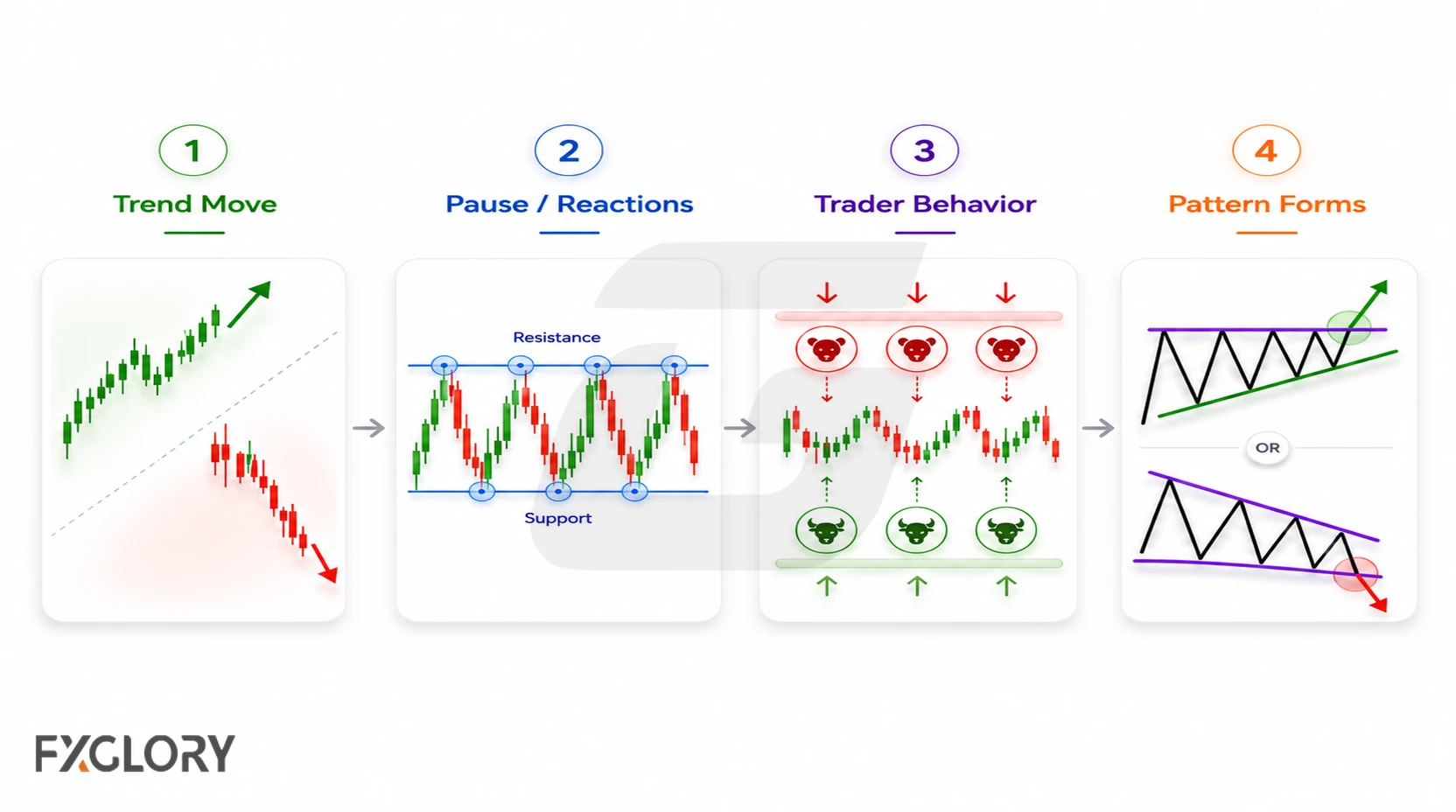
Forex market patterns form when price repeatedly reacts around certain areas. Buyers and sellers may defend a level, fail to continue a move, compress into a tighter range, or pause after a strong trend. Over time, these reactions can create recognizable structures on the chart.

The pattern is not created by the name. It is created by the behavior of price. A pattern becomes useful only when the prior movement, swing structure, boundary area, confirmation behavior, and invalidation point are clear.

  • Repeated highs or lows: Price reacts from similar areas more than once.
  • Compression: Price movement becomes tighter as highs and lows narrow.
  • Failed continuation: A market tries to extend a move but cannot hold the new level.
  • Breakout attempt: Price moves beyond a visible boundary, then either holds or returns inside.
  • Retest behavior: Price returns to a broken area and reacts from it, or moves back through it.

Some traders simplify a busy chart by first looking at the swing structure with fewer details, then returning to candlesticks for more precise price reactions. This can help beginners separate the broad shape from short-term noise.

This is why chart patterns in forex trading should be read with context. The same shape can have a different meaning in a strong trend, a sideways range, a quiet session, or a high-volatility news period.

Chart Patterns vs Candlestick Patterns
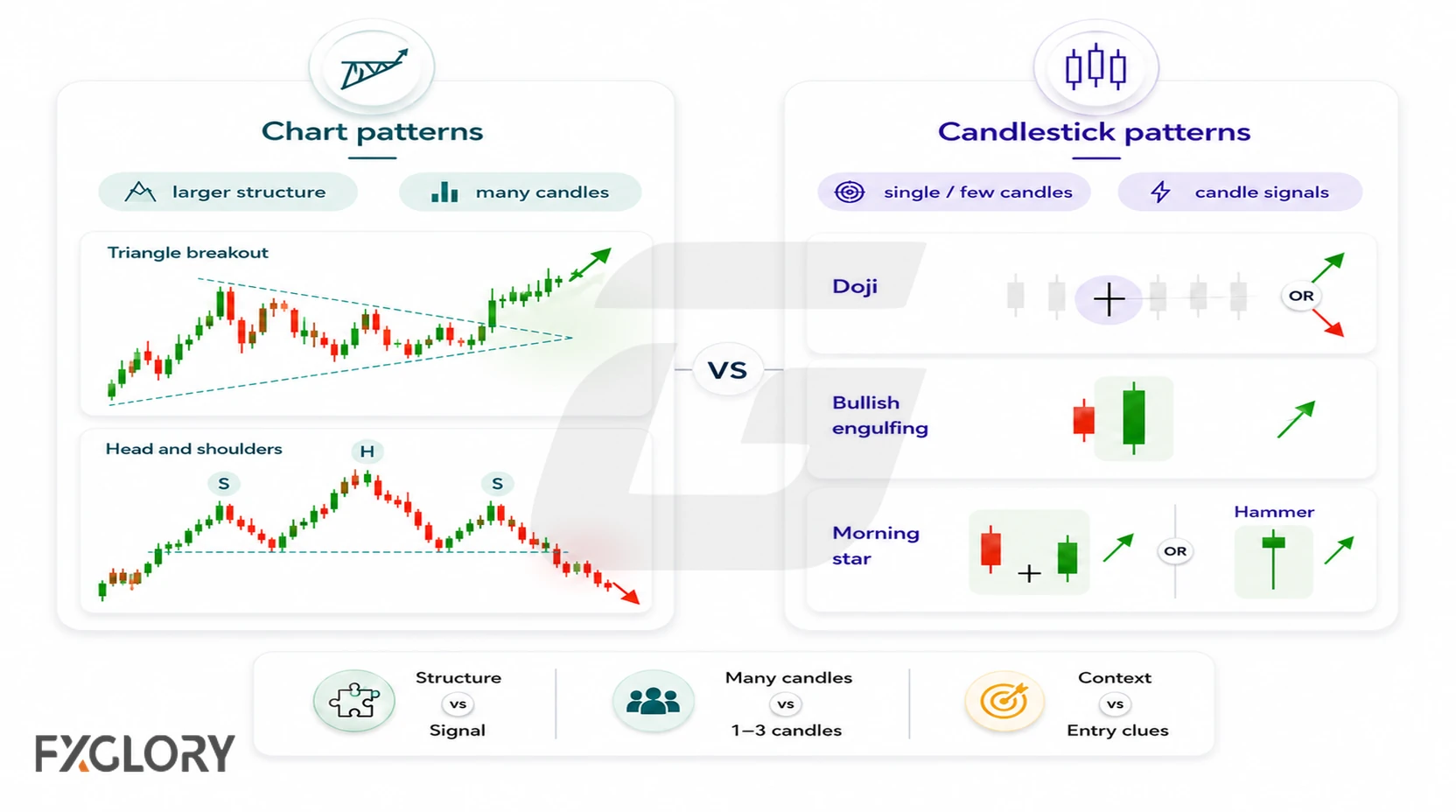
Chart patterns and candlestick patterns are both used in technical analysis, but they answer different questions.

  • Candlestick patterns: Usually focus on one candle or a small group of candles, such as a doji, engulfing candle, hammer, shooting star, or harami.
  • Chart patterns: Usually form across a broader structure, such as several swings, a range, a neckline, a triangle, a pennant, or a wedge.

A candlestick pattern may show a short-term reaction or hesitation. A chart pattern usually describes a larger structure where price has been moving, compressing, failing, or reacting over more time. When a broad structure needs candle-level context, single-candle and multi-candle reactions can help explain what is happening near the pattern boundary.

Separation rule: Do not treat one candle and a full chart structure as the same type of signal. They belong to the same chart, but they measure different parts of price behavior.

Main Types of Forex Chart Patterns

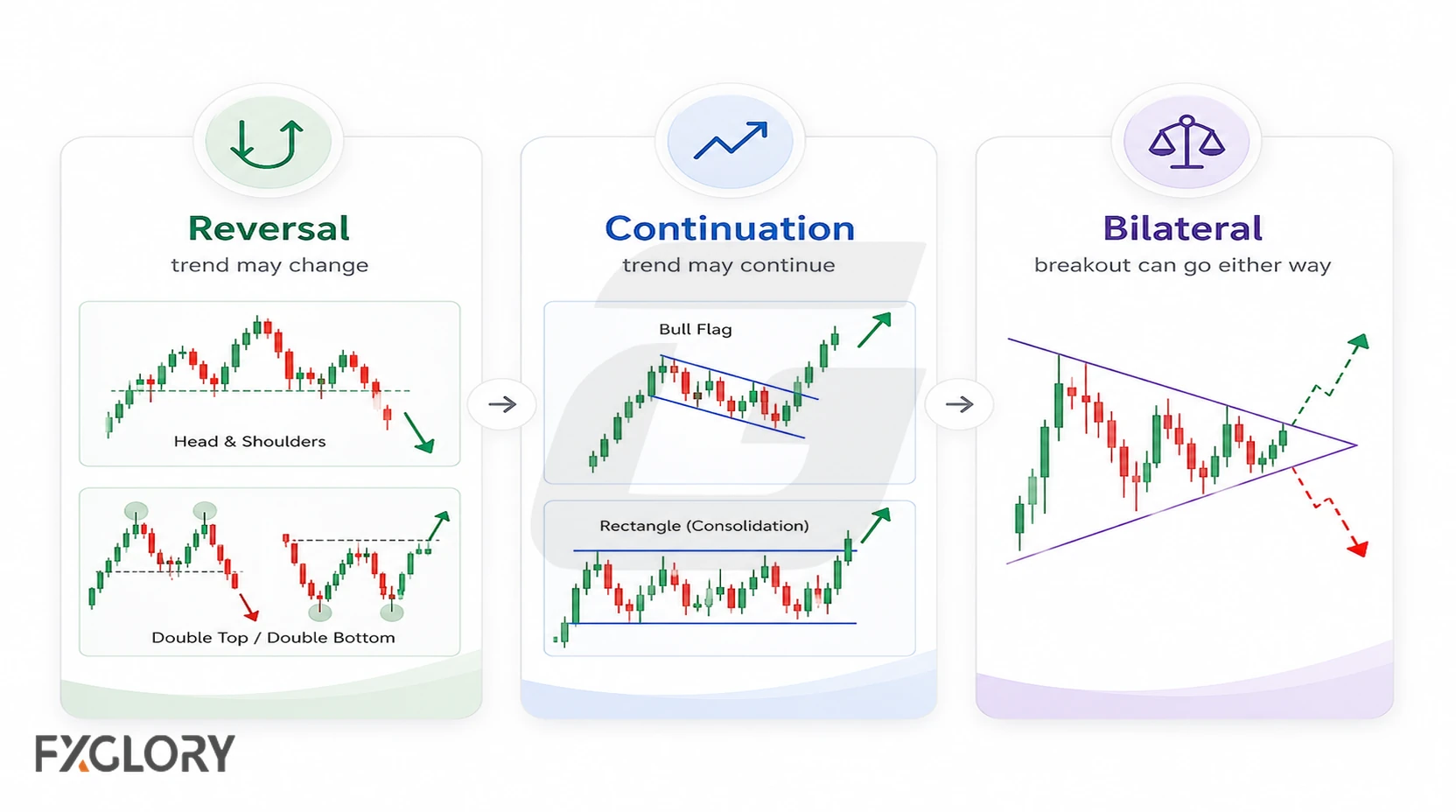
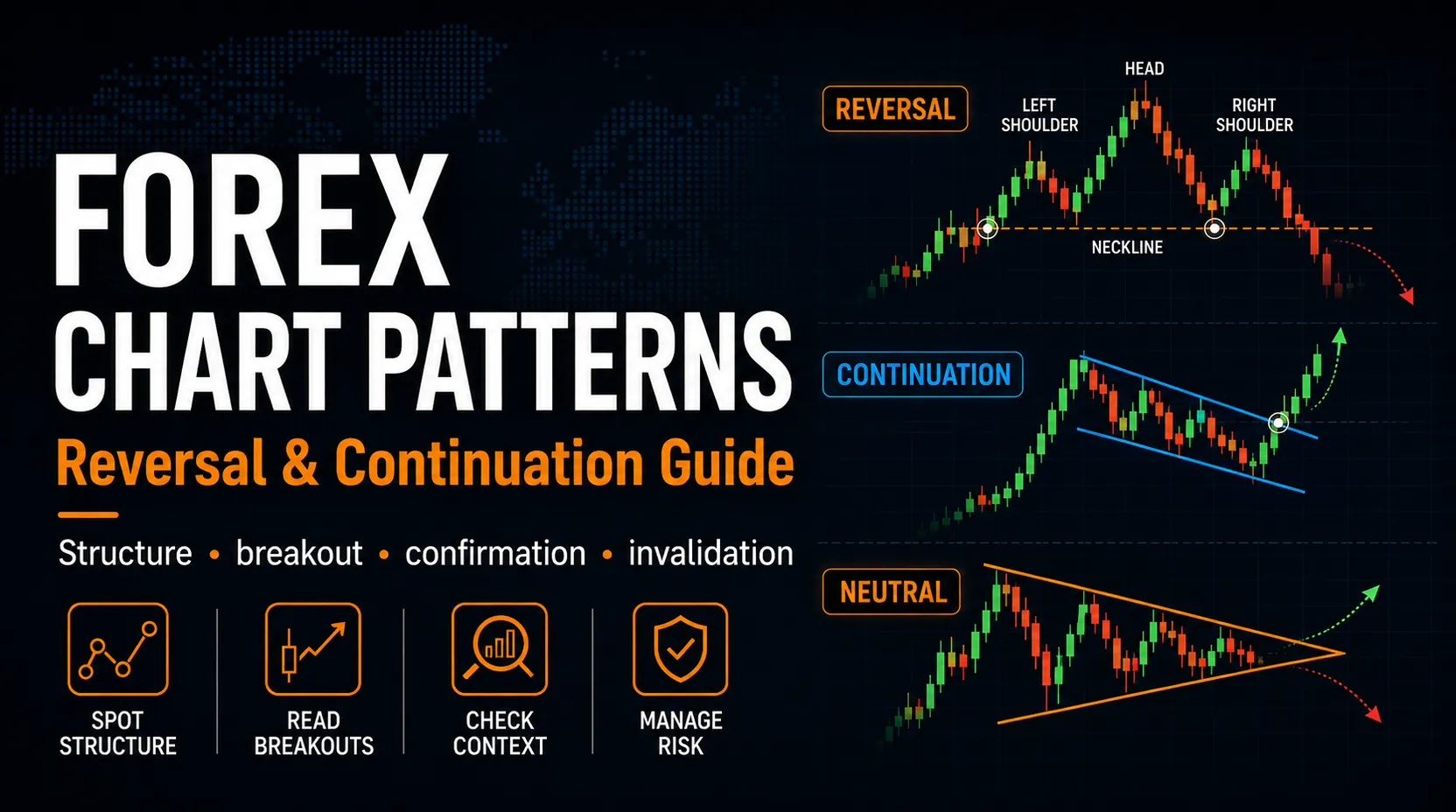
Most forex chart patterns are grouped by the type of market scenario they may describe. The group gives a reading framework, not a promise about the next move.

Pattern GroupExamplesWhat It May SuggestMain Risk
Reversal patternsHead and shoulders, inverse head and shoulders, double top, double bottomA prior trend may be weakeningThe market may range, continue, or create a false reversal
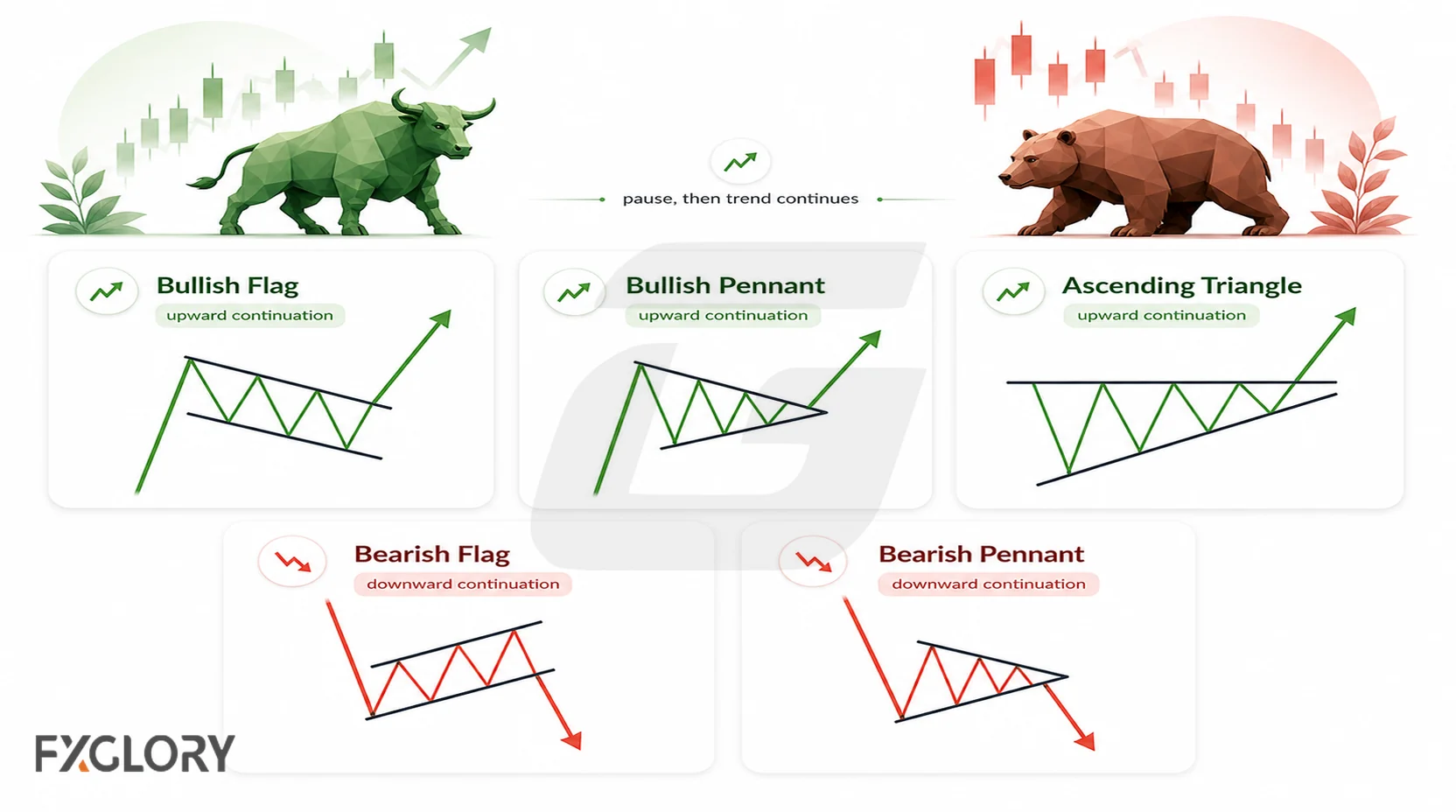
Continuation patternsFlags, pennants, rectangles, trend channelsA trend may be pausing before another attempt in the same directionThe breakout may fail or turn into a reversal
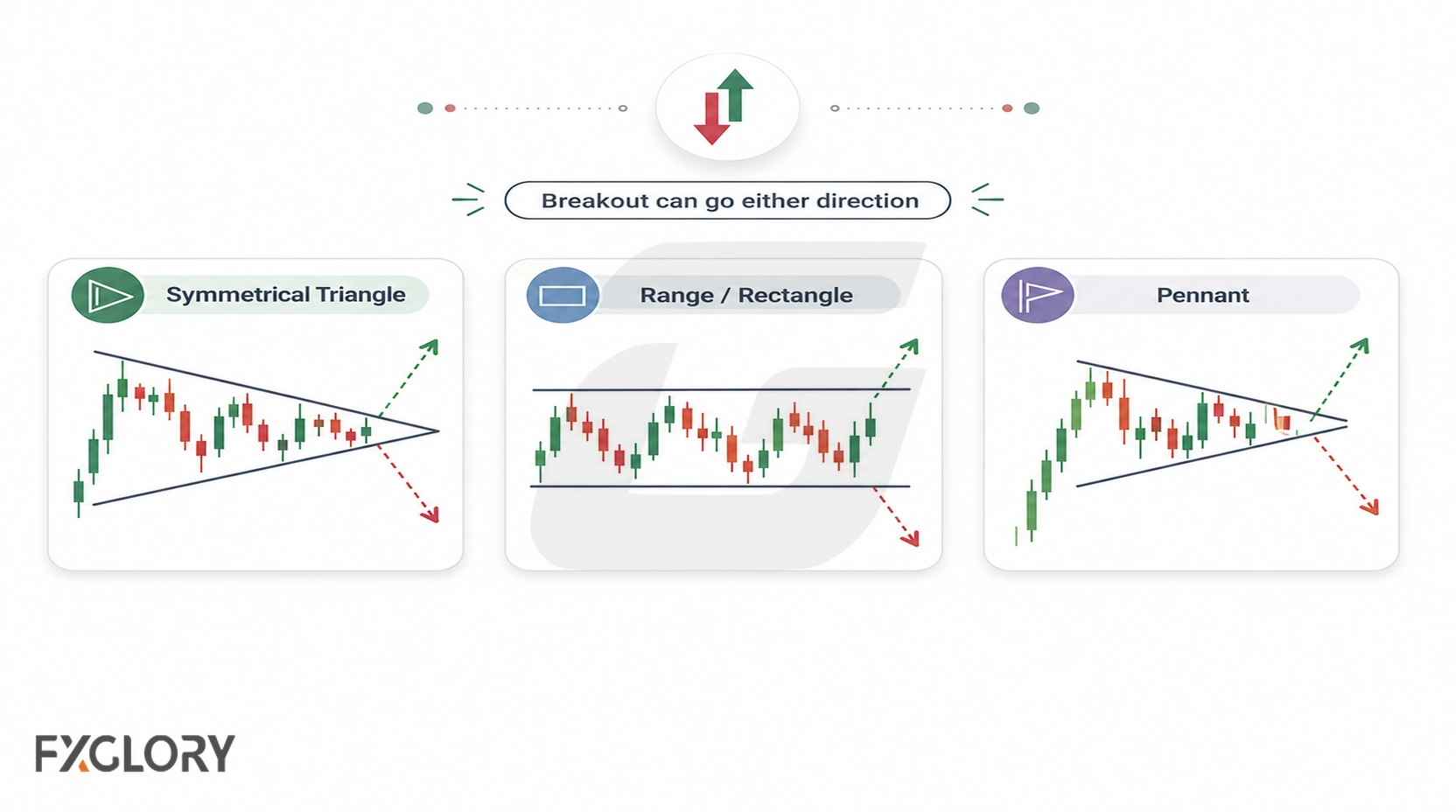
Neutral or bilateral patternsSymmetrical triangle, broad consolidation, some wedge structuresPressure is building, but direction is not confirmedGuessing the breakout direction too early
Ratio-based patternsHarmonic structures, butterfly patternPrice may be reacting around measured swing relationshipsIncorrect measurements can make the pattern misleading

A forex pattern trading plan should define the structure first, then the confirmation condition, invalidation point, position size, and conditions for standing aside.

Common Forex Chart Patterns by Function

Pattern names are useful, but price behavior matters more. The same pattern name can be meaningful in one context and weak in another.

PatternCommon GroupBest Question to AskDedicated Guide
Double topReversalHas price failed twice near a similar resistance area after a prior rise?double top pattern
W pattern / double bottomReversalHas price failed twice near a similar support area after a prior decline?W pattern structure
Head and shouldersReversalIs the market forming a multi-swing structure around a neckline?head and shoulders structure
TrianglesNeutral or continuationIs price compressing between converging boundaries?forex triangle patterns
WedgesReversal or continuationIs the market narrowing inside a rising or falling structure?rising and falling wedge behavior
PennantsContinuationDid a strong move pause inside a small converging structure?pennant pattern
Flags and rectanglesContinuation or rangeIs price pausing inside a channel-like or horizontal structure?Covered as supporting structures in continuation analysis
Harmonic patternsRatio-basedAre swing relationships being measured with specific ratios?harmonic pattern reading
Butterfly patternHarmonicDoes the structure follow a measured harmonic sequence?butterfly harmonic pattern

When a quick reminder is enough, a compact chart-pattern reference can help compare pattern groups without replacing full chart analysis.

Strong vs Weak Forex Chart Patterns

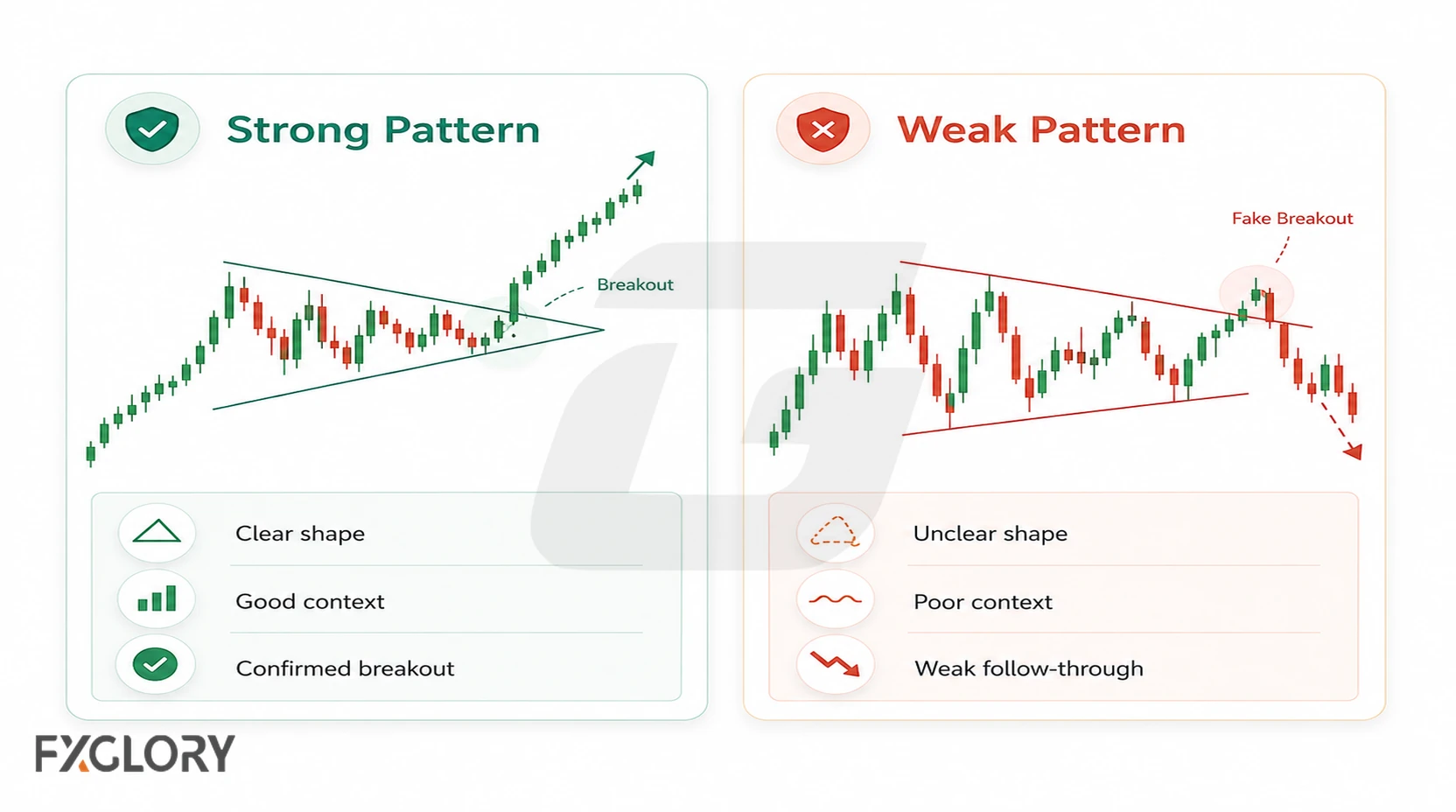
A chart pattern is easier to read when the structure is clean, the context supports the idea, and the invalidation point is clear. A weak pattern often needs too much imagination.

Chart-Reading FactorStronger Pattern ConditionWeaker Pattern Condition
VisibilityThe structure is clear without forcing lines or ignoring obvious swings.The pattern only appears after the chart is adjusted to fit the name.
Prior contextThe market condition before the pattern is easy to describe.The prior move is unclear, choppy, or already range-bound.
BoundariesSupport, resistance, neckline, or trendline areas are visible.The boundaries are vague or depend on one isolated candle spike.
ConfirmationPrice breaks, rejects, retests, or holds in a way that supports the scenario.The trader enters before price shows enough behavior around the pattern.
InvalidationThe wrong point is defined before the trade idea is considered.The pattern has a target idea but no clear point where the idea fails.
Risk conditionsSpread, volatility, news, and position size are considered.The pattern is treated as separate from execution and account risk.
Quality rule: A weaker pattern is not improved by giving it a stronger name. If the structure is unclear, the safest reading may be no pattern.

Reversal Chart Patterns in Forex

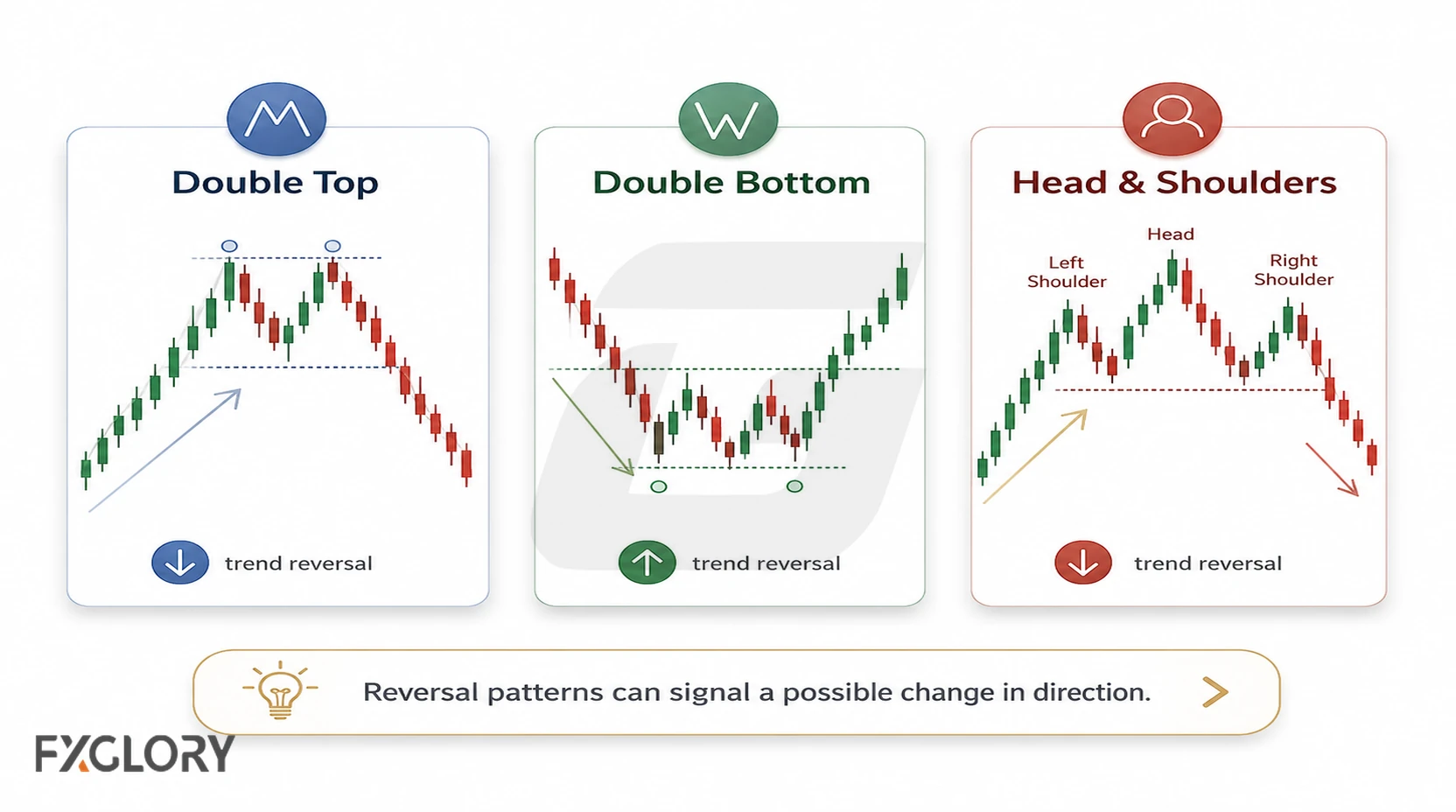
Reversal chart patterns may suggest that a previous trend is losing strength. They are more useful when a clear prior move comes first, the structure is visible, and the trader can explain where the reversal idea becomes wrong.

Examples include head and shoulders, inverse head and shoulders, double top, double bottom, and some measured harmonic structures. A reversal structure inside a sideways market may simply be range behavior, so the prior context matters.

When the main question is whether a previous move is weakening, reversal pattern structure in forex gives that topic more room.

Reversal warning: A reversal pattern does not prove that the trend has changed. It only creates a scenario that needs confirmation and invalidation.

Continuation Chart Patterns in Forex

Continuation chart patterns may suggest that price is pausing inside a broader move. They are often watched when a market trends, consolidates, and then attempts to continue.

Common continuation structures include flags, pennants, rectangles, channels, and some wedge formations. Flags often look like short channel-style pauses, while rectangles show repeated reactions between horizontal areas. These structures still need confirmation before they become useful.

When the chart mainly shows a trend pause rather than a possible trend change, forex continuation pattern context is the better next step.

Continuation warning: A pause in a trend is not proof that continuation will happen. A pattern needs a clear breakout, reaction, or retest before it becomes useful.

Neutral and Bilateral Forex Patterns

Neutral or bilateral patterns describe compression without confirmed direction. They may form when the market is building pressure, but the breakout direction is still uncertain.

Symmetrical triangles, some broad consolidations, and certain wedge structures can be read this way until price confirms direction. Ascending and descending triangles may carry directional expectations in some contexts, but the boundary behavior still matters more than the label.

When compression is the main chart structure, triangle patterns in forex show how narrowing price action can be organized without guessing the break too early.

Neutral-pattern rule: When direction is not confirmed, the pattern is a watch area, not a directional answer.

How to Confirm a Forex Chart Pattern

Confirmation does not make a chart pattern certain. It helps the trader avoid reacting to a shape before the market shows enough evidence.

  1. Start with structure: Is the pattern clear without adjusting the chart to force it?
  2. Check the prior condition: Is price trending, ranging, compressing, or moving without clean structure?
  3. Mark the boundary: Are the neckline, trendline, range edge, support area, or resistance area easy to explain?
  4. Wait for behavior: Has price broken, rejected, retested, or remained inside the pattern?
  5. Check the close: Did price hold beyond the boundary or only briefly move through it?
  6. Watch the retest: If price returns to the broken area, does it react or move back inside?
  7. Use supporting context: Momentum, volatility, trend strength, or candle reaction can support the reading.
  8. Define invalidation: Where is the pattern idea wrong?
  9. Check risk: Is the distance to invalidation acceptable for the account and plan?

Some traders combine price structure with support and resistance, trendlines, or indicators. If momentum or trend-strength context is needed, technical indicators for confirmation context may help organize the analysis.

Confirmation limit: Confirmation can reduce guesswork, but it cannot remove uncertainty from trading.

Invalidation, Retests, and Target Logic

A chart pattern is incomplete without invalidation. Invalidation is the price behavior that shows the pattern idea is no longer valid. It is different from a target. A target is a possible outcome; invalidation is the wrong point.

  • Breakout invalidation: Price breaks out, then returns and holds back inside the pattern.
  • Reversal invalidation: Price moves beyond the structure in the direction of the old trend.
  • Continuation invalidation: Price fails to continue and breaks against the original trend idea.
  • Range invalidation: Price moves outside the repeated range and holds there.

Some pattern methods estimate targets by measuring the height of a structure and projecting it from the breakout area. This can be useful for planning, but it should not be treated as a guarantee. Price may move part of the way, stall, retest, reverse, or fail immediately.

Retests also need careful reading. A retest can support a breakout scenario if price reacts from the broken area. It can also expose a false breakout if price moves back through the boundary and holds inside the pattern again.

Planning rule: A trade idea is weaker when the trader can name the pattern but cannot name the invalidation point.

Why Forex Chart Patterns Fail

Chart patterns fail when the market does not follow the scenario suggested by the structure. A clean-looking pattern can still fail because price is driven by changing orders, news, liquidity, and trader behavior.

  • False breakout: Price moves beyond the pattern boundary and then returns back inside.
  • Forced pattern: The trader sees a pattern because they want one, not because the structure is clear.
  • Weak prior context: A reversal pattern without a clear prior trend may not mean much.
  • News volatility: High-impact events can overwhelm technical structure quickly.
  • Thin liquidity: Price can move sharply through pattern boundaries when participation is lower.
  • Spread and slippage: Execution conditions can change the result around breakout or retest areas.
  • No invalidation: Without a wrong point, the pattern can turn into hope-based trading.
  • Timeframe conflict: A lower-timeframe pattern may be moving against higher-timeframe structure.

Pattern failure is not unusual. That is why chart patterns should be connected to a risk plan before any live decision is made.

Failure rule: Every pattern setup needs a wrong point before it needs a target.

Forex Context: Sessions, News, Volume, Timeframes, and Pairs

Forex chart patterns should be read with market context because currency pairs trade across global sessions. The same pattern may behave differently during active sessions, quiet periods, session overlaps, or high-impact news.

  • Session behavior: A breakout during an active session may carry different context from a move during thin liquidity.
  • News events: Economic releases and central-bank events can invalidate technical structures quickly.
  • Timeframes: A pattern on a low timeframe may conflict with higher-timeframe structure.
  • Pair behavior: Different currency pairs can have different volatility and reaction patterns.
  • Spread and slippage: Fast movement near breakout points can affect execution and risk control.
  • Volume limits: Spot forex does not have one centralized exchange volume figure, so volume-based readings should be interpreted carefully.

Some traders use tick activity as one supporting clue rather than a complete market-volume answer. When volume-style confirmation is part of the analysis, tick-volume context in forex should be treated as supporting information, not proof.

Volatility also matters. A pattern that looks clean during quiet movement can behave differently when spreads widen or price moves quickly. Tools such as ATR-based volatility reading can help traders think about how far price is moving, but they do not make a pattern certain.

A Beginner Workflow for Reading Forex Chart Patterns

A simple workflow can help beginners avoid treating pattern names as signals.

  1. Choose the chart: Select the pair and timeframe before searching for patterns.
  2. Read the market condition: Decide whether price is trending, ranging, compressing, or unclear.
  3. Mark important areas: Identify visible support, resistance, trendlines, swing highs, and swing lows.
  4. Name the structure last: Describe what price is doing before assigning a pattern name.
  5. Classify the scenario: Decide whether it is a reversal, continuation, or neutral structure.
  6. Wait for evidence: Look for breakout, rejection, retest, candle behavior, or supporting context.
  7. Define invalidation: Mark where the idea is wrong.
  8. Check trade conditions: Consider spread, slippage, news, volatility, and account risk.
  9. Review the result: Whether the idea wins or fails, review if the pattern was actually clear.

This process keeps the focus on reading the market rather than memorizing shapes.

Example: Reading a Forex Chart Pattern on GBP/USD

Suppose GBP/USD has been moving strongly and then begins to compress between lower highs and higher lows. A beginner may describe this as a possible symmetrical triangle.

The trader should not assume the breakout direction before confirmation. If price breaks above the upper boundary and holds, that may create one scenario. If price breaks below the lower boundary, that may create another. If price breaks and quickly returns inside the structure, the move may be a false break.

The pattern becomes useful only if the trader can explain the boundary, the confirmation condition, the invalidation point, and the risk. Without those parts, the triangle is not developed enough for a trading decision.

Example note: This is not a trade recommendation or signal. It shows how a chart pattern can be organized into possible scenarios before any trading decision.

Common Mistakes With Forex Trading Patterns

Chart pattern mistakes often come from treating a recognizable shape as a complete trading reason.

  • After-the-fact labeling: The pattern only looks clear after the move is over.
  • Entering before confirmation: The trader reacts to a partial structure before price confirms the scenario.
  • Forcing the pattern: The chart is adjusted to fit the pattern name instead of reading the actual structure.
  • Ignoring the higher timeframe: A lower-timeframe pattern may conflict with broader market direction.
  • Using the name as a signal: The pattern label replaces market condition, invalidation, and risk.
  • Ignoring false breakouts: Price breaks the boundary and then returns inside the structure.
  • Overloading the chart: Too many lines and indicators can make the pattern harder to read.
  • No invalidation: The trader cannot explain where the pattern idea is wrong.

A Safer Way to Use Forex Chart Patterns

Forex chart patterns help traders organize market structure. They can show possible reversal, continuation, compression, breakout, or range scenarios, but they should not be treated as automatic entries.

A beginner should first identify the pattern group, then check the market condition, pattern boundary, confirmation behavior, invalidation point, and risk. If those parts are missing, the pattern is not ready for live trading.

Chart pattern analysis becomes more useful when it supports a repeatable process. The trader should be able to explain what the pattern shows, where it fails, and why the risk is acceptable before using real money.

Final risk reminder: A forex chart pattern is only one part of a trading decision. Market condition, news, spread, slippage, volatility, position size, and account risk still matter.

Frequently Asked Questions

What are forex chart patterns?

Forex chart patterns are structures formed by price movement on a currency-pair chart. They help traders organize possible reversal, continuation, breakout, or consolidation scenarios, but they do not guarantee what price will do next.

What are the main types of forex chart patterns?

The main types are reversal patterns, continuation patterns, and neutral or bilateral patterns. Reversal patterns may suggest a prior move is weakening, continuation patterns may suggest a pause inside a trend, and neutral patterns may break in either direction.

What is the difference between chart patterns and candlestick patterns?

Candlestick patterns usually focus on one candle or a small group of candles. Chart patterns usually form across a broader structure with multiple swings, highs, lows, trendlines, or consolidation areas.

Which forex chart pattern is best?

No forex chart pattern is best in every market. A pattern is more useful when it is clear, appears in a suitable market context, has confirmation, includes invalidation, and allows acceptable risk.

Are forex chart patterns reliable?

Forex chart patterns are not guaranteed. They can help structure analysis, but they can fail because of false breakouts, news, low liquidity, weak structure, poor timing, or lack of confirmation.

Do chart patterns work on all timeframes?

Chart patterns can appear on all timeframes, but their importance changes. A lower-timeframe pattern may be less useful if it conflicts with higher-timeframe structure.

How do traders confirm a forex chart pattern?

Confirmation may include a clear breakout, a retest, a rejection from a pattern boundary, momentum support, volatility context, or alignment with support and resistance. Confirmation reduces guesswork, but it does not remove risk.

Why do forex chart patterns fail?

Forex chart patterns can fail when traders force the pattern, price breaks falsely, news changes conditions, spread or slippage affects execution, or the trader has no invalidation and risk plan.

Should beginners trade chart patterns alone?

Beginners should not treat chart patterns as complete trade signals. A pattern should be connected to market condition, support or resistance, confirmation, invalidation, position size, and risk control.

Can indicators be used with chart patterns?

Indicators can sometimes help traders read momentum, volatility, or trend strength around a chart pattern. They should be used as supporting context rather than as proof that a pattern will work.

Related Contents

Technical Analysis ForexReturn to the broader technical-analysis guide for chart reading, price behavior, support, resistance, trend, and trading context.
Forex CandlestickCompare broader chart structures with single-candle and multi-candle price reactions.
Forex Technical IndicatorsUse indicator concepts to understand momentum, trend strength, volatility, and confirmation context.
Forex Chart Patterns Cheat SheetReview a quick reference for common chart-pattern groups, direction bias, confirmation, and invalidation ideas.
Reversal Pattern ForexLearn how reversal structures are read after a prior move begins to lose strength.
Forex Continuation PatternsUnderstand patterns that may describe a pause inside a broader trend.
Forex Triangle PatternsStudy ascending, descending, and symmetrical triangle structures in forex.
Wedge Pattern ForexRead rising and falling wedge structures with trend context and confirmation.
Pennant Pattern ForexLearn how pennants are interpreted as compact consolidation structures after strong movement.
Head and Shoulders ForexReview the neckline, shoulders, prior trend, confirmation, and invalidation of this multi-swing pattern.
Double Top Pattern ForexStudy repeated resistance reactions and the conditions needed before treating a double top as a reversal scenario.
Harmonic Patterns ForexExplore ratio-based chart structures and the extra precision they require.

Practice Reading Chart Patterns Before Trading Live

Use an FXGlory demo account to practice identifying chart patterns, testing market scenarios, placing orders, and reviewing trade decisions before using real money.

Open a Demo Account