

What Is A Gravestone Doji In Forex?
A gravestone doji in forex is a single-candle doji subtype with a long upper shadow and the open, low, and close near the same lower level. The candle often looks like an inverted capital T because most of the visible range sits above the open-close area.
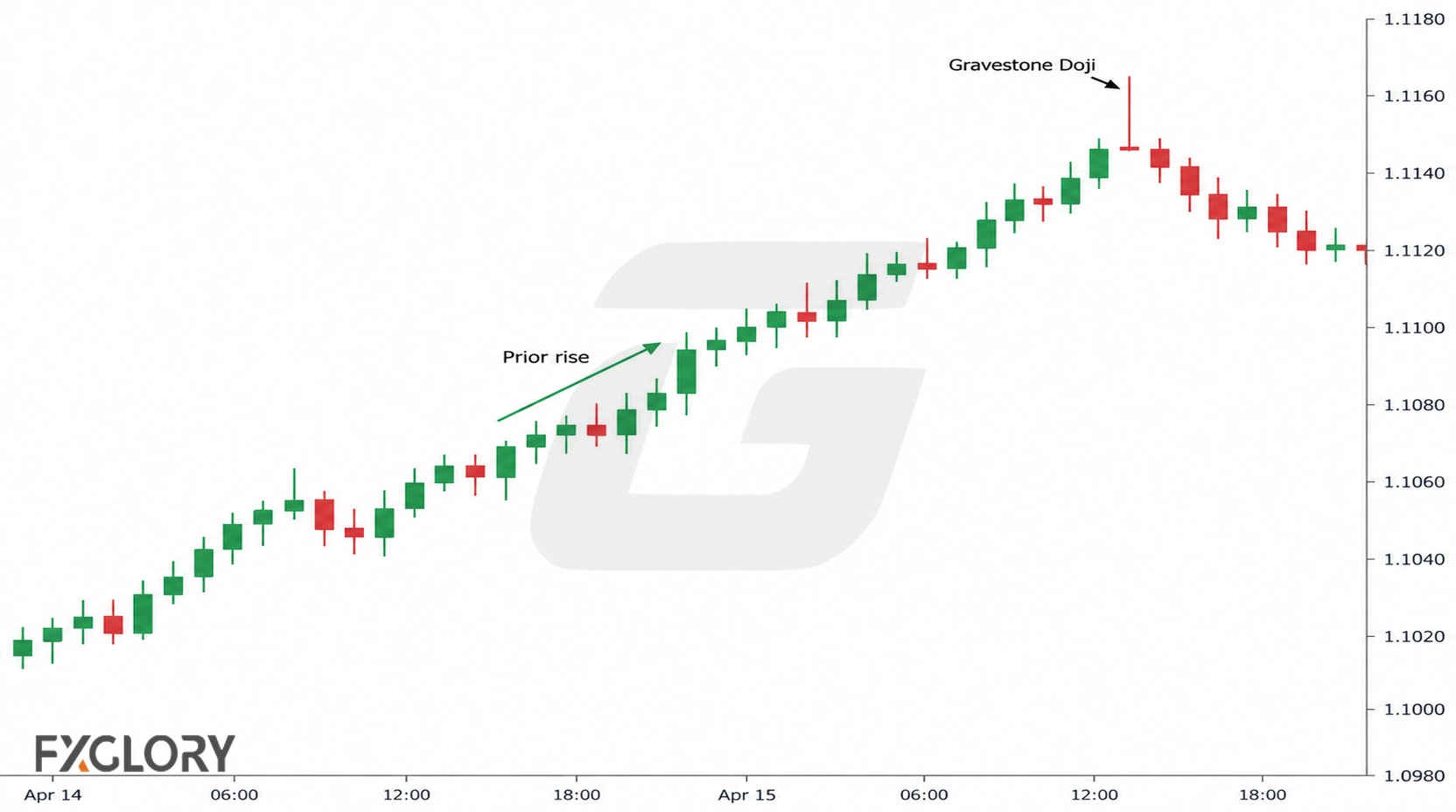
Its high records the upper extreme of the completed candle, while its close near the low shows that higher prices were not sustained through the period.
A strict gravestone doji has the open, low, and close at the same or almost the same price, with no lower shadow. In modern forex chart reading, a near-gravestone doji may still be reviewed when the body is tiny, the lower shadow is absent or very small, and the upper shadow clearly dominates the candle.
A gravestone doji does not confirm that price will fall. It is a one-candle chart clue about higher-price rejection during one completed candle period. The useful question is whether the upper shadow, doji-like body, chart location, market conditions, and follow-up movement make the candle worth reviewing.
If you need the basic doji idea first, review the open-close balance behind doji candles. Gravestone doji uses the same small-body idea, but adds a long upper shadow and a lower-side open-close area.
Gravestone Doji Anatomy
The anatomy of a gravestone doji has three main parts: a doji-like body near the low, little or no lower shadow, and a long upper shadow. The upper shadow is the feature that separates gravestone doji from a plain doji.
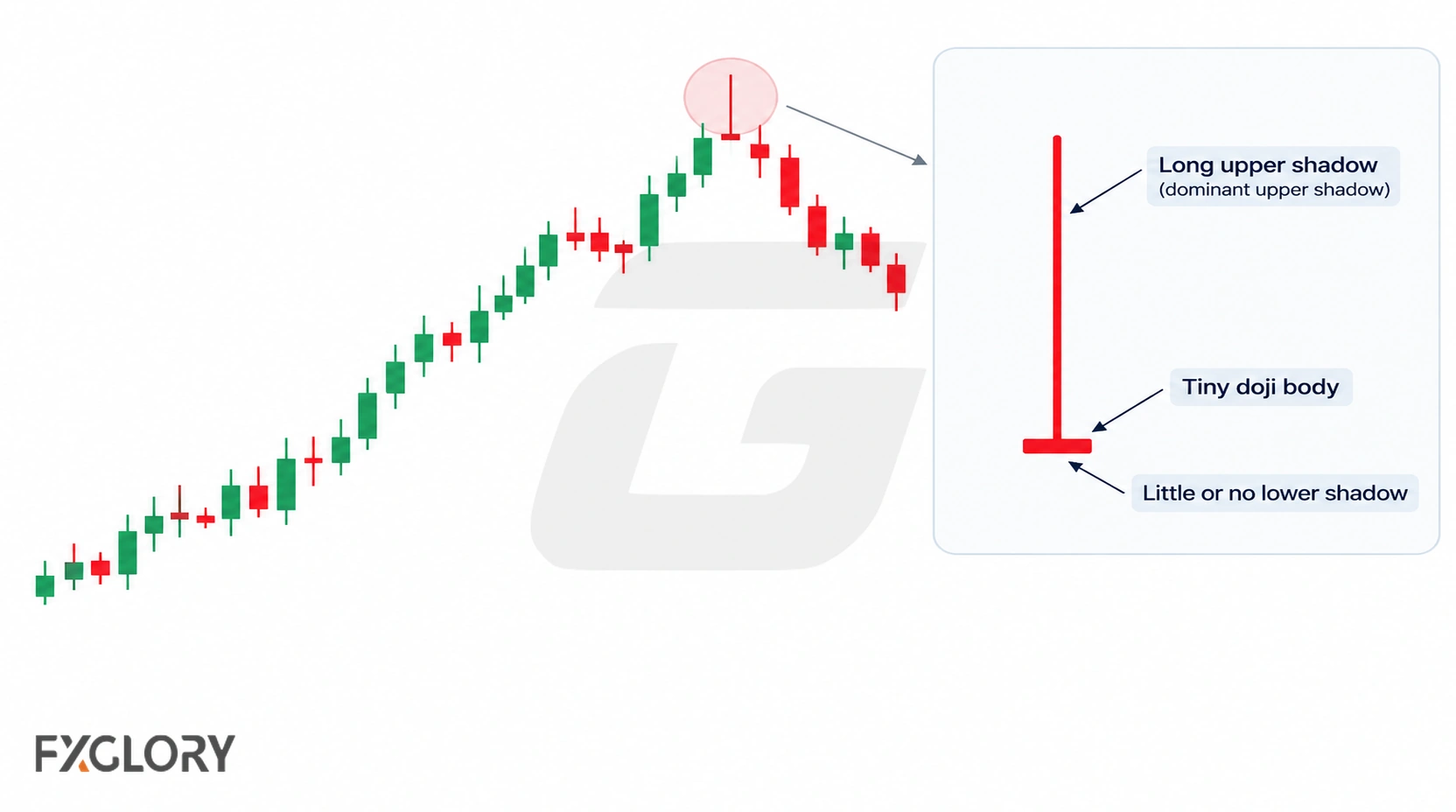
Candle color is secondary to the near-equality of the open and close and the placement of the tiny body at the lower end of the range.
| Gravestone Doji Part | Common Structure | What It Shows | Reading Caution |
|---|---|---|---|
| Open | Near the candle low. | The candle begins near the lower part of its range. | If the open is far from the low, the structure may be weaker. |
| Low | Near the open and close. | There is little or no movement below the doji body. | A visible lower shadow weakens the strict version. |
| Close | Near the open and low. | Price returned back toward the lower level before completion. | If the close is far from the open, the candle may not be a doji. |
| Real body | Tiny or nearly absent. | Open and close ended close together. | A large body makes the candle closer to a shooting-star-type structure. |
| Upper shadow | Long and clearly dominant. | Price tested higher levels and returned before the close. | A short upper shadow may not show meaningful rejection. |
| Lower shadow | None or very small. | The candle has a clean inverted-T profile. | A large lower shadow may turn the candle into another doji type. |
A candle should not be called gravestone doji while it is still forming. A late move before the close can create a larger body, add a lower shadow, or reduce the upper-shadow message.
Strict vs Near-Gravestone Doji
A strict gravestone doji has a nearly perfect inverted-T shape: open, low, and close at the same or almost the same price, no lower shadow, tiny or absent body, and a long upper shadow.
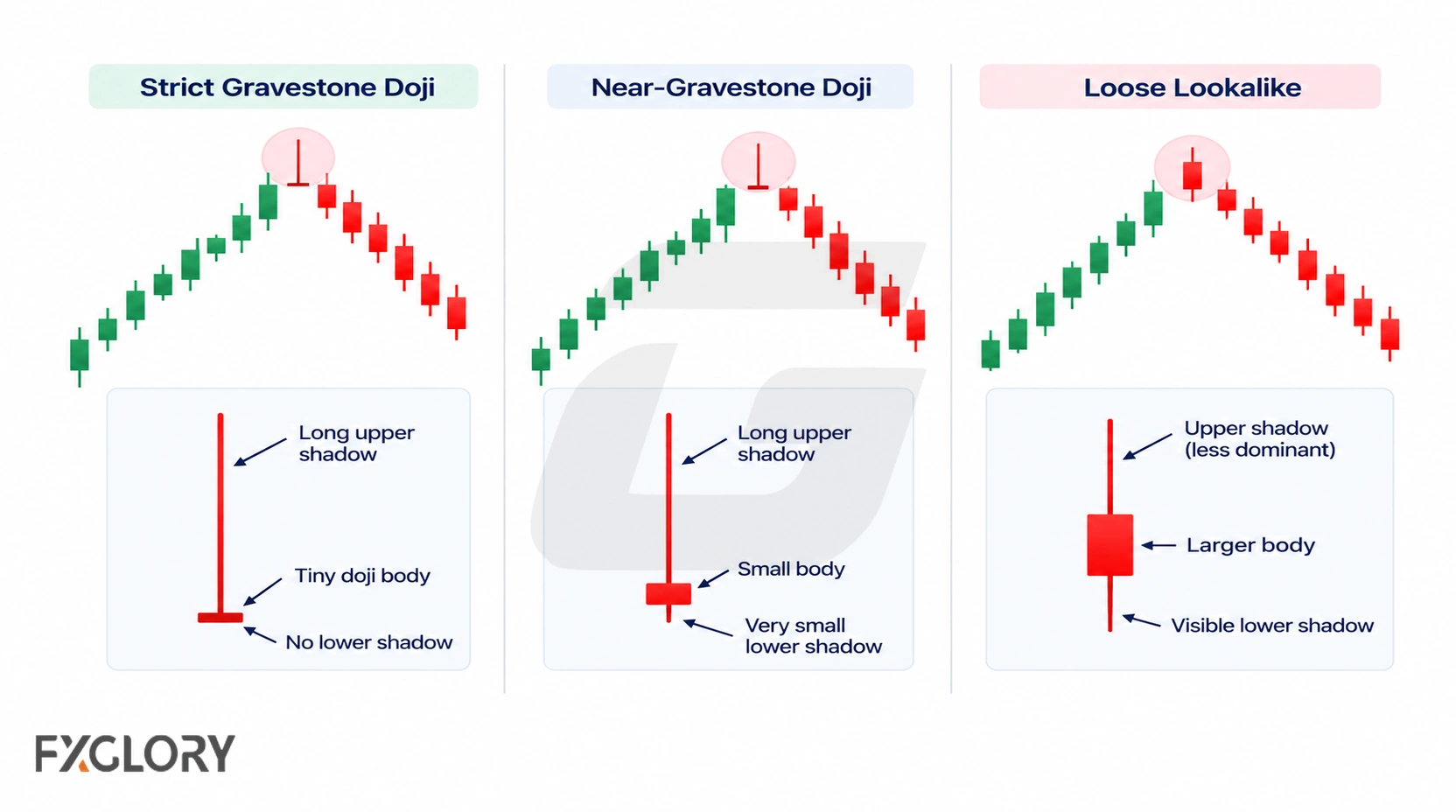
Perfect gravestone doji candles are uncommon because the structure is specific. Price must rise far above the open, then return back near the open and low before the candle closes.
Loose gravestone-like candles appear more often than true gravestone doji candles. The stricter the open-low-close alignment and upper-shadow dominance, the cleaner the label becomes.
Hypothetical example: A candle opens at 1.1000, reaches 1.1040, trades as low as 1.0999, and closes at 1.1001. Its upper shadow spans 39 pips, while the body is only 1 pip and the lower shadow is 1 pip (assuming a four-decimal quote and 0.0001 per pip). This is a near-gravestone shape, not a verified market observation.
Forex charts may show slight variations because of spread, platform feeds, liquidity, and timeframe selection. A near-gravestone doji may have a very small body or a tiny lower shadow, but the candle should still clearly show a doji-like bottom and a long upper shadow.
If the body is easy to notice as a normal candle body, or the lower shadow is clearly visible, the candle is usually better treated as a loose lookalike, a shooting-star-type candle, a long-legged doji, or another small-body candle.
| Structure | What It Looks Like | Possible Reading | Reading Caution |
|---|---|---|---|
| Strict gravestone doji | Open, low, and close nearly aligned; no lower shadow; long upper shadow. | Cleanest upper-shadow doji structure. | Still needs chart context. |
| Near-gravestone doji | Tiny body or tiny lower shadow, with dominant upper shadow. | May still show higher-price rejection. | Only acceptable when the lower area remains tight. |
| Loose lookalike | Visible body, visible lower shadow, or weak upper shadow. | The candle may no longer be a clean gravestone doji. | May belong to shooting star, spinning top, or long-legged doji territory. |
Why The Long Upper Shadow Matters
The long upper shadow is the main visual feature of a gravestone doji. It shows that price moved significantly above the open-close area during the candle period, then returned before the candle closed.
Assess the upper shadow against the entire candle range rather than applying a fixed wick-to-body ratio. When the body is almost zero, such a ratio becomes unreliable or undefined; the relevant visual feature is that nearly all of the range lies above the clustered open, close, and low.
If the upper shadow is short, the candle may not show enough higher-price rejection to deserve the gravestone label. If the body is large, the candle may be closer to a shooting star or another upper-wick candle rather than a doji subtype.
| Upper Shadow Condition | Possible Reading | Reading Caution |
|---|---|---|
| Very long upper shadow | Higher-price rejection is easier to see. | Still needs chart location and completed candle structure. |
| Moderate upper shadow | Some higher test and return may be visible. | The candle may be less clean as a gravestone doji. |
| Short upper shadow | Weak higher-price rejection. | Usually not a useful gravestone reading. |
| Long upper shadow with large body | Higher rejection may exist, but the doji structure is weak. | May be closer to a shooting-star-type candle. |
What Gravestone Doji Shows About Buyer And Seller Pressure
A completed gravestone doji shows that price reached a high well above the opening level but finished close to the low. This is consistent with a higher-price advance that was not sustained. The OHLC values alone do not identify who initiated the trades or reconstruct the precise intraperiod path.
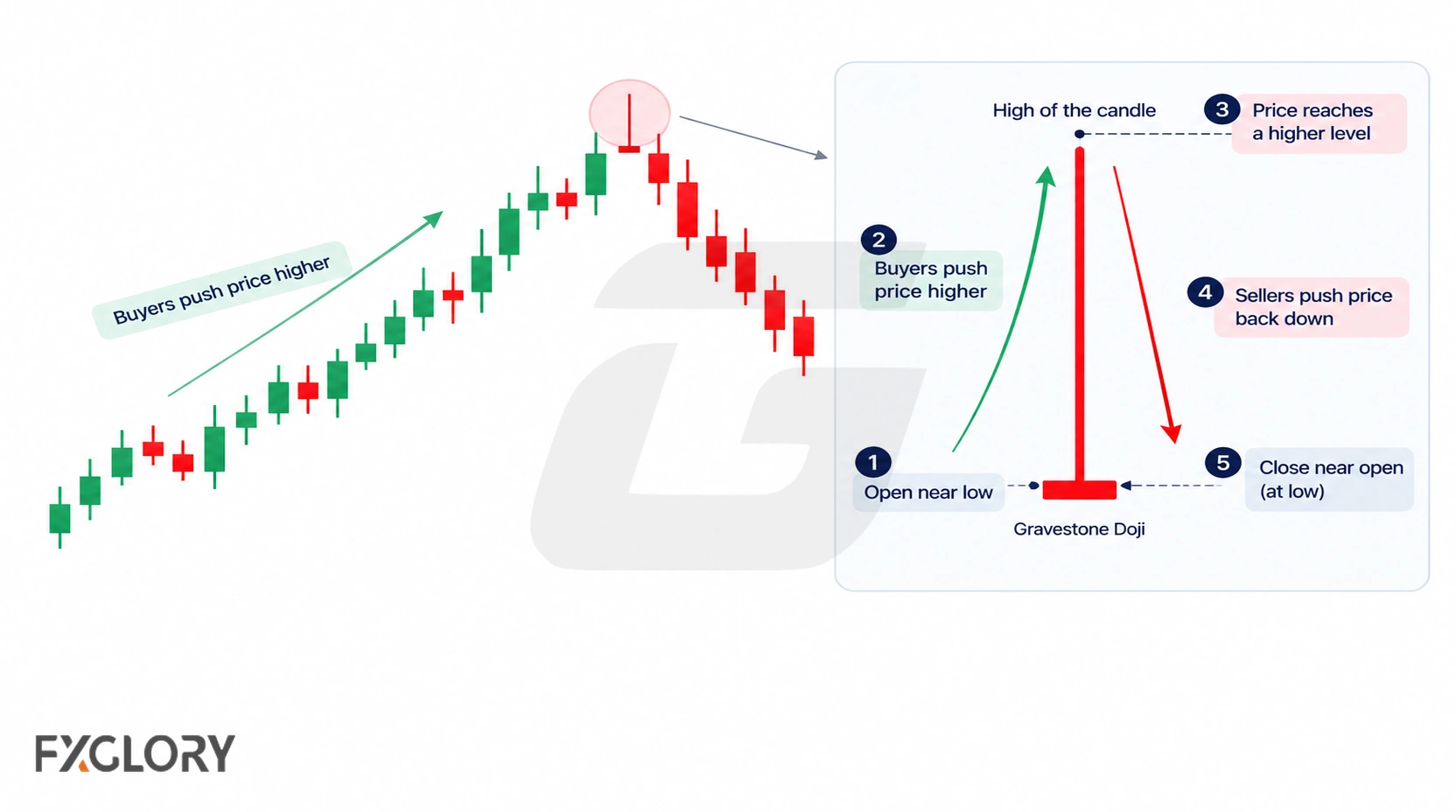
This does not prove that sellers will control the next candle or the next trend. It only shows that the higher-price attempt did not remain in control by the time the candle closed.
The pressure message becomes clearer when the candle appears after buying pressure or near a higher-price area that already matters on the chart. The same candle in random sideways movement may be less useful.
Gravestone Doji After An Uptrend
Gravestone doji is often reviewed after buying pressure, a rise, or a higher-price test. In that setting, the upper shadow shows that higher prices traded but were not sustained into the close.
The candle is easier to review when it appears near resistance, a swing high, a range high, or after upside progress slows. Those areas give the upper-shadow rejection a clearer chart location.
A gravestone doji after a rise still does not confirm a full reversal. Follow-up movement decides whether the candle area remains relevant or becomes another failed upper-wick attempt.
- Clearer context: Prior buying pressure, higher-price test, long upper shadow, tiny body near the low, and useful chart location.
- Weaker context: No prior buying pressure, short upper shadow, visible lower shadow, large body, or messy range conditions.
Gravestone Doji After A Downtrend Or In Consolidation
A gravestone doji can also appear after selling pressure or inside consolidation. In those settings, the candle should be read more carefully because the upper shadow may not carry the same meaning as it would after a rise.
After a downtrend, a gravestone doji can show that price tested higher during the candle period and returned before the close. That return may keep the candle from looking strong, but it does not automatically support a continuation reading.
Inside consolidation, gravestone-like candles can appear often as price moves between small support and resistance areas. A gravestone doji in the middle of a range is usually weaker than one near a clear range high or resistance area.
Where Gravestone Doji Matters More
A gravestone doji becomes easier to review when it appears in a place where higher-price rejection matters. Without a useful chart location, the candle may only show ordinary intraperiod movement.
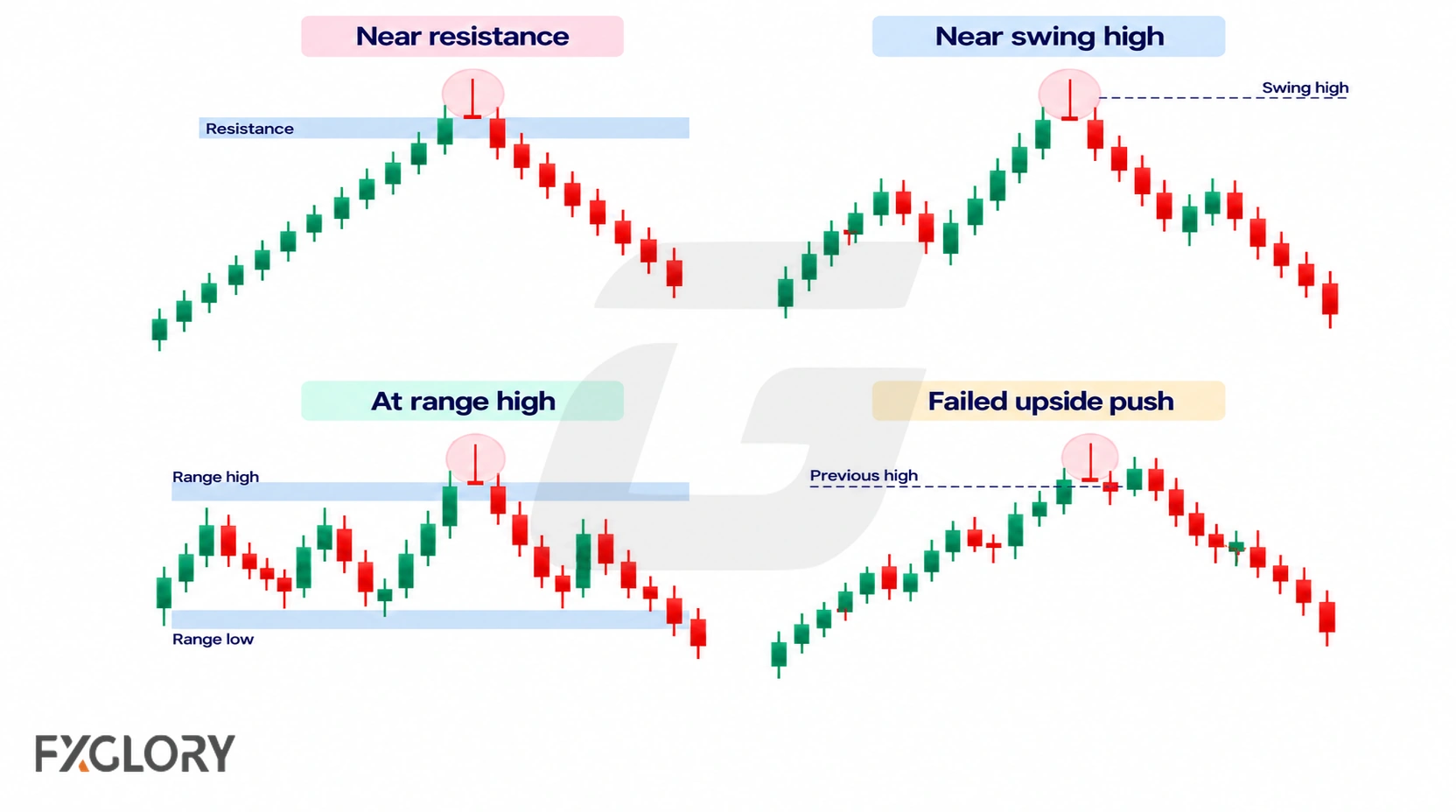
Near Resistance
A gravestone doji near resistance can show that price tested above or into a higher-price area and returned before the close. The resistance area gives the upper shadow a clearer reference point.
Near A Swing High
A swing high gives the candle a visible chart reference. If price tests a higher area and prints a gravestone doji, the upper shadow can be compared with the earlier high.
At A Range High
Inside a range, a gravestone doji near the upper boundary can be more meaningful than one in the middle of the range. The range high gives context to the higher-price test.
After A Failed Upside Push
A gravestone doji can appear after price pushes higher and then returns inside the same candle period. This can show that the higher move lost control before the close, but the candle still needs follow-up movement.
During News Or Abnormal Volatility
A long upper shadow during news, rollover, a market open, or thin liquidity can be difficult to interpret. The final candle may look clean after the fact, while real-time spread and execution conditions were unstable.
For observation, a trader can compare gravestone-like candles on live market pages such as GBP/USD around higher-price tests or gold during wider upper-shadow candles. These pages are useful for chart review, not as standalone trading reasons.
Gravestone Doji vs Dragonfly Doji
Gravestone doji and dragonfly doji are opposite doji subtypes. Both are single-candle patterns with a tiny or absent real body, but their shadows point in opposite directions.
| Doji Type | Main Structure | Common Pressure Reading | Main Difference |
|---|---|---|---|
| Gravestone doji | Open, low, and close near the same lower level, with a long upper shadow. | Higher-price rejection during one candle period. | Long shadow is above the body. |
| Dragonfly doji | Open, high, and close near the same upper level, with a long lower shadow. | Lower-price rejection during one candle period. | Long shadow is below the body. |
For the opposite doji subtype, use the long lower-shadow doji structure.
Gravestone Doji vs Shooting Star
Gravestone doji and shooting star candles can look similar because both can have long upper shadows and little or no lower shadow. The difference is the real body.
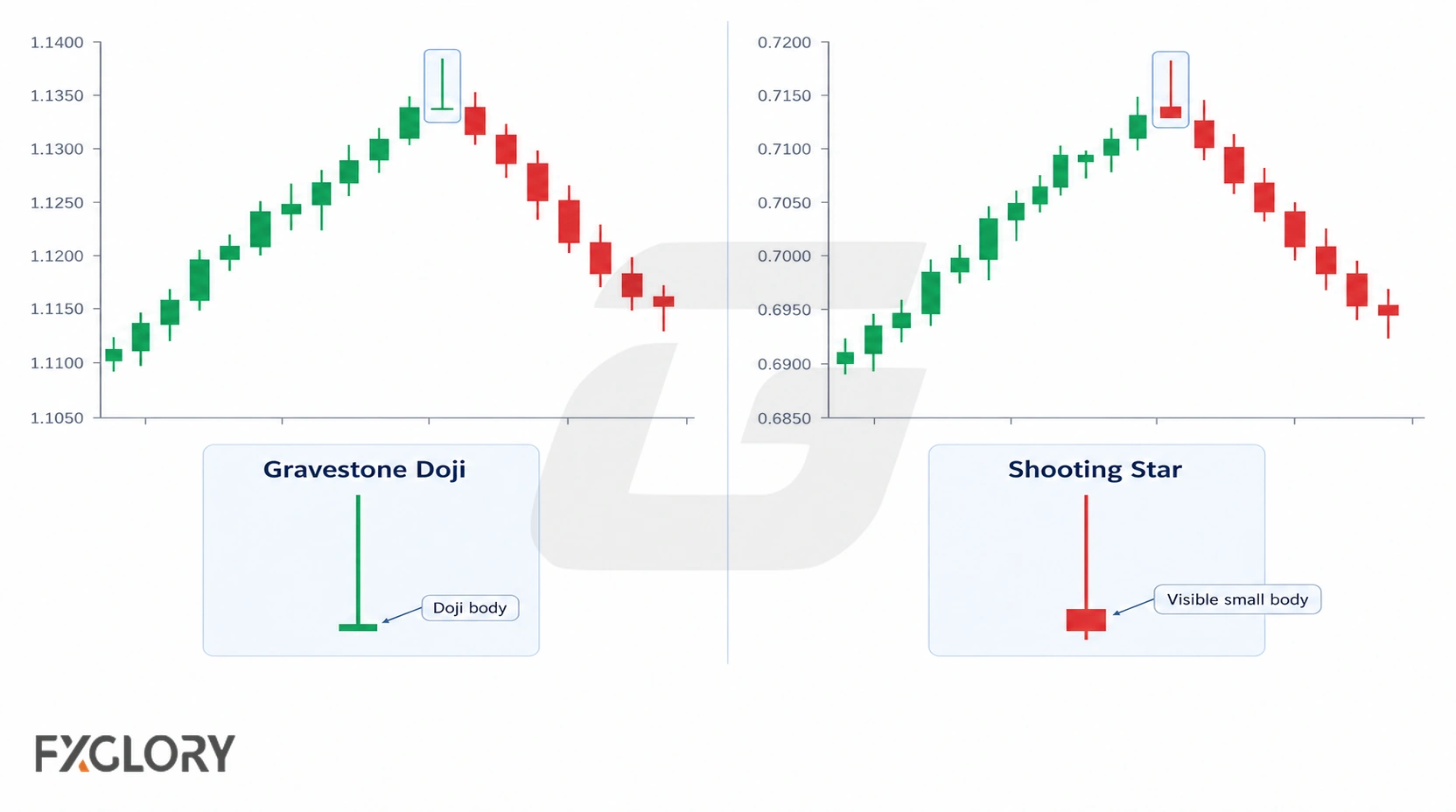
A gravestone doji has a doji-like body near the candle low, where the open and close are the same or nearly the same. A shooting star has a small real body near the low after buying pressure, but the open and close do not need to be nearly equal.
| Candle | Main Structure | Main Difference |
|---|---|---|
| Gravestone doji | Tiny or absent body near the low, long upper shadow. | Doji-like open-close balance at the lower level. |
| Shooting star | Small body near the low, long upper shadow after buying pressure. | Upper-wick rejection candle, not necessarily a doji. |
For the small-bodied upper-wick candle after buying pressure, use the shooting star candle structure.
Gravestone Doji vs Inverted Hammer
Gravestone doji and inverted hammer candles both have upper-shadow emphasis, but they are not the same candle.
An inverted hammer is usually reviewed after selling pressure and has a small body with a long upper wick. It does not require the open, low, and close to sit near the same lower level. Gravestone doji is a doji subtype, so the open and close should be equal or nearly equal near the low.
| Candle | Main Structure | Main Difference From Gravestone Doji |
|---|---|---|
| Gravestone doji | Tiny body near the low, long upper shadow, little or no lower shadow. | Doji-like open-close balance at the lower level. |
| Inverted hammer | Small body with long upper wick after selling pressure. | Upper-wick test after selling pressure, not necessarily a doji. |
For the upper-wick candle after selling pressure, use the inverted hammer structure.
Gravestone Doji vs Long-Legged Doji And Spinning Top
Gravestone doji can also be confused with long-legged doji and spinning top candles. These patterns all involve small bodies, but their wick structures are different.
| Candle | Main Structure | Main Difference From Gravestone Doji |
|---|---|---|
| Gravestone doji | Tiny body near the low, long upper shadow, little or no lower shadow. | Upper shadow dominates the candle. |
| Long-legged doji | Tiny body with long upper and lower shadows. | Both sides show wide movement, not only higher rejection. |
| Spinning top | Small body with upper and lower shadows. | Body is small but not necessarily doji-like, and both shadows matter. |
| Dragonfly doji | Tiny body near the high, long lower shadow, little or no upper shadow. | Lower shadow dominates, not upper shadow. |
For related small-body structures, compare the two-sided spinning-top candle and the lower-shadow dragonfly doji.
Gravestone Doji vs The Doji Parent Pattern
The broader doji family is identified by an open and close that are equal or nearly equal. A gravestone doji is distinguished within that family by its long upper shadow and lower-side body.
| Pattern | Main Focus | Main Difference |
|---|---|---|
| Doji candle | Open and close are the same or nearly the same. | Broad family of small-body balance candles. |
| Gravestone doji | Open, low, and close near the same lower level, with a long upper shadow. | Specific doji subtype focused on higher-price rejection. |
For the broader family, use the general doji candle guide.
Gravestone Doji Strength Filter: Stronger vs Weaker Readings
A gravestone doji does not have the same value in every chart condition. The table below helps separate clearer upper-shadow doji readings from weaker ones.
| Gravestone Doji Factor | Clearer Reading | Weaker Reading |
|---|---|---|
| Body position | Open and close sit near the low. | Body sits away from the low or becomes too large. |
| Lower shadow | No lower shadow or only a tiny one. | Visible lower shadow weakens the strict gravestone structure. |
| Upper shadow | Long upper shadow clearly dominates the candle. | Short upper shadow does not show meaningful higher rejection. |
| Body size | Tiny or nearly absent real body. | Visible body makes the candle closer to shooting-star territory. |
| Prior movement | Appears after buying pressure or a higher-price test. | Appears without useful prior movement or context. |
| Chart location | Forms near resistance, swing high, range high, or a failed upside push. | Forms in the middle of random movement. |
| Market conditions | Spread and volatility conditions are stable enough for chart review. | Forms during abnormal news movement, rollover, or thin liquidity. |
| Completed candle | The candle has fully closed. | The candle is still forming and can change shape. |
| Follow-up movement | Later price movement keeps the candle area relevant. | Price immediately makes the candle area irrelevant. |
Gravestone Doji Forex Reading Table
The table below shows how the same gravestone doji structure can change depending on chart location and candle quality.
| Gravestone Doji Situation | Possible Reading | What To Check Next |
|---|---|---|
| After buying pressure | Higher prices were tested and rejected during the candle. | Check whether follow-up movement keeps the candle area relevant. |
| Near resistance | The long upper shadow formed around a higher-price area already visible on the chart. | Check whether resistance remains relevant. |
| Near a swing high | The candle appeared around a previous upper turning area. | Compare the upper shadow with the earlier high. |
| At a range high | The candle formed near the upper boundary of a range. | Check whether the range boundary remains respected. |
| After a downtrend | The candle shows higher intraperiod testing and return. | Check whether the chart is extended or entering consolidation. |
| Inside consolidation | The candle may be ordinary range movement. | Check whether it appears near a meaningful boundary. |
| During news volatility | The long upper shadow may reflect unstable movement. | Review spread, candle range, and execution conditions. |
How To Read A Gravestone Doji In Forex
A simple workflow helps keep gravestone doji reading disciplined. The goal is to describe the candle structure before giving it more meaning than it deserves.
- Check the candle close: Review the candle only after it has completed.
- Check the doji body: Confirm that the open and close are the same or nearly the same.
- Check the body position: Review whether the open and close sit near the candle low.
- Check the lower shadow: Confirm that the lower shadow is absent or very small.
- Check the upper shadow: Review whether the upper shadow clearly dominates the candle.
- Compare with shooting star: Check whether the body is truly doji-like or only a small shooting-star body.
- Check chart location: Look for resistance, swing highs, range highs, failed upside pushes, or consolidation boundaries.
- Review market conditions: Consider volatility, spread, liquidity, rollover, and scheduled news events.
- Watch follow-up movement: A subsequent completed close below the gravestone candle's low can serve as an explicitly defined bearish follow-up condition; a move above its high challenges that interpretation. Neither outcome changes the original candle's structure or supplies a complete trade plan.
Some traders compare gravestone doji candles with technical indicators for additional context. For example, RSI can add momentum context, MACD can add trend-momentum context, ATR can add volatility context, and Bollinger Bands can help review range and expansion conditions. These tools can support candle review, but they do not remove trading risk.
Some traders also review activity or volume-style tools around a gravestone doji, but spot forex volume is usually broker/platform-specific and should not be treated as a complete confirmation by itself.
Gravestone Doji Lookalikes And Weak Interpretations
Three situations should be kept separate: an unfinished or incorrectly shaped candle is not a confirmed gravestone doji; a structurally valid gravestone in an unhelpful location may offer little interpretive value; and a valid candle followed by rising prices can fail to support a bearish interpretation without ceasing to be a gravestone doji.
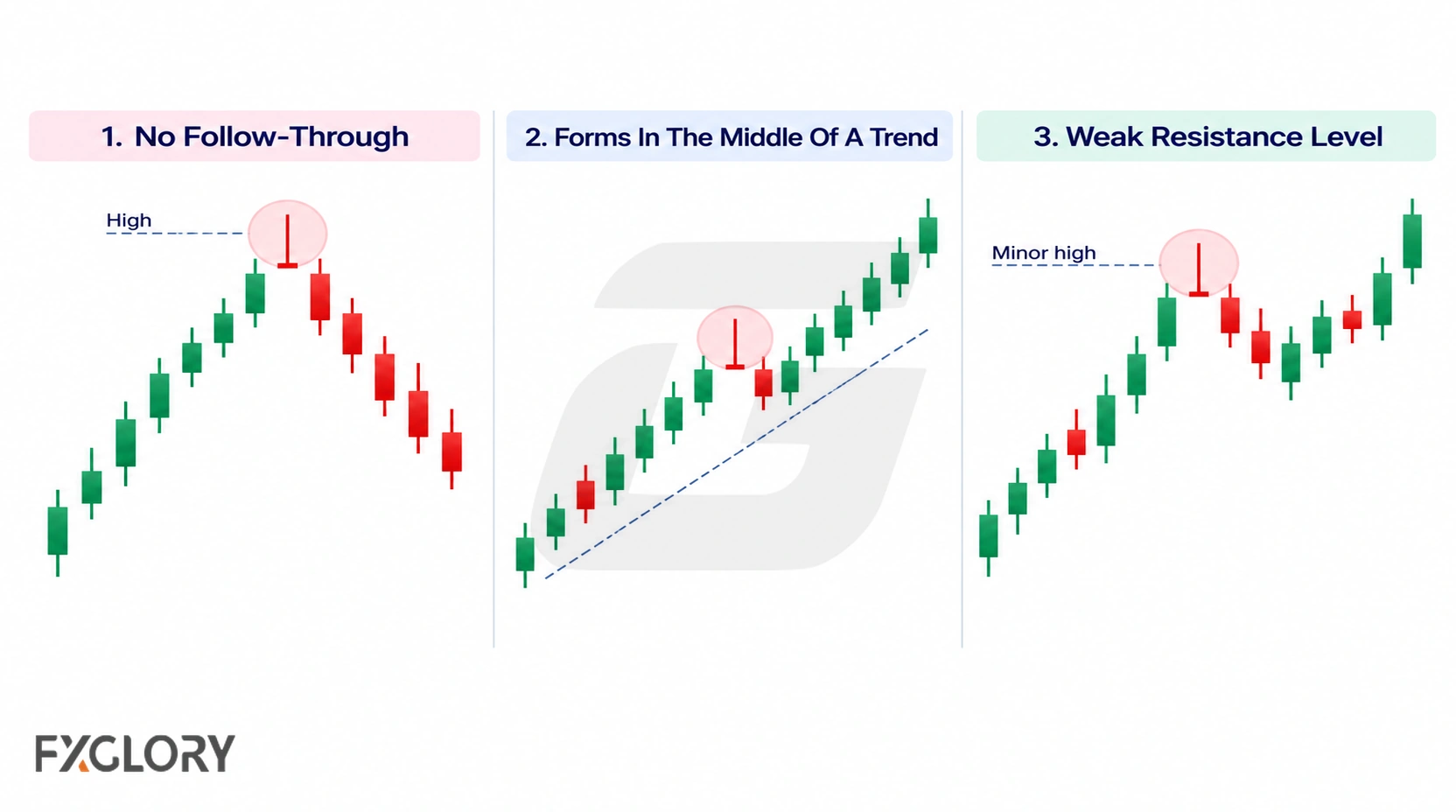
Even when the next candle initially moves lower, a bearish interpretation can subsequently fail. This is different from a candle failing the structural definition.
Unfinished Candle
A candle can look like a gravestone doji before it closes and then finish with a larger body, a visible lower shadow, or a weaker upper shadow. Gravestone doji should be reviewed after the candle has closed.
Body Too Large
If the candle has a visible real body rather than a doji-like body, it may be closer to a shooting star or another upper-wick candle.
Visible Lower Shadow
A strict gravestone doji has no lower shadow. A tiny lower shadow may be acceptable, but a visible lower shadow weakens the structure and may place the candle closer to another doji type.
Weak Upper Shadow
If the upper shadow does not clearly dominate the candle, the higher-price rejection message becomes weak.
Middle Of A Range
Gravestone-like candles can appear inside sideways movement. A candle in the middle of a messy range is usually weaker than one near resistance or a range high.
Lower-Timeframe Noise
Lower timeframes do not automatically invalidate the pattern, but they can create more frequent lookalikes. The candle needs stronger chart context when movement is short-term and noisy.
News Or Low-Liquidity Conditions
Major news, rollover, market opens, and thin liquidity can create long upper shadows that are difficult to interpret in real time. Spread and execution conditions may be unstable even when the final candle looks clean.
A valid candle does not itself specify an entry, stop, position size, or acceptable account risk. These belong to separate trade planning, not pattern identification.
What To Study After Gravestone Doji
After learning how to read gravestone doji, the next step is to compare it with broader doji structures, upper-wick candles, and multi-candle reversal-focused formations.
You can compare gravestone doji with the broader doji candle family, the dragonfly lower-shadow doji, the shooting star upper-wick candle, the spinning top candle, or the full-body marubozu candle. For nearby multi-candle comparisons, review the matching-high tweezer structure and the evening star sequence. For a wider map of candle formations, return to forex candlestick pattern groups.