What Is A Spinning Top Forex Candle?
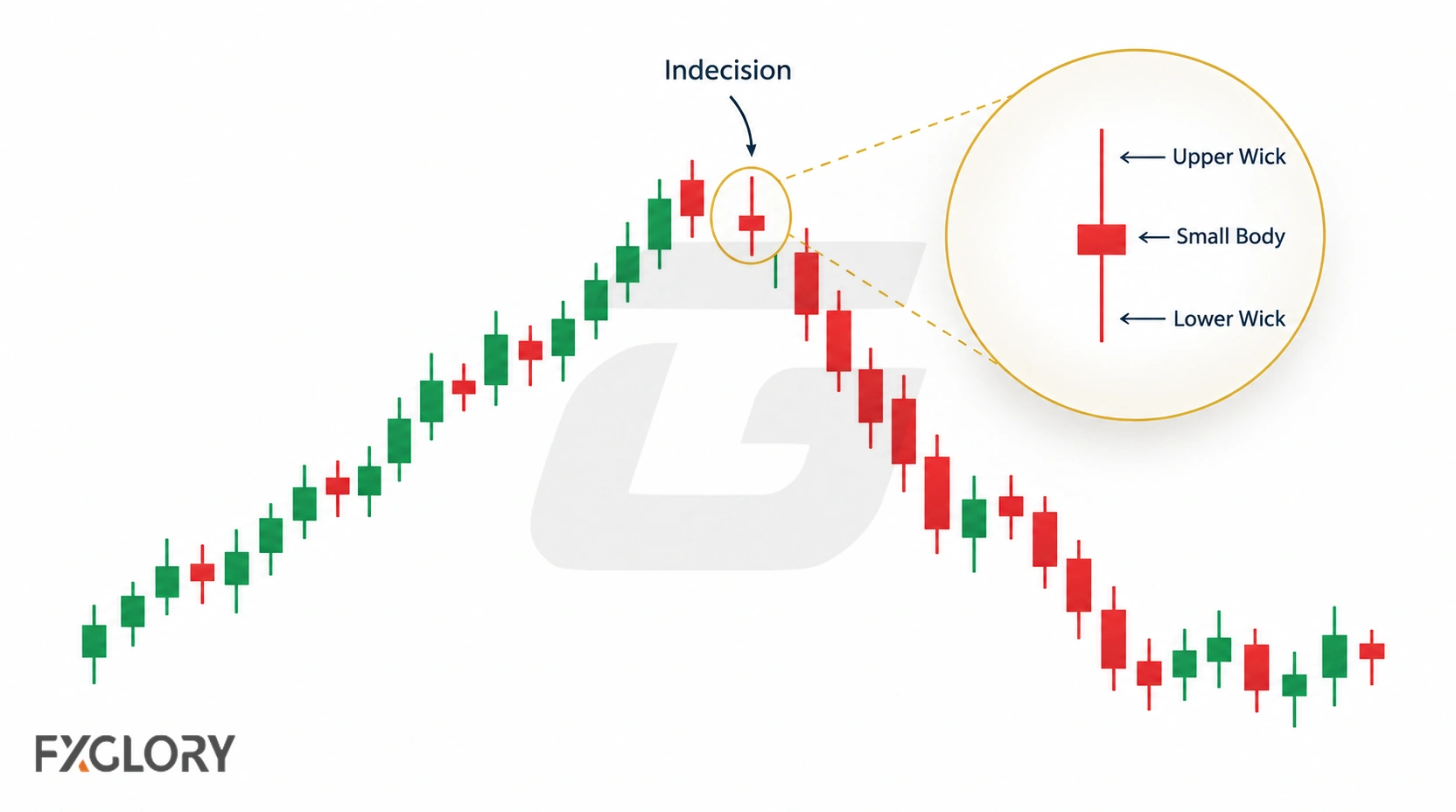
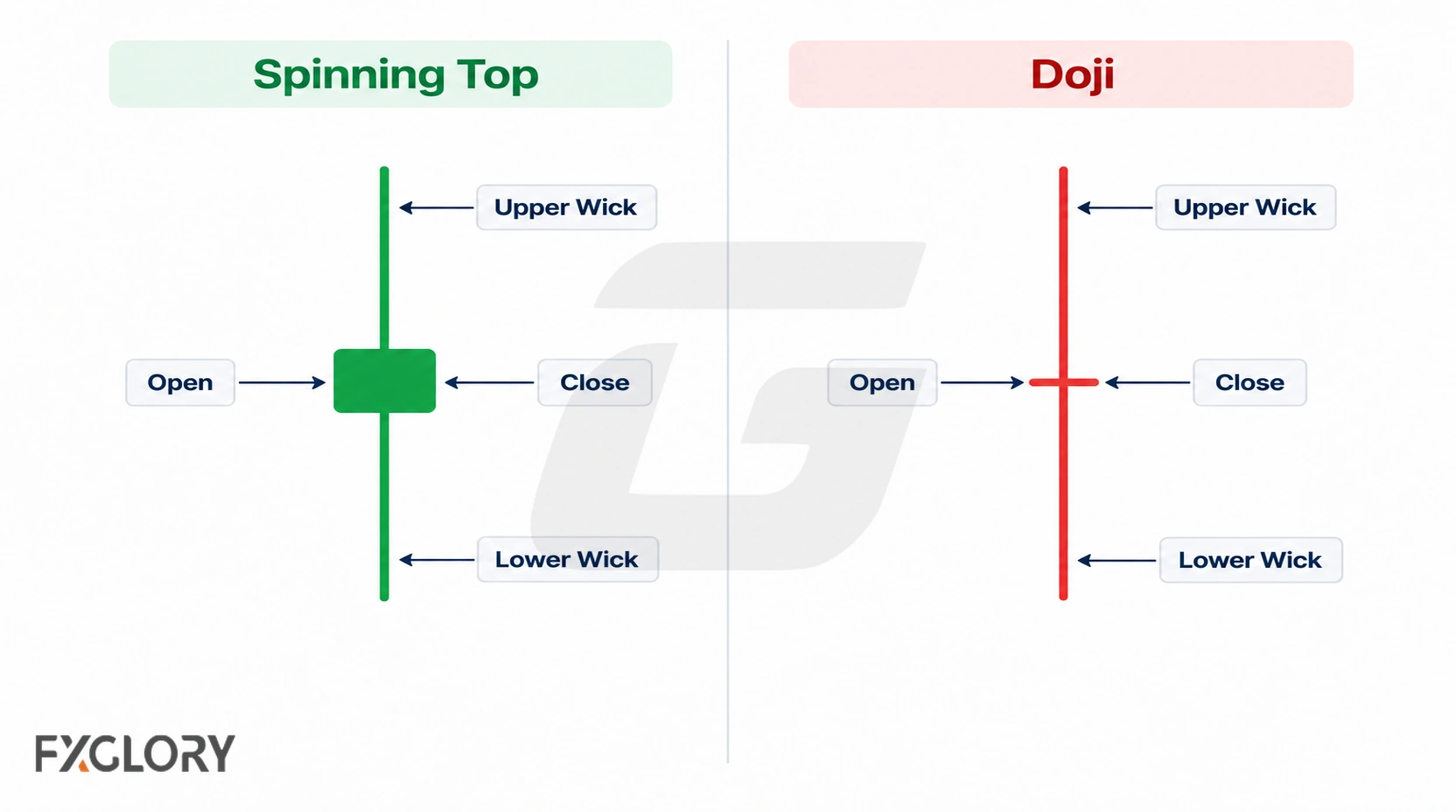
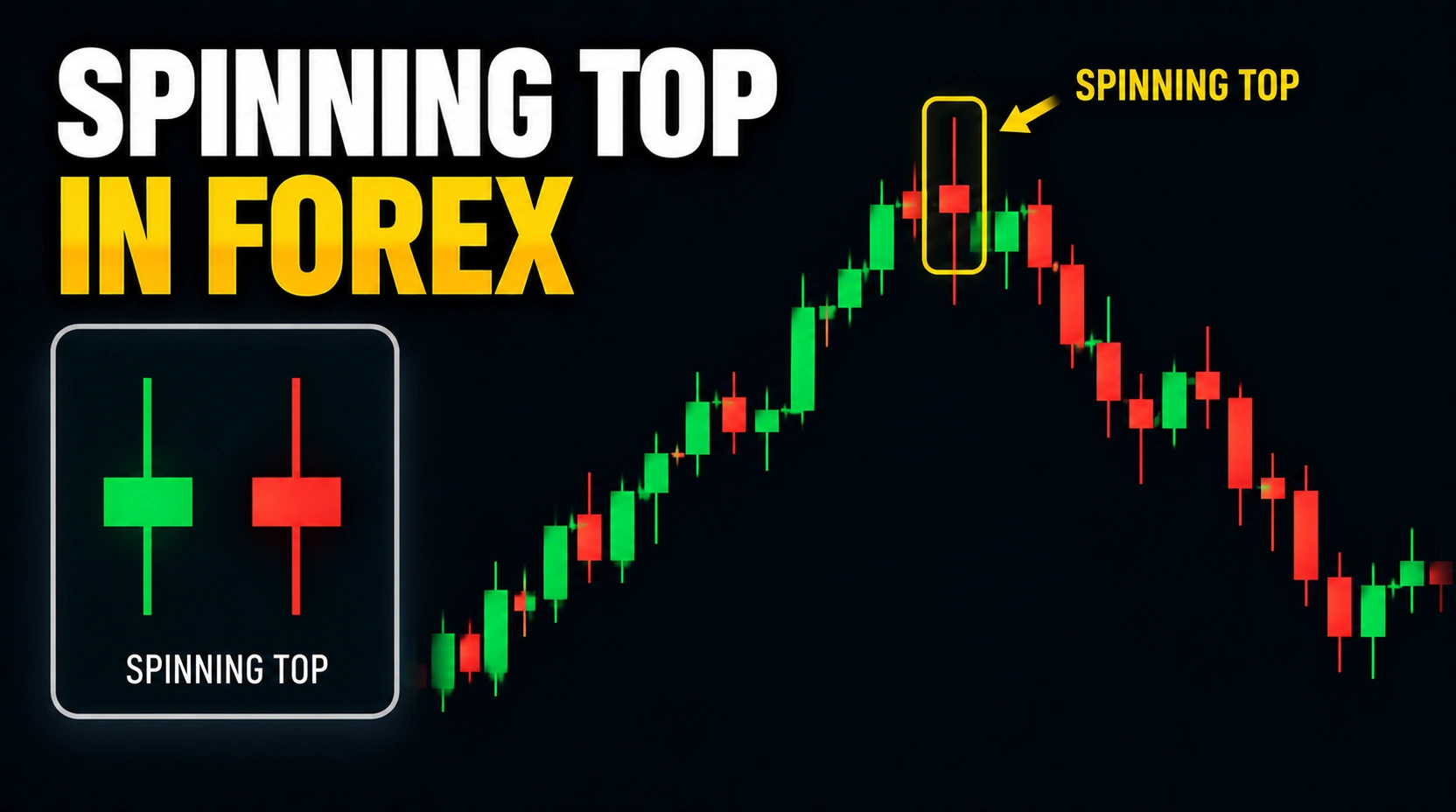
A spinning top forex candle is a candlestick with a small visible body and upper and lower wicks. The body shows that the open and close were close together, while the wicks show that price moved both above and below the body before the candle closed.
The spinning top is usually read as a hesitation candle. Buyers pushed price higher during the candle, sellers pushed price lower during the candle, but neither side kept clear control by the close. That is why spinning tops are often reviewed after a strong move, near support or resistance, or inside a period of compression.
A spinning top candlestick in forex should be judged by its small visible body, two-sided wicks, chart location, and completed candle close.
A spinning top does not prove that price will reverse or continue. It is a one-candle clue about two-sided pressure. The useful question is where the candle appeared, what came before it, how clear the body and wicks are, and what price did after the candle closed.
If you need the basic candle parts first, review the open, close, body, and wick relationship. A spinning top uses those same parts, but its message depends mainly on a small visible body and wicks on both sides.
Spinning Top Candle Anatomy
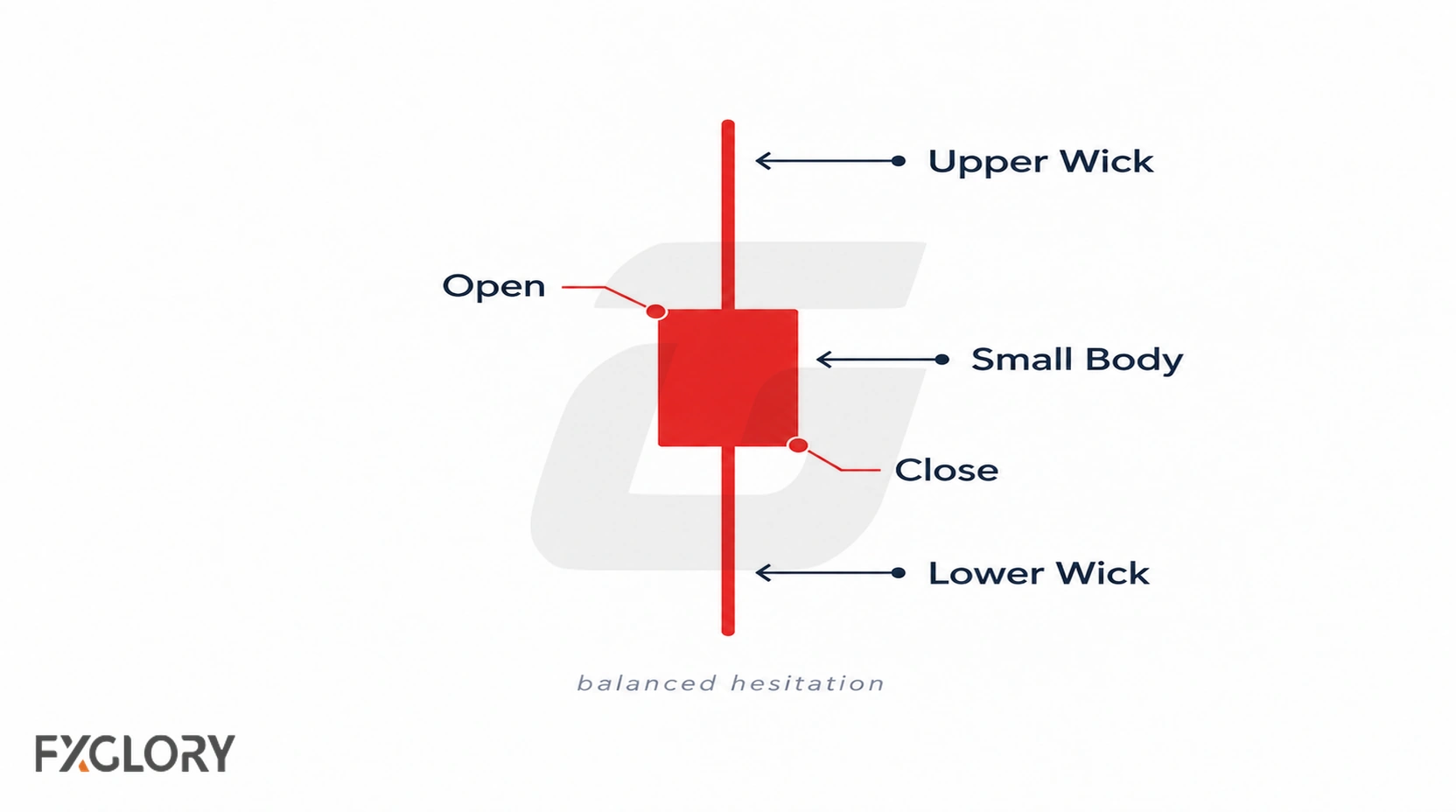
The anatomy of a spinning top candle has three main parts: a small visible body, an upper wick, and a lower wick. The body can be bullish or bearish, but the candle color is usually less important than the overall structure.
| Spinning Top Part | What It Shows | Reading Caution |
|---|---|---|
| Small visible body | The open and close are close together but not necessarily identical. | A very tiny or almost invisible body may be closer to a doji. |
| Upper wick | Price moved above the body but did not close at the high. | A very dominant upper wick may shift the reading toward upper-wick rejection. |
| Lower wick | Price moved below the body but did not close at the low. | A very dominant lower wick may shift the reading toward lower-wick rejection. |
| Close location | Price finished near the opening area. | The close should support the hesitation reading. |
| Full candle range | The high-to-low movement during the candle period. | A very wide range may reflect news or unstable volatility. |
A clean spinning top usually has a body that is small compared with the full candle range. The wicks do not have to be perfectly equal, but both sides should be visible enough to show that price explored higher and lower areas during the candle period.
What A Spinning Top Shows In Forex
A spinning top shows that price moved in both directions during the candle, but the close stayed near the open. This can suggest hesitation, balance, a pause after movement, or temporary uncertainty around a chart area.
In forex, that hesitation should be read with the pair, timeframe, spread conditions, and surrounding candles. A spinning top on a one-minute chart may be ordinary noise. A spinning top on a higher timeframe after a strong move may deserve closer review because it shows a larger period of two-sided movement.
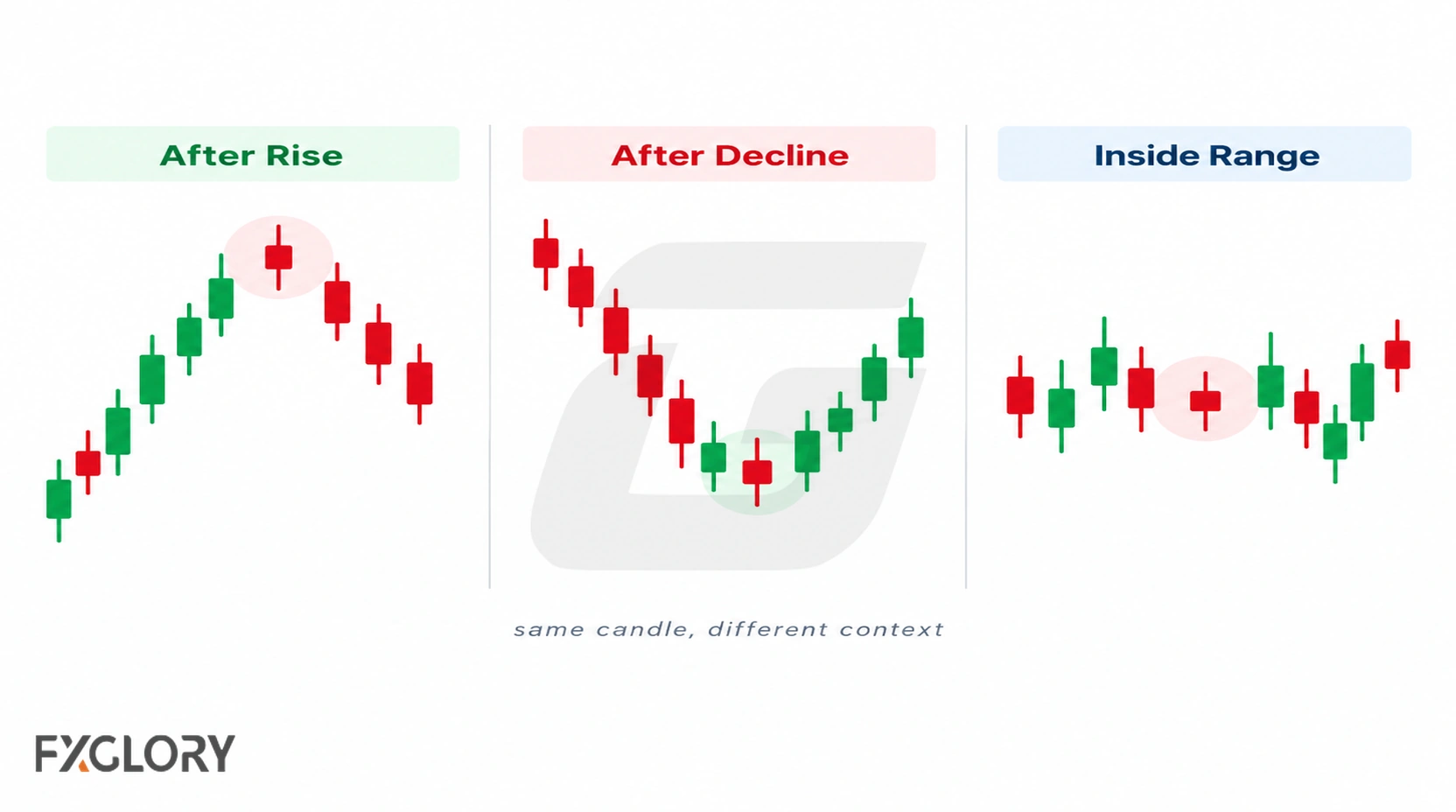
The candle can appear in an uptrend, downtrend, or range. It can appear near support, near resistance, after a strong candle, or during quiet movement. The structure is the same, but the meaning changes depending on the location.
- After a strong rise: A spinning top may show that buying pressure paused during that candle.
- After a strong decline: A spinning top may show that selling pressure paused during that candle.
- Inside a range: A spinning top may only show normal back-and-forth movement.
- Near a tested level: A spinning top may show hesitation around an area traders are already watching.
Bullish And Bearish Spinning Tops In Forex
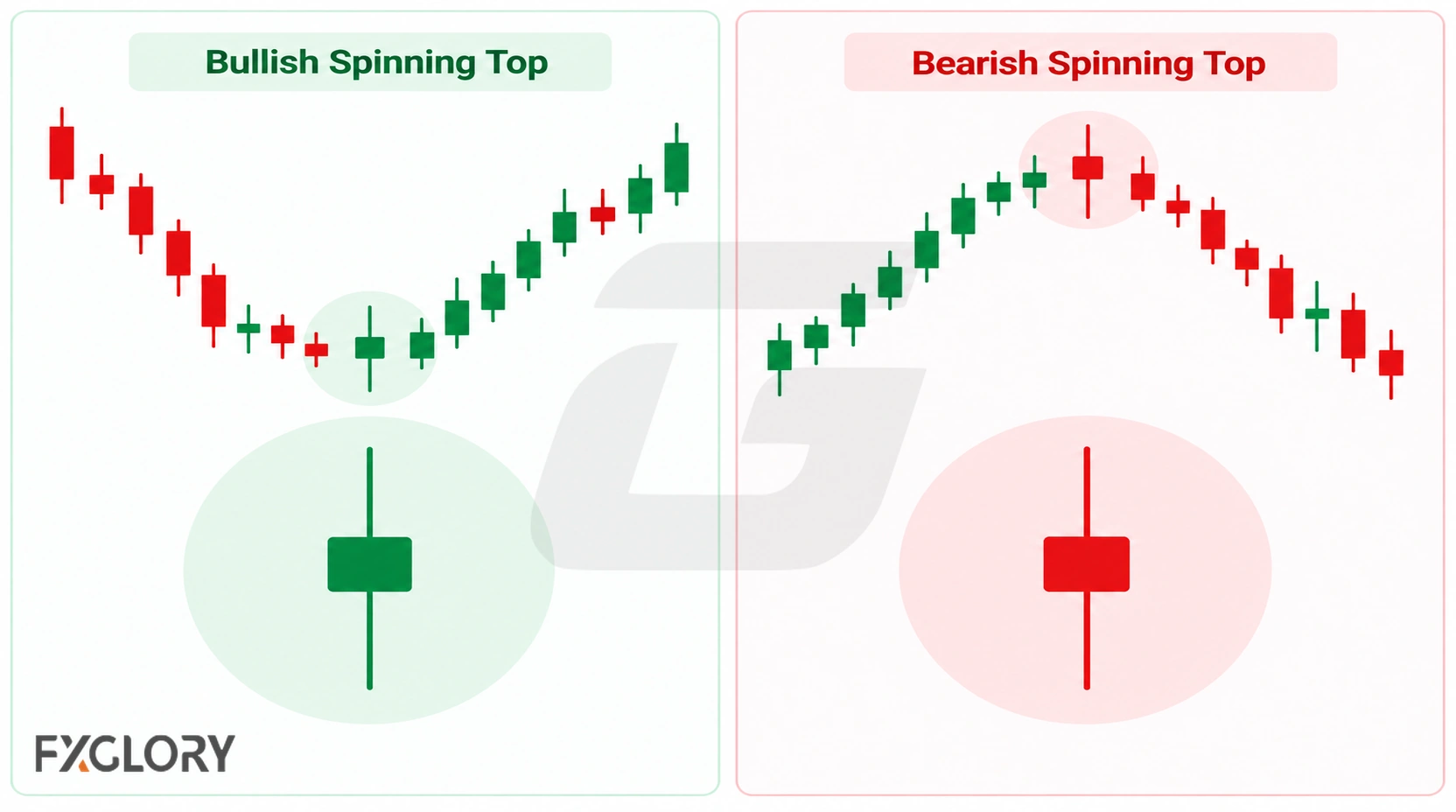
A spinning top can close bullish or bearish. A bullish spinning top closes slightly above its open. A bearish spinning top closes slightly below its open. In both cases, the body remains small compared with the full candle range.
The candle color is secondary because the main message is hesitation. A green spinning top does not automatically show strong buying pressure, and a red spinning top does not automatically show strong selling pressure. If the body is small and both wicks are visible, the candle still reflects two-sided movement.
| Spinning Top Type | Basic Structure | What To Focus On |
|---|---|---|
| Bullish spinning top | Small body that closes slightly above the open. | Body size, wick balance, location, and what price does afterward. |
| Bearish spinning top | Small body that closes slightly below the open. | Body size, wick balance, location, and what price does afterward. |
| Neutral-looking spinning top | Very small body with visible wicks on both sides. | Whether the body is visible enough to separate it from a doji. |
When reading spinning tops, avoid color-only interpretation. A slightly bullish or bearish close may matter less than the fact that price tested both directions and closed near the opening area.
Spinning Top vs Doji In Forex
The difference between a spinning top and a doji is important because both candles can show hesitation, but their body structure is not the same.
A doji has an open and close that are the same or almost the same. The body is extremely small or nearly invisible. A spinning top has a small but visible body, meaning the open and close are close together but not as equal as a doji.
| Candle | Body | Wicks | Main Reading | Deeper Guide |
|---|---|---|---|---|
| Spinning top | Small but visible body. | Upper and lower wicks usually visible. | Hesitation with some distance between open and close. | This guide. |
| Doji | Open and close are equal or almost equal. | Can vary by doji type. | Open-close balance or indecision. | Compare with doji structure |
The difference can be subtle. If the open and close are almost identical, the candle may be better reviewed as a doji. If the body is small but clearly visible, it is usually closer to a spinning top.
Spinning Top vs Similar Forex Candles
Spinning tops can be confused with several other candles. The safest way to separate them is to compare the body, wick dominance, and prior chart context.
| Candle | Main Structure | Main Difference From Spinning Top |
|---|---|---|
| Doji | Open and close are equal or almost equal. | Doji body is smaller or nearly invisible. |
| High-wave candle | Small body with very long upper and lower wicks. | High-wave candles usually show more extreme two-sided movement. |
| Hammer | Small body near the top with a long lower wick. | Hammer focuses on lower-wick rejection after selling pressure. |
| Shooting star | Small body near the bottom with a long upper wick. | Shooting star focuses on upper-wick rejection after buying pressure. |
| Pin bar | Long dominant wick and smaller body. | Pin bar focuses on one-sided rejection, not balanced two-sided hesitation. |
| Marubozu | Large body with little or no wick. | Marubozu shows strong body control, while spinning top shows hesitation. |
If both wicks are unusually long compared with the body and recent candles, the candle may be closer to a high-wave candle than a standard spinning top.
For deeper comparison, use the guides for open-close balance candles, lower-wick hammer structure, upper-wick shooting star structure, and long-wick rejection candles.
Where Spinning Top Candles Matter More
A spinning top becomes easier to review when it appears in a place where hesitation matters. Without a useful location, the candle may only be normal price noise.
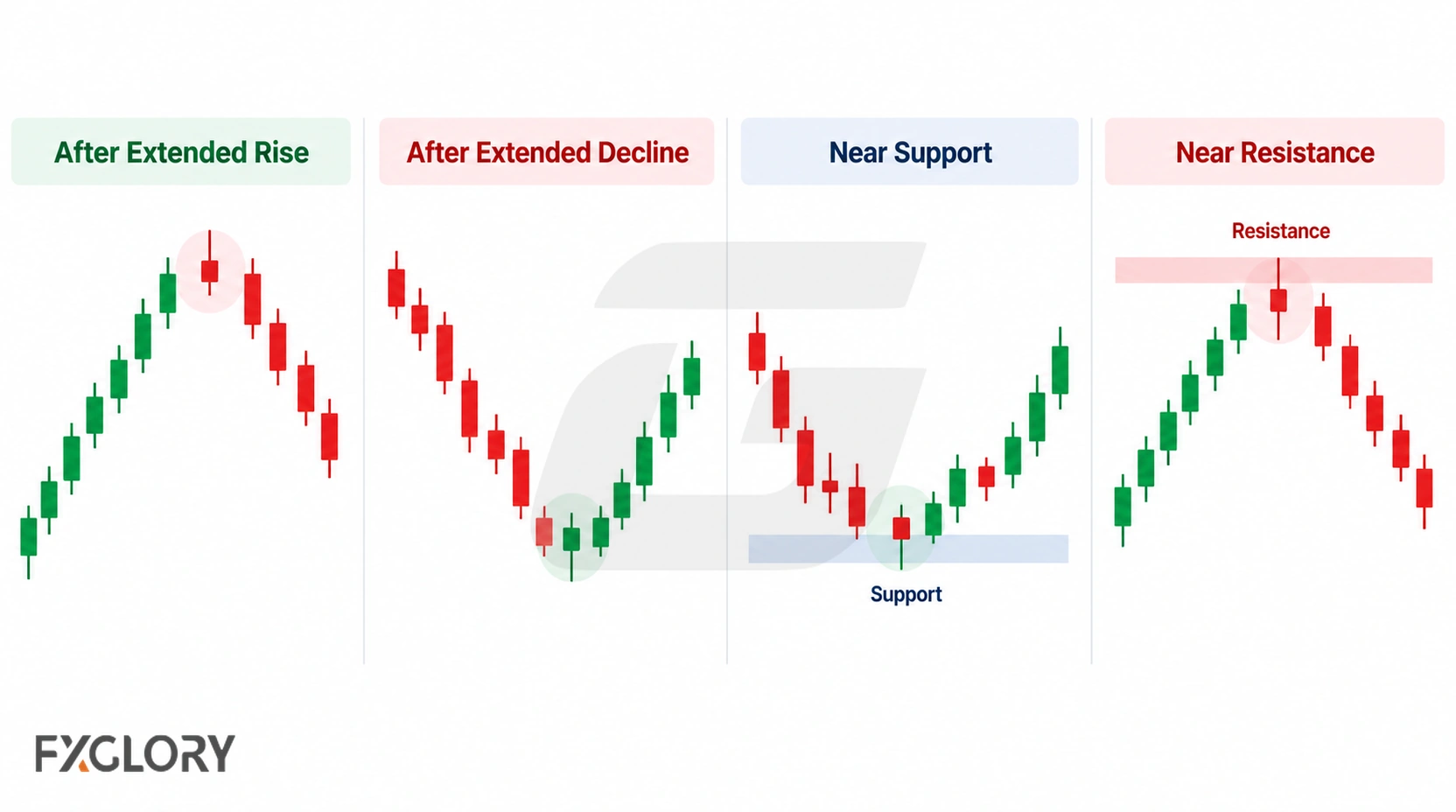
After An Extended Rise
After a strong rise, a spinning top can show that buying pressure paused during that candle. This does not confirm a reversal, but it can show that the candle did not close with the same directional strength as earlier candles.
After An Extended Decline
After a strong decline, a spinning top can show that selling pressure paused during that candle. It should still be reviewed with nearby support, volatility, and next candles.
Near Support
A spinning top near support may show hesitation around a lower-price area. The support area gives the candle a clearer location than the same candle in the middle of a range.
Near Resistance
A spinning top near resistance may show hesitation around a higher-price area. The resistance area helps explain why the candle's two-sided movement might matter.
Inside A Sideways Range
Spinning tops can appear often inside sideways ranges. In that environment, one spinning top may not say much unless it forms near a range boundary or appears as part of a clearer compression structure.
After A Large Candle
A spinning top after a large directional candle can show a pause in movement. It does not cancel the previous candle by itself, but it can show that the next candle period did not continue with the same force.
A pause after a large candle does not mean the earlier move has failed; it only shows that the next candle period closed with less directional control.
For observation, a trader can compare spinning-top-like candles on live market pages such as EUR/GBP during quieter ranges or GBP/USD during wider intraday swings. These pages are useful for chart review, not as standalone trading reasons.
Spinning Top Strength Filter: Stronger vs Weaker Readings
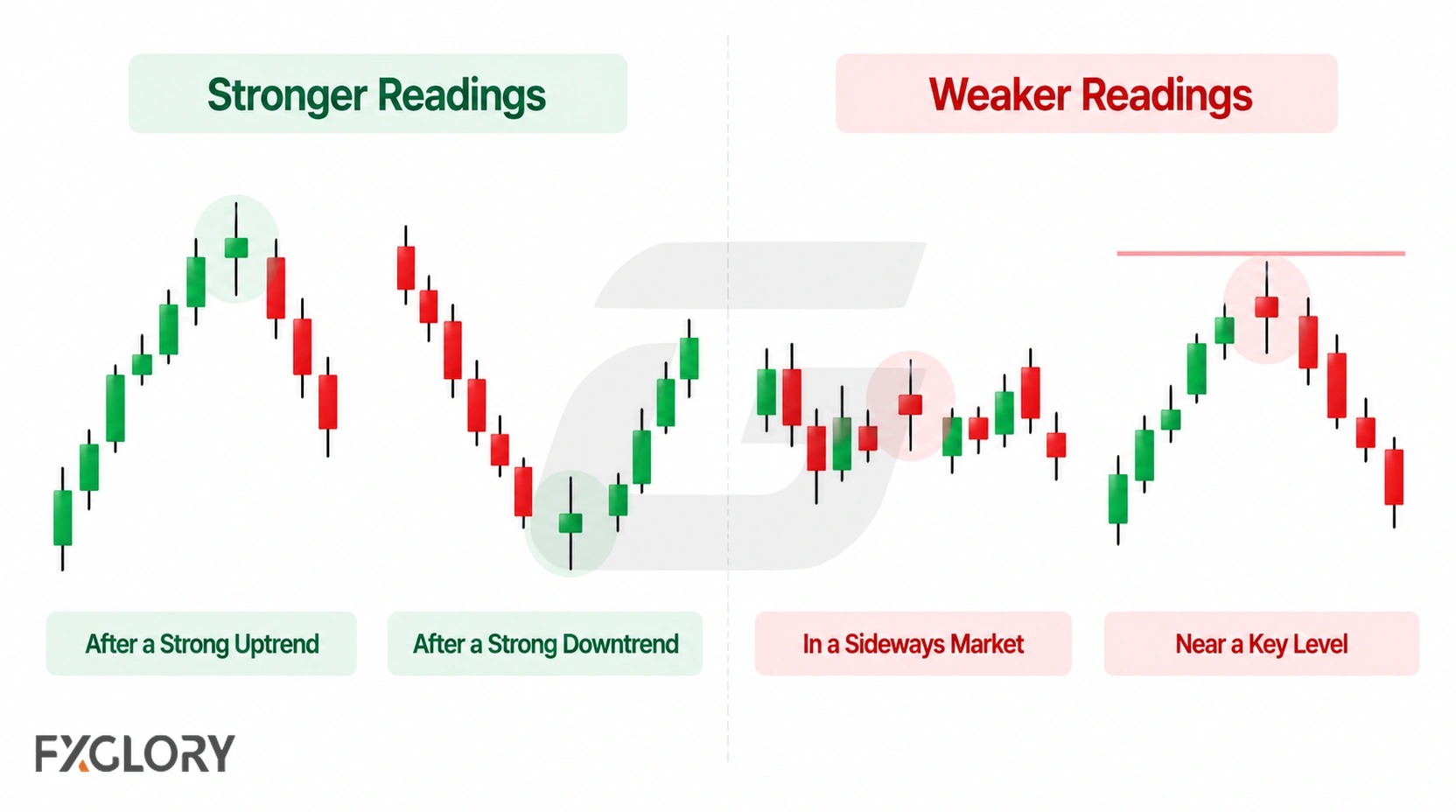
A spinning top does not have the same value in every chart condition. The table below helps separate clearer hesitation readings from weaker ones.
| Spinning Top Factor | Clearer Reading | Weaker Reading |
|---|---|---|
| Body size | The body is small but clearly visible. | The body is too large for hesitation or too tiny and closer to a doji. |
| Wick structure | Upper and lower wicks are both visible enough to show two-sided movement. | One wick dominates so much that the candle is closer to rejection than balance. |
| Chart location | The candle appears after movement, near support or resistance, or near a range boundary. | The candle appears in the middle of random price movement. |
| Prior movement | The candle appears after a clear rise, decline, strong candle, or level test. | The candle appears when price was already unclear. |
| Timeframe | The candle belongs to a timeframe that matters for the chart review. | The candle appears on a very short timeframe with heavy noise. |
| Market conditions | Spread and volatility conditions are stable enough for chart review. | The candle forms during abnormal news movement, rollover, or thin liquidity. |
| Next candles | Later candles help clarify whether hesitation continued, weakened, or resolved. | Later candles immediately make the spinning top irrelevant. |
Spinning Top Forex Reading Table
The table below shows how the same spinning top structure can change depending on chart location.
| Spinning Top Location | Possible Reading | What To Check Next |
|---|---|---|
| After a strong rise | Buying pressure paused during that candle. | Check nearby resistance and the next candles. |
| After a strong decline | Selling pressure paused during that candle. | Check nearby support and the next candles. |
| Near support | Price showed hesitation around a lower-price area. | Check whether the support area remains relevant. |
| Near resistance | Price showed hesitation around a higher-price area. | Check whether the resistance area remains relevant. |
| Inside a range | The candle may only reflect normal back-and-forth movement. | Check whether it forms near a range boundary. |
| After a large candle | The next candle period did not show the same directional control. | Check whether movement pauses, compresses, or resumes. |
| During news volatility | The wicks may reflect unstable movement. | Review spread, candle range, and execution conditions. |
How To Read A Spinning Top Candle In Forex
A simple workflow helps keep spinning top reading disciplined. The goal is to describe what the candle shows before giving the structure more meaning than it deserves.
- Check the timeframe: Decide whether the spinning top reflects a short-term pause or a broader candle period.
- Read the body: Confirm that the body is small but visible.
- Compare the wicks: Check whether both upper and lower wicks are visible enough to show two-sided movement.
- Check candle color carefully: Note whether the candle closed bullish or bearish, but do not make color the main reading.
- Review prior movement: Look for a rise, decline, large candle, range boundary, or level test before the spinning top.
- Check the chart location: Review support, resistance, swing points, range edges, or trend structure.
- Review market conditions: Consider volatility, spread, liquidity, rollover, and scheduled news events.
- Watch the next candles: Review whether later candles keep the hesitation area relevant or make it irrelevant.
Some traders compare spinning tops with technical indicators for additional context. For example, RSI can add momentum context, ATR can add volatility context, and Bollinger Bands can help review range and expansion conditions. These tools can support spinning top review, but they do not remove trading risk.
Repeated Spinning Tops And Compression
One spinning top can show a single candle period of hesitation. Two or more spinning tops in a row can show repeated hesitation, compression, or a lack of clear directional control across several candle periods.
Repeated spinning tops should not be treated as a separate decision rule. They are better reviewed as a sequence. Are the candles forming near support or resistance? Are the ranges narrowing? Are closes staying inside the same area? Is volatility quiet or unstable? These questions matter more than simply counting the candles.
| Repeated Spinning Top Situation | Possible Reading | Reading Caution |
|---|---|---|
| Two spinning tops after a strong move | Directional pressure may be pausing. | Pause does not confirm a turn. |
| Several spinning tops inside a range | Price may be moving without clear control. | This can be ordinary sideways noise. |
| Spinning tops near a level | Price may be hesitating around a visible chart area. | The level and next candles still matter. |
| Spinning tops during low liquidity | The chart may show small, uncertain candles. | Spread and execution conditions can distort the reading. |
False Or Weak Spinning Top Candles In Forex
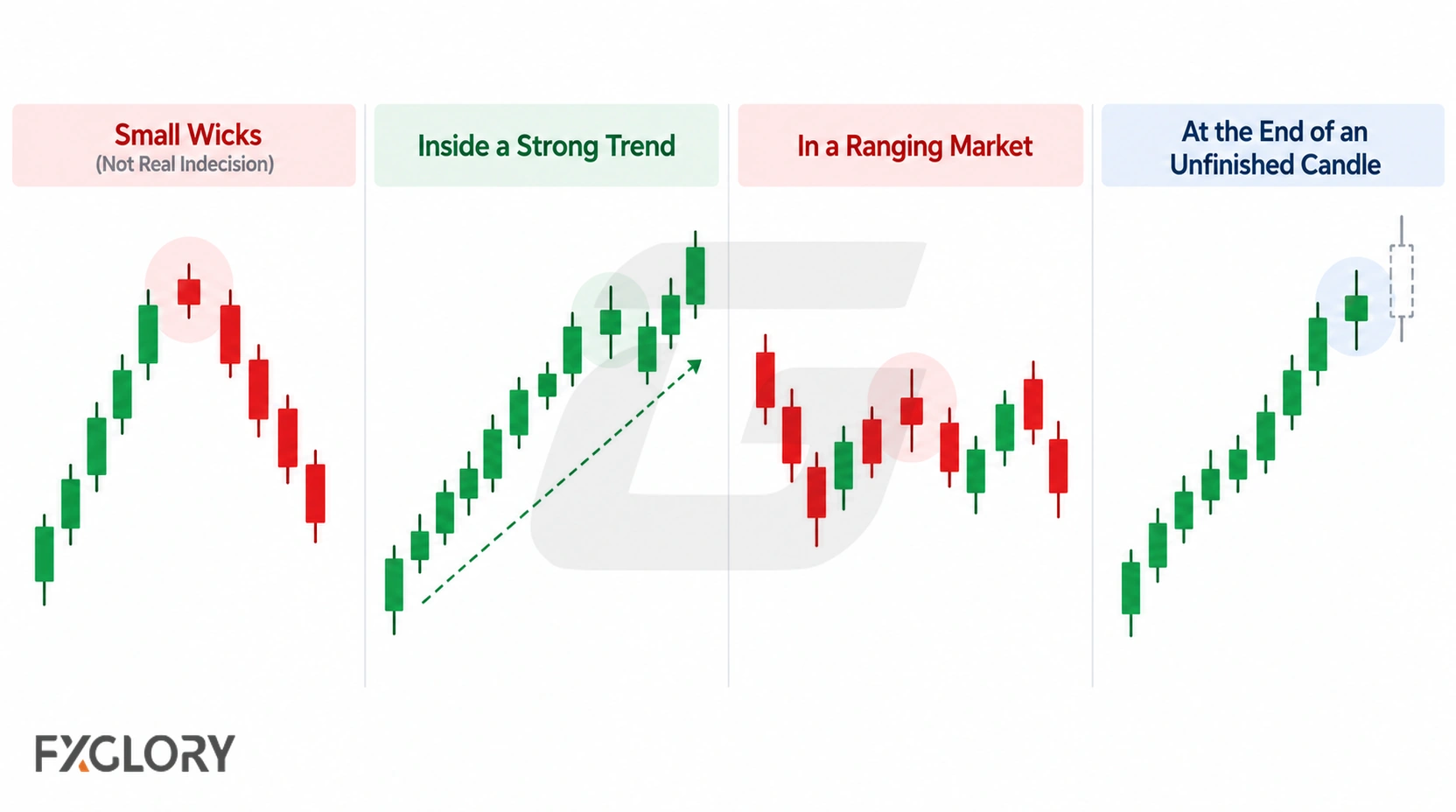
A weak spinning top looks like hesitation but does not provide a useful chart clue. This can happen when the body is not small enough, the wicks are not meaningful, the candle appears in random movement, or market conditions make the candle hard to interpret.
Body Is Too Large
If the body is large compared with the full candle range, the candle may show directional movement rather than hesitation. It may be closer to a momentum candle than a spinning top.
No Useful Chart Location
A spinning top floating in the middle of random price movement is usually weaker than one near support, resistance, a swing point, a range edge, or after a clear move.
One Wick Dominates Too Much
If one wick dominates the candle, the structure may be closer to a pin bar, hammer, or shooting star reading. A spinning top usually needs visible movement on both sides of the body.
Unfinished Candle
A candle can look like a spinning top before it closes and then finish with a much larger body or different wick structure. The completed candle matters.
News Or Low-Liquidity Conditions
Major news, rollover, market opens, and thin liquidity can create candles that look meaningful after the fact. In real time, spread and execution conditions may be unstable.
- Skip the candle when the body is not clearly small compared with the range.
- Be careful inside messy ranges where many small candles can appear.
- Do not read unfinished candles as completed spinning top formations.
- Check wick balance before treating the candle as two-sided hesitation.
- Review spread and volatility before giving meaning to a dramatic or unusually small candle.
Common Mistakes With Spinning Top Candles In Forex
Spinning tops are easy to label after seeing the small body and wicks, but they are also easy to overread. Most mistakes come from treating hesitation as a directional answer.
- Calling every small candle a spinning top: A spinning top needs a small visible body and meaningful upper and lower wicks.
- Confusing spinning tops with doji candles: A doji has an open and close that are the same or almost the same, while a spinning top has a small but visible body.
- Using candle color as the main reading: A bullish or bearish close matters less than the small body, wick structure, and chart location.
- Reading hesitation as a reversal: A spinning top can show a pause, but a pause does not confirm that the previous move has ended.
- Ignoring the chart location: A spinning top near a meaningful area is easier to review than one in random movement.
- Reading an unfinished candle: A candle that looks like a spinning top before the close may finish with a different body or wick shape.
- Overlooking spread, liquidity, and news risk: Small bodies and long wicks can appear during unstable conditions that are difficult to interpret in real time.
- Replacing risk planning with candle confidence: A spinning top should not replace position sizing, risk limits, or a clear area where the reading becomes weak.
What To Study After Spinning Top Candles
After learning how to read spinning top candles, the next step is to compare them with nearby indecision, rejection, and pattern-group concepts.
You can continue with the doji candle guide for open-close balance, return to forex candlestick pattern groups, or compare hesitation with long-wick rejection candles. For broader turning-point context, review reversal candles in forex.
Frequently Asked Questions
What is a spinning top in forex?
A spinning top in forex is a candlestick with a small visible body and upper and lower wicks. It shows that price moved both higher and lower during the candle period but closed near where it opened.
What does a spinning top candle mean in forex?
A spinning top candle usually shows hesitation or two-sided pressure. Buyers and sellers both moved price during the candle, but neither side kept clear control into the close.
Is a spinning top bullish or bearish?
A spinning top can close bullish or bearish, but the color is usually less important than the structure. Its meaning depends on the small body, two-sided wicks, prior movement, chart location, and what price does afterward.
What is the difference between a spinning top and a doji?
A doji has an open and close that are the same or almost the same, often leaving little or no visible body. A spinning top has a small but visible body, usually with upper and lower wicks.
What is the difference between a spinning top and a high-wave candle?
Both can show two-sided movement, but a high-wave candle usually has especially long upper and lower wicks. A spinning top usually has a smaller, more balanced hesitation structure.
Where does a spinning top matter more?
A spinning top can matter more after an extended rise or decline, near support or resistance, near a swing point, or after a strong candle. It is weaker when it appears in random sideways movement without a clear chart area.
What does a double spinning top mean?
Two or more spinning tops in a row can show repeated hesitation or compression. They should still be reviewed with location, volatility, candle closes, and the next candles.
When should a spinning top candle be ignored?
A spinning top is often better ignored when the candle has not closed, the body is not clearly small, the wicks are not meaningful, the chart is messy, spreads or volatility are abnormal, or there is no useful chart location.
Related Contents
Practice Comparing Spinning Tops Across Market Conditions
Use a free FXGlory demo account to observe spinning top candles across pairs, timeframes, support and resistance areas, volatility conditions, and risk scenarios before trading with real funds.
Open a Free Demo Account