

What Are Forex Scalping Indicators?
Forex scalping indicators are chart tools used to review short-term market information before, during, or after a scalp trade. They may help with trend direction, momentum timing, volatility, location, entry confirmation, exit planning, or risk control.
An indicator is not a complete scalping strategy. A signal can be considered for execution only when the intended trading method is permitted under the specific account terms and the trader has defined the market condition, session, total trading costs, setup location, stop, target, cancellation rule, and daily risk limit.
For the broader short-term framework, start with the forex scalping framework. This page focuses only on indicator use: which job each indicator can do, how tools can be combined, and when an indicator signal should be ignored.
Why There Is No Single Best Indicator For Forex Scalping
The phrase best indicator for forex scalping is popular, but it can lead to weak decisions. Scalping conditions change by pair, spread, session, volatility, timeframe, and execution workflow. One indicator may be useful in a trending session and poor in a flat range. Another may help with volatility but say nothing about direction.
The better question is: what role does this indicator perform inside the scalping plan? A moving average may filter direction. MACD may review momentum. Bollinger Bands may show volatility. ATR may support stop-distance logic. VWAP may help with intraday location. None of those tools should replace the full setup.
| Weak Question | Better Question | Why It Matters |
|---|---|---|
| What is the best scalping indicator? | What problem should the indicator solve? | Prevents random tool switching |
| Which indicator gives the most signals? | Which indicator filters weak signals? | More signals can mean more overtrading |
| Which indicator gives high win rate? | Does the method still work after losses, spread, and stop distance? | High win rate can still fail if losses are larger |
| Can I use this indicator alone? | What context, stop, target, and no-trade rules support it? | Signals need structure before execution |
Indicator Roles In A Forex Scalping Strategy
Scalping indicators are easier to judge when they are grouped by role. A trader does not need several tools saying the same thing. A cleaner system usually assigns each tool a different job.
| Indicator Role | Common Tools | What The Role Answers | Weak Use |
|---|---|---|---|
| Trend filter | EMA, SMA, moving-average ribbon, Alligator | Is the short-term structure directional or flat? | Every moving-average touch becomes a trade |
| Momentum timing | MACD, RSI, Stochastic, CCI | Is momentum supporting or rejecting the setup? | Oscillator signal is used without context |
| Volatility filter | Bollinger Bands, Keltner Channels, ATR | Is movement active, compressed, expanding, or too chaotic? | Band or ATR reading is treated as a buy or sell signal alone |
| Location reference | VWAP, moving average, support and resistance, bands | Is price near a useful area or already late? | Signal is accepted after price has already moved too far |
| Exit and risk support | ATR, Parabolic SAR, Chandelier-style trails, time stop | Where can the trade be reviewed, trailed, closed, or invalidated? | Stop is moved randomly after entry |
| Participation clue | Tick volume, OBV, MFI, CMF, KVO | What changes in activity or volume-derived readings appear in the available feed? | Forex volume is treated as centralized exchange volume |
For broader indicator logic, use the indicator strategy framework. When combining tools, each indicator should answer a different trading question.
Best Forex Scalping Indicators By Role
A useful list of forex scalping indicators should not rank tools as if one tool fits every market. The table below groups common indicators by the job they can perform in a scalping plan.
| Indicator | Scalping Role | Can Help With | Skip Or Be Careful When |
|---|---|---|---|
| EMA or SMA | Trend and pullback filter | Direction, dynamic area, trend structure | Price is flat around the average |
| Moving-average ribbon | Trend strength and compression | Stacked direction, squeeze, expansion | The ribbon is tangled and direction is unclear |
| MACD | Momentum shift | Momentum return, trend continuation, weakening move | Momentum appears after price is already extended |
| RSI | Momentum condition | Momentum pressure, exhaustion, divergence, continuation context | Overbought or oversold is used as automatic reversal |
| Stochastic | Fast timing and pullback review | Short-term timing near planned areas | Repeated crosses appear in a choppy market |
| CCI | Momentum and deviation review | Short-term momentum shifts and extended conditions | Used to fight a strong trend without structure |
| Bollinger Bands | Volatility and range behavior | Compression, expansion, band reactions, target areas | Every band touch is treated as a reversal |
| ATR | Volatility and stop-distance support | Stop realism, target realism, volatility changes | ATR is used to justify an oversized stop |
| VWAP | Intraday location reference | Price location, stretch, return-to-reference behavior | Treated as perfect volume truth in spot forex |
| Parabolic SAR | Trend-following and trailing support | Directional review and stop-trailing ideas | Sideways markets create repeated flips |
Trend Indicators For Scalping
Trend indicators help scalpers avoid treating every short-term signal as equal. A moving average, moving-average ribbon, or trend tool can help show whether price is directional, flat, compressing, or pulling back.
If moving averages are part of the plan, review how moving averages smooth price before they lag. The lag matters more in scalping because a late signal can leave little room after spread.
| Trend Tool | Useful Scalping Role | Failure Pattern |
|---|---|---|
| EMA | Reviews short-term direction and pullback location | Every EMA touch becomes an entry |
| SMA | Smoother directional reference and structure filter | Signal appears too late for a small target |
| Moving-average ribbon | Shows expansion, compression, and trend alignment | Ribbon is tangled but trader forces direction |
| Alligator-style averages | Reviews whether averages are opening, closing, or tangled | Used without spread, stop, and target rules |
| Parabolic SAR | Can support directional review or trailing logic | Repeated flips appear in sideways conditions |
Momentum Indicators For Scalping
Momentum indicators can help a scalper review whether the market is pushing in the direction of the setup or losing force. They are not enough by themselves because momentum can appear late, especially on fast charts.
| Momentum Tool | What It Can Review | Weak Use |
|---|---|---|
| MACD | Momentum shift, momentum return, weakening move | MACD confirms only after the move is already extended |
| RSI | Whether momentum supports a planned pullback or continuation near a defined price level; divergence alone does not confirm a reversal | Every overbought reading becomes a sell or every oversold reading becomes a buy |
| Stochastic | Fast timing around pullbacks or planned areas | Repeated crosses are traded in a choppy range |
| CCI | Short-term deviation and momentum shifts | Used to fight a strong trend without a level or invalidation point |
Indicator settings should be tested on the exact pair, session, and timeframe where they will be used. A faster setting can create earlier signals, but it can also increase noise; a slower setting can filter noise, but it may confirm too late for a scalp.
Momentum tools should be connected to entry and exit rules before the trade opens. An indicator trigger should already have a matching exit rule, not a decision made after the trade becomes stressful.
Volatility Indicators For Scalping
Volatility indicators help scalpers judge whether movement is available, compressed, expanding, or too unstable for the planned stop and target. This matters because scalping targets are often small and can be damaged by spread, sudden expansion, or flat conditions.
| Volatility Tool | Useful Scalping Role | Weak Use |
|---|---|---|
| Bollinger Bands | Reviews compression, expansion, band reactions, and range behavior | Every upper-band touch is sold and every lower-band touch is bought |
| ATR | Reviews stop distance, target realism, and volatility change | ATR is used to hide a stop that is too wide for the target |
| Keltner Channels | Reviews channel behavior and volatility-adjusted movement | Channel touch is used without market condition |
| Band squeeze | Reviews compression before expansion | The trader enters before direction is defined |
For Bollinger-based strategy structure, use the Bollinger Bands forex strategy guide. For ATR-based volatility planning, use the ATR forex strategy framework. If bands, ATR, or channel tools are used, check the volatility role before treating expansion as an entry signal.
VWAP And Volume Tools In Forex Scalping
VWAP is primarily an intraday price-location benchmark, while volume-style tools can offer feed-dependent activity clues. Spot forex does not have one centralized exchange volume feed, so VWAP and volume indicators on many platforms may rely on tick activity or broker-feed data rather than total global forex volume.
That does not make the tools useless. Treat VWAP as a reference price and volume-derived readings as limited activity clues, not as proof of the total market's order flow.
| Tool | Possible Scalping Role | Use Carefully When |
|---|---|---|
| VWAP | Reviews intraday location, stretched price, or return-to-reference behavior | It is treated as a standalone buy or sell signal |
| Tick volume | Reviews activity changes on the available feed | It is treated as total global forex volume |
| OBV | Reviews directional participation on the available data | The market feed is thin or the signal conflicts with price structure |
| MFI | Combines price and volume-style pressure where available | It is used without session, spread, or price context |
| CMF or KVO | Reviews accumulation or flow-style pressure where the platform supports it | The tool is used as a perfect order-flow reading |
If VWAP is part of the plan, review how VWAP behaves in forex chart analysis before using it on a fast scalping chart.
Indicator Combinations For Scalping
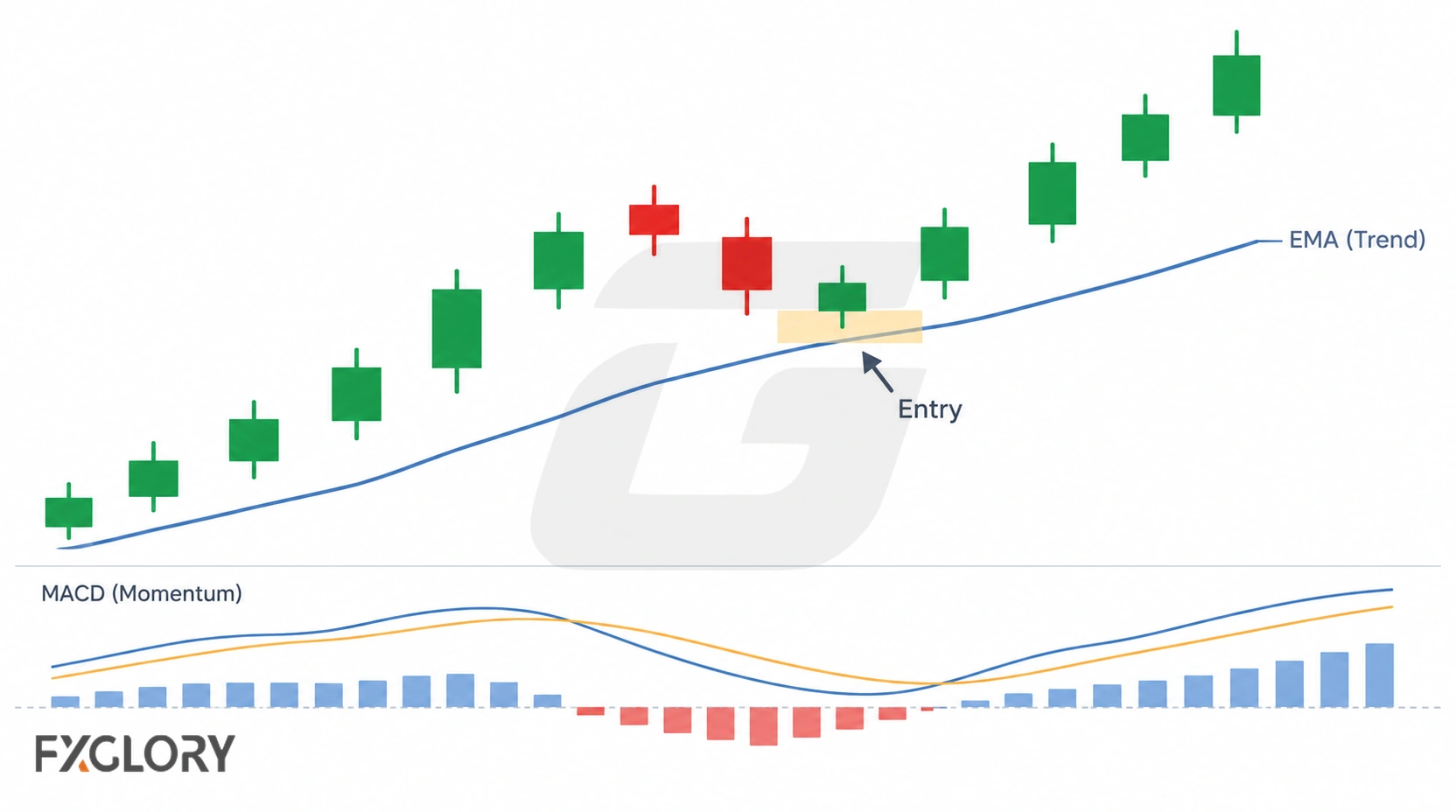
A scalping combination should be small and role-based. Two or three tools can be enough when each one answers a different question. A chart with five indicators that all repeat momentum is not safer; it is usually harder to read.
| Combination | Question 1 | Question 2 | Question 3 | Skip When |
|---|---|---|---|---|
| EMA + MACD | Is direction acceptable? | Is momentum returning? | Is the entry still near the planned area? | MACD confirms after price has already reached the target area |
| EMA + RSI | Is structure directional? | Is momentum supportive or exhausted? | Is the stop logical? | RSI is used to fight a strong trend without structure |
| Bollinger Bands + RSI | Is price stretched or compressed? | Is momentum agreeing with the reaction? | Is there room after spread? | Every band touch is treated as a reversal |
| VWAP + MACD | Where is price relative to intraday reference? | Is momentum supporting the move? | Is the signal late? | VWAP is used as a perfect order-flow signal |
| ATR + price action | Is stop distance realistic? | Where is the invalidation point? | Does the target still make sense? | ATR is used to justify an oversized trade |
Scalping Without Indicators
Some scalpers prefer price action instead of indicator-heavy charts. That can work as a structure, but it is not rule-free trading. A no-indicator scalping setup still needs a market condition, planned level, entry trigger, invalidation point, target, spread check, and cancellation rule.
| No-Indicator Element | Useful Role | Weak Use |
|---|---|---|
| Support and resistance | Defines where a reaction or breakout may be reviewed | Every touch becomes a trade |
| Retest | Checks whether price accepts or rejects a broken level | The trader enters after price already moved away |
| Candle close | Confirms reaction, rejection, continuation, or indecision | The candle pattern is used without context |
| Market structure | Shows whether the setup still supports the trade idea | Structure is ignored because the entry feels urgent |
| Time rule | Prevents a stalled scalp from becoming an unplanned hold | The trader waits because the target has not been hit |
Indicator Use On 1M, 5M, And 15M Charts
The same indicator can behave differently across short chart timeframes. On M1, it may respond quickly but produce more short-lived fluctuations and noise. On M5, some M1 noise may be smoothed, but signals may arrive later. On M15, the indicator may support slower structure or intraday planning. Chart timeframe alone does not determine whether scalping is allowed; check the trading rules for the specific FXGlory account before executing short-duration trades.
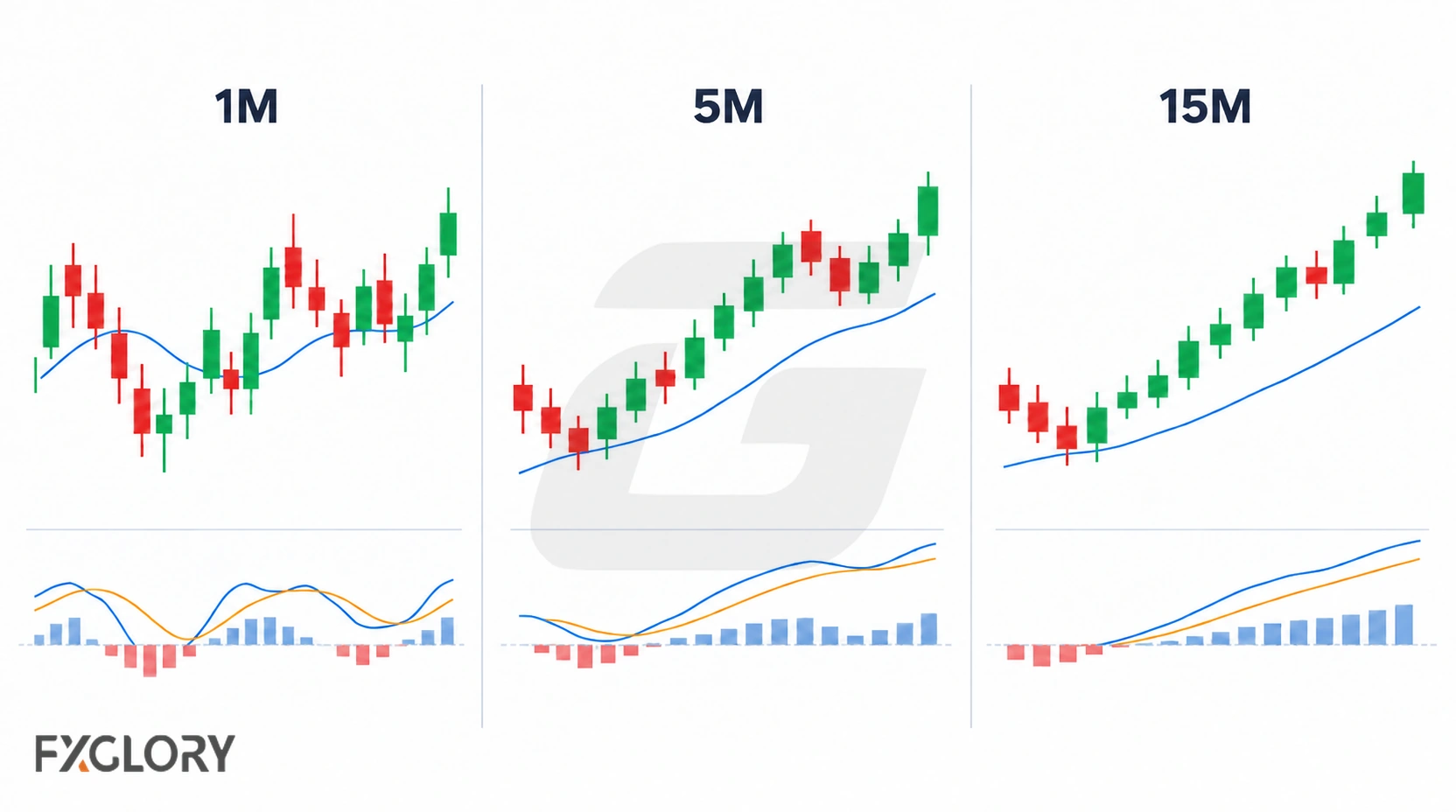
For M1 execution pressure, use the 1 minute forex strategy. For M5 indicator execution, use the 5-minute forex scalping strategy. For slower structure, use the 15 min forex strategy.
| Timeframe | Indicator Use | Main Risk |
|---|---|---|
| 1 minute | Fast trigger timing and detailed entry behavior | Noise, late reactions, and emotional re-entry |
| 5 minute | Setup review with some M1 fluctuations smoothed, but potentially later confirmation | Small targets with poorly defined stops |
| 15 minute | Slower structure, breakout planning, or intraday filter | Confirmation may arrive after the best entry area |
Why Forex Scalping Indicators Fail
Indicator-based scalping setups can fail because indicators are asked to do too much. A tool that reviews momentum cannot also replace market context, risk, exit logic, and spread checks. A signal can be technically valid and still be a poor trade.
| Failure Reason | What Happens | Better Rule |
|---|---|---|
| Lag | The signal appears after price has already moved | Use the indicator only near a planned area |
| Flat market | Indicators cross repeatedly with no useful movement | Skip when volatility and range do not fit the plan |
| Chart clutter | Too many tools create conflicting signals | Use only tools with separate roles |
| Duplicate signals | Several indicators repeat the same information | Combine trend, momentum, and volatility roles instead |
| Trading costs ignored | Small target becomes weak after spread and any applicable commission | Check the total applicable trading costs before accepting the signal |
| News volatility | Spread, speed, and slippage change quickly | Define event-risk rules before trading |
| No invalidation | Trader knows the signal but not where it is wrong | Stop logic must be clear before entry |
| Indicator hopping | Trader changes tools after every loss | Review one rule set over a meaningful sample |
Testing And Review Before Live Trading
Forex scalping indicators should be reviewed on historical examples or demo conditions before they are used with real funds. The purpose is not to find perfect chart examples. The purpose is to check whether the same indicator role, setup, stop, target, and no-trade rules can be followed repeatedly.
Record both taken and skipped trades. Skipped trades matter because many indicator mistakes come from late signals, flat markets, spread problems, and conflicting tools that should not have been traded.
- Write the indicator role before testing: trend, momentum, volatility, location, exit, or risk.
- Record whether the signal appeared near the planned setup area.
- Record whether spread, any applicable commission, stop, target, and margin were checked before entry.
- Record whether the exit followed the rule or changed under pressure.
- Compare trades that followed the plan with trades that broke it.
- Record skipped signals that were avoided because of no-trade rules.
Risk Rules And No-Trade Conditions
Scalping indicators can produce frequent signals, so risk rules must be written before the first trade. A trader can damage the account quickly by increasing size, moving stops, or taking repeated signals after the daily limit has already been reached.
Short-term indicator signals are sensitive to cost. Check the spread conditions that affect small-target trades and any commission charged by the selected account and instrument before considering frequent entries. For example, FXGlory lists asset-dependent commission on its ECN account. When stop distance, position size, leverage exposure, and margin need to be reviewed together, use the margin calculator before the order is placed. For platform workflow, review FXGlory trading platforms before relying on fast chart and order-management decisions.
| No-Trade Condition | Why It Matters | Action |
|---|---|---|
| Spread or applicable commission is too large | Total costs may make a small target impractical | Skip the signal |
| Indicator signal is late | Price may already be near the target area | Wait for a new setup |
| Indicators conflict | The plan has no clear decision | Skip until roles align |
| Market is flat | Crosses and oscillator signals can repeat without movement | Wait for better movement |
| No stop logic | The trader cannot define where the setup is wrong | Do not enter |
| News risk changes conditions | Spread, speed, and volatility can shift quickly | Follow event-risk rule |
| Daily stop reached | More signals can become revenge trades | Stop trading for the session |
| Indicator is used to recover a loss | The signal is emotional, not rule-based | Step away and review |
If the planned trade duration or hedging behavior may conflict with account conditions, do not execute the setup until the restrictions are clarified. For account-level risk controls, use the forex risk-management strategy page.
Forex Scalping Indicator Checklist
Before an indicator signal becomes a scalp trade, each item below should already be clear.
- Name the indicator role: trend, momentum, volatility, location, exit, or risk.
- Confirm the intended trading method and holding period are permitted by the specific FXGlory account rules.
- Check the trading session and pair before looking for a signal.
- Check spread and any applicable commission before accepting a small target.
- Confirm that the signal appears near a planned setup area.
- Define the invalidation point before entry.
- Choose position size only after stop distance is known.
- Decide the target, partial exit, trail, time stop, or invalidation exit before entry.
- Skip the signal if indicators conflict or price is already extended.
- Skip the signal if news risk changes spread or volatility beyond the plan.
- Stop trading when the daily loss, drawdown, or trade-count rule is reached.
- Record whether the trade followed the plan, not only whether it made or lost money.