
What Is An 5-Minute Scalping Strategy?
An 5-minute scalping strategy uses that timeframe to organize a short-term setup, confirm an entry, and manage the trade within a broader scalping plan. The timeframe alone is not the method: market context, cost, invalidation, exit logic, and risk rules determine whether a setup is usable.
5-minute sits between 1-minute and 1-minute5 in pace. It usually filters some of the very short-term noise visible on 1-minute while still showing more entry detail than 1-minute5.
For the broader short-term framework, start with the forex scalping framework. This page focuses only on the 5-minute chart: how to build a 5 minute setup, when to skip it, and how to prevent small targets from hiding large risk.
How The 5-Minute Chart Changes The Trade
Five-minute candles give short-term setups enough time to develop visible pullbacks, momentum shifts, band reactions, and key-level tests, while still requiring timely execution. The main challenge is avoiding repeated entries simply because another 5-minute signal appears.
The danger is that the chart can look clean after the move has already happened. A late 5-minute entry may leave little room for a target, and a small target can become weak if the spread, stop distance, or nearby structure is ignored.
| 5-minute Feature | How It Can Help | How It Can Hurt |
|---|---|---|
| Balanced speed | Slower than 1-minute, faster than 1-minute5 | Still fast enough for revenge re-entry |
| Cleaner candles | Some noise is filtered compared with 1-minute | False signals can still appear in flat ranges |
| Momentum visibility | Momentum shifts may be easier to review than on 1-minute | Momentum can appear after most of the move has passed |
| Short targets | Useful for active intraday windows | Spread and slippage can reduce the value of the target |
| Multiple entries | More opportunities than 1-minute5 during active sessions | More chances to overtrade if max-trade rules are missing |
5-Minute vs 1-Minute vs 15-Minute Scalping
The 5 minute chart should not be chosen only because it gives more or fewer trades. The timeframe should have a job inside the plan: context, setup, trigger, or trade management.
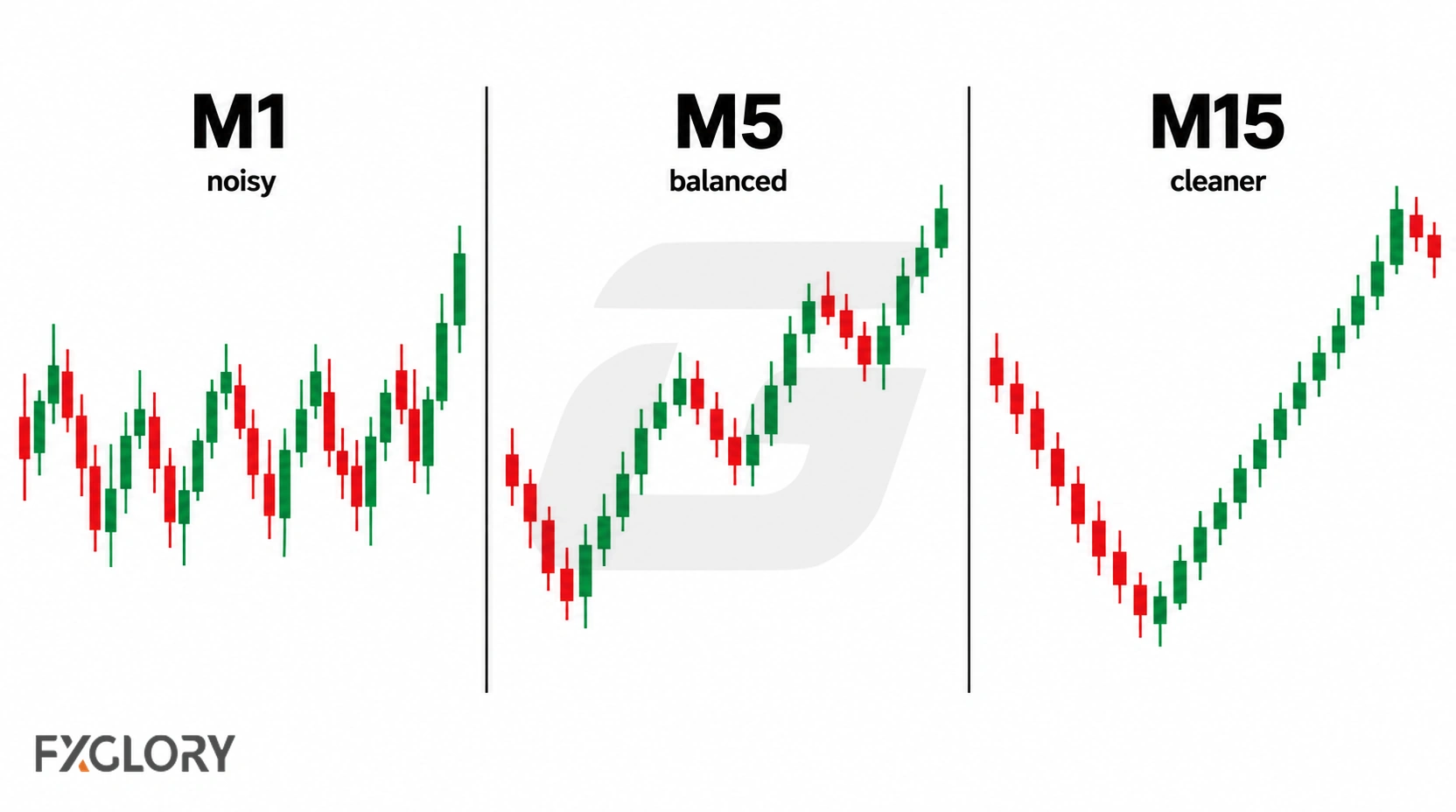
| Timeframe | Useful Role | Main Risk |
|---|---|---|
| 1 minute | Fast trigger timing and detailed entry behavior | Noise, overtrading, late reactions, and emotional re-entry |
| 5 minute | Balanced scalping setup and entry confirmation | Small targets with stops that are too large or poorly defined |
| 15 minute | Cleaner structure, slower scalping, or intraday setup planning | Late entries and wider stops if confirmation comes too late |
For faster execution pressure, compare this page with the 1 minute forex strategy. For slower structure and breakout planning, compare it with the 15 min forex strategy. If the main question is timeframe selection, use the scalping timeframe guide.
Before Using A 5 Minute Scalping Strategy
The 5-minute chart should be checked after the trader knows the session, instrument, spread condition, volatility, and higher-timeframe context. A clean 5 minute signal can still be a poor trade if the market is flat, the spread is unsuitable, the target is too close, or the stop has no logical place.
Small targets need cost control. Check the spread conditions that affect short-term trades before using frequent 5-minute entries. The margin calculator can help connect the planned position size with margin requirements before an order is placed.
| Pre-Trade Check | Question | Trade Only If |
|---|---|---|
| Session | Is this the planned trading window? | The session has enough movement for the method |
| Instrument | Does the pair or market fit 5-minute scalping? | Spread, movement, and market behavior match the plan |
| Higher timeframe | Is the wider market trending, ranging, breaking out, or unclear? | The 5-minute setup matches the wider condition |
| Spread | Does the target remain realistic after cost? | The expected movement leaves enough room after spread |
| Volatility | Is the market active but manageable? | Stop and target can be placed logically |
| News risk | Could an event change spread, speed, or volatility? | The plan allows trading under that condition |
Session quality matters for 5-minute scalping. Choose the trading window before choosing the 5-minute trigger. When EUR/USD is used as an example pair, review the EUR/USD live market page before deciding whether the current market still fits the setup.
5-Minute Scalping Decision Sequence
A 5 minute scalping strategy should follow the same order each time. If the trader starts with one candle, indicator cross, or momentum bar and creates the reason afterward, the setup cannot be reviewed clearly.
| Step | Decision | Continue Only If |
|---|---|---|
| 1. Market allowed? | The pair, session, spread, and volatility fit the method | The trade is allowed before the 5-minute signal appears |
| 2. Higher-timeframe context? | The wider chart shows trend, range, breakout, pullback, or unclear condition | The condition supports the 5-minute setup |
| 3. 5-minute setup? | The 5 minute chart shows the planned structure | The setup has location and invalidation |
| 4. Confirmation? | The 5-minute candle, indicator condition, retest, rejection, or continuation rule appears | The signal is not late or forced |
| 5. Stop? | The invalidation point is clear before entry | The stop is based on structure or volatility, not hope |
| 6. Target? | The objective is realistic after spread and nearby obstacles | The trade has room to develop |
| 7. Risk? | Position size, margin, and daily limit fit the account rules | The trade does not break risk limits |
| 8. Cancel rule? | The trade is canceled if price, spread, momentum, or context changes | The trader can skip a missed or weakened setup |
This sequence belongs inside a written trading system. A setup becomes reviewable only when context, trigger, invalidation, and review are separated.
5-Minute Long And Short Example Framework
The examples below show how a 5 minute long or short setup can be structured without turning the example into a prediction. The purpose is to define the decision path before the trade, not to claim that one pattern works in every market.
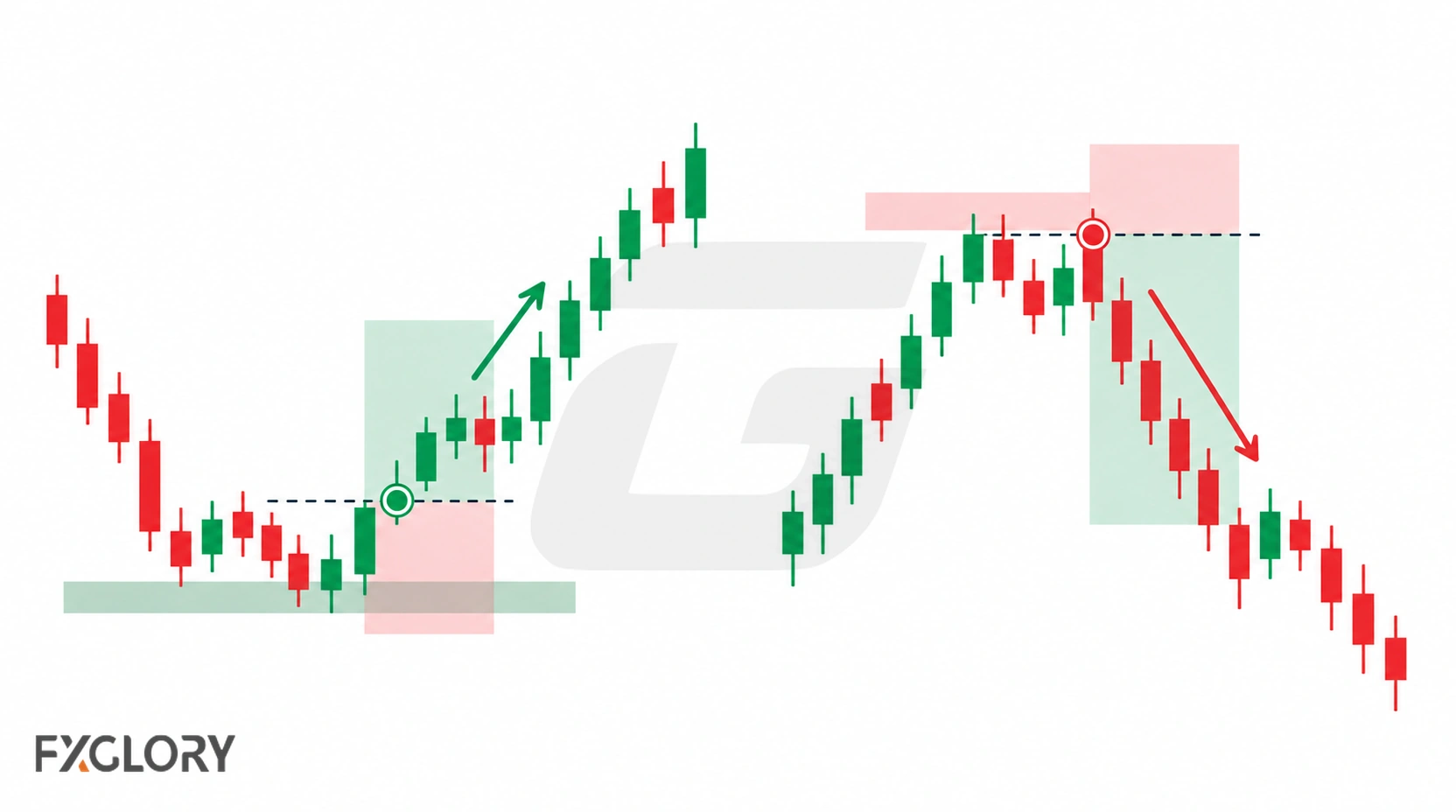
| Example | Valid Condition | Entry Confirmation | Stop Logic | Exit Logic |
|---|---|---|---|---|
| 5-minute long setup | Higher timeframe supports bullish continuation, pullback, or controlled momentum | 5-minute candle or indicator condition confirms a reaction near the planned area | Stop goes below the failed pullback, reaction low, or invalidation area | Target near prior structure, measured short-term area, fixed risk multiple, partial exit, trail, or time stop |
| 5-minute short setup | Higher timeframe supports bearish continuation, rejection, or controlled momentum | 5-minute candle or indicator condition confirms a rejection or continuation near the planned area | Stop goes above the failed retest, reaction high, or invalidation area | Target near prior support, measured short-term area, fixed risk multiple, partial exit, trail, or time stop |
| 5-minute range reaction | Price remains inside a defined short-term range and reacts near planned support or resistance | 5-minute confirms rejection at the range edge without breaking the range rule | Stop goes beyond the failed range reaction | Target near the middle of the range, opposite range edge, or time-based review point |
| 5-minute momentum setup | Price has a defined direction and the pullback does not break structure | 5-minute momentum returns after the pullback or retest | Stop goes behind the failed pullback or momentum invalidation area | Partial exit, structure target, breakeven rule, trail, or invalidation exit |
5 Minute EMA And MACD Momentum Strategy
An EMA and MACD momentum framework is one of the common 5 minute scalping ideas because it separates direction from momentum. The EMA can be used as a short-term direction or location filter, while MACD can review whether momentum is shifting back in the direction of the setup.
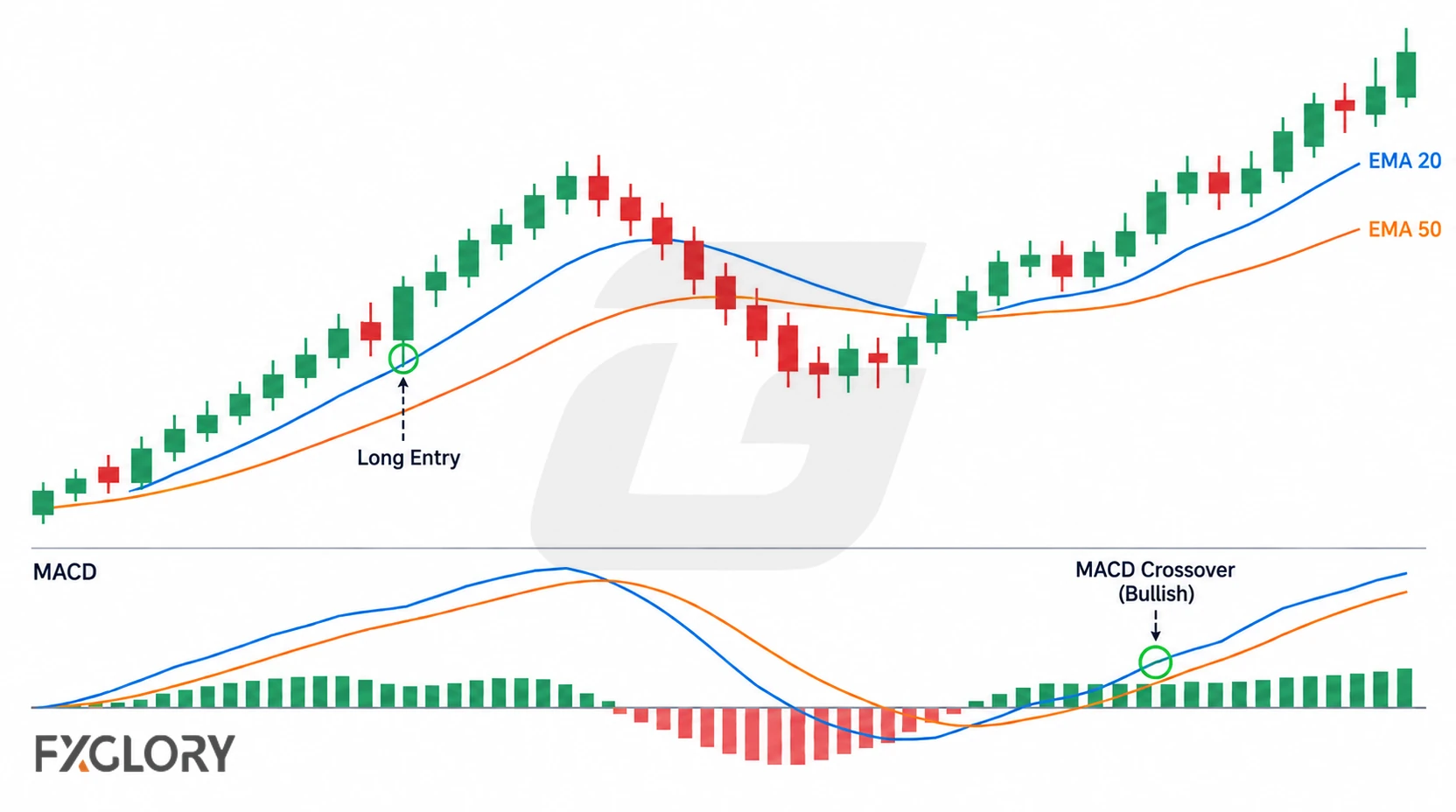
The indicator combination is not a complete strategy by itself. It still needs session, spread, setup location, stop, target, and cancellation rules. When multiple tools are combined, each indicator should answer a different trading question instead of repeating the same signal.
| Rule Part | Example 5-Minute EMA/MACD Rule | Weak Version |
|---|---|---|
| Context | Higher timeframe or session structure supports the trade direction | 5-minute MACD signal is used without wider context |
| EMA role | EMA reviews short-term direction, pullback location, or dynamic structure | Every touch of the EMA becomes a trade |
| MACD role | MACD reviews whether momentum is shifting in the planned direction | MACD cross appears after the move is already extended |
| Momentum timing | MACD should confirm momentum near the setup, not long after price has already extended | MACD flips after price has already reached the target area |
| Entry | Entry is considered only when price location and momentum agree | The trader enters because one indicator changes color or crosses |
| Stop | Stop is placed beyond the failed pullback, reaction, or momentum invalidation area | Stop is chosen after the trade starts negative |
| Exit | Use partial exit, structure target, breakeven rule, trail, time stop, or invalidation exit | Exit is decided only after emotion increases |
If moving averages are part of the setup, review how moving averages smooth price before they lag. If indicators are being used for entry and exit timing, assign each indicator a job before the 5-minute signal appears.
5 Minute Bollinger Band Scalping Framework
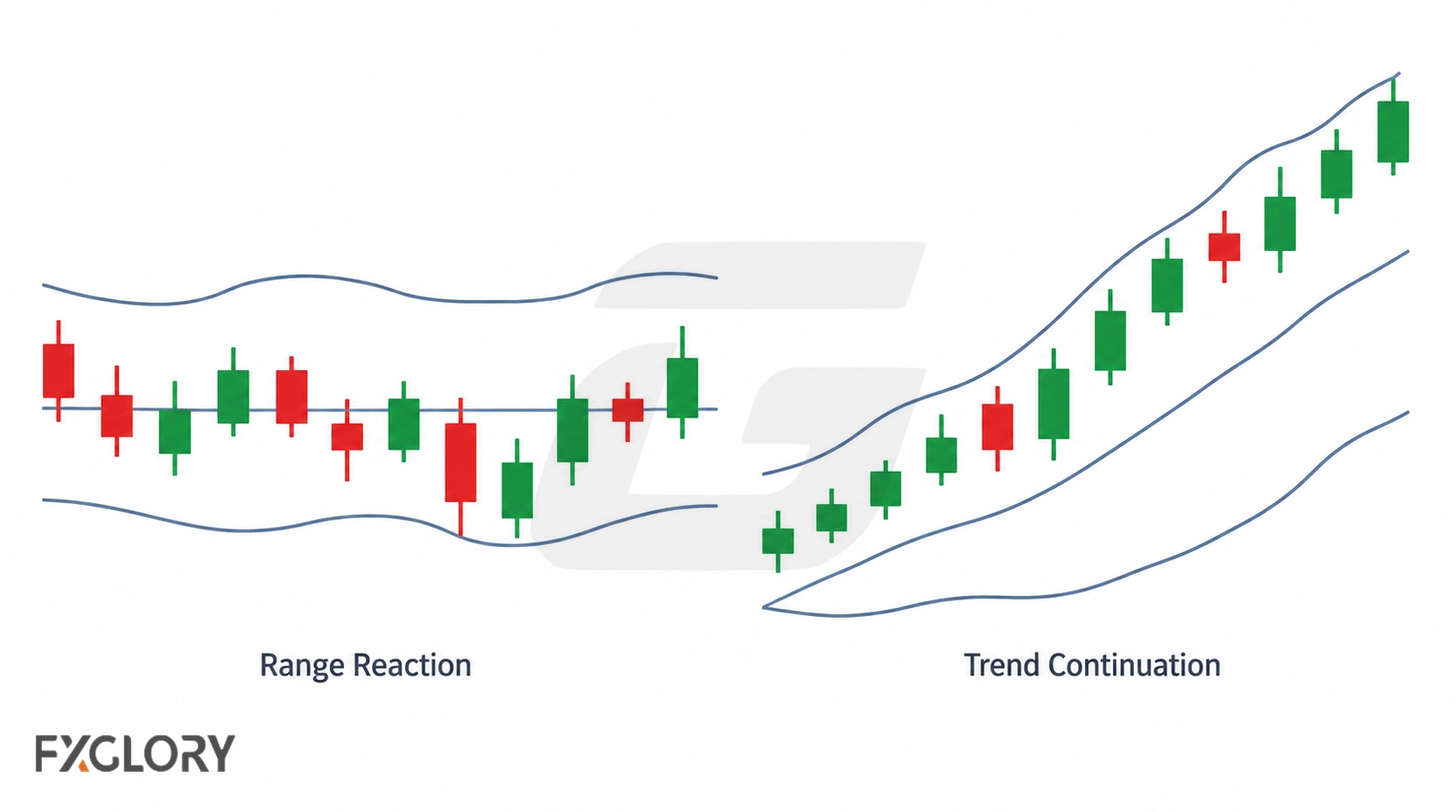
A Bollinger Band 5-minute framework can be used to review volatility, range behavior, and reactions near upper or lower bands. It should not be used as a rule that every band touch must reverse. In a breakout or strong trend, band touches can continue instead of reversing.
| Rule Part | Better Version | Weak Version |
|---|---|---|
| Market condition | Decide whether the market is ranging, trending, expanding, or unclear before using the bands | Assume every upper-band touch is a sell and every lower-band touch is a buy |
| Setup location | Look for reaction only at a planned level, band area, or structure zone | Use the band touch as the only reason for entry |
| Target logic | Target the middle band, opposite band, structure, or planned exit area only if room remains after spread | Target is selected without checking nearby congestion |
| Stop logic | Stop belongs beyond the failed reaction or invalidation area | Stop is widened because the band keeps expanding |
| Skip rule | Skip when the market is breaking out and the setup is only a reversal guess | Fight strong momentum because price looks extended |
When bands, ATR, or range conditions are used, check the volatility role before treating expansion or compression as a signal. For a broader Bollinger-based strategy framework, use the Bollinger Bands forex strategy guide.
Simple 10/15/50 SMA 5-minute Framework
A simple 5-minute moving-average framework can use a longer average for direction and shorter averages for timing. For example, a trader may use a 50-period average to review direction and faster averages such as 10 and 15 to review short-term timing. The exact numbers are less important than the role of each average.
| SMA Role | Possible Use | Skip When |
|---|---|---|
| 50 SMA | Reviews short-term direction or trend filter | Price is flat around the average and structure is unclear |
| 10/15 SMA area | Reviews short-term pullback, crossover, or timing condition | The cross appears after the move is already extended |
| Entry confirmation | Needs price location, candle behavior, and spread check before entry | The crossover is the only reason for the trade |
| Stop logic | Stop belongs beyond pullback or structure invalidation | Stop is placed randomly because the averages crossed |
| Exit logic | Exit by structure, time rule, failed momentum, or written moving-average rule | The trader waits for a reverse cross after the trade has already failed |
Common Example 5-Minute Indicator Settings
New scalpers often ask which indicator settings to use on the 5 minute chart. The settings below are common starting examples, not signals or recommendations. They should be tested, adjusted for the pair and session, and combined with setup, stop, target, and no-trade rules.
| Indicator | Common Example 5-minute Setting | Role On 5-minute |
|---|---|---|
| EMA (fast) | 9 or 21 period | Short-term timing and pullback location |
| EMA or SMA (direction) | 50 period | Short-term direction or trend filter |
| MACD | 12, 26, 9 (default) | Momentum-shift review, not an automatic entry |
| RSI | 14 period | Momentum and overbought or oversold context |
| Bollinger Bands | 20 period, 2 standard deviations | Volatility and range-reaction context |
| ATR | 14 period | Stop-distance and volatility judgment |
These numbers are examples that many platforms use by default. They are not tuned for any specific market and should be reviewed with the indicator's real role before use. For the individual explanations, see MACD, RSI, and ATR.
5-Minute Price Action And Key-Level Scalping
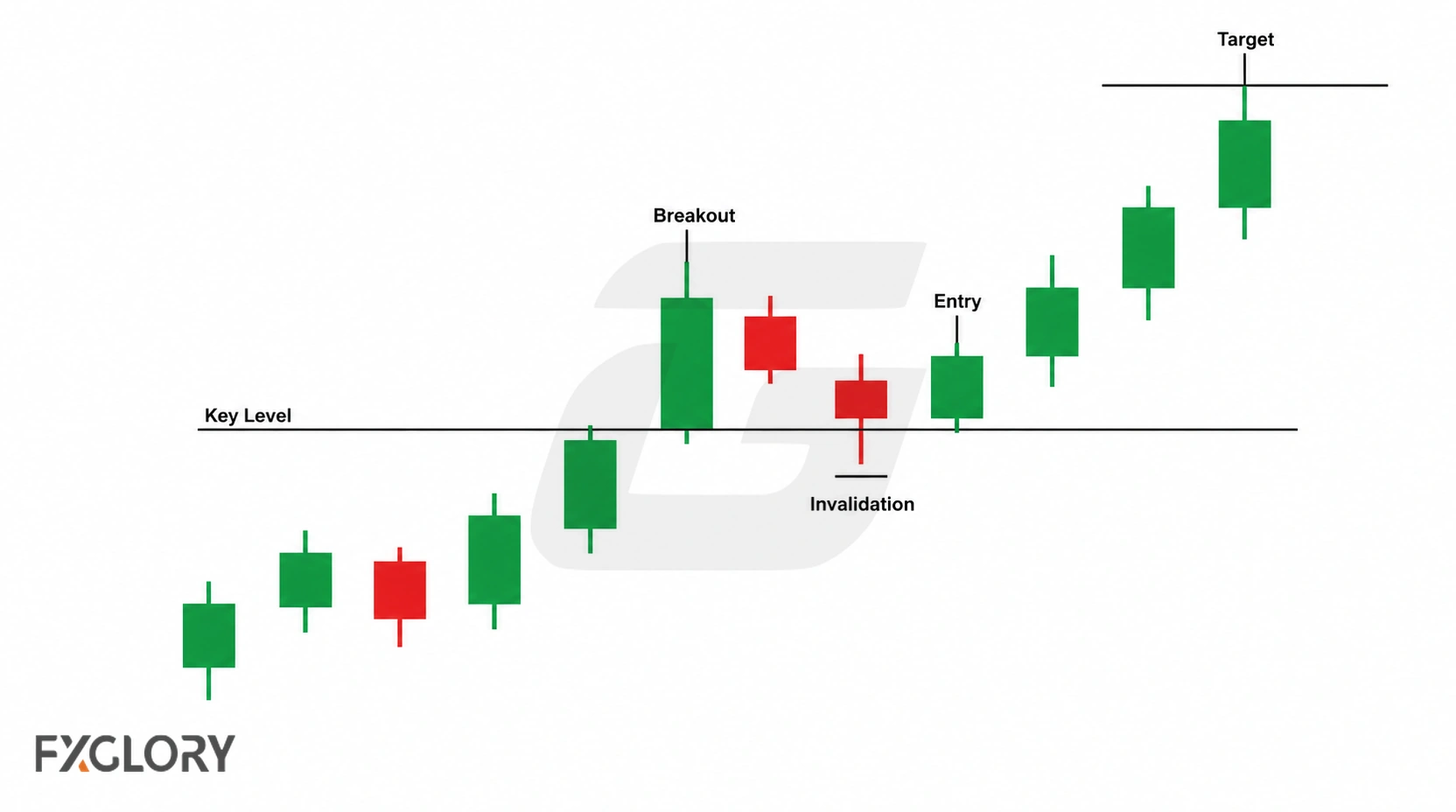
A 5 minute scalping strategy does not have to depend on indicators. Price action and key levels can be used when the trader can define the level, reaction, stop, target, and cancellation rule before entry.
| Price-Action Element | Useful Role | Weak Use |
|---|---|---|
| Support and resistance | Defines where a reaction or breakout may be reviewed | Every touch becomes a trade |
| Retest | Checks whether price accepts or rejects a broken level | The trader enters after price already moved away |
| Candle close | Confirms reaction, rejection, continuation, or indecision | The candle pattern is used without context |
| Range edge | Defines a place for range reaction or breakout planning | Range is changed after the trade opens |
| Market structure | Shows whether the setup still supports the trade idea | Structure is ignored because the entry signal appeared |
5-Minute Exit Methods
A 5 minute strategy needs an exit before the trade opens. 5-minute trades can move quickly enough that exit decisions made after entry often become emotional decisions.
| Exit Method | How It Works On 5-minute | Weak Use |
|---|---|---|
| Fixed target | Target is planned before entry and checked against spread and nearby structure | Target is chosen because the trader wants a quick result |
| Structure target | Exit is planned near support, resistance, prior swing, range edge, or intraday objective | Target is placed inside congestion with little room |
| Partial exit | Part of the position is closed at a planned objective and the rest follows a written rule | Partial exit is used to avoid deciding whether the setup is still valid |
| Breakeven rule | Stop moves to breakeven only after a defined condition is met | Stop moves too early and removes the trade before it can develop |
| Trailing stop | Stop moves by structure, volatility, or a written trailing rule | Stop is moved randomly after each candle |
| Time stop | Trade is closed or reviewed if it does not develop within the planned number of candles | A stalled 5-minute scalp becomes an unplanned hold |
| Invalidation exit | Trade closes when the condition that supported entry disappears | The trader holds because the target has not been hit |
Every 5-minute confirmation should be paired with stop, target, and time logic before entry. Entry and exit rules should be built as one chain, not repaired after the trade opens.
How To Set 5-Minute Stop-Loss And Target Levels
5-minute stops and targets should come from the setup rather than a copied pip range. First identify the price level that invalidates the trade idea. The distance from entry to that level becomes the stop distance used for position sizing. Then choose a target from nearby structure or another written exit rule and check whether spread and volatility leave enough room for the trade.
| Element | How To Set It | Check Before Entry |
|---|---|---|
| Stop level | Place it beyond the pullback, retest, range edge, reaction point, or other structure that would prove the setup wrong. | The level reflects invalidation rather than an arbitrary number of pips. |
| Stop distance | Measure the distance from the planned entry to the invalidation level. | The distance is practical for current volatility and spread. |
| Position size | Calculate size only after the stop distance is known. | The resulting loss at the stop fits the account risk limit. |
| Target | Use nearby structure, a defined risk multiple, partial-exit rule, trail, or time-based objective. | The target has enough room after spread and does not depend on forcing a fixed pip goal. |
Traders searching for a typical 5-minute EUR/USD stop in pips should treat any published number cautiously. Volatility, spread, session conditions, entry location, and market structure change, so a distance that fits one setup can be too tight or too wide for the next. To translate the chosen distance into account currency, review how pip distance, pip value, and spread cost are calculated.
Why Small 5-Minute Targets Fail
A small target can look easy on the 5 minute chart, but one poorly planned stop can erase several small winning trades. This is why 5-minute scalping should not be judged only by how often a small target is reached.
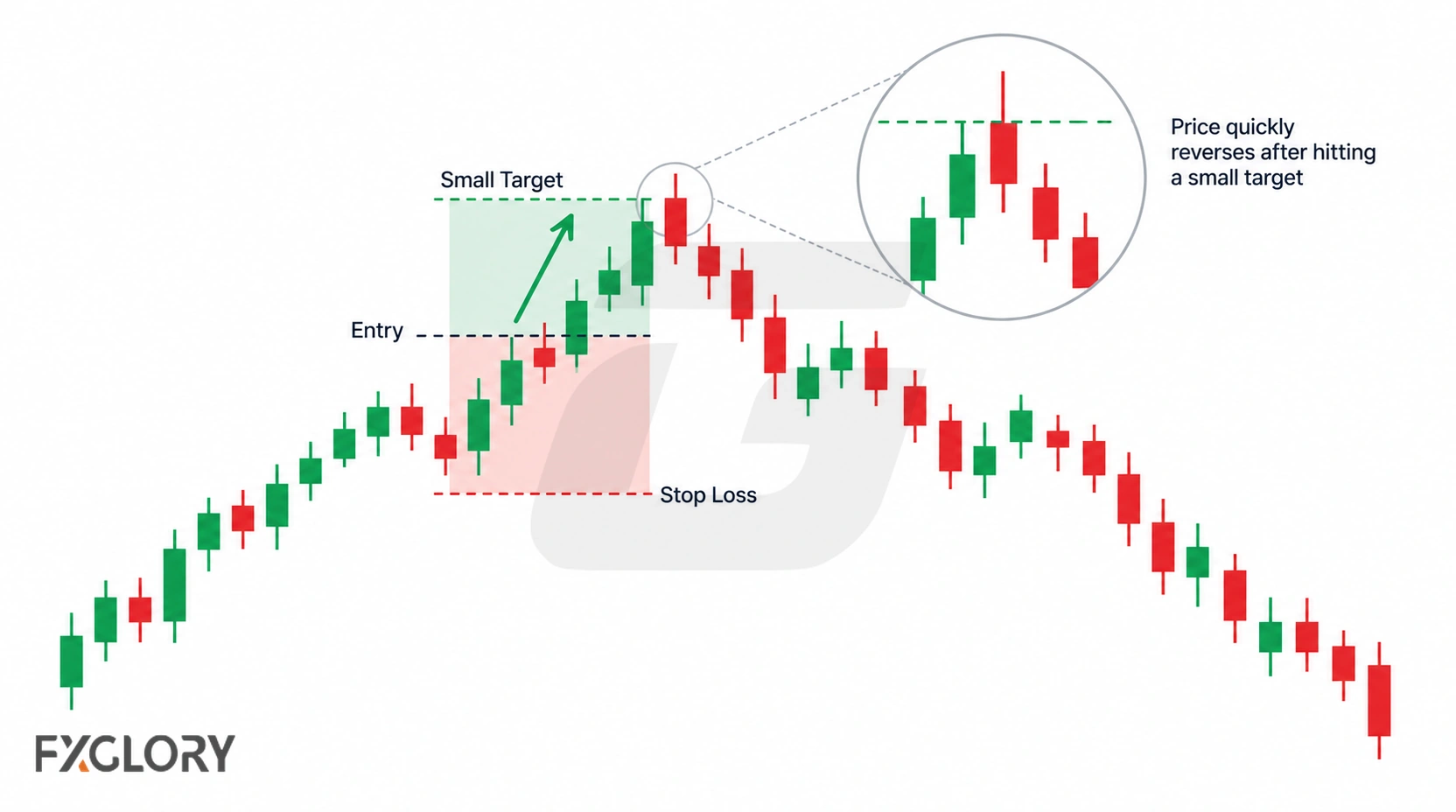
The target must still be large enough after spread, slippage, entry delay, stop distance, and nearby structure are considered. If the stop must be much wider than the target for the setup to remain logical, the trade may not fit the strategy. If the pip target, pip value, or spread cost is unclear, review how pip distance, pip value, and spread cost are calculated before using a small 5-minute target.
| Small-Target Check | Question | Warning Sign |
|---|---|---|
| Spread | How much of the target is already consumed by cost? | The spread takes too large a share of the planned move |
| Stop distance | Is the stop logical compared with the target? | The stop is much wider than the planned profit without a clear reason |
| Momentum timing | Is the entry near the planned area? | The trader enters after most of the move has already happened |
| Range width | Is the range wide enough for the target but not too wide for the stop? | The range is so tight that cost matters too much or so wide that risk becomes unclear |
| Exit plan | Can the target, partial, trail, or time stop be managed clearly? | The exit is chosen after the trade opens |
Win Rate, Testing, And Review
A 5 minute scalping strategy should not be trusted because it shows a high advertised win rate. A high win rate can still be weak if losses are larger than gains, spreads reduce small targets, or the trader keeps taking poor setups after the daily limit is reached.
The strategy should be reviewed on historical examples or demo conditions before it is used with real funds. The purpose is not to find perfect examples. The purpose is to check whether the same setup, stop, target, exit, and no-trade rules can be followed without rewriting them after each result.
- Review whether the same session rule was used each time.
- Check whether the setup was defined before entry.
- Record whether the stop and target were known before the trade opened.
- Record whether spread, margin, and position size were checked before entry.
- Compare trades that followed the plan with trades that broke it.
- Record skipped trades, especially late entries and weak signals that were correctly avoided.
Risk Rules For 5-Minute Scalping
Risk on 5-minute can build quickly because trades appear often enough to tempt repeated entries. A trader can take several trades, move stops, or increase size before noticing that the session has moved outside the plan.
For account-level risk limits, use the forex risk-management strategy page.
- Stop before entry: The trade is not ready if the invalidation point is unknown.
- Position size after stop distance: Determine the stop level and resulting stop distance first, then calculate a position size that fits the account risk limit.
- Spread before target: The target must still make sense after trading cost.
- Daily stop before trading: The session loss or drawdown limit should be set before the first trade.
- Max trade count: Limit the number of attempts so every 5-minute candle does not become a new trade.
- No revenge re-entry: A new trade needs a new valid setup, not a need to recover.
- Margin review: Check whether the position still fits margin and leverage exposure rules.
- Event risk control: Scheduled events can change spread, speed, and volatility beyond the setup rules.
No-Trade Rules For A 5 Min Scalping Strategy
No-trade rules keep the 5-minute chart from becoming a reason to force trades. A clean candle or indicator signal can look convincing, but the trade should still be skipped when the condition is weak.
- Spread problem: The planned target does not leave enough room after cost.
- Late entry: Price has already moved away from the planned area.
- Flat EMA or flat range: The market is too quiet for the target and stop to make sense.
- False momentum: MACD, candle movement, or band expansion appears after most of the move is complete.
- No clear stop: The chart does not show where the trade idea is wrong.
- Range too tight: The market has too little room after spread.
- Range too wide: The stop becomes too large for the planned target.
- News-event risk: A scheduled event may change spread, speed, or volatility beyond the plan.
- Recovery trade: The entry exists because the trader wants to recover a previous loss.
5 Min Scalping Strategy Review Checklist
Reviewing 5-minute trades only by profit or loss hides the reason behind the result. A winning trade can break rules, and a losing trade can still be correctly executed.
- Write the pair, session, spread, and higher-timeframe condition before entry.
- Record whether the 5-minute setup was EMA/MACD momentum, Bollinger reaction, SMA timing, price-action key level, range reaction, or another written method.
- Write the exact confirmation used: candle close, momentum shift, retest, rejection, band reaction, moving-average condition, or price-action trigger.
- Record whether the entry was planned, early, late, or emotional.
- Write the original stop and why that point invalidated the trade idea.
- Write the target method: fixed target, structure target, partial exit, breakeven rule, trailing stop, time stop, or invalidation exit.
- Record whether spread, margin, and position size were checked before entry.
- Record whether the trade followed the time stop or became an unplanned hold.
- Record whether the daily stop or max-trade rule was followed.
- Review whether the result came from following the rules or breaking them.