
What Is a Cup and Handle Pattern in Forex?
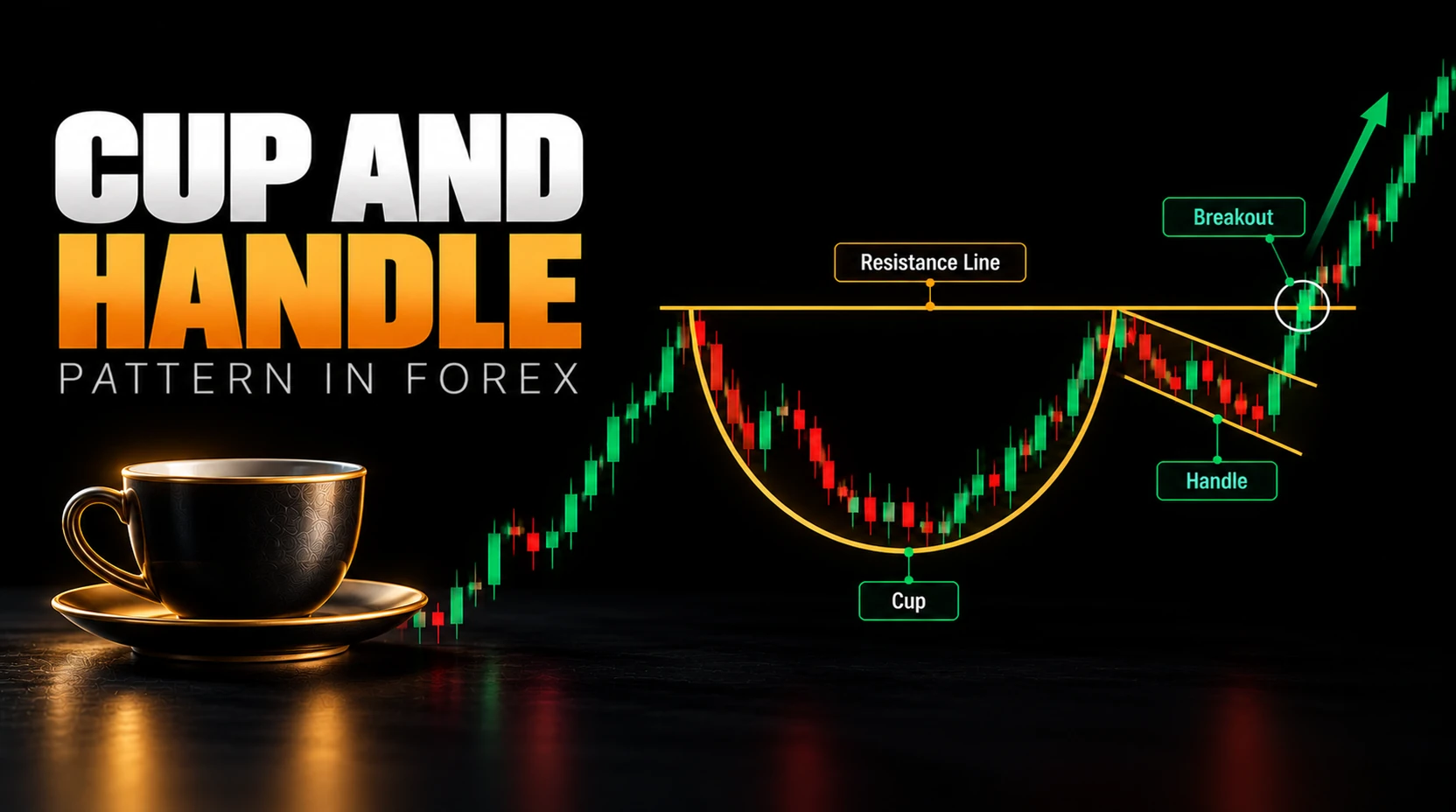
A cup and handle is a chart structure with a rounded recovery, resistance near the cup rim, and a smaller pullback or consolidation called the handle. The regular version is commonly interpreted as a potential bullish continuation or recovery pattern.
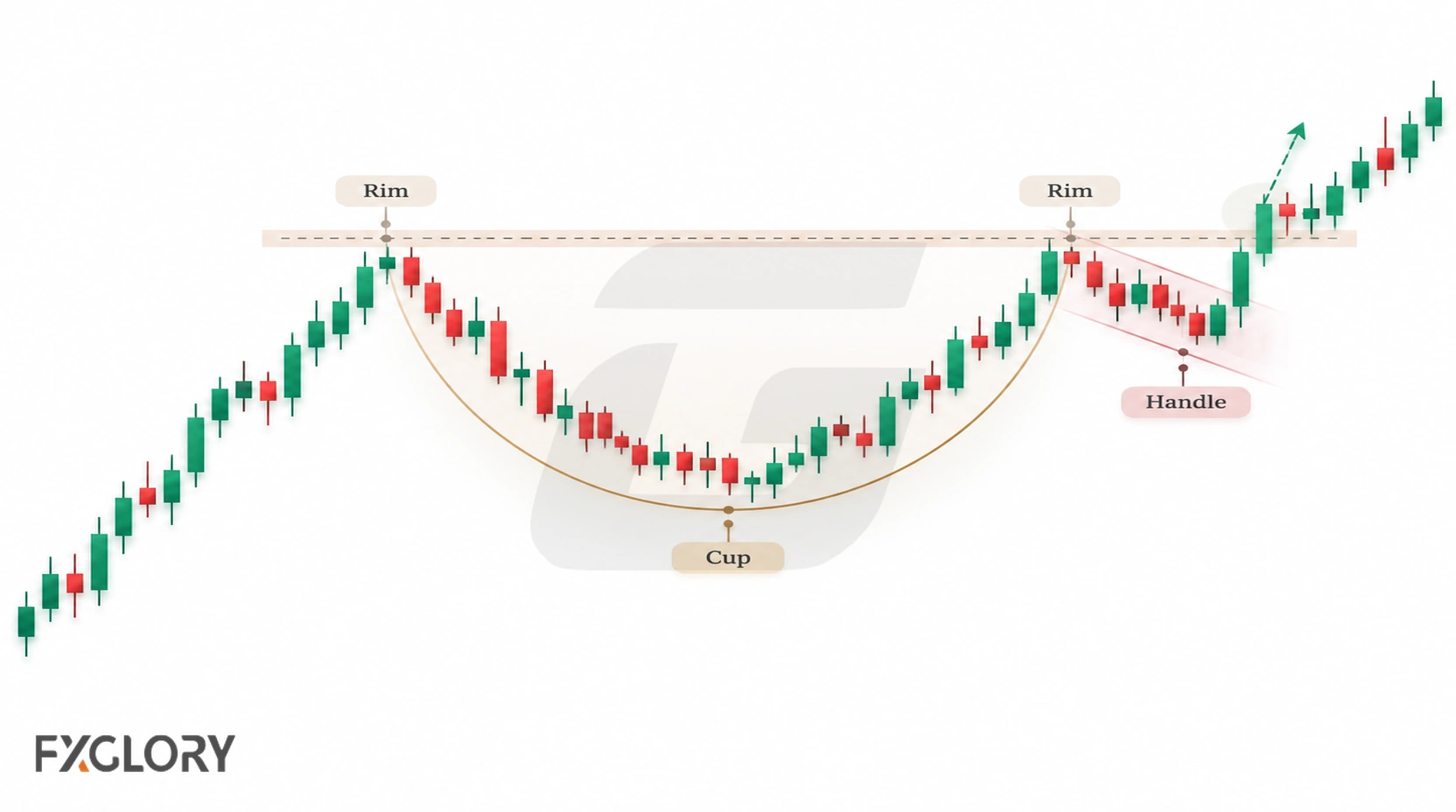
The cup and smaller handle form an identifiable candidate. A breakout above the chosen cup-rim boundary provides confirmation under a stated rule; it does not guarantee higher prices. Choosing a stop and position size is a separate trading decision.
See trend-pause pattern context for continuation setups and bottoming-pattern context for recoveries after a decline.
How Cup and Handle Patterns Form
Price declines from a left rim, slows into a curved base and recovers toward a right rim near the earlier resistance. It then pauses or pulls back in a smaller handle close to that upper area. A breakout may follow, but is not needed to identify the candidate.
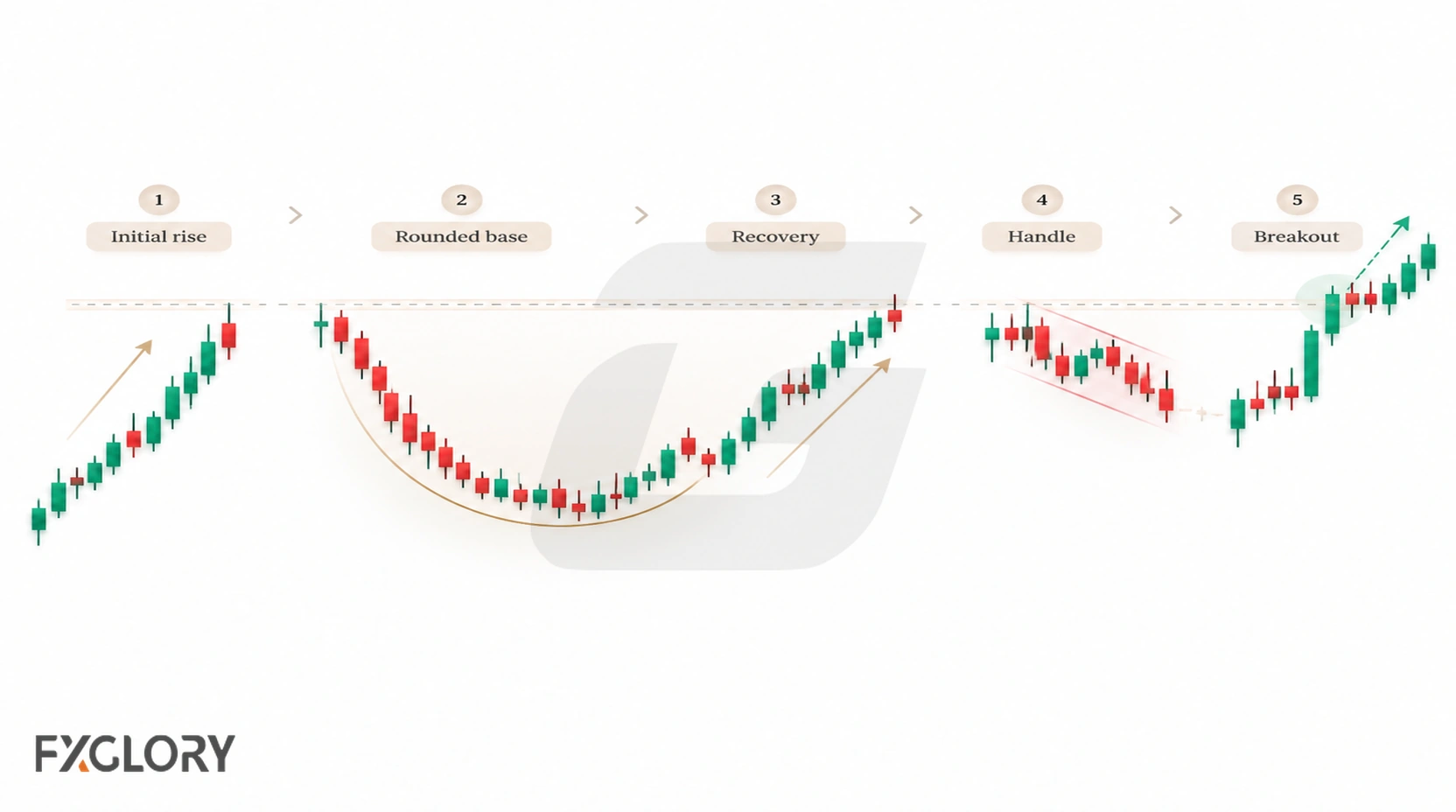
- Cup: Identify the left rim, rounded base and recovery.
- Handle: Find a smaller sideways or downward pause near the right rim.
- Rim test: Observe whether price clears the main resistance, stalls beneath it or declines into the cup.
A cup-shaped recovery with no handle is better described as a cup or rounded base, rather than a completed cup-and-handle candidate.
Cup and Handle Pattern Anatomy
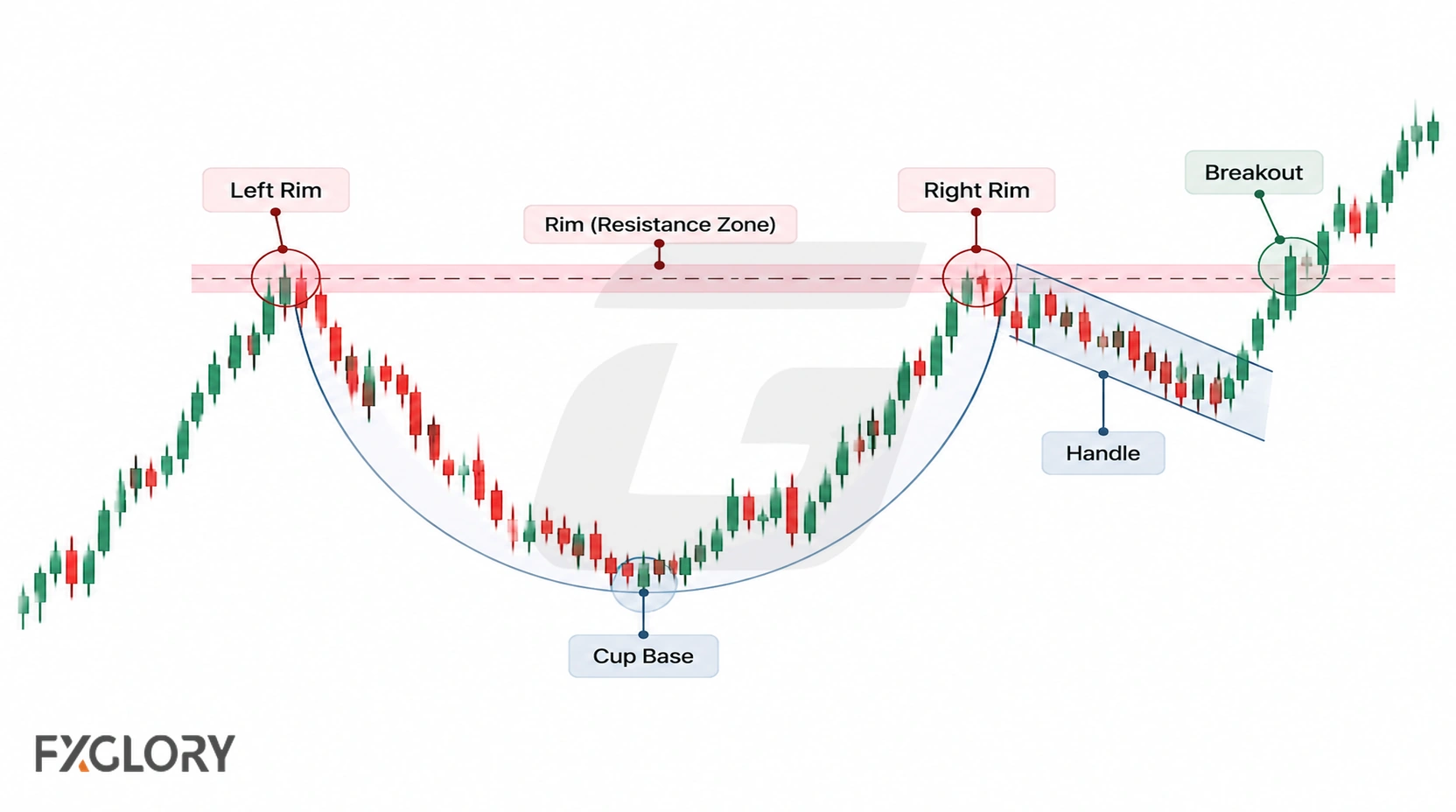
Mark structural reference points before interpreting the breakout. The rim is often a resistance zone rather than a single perfectly repeated price.
| Part | Role |
|---|---|
| Left and right rims | Upper references defining the cup resistance area |
| Rounded base | Curved recovery between the rims |
| Handle | Smaller pause or pullback near the right rim |
| Handle resistance | Local ceiling that may break before the cup rim does |
| Main cup rim | Upper zone used to judge the full-pattern breakout |
Cup Quality: Rounded U vs Sharp V
The characteristic cup is a gradual U-shaped recovery rather than one abrupt V-shaped bounce. Its base may contain uneven swings; perfect symmetry is unnecessary. Assess depth and duration in relation to the timeframe, volatility and broader market structure rather than applying a universal candle count or retracement threshold.
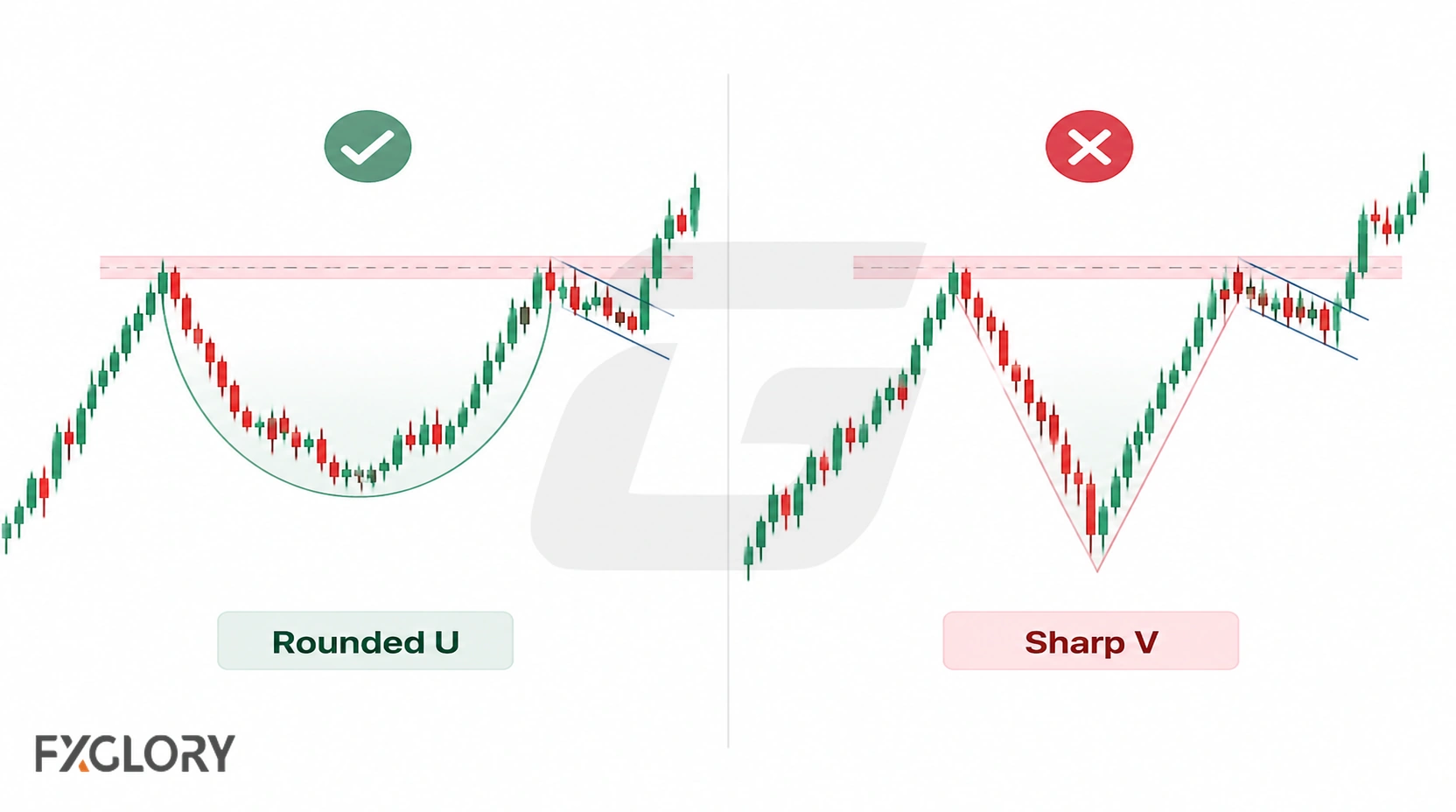
| Feature | Clearer cup | Less convincing cup |
|---|---|---|
| Base | Recognizable rounded slowing and recovery | Single reversal spike or unrelated swings |
| Rim | Recovery approaches an earlier upper zone | No coherent shared resistance area |
| Proportion | Distinguishable from local chart noise | Curve depends on arbitrary redrawing |
A very long sideways base may fit a range better than a rounded cup. A sharp bounce may be a different formation.
Recognizable vs Forced Pattern
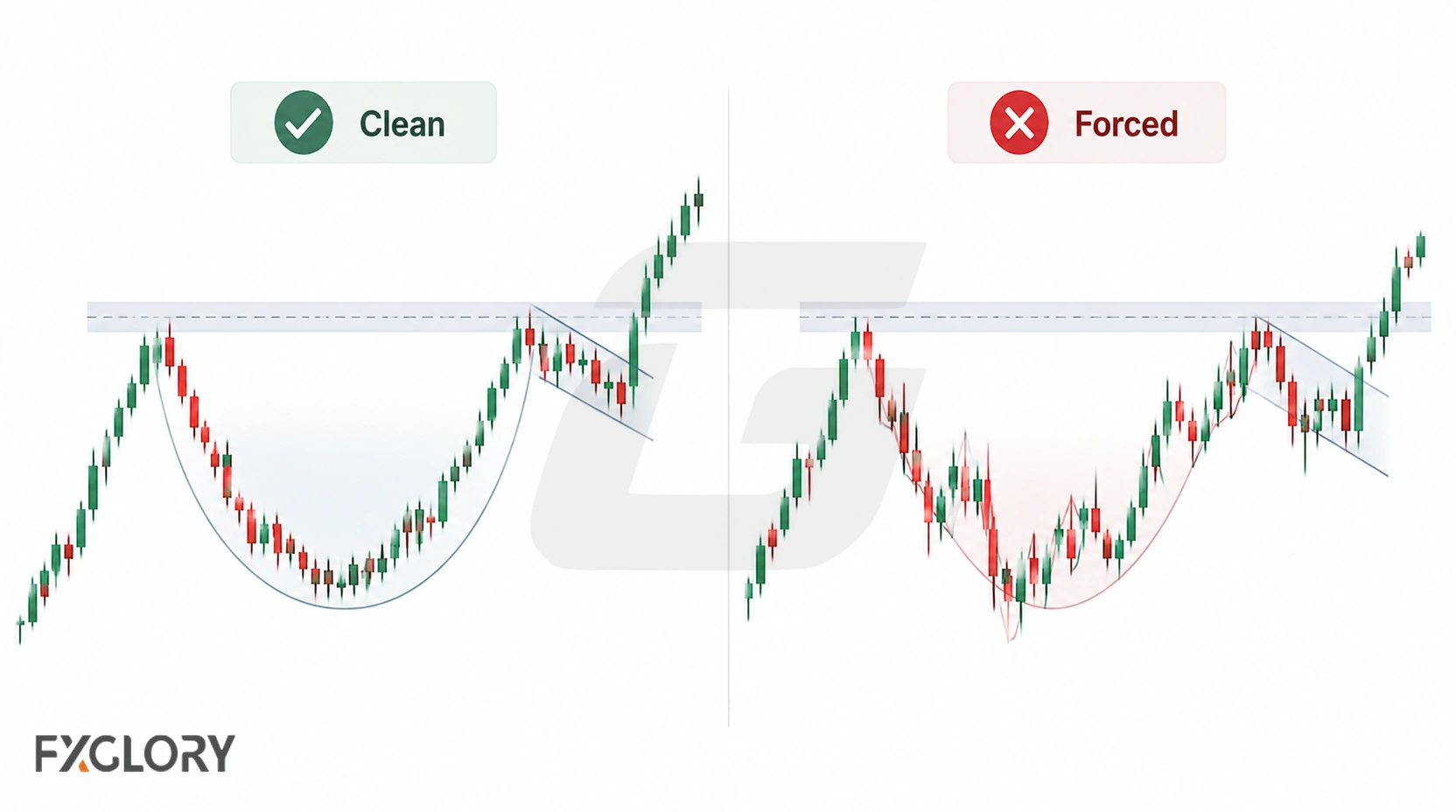
A clean interpretation fits the price swings without reshaping them. A forced interpretation ignores the chart’s scale or keeps moving its resistance boundaries. This is a chart-classification judgment, not a measure of the quality of a trader’s risk plan.
Handle Quality: Small Pullback Near the Rim
The handle is a relatively small consolidation after price recovers toward the rim. It may drift downward, move sideways or compress in a narrow range. Its role is structural: the handle does not itself confirm an upside breakout.
Compare the handle with the whole cup. A decline approaching the cup base may no longer resemble a small handle, but no universal depth or time limit applies across every currency pair and timeframe.
| Feature | More recognizable handle | Less recognizable handle |
|---|---|---|
| Location | Near the cup’s upper area | Deep inside the cup |
| Size | Clearly smaller than the cup | Comparable with the entire cup |
| Boundary | Local highs and lows can be marked consistently | Choppy swings demand repeated redrawing |
Cup and Handle Candidate vs Confirmed Pattern
A rounded cup with a recognizable smaller handle is a candidate. It remains unconfirmed while the main cup rim has not met the chosen breakout rule. A handle-trendline break alone does not establish a full-pattern breakout.
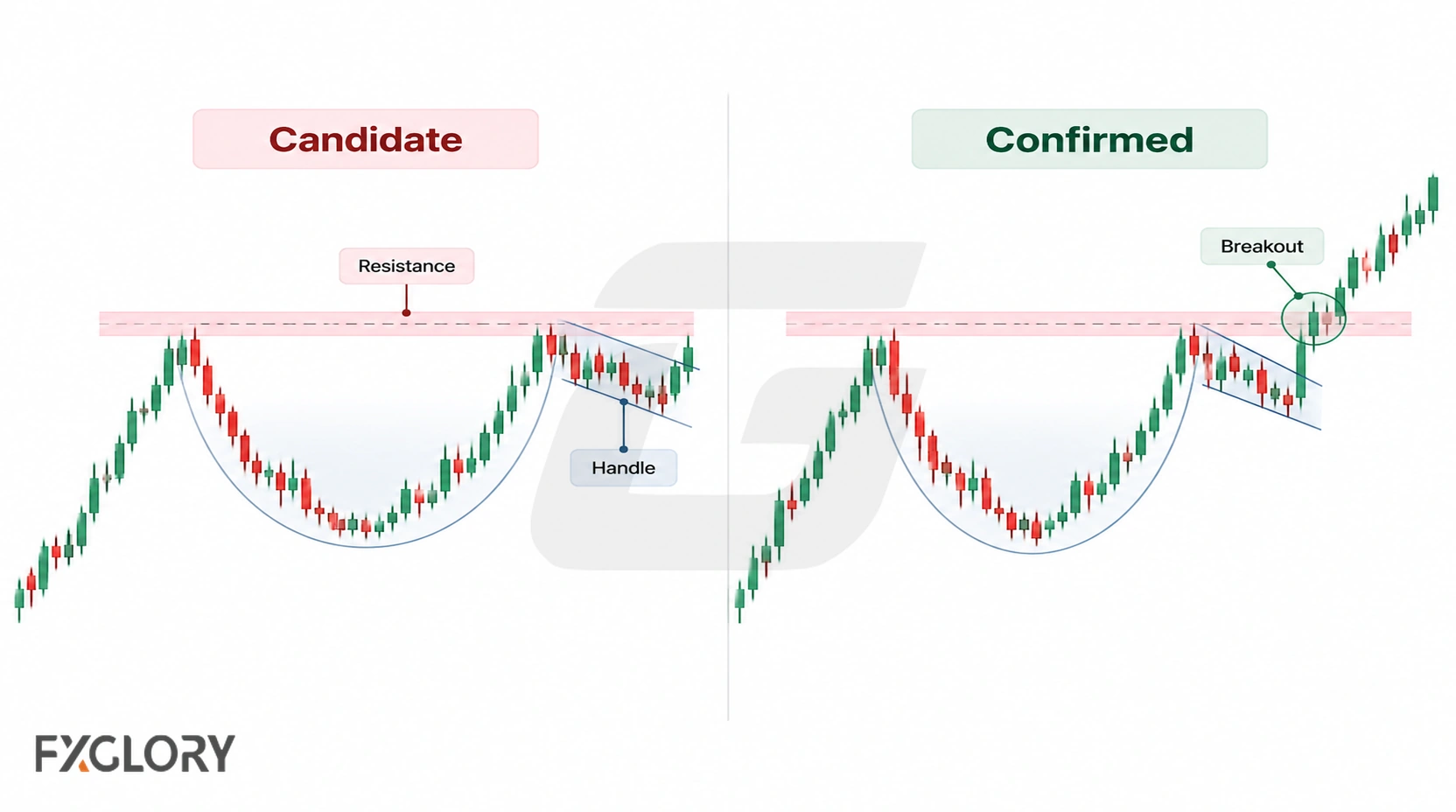
| Stage | Classification |
|---|---|
| Rounded recovery, no handle | Cup-like formation, not yet a cup-and-handle candidate |
| Handle near rim, resistance intact | Identifiable, unconfirmed candidate |
| Predetermined rim-break rule met | Confirmed breakout under that rule |
| Price later falls beneath the rim | Possible failed confirmed breakout |
Rim, Neckline, and Handle Resistance
The main rim is the resistance zone associated with the two upper sides of the cup; some guides call it a neckline. The handle also has local resistance, which may sit below the rim. Breaking a descending handle trendline may be an early development while the complete cup-and-handle breakout remains unconfirmed.
If using a close-based rule, mark the upper edge of the main rim zone and chosen timeframe before price tests them. An intrabar wick above resistance and a completed candle close above the boundary are different events.
| Event | Interpretation |
|---|---|
| Handle resistance breaks but cup rim holds | Intermediate move; full-pattern breakout unconfirmed |
| Completed candle closes above predefined rim boundary | Meets the example confirmation rule |
| Price falls back below rim after confirmation | Possible failed breakout |
Cup and Handle: Continuation or Bottoming Structure?
After an existing upward trend, the cup may represent a broader consolidation and the handle a final smaller pause before a potential bullish continuation. After a prolonged decline, a similar rounded base can instead represent a bottoming attempt. The preceding market structure, not the pattern name alone, determines which description fits.
Cup and Handle vs Rounded Bottom, W Pattern, and Inverse Head and Shoulders
The distinguishing feature is the rounded cup plus a smaller handle near its rim. A rounded base without a handle need not be called a cup and handle.
| Structure | Distinguishing feature |
|---|---|
| Cup and handle | Rounded cup followed by smaller handle near rim |
| Rounded bottom | Curved recovery without distinct handle |
| W pattern | Two recognizable support tests |
| Inverse head and shoulders | Three troughs with a lower middle trough |
Compare the W-shaped support reaction and the head-and-shoulders pattern guide for their respective structures.
Cup and Handle vs Flag, Rectangle, and Pennant
The handle may resemble a short continuation formation, but it should not be confused with the entire cup-and-handle pattern.
| Structure | Distinguishing feature |
|---|---|
| Flag | Small channel-like pause after a directional move |
| Rectangle | Range between horizontal support and resistance |
| Pennant | Converging compression after a sharp move |
| Cup and handle | Rounded cup plus a separate smaller handle near rim |
For more detail, see flag-style channel pauses, pennant compression and rectangle ranges.
Inverted Cup and Handle
The inverted version is the bearish mirror: a rounded top, a smaller upward or sideways handle near support and a potential downside break. Its confirmation is assessed at support rather than with the regular pattern’s upside rim rule.
How to Confirm a Cup and Handle Pattern in Forex
Use a rule selected before examining the breakout. One practical example requires a completed candle to close above the marked upper boundary of the main cup-rim resistance zone. A wick above the rim, a handle-trendline break and a later retest are distinct events.
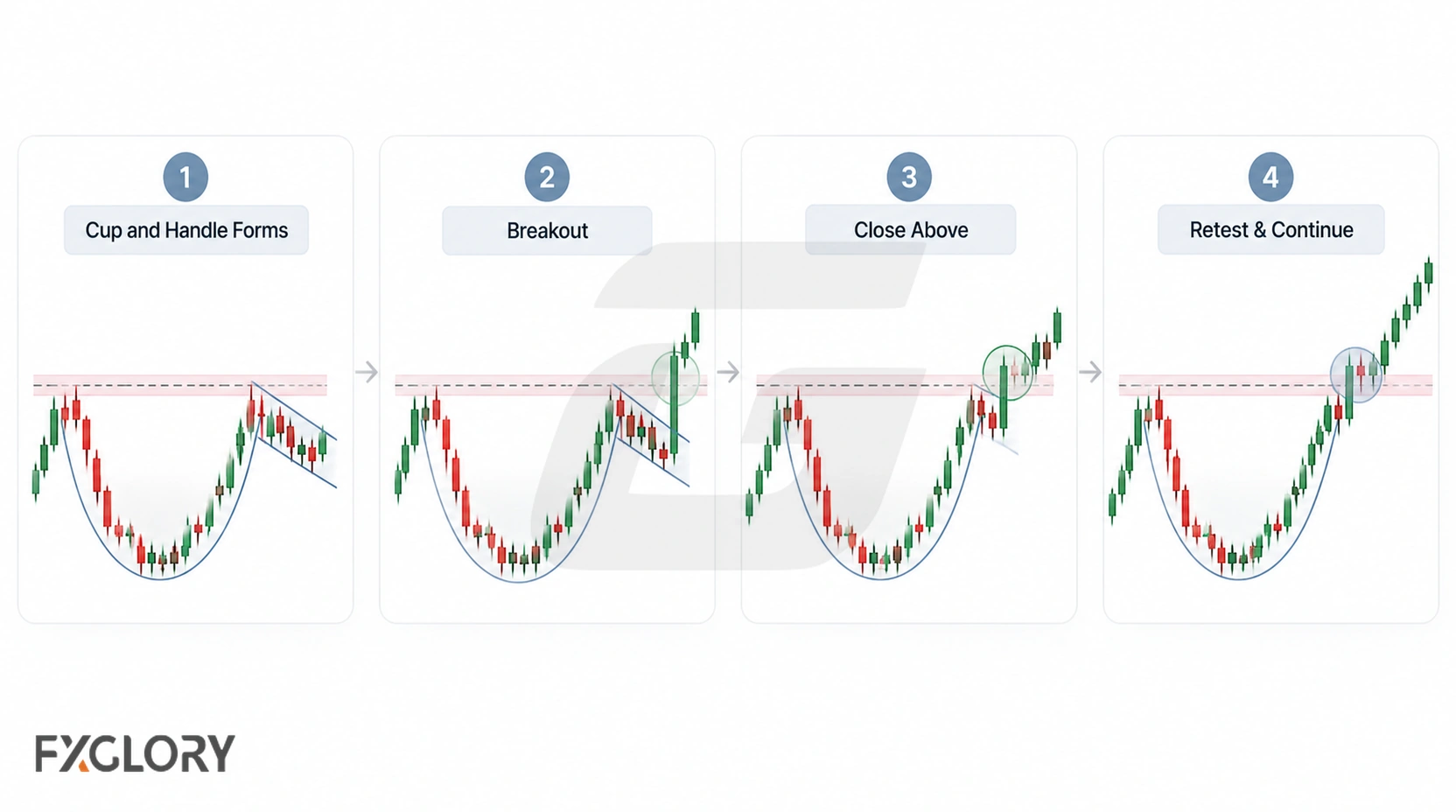
- Identify: Verify the rounded cup, rim and smaller handle.
- Define: Fix the resistance boundary and timeframe.
- Test: Check whether the completed candle meets the chosen rim-break rule.
- Observe: Follow-through, a retest or a return below resistance may occur afterward. A retest is not mandatory for the close-based rule.
A confirmed pattern is not automatically a favorable trade, particularly after price has already moved far above the rim. For trade-entry methods, see the forex breakout strategy.
Pattern Failure and Trade Invalidation
Separate structural classification, a failed breakout and the invalidation of a particular trade. A candidate whose rim remains intact is unconfirmed, not necessarily invalidated. A rounded cup without a handle has not yet become a cup-and-handle candidate.
| Chart event | More precise reading |
|---|---|
| Handle collapses deep into cup | Original candidate loses structural clarity |
| Handle breaks upward but rim does not | Intermediate move, still unconfirmed |
| Price meets rim-break rule then returns below | Possible failed confirmed breakout |
| Price remains between handle and rim levels | Unconfirmed candidate or range |
| Higher-timeframe resistance or major news intervenes | Trading context changes; not automatic structural invalidation |
A breakout can fail even though the cup and handle was identifiable and confirmed according to a predefined rule. Reclassify the later outcome without rewriting what was known at the breakout.
Cup and Handle Scanner and Automation Caution
Automated scanners can highlight candidates, but their classifications depend on price feeds and detection rules. They may mark a cup before a handle forms, redraw the rim as new candles appear, or confuse a handle break with a full-rim break.
Check whether the tool relies on completed candles, fixed boundaries and a documented breakout rule. Manually review candidate charts; scanner output alone is not a trading decision.
Cup and Handle Measuring Principle and EUR/USD Example
One conventional measured-move technique subtracts the cup low from the rim and adds that distance to the rim after a confirmed breakout. It produces an illustrative reference, not a statistically verified price forecast.
Hypothetical EUR/USD example—not observed market data: Suppose EUR/USD forms a rounded cup with a rim near 1.1000 and a low near 1.0900, then a smaller handle with local resistance near 1.0980. Clearing 1.0980 does not itself clear the main 1.1000 rim. If a close above 1.1000 is required, a completed-candle close at 1.1005 would meet that illustrative confirmation rule.
| Illustrative reference | Price or distance |
|---|---|
| Rim | 1.1000 |
| Cup low | 1.0900 |
| Handle local resistance | 1.0980 |
| Example confirming close | 1.1005 |
| Cup depth | 0.0100 (100 pips) |
| Measured-move projection | 1.1100 |
Calculation: 1.1000 − 1.0900 = 0.0100; 1.1000 + 0.0100 = 1.1100. Price need not reach the projected level and may return below the rim instead. These illustrative values are not current quotations, backtest results, a stop rule or a trading recommendation.
Forex Context: Sessions, News, Spread, Slippage, and Timeframes
Execution and market conditions matter independently of the pattern’s classification. Economic releases and trading-session changes may affect liquidity and volatility; spreads can widen, and orders can fill at prices different from chart levels. A small cup and handle can also form immediately beneath significant higher-timeframe resistance.
Volume and Tick Activity in Forex Cup and Handles
Traditional discussions sometimes mention activity fading during the handle and increasing on breakout. Spot forex has no single consolidated exchange-wide trade-volume series. Broker tick counts measure quote updates and vary with the feed.
Tick activity may add context, but it cannot independently prove a successful breakout. See tick-volume reading in forex for the distinction.
Using Indicators and Candles With Cup and Handle Patterns
Indicators and candlestick readings can describe surrounding conditions, but do not replace the chosen rim-breakout rule.
| Tool | Question it may answer | Limit |
|---|---|---|
| Momentum | Is upward momentum changing during the cup recovery? | Momentum alone cannot confirm the pattern |
| Trend strength | Is the broader market trending or ranging? | Strength is not breakout direction |
| Volatility | How large are recent movements near resistance? | Does not prescribe a stop |
| Candles | How has price reacted at the rim? | A single candle is not the whole chart structure |
For context, consult ATR-based volatility context, candlestick behavior around key areas and indicator-based chart context.
Common Mistakes With Forex Cup and Handle Patterns
- Premature confirmation: Calling a handle break a full-rim breakout.
- Forced geometry: Fitting a smooth curve to unrelated price swings.
- Ignoring handle proportion: Retaining the label after a deep decline undermines its structure.
- Changing the rule after the move: Redrawing the rim or revising confirmation retrospectively.
- Conflating pattern and trade: Assuming an identifiable pattern is automatically worth trading.
- Ignoring execution costs: Treating chart prices and actual fills as equivalent.
Beginner Workflow for the Cup and Handle Pattern
- Identify: Find the rounded cup, rim and smaller handle.
- Compare: Consider a rounded bottom, W pattern or range if the structure better fits.
- Classify: Note whether the full-rim breakout rule has been met.
- Evaluate: Check higher-timeframe levels, false breaks, news and transaction costs.
- Plan separately: If considering a trade, specify entry, stop, position size and maximum loss.
- Review: Record whether the chart met the original rules without retrospectively altering them.
A Safer Way to Read Cup and Handle Patterns in Forex
A rounded cup and compact handle near resistance identify a candidate. A predefined break of the main cup rim provides one testable confirmation rule, but the bullish breakout can still fail.
Whether to trade the setup is a separate question involving market context, entry and exit rules, costs and acceptable risk. The absence of a trade plan does not make an otherwise identifiable pattern incomplete.