
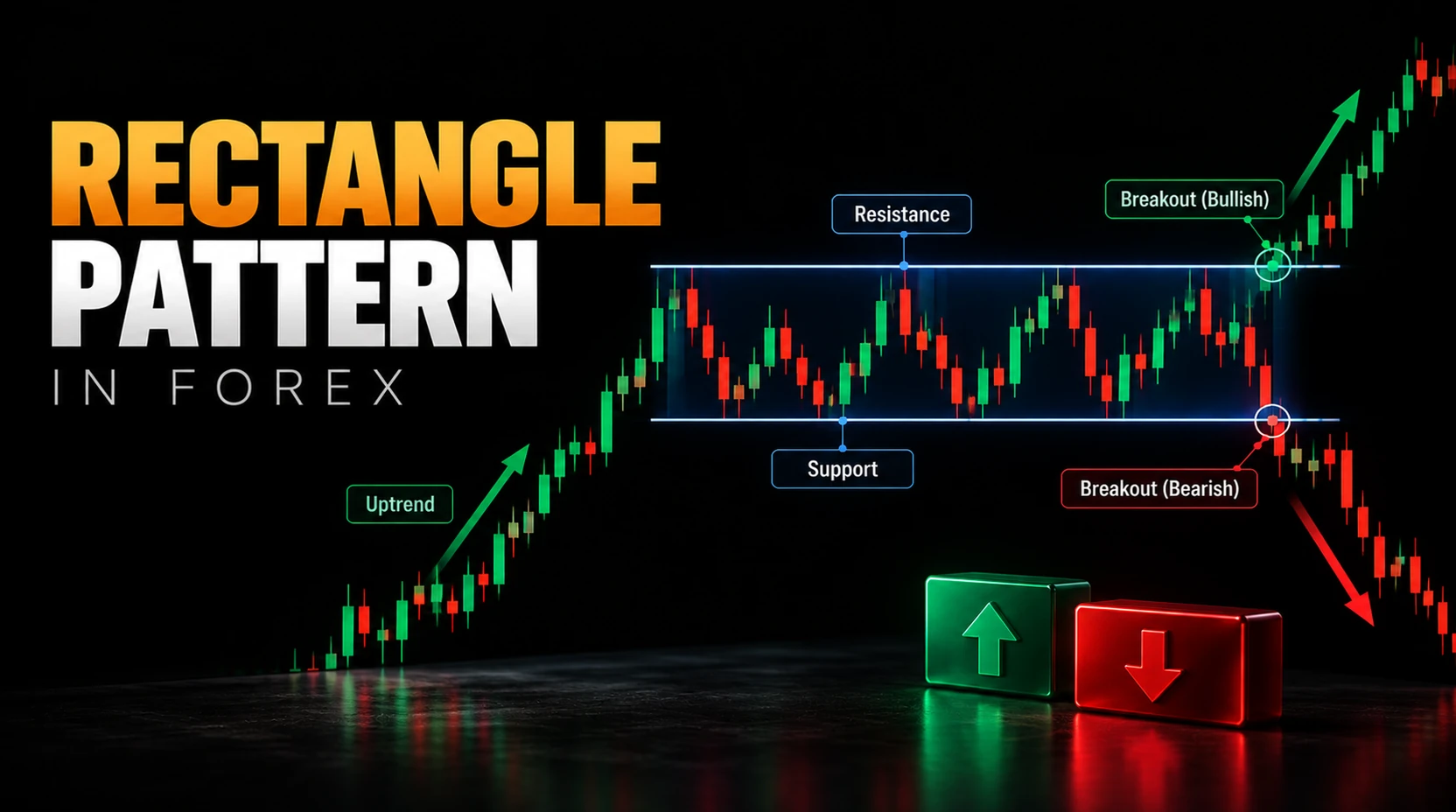
What Is a Rectangle Pattern in Forex?
A rectangle pattern forms when price repeatedly moves between approximately horizontal support and resistance. The two boundaries may be zones rather than identical price levels, and the width of the range need not contract.
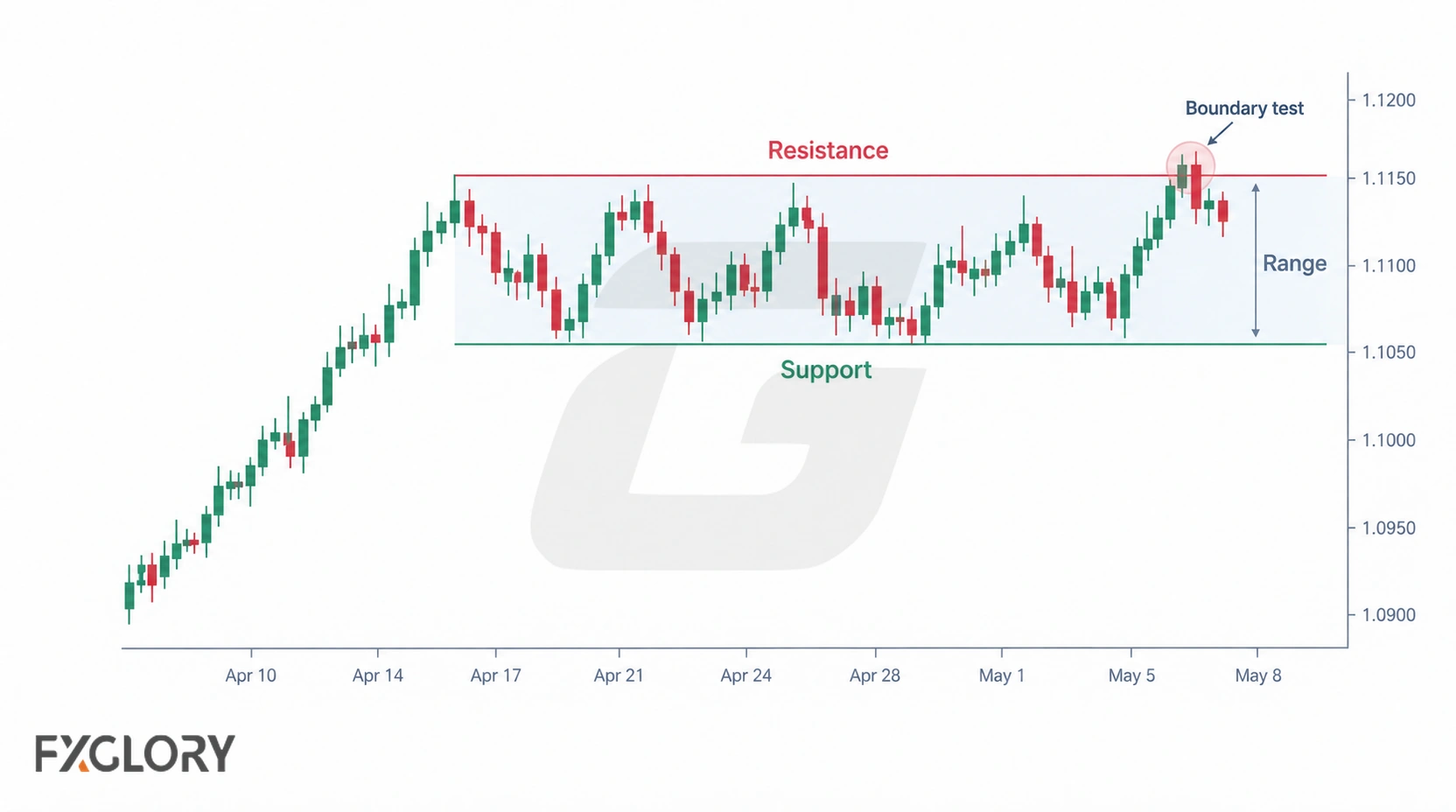
The same structure can appear after a rise, after a decline or in a sideways market. Its location supplies context, while the next boundary interaction determines whether the range persists or an upside or downside breakout develops. For related structures see the wider chart-pattern framework.
How Forex Rectangle Patterns Form
Repeated rebounds near a lower area and rejections near an upper area gradually establish two broadly level boundaries. Further tests help distinguish a sustained range from one isolated support and resistance reaction.
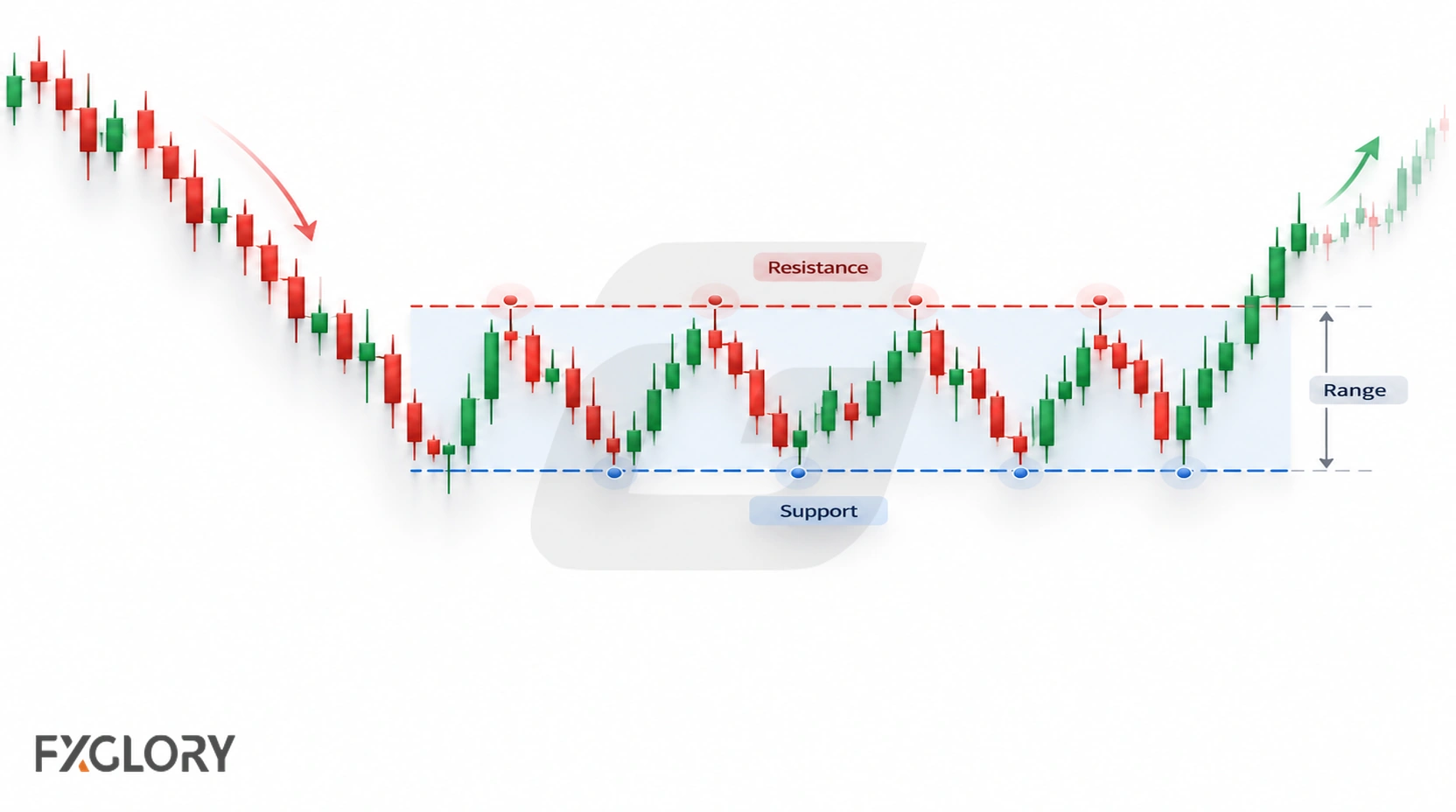
Price may rotate through the same approximate range for many candles. Its width can remain broadly stable; narrowing swings are not required. A move beyond either edge is a later development, not part of the definition of the rectangle itself.
Rectangle Pattern Anatomy
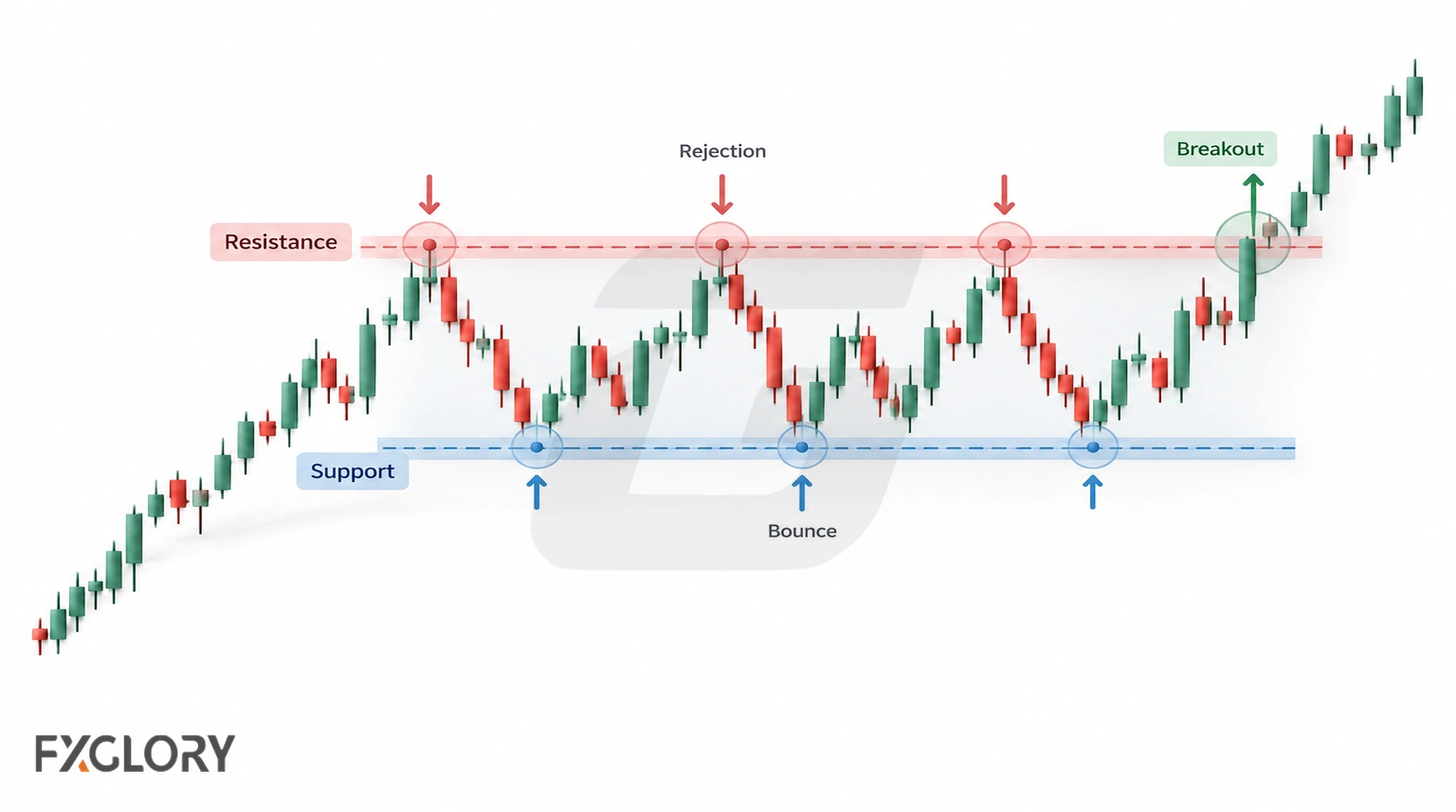
The annotated chart labels the components of a rectangle and distinguishes its range structure from a possible breakout setup.
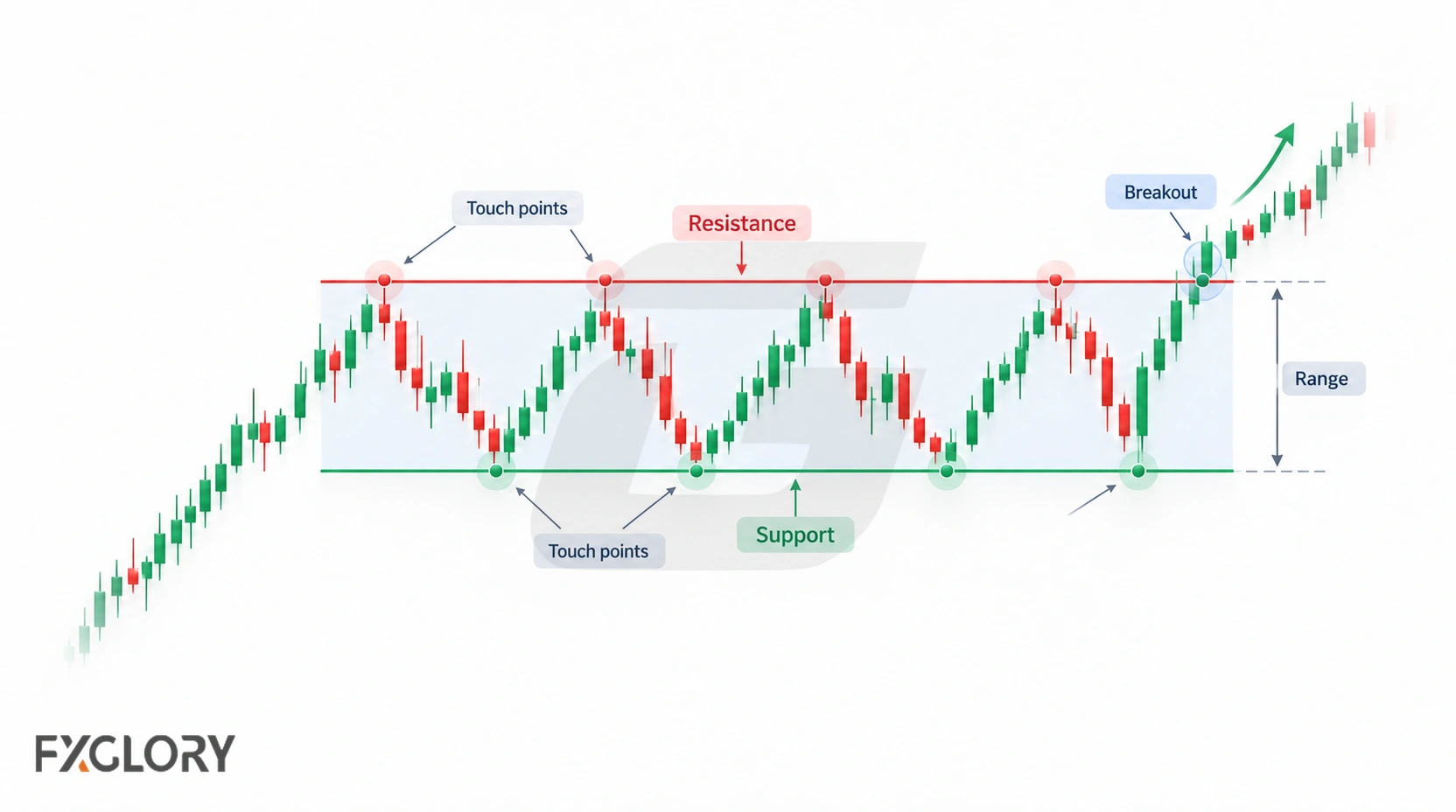
| Part | What It Means | Why It Matters |
|---|---|---|
| Resistance | The upper boundary of the rectangle | Shows where buying attempts have repeatedly struggled |
| Support | The lower boundary of the rectangle | Shows where selling attempts have repeatedly slowed or reversed |
| Range body | The price area between support and resistance | Shows the market rotating inside the rectangle |
| Boundary touches | Repeated reactions near support and resistance | Help confirm that the range is visible to the market |
| Breakout area | The zone where price tries to leave the range | Shows whether the rectangle scenario develops or fails |
| Retest area | The broken boundary may be tested again | A retest can support or weaken the breakout scenario |
| Invalidation point | The condition that makes the rectangle idea wrong | Stops the pattern from becoming an open-ended guess |
Inside the Rectangle: Boundary Reactions
While the rectangle remains intact, tests of the upper and lower zones offer more information about its boundaries than moves near the middle. Small overshoots do not necessarily end the range; repeated large violations may make its original boundaries less useful.
| Inside-Range Behavior | What It May Show | Careful Reading |
|---|---|---|
| Repeated support reactions | Price is still responding near the lower boundary | Support can still fail on a later test |
| Repeated resistance reactions | Price is still responding near the upper boundary | Resistance can still fail on a later test |
| Mid-range hesitation | Price is balanced between the two sides | Mid-range movement gives less information than boundary tests |
| Small overshoots | Price briefly moves beyond a boundary and returns | The boundary may still matter, but false-break risk is present |
| Repeated messy breaks | Price keeps violating both sides of the box | The rectangle may be too noisy or may be changing structure |
Trading reactions inside a range and trading a breakout are distinct approaches. For specific entry and exit rules within a range, see the forex range trading strategy.
Bullish Rectangle Pattern Forex
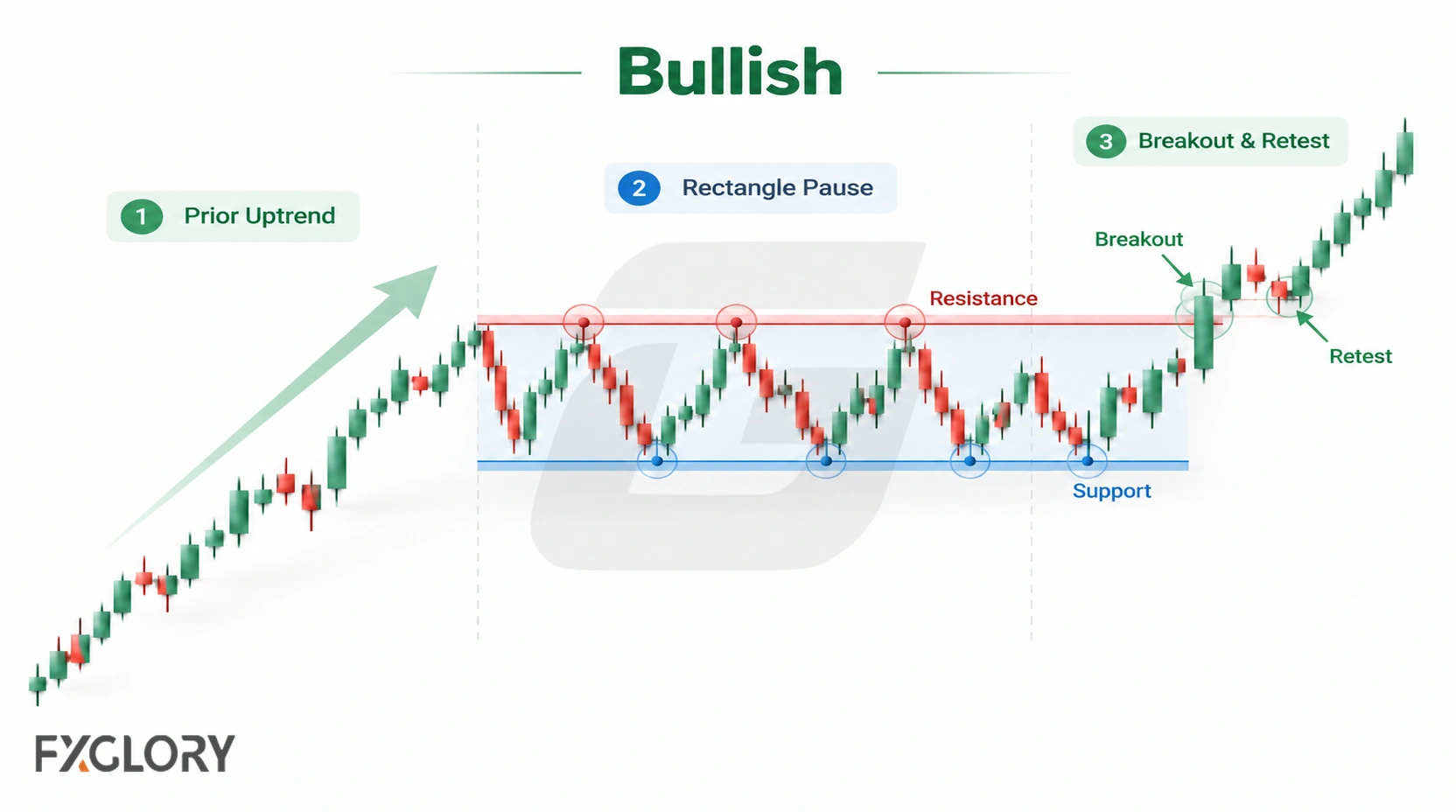
After an upward move, a horizontal pause may be studied as a bullish continuation candidate. An upside break of resistance can support that scenario under the chosen entry rule; a downside break would instead point to a different outcome.
| Bullish Rectangle Part | Useful Reading | Careful Use |
|---|---|---|
| Prior move | Price rises before the rectangle | The prior trend gives context, but does not guarantee continuation |
| Resistance | Price tests the upper boundary several times | A brief spike above resistance can still become a false breakout |
| Support | Price holds near the lower boundary | A break below support can weaken the bullish idea |
| Breakout behavior | Price moves above resistance and tries to hold | Confirmation needs more than one quick wick |
| Invalidation | Price returns inside or breaks the opposite side | The wrong point should be defined before using the pattern |
Bearish Rectangle Pattern Forex
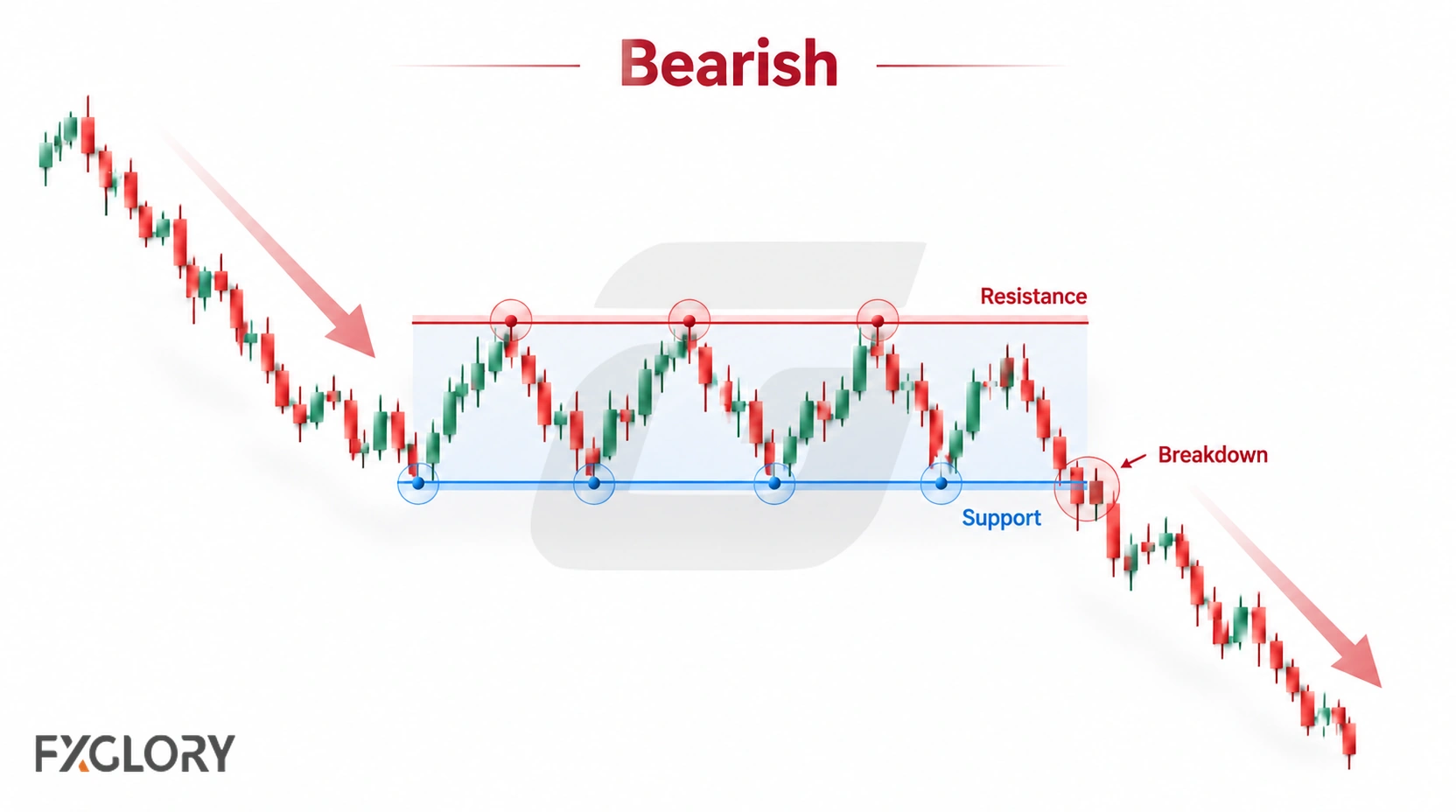
After a downward move, an established rectangle may be studied as a bearish continuation candidate. The relevant event is a qualifying move below support; a move through resistance instead challenges the expected continuation.
| Bearish Rectangle Part | Useful Reading | Careful Use |
|---|---|---|
| Prior move | Price falls before the rectangle | The prior trend gives context, but does not guarantee continuation |
| Support | Price tests the lower boundary several times | A brief spike below support can still become a false breakdown |
| Resistance | Price fails near the upper boundary | A break above resistance can weaken the bearish idea |
| Breakout behavior | Price moves below support and tries to hold | Confirmation needs more than one quick wick |
| Invalidation | Price returns inside or breaks the opposite side | The wrong point should be defined before using the pattern |
Rectangle Pattern: Continuation or Reversal?
A breakout in the direction of the preceding move is called continuation; one against it may introduce a reversal scenario. If neither boundary is broken, the market remains range-bound. A failed breakout describes the attempted escape, not necessarily an invalid rectangle.
| Rectangle Context | What It Looks Like | Careful Reading |
|---|---|---|
| Continuation rectangle | Price breaks out in the same direction as the prior move | The breakout still needs confirmation and invalidation |
| Reversal rectangle | Price breaks against the prior move | The range may have acted as a distribution or accumulation area |
| Neutral rectangle | Price rotates without a clear directional break | The market may still be balanced or waiting for new information |
| Failed rectangle | Price breaks out and returns inside the range | The breakout may have been a false move or liquidity sweep |
See broader reversal context and trend-pause pattern context for the distinct trend interpretations.
Clean vs Noisy Rectangle Patterns
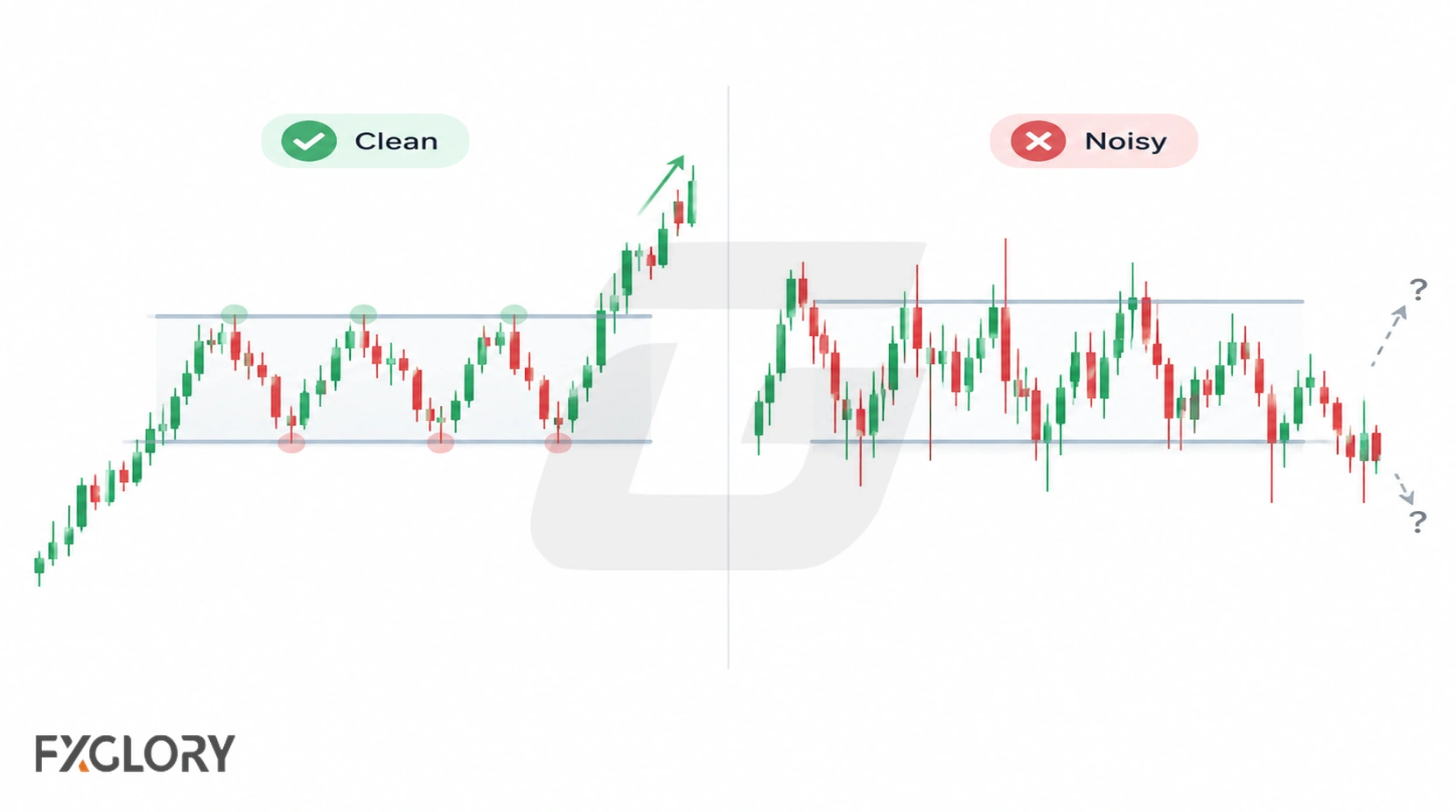
The key quality issue is whether the chosen horizontal zones describe repeated reactions without continual adjustment. A well-defined range may still experience a failed breakout; clarity of identification does not establish the probability of success.
| Range Feature | Cleaner Rectangle | Noisier Rectangle |
|---|---|---|
| Support | Several reactions near a similar lower area | Support keeps shifting or depends on one extreme wick |
| Resistance | Several reactions near a similar upper area | Resistance keeps changing or is hard to define |
| Overshoots | Small overshoots return quickly and do not destroy the range | Large overshoots repeatedly break both sides |
| Range body | Most price action stays inside the rectangle | Price spends too much time outside the supposed box |
| Breakout quality | Price leaves the range and holds or retests clearly | Price breaks out and snaps back inside repeatedly |
Rectangle vs Flag, Pennant, Wedge, Triangle, and Channel
Boundary geometry and preceding price movement help distinguish a rectangle from other consolidations. Unlike converging triangles and wedges, the rectangle does not require narrowing width.
| Structure | Main Boundary Shape | Typical Context | Careful Reading |
|---|---|---|---|
| Rectangle | Horizontal support and resistance | Range, pause, continuation, or reversal | Needs repeated boundary reactions and breakout confirmation |
| Flag | Small parallel channel after a sharp flagpole | Usually continuation after impulse | Needs a clear flagpole before the pause |
| Pennant | Small converging triangle after a sharp move | Usually compact continuation compression | Compression is more triangular than a rectangle |
| Wedge | Converging sloped boundaries | Continuation or reversal context | Angle and context matter more than the shape alone |
| Triangle | Converging, ascending, descending, or symmetrical compression | Compression before a directional decision | One or both boundaries usually differ from a rectangle’s horizontal box |
| Channel | Parallel boundaries that may slope upward, downward, or sideways | Trend channel, range channel, or corrective movement | Without horizontal support/resistance, it may not be a rectangle |
Compare the dedicated guides to flags, pennants, wedges and triangles if the boundaries fit another shape.
How to Confirm a Forex Rectangle Breakout
First distinguish identifying the range from confirming a breakout. Some methods require a completed candle close outside support or resistance; others wait for continued trading beyond the boundary or a successful retest. These are alternative criteria, not cumulative requirements.
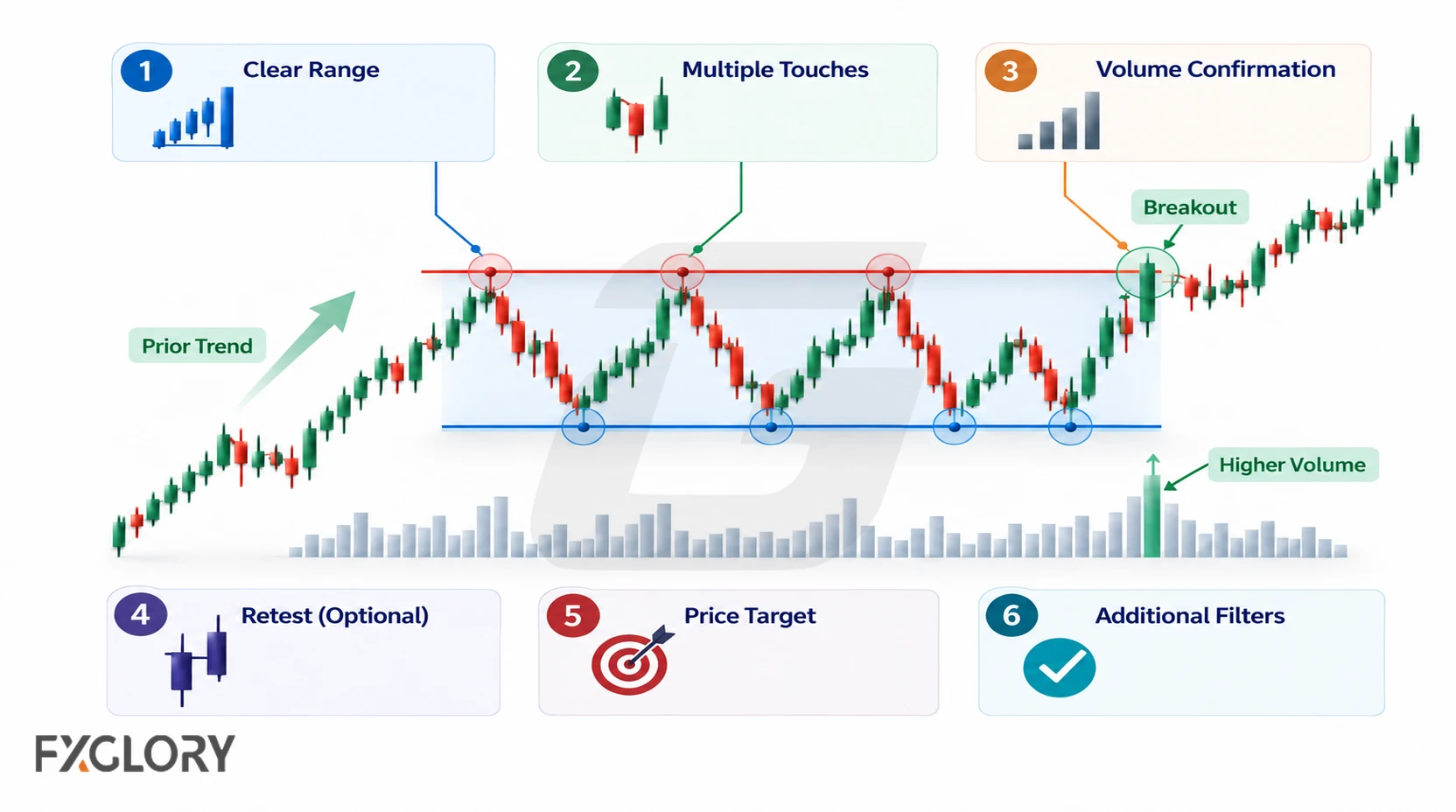
- Identify the range: Draw support and resistance zones from observable repeated reactions.
- Choose the direction-neutral trigger: State what qualifies as an upside break or downside break before reviewing an outcome.
- Observe the response: Check whether price meets the specified close, hold or retest rule; a retest may never occur.
- Define the trade cancellation: Mark the price event that would invalidate that particular entry, separately from the rectangle’s geometric existence.
- Review execution: Account for the spread, slippage, news timing, position size and available reward relative to risk.
For detailed breakout execution and testing rules, see the forex breakout strategy.
Invalidation: Range, Breakout and Trade Failure
No breakout is not rectangle invalidation. If price continues to respect both boundaries, the range remains intact even though a breakout idea has not triggered. Keep three different assessments separate:
- Range reassessment: Repeated sustained moves beyond the original zones may establish a new trading area, making the old box a poor description.
- Failed breakout: Price meets a boundary-break condition but returns into the range and triggers the chosen failure rule.
- Trade invalidation: Price reaches the predefined cancellation or stop level for a specific entry; this may differ from the opposite rectangle boundary.
An upside breakout into nearby higher-timeframe resistance, or a downside breakout toward higher-timeframe support, can leave little room for the planned objective without making the original rectangle invalid. A news release can cause a brief spike, a sharp reversal or a newly established range; assess the resulting price action rather than using the event itself as a failure criterion.
False Rectangle Breakouts
A false breakout occurs when a move beyond an edge does not sustain the qualifying breakout condition. A wick outside the box may not trigger a close-based method at all, while a qualifying breakout that later reverses can fail after entry.
| False Signal | What It Looks Like | Careful Reading |
|---|---|---|
| Single wick outside | Price pierces support or resistance and returns inside quickly | The boundary may still be active |
| Breakout without hold | Price closes or moves outside, then fails to remain there | The breakout may lack follow-through |
| Retest failure | Price retests the broken boundary and moves back into the range | The breakout idea weakens |
| Both-side sweep | Price breaks one side, then the other side, without direction | The range may be too noisy or news-driven |
| News spike | A fast event-driven move breaks the range suddenly | Review subsequent candle closes and whether price establishes a new area outside the range |
| Thin-liquidity move | Price breaks during quiet market conditions and quickly reverses | Thin liquidity can increase abrupt movement and slippage; compare the chart-price return with the chosen confirmation rule |
Spread affects quoted and executable prices; thin liquidity can increase abrupt movement and slippage. Neither alone proves that the underlying range failed.
Rectangle Scanner and Automation Caution
Automated detection can identify candidate horizontal zones, but results depend on the algorithm’s lookback window, tolerance for overshoots and definition of repeated reactions. Check whether historical rectangles are redrawn after new bars arrive and whether breakout alerts rely on completed candles or live intrabar prices.
A scanner flag is a pattern candidate, not a verified entry or execution result.
Rectangle Measuring Principle
One conventional objective measures the distance between support and resistance and projects that height beyond a breakout level. It is a geometric reference, not an estimate of how far price must travel.
| Step | What It Does | Careful Use |
|---|---|---|
| Measure height | Estimate the distance between support and resistance | The range height depends on clean boundaries |
| Watch breakout | Identify where price leaves the rectangle | A breakout can still fail |
| Use as reference | Project the height beyond the breakout area | The projection is only a scenario, not a promise |
| Check invalidation | Define where the idea becomes wrong | Invalidation should come before target focus |
A projection is useful only when compared with the structural cancellation level, nearby price barriers and execution costs. It provides no verified win rate or probability of reaching the reference.
Forex Context: Sessions, News, Spread, Slippage, and Timeframes
A rectangle formed during a quiet session can face a different execution environment during major economic news or a session overlap. Distinguish candle-price evidence from whether an order could be filled near the illustrated boundary.
- Spread: A wider bid-ask difference may trigger an order or change its effective cost even when a chart of one quoted price appears to hold a level.
- Slippage and liquidity: Thin depth and rapid movement can result in fills away from intended entry or stop prices.
- News: Observe whether price returns inside, remains outside or creates a new range after a volatility event.
- Higher-timeframe levels: Check the distance from an upside break to resistance or from a downside break to support when evaluating reward relative to risk.
Volume and Tick Activity in Forex Rectangle Patterns
Spot forex does not have one consolidated market-wide transaction-volume feed. Broker tick counts may offer activity context around a boundary test, but readings can vary by feed and do not establish the direction of the next move. See tick-volume reading in forex for details.
Using Indicators and Candles With Rectangle Patterns
Use supplementary indicators to answer a distinct question, such as recent volatility or momentum near the boundary, rather than treating multiple signals as mandatory breakout confirmation.
| Tool Type | What It Can Help Read | Careful Use |
|---|---|---|
| Momentum indicators | Whether pressure is building near support or resistance | Momentum can change before price confirms direction |
| Trend-strength indicators | Whether the market is ranging or trending | They may lag during fast breakouts |
| Volatility indicators | Whether movement is expanding or contracting inside the range | High volatility can make false breaks more common |
| Candlestick reactions | Short-term rejection or hesitation near boundaries | One candle is not the same as rectangle confirmation |
| Tick activity | Activity around support, resistance, breakout, or retest areas | It is supporting context, not centralized market volume |
ATR describes recent price-range variation, candlestick behaviour provides shorter-term price reactions, and the indicator guide covers trend and momentum tools.
Example: Reading a Rectangle Pattern on GBP/USD
Hypothetical illustration, not a live signal: Suppose GBP/USD has repeatedly rebounded from one support zone and retreated from a horizontal resistance zone. The rectangle remains intact while price trades between them.
Under a method requiring a completed candle close above resistance, a wick through that boundary followed by a close inside would not qualify. A completed close beyond it would trigger an upside scenario; a later return within the range might invalidate that trade under its exit rule. A different method could instead evaluate a downside close below support.
No observed prices, outcomes or backtest results are implied.
Common Mistakes With Forex Rectangle Patterns
Beyond ordinary boundary recognition, avoid errors that make retrospective charts look easier to trade than they were:
- Moving the box after the move: Repeatedly shifting historic boundaries to accommodate a preferred breakout.
- Changing triggers after entry: Substituting an intrabar touch for the originally required candle close.
- Conflating range and trade failure: Treating continued range movement as a failed breakout when no breakout trigger occurred.
- Ignoring executable prices: Calculating risk from idealised chart levels without the spread or realistic slippage.
A Practical Way to Read Rectangle Patterns in Forex
The rectangle is useful for distinguishing persistent horizontal range behaviour from a separately defined breakout. Establish the box from price reactions, choose whether to study range trading or breakout trading, and apply rules consistently without rewriting the boundaries after the outcome.