
What Are Bollinger Bands in Forex?
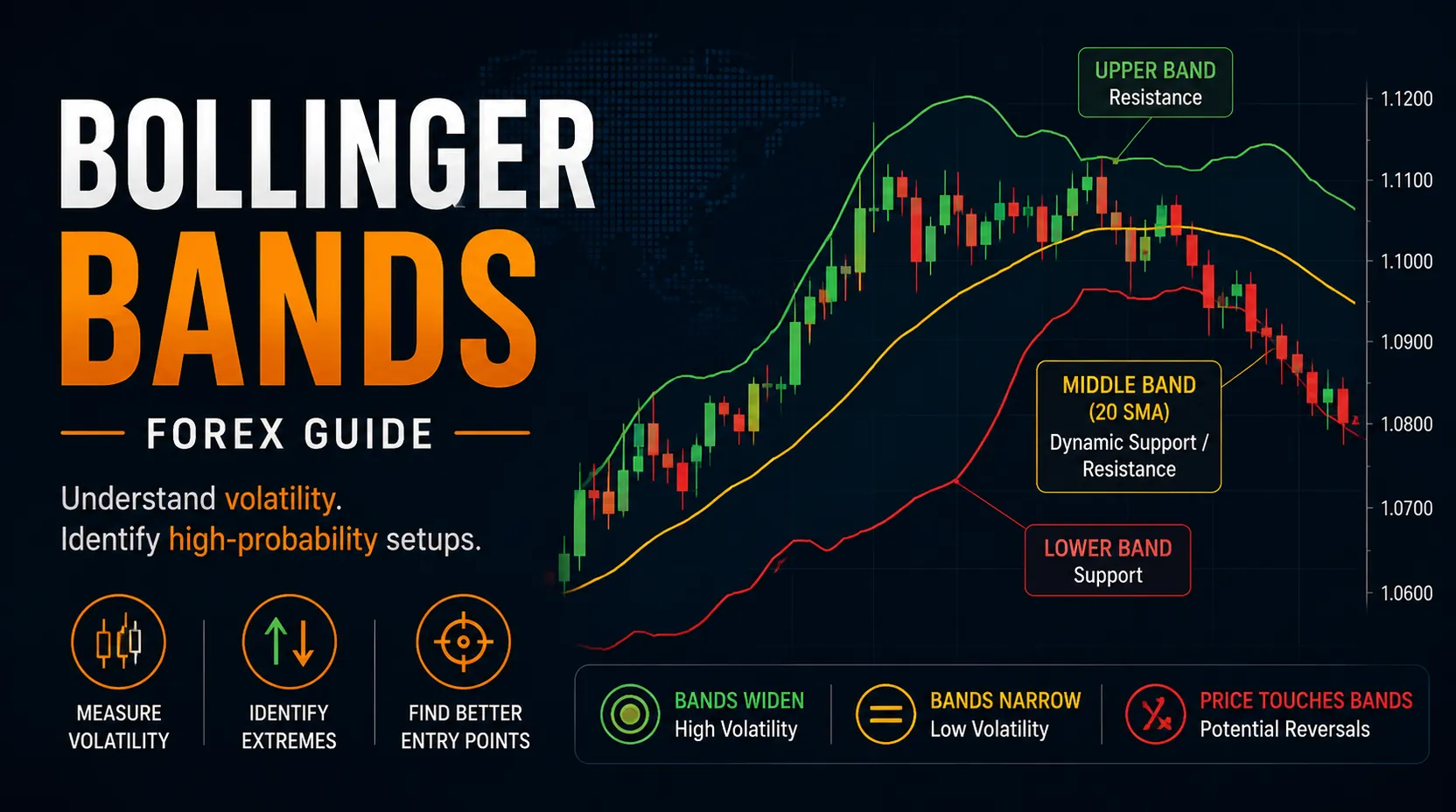
Bollinger Bands are volatility bands plotted around a moving-average centerline. In forex trading, they are used to review where price is positioned relative to a middle band and volatility-adjusted upper and lower bands.
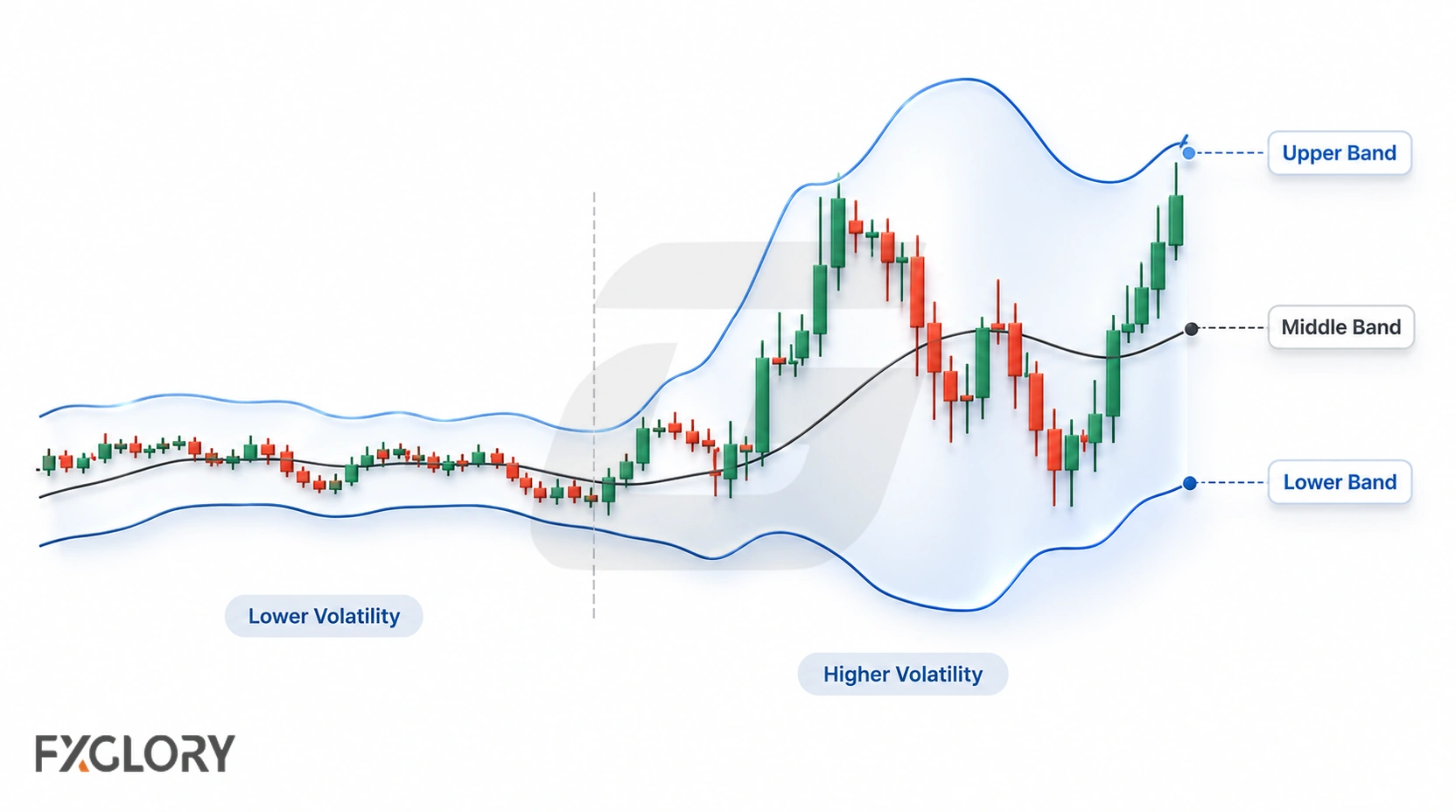
Bollinger Bands were developed by John Bollinger in the 1980s and are built around the idea that volatility changes over time. When volatility expands, the bands usually widen. When volatility contracts, the bands usually narrow.
A band touch is not a trade command. A squeeze is not a guaranteed breakout. A close outside a band is not automatic proof of continuation or reversal. Bollinger Bands only help organize price-location and volatility-band questions.
For the average range-size side of volatility, review ATR range-size context.
How Bollinger Bands Work in Forex
Bollinger Bands usually place an upper band and lower band around a middle moving average. The bands expand and contract based on volatility. This lets the trader review whether price is near the upper band, near the lower band, near the middle band, or moving outside the bands.
The bands do not decide direction. Price can touch the upper band during a trend, a range, a breakout attempt, or a false move. Price can touch the lower band during weakness, range behavior, or a fast volatility spike.
- Widening bands: Volatility may be expanding, but direction still needs price context.
- Narrowing bands: Volatility may be compressing, but breakout direction is not confirmed.
- Price near upper band: Price is near the upper volatility band, not automatically overbought or ready to reverse.
- Price near lower band: Price is near the lower volatility band, not automatically oversold or ready to reverse.
- Price near middle band: Price is near the moving-average centerline and may need structure context.
Upper Band, Middle Band, Lower Band, BandWidth, and %B
Bollinger Bands become easier to read when each part has a separate job. The upper band, middle band, lower band, BandWidth, and %B should not all be treated as the same signal.
| Component | What it shows | Main misuse |
|---|---|---|
| Upper band | Upper volatility band around price | Treating every upper-band touch as a reversal signal |
| Middle band | Moving-average centerline, commonly a 20-period SMA | Treating the middle band as guaranteed support or resistance |
| Lower band | Lower volatility band around price | Treating every lower-band touch as a reversal signal |
| BandWidth | How wide or narrow the bands are | Treating narrow bands as guaranteed breakout timing |
| %B | Where price sits relative to the bands | Treating price location as a complete trade signal |
Bollinger Bands Formula in Plain English
Bollinger Bands commonly use a 20-period simple moving average, or SMA, as the middle band. The upper and lower bands are commonly placed two standard deviations above and below that middle band.
In plain English, Bollinger Bands ask: where is price compared with its recent average, and how wide is the current volatility range around that average?
| Formula part | Plain-English meaning | Common default |
|---|---|---|
| Middle band | Recent average price path | 20-period simple moving average |
| Upper band | Upper volatility boundary around the average | Middle band plus 2 standard deviations |
| Lower band | Lower volatility boundary around the average | Middle band minus 2 standard deviations |
| Standard deviation | How spread out recent price has been around the average | Often 2, but not universal |
BandWidth and %B in Forex
BandWidth and %B are optional Bollinger Band concepts. They can help review band expansion, compression, and price location, but they should not become separate trade commands.
- BandWidth: Reviews how wide the upper and lower bands are compared with the middle band.
- Low BandWidth: Can show compression or quiet volatility, but it does not confirm breakout timing.
- High BandWidth: Can show expanded volatility, but it does not confirm clean direction.
- %B: Reviews where price sits relative to the bands, such as near the upper band, lower band, or outside the bands.
Bollinger Band Touches Are Not Signals
A touch of the upper or lower Bollinger Band only shows where price is relative to a volatility band. It does not confirm reversal, continuation, breakout, entry, or exit by itself.
Price can touch the upper band in a strong upward move and keep moving near that band. Price can touch the lower band in a strong downward move and keep pressing near that band. A band touch becomes more useful only when it is checked with structure, levels, trend context, and volatility behavior.
- Upper-band touch: Price is near the upper volatility band, but this does not automatically mean price is too high.
- Lower-band touch: Price is near the lower volatility band, but this does not automatically mean price is too low.
- Close outside a band: Movement may be strong, abnormal, or extended, but direction still needs confirmation.
- Middle-band reaction: The moving-average centerline may matter only if price structure supports it.
Bollinger Band Squeeze in Forex
A Bollinger Band squeeze appears when the upper and lower bands narrow. This shows volatility compression. It can happen before stronger movement, but it does not reveal direction or timing by itself.
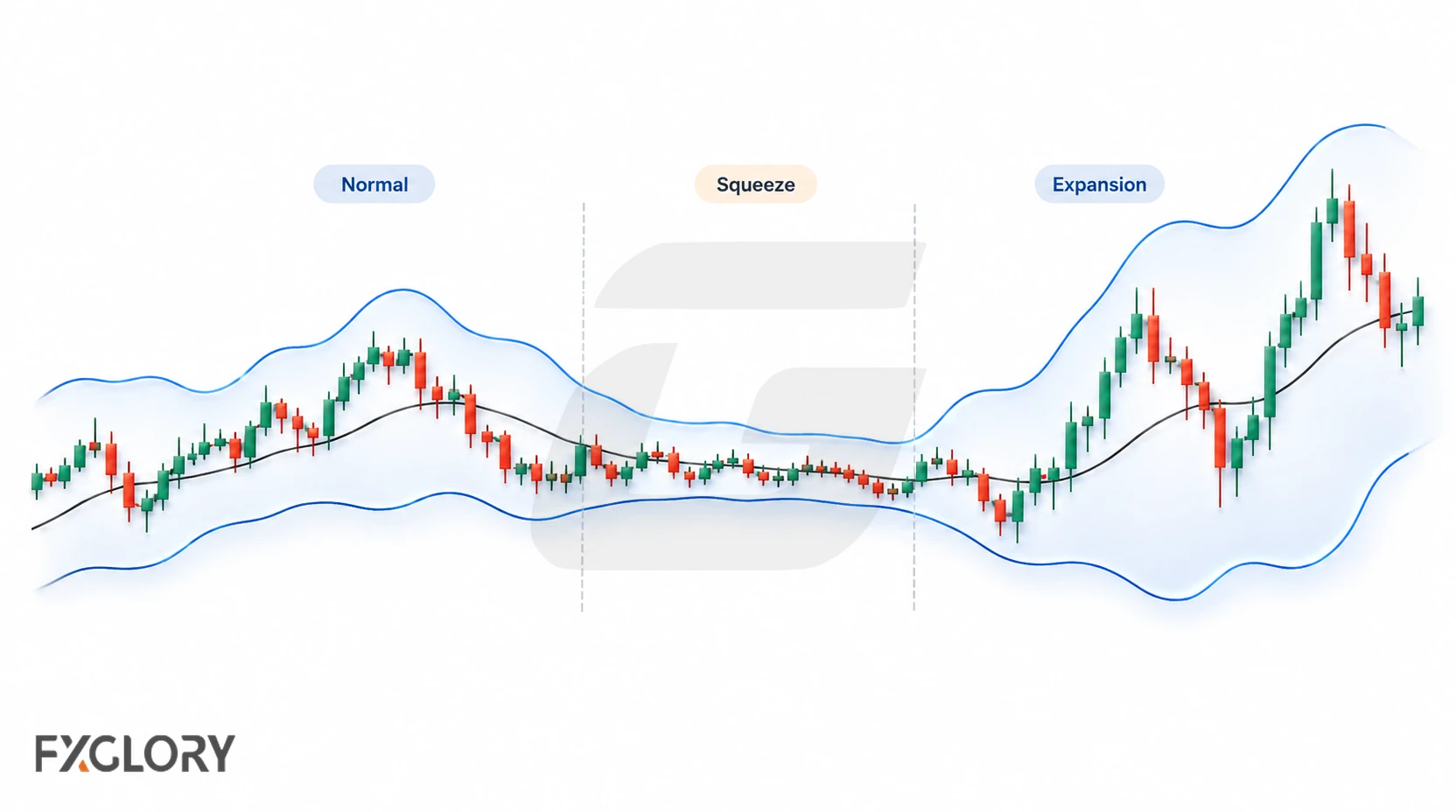
Many false assumptions start here. Narrow bands do not guarantee a breakout. A breakout attempt after a squeeze can fail, reverse, or turn into more sideways movement.
| Band behavior | What it suggests | What it does not confirm |
|---|---|---|
| Narrowing bands | Volatility may be contracting | Does not confirm breakout timing |
| Squeeze | Price may be compressed inside a quieter range | Does not confirm breakout direction |
| Band expansion after squeeze | Volatility may be increasing | Does not confirm continuation by itself |
| Failed expansion | Breakout attempt may be weak or unstable | Does not confirm reversal by itself |
When a squeeze forms near a clear level, review support and resistance zones before trusting the move.
Bollinger Band Walk in Forex
A band walk happens when price keeps moving near or outside one Bollinger Band during a strong directional move. This is one reason simple reversal assumptions can fail.
During upward pressure, price may keep pressing near the upper band. During downward pressure, price may keep pressing near the lower band. A band walk does not make price safe or predictable, but it warns against fading every band touch without trend context.
- Upper-band walk: Price keeps moving near the upper band while upward pressure remains active.
- Lower-band walk: Price keeps moving near the lower band while downward pressure remains active.
- Middle-band hold: Price may use the middle band as a dynamic reference only when structure supports it.
- Band-walk failure: Price stops holding near the band and structure begins to weaken.
Bollinger Bands in Ranging Markets vs Trending Markets
Bollinger Bands behave differently in ranges and trends. In a range, the bands may frame price rotation. In a trend, price can move along one band for longer than expected.
| Market condition | Bollinger Band behavior | Main risk |
|---|---|---|
| Quiet range | Bands may narrow and price may rotate between areas | False breakout assumptions |
| Active range | Band touches may repeat on both sides | Treating every touch as a reversal |
| Strong trend | Price may walk one band | Fighting trend pressure too early |
| Breakout attempt | Bands may expand after compression | Assuming expansion confirms direction |
| News volatility | Bands may widen quickly | Confusing volatility spike with clean structure |
When band behavior conflicts with price structure, review market structure context before trusting the reading.
Bollinger Bands Settings in Forex
The common Bollinger Bands setting uses a 20-period simple moving average with bands two standard deviations above and below the middle band. This does not make it the best setting for every pair, timeframe, or market condition.
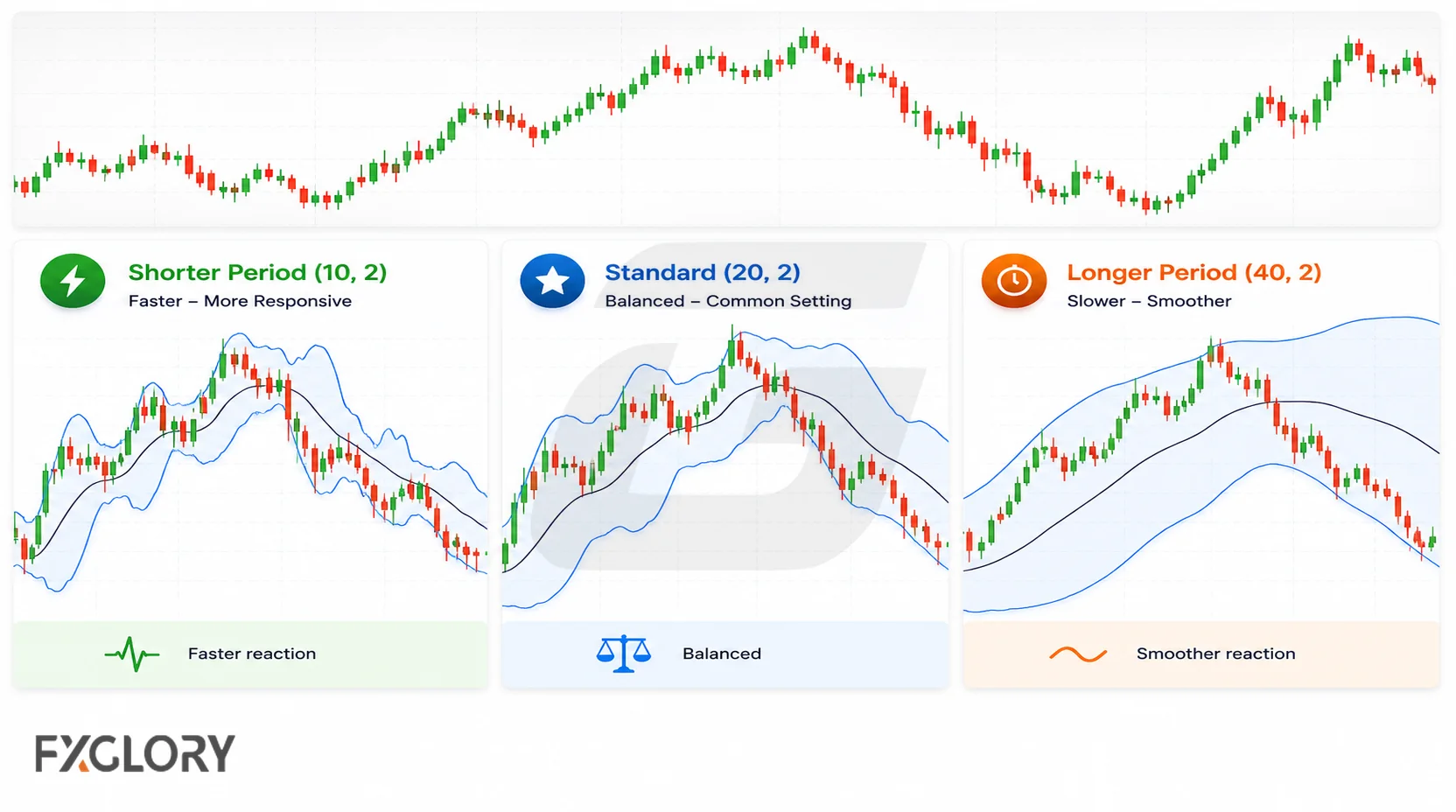
Shorter settings may react faster but can become noisy. Longer settings may smooth the bands but react later. Changing the period or standard-deviation setting only to make old examples look cleaner can create curve fitting.
- 20-period middle band: Common default, not a universal rule.
- 2-standard-deviation bands: Common default, not a guarantee that price must stay inside the bands.
- Shorter setting: Faster band reaction, more noise.
- Longer setting: Smoother band reaction, slower response.
- Changing settings too often: Can make past examples look better without improving future review.
Bollinger Bands vs ATR, ADX, Moving Averages, and RSI
Bollinger Bands are often compared with ATR, ADX, moving averages, and RSI. These tools can support each other, but they do not answer the same chart question.
| Tool | Main job | What Bollinger Bands add |
|---|---|---|
| Bollinger Bands | Volatility bands and price-location review | Shows where price sits relative to volatility-adjusted bands |
| ATR | Average range-size review | Separates band behavior from average movement distance |
| ADX | Trend-strength review | Helps check whether band movement appears inside weak or strong trend conditions |
| Moving averages | Smoothing and trend-following context | Explains the centerline foundation behind the bands |
| RSI | Gains-and-losses momentum pressure | Can support momentum context when price is near a band |
For related context, use the ATR range-size guide, the ADX trend-strength guide, and the moving-average centerline guide.
How to Use Bollinger Bands in Forex Without Treating Them as Signals
Start with market condition, then read band width, price location, band behavior, and price structure. The goal is to decide whether Bollinger Bands clarify the chart question, not to turn a band touch or squeeze into a trade command.
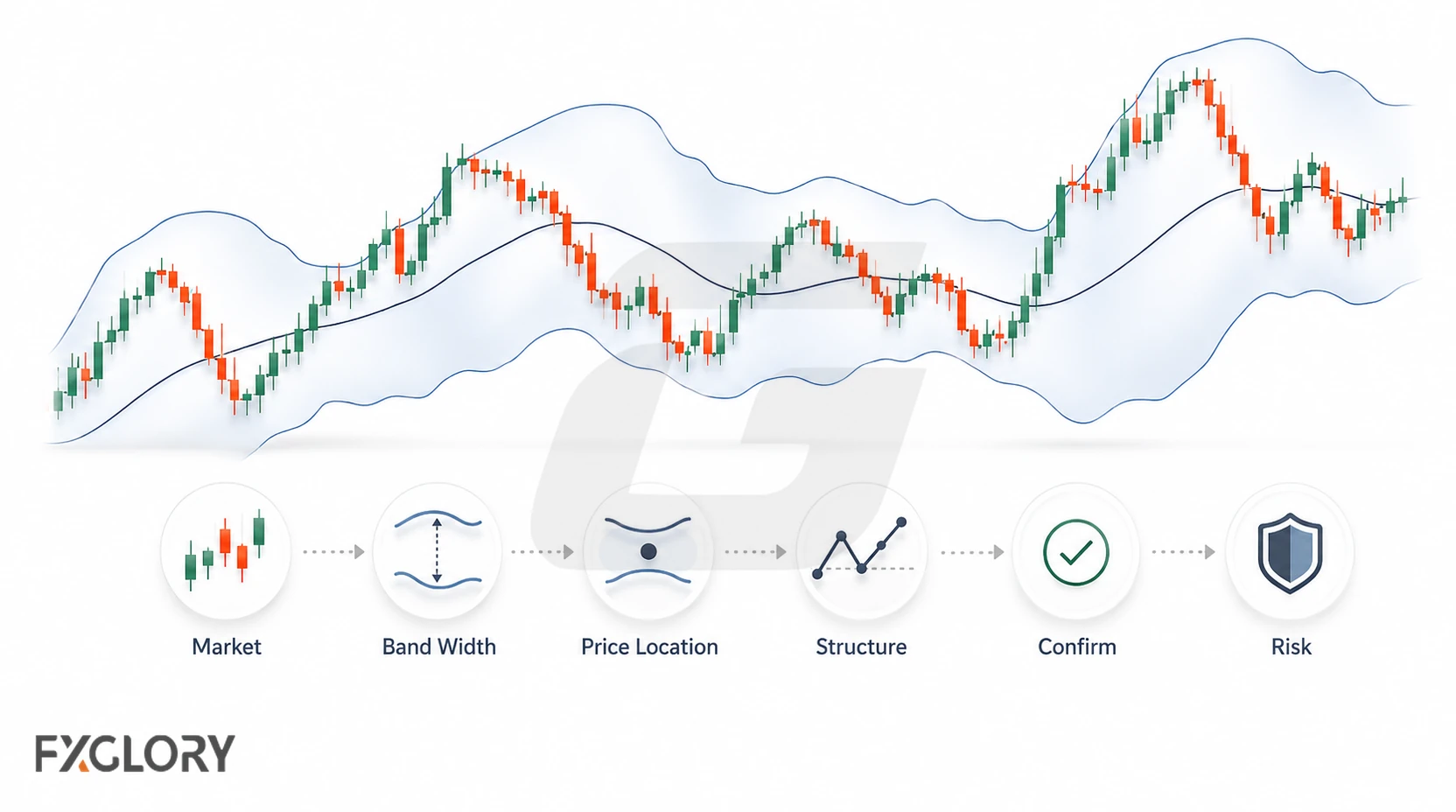
- Name the condition: Range, squeeze, trend, band walk, breakout attempt, chop, or high volatility.
- Read band width: Are the bands expanding, contracting, stable, or abnormal?
- Read price location: Is price near the upper band, lower band, middle band, or outside the bands?
- Check range or trend context: Is price rotating, walking a band, breaking out, or moving inside unclear structure?
- Check price levels: Is the band behavior near support, resistance, a range edge, or a retracement zone?
- Check confirmation: Has price reacted, failed continuation, broken structure, or shown clear follow-through?
- Define invalidation: Know where the Bollinger-based idea is wrong before using it in a plan.
Bollinger Bands with Confirmation Checks
A Bollinger Band reading becomes more useful when it is connected to price context. Confirmation does not remove risk, but it can reduce the chance of treating every band touch, squeeze, or band break as a trade idea.
- Price location: Is the band touch near support, resistance, a range edge, or a retracement zone?
- Market structure: Has price shown breakout, failed breakout, continuation, rejection, band walk, or unclear chop?
- Trend context: Is price walking a band, rotating inside a range, or moving against broader structure?
- Volatility context: Are bands expanding naturally, compressing, or widening because of abnormal movement?
- Momentum context: Does another tool support the pressure reading, or is the band reading isolated?
- Risk rule: Can the trader explain where the idea is wrong before using it in a plan?
For confirmation beyond Bollinger Bands, review support and resistance zones, market structure context, and price action in forex.
Live Market Examples: Matching Bollinger Bands to Chart Questions
The first step is to identify the Bollinger Band question, not to treat every band touch or squeeze as a signal.
| Market page | Bollinger Band question | Context to check |
|---|---|---|
| EUR/CHF live chart | Are narrow bands showing quiet range behavior? | Range boundaries, support/resistance, and spread sensitivity |
| EUR/GBP live chart | Is a band touch happening inside a range? | Price location, market structure, and repeated band reactions |
| GBP/USD live chart | Are bands expanding after compression? | Breakout quality, structure reaction, and follow-through |
| Gold live chart | Is price walking a band during a strong move? | Trend pressure, volatility, and late reversal risk |
| BTC/USD live chart | Are bands widening because of abnormal volatility? | Spread, volatility spike, execution conditions, and structure clarity |
Bollinger Bands False-Signal Filters
Use these filters when Bollinger Bands look active but the chart condition does not support the reading.
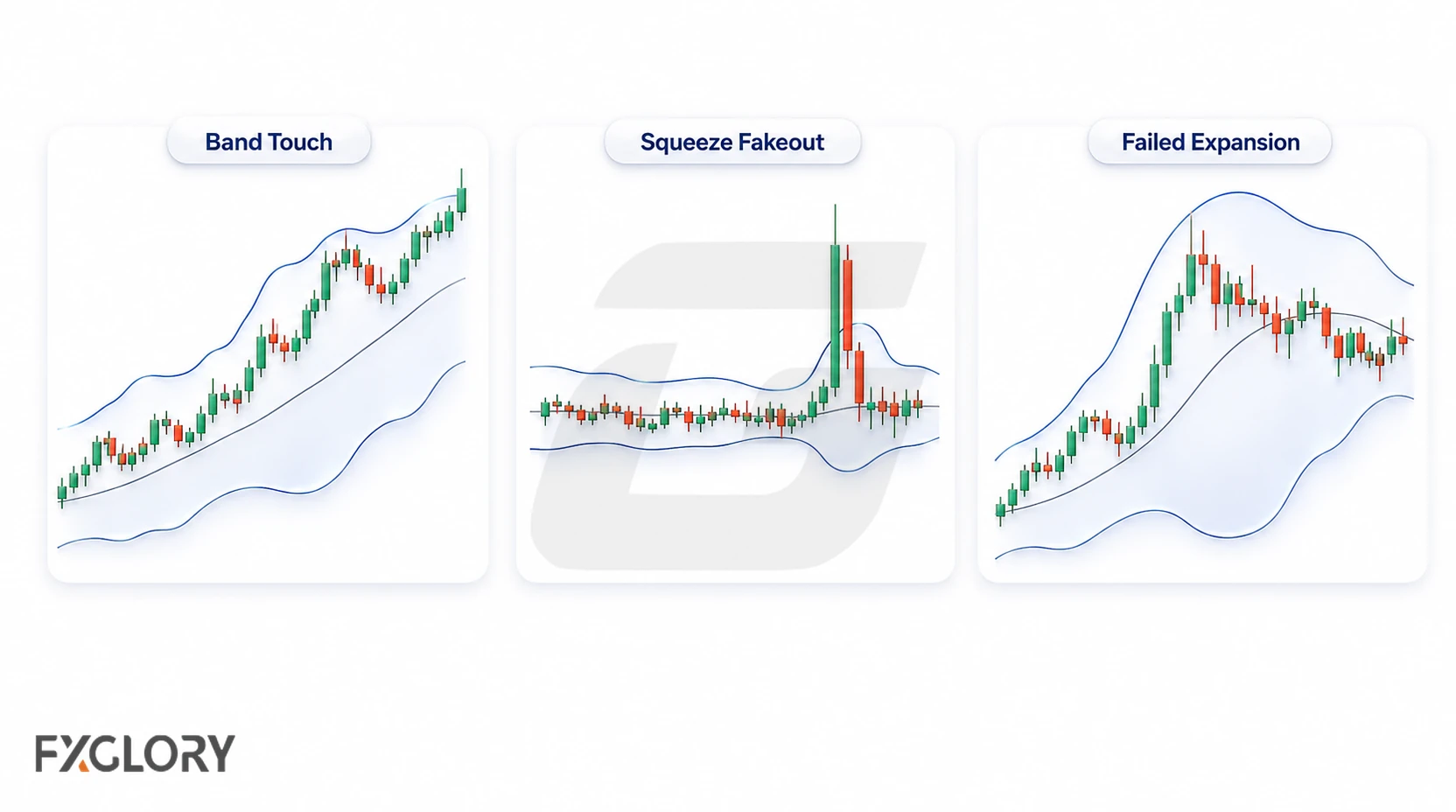
| Filter | Problem it catches | What to check |
|---|---|---|
| Band-touch filter | Upper or lower band touch treated as a reversal signal | Trend context, structure, and price reaction |
| Band-walk filter | Price keeps pressing one band during a strong move | Trend pressure, middle-band behavior, and continuation quality |
| Squeeze-direction filter | Narrow bands treated as guaranteed breakout direction | Range boundary, structure, and confirmation |
| False-breakout filter | Band expansion after squeeze fails to continue | Follow-through, retest behavior, and failed-breakout risk |
| No-structure filter | Band reading appears without price structure support | Support/resistance, swing structure, and invalidation |
| Wrong-market-condition filter | Range logic is used in a trend or trend logic is used in a range | Market condition, band walk, and price rotation |
| Settings-overfit filter | Band settings are changed only to make old examples look clean | Testing across ranges, trends, news, and volatility |
| Low-timeframe-noise filter | Band touches repeat on a noisy lower timeframe | Broader structure and timeframe alignment |
| News-volatility filter | Bands widen sharply because of event-driven movement | News risk, spread behavior, and liquidity conditions |
| No-invalidation filter | No clear place where the idea is wrong | Risk distance and invalidation rule |
How to Test Bollinger Bands in Forex
Bollinger Bands should be tested inside one market condition at a time. Testing them across random charts without separating ranges, trends, squeezes, band walks, volatility spikes, and news conditions can create misleading results.
- Choose the Bollinger job: Price-location review, squeeze review, band-walk review, range reaction, breakout context, or volatility expansion check.
- Choose the market condition: Quiet range, active range, trend, squeeze, breakout attempt, high volatility, or unclear structure.
- Choose the setting: Record whether the bands use 20 periods and 2 standard deviations or another setup.
- Read band width: Mark whether bands are narrow, wide, expanding, contracting, or abnormal.
- Read price location: Mark whether price is near the upper band, middle band, lower band, or outside the bands.
- Name the confirmation layer: Support/resistance, structure, trend context, volatility regime, momentum, or invalidation.
- Define the trigger: Write the exact price behavior that would confirm the Bollinger Band reading.
- Define invalidation: Write the price behavior that would make the idea wrong.
- Check spread and slippage context: Record whether trading costs or execution conditions could affect the setup.
- Record the failure type: Band-touch misuse, band-walk failure, squeeze fakeout, false breakout, no structure, wrong market condition, settings overfit, low-timeframe noise, news volatility, or no invalidation.
Bollinger Bands are useful only if they make the volatility-band and price-location question clearer. If they encourage prediction, hide price structure, or cannot be tied to invalidation, they should not stay in the plan.
A Practical Way to Use Bollinger Bands in Forex
Start with the market condition. Read band width, price location, squeeze or band-walk behavior, price structure, confirmation, and invalidation. If the Bollinger Band reading does not make the chart question clearer, ignore it.
Bollinger Bands do not need to predict the next move. They only need to support one part of a clear process: volatility-band review, price-location context, squeeze review, band-walk warning, range reaction, or false-breakout filter.
For comparing Bollinger Bands with other volatility tools, use the forex volatility indicator guide. For comparing Bollinger Bands with trend, momentum, volatility, and strength tools, use the best indicators for forex guide.