

Quick Answer: What Are The Main Types Of Forex Traders?
The main types of forex traders are scalpers, day traders, swing traders, position traders, trend traders, range traders, breakout traders, news traders, technical traders, fundamental traders, sentiment traders, and algorithmic traders. Some people also discuss copy traders or signal followers, but following another person or system is not the same as developing a trading process.
The most useful way to compare forex trader types is by asking four questions: how long does the trader usually hold a position, how often do they make decisions, what information do they use, and which risks are most important for that style?
A trader type does not measure skill or expected profit. Each style has different constraints: scalping is highly cost- and execution-sensitive; day trading demands more active monitoring; swing and position trading add overnight and longer-horizon exposure; news trading can face unstable execution; and algorithmic trading depends on the quality and robustness of its rules.
If you need the basic role first, start with what a forex trader does before choosing a style. If you are still building the beginner path, use the step-by-step forex trader learning roadmap before selecting a trading style.
The foreign exchange market is large and active, but size does not make any trader type safe or predictable. The Bank for International Settlements reported OTC foreign exchange turnover of $9.6 trillion per day in April 2025, yet individual trading results still depend on risk control, costs, execution, market conditions, and discipline.
Trader Type vs Trading Strategy: Why The Difference Matters
A trader type describes the broad way a trader participates in the market. It can describe holding time, screen time, decision speed, analysis method, or market trigger. A trading strategy is narrower. It defines the actual rules for setup selection, entry, stop, target, cancellation, position sizing, and review.
This difference matters because two traders can share the same type but use completely different strategies. Two day traders may both close positions before the day ends, but one may trade breakouts and the other may trade pullbacks. Two swing traders may both hold for several days, but one may use trend structure and the other may use support and resistance.
| Label | What It Describes | Example | Why It Is Not Enough Alone |
|---|---|---|---|
| Trader type | Broad style, timeframe, decision rhythm, or market approach. | Scalper, swing trader, news trader, technical trader. | It does not define exact entry, stop, target, or risk rules. |
| Trading strategy | Specific rules used to review and manage trades. | Breakout-and-retest, trend pullback, range fade, news reaction plan. | It still needs cost checks, position sizing, and execution rules. |
| Trading plan | The written operating rules for the trader. | Pairs, sessions, risk per trade, setup checklist, stop logic, review process. | It only helps if the trader follows and updates it honestly. |
Before choosing a label, write down the rules that would make the style usable. FXGlory's trading plan template helps turn a trader style into written rules instead of a loose preference.
The Four Core Timeframe Types Of Forex Traders
Most beginner guides start with four timeframe-based trader types: scalpers, day traders, swing traders, and position traders. This is a useful starting point because holding time affects spread sensitivity, screen time, stop distance, overnight exposure, emotional pressure, and how often a trader must make decisions.
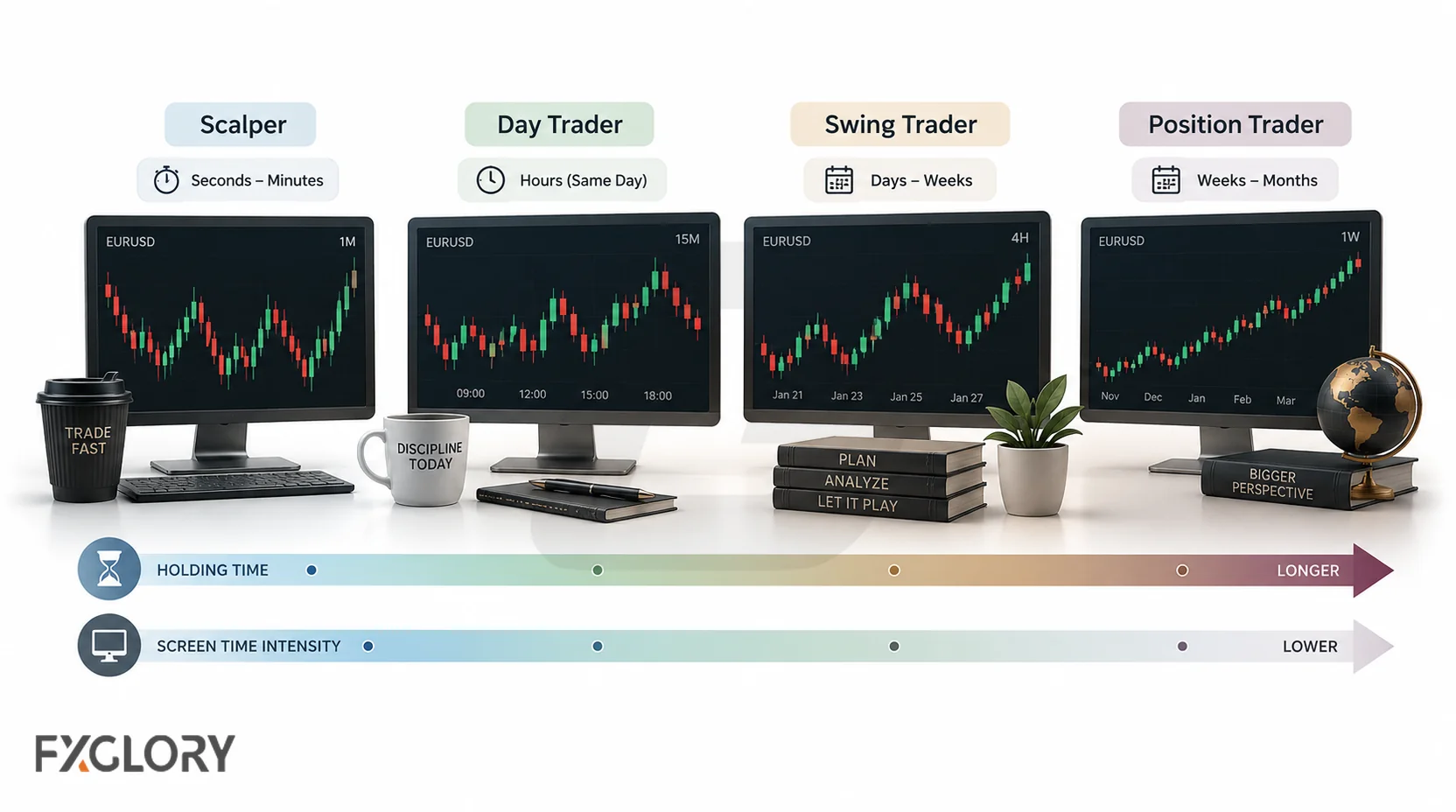
These four labels are not rigid boxes. A scalper and a day trader are both short-term traders, but their pace is different. A swing trader and a position trader may both hold beyond one session, but the position trader usually takes a longer view and needs more tolerance for macro events and drawdowns.
| Core Type | Typical Holding Time | Decision Speed | Main Pressure | Important Caution |
|---|---|---|---|---|
| Scalper | Seconds to minutes. | Very fast. | Spread, slippage, execution, focus, overtrading. | Small targets can be damaged quickly by cost and poor execution. |
| Day trader | Minutes to the same trading day. | Fast to moderate. | Screen time, session volatility, intraday discipline. | More activity does not mean better decisions. |
| Swing trader | Several days or sometimes longer. | Moderate. | Overnight risk, swap or rollover, wider stops, patience. | Less screen time does not remove risk. |
| Position trader | Weeks, months, or longer. | Slower. | Macro risk, larger drawdowns, capital tolerance, long patience. | A long-term view can still be wrong or poorly sized. |
Scalpers
A forex scalper looks for small price movements and may enter and exit trades within seconds or minutes. Scalpers usually rely on short timeframes, fast decisions, and strict exit rules, so spread, slippage, and execution quality can materially affect small targets.
Scalping gives rapid feedback, but that pace also increases decision and execution pressure. Frequent spread costs, slippage, platform hesitation, and emotional re-entry can quickly undermine a weak process.
- Scalping may be unsuitable when: the trader does not understand spread, slippage, execution delay, risk per trade, or the emotional pressure of frequent decisions.
- Cost check: Before studying scalping, review how spread conditions affect small target trades.
- Deeper guide: For rules, limitations, and risk review, use FXGlory's forex scalping guide.
Day Traders
A forex day trader usually opens and closes positions within the same trading day. Day traders may trade session movement, intraday trends, range breaks, pullbacks, or scheduled-event reactions. They usually avoid carrying trades overnight, but they still face intraday volatility and execution risk.
Day trading often needs focused screen time to monitor specific sessions, review scheduled events, wait for setups, execute without delay, and stop when predefined limits are reached.
- May fit: Traders who can monitor charts during active periods and follow same-day risk limits.
- Main risk: Fast decision cycles can lead to overtrading, revenge trading, or ignoring spread and stop rules.
- Deeper guide: Review same-day trading rules before using intraday setups.
Day trading is not the same as scalping. A scalper may take very short trades and focus on tiny movements. A day trader can still take short trades, but the broader rule is that positions are usually closed before the trading day ends.
Swing Traders
A forex swing trader looks for medium-term price swings. Swing trades may last several days or sometimes longer, depending on the setup, timeframe, and market movement. Swing traders often use support, resistance, trend structure, candlestick context, chart patterns, or fundamental themes to review whether a move has room to continue.
Swing trading usually needs less constant screen time than scalping or day trading, but holding positions across sessions can create overnight exposure, swap or rollover considerations, wider stop placement, and vulnerability to unexpected events.
- May fit: Traders who cannot watch charts all day but can review markets consistently and accept overnight uncertainty.
- Main risk: A wider holding period can create larger floating losses if position size is not controlled.
- Deeper guide: Compare swing-trading structure and risk before holding trades beyond one session.
Position Traders
A forex position trader takes a longer-term view. Position traders may hold trades for weeks, months, or longer when the plan is based on broad market direction, interest-rate expectations, inflation, central-bank policy, economic cycles, or long-term technical structure.
Position trading requires patience and risk control. Longer holding periods can expose the trader to policy changes, geopolitical shocks, rollover costs, larger drawdowns, and delayed feedback, so fewer trades do not necessarily mean simpler decisions.
- May fit: Traders who can think in longer timeframes and do not need frequent market action.
- Main risk: Larger stop distances and longer exposure can make poor position sizing very damaging.
- Deeper guide: Study position-trading risk before holding longer-term trades.
Other Forex Trader Types By Market Approach
Some trader types are based less on holding time and more on what kind of market behavior they look for. These labels can overlap with the four timeframe types. A day trader can be a breakout trader. A swing trader can be a trend trader. A position trader can use fundamental analysis. A news trader can trade intraday or avoid trading until the event reaction is clearer.
| Market-Approach Type | What The Trader Looks For | Common Risk | Helpful Next Step |
|---|---|---|---|
| Trend trader | Continuation of a directional move or broader market rhythm. | Entering late, ignoring pullbacks, or assuming every move will continue. | Review trend-trading rules before following momentum. |
| Range trader | Price movement between support and resistance or repeated range boundaries. | Trading a range just as it breaks or using stops too close to noise. | Review range-trading conditions before fading levels. |
| Breakout trader | Movement beyond support, resistance, ranges, trendlines, or compression zones. | False breakouts, late entries, spread expansion, and chasing candles. | Check breakout rules before trading range breaks. |
| News trader | Scheduled releases, central-bank events, employment data, inflation data, or sudden headlines. | Fast spreads, slippage, price gaps, whipsaws, and unclear execution conditions. | Understand news-event risk before trading releases. |
Trader Types By Decision Method
Forex traders can also be grouped by the kind of information they rely on. This is different from timeframe. A technical trader can scalp, day trade, or swing trade. A fundamental trader can be a swing trader or position trader. An algorithmic trader can automate rules for several styles.
| Decision-Method Type | Main Input | Useful For | Main Caution |
|---|---|---|---|
| Technical trader | Charts, price structure, levels, indicators, patterns, volatility. | Organizing entries, exits, invalidation, and market context. | Technical tools do not predict the future and can conflict with each other. |
| Fundamental trader | Rates, inflation, growth, central banks, employment, policy, macro themes. | Understanding why currencies may reprice over broader periods. | Fundamentals can take time to affect price and can be overwhelmed by short-term positioning. |
| Sentiment trader | Risk appetite, positioning, market mood, crowded trades, volatility changes. | Understanding when price may be affected by fear, risk-on/risk-off flows, or positioning pressure. | Sentiment is difficult to measure precisely and can change quickly. |
| Algorithmic trader | Predefined rules, automated systems, scripts, expert advisors, or quantitative filters. | Reducing manual execution mistakes and testing rule consistency. | Automation can fail because of bad rules, overfitting, execution issues, platform problems, or changing markets. |
Technical traders who are still learning chart structure can start with how to read forex charts before applying trader labels. Traders comparing timeframe fit can also review how timeframe choice changes screen time and risk behavior.
Copy Traders And Signal Followers: Important Caution
Some market education pages include copy traders or signal followers as a type of forex trader. The label can describe a person who follows another trader, signal provider, system, or social-trading feed. It should be handled carefully.
Copying a trader does not mean the follower understands the pair, stop placement, leverage, margin, spread, or reason for the trade. It also does not prove that the copied trader's past performance will continue. A signal can lose money, arrive late, or become unsuitable for a different account size or risk limit.
This page uses copy trading only as a market-education term. It does not describe it as an FXGlory service or as a substitute for learning risk management.
Retail, Professional, And Beginner Traders Are Different Labels
Retail trader, professional trader, and beginner trader describe the trader's context, not one specific strategy style. A retail trader uses personal capital through a broker account. A professional forex trader may trade as a job for an institution, company, fund, brokerage, or proprietary trading firm, or operate under a client mandate. A beginner trader is still learning the mechanics, risks, and process.
These labels can overlap with the style labels above. A retail trader can be a swing trader. A professional trader can be a day trader. A beginner may be studying scalping but not ready to trade it live. The label only becomes useful when it is connected to responsibilities, rules, and risk limits.
| Label | What It Describes | What It Does Not Prove |
|---|---|---|
| Retail forex trader | A person trading personal capital through a broker account. | It does not define timeframe, skill, income, or safety. |
| Professional forex trader | A trader with a job, mandate, employer, client responsibility, or formal trading role. | It does not guarantee profit and does not define one strategy. |
| Beginner forex trader | A trader still learning market mechanics, platform use, risk, and process. | It does not mean the trader should rush into live exposure. |
| Trader style | How the trader approaches timeframes, decisions, or market triggers. | It does not replace a trading plan. |
For the role distinction, read how retail and professional forex traders differ in responsibility and expectations.
Types Of Forex Traders Comparison Table
The table below compares common trader types by workflow, risk, and cost pressure. It is a selection aid, not a ranking. A style that suits one trader may not suit another with a different schedule, account size, temperament, or level of preparation.
| Trader Type | Holding Time | Screen Time | Common Tools | Main Cost Or Risk Pressure | May Suit | Should Avoid If |
|---|---|---|---|---|---|---|
| Scalper | Seconds to minutes. | Very high. | Short-term charts, price action, spread checks, rapid execution rules. | Spread, slippage, execution speed, overtrading. | Traders with strict rules, focus, and cost awareness. | You react emotionally to small losses or do not understand trading costs. |
| Day trader | Intraday. | High. | Session analysis, intraday levels, news calendar, technical setups. | Fast decisions, screen fatigue, same-day volatility. | Traders with scheduled market time and strong discipline. | You cannot monitor positions or stop after daily limits are hit. |
| Swing trader | Days or sometimes longer. | Moderate. | Support, resistance, trend structure, patterns, volatility, fundamentals. | Overnight events, swap or rollover, wider stops. | Traders who can review markets consistently but not all day. | You cannot tolerate open-position uncertainty between sessions. |
| Position trader | Weeks, months, or longer. | Lower but consistent. | Macro themes, higher timeframes, central-bank context, longer-term levels. | Large drawdowns, event risk, patience, position sizing. | Traders who prefer long-term analysis and fewer decisions. | You need frequent feedback or cannot tolerate slow invalidation. |
| Trend trader | Varies. | Varies by timeframe. | Trendlines, moving averages, structure, pullback rules. | Late entries, trend exhaustion, false continuation. | Traders who can wait for confirmation and accept pullbacks. | You chase every moving candle without a stop or invalidation rule. |
| Range trader | Varies. | Moderate. | Support, resistance, oscillators, range boundaries, rejection candles. | Breakouts, false level reads, stops placed inside noise. | Traders who can wait near planned boundaries. | You trade in the middle of ranges without clear levels. |
| Breakout trader | Short to medium. | Moderate to high. | Levels, close confirmation, retest rules, volatility filters. | False breakouts, chasing, spread expansion. | Traders who can wait for planned levels and cancel late trades. | You enter after large candles without room for risk and target. |
| News trader | Very short to short-term. | High around events. | Economic calendar, release times, volatility rules, no-trade filters. | Slippage, widened spread, whipsaw, execution uncertainty. | Experienced traders who understand event risk and can stand aside. | You expect news direction to be simple or guaranteed. |
| Algorithmic trader | Depends on system. | Monitoring varies. | Rules, scripts, expert advisors, testing, logs, risk limits. | Bad assumptions, over-optimization, platform or execution issues. | Traders who can test, monitor, and understand rule behavior. | You expect automation to remove risk or replace judgment. |
Which Forex Trader Type May Fit You?
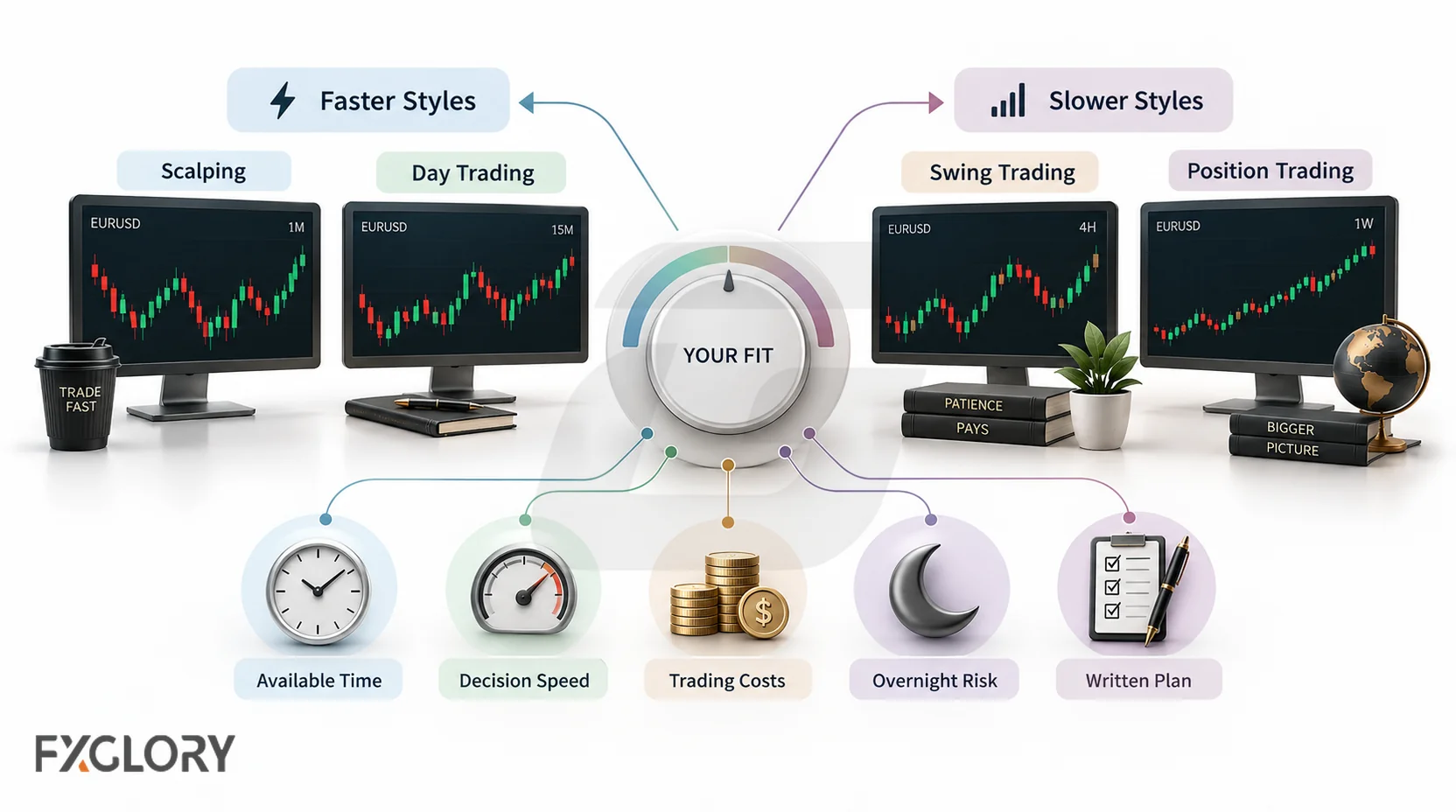
Choosing a forex trading style is not only about preference. A style should match available time, decision pace, risk limits, account conditions, trading costs, and the ability to follow a written process. A style that looks appealing may still be impractical if it requires more monitoring or faster decisions than the trader can sustain.
| Question | Why It Matters | Possible Style Direction |
|---|---|---|
| How much time can I watch the market? | Short-term styles need more attention and faster reaction. | Less time may point toward swing or position research, not scalping. |
| Can I make decisions calmly under pressure? | Fast styles create more emotional triggers. | If not, slower review-based styles may be easier to study first. |
| Do I understand spread, slippage, and execution? | Small target styles are very cost-sensitive. | If not, avoid rushing into scalping. |
| Can I accept overnight exposure? | Swing and position trades can remain open through events. | If not, study same-day styles carefully because they avoid overnight exposure but require more active monitoring. |
| Can I follow a written plan? | Every style fails without repeatable rules. | Use a plan before comparing trader labels. |
| Can I estimate margin before trading? | Leverage and margin pressure can affect every style. | Use a margin estimate before placing leveraged trades. |
Before choosing a style, compare platform workflow, order behavior, and monitoring needs. FXGlory's platform overview can help you review available platform access before building a workflow.
Which Forex Trader Types Should Beginners Avoid Rushing Into?
No trader type is categorically off-limits to beginners, but some styles expose weak preparation more quickly. Scalping, news trading, and poorly tested algorithmic trading are often risky starting points because they require fast decisions, cost awareness, execution understanding, and strong emotional control.
- Scalping: Small targets can be overwhelmed by spread, slippage, and hesitation.
- News trading: Price can move sharply in both directions, and execution conditions may change quickly.
- Algorithmic trading: Automation can repeat a bad rule faster than a manual trader can recognize the mistake.
- Style hopping: Moving from one style to another after every loss prevents proper review.
A slower style is not automatically safer, but it can give a beginner more time to observe, record, and review decisions. If the learning path is still unclear, return to the beginner roadmap for becoming a forex trader.
Cost And Risk Checks Before Choosing A Trader Type
Forex trader types differ in cost and risk pressure. A style that looks workable on a chart may be unsuitable once spread, slippage, swap or rollover, margin, and position sizing are considered.
| Check | Why It Matters | Where It Often Matters Most |
|---|---|---|
| Spread | Spread is part of the cost of entering and exiting. | Scalping and short-term day trading. |
| Slippage | Execution may differ from the expected price in fast or thin conditions. | News trading, breakout trading, fast intraday trading. |
| Swap or rollover | Holding positions beyond the trading day can involve overnight cost or adjustment. | Swing trading and position trading. |
| Margin requirement | Margin determines how much account equity is needed to hold leveraged exposure. | All styles, especially larger or longer-held positions. |
| Leverage | Leverage can magnify both profit and loss. | All styles, especially when position size is too large. |
| Stop distance | Wider stops require smaller position sizing if risk is controlled. | Swing trading, position trading, volatile pairs. |
Review spread conditions before judging small-move styles, leverage conditions before sizing positions, and margin requirements before opening leveraged exposure.
Common Mistakes When Choosing A Forex Trader Type
New traders may choose a style based on excitement, social media examples, or the promise of fast results. A more useful comparison considers time, risk, cost, temperament, and account conditions.
- Choosing the fastest style first: Fast decisions can hide weak planning and increase emotional mistakes.
- Confusing style with skill: Calling yourself a scalper, swing trader, or position trader does not prove that you have an edge or a plan.
- Ignoring trading costs: Spread, slippage, and swap or rollover can change whether a style is practical.
- Switching after every loss: One losing trade does not prove a style is wrong, and one winning trade does not prove it is right.
- Copying another trader's schedule: A style that fits one trader's time zone, account size, and temperament may not fit yours.
- Using too much leverage: Higher exposure can make an ordinary loss large enough to damage the account.
- Skipping records: Without a journal, the trader cannot tell whether the style is being followed or constantly changed.
- Trading news without a plan: Event movement can be fast, but direction, spread, and fill quality can be uncertain.
- Expecting automation to fix discipline: An automated rule can repeat poor logic consistently.
Before using any style live, build a rule set around risk, setup quality, trade management, and review. FXGlory's risk-management guide can help define limits before choosing any trader label.