

How Do You Become A Forex Trader?
Start by learning how forex trades work and how risk is created. Then practice the trading workflow on demo, write rules for entries, exits, position size and maximum loss, keep records, and review account conditions before deciding whether live trading is appropriate.
Opening an account is not the same as being ready to trade. You should be able to explain what you are buying or selling, how much exposure you are taking, where the trade idea becomes invalid, and how a loss would affect the account. For the role itself, start with what a forex trader actually does.
Before You Start: Retail Trader Or Professional Career?
The first decision is not which strategy to use. The first decision is what you mean by becoming a forex trader.
If your goal is to learn forex trading with your own account and capital, you are following the retail path. If your goal is to trade, research, or analyze currencies as a job, you are considering a professional career path. These paths overlap in market knowledge, but they differ in capital source, accountability, qualifications, tools, and expectations.
| Path | What It Means | What To Focus On First | Important Caution |
|---|---|---|---|
| Retail forex trader | You study and trade with personal funds through a broker account. | Forex basics, demo practice, risk rules, position size, platform workflow, trading plan, and account conditions. | You carry the financial risk. There is no salary or guaranteed income. |
| Professional forex trading career | You trade, research, analyze, or manage currency exposure as part of a job or institutional role. | Finance education, economics, quantitative skills, research, internships, analyst roles, institutional risk controls, and employer requirements. | A job title does not remove trading risk or guarantee performance. |
If you are unsure which path applies to you, review the difference between retail and professional forex traders before building your learning plan.
Step 1: Understand What Forex Traders Actually Do
A forex trader takes positions in currency pairs, but the job is more than choosing buy or sell. A basic trading process includes reading the quote, checking market conditions, sizing the position, planning the exit, monitoring costs and margin, and reviewing the decision afterward.
| Trader Task | What The Beginner Must Learn | Why It Matters |
|---|---|---|
| Read the quote | Base currency, quote currency, bid, ask, and spread. | The trader must know which price is used before entry or exit. |
| Choose trade size | Lot size, pip value, account balance, and risk per trade. | Position size controls how a price move affects the account. |
| Check exposure | Leverage, margin requirement, free margin, and stop-out risk. | Too much exposure can create fast losses. |
| Plan the trade | Setup, invalidation, entry reason, exit logic, and conditions to avoid. | Rules reduce emotional decisions. |
| Review the result | Outcome, mistake, condition, spread, slippage, and behavior. | Records help show whether the process is repeatable. |
For the actual trade-opening workflow, use FXGlory's step-by-step guide to how forex trades are opened and managed.
Step 2: Learn Currency Pairs, Quotes, Pips, Lots, Spread, Swap And Leverage
The fastest way to become unsafe in forex is to trade before understanding the numbers on the screen. A beginner does not need to master every advanced strategy first, but they should understand the basic mechanics that affect every trade.
| Concept | Beginner Meaning | Helpful Next Step |
|---|---|---|
| Currency pair | Two currencies priced against each other, such as EUR/USD or GBP/USD. | Review available currency pairs for market study. |
| Bid and ask | The sell side and buy side of a quote. | Understand the two prices before entry. |
| Spread | The gap between bid and ask, and part of trading cost. | Check spread conditions before judging a setup. |
| Swap or rollover | An overnight financing adjustment that may apply when a position is held beyond the trading day. | Understand overnight costs before holding trades. |
| Pip | A standard way to measure price movement in many forex pairs. | Calculate movement before estimating results. |
| Lot size | The trade-size unit that affects pip value and exposure. | Choose trade size with lot-size context. |
| Leverage | Borrowed exposure that can amplify both gains and losses. | Understand leverage before increasing exposure. |
| Margin | Required funds to keep a leveraged position open. | Estimate margin before placing a leveraged trade. |
Do not rush this step. If a trader cannot explain which side of the quote they enter at, how spread affects a new trade, how overnight costs may apply, or how lot size changes risk, live trading is too early.
Step 3: Choose A Few Currency Pairs To Study First
Beginners often make forex harder by watching too many pairs. A smaller watchlist is easier to study because each pair has its own spread behavior, volatility, liquidity, session activity, and news sensitivity.
Many beginners start by studying major pairs because they are widely followed and often have deeper liquidity than less common pairs. That does not make major pairs risk-free. It only means they may be easier to observe consistently than a long list of unfamiliar markets.
| Pair Selection Question | Why It Matters |
|---|---|
| Do I understand the two currencies in the pair? | A trader should know which economies, central banks, and news releases may matter. |
| Is the spread acceptable for my timeframe? | Shorter-term trading is more sensitive to spread and execution cost. |
| When is the pair usually active? | Session timing can affect liquidity and volatility. |
| Does the pair move smoothly or sharply around news? | Some pairs can react strongly to economic data or central-bank comments. |
| Can I track it without becoming overwhelmed? | A smaller watchlist can help beginners study decisions instead of chasing movement. |
For a live market-study starting point, review FXGlory's currency-pair market pages. Use market pages for observation and planning, not as standalone trading instructions.
Step 4: Learn What Moves Forex Prices
Forex prices move because traders, institutions, companies, funds, and other market participants constantly reprice currencies against one another. Price can respond to interest-rate expectations, inflation, employment data, GDP, central-bank policy, risk sentiment, trade flows, political events, commodity links, and surprise news.
Technical analysis can help organize price behavior, but forex is not only chart patterns. A trader should know whether a move is happening during quiet conditions, around a scheduled release, after a central-bank comment, during a risk-off move, or inside a thin-liquidity period.
- Interest rates: Expectations for higher or lower rates can affect currency demand.
- Inflation and employment data: Economic reports can shift expectations quickly.
- Central banks: Policy statements, rate decisions, and speeches can create volatility.
- Risk sentiment: Some currencies behave differently when investors seek safety or risk.
- Liquidity: Thin conditions can widen spreads or increase slippage risk.
- Geopolitics: Unexpected events can move currencies faster than normal chart conditions suggest.
Step 5: Practice On A Demo Account
Use demo trading to rehearse the full platform workflow: place and modify orders, adjust trade size, set stop-loss and take-profit levels, read the trade ticket, monitor margin, close positions, and record decisions without putting real funds at risk.
Demo results are practice evidence, not proof of future live performance. Real money can change behavior, while live conditions can introduce different execution pressure, spread changes, slippage, news volatility, and hesitation after losses.
Before relying on a setup, review past chart examples or backtest clear rules where possible. Historical review cannot prove future results, but it can reveal whether a trader is only reacting to recent wins, social-media examples, or one favorable market condition.
| Demo Task | What To Practice | What It Does Not Prove |
|---|---|---|
| Order placement | Market orders, pending orders, stop loss, take profit, and closing positions. | It does not prove you will act calmly with live money. |
| Position sizing | Lot size, pip value, margin requirement, and account exposure. | It does not remove the risk of over-sizing live trades. |
| Strategy review | Entry logic, exit rules, invalidation, and market conditions. | A short winning demo period does not prove a strategy is robust. |
| Platform workflow | Charts, order tickets, account information, and trade history. | It does not guarantee identical live execution experience. |
| Emotional rehearsal | Following rules after losses or missed moves. | Virtual money does not create the same pressure as real money. |
Use an FXGlory demo account to practice execution, risk calculation, and review habits before judging profit potential.
Step 6: Build A Trading Plan Before Live Trading
A trading plan turns learning into rules. Without a plan, a beginner may change strategy after every loss, increase size after frustration, or enter trades because the chart is moving fast.
A simple forex trading plan should explain what you trade, when you trade, what conditions are required, how you size positions, where you exit, when you stop for the day, and how you review results.
| Plan Area | Question To Answer |
|---|---|
| Market selection | Which pairs will I study, and why these pairs? |
| Time window | When will I review charts, and when will I avoid trading? |
| Setup rules | What must be present before a trade is considered? |
| Risk limit | How much can one trade lose before I stop the idea? |
| Position size | How does lot size match the account and risk limit? |
| Exit plan | Where is the trade invalid, and how will profit or loss be handled? |
| Review method | What will I record after the trade closes? |
| Stop conditions | When should I stop trading because of behavior, news, volatility, or fatigue? |
Use a trading plan template to write rules before risking live funds. A plan should be simple enough to follow and specific enough to expose mistakes.
Step 7: Learn Risk Management Before Strategy Confidence
Many beginners search for the best strategy before they understand loss control. That order is backwards. A strategy can have losing trades, false signals, missed entries, and drawdowns. Risk rules decide whether those losses remain manageable or damage the account.
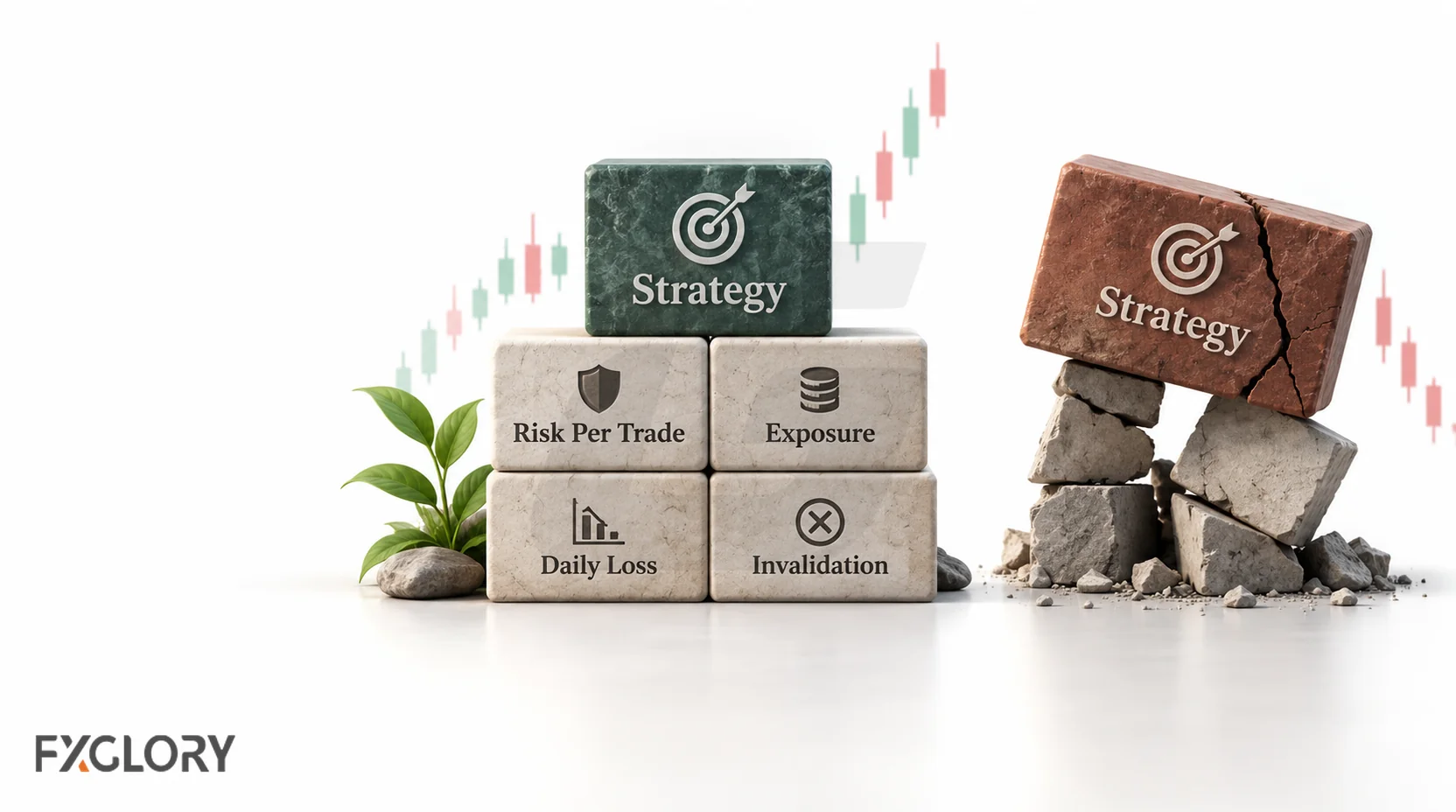
Before live trading, a beginner should know the maximum loss per trade, maximum open exposure, maximum daily or weekly loss, stop-loss logic, margin impact, and when not to trade. Risk management is not a guarantee of safety, but it is a basic requirement for disciplined trading.
- Do not use maximum leverage just because it is available. Available leverage is not the same as appropriate exposure.
- Do not increase lot size to recover losses. Revenge trading can make a bad day worse.
- Do not ignore spread and slippage. Trading cost and execution can change the result.
- Do not trade without invalidation. Every trade idea should have a point where it is no longer valid.
- Do not trade money needed for rent, bills, debt, or emergency needs. Financial pressure can lead to poor decisions.
For a deeper framework, review risk rules before judging whether a trading strategy is usable. To compare lower-exposure choices, review whether trading without leverage fits your learning approach.
Step 8: Keep A Trading Journal
A trader cannot improve what they do not record. A trading journal helps separate repeatable behavior from luck, emotional decisions, random entries, and poor market selection.
The journal does not need to be complicated. It should record enough information to explain why the trade was taken, whether the rules were followed, what the market did, what the trader did, and what should change before the next trade.
| Journal Field | Why It Helps |
|---|---|
| Date and time | Shows whether certain sessions or conditions create better or worse decisions. |
| Currency pair | Shows which pairs you understand and which ones cause mistakes. |
| Setup reason | Forces the trader to define why the trade existed. |
| Entry and exit | Shows whether execution matched the plan. |
| Lot size and risk | Reveals whether position size was controlled. |
| Screenshot or chart note | Preserves context for later review. |
| Emotion and mistake | Helps identify fear, greed, hesitation, revenge trading, or overconfidence. |
| Lesson | Turns the trade into feedback instead of just a profit or loss number. |
For a deeper review process, use the forex trading journal guide. For this roadmap, the main rule is simple: start recording before live trading, not after losses become confusing.
Step 9: Check Account Conditions, Spreads, Platforms And Margin
A forex trader needs a workflow that matches their plan. That means checking the platform, account features, spreads, leverage conditions, margin requirements, order-size rules, and stop-out or margin-call information before placing trades.
These checks should happen before live trading because they affect trade size, execution, cost, and risk. A strategy that looks acceptable without cost, spread, or margin checks may behave differently once real account conditions are included.
| Practical Check | FXGlory Page To Review | Why It Matters |
|---|---|---|
| Account features | Compare account features before choosing an account. | Minimum deposit, lot size, leverage, spreads, commissions, and account availability can differ. |
| Trading conditions | Review order size, margin call, stop-out, and platform conditions. | Account mechanics affect position management and risk. |
| Leverage rules | Review leverage conditions before sizing positions. | Leverage can change exposure and margin pressure. |
| Spread conditions | Check trading costs before judging a setup. | Spread affects entries, exits, and short-term strategies. |
| Margin requirement | Estimate margin before placing a leveraged trade. | Margin checks help prevent accidental overexposure. |
| Platform access | Compare platform access before building a workflow. | Charting, order placement, and account monitoring depend on platform behavior. |
Step 10: Move To Live Trading Only When Risk Is Affordable
Live trading should not be the first place where a beginner learns what leverage, spread, margin, and emotions feel like. A trader may consider live trading only when the money at risk is affordable to lose, the plan is written, the platform workflow is familiar, and position size is controlled.
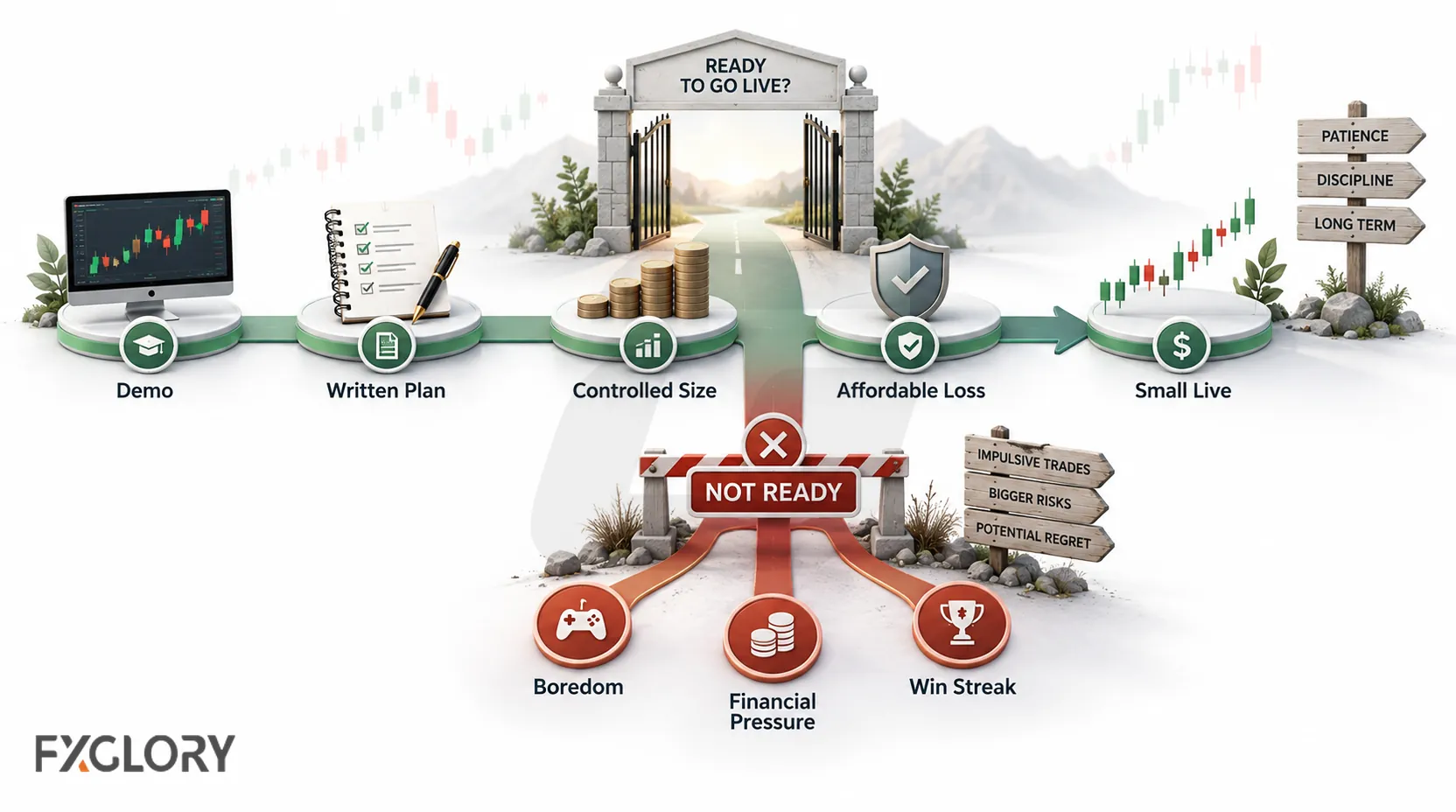
Moving from demo to live does not need to mean increasing size. A cautious transition can use smaller exposure and focus on whether the trader follows rules under real pressure rather than on short-term profit.
- Do not trade live because you are bored with demo. Boredom is not readiness.
- Do not trade live to recover personal financial pressure. Pressure can create rushed and oversized decisions.
- Do not increase size after a few winning trades. A short streak does not prove skill.
- Do not copy signals blindly. If you cannot explain the risk, you cannot judge the trade.
- Do not ignore withdrawals, deposits, account rules, or platform conditions. Operational details matter before real money is involved.
Treat promises of high returns with little or no risk as a warning sign. Forex trading can produce substantial losses, especially when leverage, poor position sizing, or rushed decisions increase exposure.
How Long Does It Take To Become A Forex Trader?
There is no fixed timeline. A beginner may understand basic terms in a few weeks, but that is not the same as being ready to trade live or consistently handle risk. Practical skill takes longer because a trader must learn market behavior, execution, position sizing, review, patience, and emotional control.
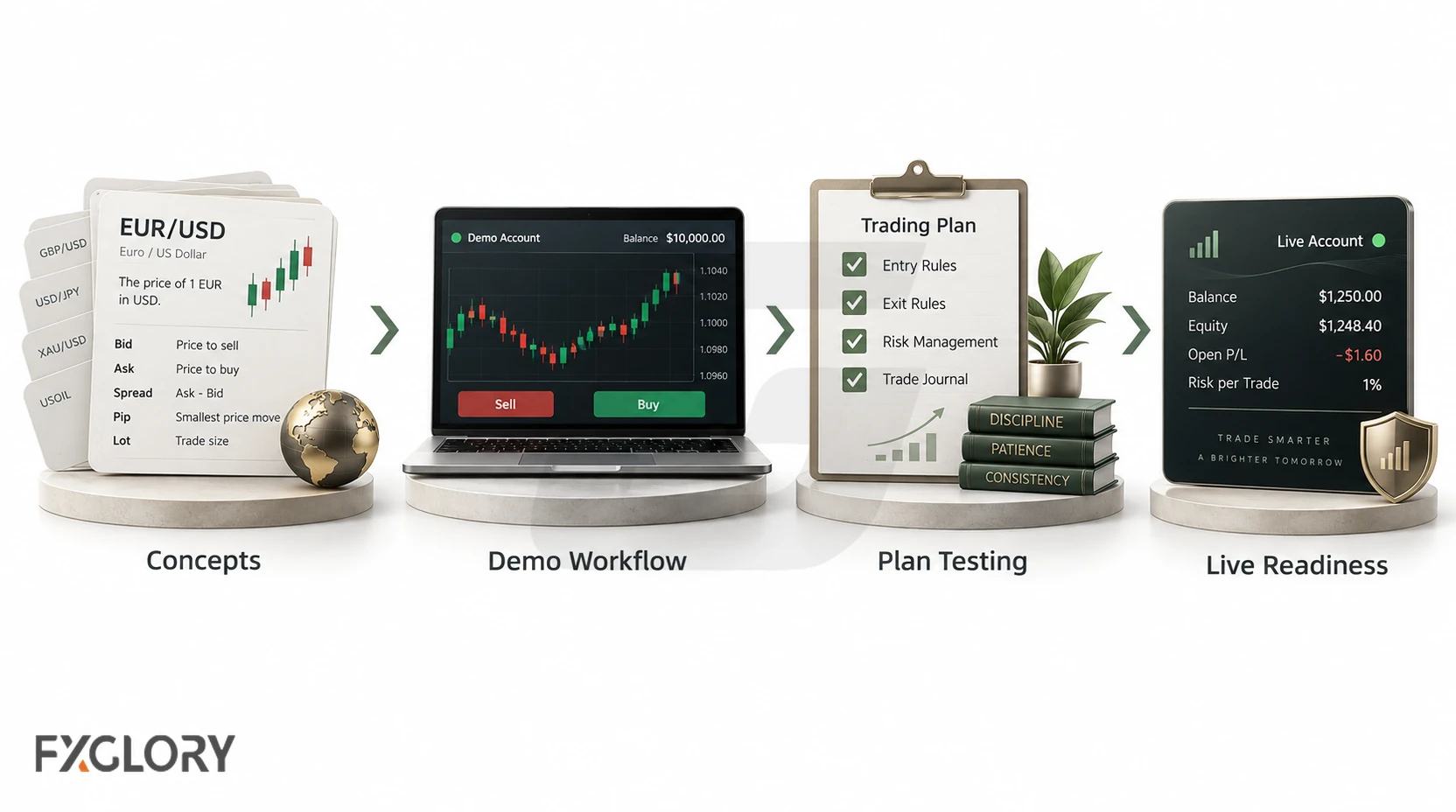
A useful way to think about progress is by stages, not calendar promises.
| Stage | What It Means | Readiness Check |
|---|---|---|
| Concept stage | You understand pairs, quotes, pips, lot size, spread, leverage, and margin. | You can explain the numbers on an order ticket before placing a trade. |
| Demo workflow stage | You can place, manage, close, and record demo trades calmly. | You follow the same process after wins and losses. |
| Plan-testing stage | You test defined rules across different market conditions. | You know when your setup is absent and can avoid trading. |
| Risk-control stage | You size trades based on predefined loss limits and margin checks. | No single trade or day can create an unacceptable loss. |
| Live-readiness review | You decide whether small live exposure is appropriate. | The funds are affordable to lose, and the goal is process testing, not quick income. |
Do not measure readiness only by time. A trader is closer to readiness when they understand risk, follow written rules, avoid forced trades, review results honestly, and can explain decisions before and after each trade.
Do You Need A Degree To Become A Forex Trader?
A self-directed retail trader does not usually need a degree simply to begin learning or trade a personal account, subject to account eligibility and local rules. Professional forex trading roles are different and may require or prefer relevant education, analytical skills, market experience, and employer-specific qualifications.
| Goal | Typical Requirement | What Matters Most |
|---|---|---|
| Learn as a retail beginner | A degree is usually not required to begin studying. | Market basics, demo practice, platform workflow, risk control, and responsible funding. |
| Trade personal funds | Formal education is usually not the deciding factor. | Account eligibility, trading conditions, position sizing, and discipline. |
| Professional trading career | Education and employer requirements vary by role and jurisdiction. | Analysis, economics, data, research, risk controls, communication, and institutional process. |
If your goal is employment or institutional trading, continue with the guide to becoming a professional forex trader for education, skills, experience, and employer expectations.
Common Mistakes When Trying To Become A Forex Trader
Some mistakes are less about missing a lesson and more about how a beginner applies what they have learned.
- Learning only from short videos or social media claims: Fast content can hide risk, missing context, and conflicts of interest.
- Copying signals without understanding invalidation: A copied entry does not explain risk, exit logic, or whether the trade fits your account.
- Trading too many pairs: A large watchlist can make it harder to learn each pair's behavior and review decisions consistently.
- Trading major news without a plan: Fast movement can make execution and risk harder to control.
- Changing rules after a short winning or losing streak: A small sample can encourage overconfidence or unnecessary strategy switching.
- Treating forex as emergency income: Financial pressure can lead to rushed decisions and oversized trades.
Beginner Readiness Checklist Before Live Trading
Use this as a decision check after working through the steps above. A “no” points to a skill, rule, or risk issue that needs more practice before live trading is considered.
| Readiness Question | Why It Matters |
|---|---|
| Can I explain what a currency pair is? | Every forex trade compares one currency against another. |
| Can I identify bid, ask, and spread? | These affect entry, exit, and trading cost. |
| Can I calculate pips and understand lot size? | These affect profit, loss, and position exposure. |
| Can I explain leverage and margin? | These affect how quickly losses can grow. |
| Do I have a written trading plan? | Rules reduce emotional decisions. |
| Do I know how much one trade can lose? | Risk must be defined before entry. |
| Have I practiced order placement on demo? | Execution mistakes should be reduced before live funds are used. |
| Do I keep a trading journal? | Records make review possible. |
| Can I stop after losses or rule violations? | Behavior control is part of risk control. |
| Is the live money affordable to lose? | Forex should not be funded with money needed for essential expenses. |
If several answers are unclear, return to the basics. Use the trading vocabulary a beginner sees before placing orders, then practice the workflow on demo before considering live risk.