Retail vs Professional Forex Trader: Quick Answer
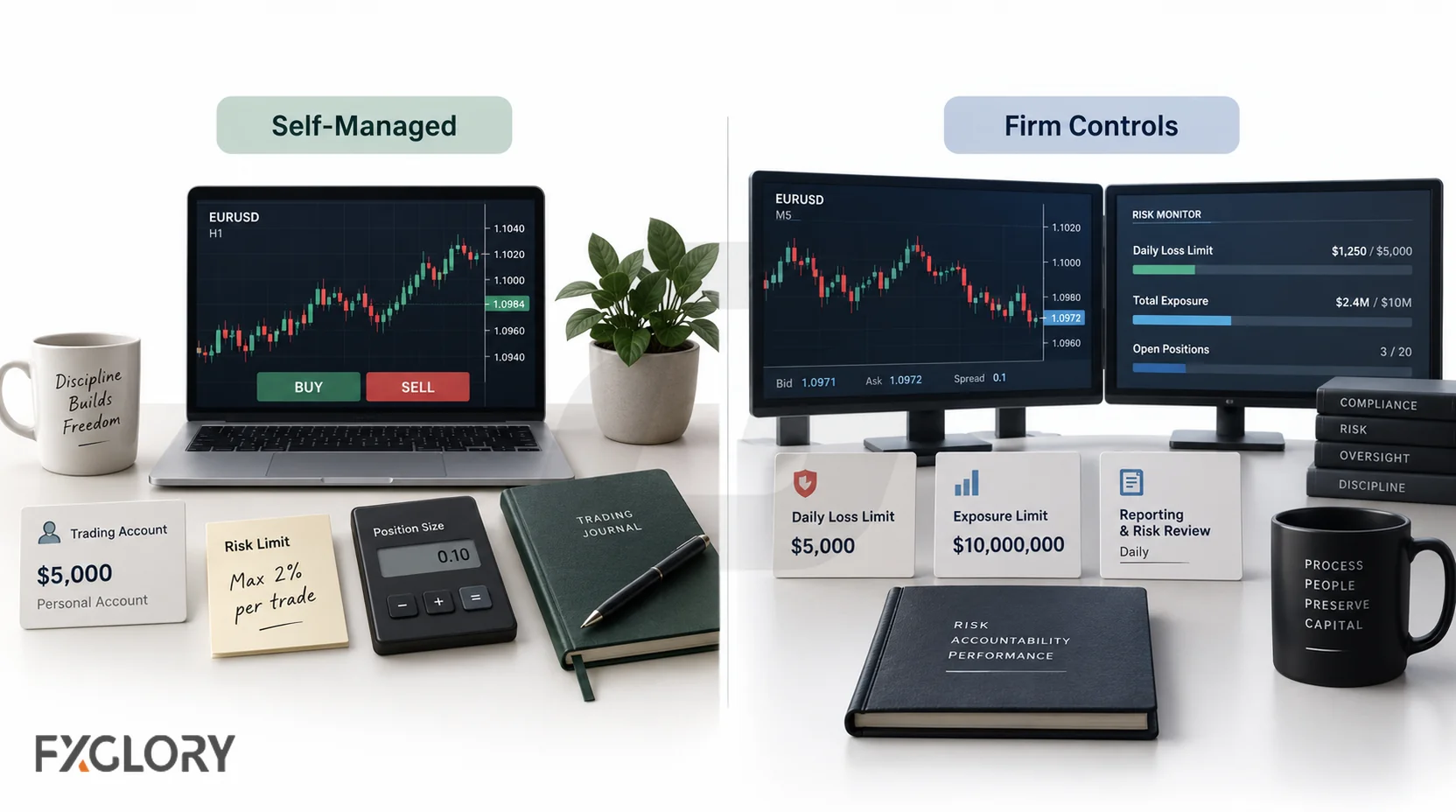
A retail forex trader usually trades personal funds through a broker account and carries personal responsibility for trade decisions, costs, margin use, and losses. A professional forex trader may trade as a paid role for a bank, fund, institution, proprietary firm, company, or client mandate. In some jurisdictions, professional client is also a formal classification that can affect leverage access, disclosures, and retail protections.
The most important difference is not the word professional. It is the trading environment. Retail traders normally operate with personal capital, smaller account size, retail platform access, and self-managed risk. Professional traders may operate with firm or client capital, defined mandates, research support, execution systems, supervision, reporting, and strict loss limits.
These labels should not be mixed. A trader can be careful and disciplined without being a professional client. A broker account may use the word Pro without making the account holder a professional trader. A professional trader can still lose money.
What Is A Retail Forex Trader?
A retail forex trader is an individual who trades currency pairs through a retail trading account, usually with personal funds. Retail traders may trade part time or full time, but they are normally responsible for choosing trades, managing risk, monitoring margin, paying trading costs, and accepting losses.
Retail traders participate through platforms and broker accounts instead of dealing directly in the institutional interbank market. They usually trade smaller sizes than banks, funds, corporations, and liquidity providers. Their trades can still be affected by institutional flows, news, central-bank decisions, spreads, liquidity, and volatility.
A retail trader may use technical analysis, fundamental analysis, economic news, price action, indicators, or a written trading plan. The retail label does not prove inexperience. It simply describes the access route and capital source.
- Capital source: Usually personal funds.
- Decision maker: Usually the trader.
- Main responsibility: Managing personal risk, costs, execution, and discipline.
- Common danger: Treating high leverage, small deposits, or short-term price movement as a shortcut to income.
To understand where retail traders sit among banks, liquidity providers, brokers, central banks, corporations, and institutions, review the wider map of forex market participants.
What Is A Professional Forex Trader?
A professional forex trader may be a person whose job involves trading currencies or managing currency exposure for an organization, fund, bank, proprietary firm, company, or client mandate. In that setting, the trader may have defined responsibilities, risk limits, reporting duties, compliance rules, and performance review.
Professional forex traders do not all do the same work. Some execute client orders. Some manage institutional risk. Some trade macro themes. Some hedge corporate currency exposure. Some work inside proprietary or fund structures. Some may focus on liquidity, pricing, or execution rather than directional speculation.
A professional environment can provide stronger research, systems, capital access, data, and oversight. It can also create pressure that retail traders do not face: job accountability, limits set by someone else, reporting requirements, client expectations, and institutional risk controls.
Professional Trader, Institutional Trader, Professional Client, And Pro Account Are Not The Same
Many comparisons become misleading because they use several different meanings of professional at the same time. The safest way to read the topic is to separate the labels before comparing them.
| Term | Meaning | What Not To Assume |
|---|---|---|
| Retail forex trader | An individual trading through a retail account, usually with personal funds. | Do not assume every retail trader is careless or new. |
| Professional forex trader | A person trading or managing currency exposure as a job or mandate. | Do not assume every professional trader makes money. |
| Institutional trader | A trader operating for a bank, fund, company, asset manager, or other institution. | Do not assume every professional trader is institutional. |
| Professional client | A formal client classification used in some regulated jurisdictions. | Do not assume this is the same as skill, employment, or account branding. |
| Pro account | An account name or product tier used by a broker. | Do not assume it is a legal professional-client classification. |
This distinction matters for FXGlory readers because account types and account features should be reviewed as product conditions, not as proof that a trader is professionally employed or legally classified as a professional client.
Retail vs Professional Forex Traders: Comparison Table
The table below compares the two groups in practical terms. It is a learning tool, not a ranking of better and worse traders.
| Area | Retail Forex Trader | Professional Forex Trader |
|---|---|---|
| Capital source | Usually personal funds. | May trade firm, client, fund, bank, company, or mandate capital. |
| Primary responsibility | Protect personal account equity and follow personal rules. | Follow mandate, risk desk, client, firm, or institutional rules. |
| Decision process | Often self-directed. | Often reviewed through risk limits, reporting, supervision, or team process. |
| Tools | Retail platforms, charts, calendars, calculators, indicators, journals, and broker resources. | May include institutional research, execution systems, internal models, client-flow data, and risk systems. |
| Market impact | Usually small trade size with limited direct market impact. | Larger orders may require careful execution to reduce market impact. |
| Costs | Costs depend on spread, commission, account type, instrument, and execution conditions. | May access negotiated pricing or institutional arrangements depending on the firm and venue. |
| Leverage and margin | Depends on broker terms, account balance, instrument, jurisdiction, and account conditions. | Depends on mandate, risk rules, venue, balance sheet, regulation, and client classification. |
| Risk control | Often self-managed; quality varies widely. | Usually structured with limits, monitoring, reporting, and review. |
| Training | Self-study, courses, demo practice, broker education, books, and personal experience. | May include finance education, desk training, mentoring, institutional tools, and formal review. |
| Income expectation | Trading result is uncertain and not salary-like. | May receive salary, bonus, allocation, or payout structure depending on role. |
| Main risk | Overleverage, emotional trading, poor planning, weak cost awareness, and unrealistic expectations. | Market loss, mandate breach, model error, execution error, client pressure, and job accountability. |
Capital, Leverage, And Margin Differences
Capital source changes trader behavior. A retail trader usually decides how much to deposit and how much of that personal account to risk. A professional trader may be assigned capital, work under a mandate, or manage currency exposure for another organization. The professional trader may have less personal freedom because risk limits and reporting requirements can be set by the firm.
Leverage can make the comparison dangerous if it is misunderstood. More leverage does not make someone more professional. It only increases the size of market exposure relative to margin. If price moves against a leveraged position, losses can build quickly and may trigger margin pressure or forced closure depending on account conditions.
FXGlory publishes separate leverage conditions and a margin calculator for estimating required margin. These pages are better places to review actual leverage and margin inputs than a retail-vs-professional comparison article.
Tools, Research, And Execution
Retail traders and professional traders may both look at charts, news, rates, economic data, and price movement. The difference is often depth, cost, infrastructure, and accountability.
A retail trader may use platform charts, technical indicators, economic calendars, price alerts, calculators, and a trading journal. A professional trader may have access to institutional news feeds, internal research, execution desks, risk dashboards, model outputs, liquidity relationships, or team review. That does not mean the professional trader is always right. It means the decision environment is different.
For retail traders using FXGlory, the practical step is to understand the tools available before trading. FXGlory's platform area lets traders review MetaTrader, WebTrader, and GloryTrader access from one place. You can compare the available FXGlory trading platforms before choosing where to observe charts, place orders, or test execution workflow.
- Use tools to reduce confusion: Tools should help define risk, cost, entry logic, exit logic, and review notes.
- Do not outsource judgment to tools: A platform, indicator, calculator, or signal cannot remove market risk.
- Practice before live risk: A demo environment can help with platform familiarity, but demo trading is not identical to live trading.
FXGlory's demo page explains that demo practice can help traders learn platform behavior without risking funds, while also noting differences from real trading. That makes it a useful place to practice order workflow before live exposure.
Costs, Spreads, And Market Access
Retail traders usually access forex through a broker account. Their practical trading cost may include spread, commission if applicable, slippage, overnight or account-specific conditions, and the cost of errors caused by fast markets or poor execution timing.
Professional or institutional traders may have different pricing arrangements, execution venues, order-routing choices, or liquidity relationships. Larger traders may also face a problem retail traders rarely create directly: their own order size can affect available liquidity or market price, especially in less liquid conditions.
Retail traders still need professional-level cost awareness. Before opening a position, check the spread, order size, instrument, margin requirement, session conditions, and upcoming news. FXGlory provides a separate page to review spread conditions before planning a trade.
Risk Management And Accountability
Professional environments usually put more structure around risk. A trader may have daily loss limits, maximum position limits, approved instruments, exposure limits, risk-desk review, reporting, and post-trade analysis. If a trader breaks those rules, there may be job, client, or mandate consequences.
A retail trader may have more freedom, but freedom can become a risk when there is no written plan. Without rules, a retail trader can increase lot size after a loss, open trades outside the strategy, ignore spread, hold during news without planning, or keep adding margin to a weak position.
The useful lesson is not that retail traders must copy institutional trading. The useful lesson is that retail traders need their own version of accountability: written risk limits, planned position size, defined invalidation, documented trades, and a rule for when not to trade.
For deeper planning, use a trading plan template to write the rules before execution, then review risk management rules that keep loss size under control.
Retail Protections And Professional-Status Risks
In some regulated jurisdictions, retail clients receive specific protections for leveraged products. ESMA's CFD intervention measures included leverage limits, margin close-out rules, negative balance protection, restrictions on incentives, and standardized risk warnings for retail clients. The FCA also finalized rules restricting how CFDs and CFD-like options are sold, marketed, and distributed to retail consumers.
Professional-client status can be different. Some providers or jurisdictions may allow experienced clients to opt into professional status if they meet certain criteria, such as trading activity, portfolio size, or relevant financial-sector experience. That status may come with different leverage access, but it can also reduce some retail protections.
This guide explains the educational distinction between trader types. FXGlory account eligibility, regional availability, trading conditions, and client terms should always be checked in the official account pages and client documents before opening or using any account.
Account Type Is Not The Same As Trader Type
A trader type describes who is trading and under what responsibility. An account type describes account features. These are separate ideas.
FXGlory account pages describe features such as minimum deposit, lot size, maximum position, leverage, spread, commission notes, VPS availability, platform access, and regional availability. Those details help a trader compare account conditions, but they do not automatically classify the person as professionally employed or legally treated as a professional client.
| Question | Correct Place To Check | Why It Matters |
|---|---|---|
| What account features are available? | Account Types | Account features affect minimum deposit, lot size, spread, commission notes, and platform access. |
| What are the trading limits and conditions? | Trading Account Conditions | Conditions affect order size, margin call, stop-out, instruments, execution, and account-level limits. |
| How much margin may a trade require? | Margin Calculator | Margin pressure changes with instrument, account size, leverage, and trade size. |
| What trading cost should be reviewed? | Spreads | Spreads affect the cost of opening and managing positions. |
Can A Retail Trader Trade More Professionally?
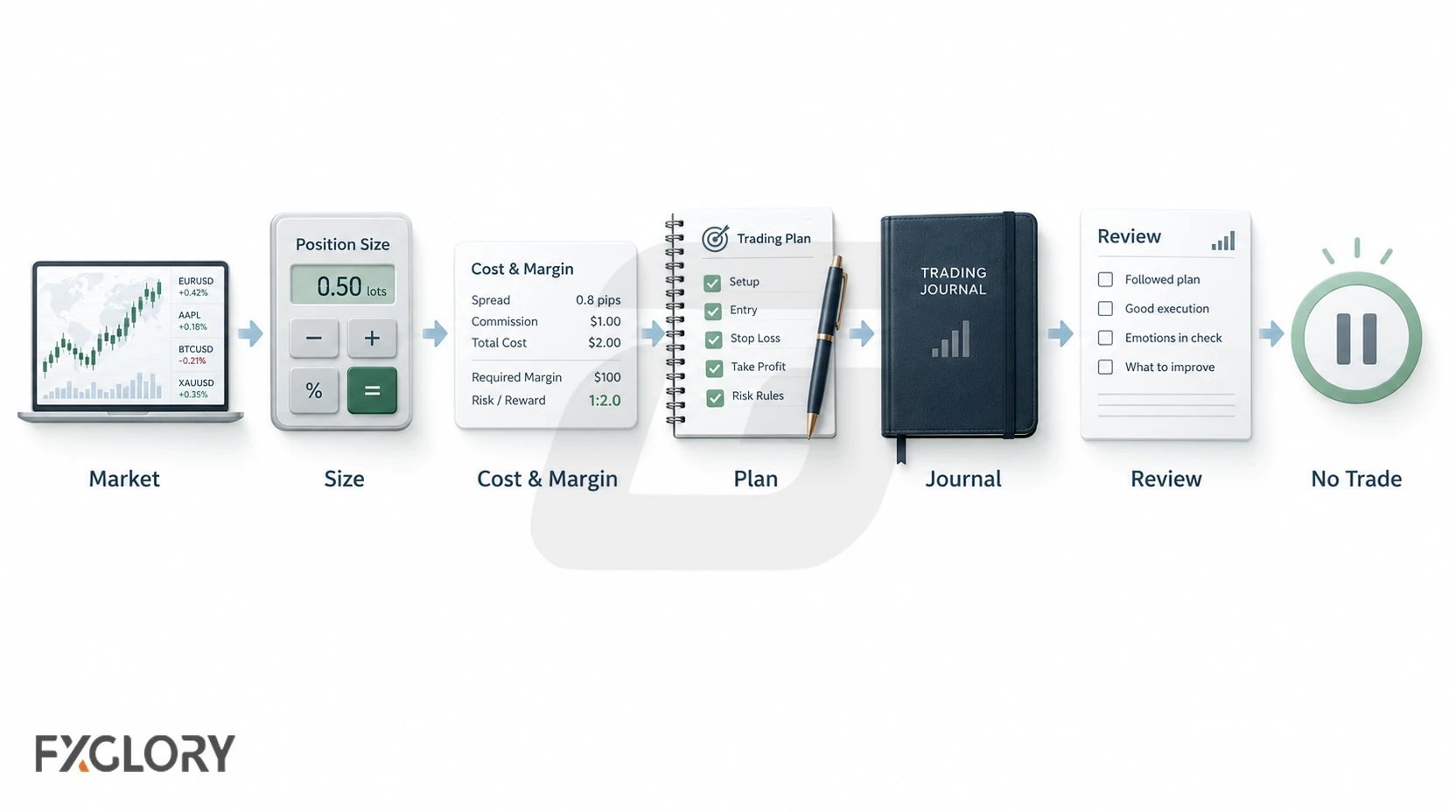
A retail trader cannot become institutional just by using a larger lot size, a Pro-labeled account, or a complex indicator. But a retail trader can build a more professional process.
Professional process means fewer random decisions and more written control. It means knowing the trade reason before entry, the invalidation point before position size, the expected cost before execution, and the review rule after closure.
- Define the market first: Know whether the trade is based on trend, range, news, support, resistance, or another clear condition.
- Size the position before entry: Decide risk before the trade, not after the price moves.
- Check cost and margin: Review spread, margin, stop-out risk, and session conditions.
- Use a written plan: A rule that is not written is easy to change under pressure.
- Keep a journal: Track entry reason, exit reason, risk taken, rule-following, and emotional state.
- Review losses without revenge trading: A loss can be normal. Breaking the plan after a loss is the larger danger.
- Know when not to trade: Professional process includes staying flat when the setup, spread, volatility, or news environment is not suitable.
Which Type Are You? Practical Self-Check
The following questions can help a reader identify their current situation without turning the comparison into a status contest.
| Question | If Yes | What To Do Next |
|---|---|---|
| Are you trading your own money through a personal broker account? | You are likely operating as a retail trader. | Focus on risk limits, cost awareness, and process discipline. |
| Are you paid by a firm, fund, bank, or company to trade or manage FX exposure? | You may be operating in a professional role. | Follow mandate, compliance, reporting, and risk-desk requirements. |
| Are you applying for professional-client status? | This may affect protections and terms in some jurisdictions. | Read eligibility rules, disclosures, and consequences carefully. |
| Are you choosing a broker account named Pro? | You are choosing an account tier or product name. | Do not confuse the account name with professional employment or client classification. |
| Are you trying to trade with more discipline? | You are working on professional process. | Build written rules, journal your trades, and control position size. |
Common Misconceptions About Retail And Professional Forex Traders
- Professional means profitable: False. Professional traders can lose money.
- Retail means unskilled: False. Retail describes access and capital source, not intelligence or discipline.
- Higher leverage means better trading: False. Higher leverage can increase account pressure and loss speed.
- A Pro account makes a trader professional: False. Account naming is not the same as employment or legal classification.
- Institutional tools remove risk: False. Better tools may improve process, but market and execution risk remain.
- Retail protections are unimportant: False. In some jurisdictions, retail protections are designed to reduce specific harms in leveraged trading.
- Copying a professional strategy is enough: False. Strategy without capital rules, costs, timing, and risk control is incomplete.
- Small accounts are harmless: False. Small accounts can still be damaged quickly when leverage and trade size are misused.
What To Review Next
After comparing retail and professional traders, the next step is to remove confusion around your own account, costs, and risk. Start by reviewing FXGlory account features, then check the trading conditions that affect order size, margin call, stop-out, and instruments. Before placing real-money trades, use the margin calculator, review spread conditions, and practice the platform workflow through a demo account.
For the broader role definition, return to the main forex trader guide. For market structure, review who participates in the forex market. For discipline, use a written trading plan and risk management rules before increasing exposure.
Sources Used
This guide uses external regulatory and market-structure references for educational context, including CFTC and NASAA retail forex risk warnings, CFTC forex fraud guidance, ESMA CFD retail product-intervention measures, ESMA MiFID II Annex II professional-client criteria, FCA CFD retail restrictions, and BIS research on retail trading in the FX market. These sources explain market and regulatory concepts; they do not describe FXGlory-specific client classification or account eligibility.
Frequently Asked Questions
What is the difference between a retail forex trader and a professional forex trader?
A retail forex trader usually trades personal funds through a broker account. A professional forex trader may trade as a paid role for a bank, fund, institution, proprietary firm, company, or client mandate. The main differences are capital source, accountability, tools, risk controls, market access, and expectations.
What is a retail forex trader?
A retail forex trader is an individual who trades currency pairs through a retail trading account, usually with personal funds and personal responsibility for losses, costs, risk settings, and trade decisions.
What is a professional forex trader?
A professional forex trader may be someone paid to trade or manage currency exposure for an institution, bank, fund, company, proprietary firm, or client. The term can also be used informally for a trader with disciplined process, or formally for a professional-client classification in some jurisdictions.
Is a professional forex trader the same as an institutional trader?
Not always. Many institutional traders are professional traders because they trade for institutions, but a professional trader may also work in other settings. Institutional trading usually involves larger capital, mandates, systems, compliance oversight, and reporting.
Is a retail trader the same as an institutional trader?
No. A retail trader usually trades a personal account with personal capital, while an institutional trader trades for an organization such as a bank, fund, company, or other financial institution. Institutional traders may have larger capital, stricter mandates, different tools, and formal reporting responsibilities.
Is a professional forex trader the same as a professional client?
No. A professional forex trader describes a person or role. A professional client is a formal classification used in some regulated jurisdictions. Professional-client status may change leverage access, disclosures, and retail protections, depending on local rules and broker terms.
Is a Pro account the same as being a professional forex trader?
No. A Pro account is an account name or product tier. It does not automatically mean the trader is employed as a professional trader or classified as a professional client. Always review the broker's account conditions and terms.
Can a retail forex trader become professional?
A retail trader may develop a more professional process through risk control, record keeping, strategy testing, and consistent review. Becoming a professional trader as a job usually requires a separate career path, relevant experience, and sometimes institutional hiring, licensing, or client-mandate requirements.
Do professional forex traders always make money?
No. Professional traders can lose money. Professional environments may provide stronger tools, capital controls, supervision, and research access, but they do not remove market risk, execution risk, leverage risk, or human error.
Do retail forex traders always lose money?
No group loses on every trade, but retail traders face serious risks. Poor leverage control, oversized positions, emotional trading, weak planning, and misunderstanding costs can lead to large losses.
Do professional forex traders use different strategies?
Sometimes. Professional traders may use institutional research, hedging, market-making, execution algorithms, macro models, or client-flow analysis. Retail traders often use simpler discretionary or technical approaches. The label does not make any strategy safe or profitable.
Do professional forex traders get higher leverage?
Professional traders or professional clients may access different leverage terms in some jurisdictions or account structures, but leverage depends on local rules, broker terms, account conditions, balance, instrument, and risk settings. Higher leverage can increase both profit and loss speed.
What protections can retail traders have that professional clients may lose?
In some regulated jurisdictions, retail CFD protections can include leverage limits, margin close-out rules, negative balance protection, standardized risk warnings, and restrictions on trading incentives. Professional-client status may reduce some protections depending on the jurisdiction and provider.
Can a part-time trader use a professional process?
Yes. A part-time retail trader can use professional-style habits such as written rules, position-size limits, a trading journal, pre-trade checks, and post-trade review. That does not make the trader a professional client or guarantee better results.
What should retail traders learn from professional traders?
Retail traders can learn to define risk before entry, avoid random position sizing, track costs, respect margin requirements, prepare for news volatility, document decisions, and stop trading when conditions do not match their plan.
Does FXGlory classify traders as retail or professional in this article?
No. This article uses retail and professional as educational market terms. It does not assign a legal client classification or account status. Review FXGlory's account pages, trading conditions, and terms for actual account features and availability.
Related Contents
Review Account Conditions Before Trading Live
Create an FXGlory account to access the client area and review available platforms, account features, trading conditions, spread information, leverage conditions, margin requirements, and your own risk limits before deciding whether live trading is suitable for you.
Create an FXGlory Account