Outside Bar Forex Pattern: Meaning, Structure & Chart Context

Learn what an outside bar means in forex, how the second candle expands beyond the previous candle range, and how to separate outside bars from engulfing candles, pin bars, inside bars, and wide volatility candles.
 
Written byHenry Green
Published
Last updated

Key Takeaways

  • An outside bar in forex is a two-candle formation where the second candle makes a higher high and a lower low than the previous candle.
  • The outside bar is defined by full high-low range expansion, not by candle-body takeover alone.
  • A bullish outside bar closes higher inside its expanded range, while a bearish outside bar closes lower inside its expanded range.
  • Outside bars can appear during continuation, reversal-review, volatility expansion, false-break, and range-bound conditions.
  • An outside bar should be reviewed with close location, prior candle structure, trend quality, support and resistance, volatility, spread, and follow-up price action.
Risk note: Forex trading involves risk of loss. An outside bar can help organize chart observations, but it cannot remove spread, slippage, volatility, leverage risk, news-event risk, low-liquidity conditions, false-break risk, or execution mistakes.

What Is An Outside Bar In Forex?

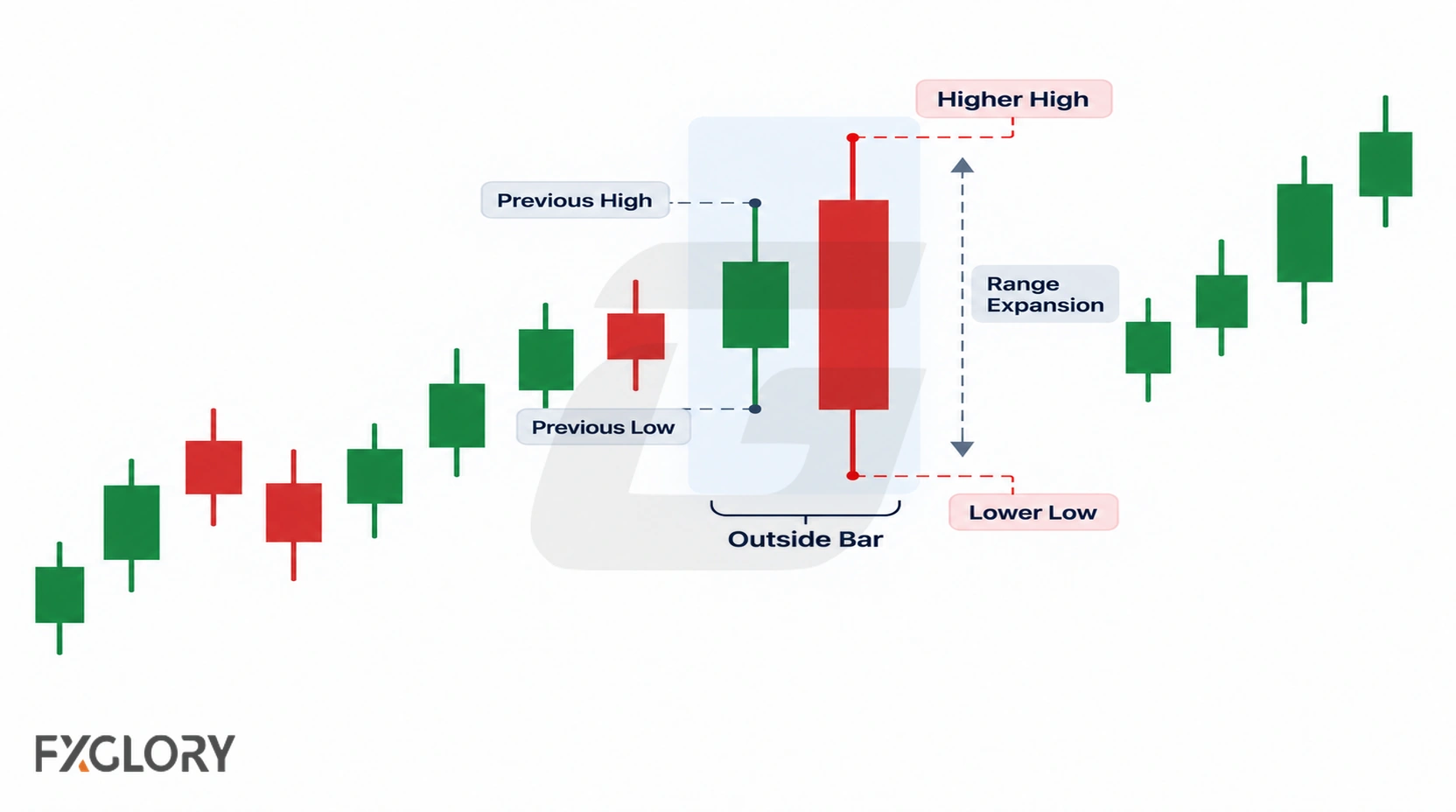
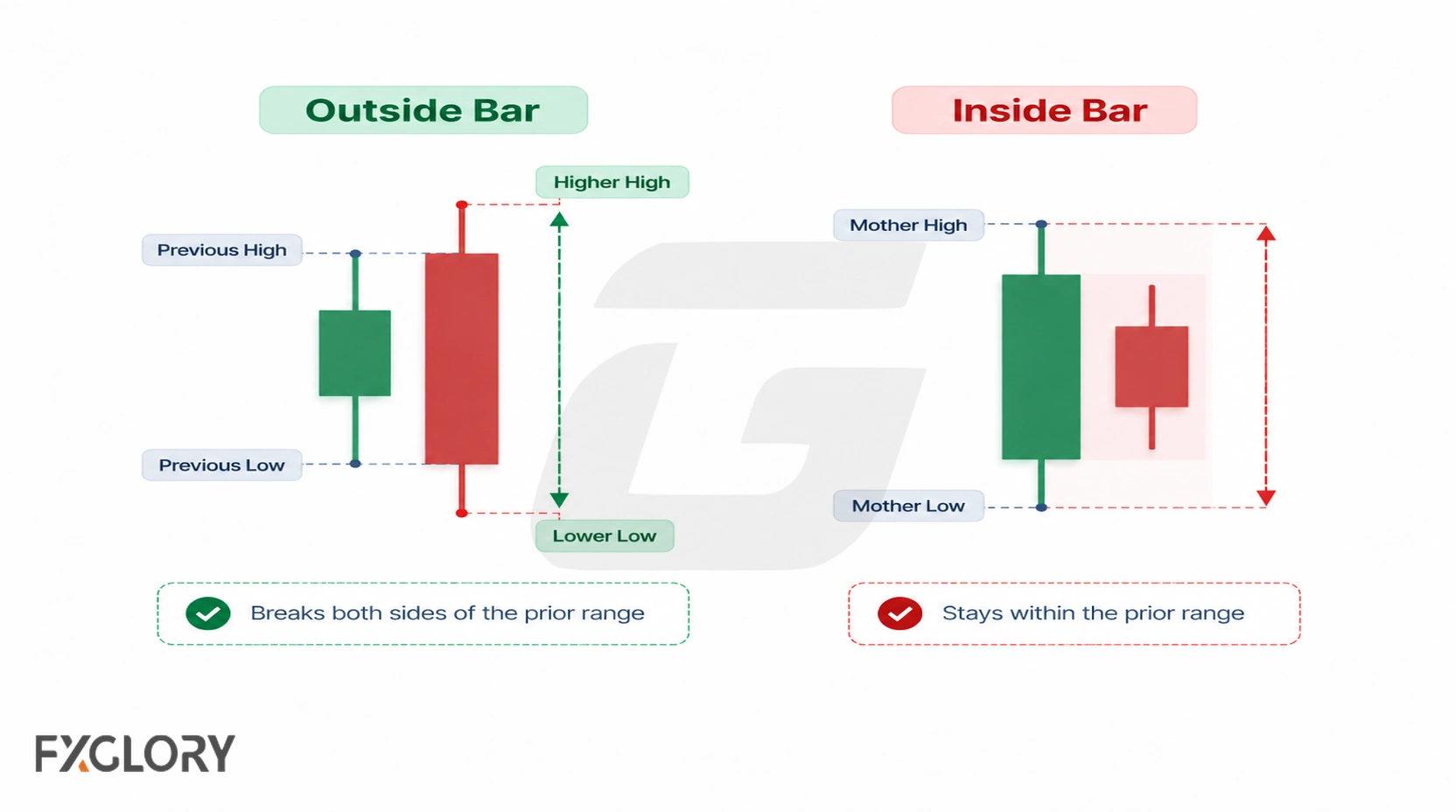
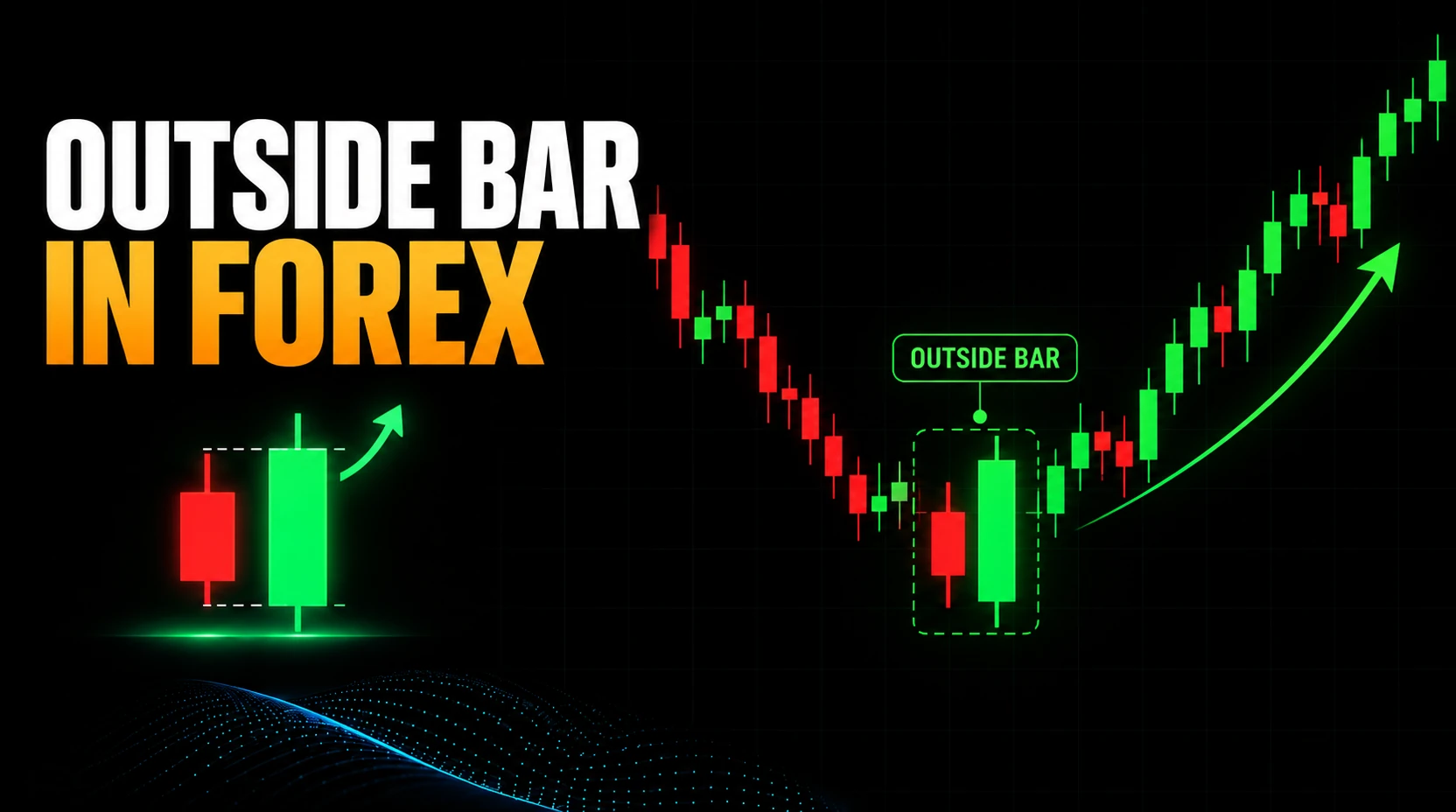
An outside bar in forex is a two-candle formation where the second candle expands beyond the full high-low range of the previous candle. The second candle makes a higher high than the previous candle and a lower low than the previous candle.

This makes the outside bar a range-expansion pattern. The market traded beyond both sides of the prior candle's range during the second candle period. That expanded range may show stronger volatility, a wider price test, a shift in pressure, or a failed attempt to hold one side of the prior range.

The outside bar is not defined by the candle body alone. A large body may appear inside the formation, but the key requirement is full high-low expansion. If only the candle bodies are being compared, the structure belongs closer to engulfing logic.

Outside bars can appear during trends, pullbacks, ranges, failed breaks, and volatile news periods. The expanded candle shows that both sides of the prior range were tested; the close and the next candles decide how useful that test becomes.

If you need candle anatomy first, review the open, high, low, close, body, and wick relationship. Outside bars use those same candle parts, but compare the full range of two completed candles.

Simple definition: An outside bar in forex is a two-candle range-expansion pattern where the second candle makes both a higher high and a lower low than the previous candle.

Outside Bar Anatomy: Previous Candle And Expansion Candle

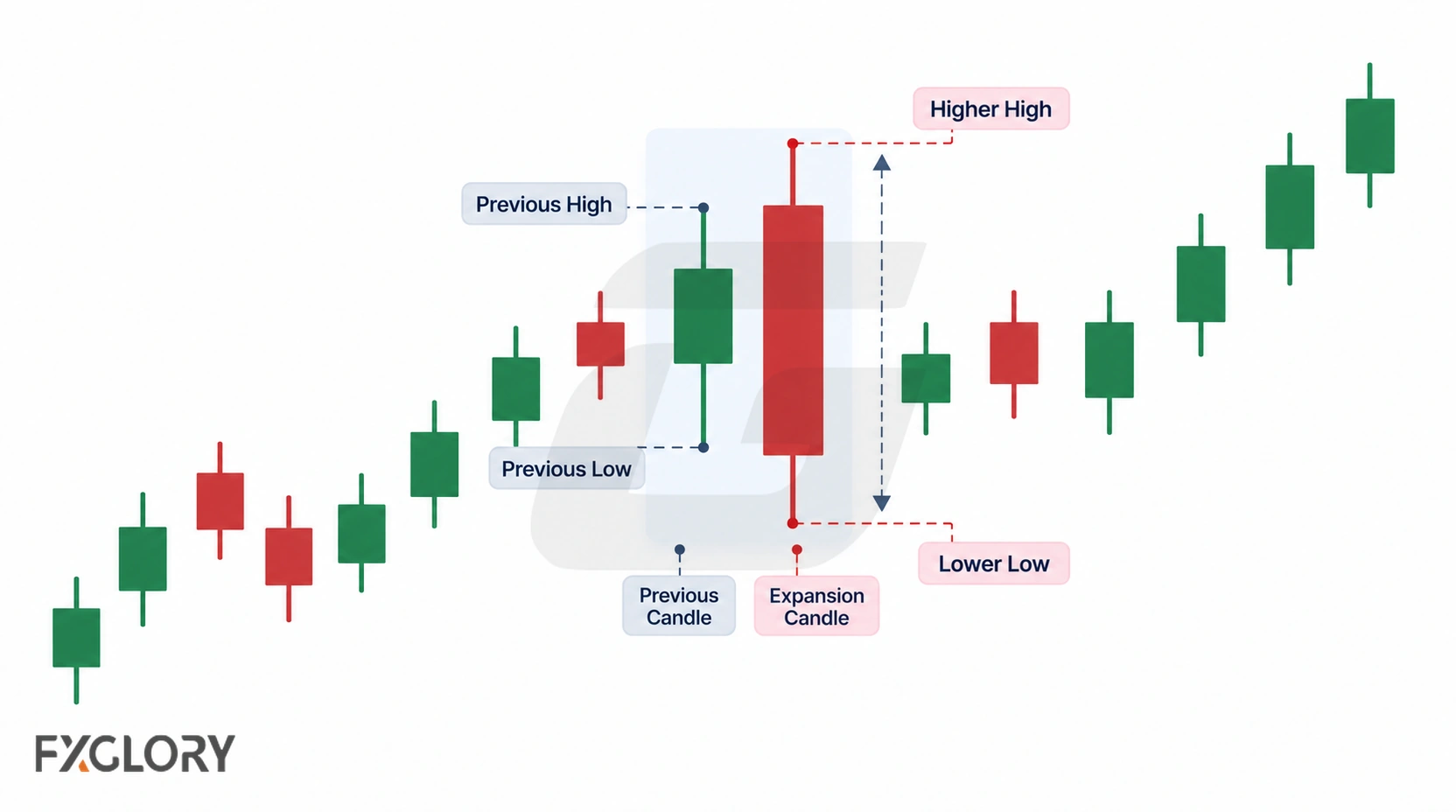
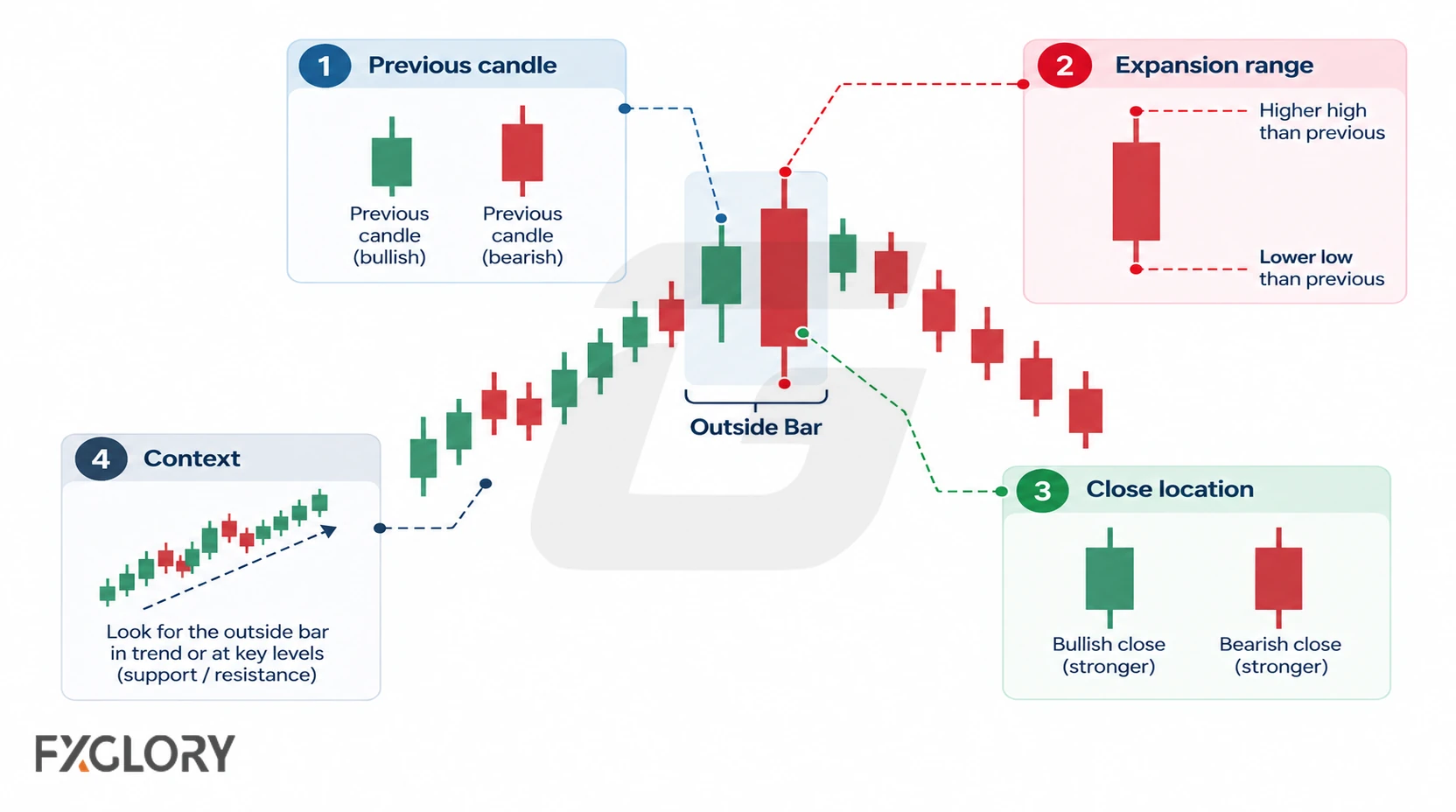
An outside bar needs two completed candles. The first candle gives the reference range. The second candle is the expansion candle because it extends beyond the previous candle's high and low.

The first candle may be bullish, bearish, small, wide, doji-like, or ordinary. What matters is that it gives the range being exceeded. The second candle must move above the first candle's high and below the first candle's low.

Outside Bar PartStructureWhat It ShowsReading Caution
Reference candleThe first candle in the two-candle formation.Creates the high-low range that the next candle exceeds.If the first candle is random or unclear, the outside-bar reading may be weak.
Outside barThe second candle with a higher high and lower low.Shows expanded movement beyond both sides of the previous candle.A wide range may reflect volatility rather than clean pressure.
Outside bar highHigher than the previous candle high.Shows price tested above the prior range.The upper break can fail if price closes weakly or returns lower.
Outside bar lowLower than the previous candle low.Shows price tested below the prior range.The lower break can fail if price closes strongly or returns higher.
Outside bar closeCan finish near the high, near the low, or near the middle.Adds context about where price settled after the expanded range.Close location adds context, but does not define the pattern.

A candle should not be labeled as an outside bar before it closes. While it is forming, it may still change shape, lose one side of the range expansion, or finish in a less meaningful position.

Reading habit: Mark the previous candle high and low first. Then check whether the next completed candle expanded beyond both sides of that range.

What Counts As A Clean Outside Bar?

A clean outside bar has a higher high and a lower low than the previous candle. This is the strict version because the second candle fully expands beyond the prior candle range.

Some traders review looser versions where the second candle breaks only one side strongly and touches or nearly touches the other side. Those versions may still show volatility or pressure, but they are not strict outside bars. They should be described carefully instead of forced into the label.

In forex, small high-low differences can vary by broker feed, spread, liquidity, session timing, and chart settings. A strict definition helps keep the structure clean, especially when comparing the pattern with inside bars or engulfing candles.

VersionStructureHow To Read ItCaution
Clean outside barSecond candle makes both a higher high and a lower low.Clear full-range expansion.Still needs chart context and follow-up movement.
Equal-high versionSecond candle matches the prior high and breaks below the prior low.Loose downside expansion.Less clean than a strict outside bar.
Equal-low versionSecond candle breaks above the prior high and matches the prior low.Loose upside expansion.Less clean than a strict outside bar.
One-sided breakSecond candle breaks only the prior high or only the prior low.Not a strict outside bar.May belong to breakout, rejection, or ordinary range logic.

For FXGlory education, the strict definition should come first. Loose versions can be mentioned as chart-reading variations, not as equal-quality examples.

Bullish And Bearish Outside Bars

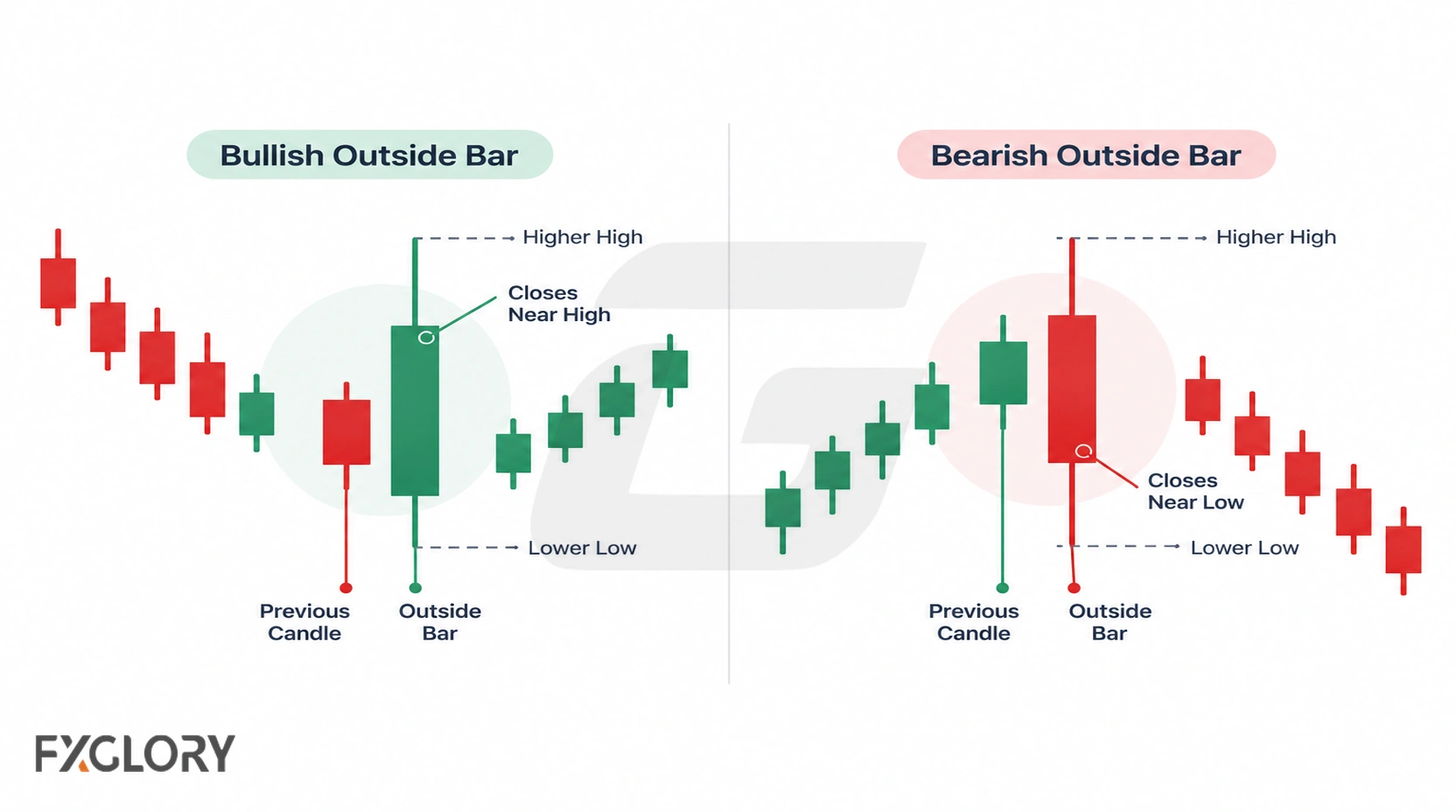
An outside bar can be bullish or bearish depending on where the second candle closes inside its expanded range. The full range expansion defines the pattern. The close location helps describe which side held more of the candle by the end of the period.

The range expansion creates the outside bar; the close location only helps describe whether the expanded candle finished with stronger upper-side pressure, lower-side pressure, or unresolved two-sided movement.

Bullish Outside Bar

A bullish outside bar expands below the previous candle low and above the previous candle high, then closes higher within its own range. When the close is near the upper part of the candle, it can show that buyers held more of the expanded range by the close.

Bearish Outside Bar

A bearish outside bar expands above the previous candle high and below the previous candle low, then closes lower within its own range. When the close is near the lower part of the candle, it can show that sellers held more of the expanded range by the close.

Outside Bar TypeRequired Range StructureClose ContextReading Caution
Bullish outside barHigher high and lower low than the previous candle.Close is higher, often nearer the upper part of the range.A bullish close still needs chart context.
Bearish outside barHigher high and lower low than the previous candle.Close is lower, often nearer the lower part of the range.A bearish close still needs chart context.
Neutral or mixed outside barHigher high and lower low than the previous candle.Close is near the middle of the expanded range.May show two-sided volatility more than clear pressure.
Close-location point: The outside bar structure comes from the high and low. The close location helps describe how the expanded range finished.

What Outside Bars Show About Range Expansion

An outside bar shows that the market moved beyond both sides of the previous candle. This can happen after compression, during a pullback, around a range edge, near a support or resistance area, or during volatile conditions.

Range expansion means the second candle covered more ground than the previous candle. That expanded movement may show momentum, rejection, failed acceptance, news volatility, or a broad two-sided test.

  • After compression: An outside bar may show that price expanded after a narrower phase.
  • Inside a trend: It may show a stronger candle inside the broader direction or a sharp counter-move.
  • Near a level: It may show that both sides of a prior range were tested around support or resistance.
  • Inside a messy range: It may be ordinary volatility with limited meaning.
  • During news conditions: It may reflect fast movement rather than clean chart structure.
Expansion caution: A wider candle is not automatically a cleaner candle. Outside bars need context because range expansion can also come from unstable volatility.

Why Outside Bar Close Location Matters

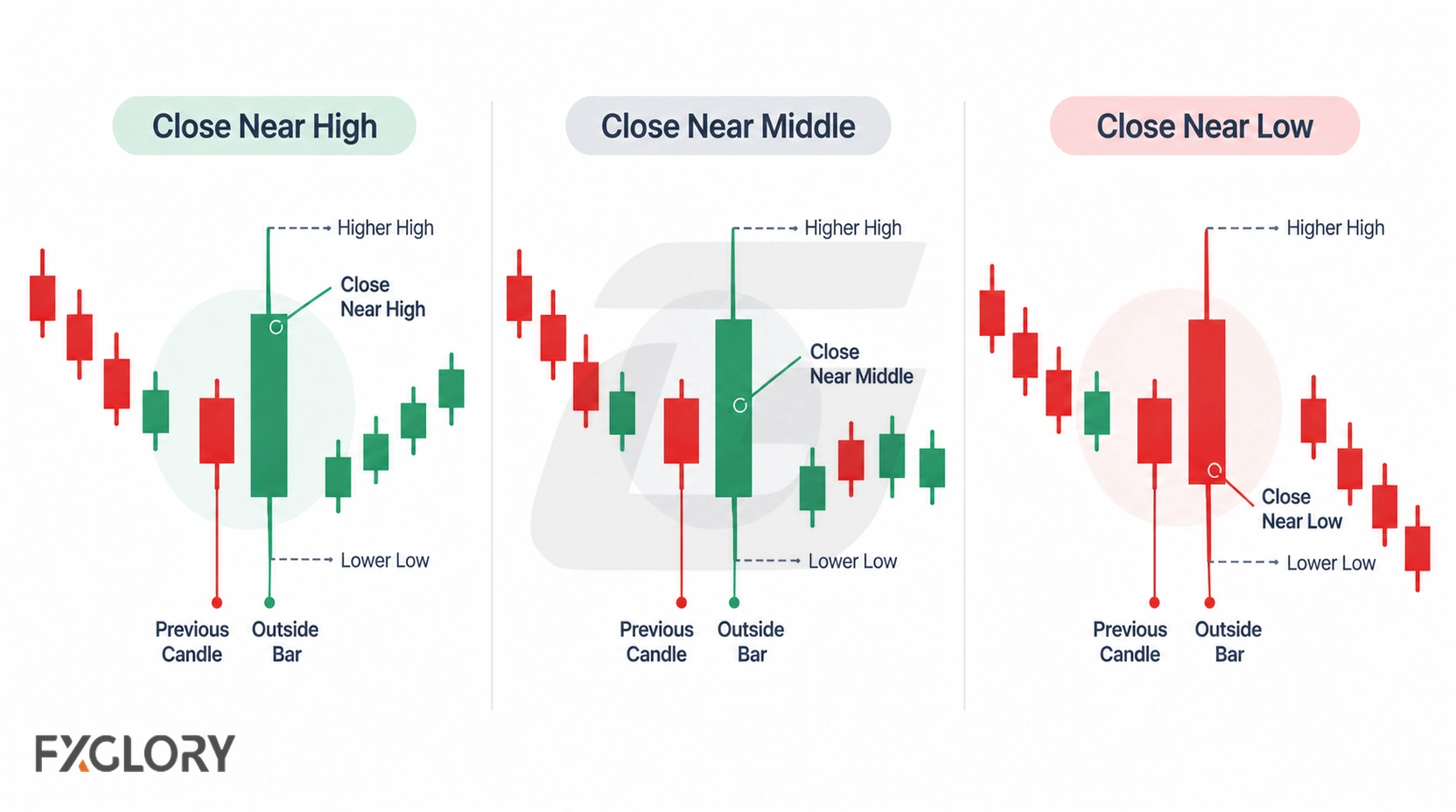
The outside bar's close location can change the way the expanded range is read. A close near the high gives a different message from a close near the low or a close near the middle.

The close does not define the outside bar, but it helps describe which side controlled the final part of the candle period. A wide candle that closes near its middle may show two-sided volatility rather than a clear directional finish.

Close LocationPossible ReadingWhat To Check Next
Close near the highPrice expanded both ways but finished near the upper side.Check whether the close is near resistance, trend structure, or a failed lower test.
Close near the lowPrice expanded both ways but finished near the lower side.Check whether the close is near support, trend structure, or a failed upper test.
Close near the middleThe candle may show broad two-sided movement.Check whether later candles clarify the range.
Very wide range with weak closeRange expansion may be unstable or unresolved.Check news, spread, volatility, and follow-up candles.

Close location is especially important when the outside bar appears near a support or resistance area. The candle may have moved beyond both sides of the previous candle, but the final close shows where price settled after that wider test.

Outside Bar After Inside-Bar Compression

An outside bar can appear after inside-bar compression. In that sequence, price first narrows inside a previous candle range, then later expands beyond a smaller reference range.

This is a natural relationship: inside bars describe compression, while outside bars describe expansion. The transition from compression to expansion can be useful for chart review, but it should still be judged by the broader market environment.

For the compression side of the comparison, review range compression before expansion in the inside bar guide.

SequenceWhat HappensReading Caution
Inside bar firstPrice narrows inside the previous candle range.Compression alone does not decide direction.
Outside bar laterPrice expands beyond the previous candle high and low.Expansion can still fail or reverse.
Compression then expansionMarket moves from smaller range to wider range.Check location, volatility, and close quality.
Compression-to-expansion check: The inside bar explains the narrowing phase. The outside bar explains the wider candle that follows. Neither pattern removes the need for context.

Outside Bar In Trend, Range, Support, And Resistance Context

An outside bar becomes easier to review when it appears in a clear chart environment. The same candle may mean different things inside a trend, at a range edge, near support or resistance, or during fast news movement.

Outside Bar In A Trend

Inside a trend, an outside bar may show stronger movement in the trend direction, a sharp pullback, or a wider test before price settles. The trend structure should be reviewed before the outside bar is given meaning.

Outside Bar Near Support

An outside bar near support can show a wider test around a lower chart area. If the candle closes away from the low, the lower-side test may matter. If it closes weakly below the area, the same candle may be read differently.

Outside Bar Near Resistance

An outside bar near resistance can show a wider test around a higher chart area. If the candle closes away from the high, the upper-side test may matter. If it closes strongly above the area, the same candle may carry a different message.

Outside Bar Inside A Range

Outside bars can appear inside sideways markets. Near range edges, they may show a wider test of the range boundary. In the middle of a range, they may only show two-sided volatility without a useful chart reference.

Outside Bar During News Or Session Changes

News events, market opens, rollover, and low-liquidity periods can create wide candles. An outside bar formed during unstable conditions may look important after the fact but may be difficult to read in real time.

For observation, a trader can compare outside-bar behavior on live market pages such as GBP/USD during active session movement or gold during wider candle ranges. These pages are useful for chart review, not as standalone trading reasons.

Outside Bar As A Range Bar vs Trend Bar

An outside bar can behave like a wide range bar or a directional trend bar depending on how it forms and closes. This distinction helps prevent every outside bar from being treated the same way.

A range-style outside bar has a wide high-low span but may close near the middle. It shows that price tested both sides of the prior candle but did not finish with a clear directional close. A middle-close outside bar often deserves less weight than an outside bar that expands beyond both sides and then closes near one extreme.

A trend-style outside bar expands beyond the prior range and closes near one side of its own range, showing a stronger finish by one side.

Outside Bar TypeWhat It Looks LikePossible ReadingCaution
Range-style outside barWide range with close near the middle.Two-sided volatility or broad testing.May not show clear directional control.
Bullish trend-style outside barHigher high, lower low, and close near the high.Expanded range with stronger upper-side finish.Still needs location and follow-up movement.
Bearish trend-style outside barHigher high, lower low, and close near the low.Expanded range with stronger lower-side finish.Still needs location and follow-up movement.
News-style outside barVery wide range during abnormal conditions.Volatility event more than clean candle structure.Spread and execution conditions may be unstable.
Range vs trend reading: The outside-bar label tells you the range expanded. The close location helps show whether that expansion finished with clear pressure or unresolved volatility.

Inside-Outside-Inside Sequence

Some chart sequences combine inside and outside bar logic. An inside-outside-inside sequence begins with a contained candle, then a wider outside candle, then another contained candle. This can show alternating compression and expansion.

The sequence can be useful for describing candle rhythm, but it should not replace the basic outside-bar definition. The outside bar itself still requires a second candle that makes a higher high and lower low than the previous candle.

Sequence PartStructureWhat It Describes
Inside barCandle range stays inside the prior candle.Compression.
Outside barCandle range expands beyond prior high and low.Expansion.
Inside bar againNext candle narrows inside the outside bar.Compression after expansion.

Because this sequence contains several candles, it should be reviewed as broader price behavior rather than a single outside-bar signal.

Outside Bar vs Inside Bar

Outside bar and inside bar are opposite range ideas. An inside bar contracts inside the previous candle range. An outside bar expands beyond the previous candle range.

PatternSecond Candle RangeCommon Chart MessageMain Difference
Inside barHigh is lower than prior high, and low is higher than prior low.Compression, pause, or reduced volatility.Second candle is contained inside the previous candle.
Outside barHigh is higher than prior high, and low is lower than prior low.Expansion, wider movement, or broader testing.Second candle expands beyond both sides of the previous candle.

The distinction is simple but important. Inside bars narrow the range. Outside bars widen it. For the opposite compression structure, review the inside bar range-compression guide.

Outside Bar vs Engulfing Candle

Outside bars and engulfing candles are often confused because both involve a second candle that appears stronger than the previous candle. The difference is what is being measured.

An outside bar is measured by the full high-low range. The second candle must make a higher high and a lower low than the previous candle. An engulfing candle is measured by body takeover. The second candle's body overtakes the previous candle's body.

PatternMain MeasurementCore StructureBest Deeper Guide
Outside barFull high-low range.Second candle expands beyond the previous high and low.This page.
Engulfing candleReal candle bodies.Second candle body overtakes the previous candle body.body-takeover logic explained in the engulfing guide.

One formation can sometimes satisfy both definitions. A candle can expand beyond the previous high and low while also engulfing the previous body. In that case, the outside-bar label describes range expansion, while the engulfing label describes body pressure.

Outside Bar vs Pin Bar And Marubozu

Outside bar is a two-candle range-expansion structure. Pin bar and marubozu are single-candle structures. This difference keeps the page from merging separate candle ideas.

Candle Or PatternStructureHow It Differs From Outside Bar
Outside barSecond candle breaks above and below the previous candle range.Two-candle range expansion.
Pin barOne candle with a long wick and close away from the tested extreme.One-candle wick rejection, not necessarily range expansion beyond a prior candle.
MarubozuOne candle with a large body and little or no wick.One-candle body pressure, not a two-candle range comparison.

For single-candle comparisons, review long-wick rejection in pin bars or full-body pressure in marubozu candles.

Outside Bar vs Piercing Pattern And Dark Cloud Cover

Outside bar, piercing pattern, and dark cloud cover are all two-candle formations, but they measure different relationships between the two candles.

The outside bar is about high-low expansion. The piercing pattern is about a bullish second candle recovering into the prior bearish body. Dark cloud cover is about a bearish second candle pushing into the prior bullish body.

PatternMain RelationshipCore Difference
Outside barSecond candle breaks both prior high and prior low.Full range expansion.
Piercing patternSecond candle recovers into the prior bearish body.Partial bullish body recovery.
Dark cloud coverSecond candle pushes into the prior bullish body.Partial bearish body pushback.

For the partial body structures, review the two-candle bullish recovery structure or the two-candle bearish pushback structure.

Outside Bar Strength Filter: Stronger vs Weaker Readings

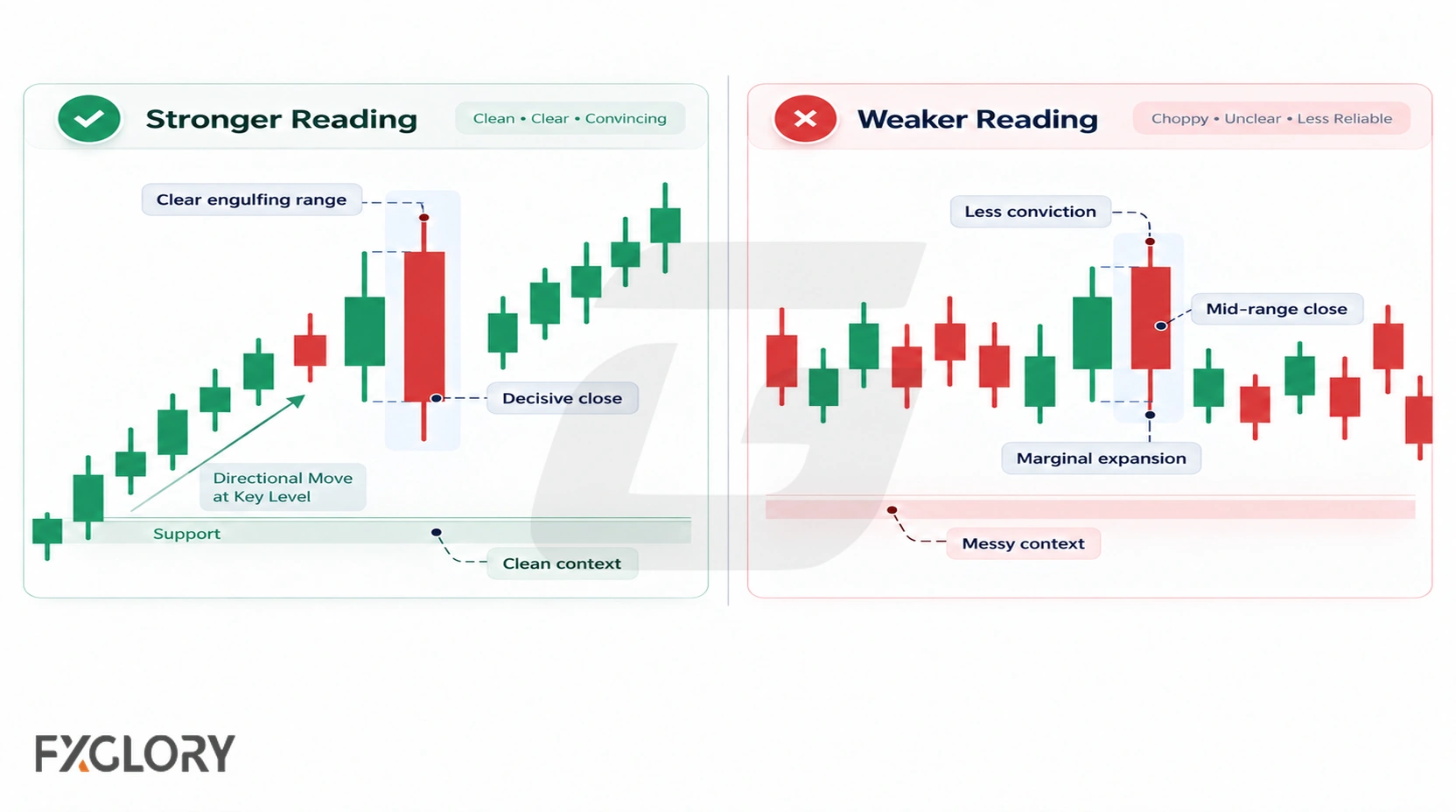
An outside bar does not carry the same value in every chart condition. A clean outside bar near a meaningful area is easier to review than a wide candle in noisy movement.

FactorCleaner ReadingWeaker Reading
Range expansionSecond candle clearly breaks both prior high and prior low.Only one side breaks, or the structure is forced.
Close locationClose near the high or low gives a clearer finish.Close near the middle may show unresolved two-sided movement.
Reference candle qualityPrevious candle gives a clear range.Previous candle is random or part of messy overlap.
Chart locationForms near support, resistance, trend structure, range edge, or swing area.Forms in the middle of unclear candles.
Market contextTrend, range, or level context is visible.Direction and level context are unclear.
VolatilityExpansion follows normal market movement.Pattern forms during news, rollover, or thin liquidity.
Follow-up movementLater price behavior keeps the outside bar area relevant.Price quickly makes the expanded range irrelevant.
Practical point: A cleaner outside bar has strict range expansion, a useful chart location, a meaningful close, and follow-up movement that keeps the expanded range relevant.

Outside Bar Forex Reading Table

The table below shows how outside bars can be reviewed in different chart settings. It is a reading aid, not a trading instruction.

Outside Bar SituationPossible ReadingWhat To Check Next
After inside-bar compressionPrice moved from narrow range to wider range.Check close quality, location, and whether expansion holds.
Inside a clean trendExpansion may align with or challenge the trend.Check whether the close supports the broader structure.
Near supportPrice tested both sides of the prior candle near a lower area.Check whether the candle closes away from or through support.
Near resistancePrice tested both sides of the prior candle near a higher area.Check whether the candle closes away from or through resistance.
Inside a messy rangeExpansion may be ordinary two-sided volatility.Check whether any clear level gives the candle meaning.
Very wide outside barMarket moved sharply beyond the prior range.Review news, spread, slippage, and volatility conditions.
Outside bar with middle closeBoth sides were tested but neither side clearly held the close.Check later candles before giving the range more weight.

How To Read An Outside Bar In Forex

A structured workflow keeps outside bars from being overused. The goal is to confirm the range expansion first, then decide whether the chart context makes it useful.

  1. Wait for the candle to close: Do not label an outside bar while the second candle is still forming.
  2. Mark the previous candle: Identify the previous candle's high and low.
  3. Confirm range expansion: Check whether the second candle made both a higher high and a lower low.
  4. Separate range from body: Do not confuse outside bar with engulfing body takeover.
  5. Read the close location: Check whether the outside bar closed near the high, near the low, or near the middle.
  6. Check chart location: Review trend structure, support, resistance, range edges, swing highs, or swing lows.
  7. Review volatility conditions: Consider spread, rollover, session changes, liquidity, and scheduled news.
  8. Watch later movement: Review whether price respects, rejects, breaks, or returns inside the outside bar range.

Some traders compare outside bars with technical indicators for context. For example, ATR can help review whether the outside bar range is unusually wide, Bollinger Bands can add range and expansion context, and RSI can add momentum context around expanded candles. These tools can support chart review, but they do not remove trading risk.

Useful question: Before giving an outside bar meaning, ask whether the second candle truly expanded beyond both sides, where it closed, and whether the surrounding chart gives the range a reason to matter.

False Breaks And Failed Outside Bar Movement

Outside bars can create false readings because they move beyond both sides of the previous candle. A wide candle may look decisive, but later price movement can return into the prior range, reject the outside bar close, or move against the initial reading.

A failed outside bar does not need a special label to be important. The key point is that range expansion can fail. The market may test above and below the previous candle without accepting either side for long.

In range conditions, an outside bar can break both sides of the prior candle and still fail to create a clean directional move.

False-Reading TypeWhat HappensSafe Reading
Upper-side failureOutside bar breaks above the prior high but cannot hold higher levels.The upper expansion may have been rejected.
Lower-side failureOutside bar breaks below the prior low but cannot hold lower levels.The lower expansion may have been rejected.
Middle closeOutside bar expands both ways but closes near the middle.The candle may show volatility more than direction.
News-driven expansionOutside bar forms during fast or unstable movement.Treat the candle as volatility first.
Quick return into prior rangeLater candles move back inside earlier price action.The outside bar area may lose importance quickly.
  • Do not assume expansion means continuation: Price can expand beyond a range and then return.
  • Be careful around news: Wide candles can form under unstable spread and liquidity conditions.
  • Check the close: A wide range with a weak close may be less clear than it first appears.
  • Review the broader chart: A failed outside bar is more meaningful when it forms near a clear level.
False-expansion caution: The outside bar shows that price expanded beyond the prior candle. It does not prove that the expanded direction will continue.

Common Mistakes With Outside Bars In Forex

Outside bars are visually obvious because the second candle is wider than the previous candle. That visibility can make the pattern easy to overread, especially when the candle forms during volatile or unclear conditions.

  • Confusing outside bar with engulfing: Outside bar uses high-low range expansion. Engulfing focuses on body takeover.
  • Calling an unfinished candle an outside bar: The second candle must close before the structure is confirmed.
  • Ignoring the close location: A wide candle with a middle close may show unresolved volatility instead of clear pressure.
  • Reading every wide candle as important: Some outside bars are only volatility spikes or noisy range movement.
  • Ignoring the reference candle: The previous candle must give a meaningful comparison range.
  • Forcing loose examples: One-sided breaks or equal-range versions are weaker than strict outside bars.
  • Ignoring chart location: Outside bars in the middle of unclear movement may not carry useful information.
  • Treating outside bars as complete systems: A candle structure is not a full trading plan.
  • Ignoring spread, rollover, and news: Forex candle shapes can be affected by unstable market conditions.
  • Replacing risk planning with candle confidence: Range expansion does not replace risk limits, position sizing, or a clear invalidation area.

What To Study After Outside Bars

After learning outside bars, the next step is to compare expansion with compression, body takeover, wick rejection, and body-pressure candles. This prevents the outside-bar label from being applied to every large second candle.

For the closest range comparison, review inside-bar range compression. For two-candle body comparison, review engulfing body takeover and harami body contraction. For single-candle pressure and rejection comparisons, review pin bar long-wick rejection and marubozu full-body pressure. For the broader pattern library, return to forex candlestick pattern groups.

Frequently Asked Questions

What is an outside bar in forex?

An outside bar in forex is a two-candle formation where the second candle makes a higher high and a lower low than the previous candle. The second candle expands beyond both sides of the previous candle's full range.

What does an outside bar mean in forex?

An outside bar can show range expansion, increased volatility, stronger two-sided movement, or a wider test of price. Its meaning depends on trend context, support and resistance, close location, volatility, and follow-up price action.

Is an outside bar bullish or bearish?

An outside bar is not automatically bullish or bearish. A bullish outside bar usually closes closer to the upper part of its range, while a bearish outside bar usually closes closer to the lower part of its range. The broader chart still matters.

Can an outside bar form after an inside bar?

Yes. An outside bar can form after inside-bar compression when price moves from a narrower range into a wider candle that breaks the previous high and low. This shows compression-to-expansion behavior, but it still needs chart context.

What is the difference between an outside bar and an inside bar?

An inside bar contracts inside the previous candle's high-low range. An outside bar expands beyond the previous candle by making both a higher high and a lower low.

What is the difference between an outside bar and an engulfing candle?

An outside bar is defined by full high-low range expansion beyond the previous candle. An engulfing candle is defined by the second candle body overtaking the previous candle body.

Can an outside bar also be an engulfing candle?

Yes, one candle can sometimes satisfy both ideas. If the full range expands beyond the previous high and low, outside-bar logic applies. If the body overtakes the previous body, engulfing logic also applies.

Does candle color define an outside bar?

No. Candle color does not define the outside bar. The required structure is a second candle with a higher high and lower low than the previous candle. The close direction can add context after the structure is confirmed.

Is an outside bar a reversal or continuation pattern?

An outside bar can appear in either continuation or reversal-review settings. The pattern itself shows range expansion. The surrounding chart decides whether that expansion is useful.

What is a failed outside bar?

A failed outside bar happens when the wide candle initially looks important, but later price movement quickly returns into the prior range, rejects the outside bar direction, or makes the expansion area less meaningful.

When should an outside bar be ignored?

An outside bar is often better ignored when it forms in a messy range, during abnormal news volatility, on very noisy lower timeframes, before the candle closes, or when the expanded range has no clear chart location.

Related Contents

Forex Candlestick GuideReview candle anatomy, bodies, wicks, open, close, high, and low before studying two-candle range expansion.
Forex Candlestick PatternsSee where outside bars fit inside broader expansion, compression, and multi-candle pattern groups.
Inside Bar In ForexCompare outside-bar range expansion with range compression before expansion.
Forex Engulfing CandleCompare full-range expansion with a two-candle body-takeover pressure shift.
Harami Candle ForexCompare outside-bar expansion with two-candle inside-body contraction.
Pin Bar In ForexCompare two-candle range expansion with one-candle long-wick rejection.
Marubozu Candle ForexCompare outside-bar expansion with one-candle full-body pressure.
Piercing Pattern ForexCompare outside-bar expansion with a two-candle bullish recovery into the prior body.
Dark Cloud Cover ForexCompare outside-bar expansion with a two-candle bearish pushback into the prior body.
Forex Reversal CandlesReview how outside bars can appear near areas where traders study possible pressure shifts.
ATR Indicator ForexReview volatility context when outside bars form with unusually wide candle ranges.
Bollinger Bands ForexUse range and expansion context when reviewing wide outside-bar candles.

Practice Reviewing Outside Bars On A Demo Account

Use a free FXGlory demo account to observe outside bars across pairs, timeframes, volatility conditions, support and resistance areas, and range-expansion scenarios before trading with real funds.

Open a Free Demo Account