
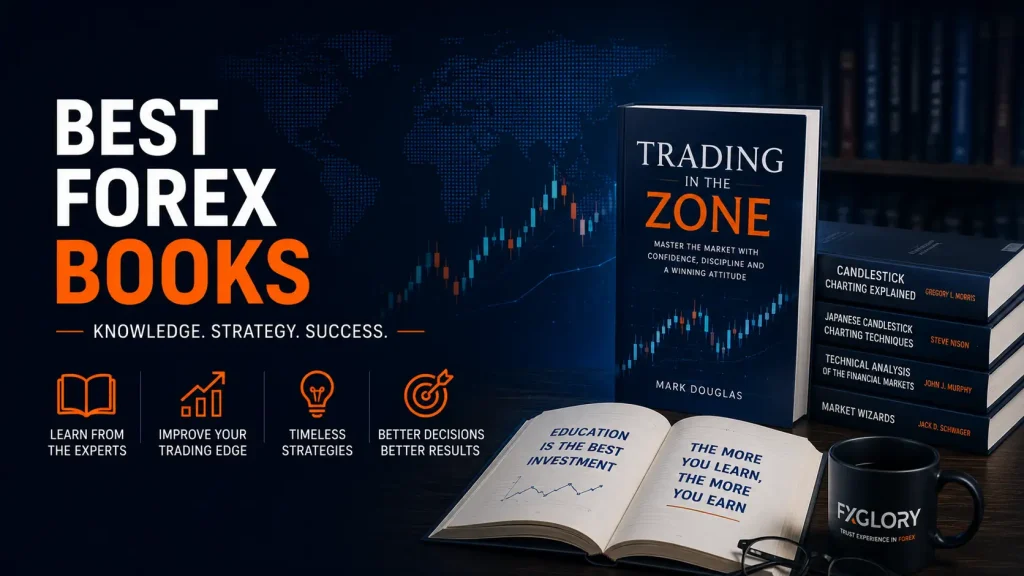
Best Forex Books: The Quick Answer
The best forex book depends on what the trader needs to learn next. A complete beginner usually needs a market-mechanics book first. A chart-focused trader may need technical analysis or candlestick books. A trader who keeps breaking rules may benefit more from psychology, journaling, and risk books than from another strategy title.
If a complete beginner can choose only one starting book, Currency Trading For Dummies by Paul Mladjenovic, Kathleen Brooks, and Brian Dolan is usually the safest first choice because it explains the currency market, pairs, quotes, major drivers, and trading basics in plain language. A reader who already knows the basics can move to Kathy Lien for currency strategy and fundamentals, John J. Murphy or Steve Nison for chart reading, Mark Douglas for psychology, and Brent Donnelly for more advanced foreign-exchange market context.
The important point is sequence. Reading a strategy book before understanding pips, pairs, spreads, margin, order types, and risk can create confidence without control. A better reading path starts with basics, then chart reading, then strategy, then psychology and risk review.
| Reader Need | Good Starting Book Type | Useful Examples | What To Do After Reading |
|---|---|---|---|
| Complete beginner | Forex basics and market mechanics | Currency Trading For Dummies by Paul Mladjenovic, Kathleen Brooks, and Brian Dolan; Forex Trading: The Basics Explained in Simple Terms by Jim Brown | Review forex terms, pairs, pips, spread, margin, and order types. |
| Chart learner | Technical analysis and candlesticks | Technical Analysis of the Financial Markets by John J. Murphy; Japanese Candlestick Charting Techniques by Steve Nison | Practice reading completed candles and chart structure before using real money. |
| Strategy learner | Currency strategy and price-action books | Day Trading and Swing Trading the Currency Market by Kathy Lien; Naked Forex by Alex Nekritin and Walter Peters | Backtest or demo-test the idea instead of trading it immediately. |
| Short-term trader | Scalping and day-trading books | Forex Price Action Scalping by Bob Volman; selected day-trading texts | Study spread, session volatility, stop distance, and execution pressure. |
| Emotional trader | Psychology and discipline books | Trading in the Zone by Mark Douglas; The Disciplined Trader by Mark Douglas; The New Trading for a Living by Alexander Elder | Track rule breaks, hesitation, FOMO, revenge trades, and overconfidence in a journal. |
| Developing trader | Risk, process, and market-story books | Trade Your Way to Financial Freedom by Van K. Tharp; Market Wizards by Jack D. Schwager; Reminiscences of a Stock Operator by Edwin Lefèvre | Convert lessons into written risk limits and trade-review rules. |
What To Include And Exclude When Choosing Forex Books
Focus on books, e-books, audiobooks, and study materials that help traders learn forex. A forex card, currency-exchange service, order-book tool, market-depth tool, or broker execution model will not teach the same skill as a trading book.
A trader should choose books by learning stage, not by promotional claims, unrealistic titles, or profit promises. Some books are forex-specific, while others are broader trading classics that still help with chart reading, risk, discipline, or trader psychology.
If basic forex terms still feel unclear, read FXGlory's guide to forex trading terms before choosing advanced books. A book becomes more useful when the reader already understands the language used in examples.
How To Choose A Forex Book Without Falling For Hype
A good forex book should make a trader more careful, not more reckless. It should explain market context, risk, examples, limitations, and decision rules. A weak book may rely on promises, shortcuts, screenshots, secret systems, or the idea that one method works in every market condition.
Before buying, downloading, or trusting a forex book, check what the book is really teaching. A beginner book should not pretend to be a complete income system. A strategy book should not ignore losing trades. A psychology book should not replace risk management. A technical-analysis book should not imply that patterns predict the future with certainty.
| Selection Question | Why It Matters | Better Signal |
|---|---|---|
| Who wrote it? | Forex is a money topic, so author credibility matters. | Clear author name, background, market experience, or educational track record. |
| Why is it recommended? | Popularity alone does not prove a book fits the reader. | The recommendation explains the learning stage, topic, limitation, and next practice step. |
| What problem does it solve? | Books that try to solve everything often stay shallow. | A clear focus: basics, technical analysis, psychology, risk, or strategy. |
| Does it discuss losses? | A book that only shows wins can distort expectations. | Examples include risk, invalidation, losing periods, and review. |
| Does it promise guaranteed profit? | Guarantees are a major warning sign in trading education. | Realistic language about uncertainty, risk, and practice. |
| Is it current enough? | Market principles can last, but platforms, costs, and regulations change. | Classic principles plus updated understanding of modern execution conditions. |
| Can it be practiced safely? | Reading alone does not build execution skill. | Clear concepts that can be tested on charts, demo accounts, or journals. |
Use public ratings, retailer listings, trader discussions, and book summaries as discovery inputs, not final proof. A best-selling forex book may be popular because of timing, price, promotion, or title appeal. A personal recommendation can be honest and still reflect only one trader's stage, market, and personality.
A Practical Reading Path For Forex Traders
The safest way to use forex books is to build a reading path. Beginners often make the mistake of jumping from one strategy book to another before learning market mechanics. That creates vocabulary without judgment.
A practical path moves from basic understanding to chart reading, then strategy review, then risk and psychology. This keeps the trader from treating a strategy as a shortcut before understanding the conditions that can make it fail.
- Start with market mechanics: Learn currency pairs, quote reading, pips, lots, spread, margin, leverage, order types, sessions, and basic news awareness.
- Move to chart reading: Study candles, support and resistance, trends, chart patterns, indicators, and timeframes.
- Add strategy books carefully: Treat every strategy as a hypothesis that needs testing, not as a ready-made income source.
- Study psychology early: Many traders fail because of FOMO, revenge trading, overtrading, hesitation, or overconfidence, not because they lacked another indicator.
- Use risk books and journaling: Convert book lessons into risk per trade, maximum drawdown limits, stop rules, and review habits.
For a beginner foundation outside books, FXGlory's how to trade forex guide can help connect reading with the actual trading process.
Best Forex Books For Beginners
The best forex books for beginners explain the market before they explain tactics. A new trader should understand what is being traded, why currency pairs move, how quotes work, how costs appear, and why leverage can turn a small mistake into a large loss.
| Book | Author | Best For | Why It Helps | Reading Caution |
|---|---|---|---|---|
| Currency Trading For Dummies | Paul Mladjenovic, Kathleen Brooks, and Brian Dolan | Complete beginners | Introduces currency market basics, terminology, participants, and trading concepts in accessible language. | Use it as a starting point, not as proof that live trading is simple. |
| Forex Trading: The Basics Explained in Simple Terms | Jim Brown | New traders who want a shorter beginner explanation | Uses plain language and practical framing for basic forex concepts. | Any included strategy idea still needs independent testing. |
| The Little Book of Currency Trading | Kathy Lien | Readers who want a compact FX overview | Can help explain currency-market thinking without overwhelming detail. | Short books can simplify topics that need deeper practice. |
Do not rush from a beginner book into large live trades. After reading, the next step is to review how quotes, charts, and order types behave in real time. A beginner can use a demo account to practice platform workflow, order placement, and basic chart review without real-money exposure.
Best Forex Technical Analysis Books
Technical analysis books help traders read chart structure, but they should not be treated as prediction manuals. A technical-analysis book can explain trends, support, resistance, indicators, candles, and patterns. It cannot make a setup certain.
| Book | Best For | What It Teaches | FXGlory Study Pair |
|---|---|---|---|
| Technical Analysis of the Financial Markets John J. Murphy | Broad technical-analysis foundation | Trends, chart patterns, indicators, market structure, and classic technical-analysis concepts. | How to read forex charts |
| Technical Analysis of the Currency Market Boris Schlossberg | Forex-focused technical learners | Technical-analysis concepts applied more directly to currency-market behavior. | Forex technical analysis |
| Getting Started in Technical Analysis Jack D. Schwager | Readers who want an easier technical-analysis entry point | Basic technical-analysis tools, chart structure, and trading-plan concepts. | Forex chart patterns |
| Encyclopedia of Chart Patterns Thomas N. Bulkowski | Pattern-focused learners | Pattern definitions, examples, and statistical thinking around chart formations. | Chart pattern review |
After reading a technical-analysis book, test whether you can identify the same structure across different pairs and timeframes without forcing labels. FXGlory's technical-analysis hub can help connect book concepts with forex-specific chart lessons.
Best Forex Candlestick And Chart Pattern Books
Candlestick books are useful because forex traders often make decisions from charts. The risk is that a trader may memorize candle names without understanding location, trend context, volatility, and confirmation.
Japanese Candlestick Charting Techniques by Steve Nison is one of the most frequently recommended candlestick books. It is useful for learning candle structure and classic candlestick thinking. The book is not a complete trading system by itself.
Before applying candlestick ideas, review FXGlory's forex candlestick guide. Candle names are less useful when the trader ignores where the candle forms and what the broader market is doing.
- Use candlestick books for structure: Learn open, high, low, close, body, wick, and multi-candle relationships.
- Use chart-pattern books for context: Patterns need trend, range, support, resistance, and timeframe review.
- Do not trade names alone: A hammer, engulfing candle, pin bar, or doji is only one piece of a larger chart.
Best Forex Strategy Books
Forex strategy books can be helpful when they explain market logic, setup conditions, invalidation, risk, and review. They become dangerous when a trader treats the title as a promise or skips testing because the examples look convincing.
| Book | Strategy Angle | Useful Lesson | Caution |
|---|---|---|---|
| Day Trading and Swing Trading the Currency Market Kathy Lien | Currency strategy, macro drivers, technical tools, and market behavior. | Connects trading decisions with currency-specific factors. | Strategies must be adapted to current conditions and personal risk limits. |
| Naked Forex Alex Nekritin and Walter Peters | Price action and indicator-light trading. | Encourages traders to observe price structure rather than depend only on indicators. | Price action still needs risk rules and clear invalidation. |
| The Black Book of Forex Trading Paul Langer | Personal strategy and trader-process framing. | Can be reviewed as one author's framework for trading development. | The title should not be read as a guarantee of profitability. |
| Forex Price Action Scalping Bob Volman | Short-term price-action scalping. | Shows how detailed short-term price reading can become. | Scalping is sensitive to spread, execution, volatility, and emotional pressure. |
For structured follow-up, use FXGlory's forex strategies hub to compare strategy-book frameworks with practical strategy lessons before risking money.
Best Forex Price Action, Scalping, And Day Trading Books
Price action, scalping, and day trading books attract many traders because they seem practical. They can help with reading market movement, but they also create one of the biggest risks: too much confidence in short-term decisions.
Scalping books require extra caution. Short-term trading can be affected by spread, slippage, execution speed, session liquidity, news, and hesitation. A strategy that looks clean in a book may feel very different when price moves quickly on a live platform.
| Book Type | When It Helps | What To Check Before Applying It |
|---|---|---|
| Price action books | When the trader wants to read candles, levels, trend, and rejection without relying only on indicators. | Support/resistance context, trend quality, volatility, and timeframe fit. |
| Scalping books | When the trader studies very short-term entries and exits. | Spread, slippage, order speed, session timing, and emotional control. |
| Day trading books | When the trader wants intraday structure and routine. | Daily loss limits, trade frequency, news schedule, and stop-trading rules. |
If scalping is the reason you are choosing a book, first review FXGlory's guide to forex scalping. The book should support a controlled routine, not encourage more trades without better rules.
Best Forex Fundamental Analysis Books
Fundamental analysis forex books help traders understand why currencies may move beyond a chart pattern. Interest rates, central-bank policy, inflation, employment data, risk sentiment, trade flows, and geopolitical events can all affect currency behavior.
Technical analysis is only one side of forex education. Traders who also want the economic side of forex can use currency-market specialists such as Kathy Lien and Brent Donnelly to connect market moves with macroeconomic context.
| Book | Author | Best For | Why It Helps | Reading Caution |
|---|---|---|---|---|
| Day Trading and Swing Trading the Currency Market | Kathy Lien | Readers who want strategy connected to currency drivers | Connects currency pairs with fundamental themes, technical setups, and trading context. | Use the ideas as study frameworks, not as automatic trade instructions. |
| The Art of Currency Trading | Brent Donnelly | Intermediate traders and readers who want professional FX context | Explains foreign-exchange market behavior, trader process, and practical market thinking from a professional perspective. | Better after basic terms, order mechanics, and chart reading are already understood. |
| The Little Book of Currency Trading | Kathy Lien | Readers who want a compact macro-aware FX overview | Introduces currency-market themes in a shorter format than larger trading manuals. | Compact explanations need follow-up study and chart practice. |
- Read fundamentals for context: Economic data and central-bank expectations can change how a pair reacts around levels.
- Do not use fundamentals as certainty: A correct economic view can still be early, already priced in, or overwhelmed by positioning.
- Combine with risk rules: News events can increase spread, volatility, and slippage.
Fundamental-analysis books are most useful when paired with a written plan. A trader should know whether the book is being used for long-term bias, event preparation, or general market understanding.
Best Forex Psychology, Risk, And Discipline Books
Many traders keep searching for another strategy book when the real issue is behavior. If trades are opened from FOMO, increased after losses, moved without a rule, or repeated out of boredom, a psychology or risk book may be more useful than a new setup.
| Book | Best For | Main Lesson | FXGlory Study Pair |
|---|---|---|---|
| Trading in the Zone Mark Douglas | Probability thinking and emotional consistency | Trading outcomes are uncertain, so discipline must be built around process rather than prediction. | Forex trading psychology |
| The Disciplined Trader Mark Douglas | Rule-breaking, emotional reaction, and trader mindset | Knowing what to do is not the same as being able to do it under pressure. | Trading tilt |
| The New Trading for a Living Alexander Elder | Mind, method, and money management | Trading requires psychological control, method selection, and risk structure together. | Forex risk management strategy |
| Trade Your Way to Financial Freedom Van K. Tharp | System thinking, position sizing, and risk concepts | Position sizing and risk structure can matter more than entry excitement. | Forex trading journal |
A psychology book only helps when the trader turns it into observable rules. Write down the exact behavior to change: fewer impulsive trades, no revenge entry after a loss, fixed risk per trade, or a stop-trading rule after emotional overload.
Best Market Story Books For Forex Traders
Market-story books are not forex instruction manuals, but they can teach how professional traders think about uncertainty, losses, conviction, risk, and patience. They are useful after the reader already understands the basics.
Market Wizards is useful because it shows different traders with different styles rather than one universal method. Reminiscences of a Stock Operator is useful for lessons around speculation, patience, overconfidence, and the cost of emotional decisions. These books are not forex-only books, so the reader should extract principles, not copy trades.
To see how these lessons appear in real trader narratives, compare them with FXGlory's forex trading success stories and forex failure stories.
Free Forex Books, E-books, Online Books, And Audiobooks
Free forex books and e-books can be useful for basic learning, but they need a stronger trust filter. A free PDF may be a legitimate educational resource, an outdated document, a copied book, a sales funnel, or a low-quality strategy file with unrealistic promises.
Free forex e-books need a separate quality check because downloadable PDFs and online libraries vary widely. The deeper question is not only which free file is available; it is whether the file is legal, current, complete, and safe to learn from.
For downloadable resources, PDF safety checks, and free e-book evaluation rules, read FXGlory's free forex books and e-books resource.
Before using a free forex e-book, check the source, author, date, rights, risk language, and whether the material is mainly trying to sell signals, account management, or a secret system. Free does not automatically mean bad, but free material should not be trusted more just because it is easy to download.
- Be careful with pirated PDFs: Unauthorized copies can be outdated, incomplete, or illegal to distribute.
- Check for sales funnels: Some e-books are written mainly to push signals, courses, or managed-account offers.
- Watch for guaranteed-profit language: Any book or PDF that promises easy income should be treated as high risk.
- Use audiobooks selectively: Audiobooks can help with psychology and market stories, but chart examples usually need visual study.
Online books, retailer listings, reader reviews, trader discussions, and book summaries can all help with discovery. They do not replace judgment. A trader should still ask whether the book fits their current stage and whether its lessons can be tested safely.
How To Use Public Book Recommendations
Public book recommendations can show what people are buying or discussing, but popularity is not the same as suitability. Reader reviews can reveal strengths and weaknesses, but ratings may reflect writing style, title appeal, or audience expectations. Trader discussions can be honest, but they are personal opinions. Short book summaries can introduce titles quickly, but they may leave out limitations.
| Recommendation Type | Useful For | Main Limitation | How To Use It Safely |
|---|---|---|---|
| Retailer listing | Finding editions, formats, reviews, and current availability. | Sales rank and reviews do not prove trading quality. | Read negative reviews and check whether the book matches your level. |
| Reader-review shelf | Discovering commonly saved, reviewed, or discussed forex and trading books. | Ratings can reward popularity, not practical usefulness. | Compare reviews from beginners and experienced traders separately. |
| Trader discussion | Seeing what traders recommend or criticize from personal experience. | Advice is fragmented and not verified expertise. | Look for specific reasons, not one-line praise. |
| Book-summary content | Getting a quick overview before choosing what to read. | Summaries may focus on attention-grabbing titles or affiliate incentives. | Use summaries to shortlist books, then verify the author, edition, and content. |
Older, Dated, And Translated Forex Books
Older forex book recommendations often include the same durable classics. Many classic books remain useful because market psychology, risk, and chart-reading principles do not expire quickly.
Still, older books can miss newer platform workflows, current execution conditions, updated regulatory realities, crypto-market overlap, and recent changes in retail trading behavior. Treat older books as principle sources, not as complete modern trading manuals.
Translated forex books in Hindi, Urdu, Tamil, or other languages can be useful when the translation is legitimate and clear. Be careful with copied PDFs, anonymous translations, and books that remove risk warnings or change examples without context.
A Simple Reading Plan For Forex Books
A reading plan prevents book-hopping. Instead of reading five books and applying none, choose one book for the current weakness and turn it into a practical exercise.
| Stage | Reading Focus | Practice Task |
|---|---|---|
| Week 1 | Forex basics and terminology. | Write definitions for pairs, pips, spread, lots, leverage, margin, stop loss, and take profit. |
| Week 2 | Chart reading, candles, and trend structure. | Mark support, resistance, trend direction, and candle context on completed charts. |
| Week 3 | One strategy or setup idea. | Backtest or demo-test the idea with fixed risk rules and written invalidation. |
| Week 4 | Psychology, risk, and review. | Start a journal that records reason for entry, risk, emotion, exit, result, and lesson. |
FXGlory's forex trading journal template can help turn reading into a review habit. A book becomes more valuable when the trader can measure whether behavior changed after reading it.
Common Mistakes When Learning Forex From Books
Books can help a trader build structure, but they can also create false confidence when used badly. The mistake is not reading. The mistake is reading without testing, journaling, or risk control.
- Looking for one perfect book: No single forex book can cover market mechanics, execution, strategy, psychology, and risk at a deep level.
- Reading strategy before basics: A trader who does not understand spread, margin, or position size can misuse even a good strategy.
- Copying examples blindly: Book examples are simplified snapshots, not live-market instructions.
- Ignoring costs: Scalping and day trading ideas can fail if spread, slippage, and execution are ignored.
- Reading too many books at once: Too many frameworks can create confusion and strategy hopping.
- Skipping psychology: A trader can understand a setup and still break rules under pressure.
- Not journaling application: Without notes, it is hard to know whether the book improved execution or only increased confidence.
What To Do After Choosing A Forex Book
Choose one book that fits the current stage. Do not read a scalping book if the real weakness is basic terminology. Do not read a psychology book passively if the real problem is repeated rule-breaking. Do not read a strategy book without a way to test the idea.
After choosing a book, pair it with one FXGlory learning area. For chart reading, use the technical-analysis guides. For strategy selection, use the strategy hub. For emotional problems, use the trader psychology guide. For risk, use the risk-management guide. For review, use a trading journal.
Books are useful when they create better questions: What is my risk before entry? What condition invalidates this trade? Am I trading because of a setup or because of emotion? Did this book change my process, or only make me feel more confident?
That is the real value of the best forex books. They should not make trading feel easy. They should make the trader more prepared, more selective, and more aware of what still needs practice.
Frequently Asked Questions
What is the best forex book for beginners?
For many complete beginners, Currency Trading For Dummies by Paul Mladjenovic, Kathleen Brooks, and Brian Dolan is a practical first choice because it explains forex basics in accessible language. A shorter alternative is Forex Trading: The Basics Explained in Simple Terms by Jim Brown. Neither book should be treated as a profit system.
What is the best book to learn forex trading?
The best book to learn forex trading depends on the learning stage. Beginners usually need a basics book first. Chart learners may need John J. Murphy or Steve Nison. Strategy learners may use Kathy Lien or price-action books. Traders who keep breaking rules may benefit more from Mark Douglas, Alexander Elder, journaling, and risk-management study.
Is Currency Trading For Dummies a good forex book for beginners?
Yes, Currency Trading For Dummies can be a useful first forex book for complete beginners because it explains currency pairs, market participants, terminology, and trading basics in accessible language. It should still be treated as an introduction, not as a complete trading system or a promise of profitability.
What is the best forex book if I already know the basics?
If you already know forex basics, choose the next book based on your weakest area. For chart reading, use technical analysis or candlestick books. For currency-market context, read Kathy Lien or Brent Donnelly. For emotional rule-breaking, read Mark Douglas or Alexander Elder. For process and risk, study risk-focused trading books and keep a trade journal.
Can forex books make me profitable?
No forex book can make a trader profitable by itself. Books can teach concepts, but profitability depends on practice, risk management, emotional control, execution, market conditions, costs, journaling, and the trader's ability to follow rules over time.
What are the best forex technical analysis books?
Common technical-analysis choices include Technical Analysis of the Financial Markets, Technical Analysis of the Currency Market, Getting Started in Technical Analysis, Japanese Candlestick Charting Techniques, and Encyclopedia of Chart Patterns. These books should be used to improve chart reading, not to assume that patterns predict the future with certainty.
What are the best forex price action books?
Naked Forex and Forex Price Action Scalping are often discussed for price-action learning. Price-action books can help traders study candles, levels, and market structure, but they still need risk rules, timeframe context, and testing.
What are the best forex strategy books?
Day Trading and Swing Trading the Currency Market, Naked Forex, Forex Price Action Scalping, and The Black Book of Forex Trading are examples of strategy-focused forex books. A trader should treat any strategy book as a framework to test, not as a guaranteed system.
What are the best forex psychology books?
Trading in the Zone and The Disciplined Trader by Mark Douglas are widely recommended trading psychology books. The New Trading for a Living by Alexander Elder also connects psychology, method, and money management. These books are useful when a trader struggles with discipline, fear, overconfidence, FOMO, or revenge trading.
Are free forex books and e-books worth reading?
Free forex books and e-books can be useful for basic education, but they should be checked carefully. Review the source, author, date, risk warnings, and whether the e-book is mainly a sales funnel for signals, courses, or unrealistic profit claims.
Are best-selling forex books always the best?
No. Best-seller lists show popularity and sales activity, not necessarily quality, suitability, or safety. Use retailer listings to check editions, reviews, and formats, but choose a book based on your learning stage and the credibility of the material.
Are older forex book lists still useful?
Many older forex book lists still include useful classics because market psychology, risk, and chart-reading principles do not expire quickly. However, older books may not reflect current platforms, execution conditions, retail trading behavior, or regulatory context, so they should be paired with updated education.
Are forex audiobooks useful?
Forex audiobooks can be useful for psychology, discipline, market stories, and general concepts. They are less useful for chart-heavy material because candles, patterns, indicators, and examples usually need visual review.
Are forex trading books in Hindi, Urdu, or Tamil reliable?
Translated forex books can be useful when the translation is legitimate and the original source is credible. Be careful with anonymous PDFs, copied material, outdated examples, or translations that remove risk warnings and make trading sound easier than it is.
Should I read forex books before opening a demo account?
Reading a beginner forex book before demo trading can help with terminology and market mechanics. Demo practice is still important because it helps the trader apply book concepts to charts, order placement, spreads, margin, and trade review without real-money exposure.
What should I read after a beginner forex book?
After a beginner book, choose based on your weakness. If charts are unclear, read technical analysis or candlestick material. If entries are random, study strategy and price action. If rules keep breaking, read psychology and risk books. If mistakes repeat, start journaling trades.
Related Contents
Turn Reading Into A Tested Trading Process
Create an FXGlory account to review the trading environment, platform workflow, account conditions, instruments, margin requirements, leverage settings, and order process before placing a real-money trade.
Create an FXGlory Account