
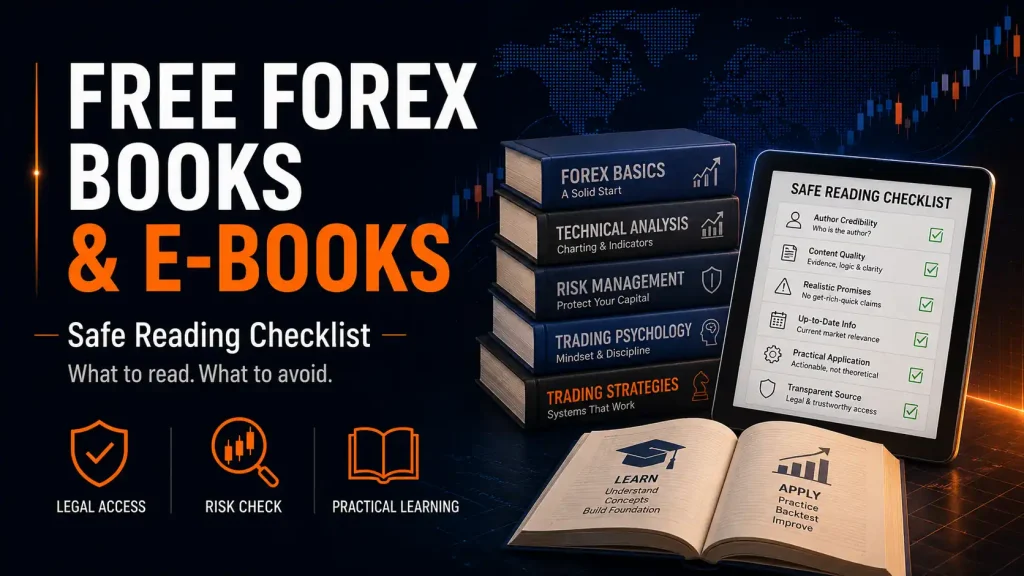
Free Forex Books: The Quick Answer
Free forex books can help a trader learn terminology, market mechanics, chart basics, risk concepts, and trading psychology. They become misleading when they are treated as trading signals, secret systems, or proof that forex income is easy.
A useful free forex e-book should answer basic questions clearly: who created it, when it was written, whether it is legal to access, what risk it explains, what losses it discusses, and how a trader should practice the idea before live exposure. A weak free PDF usually hides the author, promises fast results, ignores losing trades, or pushes the reader toward signals, courses, or managed-account offers.
A practical approach is simple: check the resource first, read one topic at a time, take notes, test one idea on demo, and record what changed in the trading process. Free material should make a trader more selective, not more eager to trade bigger.
Use A Free Forex Book Evaluation Checklist First
Before trusting a free forex book, score it. A checklist prevents the reader from accepting a PDF just because it is easy to download or has an exciting title.
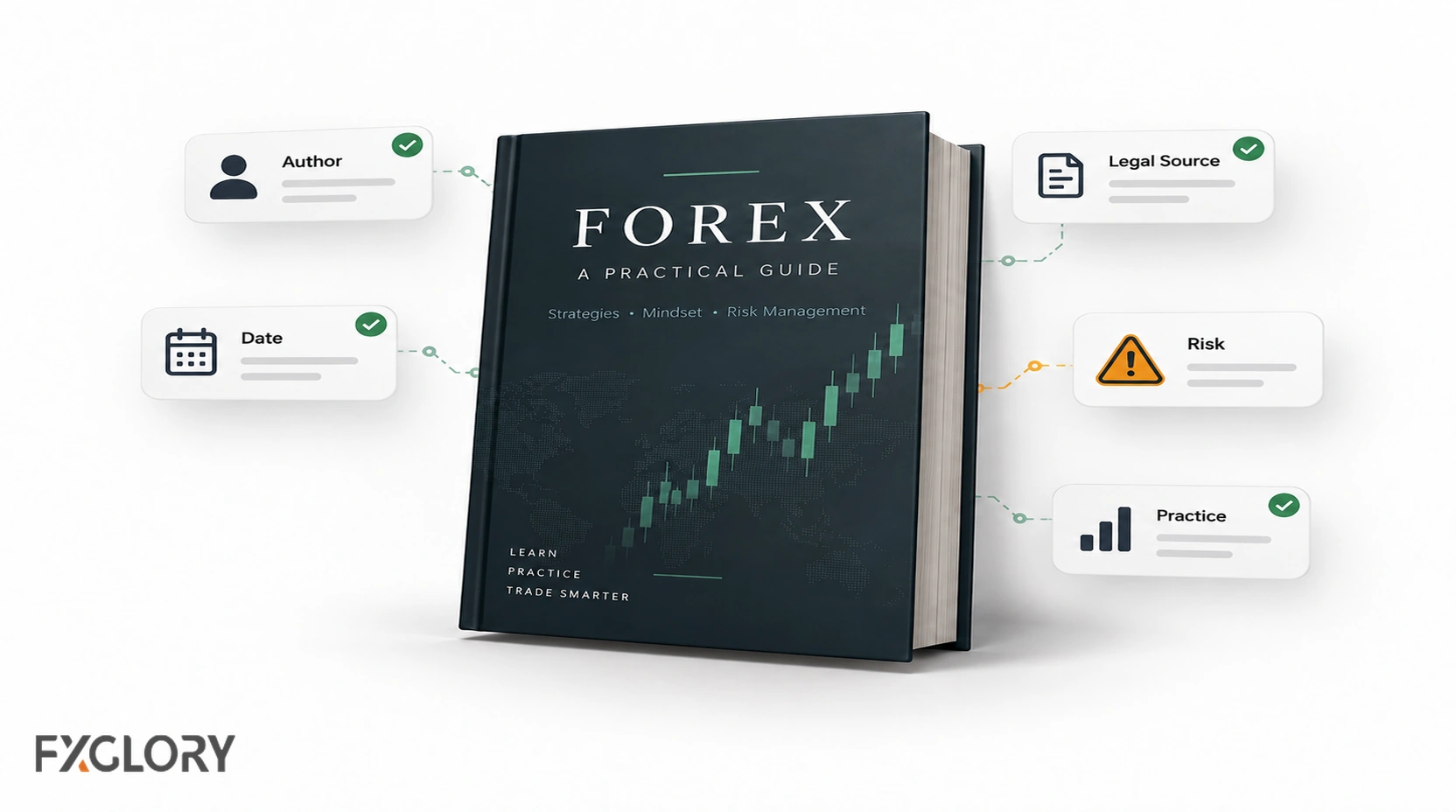
View Free Forex Book Evaluation Checklist
The checklist is useful before reading beginner material, strategy PDFs, translated books, trading psychology resources, and online lessons. It asks practical questions about author identity, source quality, legal access, risk warnings, profit claims, strategy testing, and whether the material fits the trader's current learning stage.
- Use it before downloading: A few minutes of checking can prevent hours spent on weak or risky material.
- Use it before trading an idea: A strategy explanation is not enough unless risk, invalidation, and testing are clear.
- Use it after reading: A book that creates no rule, note, or practice task may not have changed the trader's process.
What Counts As A Free Forex Book Or E-book?
A free forex book can be a full e-book, a short PDF, a lesson collection, a platform manual, a trading workbook, an audiobook, a translated resource, or a company-published education file. The format matters less than the quality and purpose of the material.
Some free resources are helpful introductions. Others are thin documents built around a sales pitch. A trader should not judge quality by length alone. A 10-page risk checklist can be more useful than a 100-page strategy file that hides losses.
| Resource Type | What It Can Teach | Main Risk | Best Use |
|---|---|---|---|
| Beginner e-book | Pairs, pips, spread, lots, leverage, margin, and basic order types. | May make live trading sound easier than it is. | Use it to learn terms before chart and demo practice. |
| Strategy PDF | Entry ideas, setup examples, indicators, price action, or market rules. | May hide losing examples, drawdown, spread cost, and weak market conditions. | Use it as a test idea, not as a signal. |
| Technical-analysis PDF | Candles, trends, support, resistance, patterns, and indicators. | May make chart patterns look more certain than they are. | Practice on completed charts and record failed examples. |
| Psychology resource | Discipline, fear, greed, patience, and rule-following. | May stay too general unless tied to trade records. | Turn the lesson into a written behavior rule. |
| Trading workbook | Checklists, journal prompts, exercises, and review routines. | May be ignored after download. | Use it while reviewing demo or live trades. |
| Audiobook | Mindset, market stories, and broad concepts. | Weak for chart-heavy examples. | Use it for psychology and review, not candle memorization. |
Useful Free Forex Material vs Risky Free Material
The difference between useful and risky free material is usually visible in the first few minutes. Useful material slows the trader down and explains uncertainty. Risky material creates urgency, excitement, and the feeling that one file has solved trading.
| Useful Material | Risky Material |
|---|---|
| Names the author, publisher, or company responsible for the material. | Hides ownership or uses vague authority claims. |
| Explains that losses, spreads, slippage, leverage, and margin affect results. | Talks mainly about income, freedom, or fast account growth. |
| Shows how to practice an idea safely before live exposure. | Pushes immediate live trading or large position size. |
| Includes losing examples, invalidation, and risk limits. | Shows only winning examples or perfect chart screenshots. |
| Helps the trader write rules, notes, or review questions. | Encourages copying entries without understanding. |
| Fits a specific learning stage. | Claims to solve every trading problem at once. |
Download, Read Online, Or Skip?
Not every free forex resource deserves the same action. Some are safe to read online, some are useful after a quick check, and some should be skipped before they shape the trader's habits.
| Resource Type | Use When | Avoid When | Next Action |
|---|---|---|---|
| Official beginner e-book | The source is clear, the material explains terms and risk, and there is no pressure to trade immediately. | The file uses income promises or hides leverage, margin, spread, and loss risk. | Read the basics, then practice terminology and order workflow on demo. |
| Independent education PDF | The author is named, the date is visible, and examples include limits or losing scenarios. | The author is anonymous or the material claims one method works in all conditions. | Score it with the checklist before taking notes. |
| Old free forex book | The material teaches durable ideas such as risk, psychology, basic chart structure, or market mechanics. | It depends on outdated platform steps, old broker rules, or missing risk warnings. | Keep the principle and verify execution details elsewhere. |
| Anonymous strategy PDF | Rarely suitable as a primary learning source. | The file has no author, no testing method, no losing examples, or a secret-system tone. | Skip it unless the idea can be independently tested with strict risk limits. |
| Translated PDF | The original source is named and technical terms are translated clearly. | The file removes risk warnings, changes examples, or comes from an unknown upload. | Check key terms such as margin, leverage, spread, lots, and drawdown. |
| Audiobook or short lesson | The topic is psychology, discipline, trading habits, or market stories. | The topic depends on charts, candle shape, indicator settings, or setup screenshots. | Write one rule or question after listening. |
| Document-sharing upload | Only when legal ownership and source quality are clear. | The file looks copied, scanned, incomplete, unauthorized, or stripped of attribution. | Do not download or share it; choose a legal source. |
An 8-Point Quality Check For Any Free Forex Book
A simple score helps separate useful material from files that only look helpful. Give one point for each item the resource satisfies. A strong score does not make the material safe to trade live, but it does make the resource more suitable for study.
| Quality Area | What To Check | Why It Matters |
|---|---|---|
| Identity | Author, publisher, company, or responsible source is clear. | Anonymous money advice is hard to trust. |
| Date | The material shows when it was created or updated. | Trading platforms, costs, and rules can change. |
| Legal access | The file appears to be shared by the rights holder or an official distributor. | Unauthorized copies can be incomplete, outdated, or illegal to share. |
| Learning stage | The resource says whether it is for beginners, chart learners, strategy learners, or risk review. | A beginner can misuse advanced material. |
| Risk language | Losses, leverage, margin, spread, slippage, and volatility are explained. | Risk context helps the reader assess claims more critically. |
| Loss examples | The book includes losing trades, failed setups, or limitations. | Only showing wins creates unrealistic expectations. |
| Practice step | The material gives a demo, chart, journal, or review exercise. | Reading without application rarely changes behavior. |
| Sales pressure | The resource does not rely on urgency, secret systems, or income promises. | Pressure language can push traders into bad decisions. |
- 7-8 points: Stronger study candidate. Read critically and test ideas in a controlled environment.
- 4-6 points: Mixed quality. Fill important gaps before applying anything to trading decisions.
- 0-3 points: Weak study candidate. Do not rely on it for live trading decisions.
Legal And Source Checks Before Downloading A Forex PDF
A free file is not automatically legal or reliable. Some PDFs are distributed by the author, publisher, broker, or education provider. Others are copied from paid books without permission. A copied file can be incomplete, altered, old, or missing important context.
Before downloading or sharing a forex PDF, check whether the file is offered by the original creator, an official partner, or a clearly responsible organization. Avoid files that look like copied scans, file dumps, or documents with removed attribution.
- Check the host: The file should come from a source that has a clear right to publish it.
- Check the author: Money education without author identity deserves caution.
- Check the date: Old examples can still teach principles, but platform and execution details may be stale.
- Check the purpose: A file that mostly pushes signals, accounts, or managed services is not neutral education.
- Check the risk language: A resource that avoids losses, drawdown, and leverage risk is not complete.
Do not download unauthorized copies of paid trading books just because they appear as free PDFs. A file can be easy to find and still be illegal, incomplete, outdated, altered, or unsafe to learn from.
Risk Checks Before Trusting A Free Forex Book
A free forex book should not be trusted simply because it looks professional or is easy to access. Compare its claims with clear risk disclosures and check whether it explains leverage, losses, trading costs, execution, and uncertainty.
| Risk Check | What To Review | Why It Matters |
|---|---|---|
| FXGlory Risk Disclosure | Review the stated risks of leverage, loss, execution, and market conditions before relying on educational material. | A free book should not present leveraged trading as certain, low-risk, or suitable for everyone. |
| Profit claims | Look for guarantees, fixed-income promises, or unusually certain performance language. | Educational material should explain uncertainty rather than imply assured outcomes. |
| Leverage and margin | Check whether the resource explains how leverage increases exposure and how margin requirements affect positions. | Strategy examples are incomplete when position exposure and loss risk are ignored. |
| Execution and costs | Check whether spreads, slippage, order execution, and changing market conditions are acknowledged where relevant. | Clean chart examples can omit costs and execution effects that matter in live trading. |
Good education does not remove risk. It should help the trader ask better questions before using real money: what is the position size, what is the margin requirement, where is the invalidation point, how large can the loss become, and what rule stops the session?
How Beginners Can Use Free Forex Books
Beginners should use free forex books to learn the language of the market first. The first goal is not to find a winning setup. The first goal is to understand what a trade is, what affects cost, and how a small position can become risky when leverage and margin are misunderstood.
| Beginner Topic | What A Free Book Should Explain | Practice After Reading |
|---|---|---|
| Currency pairs | Base currency, quote currency, major pairs, minor pairs, and how quotes move. | Write how a pair quote changes when the base currency strengthens or weakens. |
| Pips and spread | How price movement and transaction cost appear in trading. | Watch spread change across different pairs and trading times. |
| Lots and position size | How trade size affects money at risk. | Calculate loss size before thinking about profit. |
| Leverage and margin | How exposure can become larger than the account balance. | Review margin needs before increasing lot size. |
| Orders | Market, limit, stop, stop loss, and take profit orders. | Practice order placement on demo before using real capital. |
| Risk rule | How much loss is acceptable before entry. | Write a maximum risk rule and a stop-trading rule. |
Use FXGlory's forex trading terms and how to trade forex lessons to support beginner reading before moving to strategy material.
How To Read Free Forex Strategy E-books
Strategy e-books attract traders because they look practical. The danger is that examples in a book are usually selected after the fact. A clean chart in a PDF does not show spread, hesitation, slippage, losing streaks, or the emotional pressure of live execution.
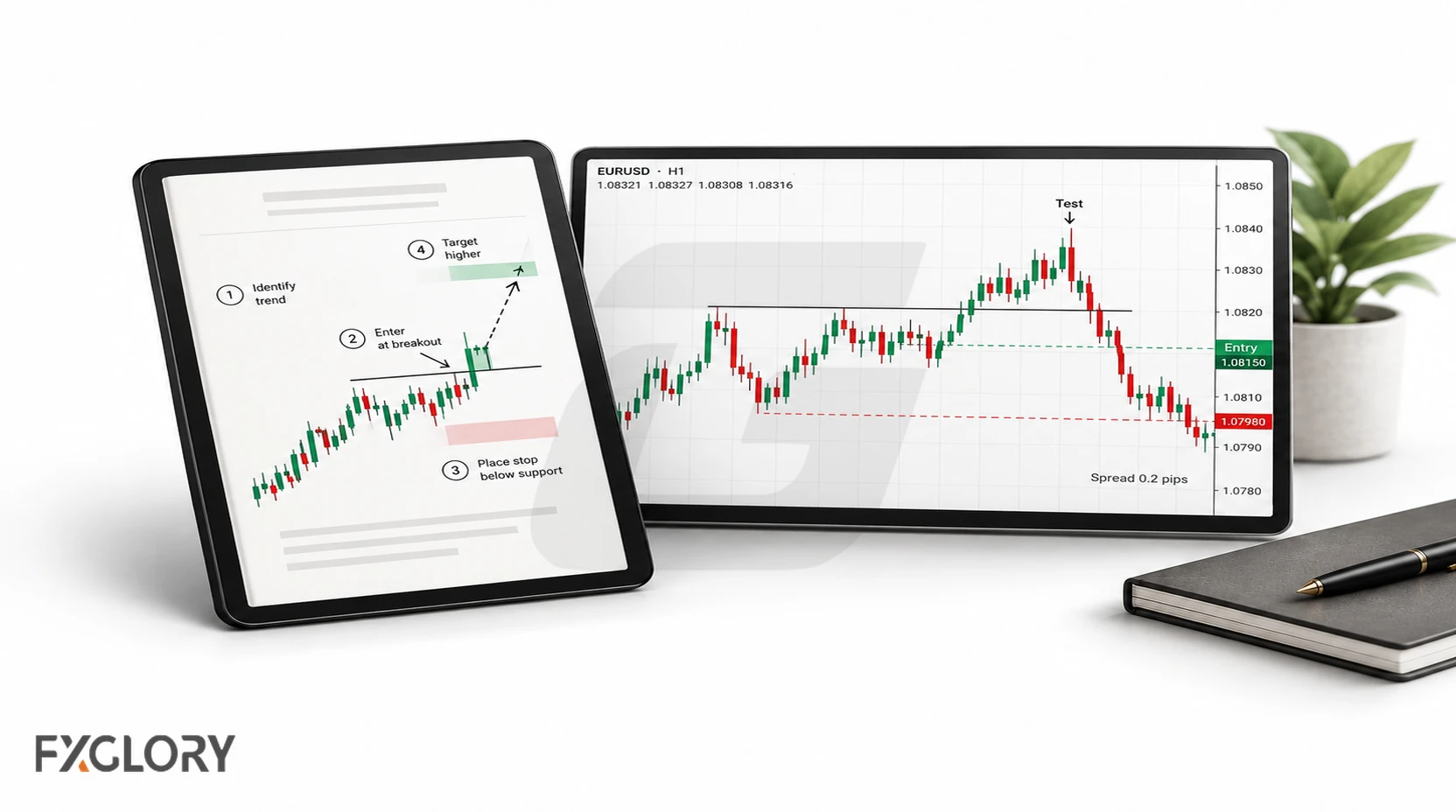
Read a free strategy e-book as a framework to test. The material should explain entry conditions, stop logic, invalidation, trade management, weak market conditions, and examples where the idea fails. Without those details, the strategy is incomplete.
- Do not copy entries immediately: A strategy example is not a live signal.
- Find the invalidation point: The book should explain when the trade idea is wrong.
- Check market conditions: A setup may behave differently in trends, ranges, news periods, and low liquidity.
- Calculate spread impact: Short-term methods can fail when cost is ignored.
- Record failed examples: A method that only looks good on selected examples may not survive testing.
Compare any strategy idea with FXGlory's forex strategies and risk management strategy lessons before risking live money.
Free Technical Analysis PDFs And Chart Lessons
Technical-analysis PDFs can help traders learn candles, trends, support and resistance, chart patterns, indicators, and timeframes. They are useful for vocabulary and chart structure. They are not proof that a pattern will work on the next trade.
| Chart Topic | Useful Free Material Should Show | Common Weakness |
|---|---|---|
| Candlesticks | Candle body, wick, open, high, low, close, and location on the chart. | Memorizing candle names without context. |
| Support and resistance | How levels form, break, retest, and fail. | Drawing too many levels after the move has already happened. |
| Chart patterns | Trend context, range structure, breakout risk, and false breaks. | Treating every pattern as predictive. |
| Indicators | What the indicator measures and when it performs poorly. | Using signals without understanding lag or market condition. |
| Timeframes | How higher and lower timeframes can conflict. | Entering from one timeframe while ignoring broader structure. |
For chart practice, use FXGlory's forex chart-reading lesson, candlestick lesson, and chart-pattern lessons while reviewing examples from a PDF.
Free Risk, Psychology, And Discipline Resources
Many traders do not need another setup. They need better control over risk, emotion, and review. Free material about psychology and risk can be valuable when it turns into specific behavior rules.
A useful psychology resource should help the trader identify fear, greed, hesitation, revenge trading, FOMO, overconfidence, boredom, and the urge to increase size after a loss. A useful risk resource should explain position size, drawdown, stop placement, and maximum loss before entry.
| Problem | Useful Reading Focus | Action After Reading |
|---|---|---|
| FOMO | Why late entries feel urgent. | Write a rule for missed trades. |
| Revenge trading | Why loss-recovery pressure damages decisions. | Set a cooldown and session-stop rule. |
| Overtrading | Why more trades can reduce quality. | Define maximum trades per session. |
| Overconfidence | Why early wins can distort risk. | Keep size stable after winning periods. |
| Weak review | Why memory is not enough. | Record setup, risk, emotion, exit, and lesson. |
Use FXGlory's forex trading psychology and forex trading journal lessons to turn reading into measurable behavior.
Online Reading, Short Lessons, And Audiobooks
Online lessons and audiobooks can help when a trader wants flexible study. They are strongest for broad concepts, mindset, and market stories. They are weaker for material that depends on chart screenshots, candle location, pattern shape, or indicator settings.
- Use audio for psychology: Discipline, patience, and risk lessons can be useful while listening.
- Use visual material for charts: Candlesticks, patterns, indicators, and setup examples need chart review.
- Pause often: A short lesson should still create notes, questions, or practice tasks.
- Avoid passive study: Listening without writing rules usually changes little.
Translated Free Forex Books
Translated forex books can help traders learn in a familiar language. The risk is that translations may be incomplete, unauthorized, outdated, or missing important risk warnings. A poor translation can also distort technical terms such as margin, leverage, spread, stop loss, drawdown, and position size.
| Translation Check | Why It Matters |
|---|---|
| Original source is named. | The reader can compare the translation with the original material. |
| Risk warnings remain visible. | Risk language should not disappear during translation. |
| Technical terms are consistent. | Wrong translation of margin, leverage, or lots can lead to serious misunderstanding. |
| Examples still fit current trading conditions. | Old platform screenshots or outdated market assumptions may confuse beginners. |
| The file is not an unauthorized copy. | Legal access and content integrity matter. |
When reading translated material, keep a glossary of key terms. Compare those terms with FXGlory's forex terminology lesson before using the material for trade decisions.
Use A 4-Week Forex Reading Plan
A reading plan prevents book-hopping. Instead of opening many PDFs and applying none, choose one learning focus per week and turn it into a practice task.
View 4-Week Forex Reading Plan Template
| Week | Reading Focus | Practice Task |
|---|---|---|
| Week 1 | Forex terms, pairs, pips, spread, lots, margin, leverage, and orders. | Write definitions and practice basic order placement on demo. |
| Week 2 | Charts, candles, support, resistance, trends, and timeframes. | Mark completed charts without entering trades. |
| Week 3 | One strategy idea from one resource. | Test the idea with fixed risk and written invalidation. |
| Week 4 | Psychology, risk, journaling, and review. | Write one rule to add, one habit to stop, and one review field to track. |
The plan works best when the trader finishes each week with a visible output: definitions, chart notes, test results, or journal rules. Reading alone is not enough.
Use A Forex Book Notes Template
Notes turn free reading into action. Without notes, a trader may remember the exciting part and forget the risk warning. A simple note structure helps separate concepts from trade decisions.
View Forex Book Notes Template
| Note Field | Question To Answer |
|---|---|
| Book or resource name | What exactly did you read? |
| Author or source | Who is responsible for the material? |
| Main concept | What one idea is worth remembering? |
| Risk warning | What can go wrong if this idea is applied badly? |
| Rule to apply | What will change in your trading process? |
| Practice task | What can be tested on charts or demo? |
| Decision | Will you keep, review, or discard the material? |
Common Red Flags In Free Forex Books
A free forex book deserves caution when it pushes the reader toward risk before explaining that risk. Key warning signs include profit promises, sales pressure, missing authorship, and an absence of losing examples.
- Guaranteed-profit language: Any promise of easy, certain, or risk-free income should be treated as dangerous.
- No author identity: A resource about money should show who created it.
- No losing examples: A method that only shows wins is incomplete.
- No risk calculation: Entry examples without position size, stop, or risk are not usable.
- Extreme leverage encouragement: Large exposure can magnify losses quickly.
- Urgent sales pressure: Education should not depend on panic or fear of missing out.
- Signal dependency: A book that teaches copying instead of understanding is weak education.
- Unrealistic account growth: Fast transformation claims can push traders toward oversized risk.
- Outdated platform examples: Old screenshots and processes may not match current trading conditions.
- No practice step: Useful education should lead to safe testing, journaling, or review.
When To Skip A Free Forex Book
Skipping weak material is a trading skill. Every hour spent on a poor PDF can create bad habits or false confidence. A trader does not need to finish a resource just because it was free.
| Skip When | Reason | Better Action |
|---|---|---|
| The material promises fast income. | Profit pressure can lead to dangerous sizing. | Return to risk and basics. |
| The author or source is unclear. | Accountability is missing. | Choose material with clear responsibility. |
| The strategy has no losing examples. | The method is not presented honestly. | Look for examples that include invalidation and drawdown. |
| The book pushes signals or managed accounts. | The education may be secondary to the offer. | Study independent risk and trade review first. |
| The examples feel too easy. | Selected examples can hide real execution problems. | Test the idea on messy charts and demo records. |
What To Do After Reading A Free Forex Book
After finishing a free forex book, do not jump straight into live trades. Convert the material into one small process change. That change might be a better risk calculation, a chart-marking exercise, a new journal field, a stop-trading rule, or a demo test.
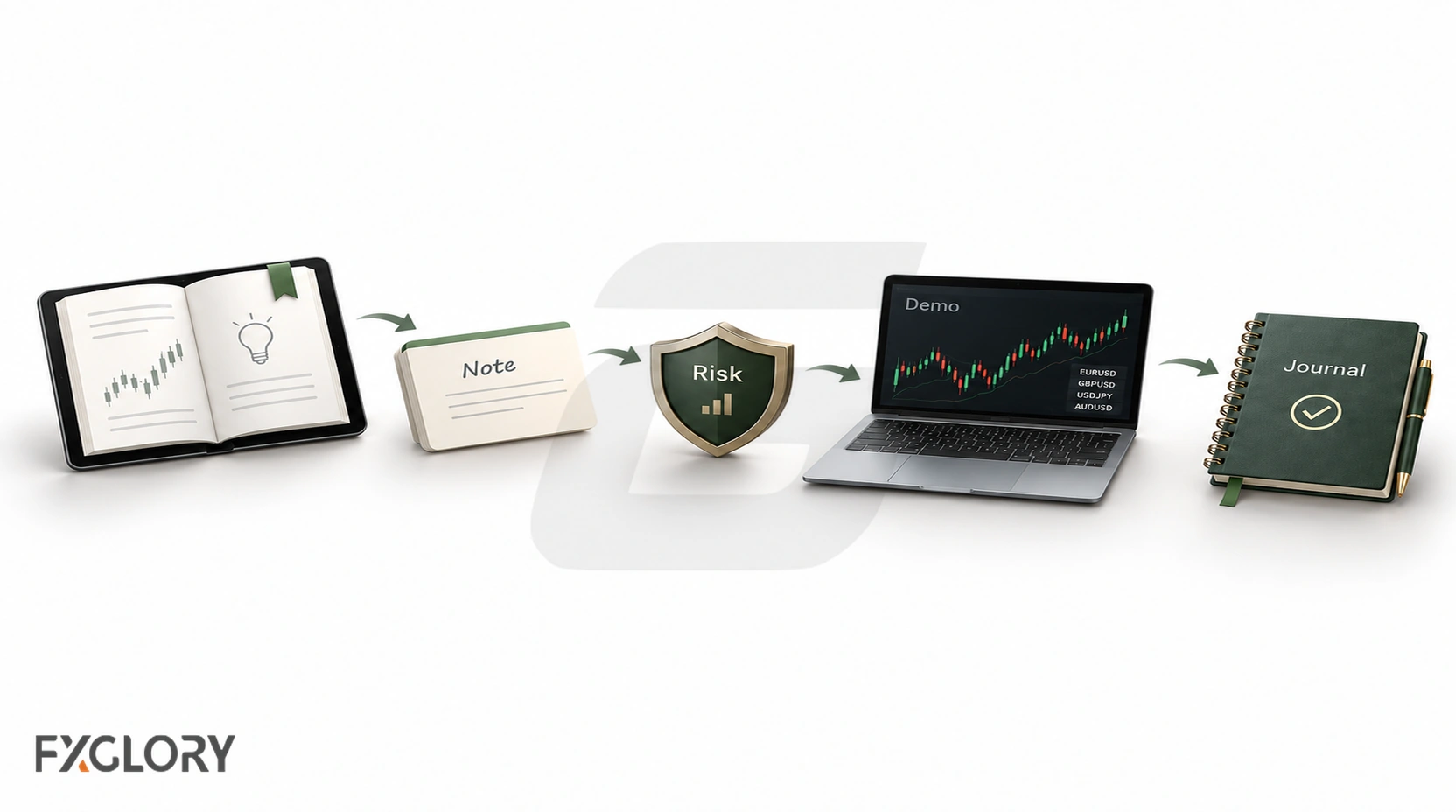
- Score the material: Use the checklist before trusting it.
- Write one lesson: Keep the most useful idea in one sentence.
- Name one risk: Identify how the idea could damage the account if misused.
- Create one practice task: Use charts, demo, or journal review before live exposure.
- Compare with FXGlory education: Use beginner, chart, strategy, psychology, and risk lessons to fill gaps.
- Review account conditions: Understand margin, leverage, instruments, spread, and order workflow before trading live.
Demo practice cannot guarantee live results, but it can help a trader connect reading with platform workflow, order placement, spread, margin, and review habits without real-money exposure. FXGlory's demo account page is a practical place to rehearse basic execution before using real capital.
For a broader reading path that includes paid and classic books, use FXGlory's Best Forex Books resource after checking whether free material is enough for the current learning stage.