
Quick Answer: What Is Forex Trading Psychology?
Forex trading psychology is the way a trader's emotions, habits, biases, discipline, and stress responses affect decisions in the currency market. It does not mean removing emotions. It means recognizing fear, greed, revenge trading, tilt, FOMO, overconfidence, hesitation, and bias early enough to follow a written trading plan, risk limits, and review process instead of reacting impulsively.
A trader with better psychology is not guaranteed to make money. The practical goal is smaller and more realistic: reduce avoidable behavior errors such as chasing late entries, increasing lot size after losses, holding losing trades without a rule, skipping pre-trade checks, or trading when emotional pressure is already high.
If you are new to the role itself, first review what a forex trader is responsible for before the order. If you are still building the learning path, use the beginner roadmap for becoming a forex trader before treating psychology as a standalone skill.
Why Psychology Matters In Forex Trading
Forex traders make decisions under incomplete information. Price can move quickly, spreads can change, news can create volatility, and leverage can make a small price move feel much larger than it looks on the chart. In that environment, emotional decisions can damage a trading plan faster than a weak chart reading.
Forex market psychology can also describe how groups of traders react to changing expectations around interest rates, inflation, employment data, risk sentiment, central-bank language, geopolitical stress, or sudden volatility. That is different from personal trading psychology, which is the individual trader's ability to respond to those conditions without breaking risk rules.
Trading psychology matters because many errors happen after the trader already knows the rule: increasing size after a loss, chasing a missed entry, or moving a stop because accepting the loss feels uncomfortable. The practical response is to connect each recurring pressure to a written control before the trade begins.
- Fear can cause early exits, freezing, or avoiding valid setups.
- Greed can cause oversizing, overtrading, or moving targets without a rule.
- Revenge trading can turn one loss into several rushed trades.
- Tilt can turn frustration or pressure into rushed, oversized, or rule-breaking decisions.
- FOMO can push traders into late entries after the planned level is gone.
- Overconfidence can make recent wins feel like proof of certainty.
Trading Psychology Is Not Positive Thinking
Forex psychology is sometimes described as confidence, mindset, or staying positive. That framing is too weak for real trading decisions. A positive mood does not control risk, calculate position size, or stop a revenge trade.
Useful trading psychology is practical. It turns emotional pressure into rules that can be checked before, during, and after a trade. A trader does not need to feel calm every minute. A trader needs a process that still works when they are excited, disappointed, uncertain, or tempted to break rules.
Fear, Greed, FOMO, Revenge Trading, Tilt And Overconfidence
The most common emotions in forex trading are not unusual. They are normal human responses to uncertainty, money, and feedback. The danger appears when those emotions control the next click.
Fear
Fear can appear before entry, after entry, or after a loss. A fearful trader may close a trade before the plan is tested, refuse to enter a valid setup, or avoid reviewing mistakes. Fear is more manageable when the trader knows the maximum planned risk before entry.
Greed
Greed often appears after a winning trade or during a fast move. It can lead to larger positions, extra trades, target-moving, or ignoring spread and slippage. Greed is easier to control when position size and target rules are written before the trade opens.
FOMO
FOMO is the pressure to join a move after the planned entry has passed. On this broad psychology page, the key control is simple: do not replace the entry plan with urgency.
Revenge Trading
Revenge trading happens when a previous loss becomes the reason for the next trade. A predefined cooldown after losses or broken rules helps separate the next decision from the previous result.
Tilt
Tilt is an emotional state where frustration or pressure lowers decision quality. The broad control is to stop the session from accelerating: use a cooldown, trade-count limit, or daily loss limit before rule-breaking spreads to more trades.
Overconfidence
Overconfidence can appear after a winning streak. The trader may reduce preparation, increase risk, ignore the plan, or believe the market is easier than it is. Fixed risk limits and scheduled review dates help stop recent wins from changing the whole process.
Deep-Dive Guides For Specific Psychology Problems
This page explains forex trading psychology as the parent topic. The pages below go deeper into specific behaviors that need their own rules, journal tags, and stop conditions.
| Problem | What It Means | Use This Guide |
|---|---|---|
| Revenge trading | The previous loss starts controlling the next trade. | When a loss becomes the reason for the next order |
| FOMO trading | Fear of missing a move creates late entries or skipped checks. | When urgency replaces the entry plan |
| Overtrading | Trading activity goes beyond the plan's limits. | When repeated activity becomes the problem |
| Trading tilt | Emotional overload makes rule-breaking feel reasonable. | When emotion lowers decision quality |
Common Trading Biases That Affect Forex Decisions
Emotions are only one part of forex psychology. Biases also shape trading decisions. A bias is a thinking shortcut that can make a trader interpret information in a distorted way.
Biases are dangerous because they can feel logical in real time. A trader may believe they are analyzing the market, while actually selecting only the information that supports the trade they already want to take.
| Bias | How It Can Appear In Forex | Control To Use |
|---|---|---|
| Confirmation bias | The trader only looks for analysis that supports the planned trade. | Write one clear reason the trade could be wrong before entry. |
| Recency bias | A few recent wins or losses change the trader's view of the whole strategy. | Review a larger sample before changing rules. |
| Loss aversion | The trader holds a losing trade too long because closing it feels painful. | Define invalidation and position size before entry. |
| Outcome bias | The trader calls a broken-rule trade good because it made money. | Grade rule-following separately from profit or loss. |
| Hindsight bias | After a move, the trader believes the outcome was obvious. | Save pre-trade notes or screenshots before the result is known. |
| Overconfidence bias | The trader treats a winning period as proof of special skill. | Keep risk fixed until a planned review date. |
How Leverage, Margin And Fast Markets Increase Emotional Pressure
Forex psychology becomes harder when position size is too large for the account or the trader's emotional tolerance. Leverage can magnify exposure, and that can magnify fear, greed, and urgency. Before increasing exposure, understand how leverage changes the size of market exposure.
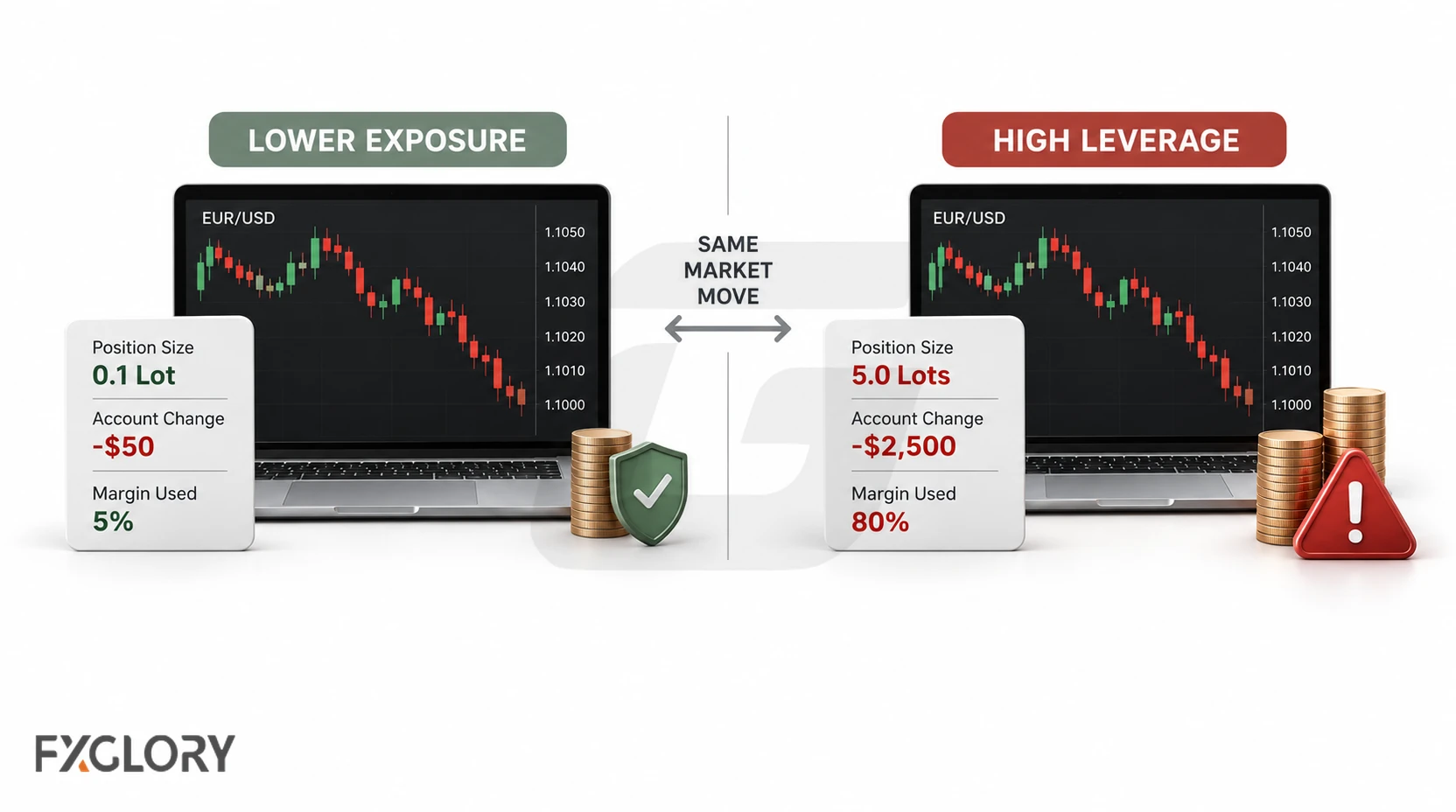
Margin pressure can also change behavior. A trader who does not understand margin may react emotionally when account equity changes, positions approach risk limits, or several trades are open at once. Use the margin calculator to estimate margin before emotion changes position size.
Costs matter too. Scalpers and short-term traders can be especially sensitive to spread, slippage, and execution quality because they may target smaller moves. Before rapid trading, check spread pressure before judging a short-term setup.
- High leverage can make a normal move feel emotionally extreme.
- Unclear margin use can create panic decisions.
- Spread and slippage can make a trade feel unfair if costs were not checked first.
- News events can trigger fast movement and impulsive reactions.
- Low-liquidity periods can make price movement and execution harder to interpret.
Emotion Control Table
The table below turns common emotions into practical controls. It is not a guarantee. It is a way to reduce avoidable mistakes.
| Emotion Or Pressure | Common Mistake | Practical Control |
|---|---|---|
| Fear | Exiting early, freezing, or avoiding valid setups. | Predefine invalidation, stop logic, and maximum planned loss. |
| Greed | Oversizing, moving targets, or adding extra trades. | Use max risk per trade and a rule against unplanned target changes. |
| Revenge | Trading after a loss to recover quickly. | Use a cooldown after losses or after any broken rule. |
| FOMO | Chasing a move after the planned entry has passed. | Use an entry checklist and write the missed trade in the journal instead. |
| Overtrading | Taking repeated trades beyond plan limits. | Use trade-count, pair-list, and stop-for-day rules. |
| Overconfidence | Increasing lot size after a winning streak. | Keep position size fixed until a scheduled review. |
| Boredom | Forcing trades when no setup is present. | Set a no-setup rule and stop reviewing the chart as if a trade must appear. |
| Frustration | Changing strategy after a small sample of losses. | Review enough trades before changing the method. |
Bias Control Table
Bias control starts before entry. A trader should not wait until the trade is moving against them to decide whether the original idea was weak.
| Question Before Entry | Bias It Helps Check | Why It Matters |
|---|---|---|
| What would prove this trade idea wrong? | Confirmation bias | Forces the trader to look for invalidation, not only support. |
| Am I changing rules because of the last few trades? | Recency bias | Prevents overreacting to a small sample. |
| Would I still take this trade if the last trade had won? | Revenge bias | Checks whether the trade is recovery-driven. |
| Did I follow rules, or did the trade only happen to win? | Outcome bias | Separates process quality from result luck. |
| Did I write the idea before the move happened? | Hindsight bias | Prevents pretending the outcome was obvious after the fact. |
How To Build Better Forex Trading Psychology
Better psychology is built through repeated, measurable behaviors rather than vague promises about discipline.
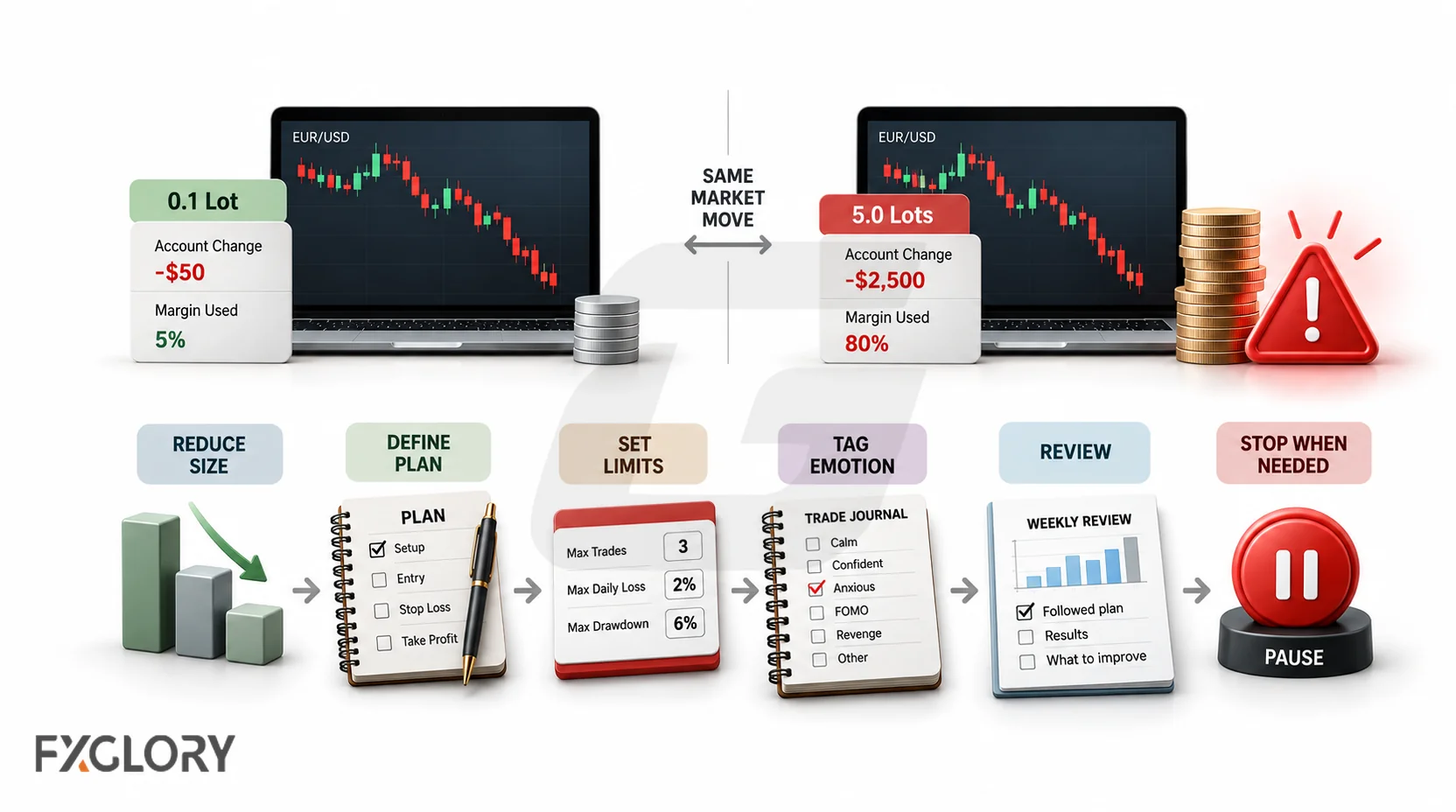
A useful improvement routine is simple: reduce size until decisions are stable, define the setup before entry, tag emotional decisions after the trade, review rule-following weekly, and stop trading when the session state becomes emotional rather than analytical.
- Reduce position size until decisions are stable: Oversized risk makes discipline harder.
- Write the trade plan before entry: Entry, invalidation, position size, and exit logic should not be invented after the trade opens.
- Use trade-count limits: A maximum number of trades per session can reduce overtrading.
- Use loss limits: A daily or weekly stop can prevent one emotional period from damaging the account.
- Tag emotional trades: Mark FOMO, revenge, fear, greed, boredom, or overconfidence in the journal.
- Review rule-following, not only profit: A winning broken-rule trade can still be a bad process.
- Match style to temperament: Use trader style selection to avoid choosing a method that requires more screen time or stress tolerance than you can manage.
Pre-Trade Psychology Checklist
A pre-trade checklist should be short enough to use. If it is too long, a stressed trader may skip it.
- Can I explain the setup in one or two sentences?
- Do I know the invalidation point before entry?
- Is the position size within the written risk limit?
- Have I checked spread and event risk?
- Am I entering because of the plan, not because of FOMO?
- Am I trying to recover a recent loss?
- Would I still take this trade if no one else could see it?
- Do I know what I will review after the trade closes?
When Psychology Says You Should Not Trade
A strong psychology rule often tells a trader to do nothing. Not trading can be the correct decision when emotional pressure is already high.
- You are angry after a loss.
- You are trying to make money back today.
- You are tired, distracted, or rushing.
- You cannot explain the setup and risk clearly.
- You changed lot size because of emotion.
- You are chasing a move you missed.
- You are trading because social media is excited.
- You already broke today's rules.
- You need the trade to work because the money is needed elsewhere.
How A Trading Plan Helps Control Emotions
A trading plan gives psychology something to follow. Without a written plan, “discipline” is too vague. The trader can always justify the next action after emotion appears.
A useful plan defines setup conditions, risk per trade and maximum open exposure, trade frequency, invalidation, stop logic, review rules, and no-trade conditions. If those rules are missing, the trader is more likely to improvise during pressure.
For a practical structure, use the trading plan template to turn emotions into written trade rules.
How A Journal Helps Reveal Emotional Patterns
A trading journal is one of the clearest ways to detect psychological patterns. A trader may believe they have a strategy problem when the real issue is rule-breaking after losses, oversizing after wins, or entering late because of FOMO.
For this page, the journal does not need to become complicated. Track the setup, position size, planned risk, entry reason, exit reason, emotional state, rule-following grade, and one lesson. Over time, repeated emotional tags can show which mistakes need the strongest controls.
| Journal Tag | What It May Reveal | Possible Control |
|---|---|---|
| FOMO | Late entries after fast movement. | Require planned entry levels before trading. |
| Revenge | Trades opened after losses to recover quickly. | Use a cooldown or daily loss stop. |
| Overtrading | Repeated trades after the plan's limit or setup quality drops. | Use trade-count limits, pair limits, and a stop-for-day rule. |
| Fear | Exiting before the plan is tested. | Reduce position size and predefine invalidation. |
| Greed | Moving targets or increasing lot size. | Use fixed risk and target-change rules. |
| Boredom | Trades taken without a valid setup. | Use a no-setup, no-trade rule. |
Demo Practice And The Live-Account Difference
Demo practice can help traders learn platform actions, order placement, chart review, and rule-following without live-fund pressure. This is useful, especially for beginners who are still learning execution mechanics.
Demo trading does not fully recreate live psychology. Real money can change fear, greed, hesitation, and position-size behavior. A trader who follows rules on demo may still need smaller size, stricter limits, and slower decision-making when moving to live conditions.
Use an FXGlory demo account to practice platform actions before live-fund pressure, but do not treat demo results as proof of future live performance.
What Trading Psychology Cannot Fix
Trading psychology is important, but it is not magic. It cannot make an untested strategy reliable, remove spread or slippage, stop news volatility, prevent every loss, or make leverage safe. It also cannot turn money needed for bills into suitable trading capital.
Psychology also cannot replace market knowledge. A trader still needs to understand currency pairs, bid and ask prices, pips, lot size, leverage, margin, and trading costs. If those basics are weak, revisit the learning path before testing live discipline.
Common Forex Trading Psychology Mistakes
- Trying to become emotionless: The goal is rule-following under emotion, not removing all emotion.
- Risking too much and blaming psychology: Oversized positions create pressure that is hard to manage.
- Calling a lucky win discipline: A broken-rule trade can win and still be a poor decision.
- Changing strategy after a few trades: Small samples can create false confidence or false doubt.
- Moving stops because a loss feels uncomfortable: This turns planned risk into emotional risk.
- Using demo results as live proof: Demo practice helps execution, but live money changes behavior.
- Trading through exhaustion or anger: Poor state can weaken decision quality.
- Following signals because of FOMO: A signal does not remove the need to understand risk and position size.
- Ignoring fraud warnings: High-return, low-risk promises can exploit fear, greed, and urgency. If trading starts to resemble betting behavior rather than a rule-based process, review whether forex is being treated like gambling.