

Forex Failure Stories: The Honest Answer First
Forex failure stories usually repeat the same pattern: the trader risks too much, trades without a written plan, follows emotion after a loss, copies signals without understanding risk, uses leverage before understanding margin, or tries to force income from an account that is too small for the goal.
The loss amount is not the most important part of a forex failure story. The diagnosis is. What broke first: position size, stop discipline, psychology, patience, strategy testing, capital pressure, or trust in someone else's signal? A story worth learning from should change what the trader risks, records, avoids, or practices before another live trade is placed.
A losing trade is not automatically a failure. A planned loss with controlled risk is part of trading. A failure begins when the trader breaks the plan, adds size to recover, ignores margin pressure, moves the stop because of hope, or keeps trading after anger, fear, or desperation has taken over.
If a failure story feels uncomfortable, that is usually where the lesson is. The trader may remember the moment they ignored the stop, doubled the lot size, trusted a signal they did not understand, or kept clicking because the account was already damaged. That moment matters more than the headline loss.
What Counts As A Forex Failure Story?
A forex failure story can be dramatic, such as a blown account, a margin call, or a large loss after a news event. It can also be quiet: months of small, repeated losses caused by poor review, weak discipline, or a strategy that was never tested properly.
Forex trading failure stories worth reviewing are not only about money. They show a chain of decisions. A trader may start with small wins, increase size too quickly, ignore the first warning signs, join a signal group, chase a loss, and then realize the account damage came from behavior more than from one trade.
| Failure Story Type | What Usually Happens | What To Diagnose | Better Question |
|---|---|---|---|
| Blown account story | Most or all of the account is lost. | Leverage, position size, stop discipline, and margin pressure. | What rule would have capped the damage? |
| Slow-bleed story | The account declines gradually through many small poor decisions. | Spread cost, weak setups, overtrading, and no review routine. | Which repeated trade should have been removed? |
| Signal-group loss | The trader follows entries without understanding the trade. | Dependency, missing invalidation, and unverified performance claims. | Could the trader explain the risk before entry? |
| Revenge spiral | One loss becomes several larger trades. | Emotional recovery pressure and no stop-trading rule. | When should the session have ended? |
| Small-account pressure | The trader tries to make income from insufficient capital. | Unrealistic targets and oversized risk. | Was the goal forcing dangerous sizing? |
| Strategy-hopping story | The trader changes methods after every losing streak. | No testing sample and no stable review process. | Was the method actually tested or only abandoned? |
If you are still defining what a trader is responsible for, start with FXGlory's forex trader role guide. Failure stories make more sense when the trader's responsibilities are clear: risk, execution, review, discipline, and account protection.
Forex Failure Story Snapshots And The Real Lesson
Shared forex failure stories can be honest, painful, incomplete, emotional, or exaggerated. The safest approach is to read the human pressure, identify the behavior pattern, and avoid treating any personal claim as audited proof.
The strongest stories usually have a moment the trader can name: the trade they should have skipped, the stop they moved, the account size they tried to force, the signal they copied without understanding, or the day they kept trading after they already knew they were not calm.
| Story Pattern | What It Can Feel Like | What Usually Broke | Lesson Worth Keeping |
|---|---|---|---|
| The decade-long failed trader | The trader keeps returning because forex is accessible, active through the week, and easy to re-enter after damage. | Market fit, overactivity, leverage attraction, and inability to stop. | If the market structure keeps triggering bad behavior, stepping away may be the best risk decision. |
| The large-loss confession | Early wins feel like proof, then larger trades and weak defense erase the account. | Overconfidence, poor sizing, signal dependency, and no written loss limit. | Early profit is not proof of skill until it survives losses and a meaningful sample. |
| The long-term loss post-mortem | The trader feels stuck after years of fear, inconsistency, and repeated losses. | No stable process, emotional fatigue, and repeated rule changes. | The account may not need a new indicator; it may need smaller risk and clearer review. |
| The side-hustle shortcut story | The trader treats forex as a fast escape from financial pressure. | Survival-money risk, quick-money belief, and emotional pressure. | Money needed for daily life should not be exposed to trading risk. |
| The small-capital pressure story | The account feels too small for the trader's goal, so each trade becomes too important. | Unrealistic targets and oversized risk. | A small account should be used for skill development, not forced salary replacement. |
| The dramatic loss story | The story focuses on cars, lifestyle loss, shame, or one emotional collapse. | Gambling behavior, oversized risk, or no risk boundary. | The emotional shock is not the lesson; the missing rule is the lesson. |
The 10 Most Common Forex Failure Patterns
Forex failure rarely comes from one candle alone. Damage usually builds through repeated behavior. The same trader may have more than one pattern at the same time: too much size, no journal, FOMO entries, and revenge trading after a loss.
- Trading without a written plan: The trader cannot explain the setup, invalidation point, risk, or exit before entry.
- Using position size that is too large: Normal price movement becomes emotionally unbearable.
- Increasing risk after a loss: The next trade becomes a recovery attempt instead of a planned trade.
- Overtrading: The trader opens trades because the market is moving, not because the setup is valid.
- FOMO entries: The trader enters late because watching price move feels worse than missing the trade.
- Revenge trading: The previous loss becomes the reason for the next position.
- Signal dependency: The trader follows another person's entry without understanding stop, target, timing, spread, or context.
- Strategy hopping: The trader abandons methods too quickly and never gathers a useful sample.
- Ignoring costs and conditions: Spread, slippage, swaps, rollover, low liquidity, and news volatility are not reviewed.
- No post-trade review: The same mistake repeats because it is never named, measured, or turned into a rule.
For behavior-specific follow-up, review FXGlory's guides to overtrading, FOMO entries, revenge trading, and trading tilt when those patterns are the main problem.
Blown Account vs Controlled Losing Trade
One of the most important distinctions in forex failure stories is the difference between a controlled losing trade and a failure. A controlled loss may still hurt, but it does not mean the trader failed. It means the market did not move as expected while the trader stayed inside the plan.
A failure is different. A failure usually includes a broken rule: no stop, moved stop, oversized risk, revenge trade, entry without setup, holding during a news event without a plan, or adding to a losing trade because the trader cannot accept being wrong.
| Situation | Controlled Loss | Failure Warning |
|---|---|---|
| Entry reason | Trade matched a written setup. | Entry happened because of impulse, boredom, or pressure. |
| Risk size | Risk was defined before entry. | Risk changed after the trade was opened. |
| Stop logic | Stop had a clear invalidation reason. | Stop was moved to avoid accepting the loss. |
| Emotional state | Trader could explain the decision calmly. | Trader felt angry, desperate, rushed, or embarrassed. |
| After the result | Trade was reviewed and logged. | Trader immediately opened another trade to recover. |
| Account effect | Loss was tolerable inside the plan. | Loss damaged the account or decision quality. |
This distinction matters because traders sometimes treat every loss as failure and then change methods too quickly. Others treat broken-rule losses as normal and never correct the behavior. Both reactions can damage long-term development.
Why Early Wins Can Lead To Bigger Forex Failures
Some forex loss stories begin with success. A beginner wins a few trades, feels confident, increases lot size, and starts believing the market is easier than expected. That early confidence can be dangerous because the trader may not yet know whether the wins came from skill, market conditions, luck, or too much exposure.
Early wins can hide weak risk habits. If a trader wins while breaking rules, the account may reward the exact behavior that later causes damage. A lucky trade taken with oversized risk can teach the wrong lesson: that risk was skill.
- Early profit can create false confidence: A short winning streak is not a full performance record.
- Position size may increase too quickly: The trader wants the next win to feel larger than the last one.
- Normal losses feel like personal failure: The trader was not prepared for drawdown after the early high.
- Stops become negotiable: The trader expects the market to return because previous trades worked.
- Review is delayed: Wins reduce the motivation to check whether the process was actually sound.
How Leverage And Small-Account Pressure Make Failure Worse
Leverage can make a small account feel powerful, but it can also make normal price movement dangerous. The problem is not only that leverage increases exposure. The problem is that traders often combine leverage with unrealistic goals, weak stop discipline, and the desire to turn a small account into fast income.
Small-account pressure is a major theme in forex trader failure stories. When a trader expects a small deposit to produce salary-level returns, the math pushes them toward oversized positions. The trader may know the risk is too high, but the goal feels impossible without it.
| Pressure Point | How It Damages Trading | Safer Check |
|---|---|---|
| Small account, large income goal | Forces unrealistic return expectations. | Separate skill-building from income expectations. |
| High leverage availability | Makes large exposure easy to open. | Calculate margin and loss size before entry. |
| Wide stop with large lot size | One normal move can cause severe account damage. | Position size should fit the stop distance, not the desired profit. |
| Low margin buffer | The account becomes sensitive to small adverse moves. | Review margin pressure before increasing exposure. |
| Recovery mindset | The trader increases risk after a loss. | Use a stop-trading rule after rule-breaking or daily loss limit. |
Before increasing exposure, review FXGlory's leverage conditions and use the margin calculator to understand how trade size, leverage, and margin requirements interact. These checks do not remove trading risk, but they can prevent a trader from opening a position without knowing the exposure.
Signal Groups, Gurus, And Screenshot-Driven Mistakes
Many forex failure stories include a shortcut. The trader joins a signal group, buys a strategy, follows a social media account, copies a screenshot, or believes a lifestyle claim. The danger is not only that the signal may be poor. The deeper danger is that the trader gives away responsibility for the decision.
A copied trade still uses the trader's own account, margin, spread, execution, and emotions. If the trader cannot explain the entry, invalidation point, risk, and exit plan, the trade is not controlled by understanding. It is controlled by trust in another person's claim.
- Unverified performance: A screenshot may show one result without deposits, withdrawals, losses, drawdown, or open risk.
- No personal risk fit: A signal provider's lot size may be unsuitable for another trader's account.
- Late execution: Entry price, spread, and slippage can differ by the time a follower enters.
- No context: The trader may not know whether the trade depends on news, session timing, or liquidity.
- Dependency loop: The trader stops building skill and waits for instructions.
The Psychological Failure Loop
A forex failure story often follows an emotional loop. The trader loses, feels pressure, wants to repair the account, enters too quickly, loses more, then feels even more pressure. The next decision becomes less analytical and more personal.
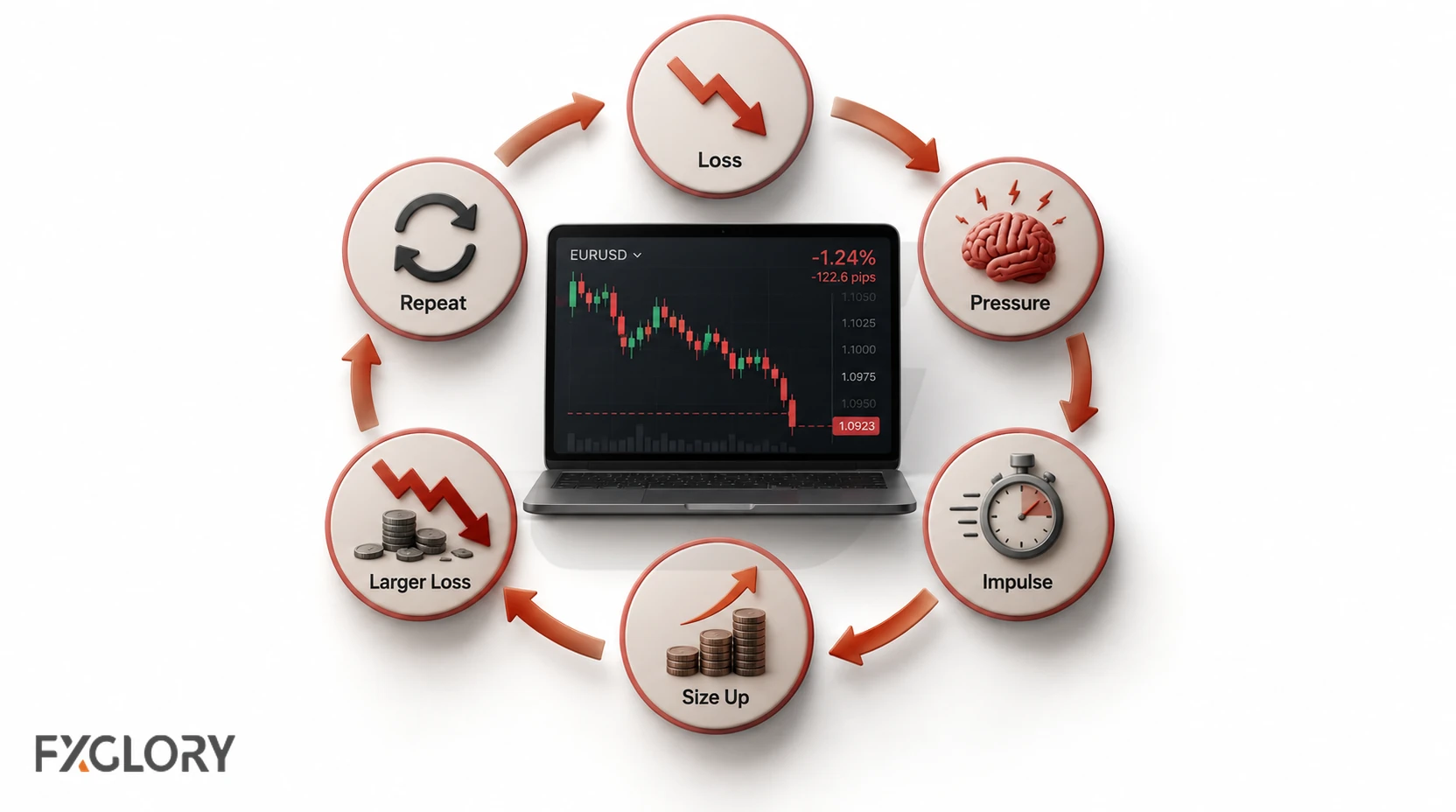
This loop can happen after a large loss, but it can also happen after a missed trade. The trader sees price move without them, feels left behind, enters late, gets stopped, then tries to recover. FOMO and revenge trading can become the same chain with different starting points.
| Loop Stage | What The Trader Feels | Typical Mistake | Interrupt Rule |
|---|---|---|---|
| Loss | Frustration, embarrassment, or disbelief. | Refusing to accept the trade is invalid. | Log the loss before taking another trade. |
| Pressure | Need to recover quickly. | Increasing lot size or shortening analysis. | Use a fixed cooldown period. |
| Impulse | Fear of missing the next move. | Entering without setup confirmation. | Require a written reason before entry. |
| Second loss | Anger or panic. | Taking another trade immediately. | End the session after broken rules. |
| Account damage | Desperation. | Risking more because the account is already down. | Stop live trading and review the post-mortem. |
When emotion is the real failure point, a new indicator will not fix the problem. FXGlory's forex trading psychology guide is the better place to study fear, greed, overconfidence, hesitation, and emotional discipline in more depth.
When A Trader Should Stop Trading
One of the clearest lessons from forex failure stories is that stopping can be a trading skill. A trader does not need to wait for a full blown account before stopping. The stop should happen when decision quality is no longer reliable.
- Stop after a daily loss limit is hit: The next trade should not be a recovery attempt.
- Stop after breaking a rule: A broken rule means the process needs review before more money is exposed.
- Stop when the next trade cannot be explained: If the setup, risk, stop, and exit are unclear, the trade is not ready.
- Stop when anger or panic appears: Emotional urgency can turn one loss into several.
- Stop after moving a stop without a plan: That behavior should be reviewed before another entry.
- Stop during fatigue: Poor sleep, stress, and distraction reduce decision quality.
- Stop before using survival money: Money needed for living costs should not be exposed to trading risk.
How To Do A Forex Failure Post-Mortem
A failure post-mortem turns a painful loss into specific information. The goal is not to punish the trader. The goal is to identify what can be changed before the next live trade.
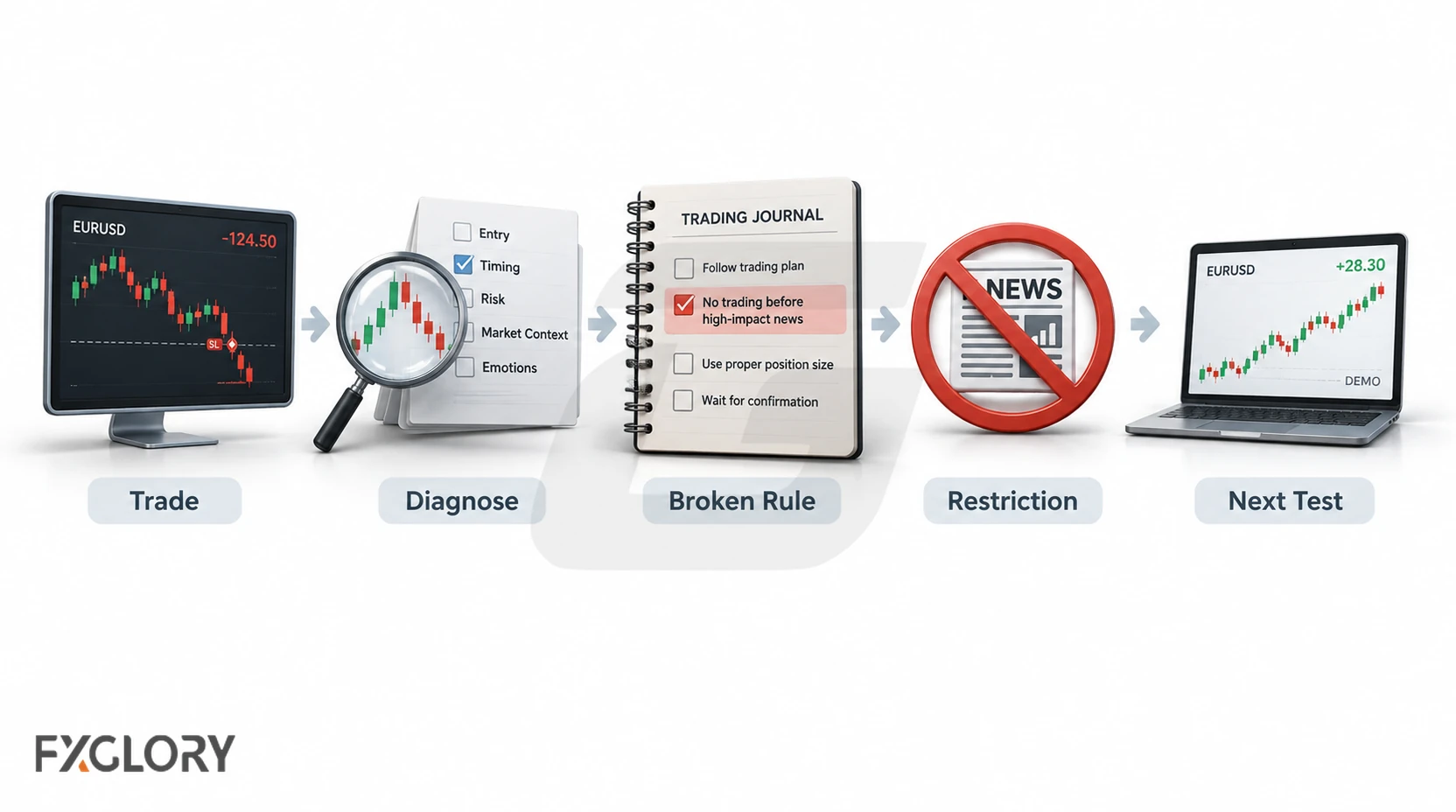
The first step is to separate market loss from process failure. A market loss asks, did the planned trade fail normally? A process failure asks, did the trader break a rule or trade without one?
| Post-Mortem Field | Question To Answer | Why It Matters |
|---|---|---|
| Trade reason | Why was the trade opened? | Reveals whether the entry had a setup or only emotion. |
| Risk amount | How much of the account was at risk? | Shows whether the loss was tolerable before entry. |
| Position size | Was lot size matched to stop distance? | Identifies sizing errors and leverage pressure. |
| Stop behavior | Was the stop placed, moved, ignored, or removed? | Shows whether invalidation was respected. |
| Market condition | Was there news, low liquidity, rollover, spread widening, or unusual volatility? | Reveals whether trading conditions were suitable. |
| Emotion tag | Was the trade driven by FOMO, revenge, boredom, fear, or overconfidence? | Names the behavior pattern. |
| Rule broken | Which rule failed or did not exist? | Turns the story into a correction. |
| Next restriction | What must be reduced, paused, or tested before trading again? | Prevents the same mistake from repeating immediately. |
A post-mortem works better when the trader already keeps records. FXGlory's forex trading journal guide explains what to record before and after trades, while the journal template guide helps turn review fields into a repeatable structure.
How To Judge Shared Forex Failure Stories
Shared forex failure stories can be useful because they show the emotional side of trading: shame, pressure, quick-money hope, repeated mistakes, and the pain of losing money that should not have been risked.
They also have limits. A personal story may not show the full account history, deposits, withdrawals, drawdown, open risk, position size, or the exact decision chain behind the loss. A short story, screenshot, recorded example, or comment can describe a real experience without proving complete trading performance.
| Story Format | What It Can Teach | What It Cannot Prove By Itself | How To Use It |
|---|---|---|---|
| Detailed personal thread | Raw frustration, long-term struggle, and market-fit problems. | Audited performance or universal truth about forex. | Extract warning signs and questions to ask yourself. |
| Personal loss essay | Decision chain, emotional triggers, shortcut beliefs, and lessons after loss. | Whether the exact loss amount is verified. | Study the sequence of decisions, not only the headline number. |
| Trader discussion | Peer experience, repeated practical mistakes, and different views from traders. | That every comment is expert, complete, or suitable for your account. | Look for repeated themes rather than one dramatic claim. |
| Short personal answer | Quick personal examples and common beginner questions. | Full trading context or complete risk record. | Use it as a prompt for review, not as evidence. |
| Recorded loss story | Emotional impact and visual storytelling. | Trading history, drawdown, withdrawals, or risk controls unless shown clearly. | Be skeptical of lifestyle footage and dramatic titles. |
What Not To Learn From Forex Failure Stories
Failure stories can help a trader become more careful, but they can also teach the wrong lesson when read emotionally. A trader who loses money may blame forex as a whole, the broker, the market, a strategy, or bad luck when the deeper issue was risk behavior. Another trader may read a disaster story and decide losses are normal, then continue dangerous habits.
A failure story can also show market-fit problems. If 24-hour access, frequent price movement, and leverage repeatedly trigger impulsive behavior, the lesson may be to stop live forex trading until the behavior is controlled, not to search for a more exciting setup.
- Do not learn that every loss is avoidable: Losses are part of trading. Broken-rule losses are the problem.
- Do not learn that recovery requires bigger risk: Increasing size after damage usually makes the account more fragile.
- Do not learn that the market owes the money back: The next trade has no responsibility to repair the last one.
- Do not learn that all advice is equal: Anonymous comments and verified risk principles are not the same.
- Do not learn that a new market will fix poor behavior: Overtrading, FOMO, and revenge can follow the trader anywhere.
- Do not learn that quitting is always failure: Stopping live trading can be the correct decision when risk behavior is uncontrolled.
If the question is broader than failure stories and you want to review realistic profit expectations, use FXGlory's guide on whether traders can really make money trading forex. For failure diagnosis, keep the focus on what broke, what warning sign appeared, what rule was missing, and what must change before the next live trade.
Practical Recovery Checklist After A Forex Failure
Recovery does not begin with a larger trade. It begins with reducing the conditions that caused the damage. A trader who lost money through broken rules should not immediately return to live risk with the same size, same habits, and same pressure.
- Pause live trading: Do not trade again until the loss is written down clearly.
- Classify the loss: Decide whether it was a controlled losing trade, a risk mistake, a psychology mistake, or a market-condition mistake.
- Identify the first broken rule: The first failure point is often earlier than the final loss.
- Reduce position size: If size made the trade emotional, the next size is too large until proven otherwise.
- Remove one repeated behavior: Focus on one issue first, such as revenge entries or trades outside your planned session.
- Write a stop-trading rule: Define exactly when the session ends.
- Practice the correction on demo: Test order entry, stop placement, and review habits without real-money pressure.
- Review account conditions before live trading: Understand spreads, margin, leverage, minimum trade size, and execution environment.
- Return slowly if suitable: Live trading adds emotion, so the first live step should be smaller than the trader wants, not larger.
For account-specific preparation, review FXGlory's trading account conditions before live exposure. For platform practice without real-money risk, use the demo account option to rehearse order placement, journal fields, and stop-trading rules.
Official Risk Context Around Forex And CFD Failure
Forex is a large global market, but market size does not make trading easy. The Bank for International Settlements reported that global OTC foreign exchange turnover averaged trillions of dollars per day in its 2025 survey materials, which shows the scale of the market but not a retail trader's chance of success.
Regulators also warn that retail trading can be dangerous when leverage, CFDs, poor risk controls, or fraudulent claims are involved. The CFTC/NASAA investor alert warns about foreign exchange currency fraud and retail off-exchange forex risk. ESMA's retail CFD intervention described investor-protection concerns and reported that a large share of retail CFD accounts lost money in its reviewed evidence.
| Trust Source | Why It Matters | How To Use It |
|---|---|---|
| CFTC/NASAA forex fraud alert | Warns investors about foreign exchange currency fraud and off-exchange retail forex risk. | Be skeptical of guaranteed returns, pressure tactics, and unverifiable claims. |
| ESMA CFD investor-protection action | Shows why regulators have restricted certain CFD features for retail-investor protection. | Respect leverage, margin, and loss-risk disclosures instead of treating them as formalities. |
| BIS Triennial Central Bank Survey | Provides market-scale context for global FX and OTC derivatives turnover. | Understand that a huge market can still be difficult and risky for an individual trader. |