Forex Trading Success Stories: The Fast Answer
Forex trading success stories are useful only when they show what the trader did before, during, and after the result: how risk was limited, how losses were handled, how emotions were controlled, how trades were reviewed, and what part of the story cannot be copied.
The dangerous version is the story that shows a large profit and hides the risk. A story worth learning from should make the reader more careful, not more impulsive. It should explain capital, drawdown, mistakes, time, method, and evidence.
Famous forex trader stories can teach macro thinking, patience, and risk awareness. Everyday forex trader stories can teach discipline, journaling, smaller position size, and the slow work of removing repeated mistakes. Neither type should be treated as a guarantee.
Forex Trading Success Stories: Snapshots And The Real Lesson
A useful success story should give the lesson quickly before the details become distracting. The examples below focus on what the trader's story can teach, what changed in the process, and what should not be copied.
| Story Type | What People Usually Notice | Behavior Change Or Process Lesson | What Not To Assume |
|---|---|---|---|
| George Soros and the pound | A famous currency trade during the 1992 Black Wednesday period. | The process point is to connect a trade to macro pressure, policy limits, positioning, timing, and a clear risk boundary before acting. | Retail traders should not copy institutional size or assume one macro view makes a trade safe. |
| Stanley Druckenmiller-style macro trading | Large global macro decisions and flexible positioning. | The behavior change is dropping ego when evidence changes and protecting capital before defending an old opinion. | Professional macro resources are not the same as a beginner chart setup. |
| Bill Lipschutz-style risk lesson | A trader associated with currency trading success after learning from painful losses. | The risk lesson is that a good market idea can still fail if position size, timing, or risk control is poor. | Early wins do not prove long-term skill. |
| Andrew Krieger-style volatility trade | A large currency position during an unusual market period. | The process point is to respect unusual volatility first, then decide whether the opportunity is worth the exposure. | Extreme leverage is not a beginner lesson. |
| Retail trader recovery story | A trader loses through overtrading, then improves after reducing risk and keeping records. | The behavior change is stopping the attempt to win the day back and protecting the next week instead. | A recovery story does not mean every damaged account can be rebuilt. |
| Beginner-to-professional story | A trader moves from confusion to a structured routine. | The behavior change is replacing random trades with routine, review, testing, patience, and smaller expectations. | Professional trading is not created by a single strategy download. |
For full famous-trader profiles, use FXGlory's separate guide to top forex traders. For wealth claims and public estimate problems, use the richest forex trader discussion. Use those guides when you want profile or wealth context; use the lessons below to decide what can and cannot be copied.
What Counts As A Forex Trading Success Story?
A forex success story does not have to mean a trader became rich. A realistic story can be about surviving the first year, learning to stop after a daily loss limit, reducing leverage, journaling every trade for a long sample, or becoming honest about weak setups.
That matters because online success forex traders stories often focus on the final outcome. The useful part is usually hidden in the middle: the losses, the rule changes, the mistakes, the time spent practicing, and the point where the trader stopped treating trading like a quick-money attempt.
| Success Story Type | What It Can Teach | What It Cannot Prove |
|---|---|---|
| Historic famous trader case | Market context, conviction, research, and risk decisions. | That retail traders can copy the same size, access, or outcome. |
| Professional trader career | Routine, specialization, research, discipline, and responsibility. | That trading income is simple or quick. |
| Retail trader journey | Emotional pressure, overtrading, small-account limits, and gradual improvement. | That one person's timeline applies to everyone. |
| Personal trader discussion | Raw questions traders ask when things are not working. | Verified performance or complete context. |
| Public performance claim | Personal experience, transformation claims, or public-facing profit stories. | Account proof unless detailed evidence is shown. |
| Prop or funded-account story | How access to capital changes objectives and pressure. | That funding terms, payouts, rules, or risk limits match ordinary live trading. |
The word success should be handled carefully. A trader who makes one large gain by risking too much has not shown the same kind of success as a trader who follows a tested process through wins and losses. A trader who earns from education, signals, affiliates, or fund fees should not be presented as proof that the same income came from personal forex trades.
Why Forex Trading Stories Can Mislead Traders
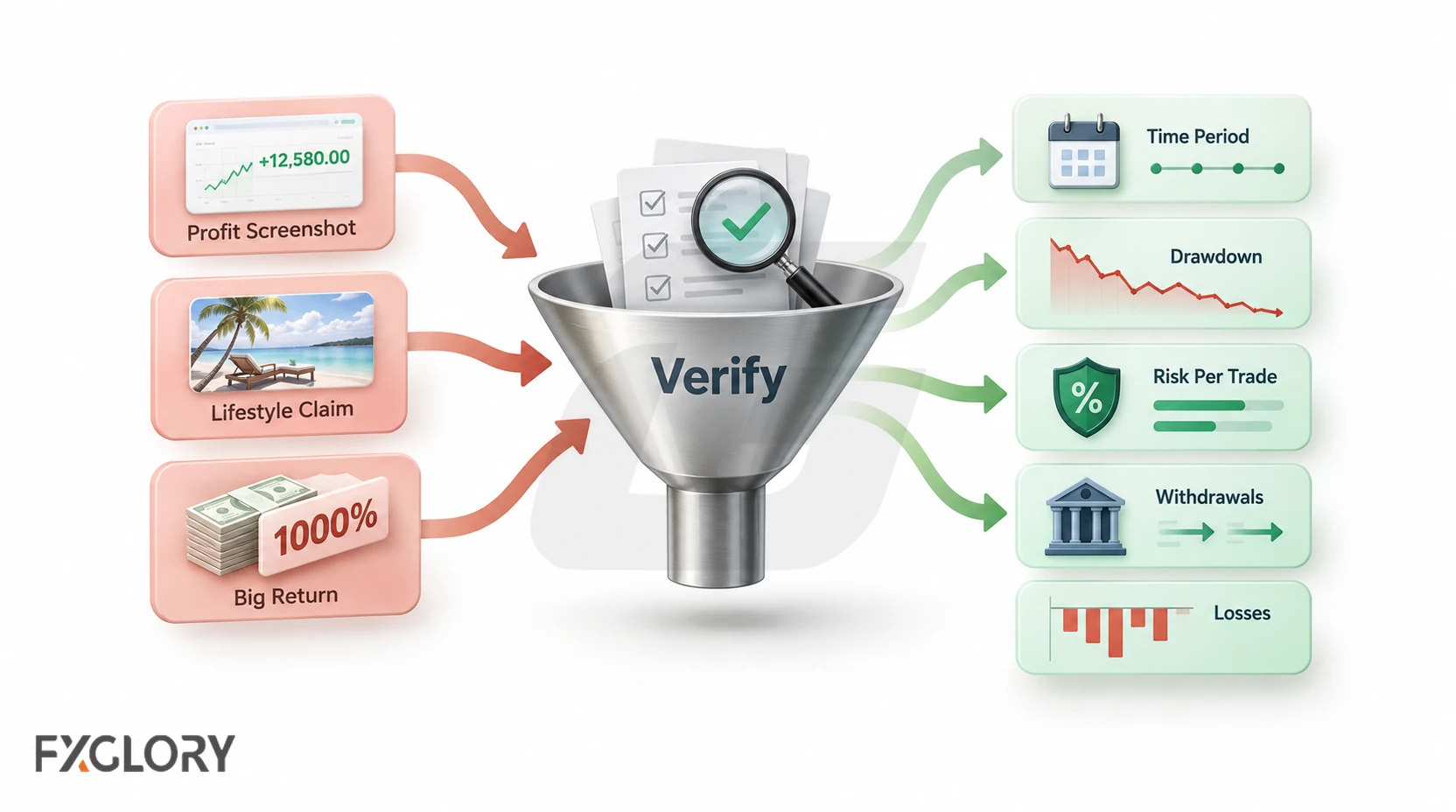
Forex stories become misleading when they remove the parts that would help a reader judge risk. A screenshot can show profit without showing the deposit. A lifestyle claim can show confidence without showing drawdown. A famous case can show a historic win without showing institutional capital, team research, or how unusual the market conditions were.
- Profit without risk: A large gain means little if the trade also risked account ruin.
- Screenshot without history: One winning trade does not show withdrawals, losses, fees, spread cost, or consistency.
- Net worth without source: A trader's wealth may come from funds, books, businesses, courses, or investments, not only personal forex trades.
- One trade as a method: A rare event does not become a repeatable trading plan.
- Lifestyle as proof: Cars, travel, watches, and luxury images are not audited trading records.
- No losing period: A story that shows no losses is either incomplete or not useful for risk education.
Evidence Quality: How To Judge A Forex Success Story
Not all forex trader stories deserve the same trust. Public historical cases, personal trader stories, professional profiles, promotional claims, and profit screenshots do not carry the same evidence weight.
Lifestyle claims, screenshots, dramatic headlines, and emotional storytelling are not trading evidence unless they show account history, risk taken, drawdown, withdrawals, time period, and whether the result came from trading or another business around trading.
Retail leveraged trading is high risk. The CFTC and NASAA warn that off-exchange forex trading by retail investors can be extremely risky and, in some cases, fraudulent. ESMA reported that analyses across EU jurisdictions found high loss rates among retail CFD accounts. BIS market data also shows that the foreign exchange market is very large, but market size does not make trading easy or safe.
| Evidence Level | Example | How To Use It | Weak Point |
|---|---|---|---|
| Public historical case | Well-known currency trades discussed across market history. | Study the decision context and risk lesson. | Details may be simplified, and institutional conditions may not transfer to retail trading. |
| Public career profile | A known trader, fund manager, or professional background. | Study habits, specialization, research, and risk culture. | Public reputation does not reveal every trade or drawdown. |
| Personal retail story | A trader explaining how long it took to improve. | Learn from emotional mistakes, timelines, and process changes. | Anecdotal and not proof of typical results. |
| Trader discussion | Questions from traders about consistency, losses, and expectations. | Find common problems such as overtrading, blown accounts, and unrealistic expectations. | Not audited and often incomplete. |
| Lifestyle or public-performance claim | A public claim built around profit, lifestyle, or personal transformation. | Use it as a question to investigate. | Not proof unless full performance, risk, drawdown, and withdrawals are shown. |
| Promotional claim | A profit post connected to a course, signal, copy service, or affiliate offer. | Use it only as a claim to verify. | May hide risk, losses, incentives, and income source. |
A stronger story shows deposit and withdrawal context, trade sample size, maximum drawdown, time period, risk per trade, losing streaks, strategy rules, and whether the trader earned money from trading or from something around trading.
- Ask for the time period: A week of profit does not show consistency.
- Ask for drawdown: Return without drawdown can hide dangerous exposure.
- Ask for risk per trade: A high return may come from risk most traders cannot tolerate.
- Ask for withdrawals: Account balance screenshots do not always show realized profit.
- Ask for income source: Trading profit, course revenue, signal revenue, and affiliate revenue are not the same.
- Ask for losing trades: The way losses are handled is often more useful than the winning trade.
Famous Forex Trader Stories: Process Lessons Without Copying The Trade
Famous forex traders are often used in success stories because the names are recognizable and the outcomes are dramatic. The safer way to read them is to extract the principle and ignore the temptation to copy the trade size.
| Famous Story | Core Lesson | Retail Boundary |
|---|---|---|
| George Soros | Macro pressure, central-bank limits, market positioning, and timing can align in rare currency situations. | The famous trade size and institutional context are not a retail template. |
| Stanley Druckenmiller | Strong traders can change their view, protect capital, and wait for high-conviction conditions. | Conviction without a loss limit can become account damage. |
| Bill Lipschutz | Risk control can matter more than being right on direction. | A good idea can still lose if size and execution are wrong. |
| Andrew Krieger | Volatile periods can create large currency moves. | Extreme exposure is not the lesson a beginner should copy. |
| Paul Tudor Jones | Defense, preparation, and market psychology can protect a trader from overconfidence. | Bold market calls should not replace a written risk plan. |
| Systematic and trend-following traders | Rules, testing, and repeatability can reduce random decision-making. | A named system still needs testing, execution skill, and risk limits. |
For the Soros case specifically, use FXGlory's focused breakdown of Soros-style macro lessons to study the macro context, risk boundaries, and retail-trader limitations in more detail.
Everyday Forex Trader Stories: The Version Most Beginners Need
Everyday forex traders stories are usually less dramatic than famous cases, but they are often more relevant to beginners. They show what happens when the trader faces ordinary pressure: losses, boredom, weak setups, small accounts, fear after entry, greed after wins, and the need to stop trading when the plan is already broken.
| Everyday Story | Early Problem | What Changed | Review Point |
|---|---|---|---|
| The strategy hopper | Changes indicators or methods after every losing streak. | Tests one method long enough to understand its behavior. | Changing tools constantly can hide the real problem: no stable process. |
| The overleveraged beginner | Uses size that makes normal price movement emotionally unbearable. | Reduces exposure and focuses on survival. | A small account needs smaller expectations, not larger risk. |
| The revenge trader | Tries to recover losses immediately. | Uses a stop-trading rule after emotional pressure appears. | Stopping can protect the account better than one more trade. |
| The FOMO trader | Chases moves after the planned level is gone. | Waits for defined conditions instead of urgency. | Missed trades are cheaper than forced trades. |
| The journal avoider | Repeats mistakes because nothing is recorded. | Tracks reason, risk, emotion, execution, and review notes. | Memory is not a trading journal. |
| The early winner | Wins at first, increases size, and gives back gains. | Keeps size stable after wins and reviews a larger trade sample. | A good week is not proof of long-term edge. |
Trader behavior often explains why the same lesson appears in different success stories. If emotional pressure is the main issue, review FXGlory's guide to forex trading psychology. If repeated trades are the problem, use the dedicated guide on trading too much after the plan is already broken. If the story is about chasing moves, use the guide on FOMO entries after the planned opportunity has passed.
What Successful Forex Trader Stories Have In Common
Different successful forex traders use different markets, timeframes, and methods. The shared lessons are usually deeper than the setup.
- They protect capital first: The account must survive losing trades, bad conditions, and human mistakes.
- They know what their method is not built for: A method has weak conditions as well as strong conditions.
- They accept controlled losses: A loss inside the plan is different from a loss caused by broken rules.
- They treat psychology as a risk factor: Fear, greed, revenge trading, FOMO, and tilt can change position size and execution.
- They review trades in writing: Without records, repeated mistakes are easy to explain away.
- They do not treat one result as proof: A meaningful sample matters more than one exciting win.
- They respect costs and conditions: Spread, slippage, swap, margin, volatility, and liquidity affect real outcomes.
- They lower expectations when capital is small: Small accounts are usually better for practice than income pressure.
These lessons connect stories with process. FXGlory's separate guide to forex trading success habits covers the broader behavior framework.
What Beginners Should Not Copy From Forex Success Stories
A beginner can learn from successful forex trader stories without copying the trade. That difference protects the account.
| Do Not Copy | Why It Is Dangerous | Copy This Instead |
|---|---|---|
| Large position size | A normal market move can become a major account loss. | Define risk before entry and keep position size small enough to follow the plan. |
| Extreme leverage | Leverage can make losses grow faster than the trader expects. | Review margin, stop distance, lot size, and worst-case movement. |
| One famous macro bet | Historic trades are often tied to rare conditions. | Study the reasoning, invalidation point, and risk boundary. |
| Lifestyle motivation | It can push the trader toward impatience and oversized risk. | Measure execution quality and rule-following. |
| Profit screenshots | They may hide deposits, withdrawals, losses, fees, and drawdown. | Look for complete performance context. |
| Borrowed confidence | Another trader's conviction does not fit your account or psychology. | Practice decisions that you can explain and risk yourself. |
Before taking live exposure, review the conditions that affect real trades. FXGlory's trading account conditions, leverage conditions, and margin calculator help connect story-based motivation with account-level reality.
How Long Does Forex Trading Success Take?
There is no reliable universal timeline. Personal forex trading stories often mention months or years because trading combines several skills at once: market reading, risk control, execution, emotional discipline, recordkeeping, and the ability to stop when conditions are poor.
A trader may learn chart patterns quickly and still fail because of position size. Another trader may understand risk but keep changing methods. Another may have a tested method but break rules after a loss. The timeline depends on the weakest link.
| Stage | What The Trader Learns | Common Failure Point | Better Measure |
|---|---|---|---|
| First exposure | Charts, orders, pips, spread, leverage, and platform mechanics. | Thinking access to the market means trading skill. | Can the trader explain the order, risk, and cost before entry? |
| Method search | Indicators, price action, news, sessions, and timeframes. | Changing methods after normal losses. | Can the trader test one framework over a meaningful sample? |
| Early live trading | Real-money emotion, hesitation, slippage, and discipline pressure. | Increasing size to recover losses. | Can the trader keep risk stable after wins and losses? |
| Review phase | Repeated mistakes, emotional triggers, and poor conditions. | Ignoring journal evidence. | Is one repeated mistake becoming less frequent? |
| Process maturity | When not to trade, when to stop, and how to protect capital. | Overconfidence after a profitable period. | Can the trader protect gains without changing risk behavior? |
For beginners, the more useful path is not copying someone else's timeline. It is building the basic role correctly. Start with FXGlory's beginner path to becoming a forex trader before treating any success story as a model.
Common Myths Created By Forex Trading Success Stories
Forex success stories can create myths that sound positive but damage behavior. These myths should be removed before the story becomes part of a trader's expectations.
| Myth | Reality | More Careful Reading |
|---|---|---|
| Successful traders win all the time. | Skilled traders still lose trades. | Controlled loss matters more than avoiding every loss. |
| One big trade can build the account. | One big trade can also destroy the account. | Judge decisions by repeatable risk-adjusted process. |
| High leverage is the shortcut. | Leverage increases exposure and can accelerate losses. | Understand margin pressure before increasing size. |
| A small account can quickly become income. | Small accounts often pressure traders into dangerous risk. | Treat small accounts mainly as practice capital. |
| Famous traders use secret indicators. | Many stories point to research, patience, risk, and discipline. | Simple rules followed consistently can be more useful than complex tools. |
| Confidence creates success. | Confidence without invalidation can become stubbornness. | Write the exit and stop conditions before entry. |
| A success story proves the opportunity is safe. | A story can hide the risks that made the result possible. | Look for drawdown, risk, and time period before trusting the lesson. |
Many mistakes behind these myths have their own behavioral pattern. For more detail, review FXGlory's guides to revenge trading after losses, trading tilt, and journaling trades before the same mistake repeats.
Turn A Forex Success Story Into A Practice Rule
The safest use of forex trading success stories is to turn each story into one action that changes your own process. Do not copy the result. Extract the behavior.
- Classify the story: Is it a famous historical case, a retail journey, a personal claim, a public performance claim, or a promotional offer?
- Separate outcome from process: Write down what the trader actually did before the result appeared.
- Find the risk rule: Look for position size, stop logic, maximum loss, drawdown control, or margin use.
- Find the psychology risk: Identify fear, greed, FOMO, revenge trading, tilt, overconfidence, or boredom.
- Find the review habit: Look for journaling, testing, screenshots with notes, or repeated mistake tracking.
- Find the non-copyable part: Institutional capital, rare market conditions, extreme leverage, or one unusual event should stay out of your plan.
- Write one practice rule: Reduce risk, limit trades, add a checklist, review a sample, or pause after a rule break.
If the story teaches journaling, use a structured forex trading journal template instead of relying on memory. If it teaches risk control, review FXGlory's risk management strategy guide. If it teaches small-account realism, compare it with the guide to trading forex with $100 without treating it as income capital.
Demo practice cannot guarantee live results, but it can help a trader learn platform workflow, order placement, journal habits, and basic rules without real-money exposure. FXGlory's demo account option is the natural place to practice before using real capital.
Frequently Asked Questions
Are forex trading success stories real?
Some forex trading success stories are based on public market history, while many online stories are personal, promotional, incomplete, or unverifiable. A useful story should show process, risk, losses, drawdown, time period, and evidence, not only a profit number.
What is a realistic forex success story?
A realistic forex success story includes mistakes, losses, smaller position size, clearer rules, better journaling, emotional control, and a longer learning period. It does not present profit as guaranteed or easy.
Has anyone become rich from forex trading?
Yes, some famous traders and fund managers are associated with major currency trades and large fortunes. Their outcomes are exceptional and often connected to institutional capital, professional research, broad market access, business income, or fund management rather than simple retail trading.
What percentage of forex traders are successful?
There is no single reliable global percentage for forex trader success because brokers, jurisdictions, products, time periods, and definitions of success differ. Do not treat unsourced 10%, 20%, or similar claims as universal facts. The more careful conclusion is that retail leveraged trading is high risk, and some regulators have reported high loss rates in retail CFD markets within their own review contexts.
Can beginners become successful forex traders?
A beginner can improve through education, demo practice, small risk, journaling, risk management, and emotional discipline. Success is not guaranteed, and a beginner should not copy large-risk trades from famous traders.
How long does it take to become successful in forex trading?
There is no fixed timeline. Some traders improve in months, others need years, and many never become consistently profitable. Progress should be measured by fewer repeated mistakes, better risk control, stronger review habits, and more consistent execution.
Are online forex success stories trustworthy?
An online forex story can be useful as a personal account, but it should not be treated as proof unless it shows full context: account history, deposits, withdrawals, drawdown, risk per trade, time period, and whether income came from trading or from courses, signals, sponsorships, or affiliates.
What proof should a forex success story show?
Better proof includes verified account history, trade sample size, maximum drawdown, deposits, withdrawals, risk per trade, fees, spread or commission impact, losing periods, and whether the results were repeated across different market conditions.
Why do many traders fail after early wins?
Early wins can create overconfidence. Traders may increase lot size, ignore stops, overtrade, chase setups, or believe the method is stronger than it is. A winning period without risk control can become dangerous.
Can forex trading become a full-time career?
Forex trading can be a career for some professional traders, but full-time trading requires capital, skill, risk controls, emotional stability, records, and realistic income expectations. A retail trader should not leave stable income because of a success story.
Can you make money trading forex with $100?
A small account can help a trader practice live execution where broker rules allow it, but it is usually not realistic income capital. Trying to turn $100 into meaningful income quickly often requires dangerous risk.
Do successful forex traders never lose?
No. Losses remain part of trading. The difference is that controlled traders define risk before entry, accept invalidation, record mistakes, and avoid turning one loss into a larger emotional problem.
What should I do after reading forex trading success stories?
Turn each story into one practical rule. Decide what you will risk, what you will record, which emotional trigger you will avoid, which setup you will practice, and when you will stop trading for the session.
Can forex trading success stories be dangerous?
Yes. A story becomes dangerous when it encourages extreme leverage, copying another trader, ignoring losses, rushing into live trading, or treating one exceptional result as normal.
Related Contents
Review The Trading Environment Before Live Exposure
Create an FXGlory account to review platform workflow, account conditions, available instruments, margin requirements, and order settings before placing a real-money trade.
Create an FXGlory Account