George Soros Forex Trading Strategies: Global Macro, Reflexivity & Retail Lessons

George Soros did not use a simple retail indicator setup. His forex strategy was built around global macro analysis, reflexivity, policy pressure, currency mispricing, institutional position sizing, and strict willingness to change when the thesis broke.
 
Written byHenry Green
Published
Last updated
George Soros Forex Trading Strategies

Key Takeaways

  • George Soros' forex strategy is best described as global macro trading, not a simple chart pattern, signal, or mechanical retail system.
  • His most famous forex trade was the 1992 British pound short, where the thesis centered on pressure inside the European Exchange Rate Mechanism.
  • Reflexivity was central to Soros' thinking: market prices and market beliefs can influence the fundamentals they appear to reflect.
  • Soros is usually described as a macro and event-driven trader, not a technical-analysis-first trader. Technical tools may help with timing, but they were not the core of the Soros approach.
  • Pyramiding in a Soros-style context means adding to a planned winning thesis, not averaging down into a losing trade.
  • Retail traders can study Soros' process, risk thinking, and flexibility, but should not copy his institutional size, leverage, or one-way macro conviction.
  • Soros also had major losses, which is why any useful lesson from his career must include risk limits, invalidation, and humility.

What Was George Soros' Forex Trading Strategy?

George Soros' forex trading strategy was a global macro approach, not a simple retail indicator setup. He looked for currency mispricing created by policy pressure, economic imbalance, market expectations, and reflexive feedback loops between price and fundamentals. His most famous example was the 1992 British pound short, but the useful retail lesson is the process, not the trade size.

In practical terms, Soros studied where a currency system looked unstable, where policymakers were under pressure, and where market positioning could force a larger move. He was willing to build large institutional positions when the thesis strengthened, but he was also known for changing when evidence changed.

Risk and realism note: This page is educational only. It does not provide trading signals, copy-trading instructions, managed-account advice, personal financial advice, or profit promises. Soros' trades were institutional macro trades, not templates for retail accounts. Forex trading involves risk of loss, including leverage, margin, spread, slippage, execution, stop-loss, news-event, platform, and emotional decision-making risks.

For the broader profile context, read why Soros appears in famous trader lists. For wealth and net-worth intent, read why Soros is often called the richest forex trader.

George Soros' Forex Strategy In One Table

Strategy ElementHow It Worked In Soros' ApproachRetail-Safe Lesson
Global macro analysisCurrency decisions were connected to rates, inflation, policy, reserves, capital flows, and political pressure.Do not trade a currency pair without understanding the main macro forces around it.
ReflexivityMarket beliefs and price moves could affect the fundamentals they appeared to reflect.Watch how price, sentiment, positioning, and policy pressure can reinforce each other.
Currency-peg pressureSoros looked for systems where authorities had to defend a currency level under stress.Do not assume a central bank or peg is unbreakable.
Large directional thesisHe used strong conviction when the macro setup and market pressure aligned.Conviction must still have invalidation and position-size limits.
Scaling / pyramidingSize could be increased when the thesis gained confirmation.Add only to planned winning positions, never to rescue losing trades.
FlexibilitySoros was known for changing when the facts changed.A strong view is useful only while evidence supports it.
Institutional executionHis trades involved hedge-fund capital, liquidity access, and professional infrastructure.Retail traders should not copy institutional leverage or scale.

The Core: Global Macro, Not Indicator Trading

Soros is best understood as a global macro trader and investor. Global macro trading studies broad forces that can move currencies and other markets: interest rates, inflation, central-bank credibility, government policy, capital flows, debt pressure, commodity shocks, and market expectations.

For the broader retail-safe framework behind this section, see how a global macro forex trading strategy connects policy, rates, inflation, capital flows, and cross-market signals before a trade thesis is built.

This is very different from a retail strategy that says, for example, “buy when one indicator crosses another.” Soros' approach began with a macro thesis. A chart could help a trader observe timing or market pressure, but the engine was the imbalance behind the market.

Macro InputWhy It Matters In ForexRetail Question To Ask
Interest-rate policyRate expectations can change demand for a currency.Is the market expecting tighter or easier policy?
InflationHigh inflation can pressure real returns and central-bank decisions.Is inflation forcing policy action?
Currency peg or bandA defended level can break if the cost of defense becomes too high.Who is defending the level, and what is the cost?
Foreign reservesAuthorities may need reserves to defend a currency.Does the defense look sustainable?
Political pressurePolicy decisions can become harder during economic or public pressure.Is politics making the policy path weaker?
Market positioningCrowded positioning can accelerate a move or reversal.Is the trade already crowded?
Cross-market signalsBonds, equities, commodities, and currencies can confirm or challenge each other.Do other markets support the currency view?

For the basic role and responsibilities behind trading decisions, review what a forex trader actually does.

Reflexivity Explained In Plain English

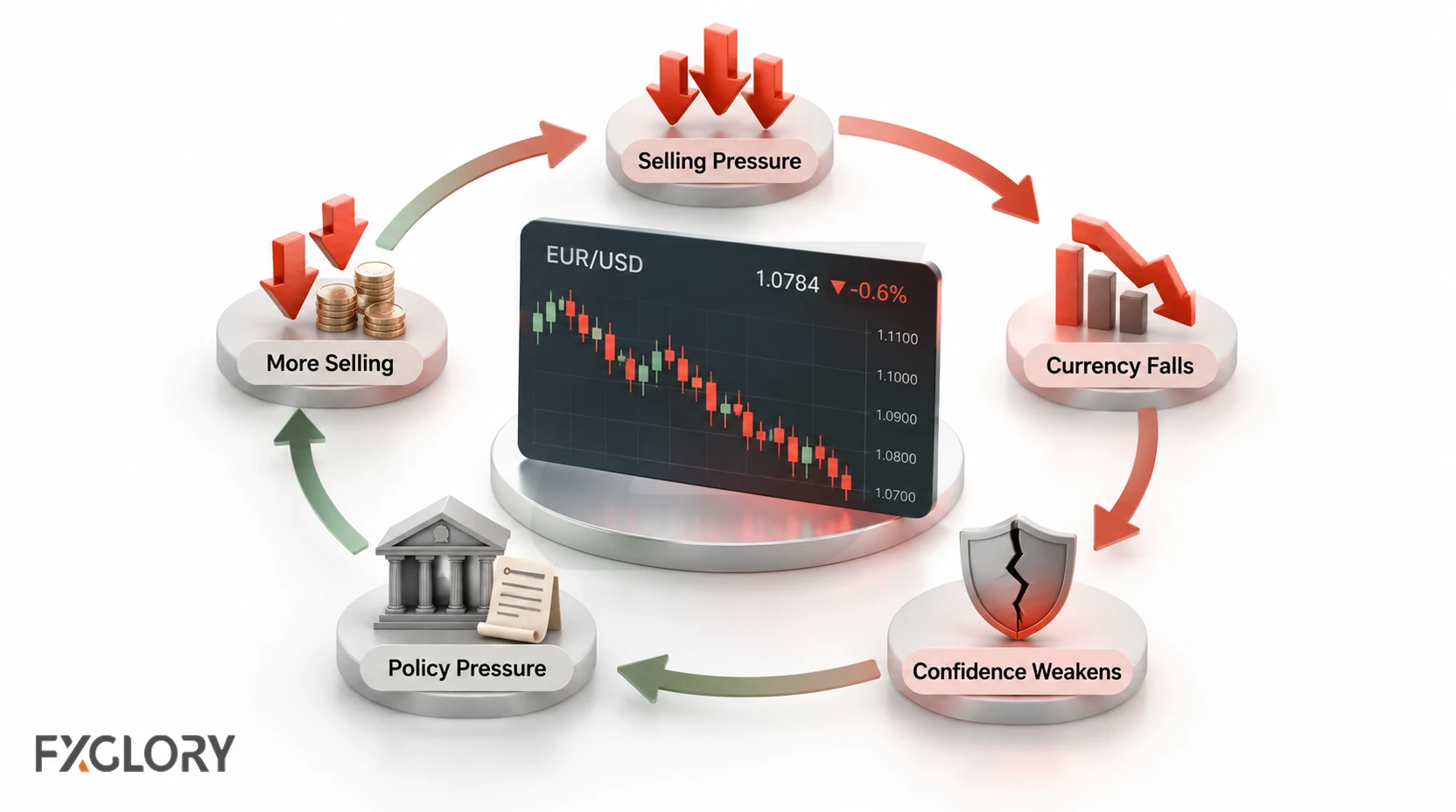
Reflexivity is the idea that markets do not only reflect fundamentals; market prices and beliefs can also influence the fundamentals themselves. In forex, this can happen when a currency move changes confidence, policy pressure, reserve use, capital flows, or trader positioning.

For example, a currency under pressure may force a government or central bank to defend it. That defense can become expensive. If traders believe the defense is weakening, selling pressure can grow. The selling then increases the pressure policymakers face. That feedback loop is exactly the type of environment Soros looked for.

Plain-English version: Soros did not only ask, “What is the fair value?” He also asked, “How will market behavior change the situation itself?”
Normal ViewReflexive View
Prices reflect fundamentals.Prices can also pressure fundamentals.
Traders react to policy.Trader behavior can force policy stress.
A currency level is stable until data changes.A currency level can become unstable when belief in it changes.
A trend is only price movement.A trend can feed positioning, liquidity, confidence, and policy response.

The Black Wednesday Trade

Soros' most famous forex trade was the 1992 short against the British pound. The setup came from pressure inside the European Exchange Rate Mechanism, where Britain had to keep the pound within a target band against the German mark.
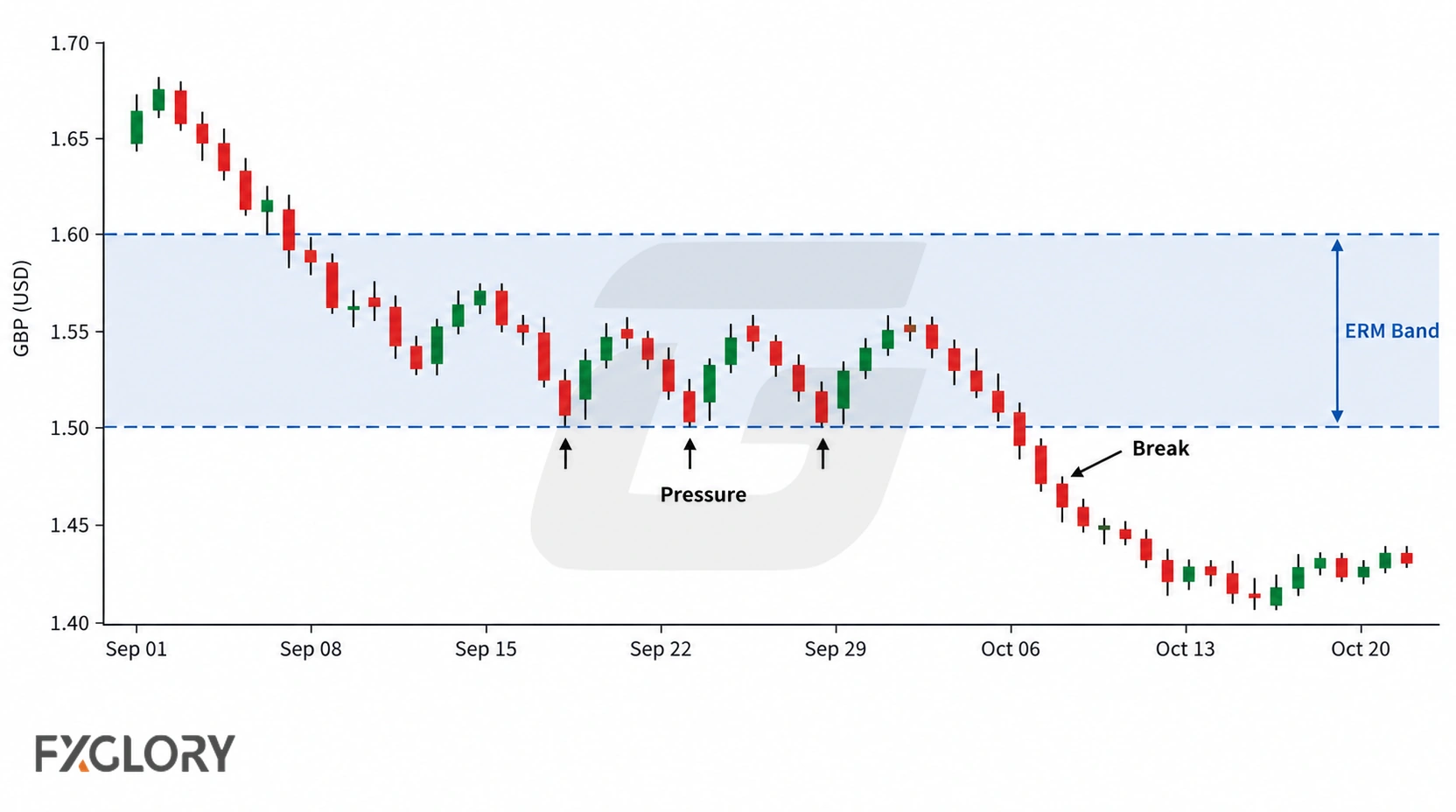
The basic thesis was that the pound was overvalued and that Britain would struggle to defend it. Higher interest rates could attract currency support, but they also created economic and political pressure. As that pressure increased, the pound's defense became harder to sustain.

StepWhat HappenedWhy It Mattered
1. ERM commitmentBritain had to keep the pound within a band.The currency level depended on policy defense.
2. Economic pressureHigh inflation, low growth pressure, and rate-policy tension made defense harder.The peg-like structure became vulnerable.
3. Short thesisSoros built a short position against the pound.The trade targeted a possible break in policy credibility.
4. Position increasePublic accounts describe a move from roughly $1.5B to about $10B in short exposure.This was institutional scale, not retail size.
5. ERM exitBritain left the exchange-rate mechanism on Black Wednesday.The pound fell sharply after the defense failed.
6. Reported profitThe trade is widely reported as producing around or more than $1B in profit.The result became one of the best-known currency trades in history.
Retail caution: The lesson is not “short pegged currencies.” The lesson is to understand policy pressure, risk, liquidity, and invalidation before taking any trade.

How Soros Built A Trade Thesis

A Soros-style forex thesis was not just “the currency looks high.” It connected the market price to the policy structure behind it. A strong thesis needed a reason the market could move, a reason the pressure could intensify, and a reason the current price could become hard to defend.

  • Policy structure: What level or policy is the market testing?
  • Economic conflict: Is the policy becoming expensive or politically difficult?
  • Market behavior: Are other traders and institutions increasing pressure?
  • Confirmation: Is the thesis getting stronger through price, policy, or public statements?
  • Invalidation: What would prove the trade wrong?
  • Exit logic: When should the position be reduced, closed, or reviewed?

Retail traders can adapt this into a written plan with entry conditions, invalidation, risk per trade, maximum exposure, and review rules. Use a written trading plan before turning a macro idea into a trade.

Retail Next StepWhat To Write Before The Trade
1. Define the macro pressureWhat policy, rate, inflation, peg, or capital-flow pressure is affecting the currency?
2. Define the market evidenceWhat price action, volatility, news, or cross-market signal supports the thesis?
3. Define invalidationWhat exact condition means the idea is wrong?
4. Define riskHow much can be lost if the trade fails, including spread, slippage, and gap risk?
5. Define add-on rulesWhat must happen before adding size, and what is the total exposure limit?
6. Define reviewWhat will be recorded in the journal after the trade closes?

Did George Soros Use Technical Analysis?

Soros is generally described as a macro and event-driven trader, not a technical-analysis-first trader. Public descriptions of his approach emphasize macroeconomic analysis, reflexivity, policy pressure, and market behavior rather than a fixed chart pattern or indicator system.

That does not mean technical analysis is useless. A trader may use charts to observe timing, liquidity, trend pressure, support and resistance, volatility, or execution conditions. The key distinction is that technical analysis was not the main reason behind Soros' famous forex thesis.

QuestionBest Answer
Was Soros a pure technical trader?No. He is usually described as a macro trader.
Did charts possibly matter?They may have helped with timing, market pressure, or execution.
Was the pound short based on an indicator?No. The central thesis was policy and macro pressure.
Can retail traders combine macro and charts?Yes, but the chart should not replace risk rules or invalidation.

Pyramiding: What Soros-Style Scaling Means And What It Does Not Mean

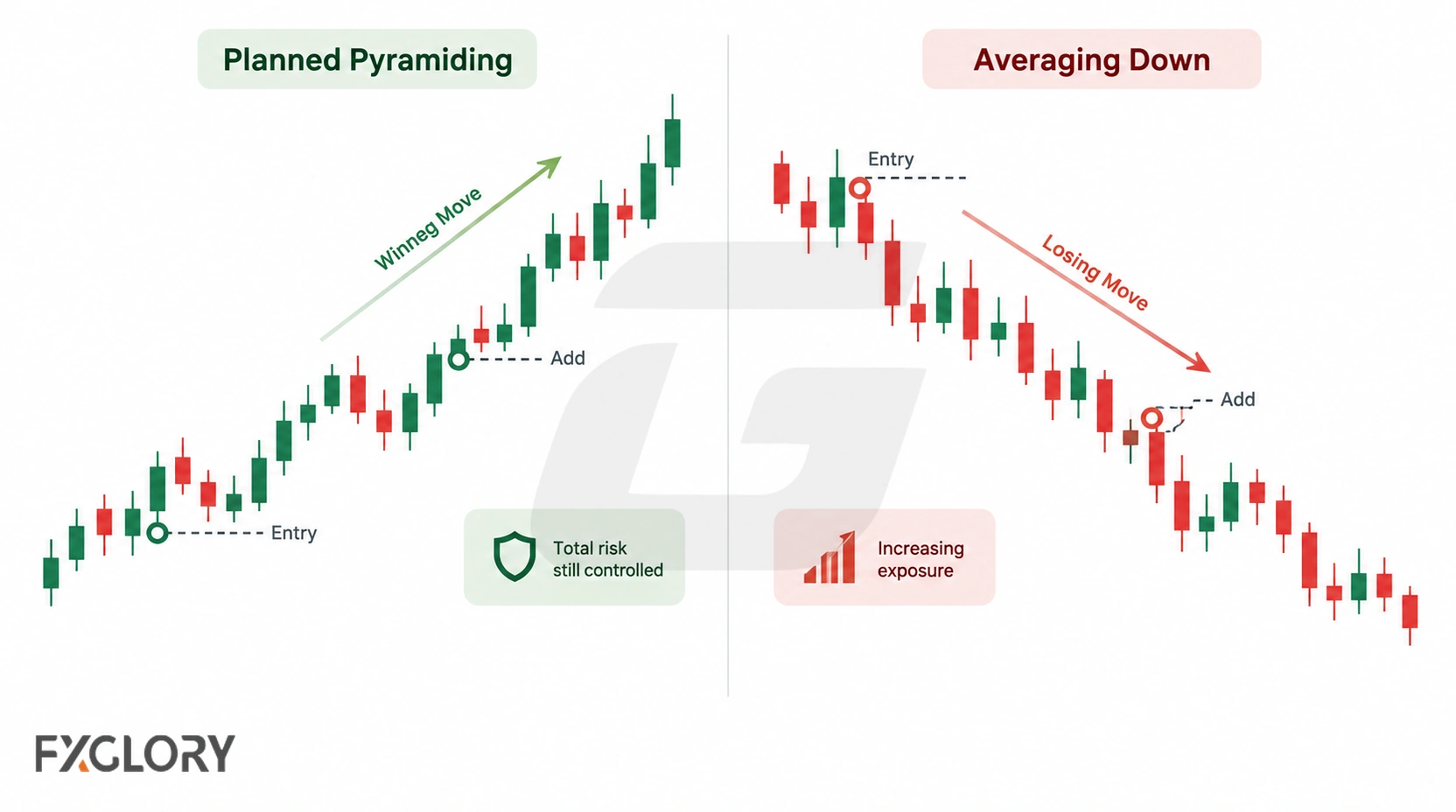
Some competitor pages describe Soros-style position building as pyramiding: adding size as the trade works and the thesis gains confirmation. That idea can be useful, but it is also dangerous when misunderstood.

Pyramiding is not the same as averaging down. Pyramiding adds to a planned winning trade under predefined conditions. Averaging down adds to a losing trade because the trader hopes price will come back.

BehaviorWhat It MeansRisk
Planned pyramidingAdding only when the trade moves in favor and risk remains controlled.Can still increase exposure quickly.
Averaging downAdding to a losing trade without a fresh valid thesis.Can turn a planned loss into a large loss.
Revenge addingIncreasing size after frustration or a prior loss.Usually emotional, not strategic.
News-chasingAdding after headlines without risk planning.Spread, slippage, and reversal risk can increase.
Hard rule: Do not add to a position unless the add-on risk, stop logic, total exposure, and invalidation are defined before the trade.

For practical risk rules, use risk rules before position size.

Risk Management Lessons From Soros

The safest lesson from Soros is not “take big trades.” It is that a big thesis still needs risk control, invalidation, and flexibility. Soros' public reputation includes large wins, but it also includes major losses. That matters because macro conviction can become dangerous when a trader refuses to change.

Risk PrincipleHow It AppliesRetail Version
Define invalidationA thesis needs a condition that proves it wrong.Write the stop or exit reason before entering.
Respect sizeLarge positions can damage the account quickly.Keep risk small enough to survive being wrong.
Review leverageLeverage magnifies exposure and loss speed.Review leverage conditions before increasing trade size.
Separate conviction from stubbornnessA strong thesis can become identity-driven.Use evidence, not ego, to stay or exit.
Expect slippage and execution riskMacro events can move fast and gap through levels.A stop is not a profit guarantee or a perfect-fill guarantee.
Document the decisionLarge themes can feel obvious after the move.Track the reason, evidence, risk, and result in a journal.

Use a journal that reviews whether the thesis actually worked, not only whether the trade made money.

Soros' Other Currency Trades: Thai Baht And Japanese Yen

The pound trade is the best-known Soros currency story, but it is not the only one discussed in financial-market coverage. Public accounts also discuss Soros-related trades around the Thai baht during the Asian financial crisis and the Japanese yen during the Abenomics period.

Trade ThemeCore IdeaRetail Lesson
British pound, 1992Pressure on a defended exchange-rate band.Policy credibility can matter more than a chart signal.
Thai baht, 1997Currency-defense pressure during a broader regional crisis.Peg and reserve pressure can create unstable conditions.
Japanese yen, 2013-2014Monetary easing and yen weakness linked with Abenomics.Central-bank policy can reshape currency expectations.

Do not treat these as repeatable setups. They belonged to specific periods, institutions, liquidity conditions, and policy environments.

What Soros Got Wrong

A useful Soros page should not read like hero worship. Public accounts describe major losses as well as major wins, including losses connected with the 1987 crash, the Russian debt crisis, and technology-bubble trades.

This is important for retail traders because it breaks the myth that a strong macro trader is always right. The best traders can still be wrong. The difference is whether risk is controlled when the thesis fails.

Wrong LessonBetter Lesson
“Soros won big, so conviction is enough.”Conviction without invalidation can be dangerous.
“Big traders always know more.”Large players can influence volatility, but they are not always better informed.
“A famous macro view is safer than a small setup.”Macro trades can be volatile, crowded, and politically exposed.
“A loss means the thesis was stupid.”A trade can be well reasoned and still lose.
Anti-hype point: The existence of a famous winning trade does not remove the need for risk limits, stop logic, and emotional discipline.

What Retail Forex Traders Can Learn From Soros

Retail traders cannot copy Soros' scale, but they can learn from the structure of his thinking.

  • Start with the pressure: Ask what is forcing the currency to move or stay defended.
  • Connect markets: Watch rates, bonds, equities, commodities, and policy expectations when they matter to a currency pair.
  • Define the thesis: Know what you believe and why.
  • Define the invalidation: Know what would prove the thesis wrong.
  • Respect liquidity: News events and policy breaks can create spread and slippage risk.
  • Use smaller risk than your conviction wants: Strong beliefs can still be wrong.
  • Review the decision: Learn from evidence, not from admiration for famous traders.

For process habits beyond one famous trader, read process habits behind long-term improvement.

What Retail Traders Should Not Copy From Soros

Do Not CopyWhy It Is DangerousSafer Alternative
Institutional position sizeRetail accounts do not have the same capital base, liquidity access, or risk capacity.Size each trade according to your own account and written limits.
High leverage because Soros used leverageLeverage can accelerate losses and margin pressure.Understand margin and total exposure before opening a trade.
One famous macro tradeThe historical setup may not repeat.Trade only the setup in front of you, with current evidence.
Political certaintyPolicy outcomes can surprise the market.Plan for multiple scenarios, not one preferred story.
Adding size without rulesUnplanned scaling can turn a manageable loss into a large loss.Add only under predefined conditions and total-risk limits.
Hero worshipAdmiration can lower critical thinking.Separate lessons from copycat behavior.

For the emotional side of conviction, review how trading psychology affects risk decisions.

Soros Strategy vs Normal Retail Forex Strategy

A Soros-style institutional macro trade and a normal retail forex trade are different in scale, information environment, execution, and risk tolerance.

AreaSoros-Style Institutional MacroRetail Forex Trading
CapitalHedge-fund and institutional capital.Personal account capital.
ResearchProfessional macro research, networks, and cross-market analysis.Public data, platform tools, and personal study.
Position sizeCan involve very large directional exposure.Must fit account risk and margin limits.
ExecutionInstitutional liquidity relationships and infrastructure.Broker/platform execution with spread, slippage, and order-risk considerations.
Time horizonCan hold a macro thesis while pressure builds.Depends on account size, swap costs, margin, and trader plan.
Risk capacityProfessional structure and capital buffers.Personal financial limits. Never risk money needed for essential expenses.

This is why institutional macro trades are not retail trading templates.

Sources And Trust Notes

This article uses public market-education, academic, and risk-disclosure sources for historical context and retail-risk framing. It does not claim to reconstruct Soros' private decision process or provide a copyable trading system.

FXGlory's Risk Disclosure explains trading, leverage, order-execution, stop-loss, platform, and other risks that matter before any retail trader acts on a strong market view.

This page does not provide Soros-style signals, trade recommendations, account management, copy-trading instructions, legal advice, tax advice, or any guarantee of trading results.

Frequently Asked Questions

What was George Soros' forex trading strategy?

George Soros' forex trading strategy was a global macro approach. He looked for currency mispricing created by policy pressure, economic imbalance, investor expectations, and feedback loops between market prices and fundamentals.

What is George Soros' global macro strategy?

His global macro strategy involved studying currencies, interest rates, policy decisions, capital flows, bonds, stocks, commodities, and political pressure together. The goal was to find major imbalances where markets and policymakers were under stress.

What is the George Soros forex strategy in simple words?

In simple words, Soros looked for situations where a currency price could not hold because the economic and policy pressure behind it was too strong. He then built a large directional thesis and changed course if the evidence stopped supporting it.

Did George Soros use technical analysis?

Public descriptions of Soros present him mainly as a macro and event-driven trader, not a technical-analysis-first trader. Technical analysis may help traders think about timing, liquidity, and execution, but it was not the main engine of the Soros strategy.

What indicators did George Soros use?

There is no reliable public evidence that George Soros used one fixed retail indicator system. Public descriptions of his approach point to macro analysis, policy pressure, reflexivity, and risk judgment rather than a specific indicator such as RSI, MACD, or moving averages.

Was George Soros a day trader or a swing trader?

George Soros is best understood as a global macro trader and investor, not a normal retail day trader or scalper. His famous currency trades were based on macro pressure and institutional positioning, not quick intraday indicator signals.

Did George Soros use fundamental analysis?

Yes. Soros' approach relied heavily on macroeconomic and fundamental forces such as central-bank policy, currency pegs, interest-rate pressure, inflation, government credibility, capital flows, and market expectations.

What is reflexivity in George Soros' trading?

Reflexivity is the idea that market prices and market beliefs can influence each other. In forex, a currency move can affect policy pressure, reserves, trader positioning, and confidence, which can then strengthen or reverse the move.

What was George Soros' Black Wednesday trade?

The Black Wednesday trade was Soros' famous 1992 short position against the British pound. The trade was based on pressure inside the European Exchange Rate Mechanism and Britain's difficulty defending the pound's exchange-rate band.

What currency pairs did George Soros trade?

The most famous public examples involve the British pound, the Thai baht, and the Japanese yen. These are historical examples, not current trade recommendations or signals.

How much did George Soros make shorting the British pound?

The 1992 British pound trade is widely reported as producing around or more than $1 billion in profit for Soros. Some reports describe nearly $2 billion after the position was fully unwound. These figures should not be treated as retail trading expectations.

Did George Soros use leverage?

Yes, Soros' famous trades involved institutional-scale leverage and large directional exposure. Retail traders should not copy that scale; leverage can magnify losses as well as gains.

Did George Soros pyramid trades?

Soros-style scaling is often discussed as adding to a trade when the thesis is working. Retail traders should not confuse this with averaging down or adding to losing positions because they do not want to accept a loss.

Can retail traders use George Soros' strategy?

Retail traders can study Soros' principles, such as macro awareness, risk definition, flexibility, and thesis review. They should not copy his position size, leverage, institutional execution, or one-way conviction.

Can beginners trade like George Soros?

No beginner should try to trade like George Soros. Beginners should learn market basics, risk management, order execution, journaling, and emotional control before using complex macro ideas.

Was George Soros a forex trader or a macro trader?

George Soros is better described as a global macro trader and investor with famous currency trades. He did trade currencies, but his method covered many markets and macro forces.

What made the pound trade work?

The pound trade worked because Soros and other speculators identified pressure in a currency-peg system. Britain had to defend the pound inside an exchange-rate band, but the economic and policy pressure became too difficult to sustain.

What are Soros' main trading rules?

The safest Soros-style lessons are: define the thesis, understand the macro pressure, know where the thesis is wrong, size risk carefully, add only when evidence improves, and change direction when facts change.

What can forex traders learn from George Soros?

Forex traders can learn to think in terms of policy pressure, expectations, capital flows, risk/reward, and invalidation. The useful lesson is process, not copying the trade.

What should retail traders not copy from George Soros?

Retail traders should not copy Soros' institutional leverage, position size, macro certainty, political speculation, or famous trade outcomes. Their account size, liquidity, and execution conditions are different.

Was George Soros always right?

No. Soros had major losses as well as famous wins. His career is useful partly because it shows that even strong macro traders need risk limits and the ability to change when wrong.

What did George Soros get wrong?

Public accounts describe losses around the 1987 crash, the Russian debt crisis, and technology-bubble trades. These examples show why a macro thesis still needs risk control.

Is George Soros' strategy still useful today?

The principles remain useful: macro pressure, reflexivity, risk definition, and flexibility. The exact trades, scale, and market conditions cannot be copied directly.

Can George Soros' forex strategy be backtested?

Parts of a macro idea can be studied historically, but Soros' discretionary reflexive approach is not a simple mechanical backtest. A backtest cannot fully capture policy pressure, liquidity, central-bank credibility, trader positioning, and human judgment.

Is global macro trading the same as forex trading?

No. Forex trading focuses on currency pairs. Global macro trading can include currencies, rates, bonds, equities, commodities, policy expectations, and cross-market relationships.

Does George Soros' strategy work for small accounts?

The institutional Soros strategy does not transfer directly to small accounts. Small accounts need stricter position sizing, cost awareness, simpler rules, and lower tolerance for drawdown.

Does FXGlory provide George Soros forex signals?

No. This page is educational. FXGlory does not provide Soros-style signals, copy-trading instructions, managed-account advice, or profit promises based on famous trader results.

What is the safest conclusion from George Soros' trading career?

The safest conclusion is that strong traders define a thesis, respect risk, stay flexible, and understand when market feedback can change the fundamentals. The dangerous conclusion is to copy large leveraged trades.

Related Contents

Top Forex TradersSee why Soros appears in famous trader lists and how his lessons compare with other major forex and macro traders.
Global Macro Forex Trading StrategySee how policy, rates, inflation, capital flows, and cross-market signals can support a forex thesis.
Who Is the Richest Forex Trader?Separate Soros' fame and net-worth context from pure forex trading profit.
Forex TraderReview what a forex trader actually does before comparing retail trading with institutional macro trading.
Retail vs Professional Forex TraderUnderstand why institutional macro trades are not retail trading templates.
Forex Risk Management StrategyBuild risk rules before increasing trade size or acting on a strong macro view.
Forex Trading Plan TemplateTurn macro ideas into written trade rules, invalidation points, and review conditions.
Forex Trading JournalReview whether a thesis actually worked instead of judging only the final profit or loss.
Forex Trading PsychologySeparate conviction from stubbornness when a trade becomes emotionally important.
How to Be Successful in Forex TradingFocus on process habits, review, discipline, and realistic improvement.
Leverage ConditionsReview leverage before comparing your account with famous institutional macro trades.
Risk DisclosureRead FXGlory's disclosure on trading, leverage, execution, stop-loss, platform, and market risks.
Open a Demo AccountPractice process and execution workflow without putting live capital at risk.

Practice Process Before Risking Live Capital

Use FXGlory's trading environment to review account conditions, leverage rules, execution workflow, and your own written risk limits before placing a real-money trade.

Create an FXGlory Account