

What Is A Global Macro Forex Trading Strategy?
A global macro forex trading strategy compares the economic and policy forces affecting both currencies in a pair, then checks whether rates, bonds, commodities, equities, capital flows, geopolitics, and risk sentiment support the same relative view. The emphasis is not one data release or one chart signal, but how several markets and policy expectations interact.
For detailed economic-data execution, use the forex fundamental strategy framework. For rollover and interest-rate-differential mechanics, use the carry trade forex guide.
How Global Macro Trading Applies To Forex
Forex is naturally macro-driven because every currency pair compares two economies, two central banks, two policy paths, and two sets of market expectations. A macro trader does not ask only whether EUR/USD, GBP/USD, USD/JPY, or AUD/USD looks high or low on a chart. The trader asks what economic forces could make one side of the pair more attractive than the other.
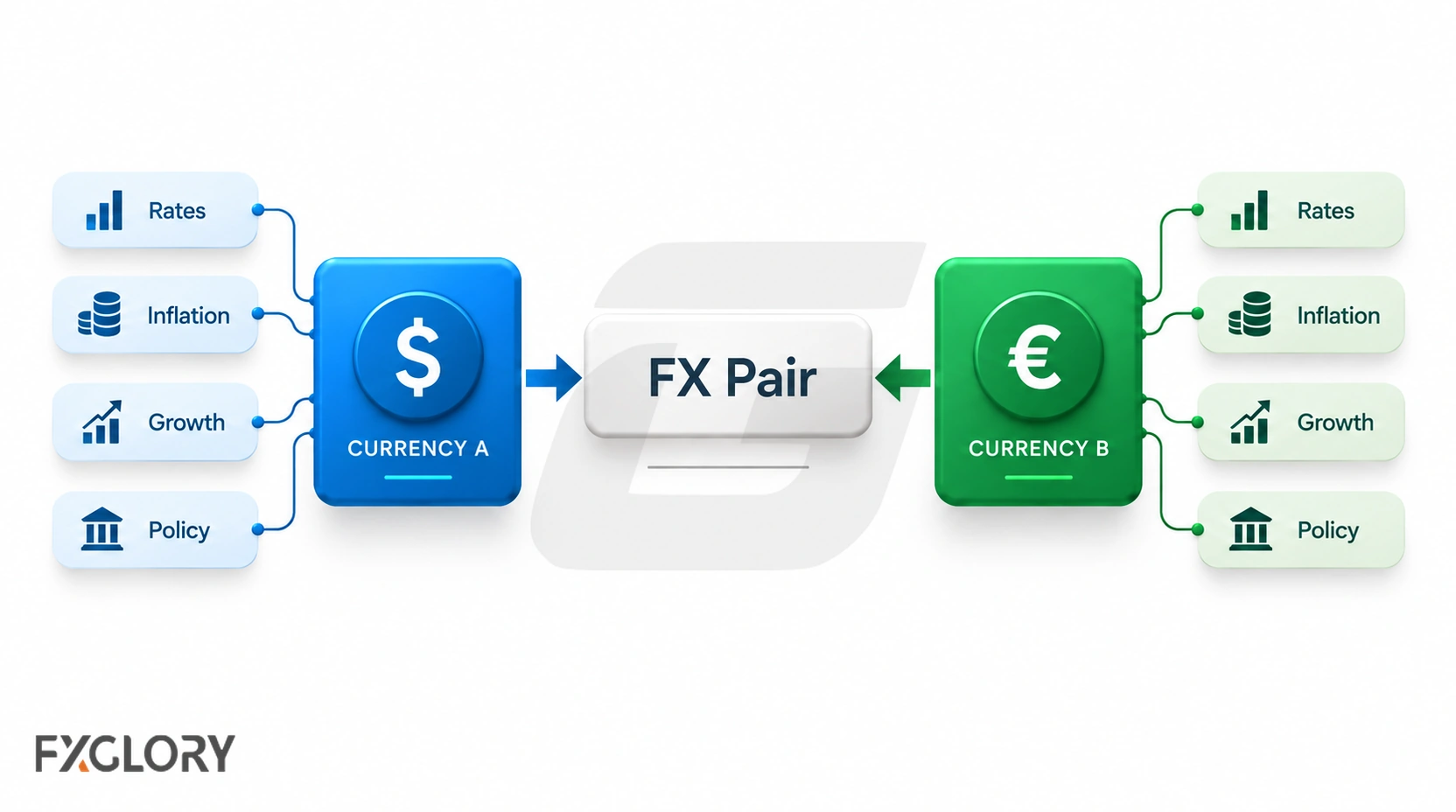
For example, higher expected real yields, stronger relative growth, safe-haven demand, or improving capital inflows can support a currency, while expected rate cuts, fiscal stress, weaker relative growth, or capital outflows can pressure it. The effect is not mechanical: the market may already have priced in the development, and the same variable can matter differently depending on why it changed.
| Institutional Concept | Retail Forex Translation |
|---|---|
| Cross-asset valuation | Watch rates, bonds, commodities, equities, and FX together instead of isolating one pair. |
| Long/short across asset classes | Express a macro view through a currency pair only when the pair is liquid and risk is defined. |
| Fair value | Ask whether a currency looks stretched relative to rates, inflation, growth, or policy pressure. |
| Sentiment models | Watch crowded positioning, extreme optimism or pessimism, and reversal risk. |
| Systematic macro | Use rules or filters instead of reacting randomly to headlines. |
| Discretionary macro | Use human judgment, but write down the thesis and invalidation. |
Before applying macro ideas, review how currency pairs express relative views and how the forex market connects global economies.
Global Macro vs Fundamental Analysis vs News Trading vs Technical Analysis
Many traders confuse global macro with fundamental analysis, news trading, or technical analysis. They can overlap, but they are not the same.
| Approach | Main Question | Common Mistake |
|---|---|---|
| Fundamental forex analysis | What economic data supports one currency over another? | Looking at one data point without policy or market context. |
| Global macro forex strategy | How do policy, rates, growth, geopolitics, capital flows, bonds, commodities, equities, and risk sentiment interact? | Building a broad story without defined risk, pair expression, or invalidation. |
| News trading | How does price react to a specific event or headline? | Reacting late after spreads widen or volatility spikes. |
| Technical analysis | What does price action show about trend, levels, volatility, and timing? | Using a chart signal without understanding the macro event risk around it. |
This page focuses on the cross-market macro framework. For a trade-plan page built around economic data, central banks, inflation, employment, growth, economic-calendar use, and chart timing, read how fundamental strategy turns analysis into forex rules.
The Main Macro Drivers Of Currency Pairs
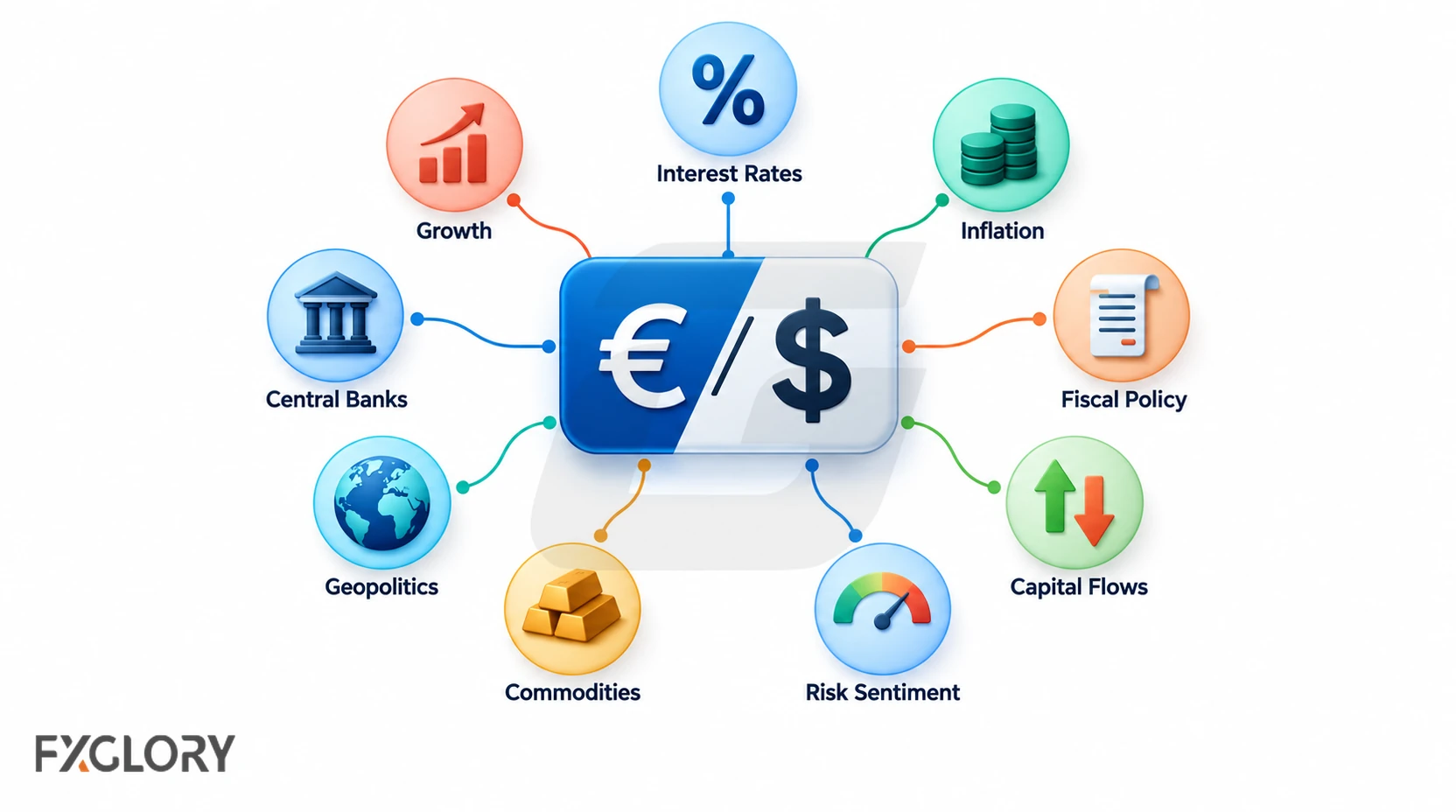
Start by identifying the dominant driver and the evidence that would confirm or contradict it. Combining many weak arguments can make it harder to tell why the thesis is working or failing.
| Driver | Why It Matters | Question To Ask |
|---|---|---|
| Interest-rate expectations | Expected yields can affect capital flows and currency demand. | Is the market pricing hikes, cuts, or a policy pause? |
| Inflation | Inflation affects real yields, policy pressure, and currency confidence. | Is inflation forcing or preventing central-bank action? |
| Central-bank credibility | Currency reactions depend on whether markets believe policymakers. | Does the market trust the central bank's message? |
| Growth | Growth affects investment flows, risk appetite, and policy expectations. | Is the economy accelerating or slowing relative to peers? |
| Fiscal policy | Deficits, debt, and spending can affect confidence and yields. | Is fiscal pressure supporting or hurting the currency? |
| Capital flows | Foreign investment and repatriation can support or pressure a currency. | Are flows moving into or out of the economy? |
| Geopolitics | Political shocks can change safe-haven demand and risk appetite. | Is the currency exposed to sanctions, conflict, elections, or trade risk? |
| Commodity exposure | Some currencies are sensitive to oil, metals, or export prices. | Does the commodity trend support or pressure the currency? |
| Risk sentiment | Markets may prefer safe havens or higher-beta currencies depending on conditions. | Is the market seeking safety or return? |
Discretionary, Systematic, And CTA Macro Approaches
Global macro is not one fixed strategy. Institutional sources commonly separate discretionary macro, systematic macro, and CTA or managed-futures approaches. Retail traders do not need to copy fund structures, but they should understand the difference.
| Approach | How It Works | Retail-Safe Interpretation |
|---|---|---|
| Discretionary global macro | A human trader forms a thesis from macro data, policy, politics, and market behavior. | Useful only if the thesis, risk, and invalidation are written down. |
| Systematic global macro | Rules or models evaluate macro variables, valuation, trend, or sentiment across markets. | Use simple filters consistently; do not call random opinions a system. |
| CTA / managed futures | Often rule-based and active across currencies, rates, commodities, and indexes. | Understand that many CTA approaches are multi-asset and not the same as retail spot forex. |
The approaches differ in how decisions are generated, not in the need for predefined risk controls and a repeatable decision process.
How To Build A Global Macro Forex Trade Thesis
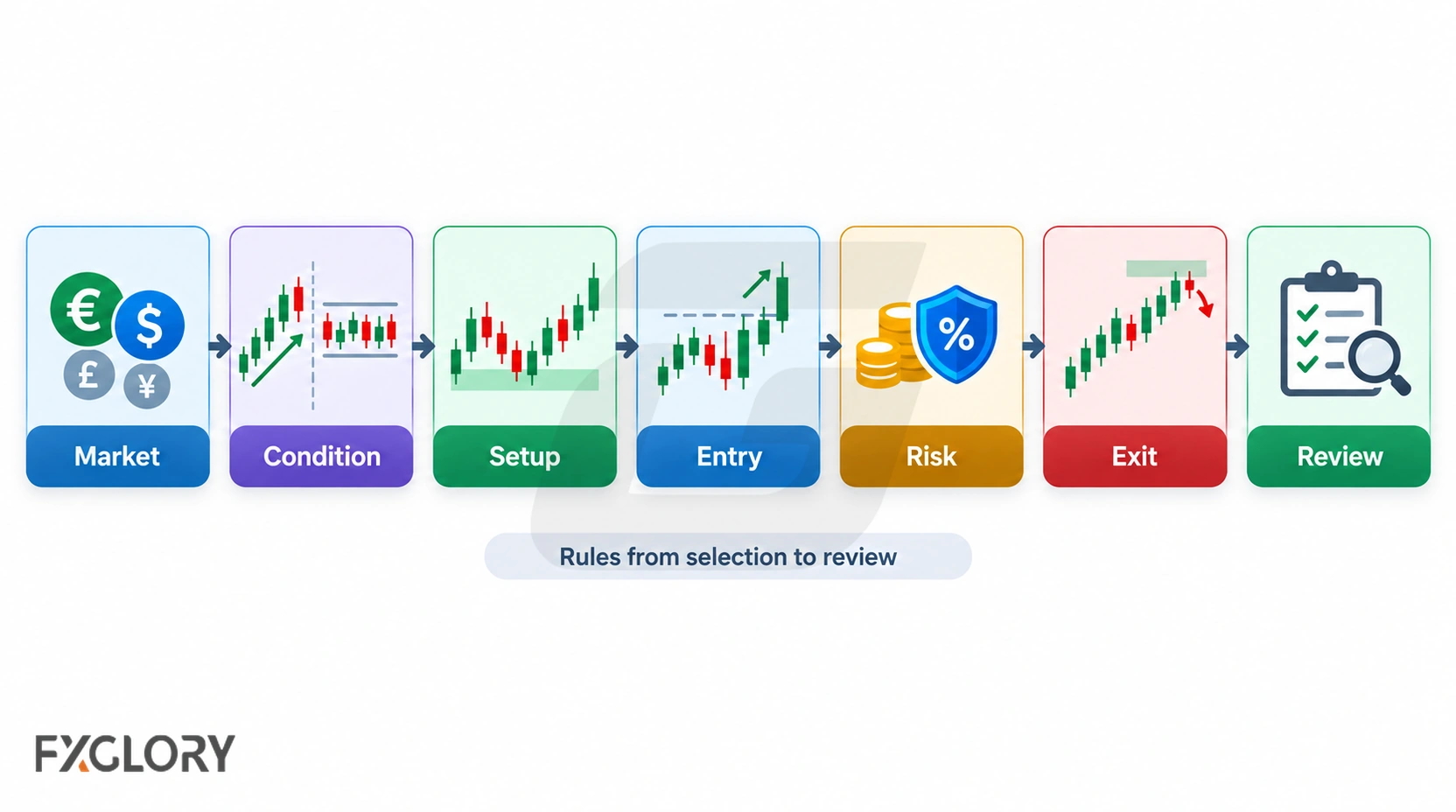
A written macro thesis makes the reasoning testable: it states the main driver, why the selected pair expresses it, what evidence supports the view, and what conditions would invalidate it.
| Step | Question | Example Of A Useful Answer |
|---|---|---|
| 1. Macro theme | What is the main economic pressure? | Rate divergence, inflation surprise, central-bank shift, fiscal stress, or safe-haven demand. |
| 2. Pair selection | Which pair best expresses the view? | A liquid pair where one currency has a clearer macro advantage than the other. |
| 3. Evidence | What data, policy, or market signal supports the thesis? | Central-bank guidance, yield movement, inflation trend, PMI, commodity move, or risk sentiment. |
| 4. Timing | Is the trade before, during, or after a key event? | Entry is planned around event risk, spread conditions, and price confirmation. |
| 5. Invalidation | What proves the thesis is wrong? | Central-bank reversal, data surprise, broken price structure, or cross-market contradiction. |
| 6. Risk | How much can be lost if wrong? | Risk per trade, stop logic, margin, slippage, and gap risk are defined. |
| 7. Exposure | Is the same risk repeated elsewhere? | Check total USD, JPY, commodity, gold, or risk-on/risk-off exposure. |
| 8. Review | How will the trade be judged after closing? | Review thesis quality, execution, risk control, and emotional discipline. |
Turn this into a written rule set with a trading plan that defines thesis and invalidation, then track the result with a journal that records the macro idea, not only profit or loss.
Currency Strategy Examples Without Trade Signals
The examples below explain macro themes. They are not trade recommendations, signals, or instructions to buy or sell any currency pair.
| Macro Theme | How It May Affect Forex | Main Risk |
|---|---|---|
| Interest-rate divergence | A currency may gain support if its central bank is expected to stay tighter than another. | The market may already price it in, or the central bank may shift tone. |
| Policy divergence | One central bank signals tightening while another signals easing. | Forward guidance can change quickly. |
| Safe-haven demand | During stress, some currencies may benefit from risk-off flows. | Risk sentiment can reverse sharply. |
| Commodity-currency exposure | Commodity exporters may be affected by oil, metals, or agricultural prices. | The currency may react more to rates or risk sentiment than commodities. |
| Carry-trade theme | Traders may favor higher-yielding currencies when volatility is low; detailed swap and rollover mechanics belong in a dedicated carry-trade plan. | Carry trades can unwind quickly during market stress, and positive carry can be outweighed by price movement, spread, swap changes, leverage, or margin pressure. |
| Currency-peg pressure | A defended currency level may face pressure if policy costs rise. | Central-bank intervention can be powerful and unpredictable. |
| Fiscal stress | Debt, deficits, or political conflict may pressure confidence. | Markets may ignore the issue longer than expected. |
For the detailed rollover, swap, funding-currency, target-currency, and positive/negative carry mechanics, use the carry trade forex guide instead of treating carry as a small subsection of global macro.
Cross-Market Signals Macro Traders Watch
Global macro traders compare currencies with bonds, yields, equities, commodities, volatility, and credit conditions to test whether the wider market confirms or contradicts the FX thesis.
| Market Signal | Why It Matters For Forex | Possible Warning |
|---|---|---|
| Bond yields | Yields can reflect rate expectations, inflation, and capital flows. | Rising yields can support or hurt a currency depending on why they rise. |
| Yield curves | Curve shape can reflect growth and policy expectations. | A curve move may signal recession risk, not simple currency strength. |
| Equities | Risk appetite can influence higher-beta and safe-haven currencies. | Equity strength may not support every risk-sensitive currency equally. |
| Commodities | Oil, gold, and metals can affect commodity-linked currencies and inflation views. | Commodity sensitivity changes over time. |
| Volatility | Rising volatility can change carry-trade and risk-sentiment behavior. | High volatility can increase spread and slippage risk. |
| Credit stress | Credit concerns can change risk appetite and safe-haven flows. | FX reactions can be fast and disorderly. |
Risk Management For Macro Forex Trades
A coherent macro story can encourage overconfidence, so risk limits must remain independent of conviction. Even a well-supported view can be early, crowded, invalidated by new information, or disrupted by a policy surprise.
- Leverage risk: A strong macro view can tempt traders into oversized positions.
- Spread and slippage risk: Data releases and central-bank events can widen costs and worsen fills.
- Gap risk: Weekends, elections, geopolitical events, and surprise announcements can move price beyond expected levels.
- Swap risk: Holding positions can create rollover costs depending on pair, direction, and conditions.
- Correlation risk: Several trades may secretly express the same USD, JPY, gold, oil, or risk-sentiment exposure.
- Policy surprise risk: Central banks can change tone, intervene, or intentionally surprise markets.
- Data revision risk: Jobs, GDP, inflation, and other macro reports can be revised, changing the evidence behind the thesis.
- Thesis attachment: Traders may defend the story after the market invalidates it.
Use risk rules before a macro view becomes a position, check margin requirements before holding larger exposure, and review leverage conditions before trading macro events.
When Not To Use A Global Macro Forex Strategy
Skip the trade when the thesis cannot be expressed with clear relative reasoning, defined invalidation, and manageable event or exposure risk.
| Do Not Trade When | Why It Is A Problem |
|---|---|
| You cannot explain both currencies in the pair. | Forex is relative; one-sided analysis is incomplete. |
| The thesis is only one headline. | A headline reaction is not a macro framework. |
| The event risk is too close. | Spread, slippage, and whipsaw risk can increase around data and central-bank events. |
| You are using high leverage because the idea feels obvious. | Obvious ideas can already be priced in or crowded. |
| Your account cannot tolerate overnight volatility. | Macro trades may move during inactive hours, weekends, or unexpected news. |
| The same exposure is repeated across trades. | Multiple positions can behave like one oversized position. |
| There is no invalidation point. | Without invalidation, a thesis can become an excuse to hold a bad trade. |
Can Retail Traders Use Global Macro Trading?
Retail traders can use global macro analysis by keeping the process narrow: identify the dominant relative driver, choose a pair that expresses it clearly, define event and cross-market checks, and keep total exposure simple enough to monitor.
| Institutional Macro Trader | Retail Forex Trader |
|---|---|
| May trade currencies, rates, bonds, commodities, indexes, forwards, futures, swaps, and options. | Usually expresses the idea through a forex pair available on a trading platform. |
| May use large research teams and multi-asset models. | Uses public data, economic calendars, charts, broker conditions, and personal review. |
| May hold complex portfolios and hedge exposures. | Must keep exposure simple enough to monitor and control. |
| May tolerate institutional drawdown and liquidity conditions. | Must protect personal capital and avoid money needed for essential expenses. |
For this distinction, read why hedge-fund macro trading is not retail trading.
How This Connects To George Soros
George Soros is a well-known global macro case study because his currency trades focused on policy pressure, market expectations, and reflexive feedback loops. His Black Wednesday trade illustrates how a macro thesis can connect policy constraints with market pricing. For the detailed case study, read Soros as a global macro example.
Sources And Trust Notes
The article draws on institutional, academic, educational, and regulatory material to frame global macro as a top-down, cross-asset approach and to distinguish discretionary, systematic, and managed-futures contexts. These sources inform the definitions and risk framing; they do not provide trade recommendations for this page.
FXGlory's Risk Disclosure explains trading, leverage, order-execution, stop-loss, one-click trading, platform, and other risks that matter before trading around macro events.
This page does not provide global macro signals, trade recommendations, account management, copy-trading instructions, legal advice, tax advice, or any guarantee of trading results.