Megaphone Pattern Forex: Broadening Formation Guide

Learn how the megaphone pattern forms in forex, why widening highs and lows matter, how diverging boundaries reflect volatility expansion, and how breakouts, return-inside moves, timeframe, news, spread, slippage, tick activity, and risk control affect the pattern.
 
Written byHenry Green
Published
Last updated

Key Takeaways

  • A megaphone pattern in forex is a broadening formation where price swings widen between diverging upper and lower boundaries.
  • The structure usually shows higher highs and lower lows, which means the market is expanding rather than compressing.
  • A megaphone pattern does not confirm direction by itself. Price can break higher, break lower, return inside the pattern, or keep widening.
  • Boundary quality matters. One high and one low are not enough; the structure becomes clearer after repeated reactions on both widening sides.
  • False breakouts, return-inside moves, noisy swings, news volatility, spread, slippage, timeframe conflict, scanner misreads, and poor risk control can make megaphone patterns fail.
Risk note: Forex trading involves risk of loss. A megaphone pattern can help organize widening price swings and possible breakout scenarios, but it does not guarantee direction, follow-through, reversal, continuation, or a target.

What Is a Megaphone Pattern in Forex?

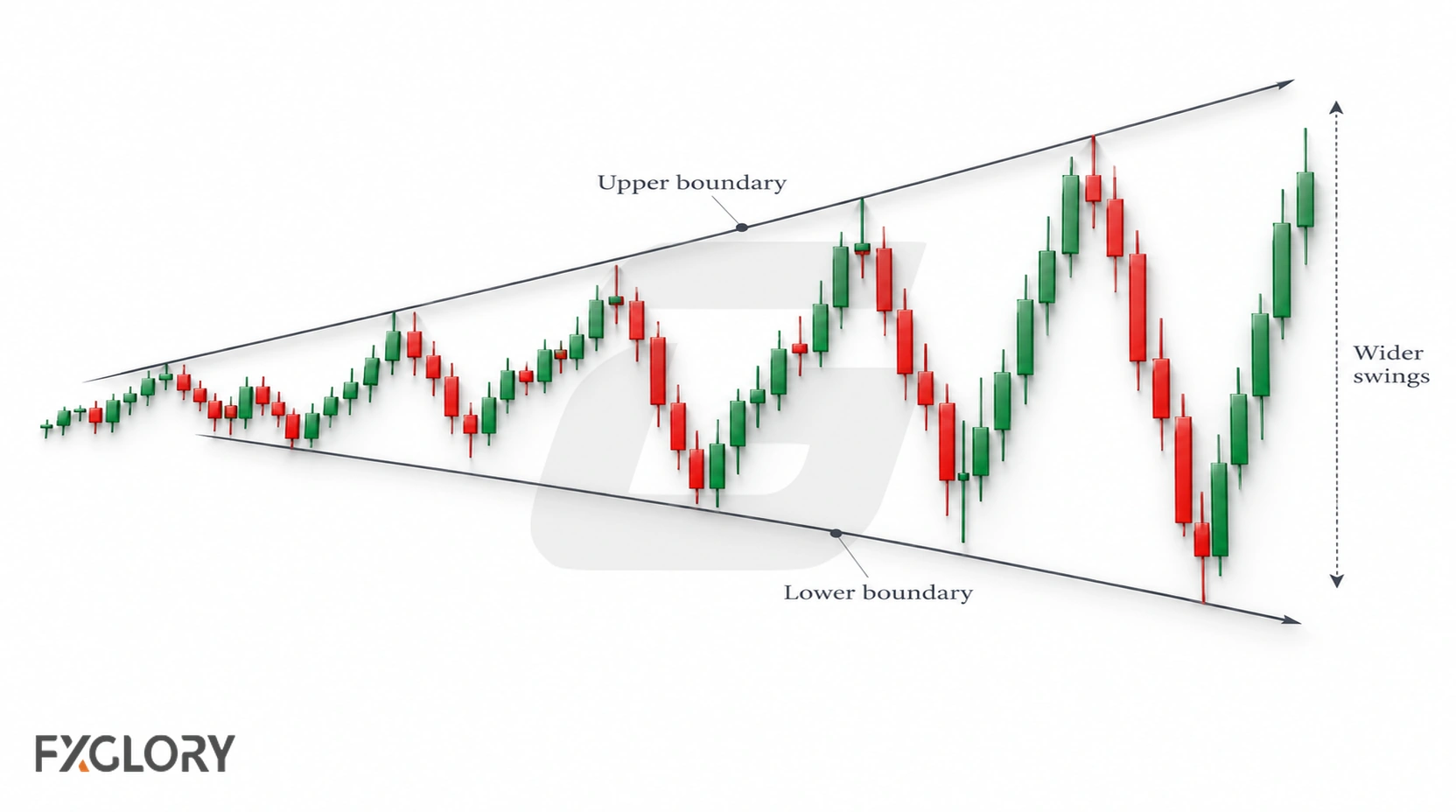
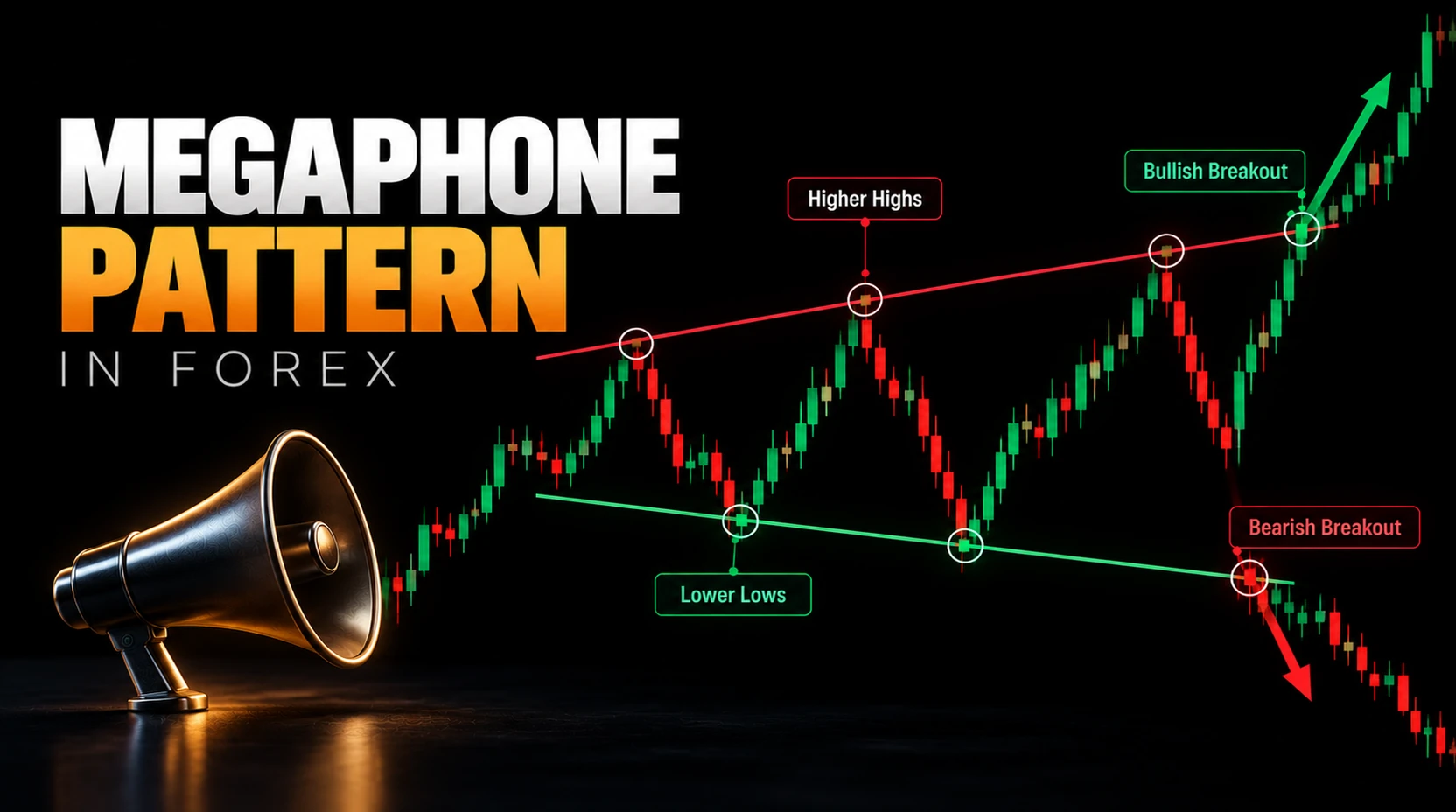
A megaphone pattern in forex is a broadening chart formation where price swings widen over time between two diverging boundaries. The upper boundary usually connects rising swing highs, while the lower boundary connects falling swing lows.

The structure is called a megaphone because it expands from left to right. It may also be called a broadening formation, broadening wedge, expanding triangle, or inverted symmetrical triangle, depending on the source and exact shape. When this page uses expanding triangle, it means a widening structure, not the narrowing triangle patterns covered separately.

The important idea is expansion. Price is not compressing into a narrower range; it is making wider moves. This can reflect disagreement between buyers and sellers, unstable volatility, or a market reacting strongly around new information.

For the broader pattern map, review the full chart-pattern framework.

Plain-English idea: A megaphone pattern shows price swings getting wider. The useful question is not only where the boundaries are, but whether price can leave the widening structure and stay outside it.

How Megaphone Patterns Form

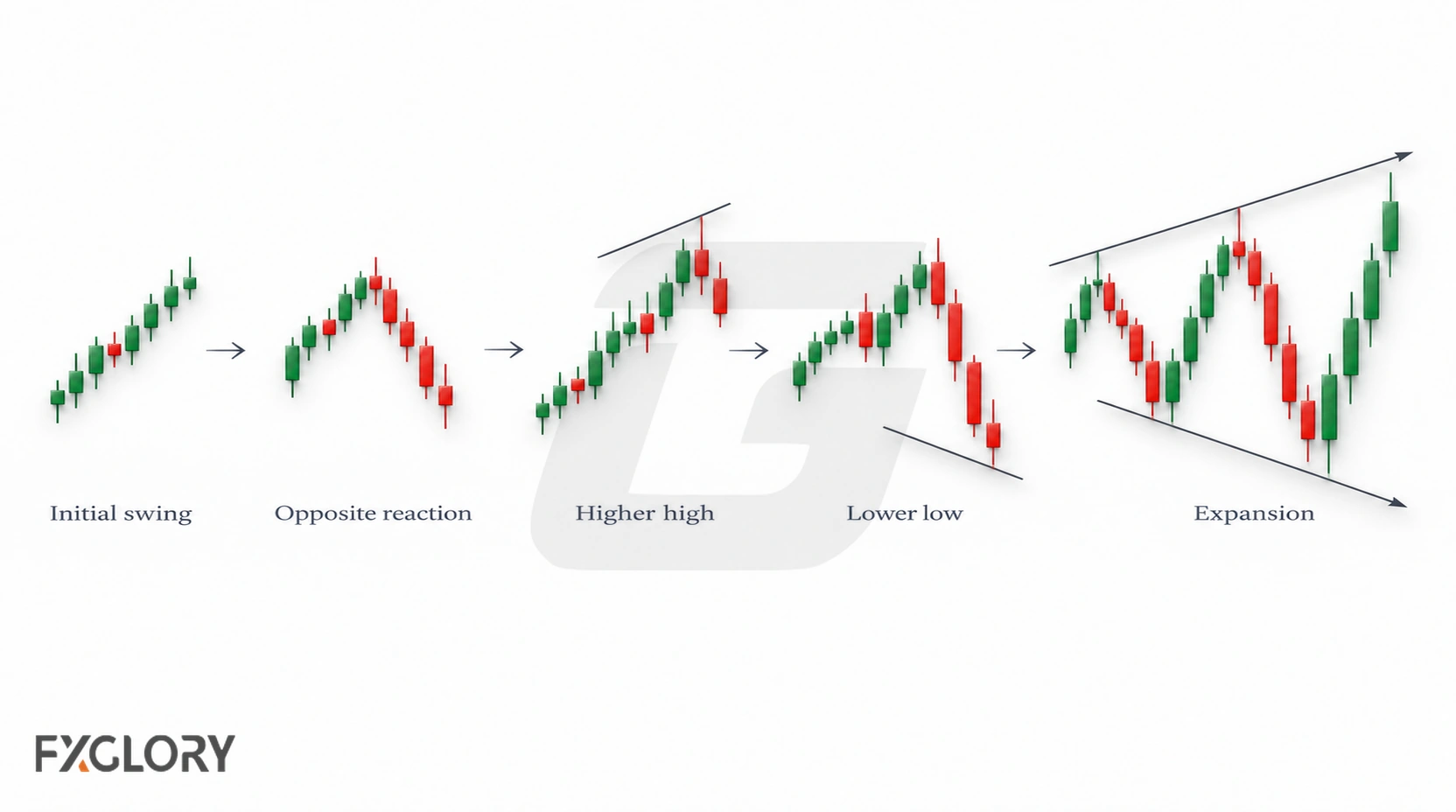
A megaphone pattern forms when each new swing reaches farther than the previous one. Price may create higher highs on the upper side and lower lows on the lower side, causing the structure to widen.

This can happen when market participants disagree about value, when volatility expands, when news changes expectations, or when price repeatedly overshoots both sides of a developing range.

  • First swing: Price creates an early high or low that begins the structure.
  • Opposite swing: Price reacts strongly in the other direction.
  • Higher high: The next upper swing moves beyond the earlier high.
  • Lower low: The next lower swing moves beyond the earlier low.
  • Diverging boundaries: The upper and lower trendlines spread apart.
  • Break or return: Price tests whether it can leave the formation or continue widening inside it.

A megaphone becomes easier to read when the widening boundaries, repeated reactions, breakout area, and invalidation point are visible without forcing the chart.

Megaphone Pattern Anatomy

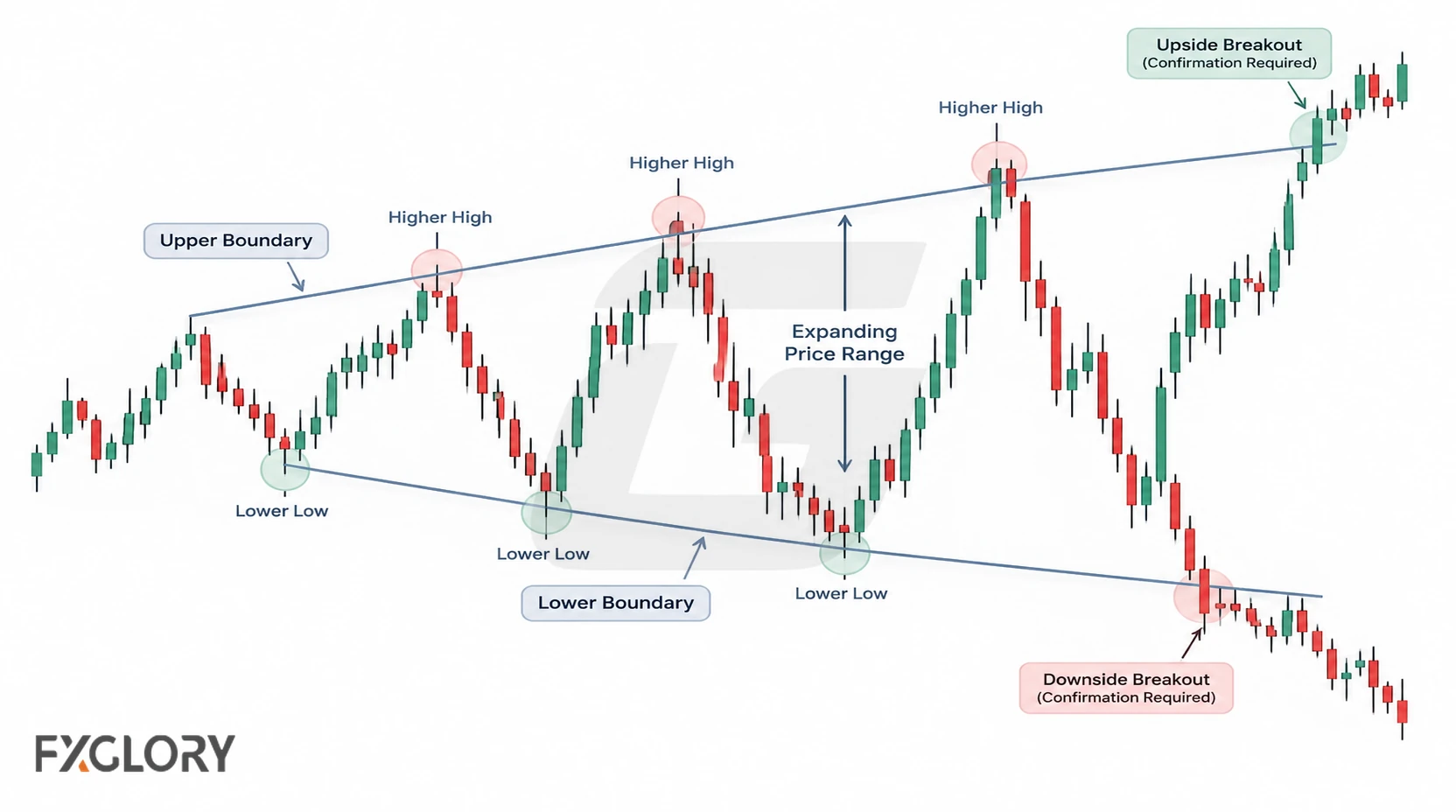
A forex megaphone pattern is built around diverging boundaries and expanding swings.

PartWhat It MeansWhy It Matters
Upper boundaryA rising line or zone connecting wider swing highsShows where upward extensions are being tested
Lower boundaryA falling line or zone connecting wider swing lowsShows where downward extensions are being tested
Higher highsEach upper swing reaches beyond a prior highShows expansion on the upside
Lower lowsEach lower swing reaches beyond a prior lowShows expansion on the downside
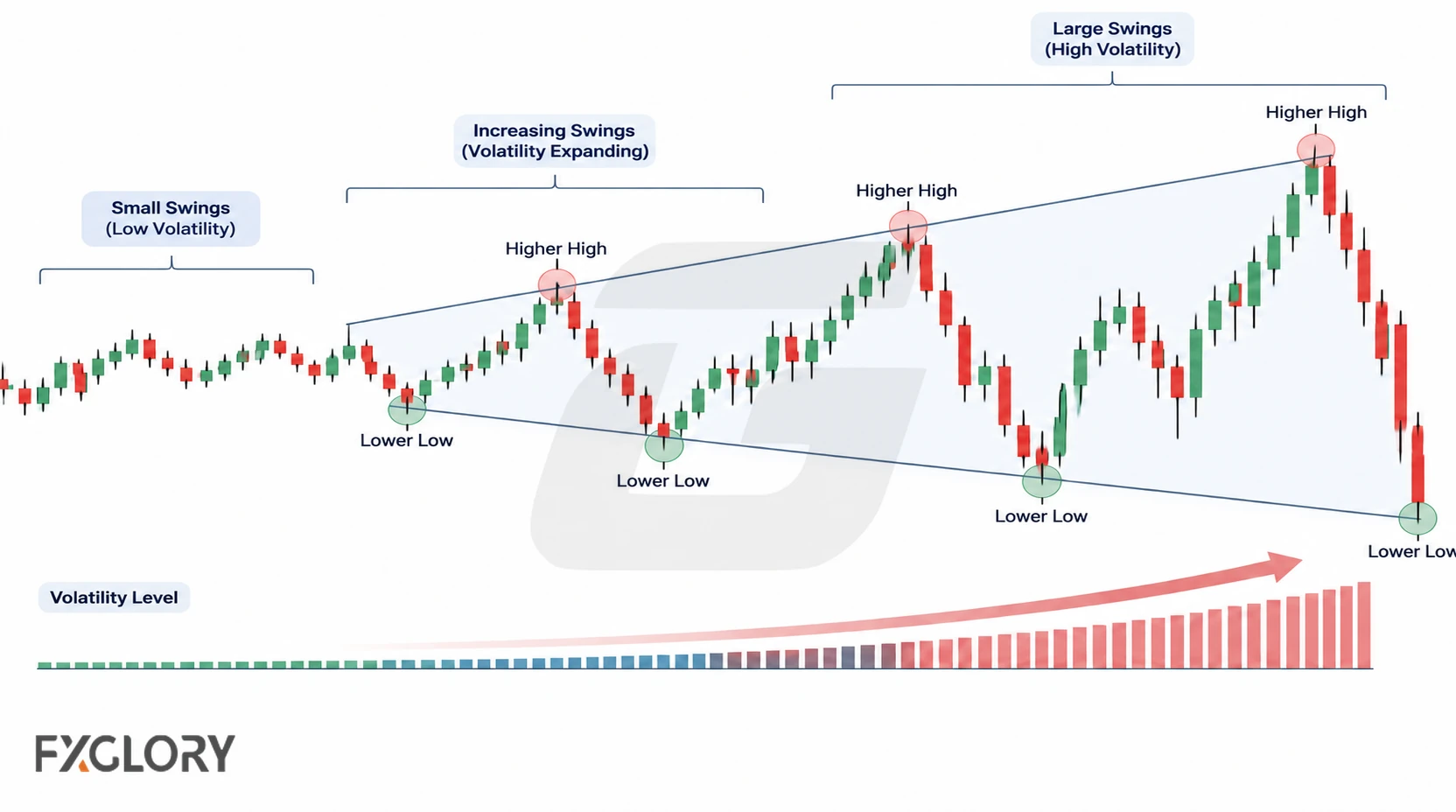
Widening bodyThe space between both boundaries grows over timeShows volatility expansion rather than compression
Boundary touchesRepeated reactions near the widening sidesHelp separate a real candidate from random noise
Breakout areaThe zone where price tries to leave the formationShows whether the scenario develops, fails, or returns inside
InvalidationThe condition that makes the megaphone idea wrongStops the pattern from becoming an open-ended directional assumption
Structure rule: A megaphone pattern needs widening boundaries. If the lines converge, the structure is closer to a triangle or normal wedge.

Volatility Expansion: Why the Pattern Feels Unstable

The megaphone pattern is different from compression patterns because each swing can become larger than the last. This often makes the chart feel unstable. Price may overshoot resistance, reverse sharply, break support, reverse again, and keep widening.

That widening movement can make the pattern difficult to use without a clear process. A boundary break may look important, but a fast return inside the formation can weaken the breakout idea.

Market BehaviorWhat It SuggestsCareful Reading
Higher highs and lower lowsBoth sides are extending fartherDirection is not confirmed by expansion alone
Larger candles or wider swingsVolatility may be increasingRisk can expand around entries, stops, and retests
Fast reversals near boundariesBoth buyers and sellers are reacting stronglyFalse breaks and whipsaws may become more common
News-driven movementNew information may be widening the rangeThe pattern can break or distort quickly
Expansion shortcut: Triangle patterns usually compress. Megaphone patterns expand. That expansion is the main feature.

Megaphone Pattern Map

Use the quick map below to separate a megaphone candidate from a random volatile range.

StageVisual CueWhat It MeansRisk Check
1. Initial swingPrice creates an early high or lowThe structure begins formingOne swing is not a pattern
2. Opposite reactionPrice reverses strongly in the other directionThe first range begins to appearThe structure is still early
3. Wider highPrice reaches beyond a previous upper swingThe upper side starts expandingA single overshoot can still be noise
4. Wider lowPrice reaches beyond a previous lower swingThe lower side starts expandingCheck whether boundaries are truly diverging
5. Repeated boundary reactionsPrice reacts around both widening sidesThe megaphone candidate becomes clearerToo much random movement weakens clarity
6. Break or returnPrice leaves, retests, holds, or returns insideThe scenario develops or failsA return inside can weaken the breakout idea
Visual shortcut: Wider high → wider low → diverging boundaries → boundary test → hold, retest, or return inside.

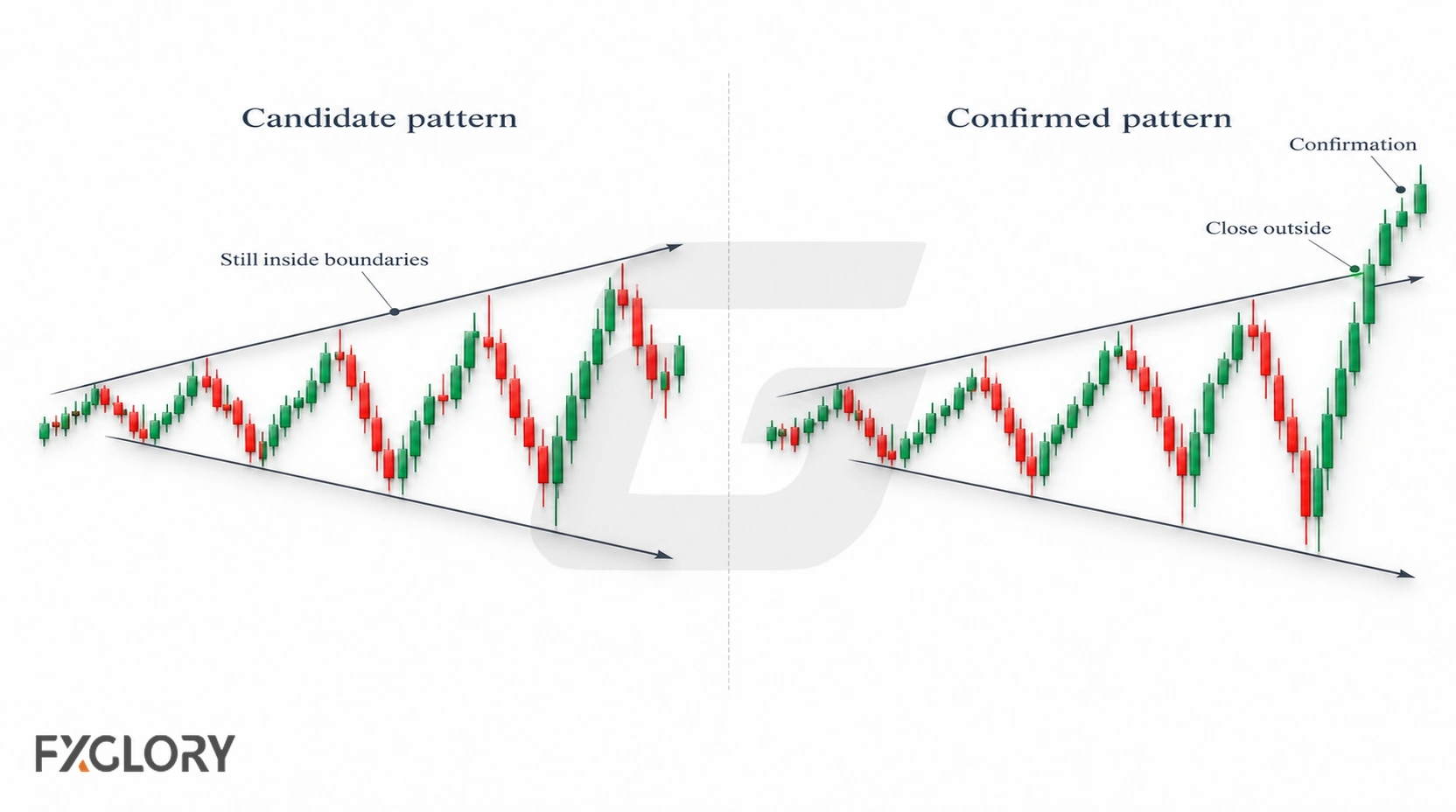
Megaphone Candidate vs Confirmed Pattern

A megaphone candidate appears when price begins widening between diverging boundaries. A more developed scenario appears only when price shows meaningful behavior around one of those boundaries.

StageWhat Is VisibleCareful Reading
Early movementPrice swings strongly in both directionsThis may be random volatility, not a pattern
Candidate megaphonePrice forms widening highs and lowsThe structure still needs boundary quality
Developed scenarioPrice breaks beyond a boundary and tries to holdThe break still needs follow-through, retest, or hold behavior
Failed scenarioPrice returns inside after the break or loses clear boundariesThe megaphone reading weakens or becomes invalid
Completion rule: Do not treat widening swings as confirmation by themselves. Boundary behavior decides whether the scenario develops.

Boundary Quality and Touch Count

Boundary quality matters because megaphone patterns are easy to force around noisy price action. One high and one low are not enough. The structure becomes clearer after price reacts several times around both widening sides.

Some traders look for at least five meaningful swings or touches before treating the formation as more developed. This should be used as a quality guideline, not a guarantee. Five weak touches are not better than three clear reactions. The more important question is whether the boundaries are visible without constantly redrawing them.

Boundary FactorCleaner MegaphoneWeaker Megaphone
Upper boundarySeveral highs react near a rising outer line or zoneThe upper side must be redrawn after every swing
Lower boundarySeveral lows react near a falling outer line or zoneThe lower side has no clear relationship to prior lows
ExpansionSwings widen in a recognizable wayMovement is random and does not form a usable structure
Touch countMultiple meaningful reactions appear on both sidesThe pattern is based on only one or two points
Pattern fillPrice moves through the formation with visible structureThe formation is mostly empty or built from isolated spikes
Boundary rule: If the megaphone only appears after redrawing both sides many times, the structure may not be clear enough.

Megaphone Top and Megaphone Bottom

Megaphone patterns may appear near market tops, near market bottoms, or inside broader trend movement. The label should not decide direction by itself.

ContextWhat It Looks LikeCareful Reading
Megaphone topWidening swings appear after a strong upward moveThe structure may show instability, but reversal still needs confirmation
Megaphone bottomWidening swings appear after a strong downward moveThe structure may show unstable basing, but recovery still needs confirmation
Broadening bottomExpansion appears near a lower area after a declineThe structure can still fail if price cannot break and hold beyond resistance
Continuation contextPrice breaks in the direction of the prior moveThe breakout still needs hold, retest, and invalidation logic
Reversal contextPrice breaks against the prior moveThe broader trend and nearby levels still matter
Neutral contextPrice keeps widening without a clear exitThe market may remain unstable or unresolved

When the pattern breaks with the prior move, continuation-pattern context may help organize the scenario. When it breaks against the prior move, reversal-pattern context may be more relevant.

Direction rule: A megaphone can appear before continuation, reversal, or further range expansion. The boundary break and follow-through matter more than the label.

Ascending and Descending Broadening Wedges

Broadening wedge forex structures are megaphone-style patterns with sloped diverging boundaries. They may tilt upward, downward, or expand more sideways.

VariantWhat It Looks LikeCareful Reading
Sideways megaphoneUpper boundary rises and lower boundary fallsClassic widening structure with unclear direction until boundary behavior develops
Ascending broadening wedgeBoth boundaries slope upward while spreading apartPrice is rising but swings are expanding, so instability can increase
Descending broadening wedgeBoth boundaries slope downward while spreading apartPrice is falling but swings are expanding, so sharp reversals or failures can occur
Irregular broadening patternThe formation widens but does not fit a clean variantThe pattern may be too noisy or may require broader context

This page treats broadening wedges as part of the megaphone family because the shared feature is widening movement. For narrowing wedge structures, review the angled compression guide.

Variant rule: Broadening wedge does not mean normal wedge. A normal wedge narrows; a broadening wedge expands.

Megaphone vs Triangle, Wedge, Channel, and Rectangle

Megaphones are often confused with other boundary-based patterns. The main difference is that megaphones expand, while many other structures compress, stay parallel, or stay horizontal.

StructureMain Boundary ShapeCareful Reading
MegaphoneDiverging boundaries with wider highs and lowsVolatility expansion is the defining feature
TriangleConverging boundaries or flat-plus-sloping compressionIf price is narrowing, triangle context may fit better
Normal wedgeConverging sloped boundariesIf the pattern narrows rather than widens, it is not a megaphone
ChannelParallel sloped boundariesIf swings stay inside parallel lines, channel behavior may fit better
RectangleHorizontal support and resistanceIf the range stays flat and horizontal, rectangle behavior may fit better

If boundaries converge, narrowing triangle compression may be closer. If sloped boundaries converge, normal wedge compression may fit better. If price rotates between horizontal levels, horizontal range behavior may be more relevant.

Pattern-choice rule: Megaphone means expansion. If the structure is narrowing, parallel, or flat, another pattern may be a better fit.

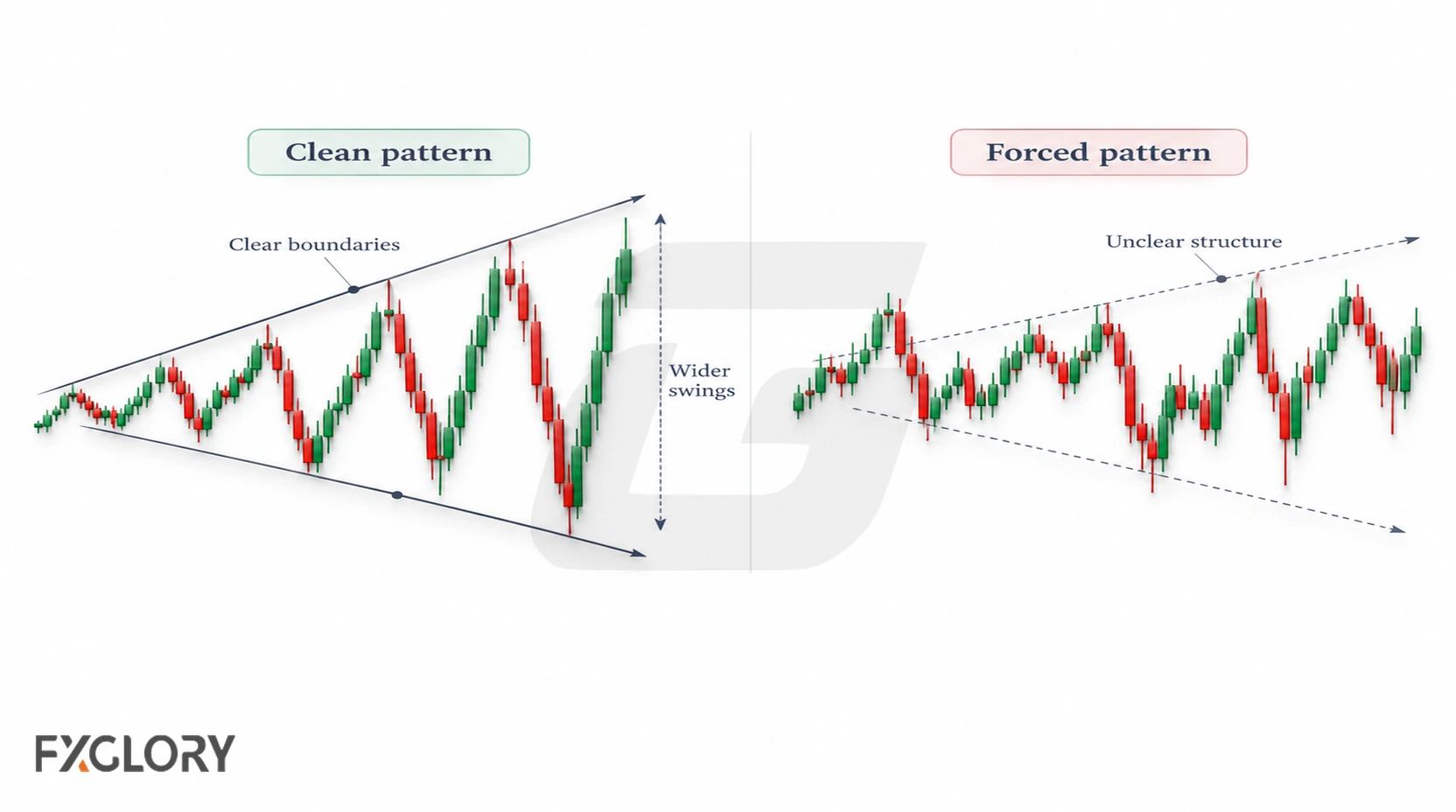
Clean vs Forced Megaphone Patterns

A clean megaphone has widening swings, visible diverging boundaries, repeated reactions on both sides, and a clear point where the idea becomes wrong. A forced megaphone depends on drawing outer lines around random volatility.

A few event-driven spikes do not automatically create a clean megaphone. The structure still needs repeated boundary behavior, visible expansion, and a clear invalidation point.

Chart FactorCleaner MegaphoneForced Megaphone
ExpansionSwings widen in a visible sequencePrice is volatile but not structurally widening
Upper boundaryHigher highs connect into a usable outer zoneOnly one extreme wick defines the upper side
Lower boundaryLower lows connect into a usable outer zoneOnly one extreme wick defines the lower side
Touch qualityBoth boundaries have repeated reactionsThe pattern depends on isolated spikes
Breakout behaviorPrice leaves the formation with clear hold, retest, or failure behaviorEvery overshoot is treated as a confirmed breakout
Risk planInvalidation and position risk are defined before actingThe trader focuses on direction but not the wrong point
Clean-pattern rule: Volatility alone is not a megaphone. The swings need to widen in a recognizable structure.

How to Confirm a Megaphone Pattern in Forex

Confirmation helps separate a visible megaphone candidate from a more developed breakout or reversal scenario. It does not prove that price will continue after leaving the formation, but it gives more information than the widening shape alone.

  1. Check expansion: Are the swings widening rather than narrowing?
  2. Mark the upper boundary: Can higher highs be connected without forcing the line?
  3. Mark the lower boundary: Can lower lows be connected without forcing the line?
  4. Check repeated reactions: Has price reacted around both widening sides more than once?
  5. Watch the boundary test: Does price break beyond the upper or lower boundary?
  6. Check the close or hold: Does price stay outside or quickly return inside?
  7. Watch the retest: If price returns to the broken boundary, does the area still matter?
  8. Check the distance from the boundary: If price has already moved far away, invalidation and risk may become harder to define.
  9. Use supporting context: Momentum, volatility, candles, and broader trend context may support or weaken the scenario.
  10. Define invalidation: Decide what price behavior cancels the megaphone idea.

Confirmation can include a close outside the boundary, a retest reaction, a structure shift, or price holding beyond the broken side. None of these removes risk.

Confirmation limit: A boundary break can still become a false breakout. Confirmation reduces guesswork; it does not remove risk.

Return-Inside and False Breakout Risk

A return-inside move happens when price breaks beyond one side of the megaphone and then moves back into the formation. This matters because megaphone patterns often form during unstable market conditions, where boundary overshoots can be common.

False SignalWhat It Looks LikeCareful Reading
Single wick outsidePrice pierces the boundary and returns inside quicklyThe boundary may still be active
Break without holdPrice closes or moves outside but cannot stay thereThe breakout may lack follow-through
Retest failurePrice retests the broken boundary and returns into the patternThe breakout idea weakens
Opposite-side sweepPrice breaks one side, then swings toward the other sideThe formation may still be expanding rather than resolving
Late breakout chasePrice has already moved far from the boundary before the scenario is reviewedRisk and invalidation may be difficult to define clearly
News spikeA fast event-driven move breaks the pattern suddenlyWait for structure to rebuild before judging the pattern
Return-inside warning: A move outside the megaphone is not enough by itself. What price does after leaving the boundary matters.

Invalidation: When the Megaphone Idea Fails

Invalidation is the condition that shows the megaphone idea is no longer useful. It should be defined before focusing on any possible breakout, reversal, continuation, or measured-move scenario.

  • No clear expansion: Price is volatile but does not create recognizable widening swings.
  • Boundary failure: The upper or lower side must be redrawn repeatedly until it loses meaning.
  • False breakout: Price breaks outside the formation, then returns inside and holds there.
  • Opposite-side break: The expected direction fails and price breaks the other side instead.
  • Pattern transformation: The structure turns into a rectangle, channel, triangle, or ordinary range.
  • Higher-timeframe conflict: The breakout idea forms directly into stronger support, resistance, or broader trend conflict.
  • News-driven shift: A high-impact event changes volatility and overwhelms the pattern.
  • No clear wrong point: The trader cannot explain where the megaphone idea becomes invalid.
Wrong-point rule: A megaphone pattern is incomplete if the trader can draw widening lines but cannot name the invalidation point.

Megaphone Measuring Principle

Some megaphone methods use the height or width of the formation near the breakout area to estimate a possible move after price leaves the structure. The basic idea is to measure the distance between the boundaries and use that distance as a planning reference beyond the breakout area.

This can help organize a scenario, but it should not be treated as a target guarantee. Price may move only part of the way, retest the boundary, return inside the formation, keep widening, reverse, or fail immediately.

StepWhat It DoesCareful Use
Measure structure widthEstimate the distance between widening boundaries near the breakout areaThe reference depends on clean boundaries
Watch boundary behaviorIdentify whether price breaks and holds outside the formationA break can still fail
Use as referenceProject a possible distance beyond the broken boundaryThe projection is only a scenario, not a promise
Check invalidationDefine where the idea becomes wrongInvalidation should come before target focus
Target caution: The megaphone width is a planning reference, not a forecast. Risk control still matters more than any projected move.

Forex Context: News, Sessions, Spread, Slippage, and Timeframes

Forex megaphone patterns should be read with market conditions because currency pairs trade across global sessions. A broadening pattern that looks clear during quiet movement may behave differently during a session overlap, economic release, or fast volatility shift.

  • News events: Economic releases and central-bank comments can expand swings quickly and distort the pattern.
  • Session behavior: Boundary tests during active sessions may behave differently from moves during thin liquidity.
  • Spread and slippage: Fast movement around widening boundaries, breakouts, retests, or invalidation areas can affect execution and risk.
  • Pair behavior: Different currency pairs may widen, reverse, overshoot, and break from megaphone structures differently.
  • Timeframes: A lower-timeframe megaphone can be noise inside a higher-timeframe trend or range.
  • Volatility shift: Expanding swings can make stop placement, position size, and invalidation harder to manage.

A megaphone pattern becomes more useful when the trader can explain the widening structure, boundary quality, breakout condition, invalidation, and market conditions before considering any trade decision.

Volume and Tick Activity in Forex Megaphones

Many broadening-formation discussions mention volume behavior around boundary tests and breakouts. In spot forex, this needs caution because there is no single centralized exchange volume figure for the entire market.

Some traders use tick activity as a supporting clue around widening swings, boundary tests, breakouts, retests, or return-inside moves. This can add context, but it should not be treated as proof of direction. When volume-style context matters, tick-volume reading in forex should stay secondary to structure, confirmation, and risk.

Volume caution: In forex, tick activity may support the reading, but boundary quality, breakout behavior, confirmation, and invalidation still matter more.

Using Indicators and Candles With Megaphone Patterns

Indicators and candlestick reactions can support megaphone analysis, but they should not replace price structure. The pattern still needs widening swings, diverging boundaries, confirmation behavior, and invalidation.

Tool TypeWhat It Can Help ReadCareful Use
Volatility indicatorsWhether movement is expanding as the pattern developsHigh volatility can make false breaks more common
Momentum indicatorsWhether pressure is shifting near a boundaryMomentum can change before price confirms a breakout
Trend-strength indicatorsWhether the broader market is trending, ranging, or unstableThey may lag during sharp reversals or whipsaws
Candlestick reactionsShort-term rejection or acceptance around widening boundariesOne candle is not the same as megaphone confirmation
Tick activityActivity around boundary tests, breakouts, and return-inside movesIt is supporting context, not centralized market volume

When swing size expands, ATR-based volatility context can help frame conditions. When candle reaction matters near the widening boundaries, candlestick behavior around key areas can add short-term detail. For broader momentum or trend context, indicator-based chart context may help organize the reading.

Megaphone Scanner and Automation Caution

Some traders use scanners or automated tools to identify megaphone or broadening-formation candidates. These tools may help surface possible widening structures, but they should not replace manual validation.

A scanner can misread random volatility as a megaphone, mark a pattern before both boundaries are clear, redraw the outer lines as new swings form, or ignore higher-timeframe support, resistance, news conditions, spread, and slippage. A detected megaphone still needs visible expansion, repeated boundary reactions, confirmation behavior, invalidation, and risk control.

Scanner rule: Treat scanner output as a candidate list, not a trading decision.

Example: Reading a Megaphone Pattern on EUR/USD

Suppose EUR/USD starts making wider swings. The next high moves above the previous high, and the next low moves below the previous low. After several reactions, the upper and lower boundaries begin to diverge.

A trader may first describe the market as a megaphone candidate, without assuming direction. If price breaks above the upper boundary and holds, that creates one scenario to study. If price breaks below the lower boundary and holds, that creates another scenario. If price breaks out and quickly returns inside, the breakout idea may weaken.

The useful questions are simple: Are the boundaries widening? Are there repeated reactions on both sides? Is price holding outside the formation or returning inside? Where is the megaphone idea wrong?

Example note: This is not a trade recommendation or signal. It shows how a megaphone pattern can be organized into possible scenarios before any trading decision.

Common Mistakes With Forex Megaphone Patterns

Megaphone mistakes often happen when traders treat volatility as structure before the widening boundaries are actually clear.

  • Calling it too early: The trader labels the pattern before repeated boundary reactions appear.
  • Forcing the boundaries: Lines are drawn around random spikes to create a megaphone shape.
  • Confusing expansion with compression: A narrowing triangle or wedge is treated as a megaphone.
  • Confusing expanding triangle terminology: The trader mixes widening megaphone-style structures with narrowing triangle patterns.
  • Ignoring event spikes: A few news-driven moves are treated as a clean broadening structure.
  • Ignoring return-inside moves: Price breaks a boundary briefly, then moves back into the formation.
  • Assuming direction too early: The trader chooses bullish or bearish before boundary behavior confirms.
  • Ignoring touch quality: The structure is based on one high and one low instead of meaningful repeated reactions.
  • Counting weak touches as proof: Several weak or forced touches are treated as better than fewer clear reactions.
  • Chasing a late breakout: Price has already moved far from the boundary, making invalidation and risk harder to define.
  • Ignoring news volatility: A widening pattern around economic releases is treated like a calm technical structure.
  • Overtrusting scanners: A detected broadening-formation candidate is treated as a confirmed pattern.
  • Missing higher-timeframe context: A lower-timeframe megaphone forms directly into larger support, resistance, or trend conflict.
  • Overusing volume assumptions: Volume-style clues are treated as if spot forex had one centralized exchange volume figure.
  • No invalidation: The trader knows the expected direction but not the point where the idea is wrong.

Beginner Workflow for the Megaphone Pattern

A clear process helps keep megaphone patterns from becoming simple line drawing around volatile swings.

  1. Check expansion: Decide whether price is widening rather than narrowing.
  2. Mark the upper boundary: Look for higher highs that form a usable outer line or zone.
  3. Mark the lower boundary: Look for lower lows that form a usable outer line or zone.
  4. Check touch quality: Decide whether both sides have meaningful repeated reactions.
  5. Check pattern alternatives: Decide whether the chart looks more like a triangle, normal wedge, channel, rectangle, or ordinary volatility.
  6. Watch the boundary test: Look for a break, close, hold, retest, or return-inside behavior.
  7. Watch for false breakouts: Check whether price moves back into the formation after leaving it.
  8. Watch for event-spike distortion: Decide whether widening movement is structural or only a few news-driven extremes.
  9. Watch for late-breakout risk: If price has already moved far from the boundary, check whether invalidation is still clear.
  10. Define invalidation: Mark where the megaphone idea becomes wrong.
  11. Check forex conditions: Consider news, session, spread, slippage, volatility, and pair behavior.
  12. Review the outcome: Whether the idea works or fails, check if the megaphone structure was actually clear.

This process keeps the focus on expansion, boundary quality, confirmation, invalidation, and risk instead of treating wide swings as an automatic signal.

A Safer Way to Read Megaphone Patterns in Forex

The megaphone pattern helps traders organize a market that is making wider swings between diverging boundaries. It is a volatility-expansion structure, not a direction guarantee.

The strongest megaphone ideas usually have visible widening swings, repeated boundary reactions, a clear breakout or failure area, and a defined invalidation point. If these parts are missing, the pattern may not be ready for a trading decision.

Megaphone-pattern analysis becomes more useful when it is read with context. News, sessions, spread, slippage, volatility, timeframe alignment, pair behavior, position size, and account risk still matter.

Final risk reminder: A forex megaphone pattern is only one part of a trading decision. Widening swings do not guarantee breakout direction, and every scenario needs confirmation, invalidation, and risk control.

Frequently Asked Questions

What is a megaphone pattern in forex?

A megaphone pattern in forex is a broadening chart formation where price swings widen over time between diverging boundaries. The phrase forex megaphone pattern usually refers to this same expanding structure with higher highs and lower lows.

What is a megaphone chart pattern forex traders watch for?

A megaphone chart pattern forex traders watch for usually shows widening price swings, an upper boundary that rises, and a lower boundary that falls. The pattern reflects volatility expansion, not automatic direction.

Is a megaphone pattern bullish or bearish?

A megaphone pattern is not automatically bullish or bearish. Price can break above the upper boundary, break below the lower boundary, return inside the formation, or keep widening. Context, confirmation, and invalidation matter.

What is a broadening formation in forex?

A broadening formation in forex is a structure where price moves between diverging boundaries and creates wider swings over time. The phrase broadening formation forex usually refers to this same megaphone-style expansion pattern.

What is a broadening wedge forex pattern?

A broadening wedge forex pattern is a widening structure with sloped diverging boundaries. It may rise, fall, or expand sideways. Unlike a normal wedge, which narrows, a broadening wedge expands.

How many touches does a megaphone pattern need?

There is no guaranteed number, but one high and one low are not enough. The structure becomes easier to read after repeated reactions on both widening boundaries, often with several meaningful swings across the formation.

What confirms a megaphone pattern?

Confirmation may include a break beyond one boundary, a close outside the formation, a retest, or price holding beyond the broken area. A quick move outside the boundary can still return inside and fail.

What invalidates a megaphone pattern?

A megaphone idea may weaken or fail if the boundaries stop widening clearly, price breaks out and returns inside, the structure becomes random noise, or the trader cannot define where the pattern idea becomes wrong.

What is the difference between a megaphone and a triangle?

A triangle usually has converging boundaries and compression. A megaphone has diverging boundaries and expansion. Triangle patterns narrow; megaphone patterns widen.

Should beginners trade megaphone patterns alone?

Beginners should not treat a megaphone pattern as a complete trade signal. The structure should be studied with boundary quality, volatility, confirmation, invalidation, position size, and risk control.

Related Contents

Forex Chart PatternsReturn to the wider chart-pattern framework for reversal, continuation, neutral, harmonic, compression, and expansion structures.
Forex Chart Patterns Cheat SheetCompare megaphone patterns with other common chart-pattern groups in a compact reference.
Forex Triangle PatternsCompare widening megaphone structures with narrowing triangle compression.
Wedge Pattern ForexCompare broadening wedges with normal wedge structures that narrow into converging boundaries.
Rectangle Pattern ForexCompare widening megaphone ranges with horizontal support-and-resistance rectangles.
Forex Continuation PatternsReview broader continuation context when a broadening formation breaks with the prior move.
Reversal Pattern ForexReview broader reversal context when a broadening formation breaks against the prior move.
Forex Technical IndicatorsUse indicator concepts to think about volatility, momentum, trend strength, and confirmation context.
ATR Indicator ForexUse volatility context when reading expanding swings, breakout distance, and false-break risk.
Forex Tick Volume IndicatorUse tick-activity context carefully when reading boundary tests, breakouts, retests, and return-inside moves.

Practice Reading Megaphone Patterns Before Trading Live

Use an FXGlory demo account to practice identifying widening swing structures, testing breakout and return-inside scenarios, placing demo orders, and reviewing decisions before using real money.

Open a Demo Account