

What Are Forex Continuation Candlestick Patterns?
Forex continuation candlestick patterns are candle formations that may appear during an existing move and suggest that price is pausing before possibly continuing in the same direction.
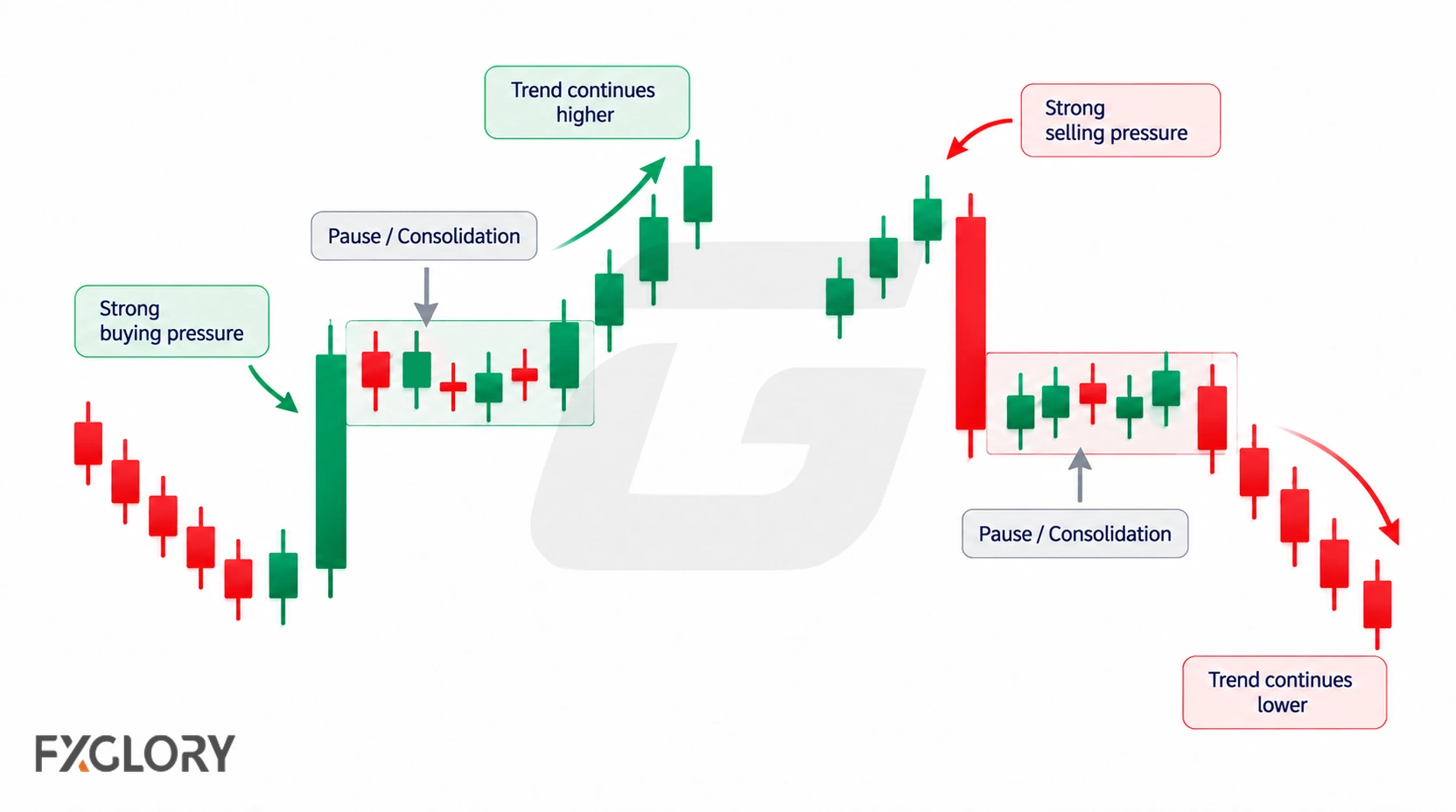
The word “continuation” does not mean the next move is guaranteed. It means the pattern is usually studied inside trend context, after price has already shown direction. A continuation candle without a clear prior move is usually weaker.
This page explains continuation candles as a group. For the broader candlestick framework, review the main forex candlestick patterns guide.
How Continuation Candlestick Patterns Work
Continuation patterns usually show one of three things: a pause inside a trend, controlled pullback against the trend, or renewed pressure in the trend direction.
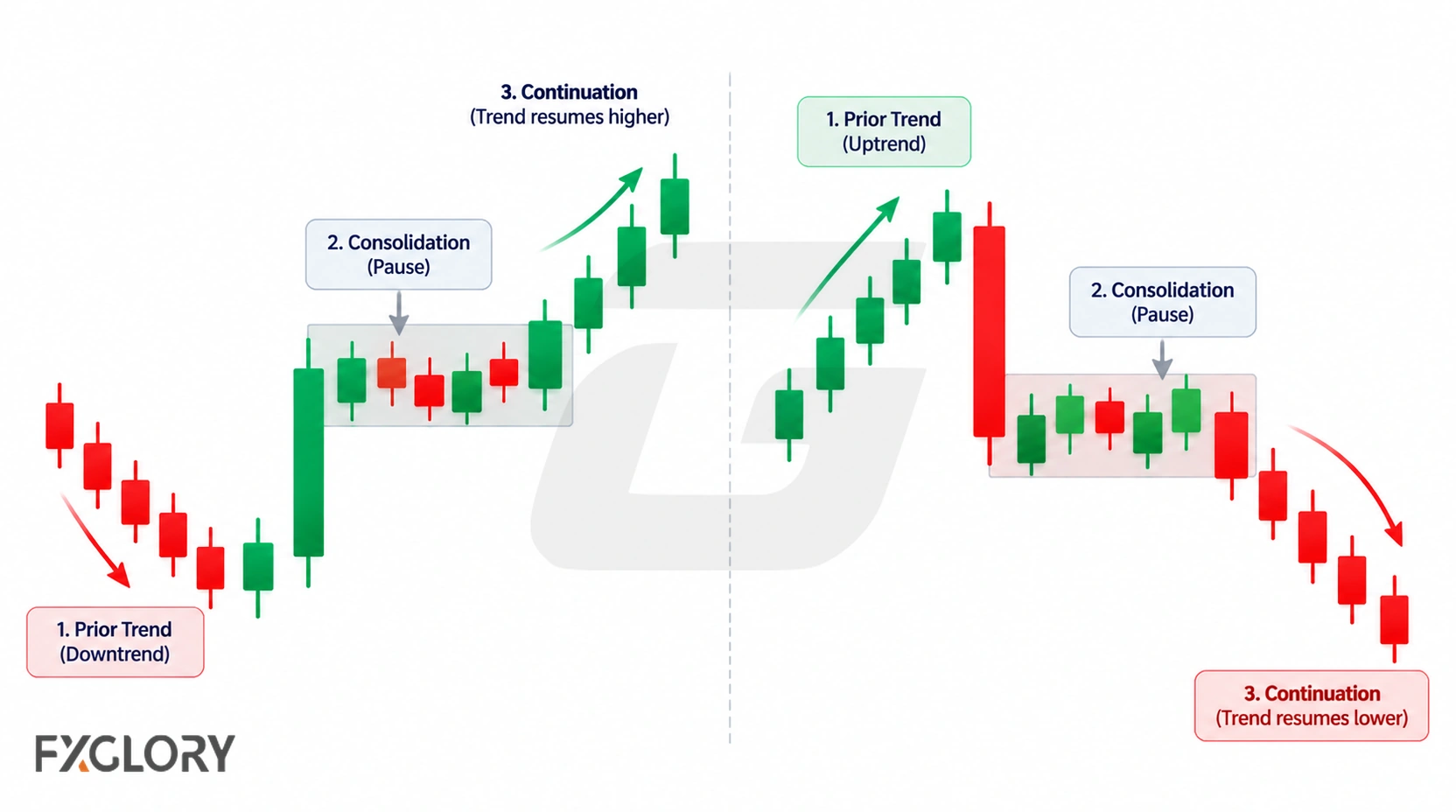
The strongest continuation readings usually begin with a clear prior move. After that, price may compress, pull back, hold a range, or print a strong candle in the trend direction. Traders then watch whether the next candle or breakout confirms continuation or invalidates the idea.
- Prior trend: The pattern is easier to read when price already has direction.
- Pause or pullback: Price may slow down without fully reversing.
- Containment: Smaller candles may stay inside the range of a larger candle or inside the prior trend structure.
- Breakout behavior: Price may need to close beyond the continuation area before the idea becomes clearer.
- Scenario limits: Later price movement can contradict the continuation interpretation even when the original candle structure was valid.
Continuation candles are not automatic entry signals. They are chart structures that need price behavior, location, spread, volatility, and risk context.
Continuation Candles vs Continuation Chart Patterns
Continuation candlestick patterns and continuation chart patterns are related, but they are not the same. A continuation candlestick pattern is built from one candle or a short candle sequence. A continuation chart pattern, such as a flag, pennant, triangle, or rectangle, usually forms across a wider price structure.
This page focuses on candlestick continuation patterns. Traders who want the broader pattern framework can review chart-pattern continuation and reversal context.
Bullish vs Bearish Continuation Candles
Continuation patterns can appear during upward or downward movement.
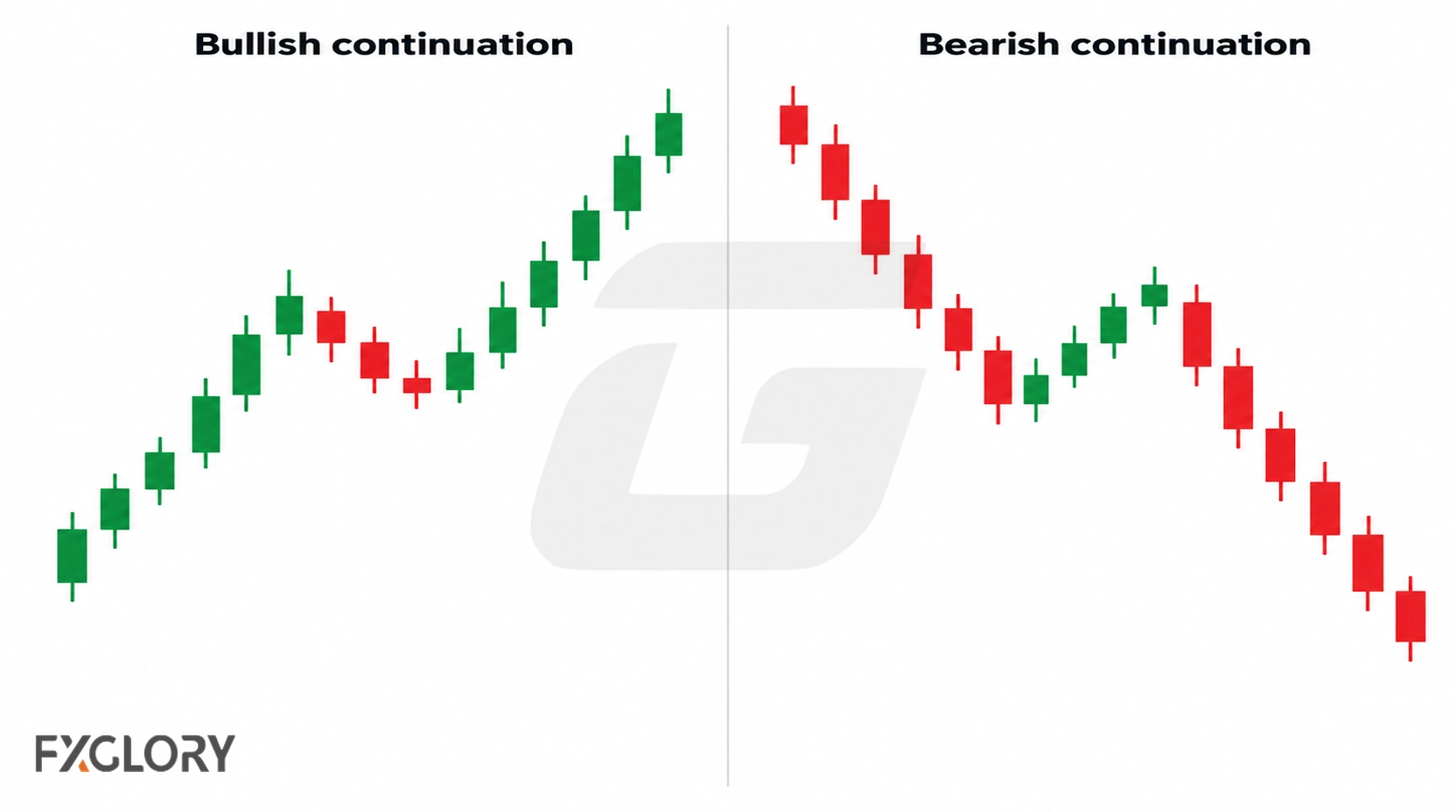
- Bullish continuation candle: Forms during an upward move and may indicate that upward price movement is resuming after a pause or pullback.
- Bearish continuation candle: Forms during a downward move and may indicate that downward price movement is resuming after a pause or pullback.
- Neutral location: If the pattern forms in the middle of a messy range, it may not have clear continuation meaning.
- Failed continuation: If price breaks against the expected direction, the candle may become part of a reversal or range structure instead.
Main Continuation Candlestick Patterns in Forex
Continuation candlestick patterns can be simple or complex. Some use only one or two candles, while others need several candles and more precise structure.
- Rising Three Methods: A bullish continuation pattern where smaller pullback candles form inside the range of a strong bullish move before another bullish candle attempts continuation.
- Falling Three Methods: A bearish continuation pattern where smaller rebound candles form inside the range of a strong bearish move before another bearish candle attempts continuation.
- Inside Bar: A compression candle where the full range sits inside the previous candle’s range. It can support continuation when it breaks with the prior trend.
- Outside Bar: A range-expansion candle that can support continuation if the expansion and close align with the existing move.
- Marubozu: A strong-bodied candle that may support continuation when it appears with trend pressure and follow-through.
- Mat Hold: A multi-candle continuation setup that often appears in textbooks with gaps and a controlled pullback before continuation.
- Tasuki Gap: A gap-based continuation pattern where price attempts to hold the direction of the prior gap.
- Separating Lines: A continuation pattern where candles open near a similar level but close in the trend direction.
- On Neck, In Neck, and Thrusting: Bearish continuation patterns that appear after a downward move and show only limited bullish recovery before sellers may continue pressure.
Some traders also discuss Three White Soldiers as directional pressure and Three Black Crows as directional pressure when they appear with an existing trend. They should be handled carefully because they can also appear near exhaustion or reversal areas depending on location. This page keeps them as supporting context rather than the main continuation-pattern group.
The patterns above should not be treated as equal in every market. Some are easier to see in forex than others because spot forex often has fewer clean gaps than exchange-traded markets.
Rising Three Methods in Forex
The Rising Three Methods pattern is usually studied as a bullish continuation pattern. It begins with a strong bullish candle, followed by smaller candles that pull back or pause without fully damaging the larger bullish structure. A later bullish candle attempts to continue the original move.
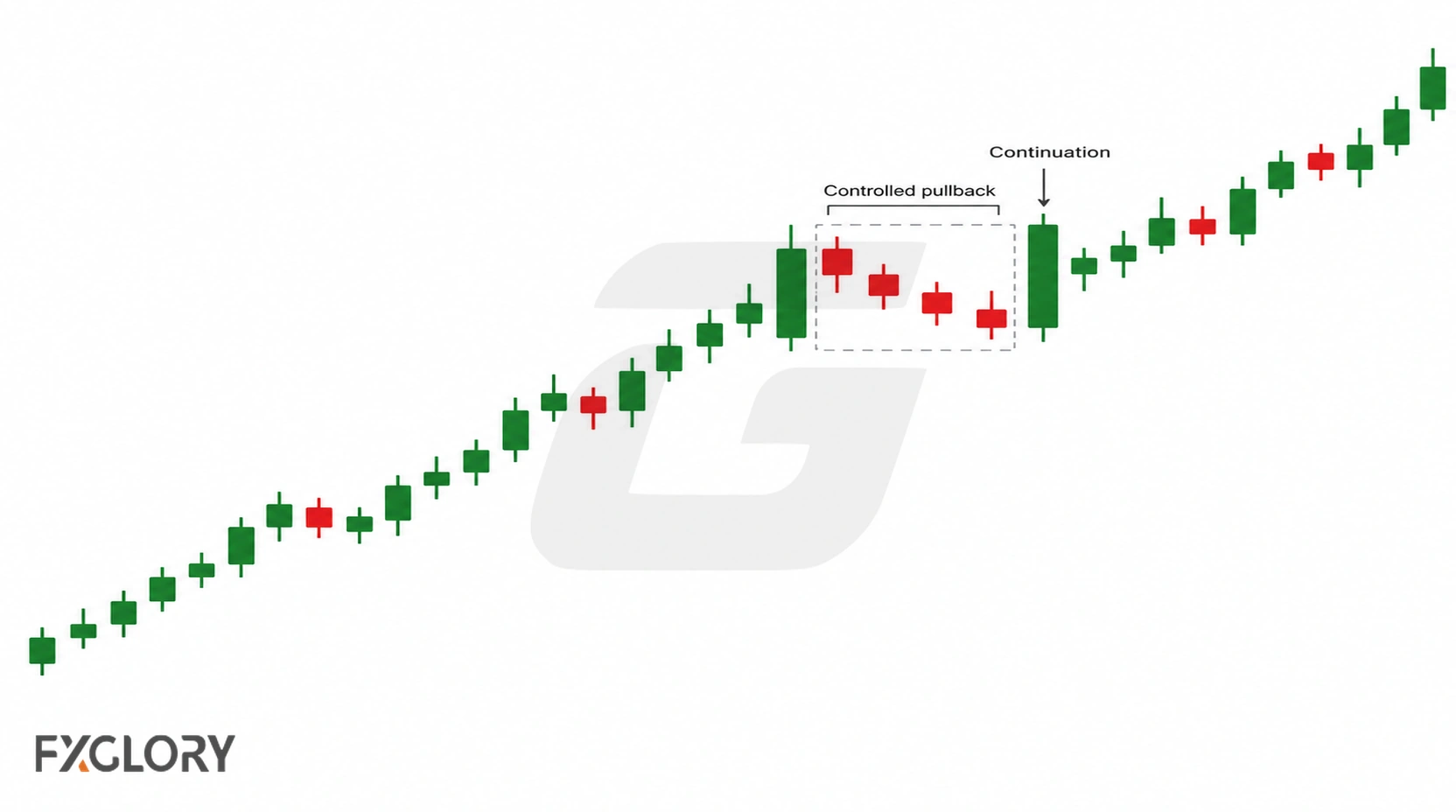
The key idea is controlled pullback. The smaller middle candles should not erase the first candle’s pressure. The final candle should show that buyers are trying to resume control.
For the complete single-pattern guide, review the Rising Three Methods forex pattern.
- Do not force the middle candles: If they break the structure too deeply, the continuation idea weakens.
- Do not enter before completion: The final candle matters because it shows whether pressure returns.
- Watch nearby resistance: A continuation pattern pushing directly into resistance needs caution.
Falling Three Methods in Forex
The Falling Three Methods pattern is usually studied as a bearish continuation pattern. It begins with a strong bearish candle, followed by smaller candles that rebound or pause without fully damaging the bearish structure. A later bearish candle attempts to continue the original move.
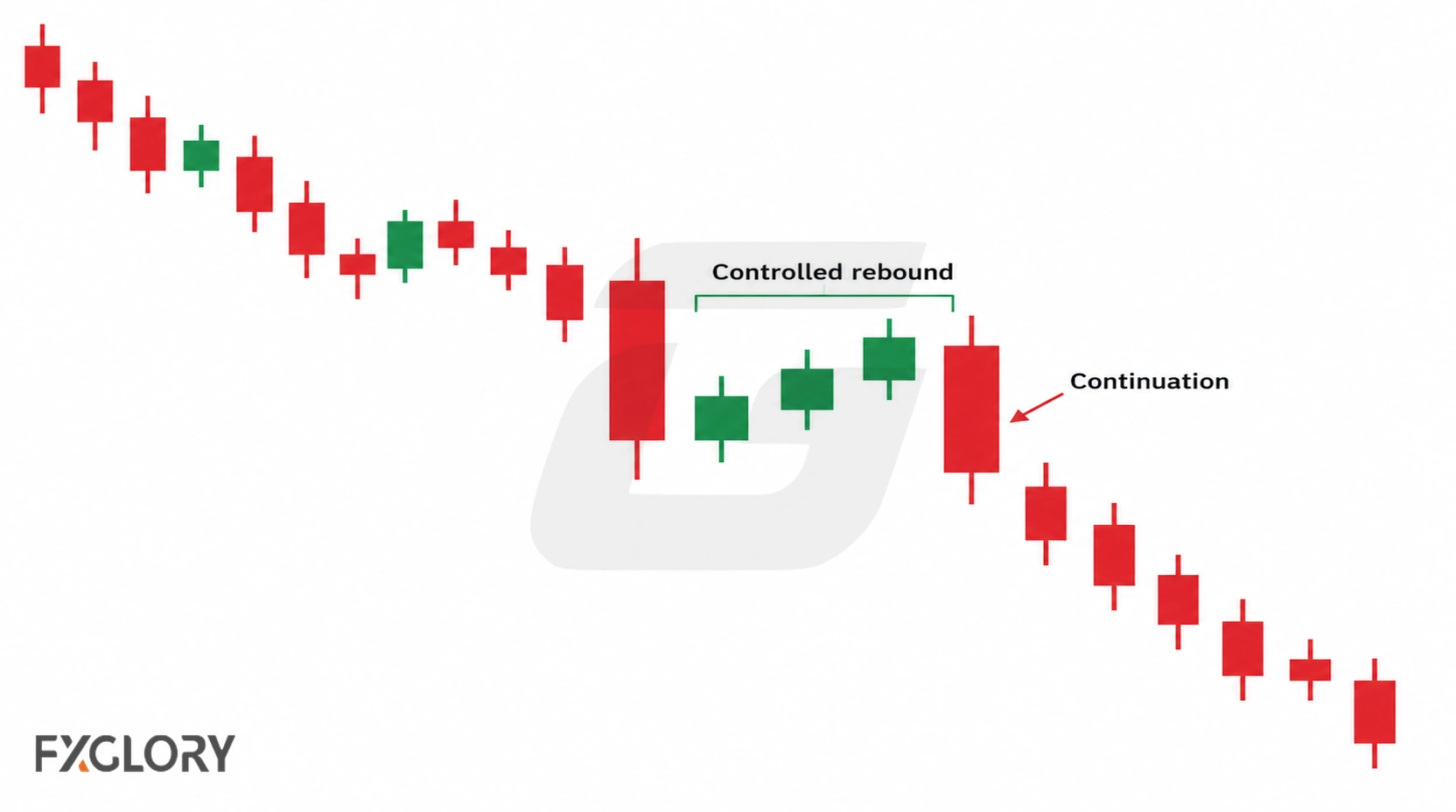
The key idea is controlled rebound. The smaller middle candles should not fully reverse the first bearish candle’s pressure. The final candle should show that sellers are trying to resume control.
For the complete single-pattern guide, review the Falling Three Methods forex pattern.
- Do not ignore the first candle: The pattern needs a strong prior bearish move or candle context.
- Do not treat any three small candles as continuation: The pullback should stay controlled.
- Watch nearby support: A bearish continuation pattern pushing directly into support needs caution.
Inside Bar as a Continuation Pattern
An inside bar forms when the full range of a candle sits inside the previous candle’s high and low. It often shows compression or temporary balance after a larger candle.
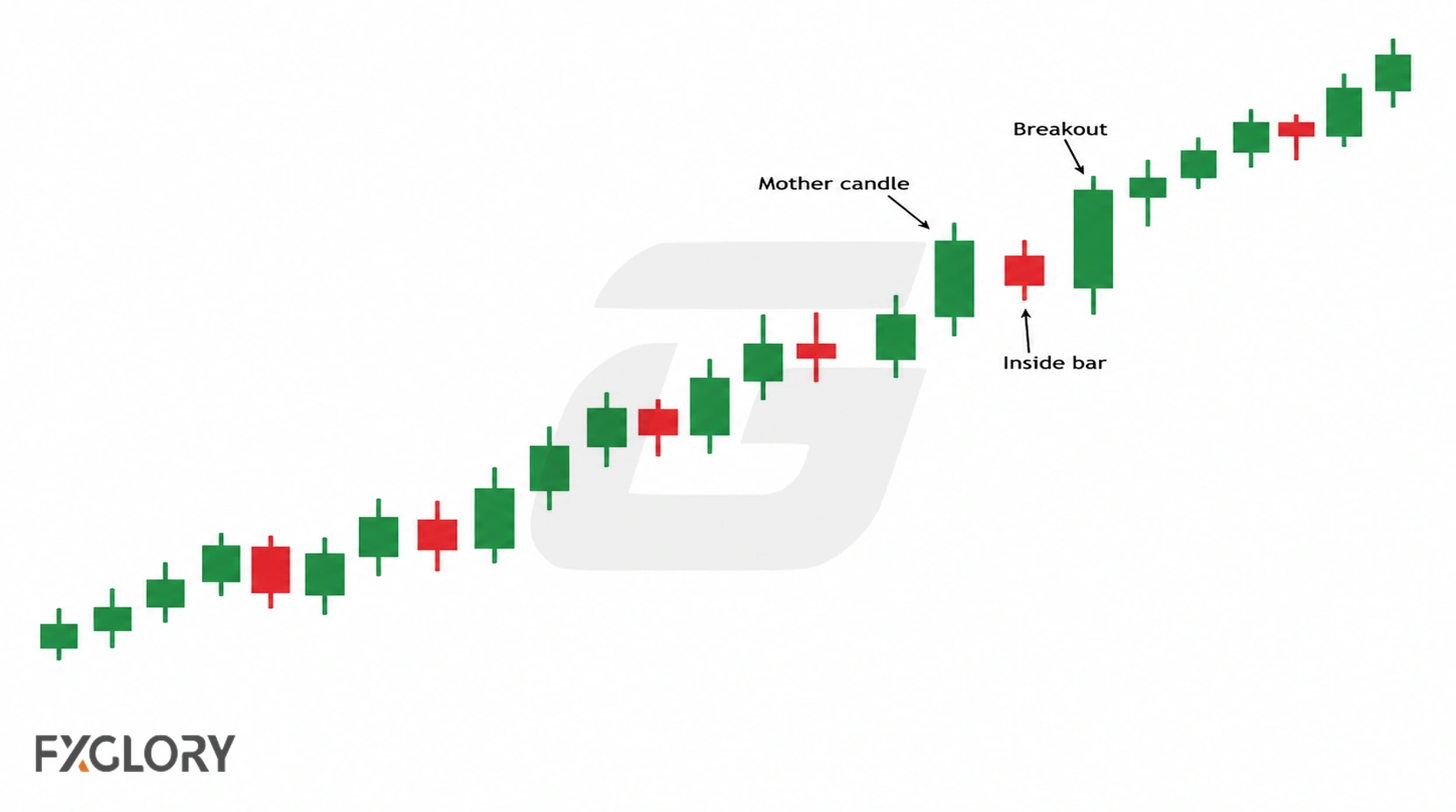
An inside bar can act as a continuation pattern when it forms inside a clear trend and price later breaks in the trend direction. It can also fail, break the other way, or become part of a range.
For the full inside-bar guide, review inside-bar compression and breakout behavior.
- Continuation reading: The inside bar pauses inside the trend, then price breaks with the prior move.
- Range reading: Multiple inside candles may show hesitation instead of continuation.
- Failure reading: Price breaks against the trend and invalidates the continuation idea.
Outside Bar as a Continuation Pattern
An outside bar forms when a candle expands beyond the previous candle’s high and low. It shows range expansion, but the meaning depends on location and candle close.
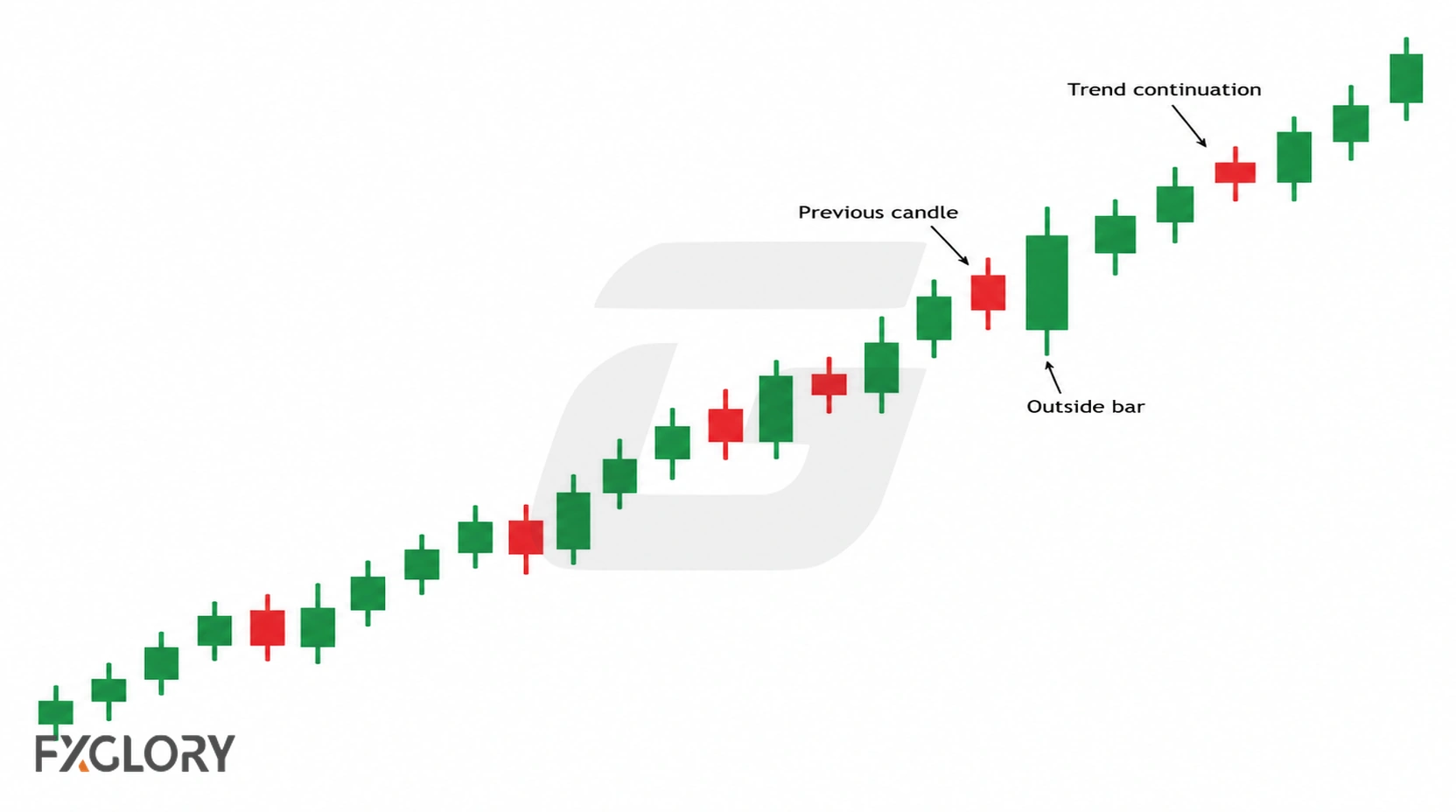
An outside bar can support continuation when it appears during an existing move and closes strongly in the direction of that move. It can also become a reversal clue if the candle rejects one side and closes against the trend.
An outside bar should be judged by its close, location, and follow-through. A wide outside bar with a weak close can expand range without giving a clean continuation signal.
For the complete outside-bar guide, review outside-bar range expansion in forex.
- Continuation reading: The outside bar expands range and closes with the prior trend.
- Reversal reading: The outside bar sweeps one side and closes against the trend.
- Noise reading: The outside bar forms during messy range conditions and gives no clean direction.
Marubozu as Continuation Pressure
A Marubozu candle has a strong body and little or no wick. In continuation analysis, it may show that directional pressure is still active when it appears with trend context.
A bullish Marubozu during an upward move may support the idea that buyers remain active. A bearish Marubozu during a downward move may support the idea that sellers remain active. The candle still needs follow-through and should not be used alone.
For the complete candle guide, review Marubozu candle pressure in forex.
- Continuation use: A Marubozu can support directional pressure when it appears with the trend.
- Exhaustion risk: A strong candle after an extended move can also appear near exhaustion.
- Location matters: A Marubozu into support, resistance, or news movement needs caution.
Gap-Based Continuation Patterns and Forex Caution
Some continuation candlestick patterns were first described in markets where gaps are more common. These include Mat Hold, Tasuki Gap, Rising Window, Falling Window, and some separating-line interpretations.
Spot forex trades across global sessions and often does not show clean textbook gaps during normal weekday movement. Gaps may still appear around market open, weekend reopening, thin liquidity, or news conditions, but they should not be forced into every chart.
- Mat Hold: A multi-candle continuation structure where a strong candle is followed by a controlled pause and later continuation. Textbook versions often use gaps.
- Tasuki Gap: A gap continuation pattern where the pullback does not fully close the prior gap.
- Rising and Falling Window: Gap-based continuation ideas that need careful forex interpretation.
- Separating Lines: A same-open continuation idea where the second candle closes strongly with the trend.
- On Neck, In Neck, and Thrusting: Bearish continuation structures after a decline, usually requiring careful candle-close reading.
How to Confirm Continuation Candlestick Patterns
Confirmation helps separate a continuation candidate from a clearer continuation scenario. It does not remove risk, but it gives more information than the candle name alone.
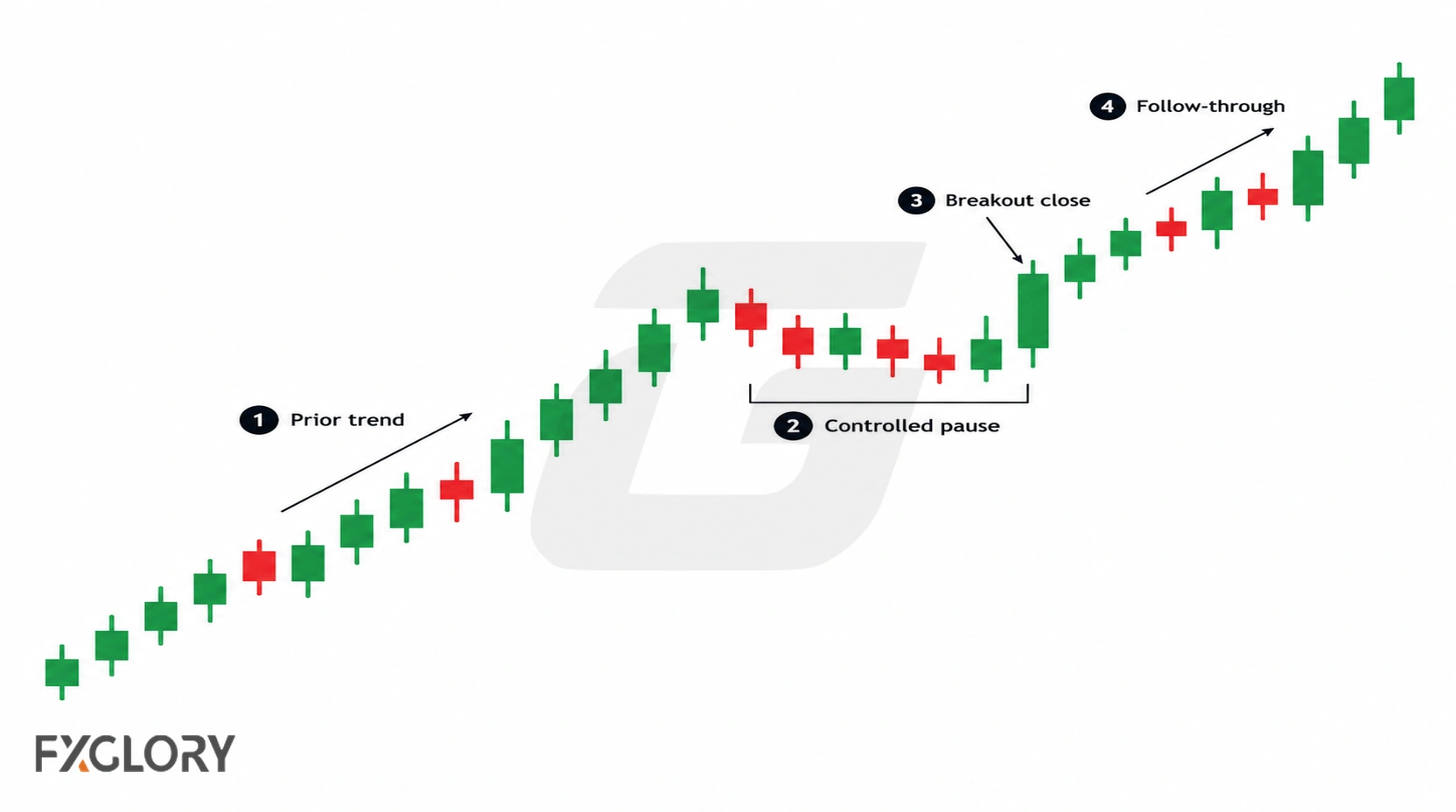
- Check the prior trend: The pattern should form after a clear move, not inside random noise.
- Study the pause: The pullback or compression should not fully damage the prior structure.
- Wait for candle close: A live candle can change before the period ends.
- Watch breakout direction: Price should break or close in the direction that supports continuation.
- Check support and resistance: Continuation into a major opposite level needs caution.
- Review volatility: Wider movement can make stop and invalidation planning harder.
- Separate trade planning: If considering a trade, define the exit condition and account risk independently of pattern confirmation.
For broader trend context, review the direction layer behind continuation candles. For levels that may block or support continuation, review support and resistance around continuation areas.
When a Continuation Candlestick Pattern Fails
A continuation candidate may never confirm, while a confirmed continuation scenario may later fail if price reverses or moves back into its former range. A trader’s chosen exit or stop level is a separate risk-planning decision.
- Unclear prior move: A weak or unclear earlier trend makes continuation classification less convincing before confirmation; it is not a failed confirmed pattern.
- Pullback breaks too deeply: The pause becomes a larger reversal or range.
- Breakout fails: Price breaks in the expected direction but quickly returns inside the pattern area.
- Opposite close forms: A candle closes strongly against the continuation direction.
- Nearby level blocks price: Support or resistance stops follow-through.
- News changes volatility: A scheduled or unexpected event produces movement that contradicts the continuation scenario.
Continuation Candles vs Reversal Candles
Continuation candles and reversal candles are separated mainly by context. The same candle shape can mean different things depending on where it appears.
- Continuation context: The candle forms inside an existing move and supports a pause-and-resume scenario.
- Reversal context: The candle forms near an exhausted move, major level, or rejection area and suggests a possible turn.
- Range context: The candle forms inside sideways movement and may not give clear continuation or reversal information.
- Failure context: Price breaks against the expected direction and changes the candle’s meaning.
For reversal-focused candles, review candles that appear near possible turning areas.
Forex Context: Spread, Volatility, Sessions, and News
Forex continuation candles should be read with market conditions because currency pairs trade across global sessions and can react quickly to news, liquidity changes, and spread conditions.
- Spread: Wider spreads can affect entries, exits, and invalidation around a breakout.
- Volatility: Fast movement can cause overshoots, false breaks, or difficult stop planning.
- Session timing: Continuation patterns may behave differently during active sessions and thin-liquidity periods.
- News events: Economic releases and central-bank comments can overpower candle structures.
- Pair behavior: Major pairs, crosses, and exotic pairs may trend and retrace differently.
- Timeframe conflict: A lower-timeframe continuation candle may fight a higher-timeframe level or reversal structure.
When movement size matters, traders may review volatility context before trusting continuation candles.
Common Mistakes With Continuation Candlestick Patterns
Continuation-candle mistakes often happen when traders focus on the pattern name instead of the market environment around it.
- Ignoring prior trend: A continuation pattern without a clear prior move is weak.
- Entering before candle close: A live candle can change before it completes.
- Forcing gap patterns in spot forex: Some textbook patterns need gaps that may not appear cleanly in forex.
- Confusing inside bar and harami: Inside bar is range containment; harami is body contraction.
- Confusing outside bar and engulfing: Outside bar is full-range expansion; engulfing is body takeover.
- Treating Marubozu as always safe: Strong candles can also appear near exhaustion.
- Ignoring nearby levels: Continuation into support or resistance can fail quickly.
- Undefined invalidation: The trader has not established which price behavior would invalidate the continuation scenario.
Beginner Workflow for Continuation Candles
A simple workflow can stop continuation candles from becoming isolated pattern names.
- Start with direction: Identify whether price is trending, ranging, or unclear.
- Find the pause: Look for compression, controlled pullback, or strong trend-pressure candle.
- Name the pattern carefully: Decide whether it resembles Rising Three Methods, Falling Three Methods, Inside Bar, Outside Bar, Marubozu, or another continuation structure.
- Check location: Compare the pattern with nearby support, resistance, and recent swing structure.
- Wait for close or breakout: Avoid judging the pattern before the relevant candle closes.
- Define invalidation: Decide what price behavior cancels the continuation idea.
- Review spread and volatility: Make sure execution conditions do not distort the setup.
- Practice first: Study examples on demo charts before using real money.
A Safer Way to Read Forex Continuation Candlestick Patterns
Forex continuation candlestick patterns are most useful when they are treated as trend-context tools. They can help traders study pauses, controlled pullbacks, range compression, breakout behavior, and directional pressure.
The pattern name alone is never enough. Use the earlier pattern descriptions to identify the candle structure, then distinguish any subsequent confirming price action from the separate decision to take a trade.