

What Is The Falling Three Methods Pattern In Forex?
The falling three methods pattern in forex is a bearish continuation candlestick formation that usually appears during an existing downward move. It shows an initial downward move, a contained upward pause or consolidation, and renewed downward movement.
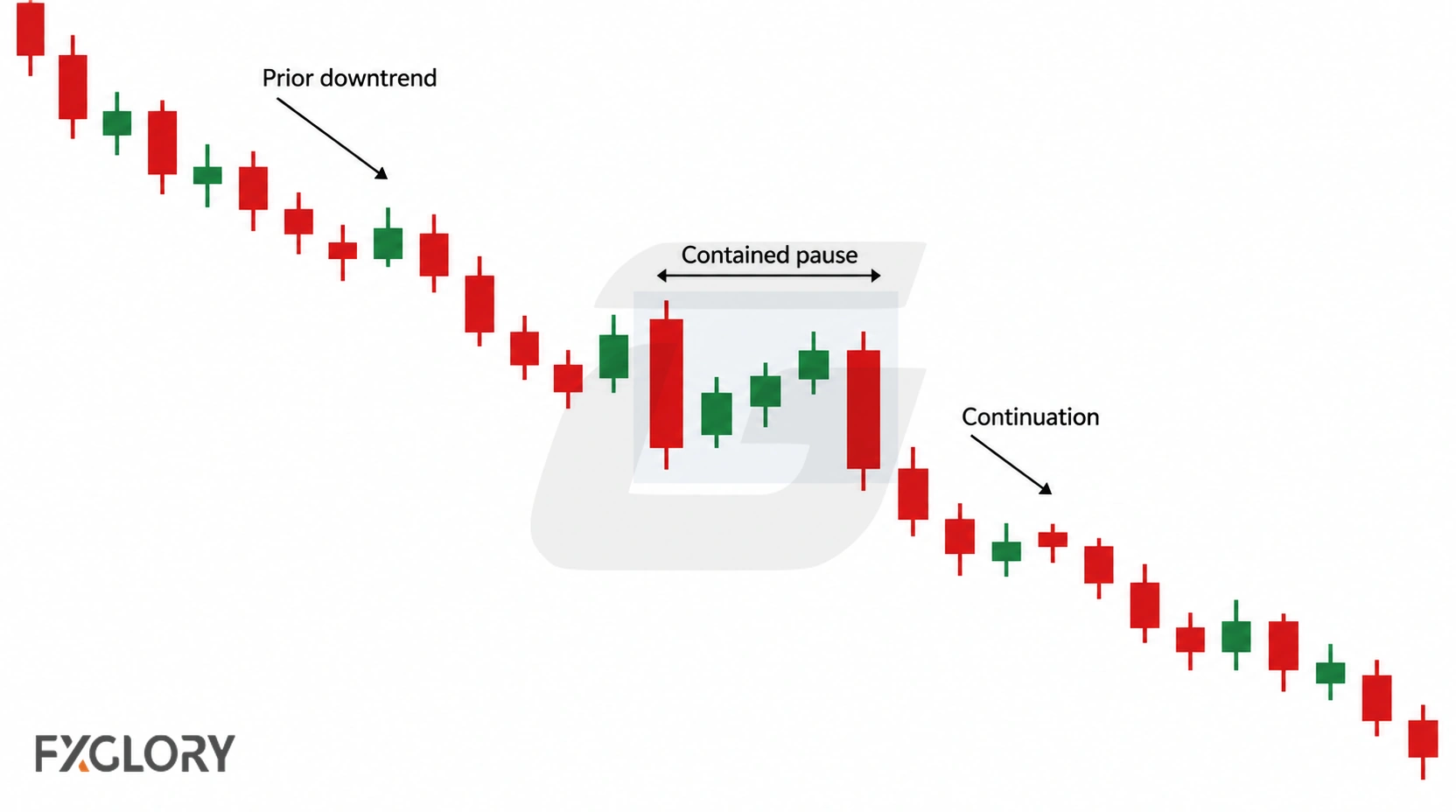
The classic structure has five candles. The first candle is a strong bearish candle. The next three candles are smaller candles that usually move against the first candle or pause inside its range. The final candle is bearish and shows renewed downward price movement after the controlled pause.
The pattern is not defined by the number three alone. Some chart readings allow more than three middle candles if the pause remains controlled and contained within the first candle's range. The important idea is the sequence: downward pressure, contained upward pause, downward response.
Falling three methods should not be read as a standalone trading reason. It is a multi-candle structure that needs downtrend context, clean containment, a meaningful final candle, and follow-up price action.
A bearish continuation sequence can become harder to read near a lower-price reaction area.
If you need candle anatomy first, review the open, high, low, close, body, and wick relationship. Falling three methods uses those same candle parts, but organizes them into a longer bearish continuation sequence.
Why It Is Called Falling Three Methods
The name comes from traditional Japanese candlestick terminology and the broader idea often associated with Sakata’s Five Methods. Falling three methods belongs to the three methods family of continuation patterns, where smaller candles mark a pause before the larger bearish direction tries to continue.
The word falling points to the bearish direction of the sequence. The three methods part refers to the classic middle pause of three smaller candles, although some chart readings allow more middle candles when the pause remains controlled and contained.
This background keeps the pattern focused on continuation. The pattern is not simply any five candles on a chart; it is a bearish continuation sequence where a brief counter-move fails to undo the earlier sell-side pressure.
Falling Three Methods Pattern Anatomy
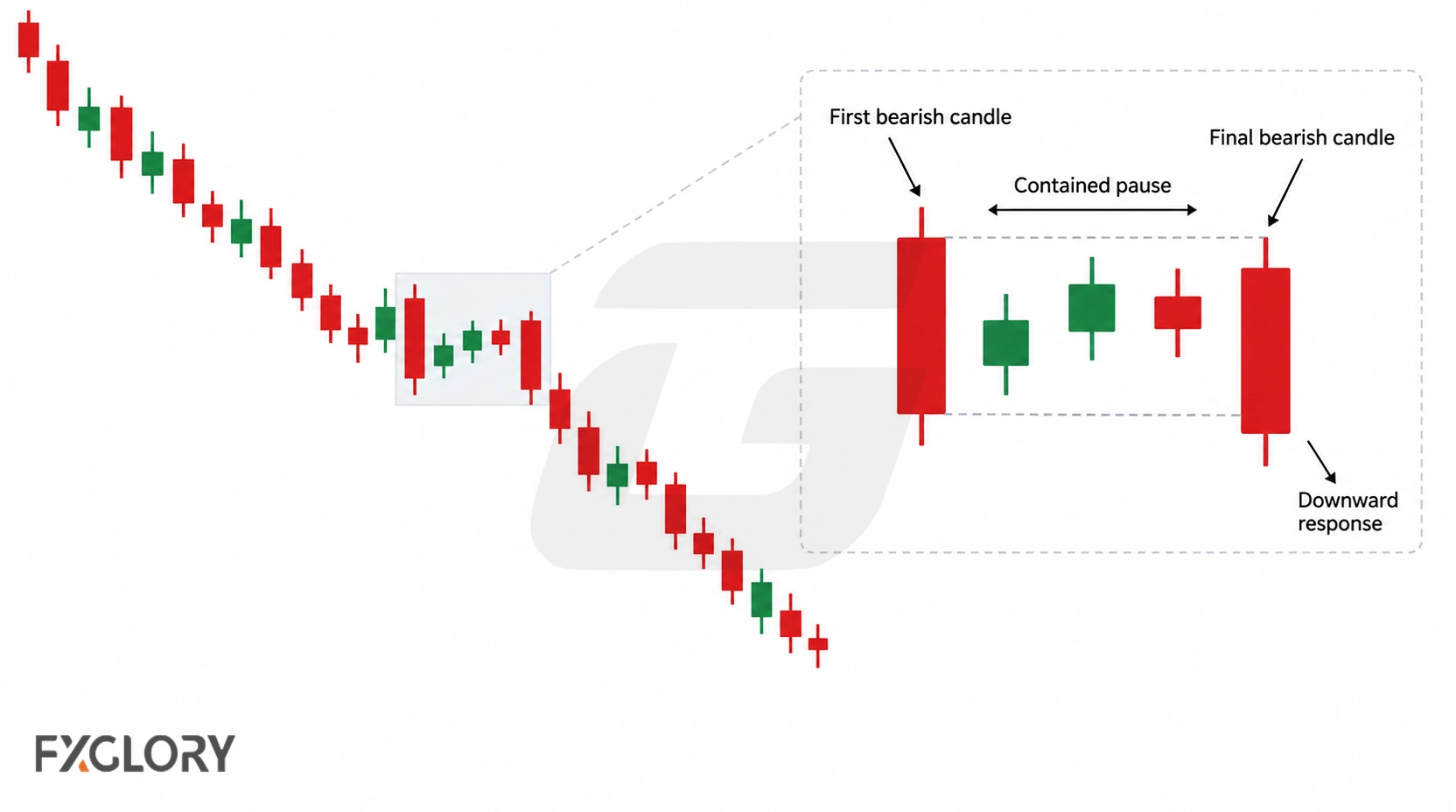
The falling three methods pattern is built from a first pressure candle, a middle pause, and a final response candle. Each part matters because the pattern is a sequence, not a single candle.
| Pattern Part | Typical Structure | What It Shows | Reading Caution |
|---|---|---|---|
| Existing downtrend | Price is already moving downward before the pattern. | The formation is reviewed as continuation, not as a top reversal. | Without a prior downward move, the pattern loses its main context. |
| First candle | Strong bearish candle with a visible body. | Initial downward pressure. | A news-driven candle may be less clean than normal trend pressure. |
| Middle candles | Three or more smaller candles, often bullish or mixed. | Controlled pause or upward pullback. | The cleaner version keeps these candles inside the first candle's range. |
| Final candle | Bearish candle that closes below the first candle's close and may push below the first candle's low. | Downward movement resumes after the contained pause. | A weak final candle can reduce the quality of the reading. |
| Full sequence | Bearish pressure, contained pause, bearish response. | Continuation attempt inside a downtrend. | The pattern still needs chart context and later price action. |
The middle candles are not random filler. They are the pause that separates falling three methods from patterns that only show consecutive bearish candles.
Falling Three Methods Recognition Quality
Falling three methods should be recognized by structure quality, not by candle count alone. The best examples show a clear downward move, a strong first candle, a contained middle pause, and a final bearish candle that restores downward pressure.
| Recognition Level | Structure | Reading Quality |
|---|---|---|
| Ideal | Clear downtrend, strong bearish first candle, three small contained candles, and strong bearish final candle closing below the first candle's close. | Cleanest version of the pattern. |
| Acceptable | More than three small middle candles, if the pause remains controlled and contained inside the first candle's range. | Still usable as a longer pause, but needs careful review. |
| Weak | No clear downtrend, large middle candles, broken containment, or weak final candle. | Continuation reading is reduced. |
| Avoid | Random five-candle group in a range, news-driven volatility sequence, or messy candle overlap. | Do not force the pattern label. |
Clean vs Loose Falling Three Methods Structure
A clean falling three methods pattern has a strong bearish first candle, smaller middle candles that remain inside the first candle's high-low range, and a final bearish candle that shows renewed downward pressure. The closing condition is examined in the final-candle section; here, the key distinction is whether the pause remains contained and the last candle restores a clear downward move.
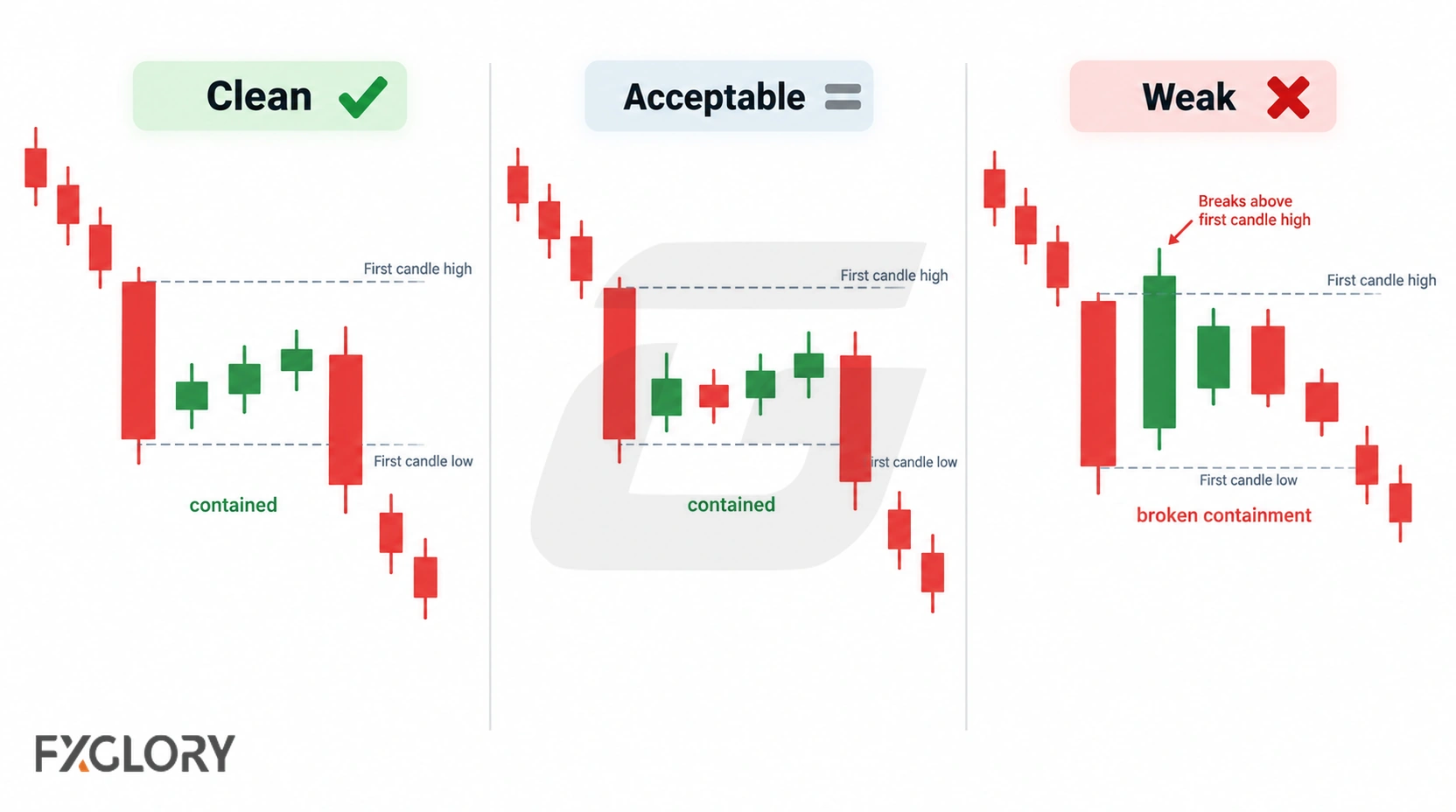
Looser versions may include more than three middle candles or slightly mixed middle-candle colors. Large middle candles or a break above the first candle's high weaken the contained-pause structure; final-candle criteria are examined separately below.
| Version | Structure | How To Read It | Caution |
|---|---|---|---|
| Clean version | Strong bearish candle, contained small pause candles, strong bearish final candle. | Clear pause-and-resume continuation structure. | Still needs downtrend context and follow-up movement. |
| More-than-three middle candles | Four or more small candles remain controlled inside the first candle's range. | Longer pause inside the same continuation idea. | Too many middle candles can shift the chart into range behavior. |
| Mixed-color middle candles | Middle candles are small and mixed rather than all bullish. | Pause or consolidation may still be present. | Structure weakens if the pause becomes wide or messy. |
| Broken containment | Middle candles move above the first candle's high. | Continuation reading becomes weaker. | This may no longer be a clean falling three methods pattern. |
| Weak final candle | Final candle does not close below the first candle's close or does not restore downward pressure. | Continuation reading remains unresolved. | The sequence may be only a pause, not a clean resumption. |
What Falling Three Methods Shows About Market Pressure
Falling three methods describes a pause inside a downward move. The first candle shows downward pressure. The middle candles show that price pulled back upward or moved sideways without fully undoing that pressure. The final candle shows renewed downward movement after the pause.
This sequence is why the pattern is usually treated as continuation rather than reversal. It does not start from an uptrend high like a bearish reversal pattern. It appears after downward pressure already exists.
The middle candles are important because they show whether the pause is controlled or aggressive. A controlled upward pause stays relatively small and contained. A strong upward recovery can damage the continuation reading.
- First candle: Shows initial downward pressure.
- Middle candles: Show a pause, upward pullback, or consolidation phase.
- Final candle: Shows renewed downward pressure after the pause.
- Full sequence: Shows a possible continuation attempt inside an existing downward move.
Why Downtrend Context Matters
Falling three methods needs a downward context. Without a visible downward move before the pattern, the formation becomes much harder to interpret. A bearish candle, a few small candles, and another bearish candle do not automatically create a continuation pattern unless there is something to continue.
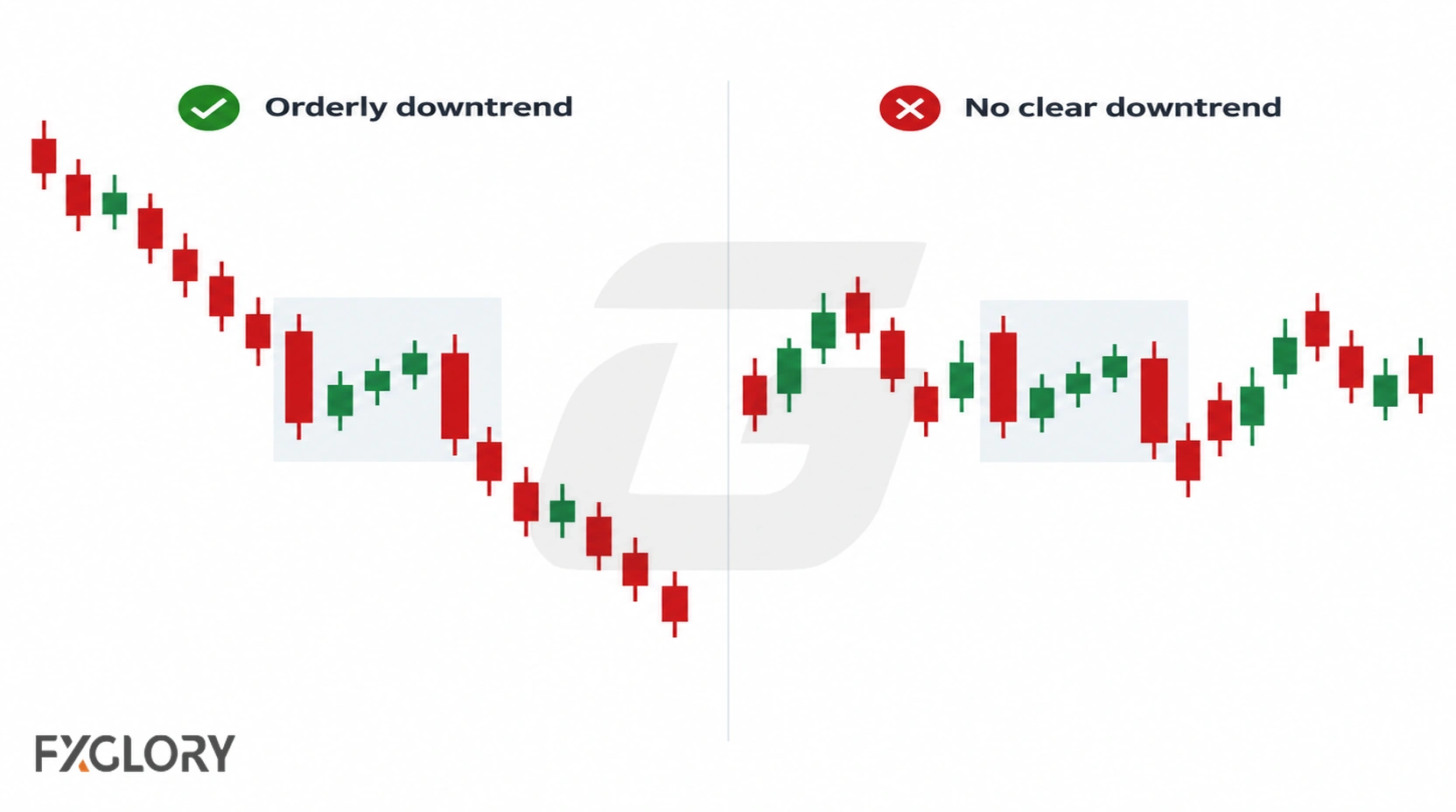
The pattern is usually cleaner when it forms inside an orderly downward move. It becomes weaker when it appears after an exhausted selloff, inside a choppy range, near a major support area, or after a news-driven candle that may not reflect normal market rhythm.
| Downtrend Context | Reading Quality | Why It Matters |
|---|---|---|
| Orderly downward move | Cleaner continuation context. | The pattern appears inside visible downward structure. |
| Extended downward move | Needs caution. | The sequence may form after pressure is already stretched. |
| Choppy sideways movement | Weak reading. | The pattern may be ordinary candle overlap, not continuation. |
| Near major support | Needs extra caution. | The final bearish candle may face a lower-price area where price has reacted before. |
| News-driven first candle | Treat carefully. | The first candle may reflect abnormal volatility instead of clean trend pressure. |
| No clear prior downtrend | Low-quality reading. | Continuation logic is weak when there is no clear move to continue. |
For observation, a trader can compare multi-candle continuation behavior on live market pages such as GBP/USD during active session movement or gold during wider candle sequences. These pages are useful for chart review, not as standalone trading reasons.
Middle Candle Containment In Falling Three Methods
The middle candles are the heart of the pattern. They should show a controlled pause rather than a full bullish reversal. In the cleaner version, the middle candles remain inside the high-low range of the first bearish candle.
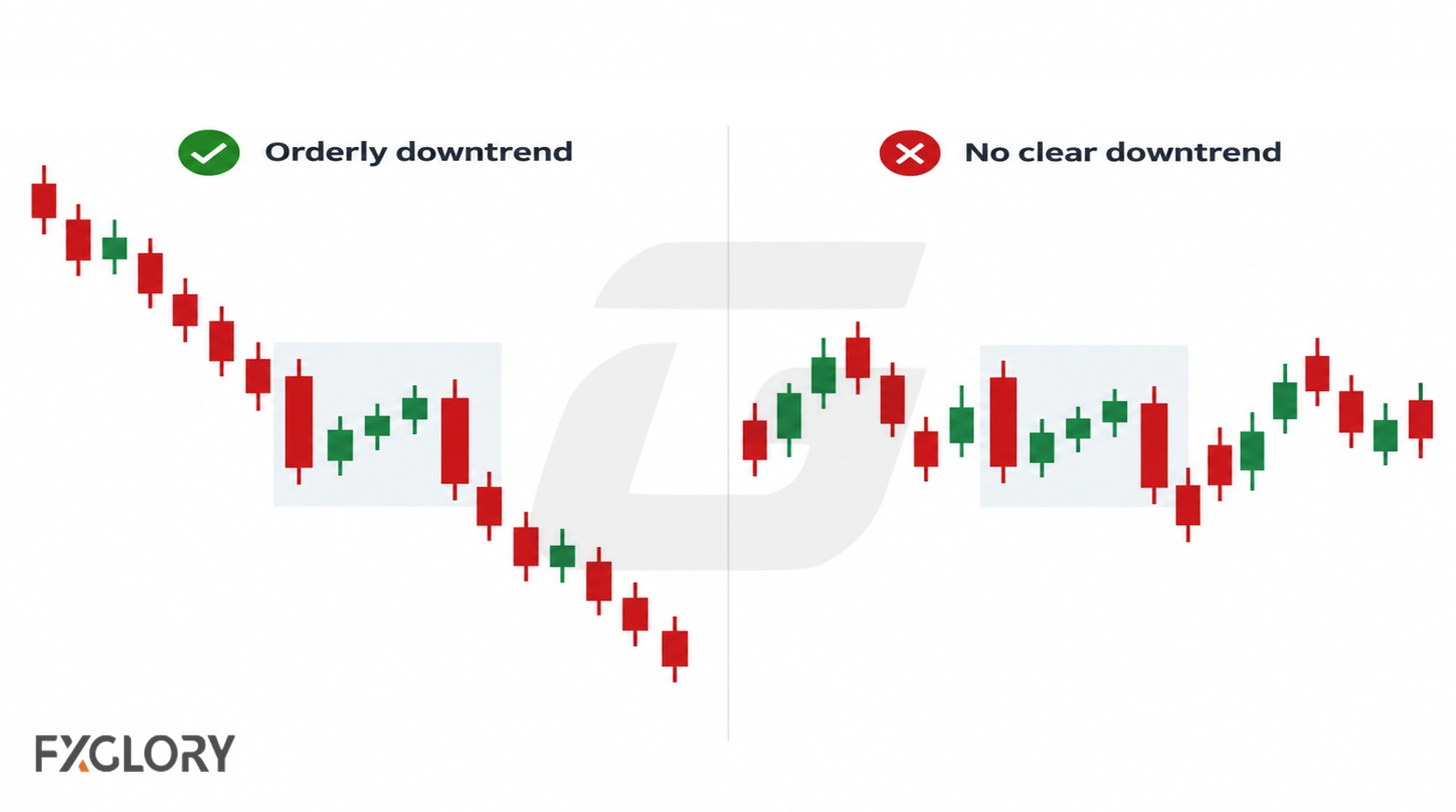
The middle candles are often bullish, but they do not have to show strong buying. Their job is to show that the market paused without breaking the structure created by the first candle.
Some chart readings focus on middle candle bodies staying inside the first candle's range, while stricter readings prefer the full high-low range of the middle candles to remain contained. For a cleaner educational definition, full-range containment is the safer standard.
| Middle Candle Behavior | Possible Reading | Pattern Quality |
|---|---|---|
| Small candles inside the first candle range | Controlled upward pullback or pause. | Cleaner. |
| Body-only containment | Middle candle bodies stay inside the first candle's range, even if some wicks extend farther. | Less strict; review carefully. |
| Full-range containment | Middle candle highs and lows stay inside the first candle's high-low range. | Cleaner educational standard. |
| Small mixed candles inside the first candle range | Consolidation after downward pressure. | Still usable if contained. |
| Large bullish middle candles | Upward recovery may be too aggressive. | Weaker. |
| Middle candles break above the first candle high | First candle structure is damaged. | Weak or invalid for clean reading. |
| Too many middle candles | Pause may turn into a range. | Needs caution. |
How To Review The Final Bearish Candle
The final candle is the response candle. It shows whether downward pressure returned after the middle pause. A stronger final candle usually has a visible bearish body and finishes in the lower part of its own range.
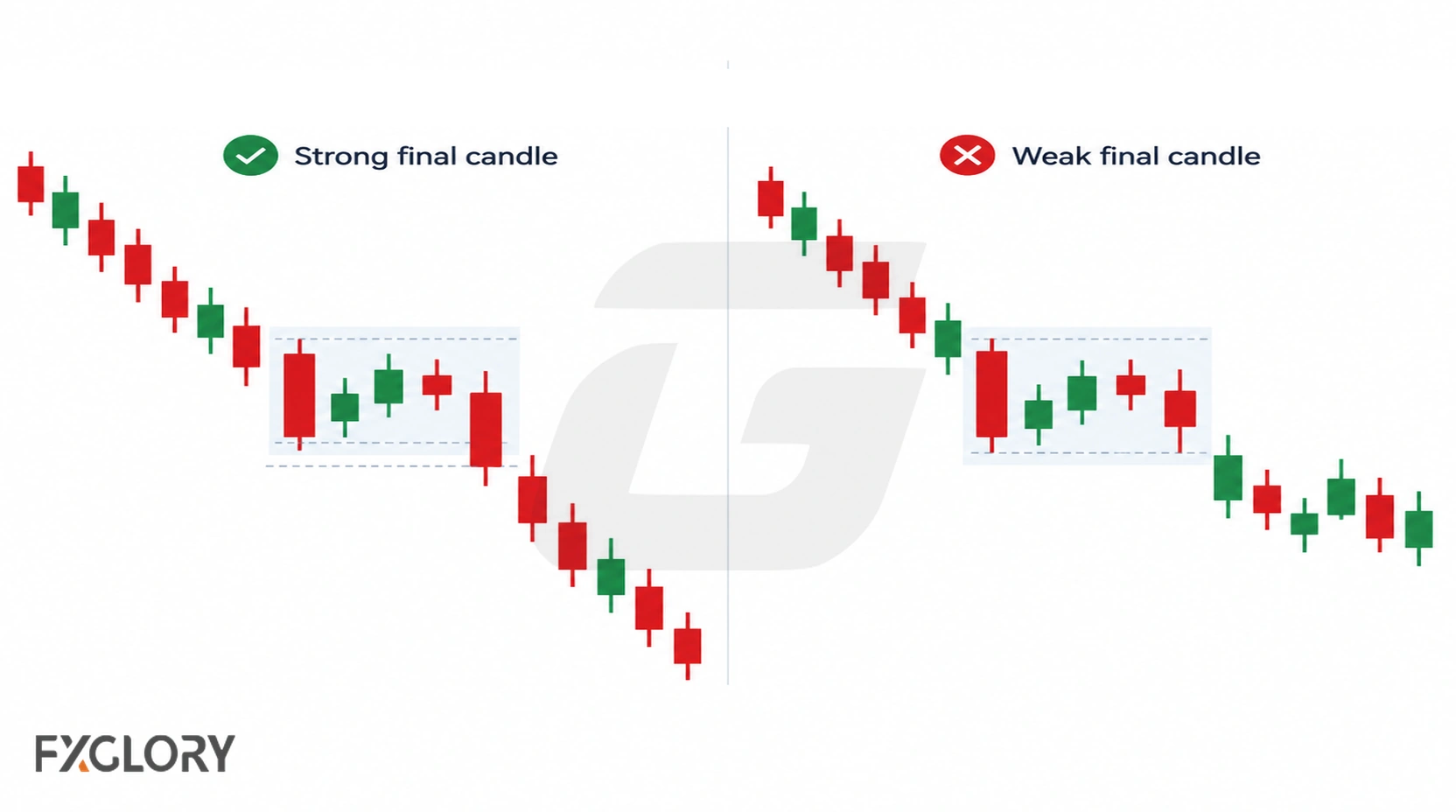
Published recognition rules vary: some require the final bearish candle to close below the first candle's close, while stricter definitions require a close below the first candle's low. In either case, a completed bearish candle that moves decisively beyond the contained pause provides clearer evidence of renewed downward movement; one that stalls within the pause does not satisfy a strong continuation reading.
| Final Candle Feature | Cleaner Reading | Weaker Reading |
|---|---|---|
| Body size | Visible bearish body. | Small body or hesitation candle. |
| Close location | Close near the lower part of the candle. | Close near the middle or upper part. |
| Relationship to first candle | Closes below the first candle's close under one definition; stricter criteria require a close below its low. | Closes weakly or remains within the middle-candle pause. |
| Volatility condition | Final candle fits normal chart rhythm. | Final candle is a sudden news-driven spike. |
A strong final candle improves the sequence reading, but it does not remove the need for broader chart context.
Falling Three Methods vs Rising Three Methods
Falling three methods has a bullish opposite called rising three methods. The main split is the side of the trend being tested. Falling three methods belongs to a sell-side continuation setting, while rising three methods belongs to a buy-side continuation setting.
| Pattern | Market Context | Basic Sequence | Deeper Guide |
|---|---|---|---|
| Falling three methods | Existing downward move. | Strong bearish candle, contained upward pause, strong bearish candle. | This page. |
| Rising three methods | Existing upward move. | Strong bullish candle, contained pullback, strong bullish candle. | bullish pause-and-resume continuation structure. |
Studying the pair together can help separate bearish continuation logic from its bullish counterpart without blending the two structures.
Falling Three Methods vs Three Black Crows
Falling three methods and three black crows are both bearish formations, but they are not the same structure.
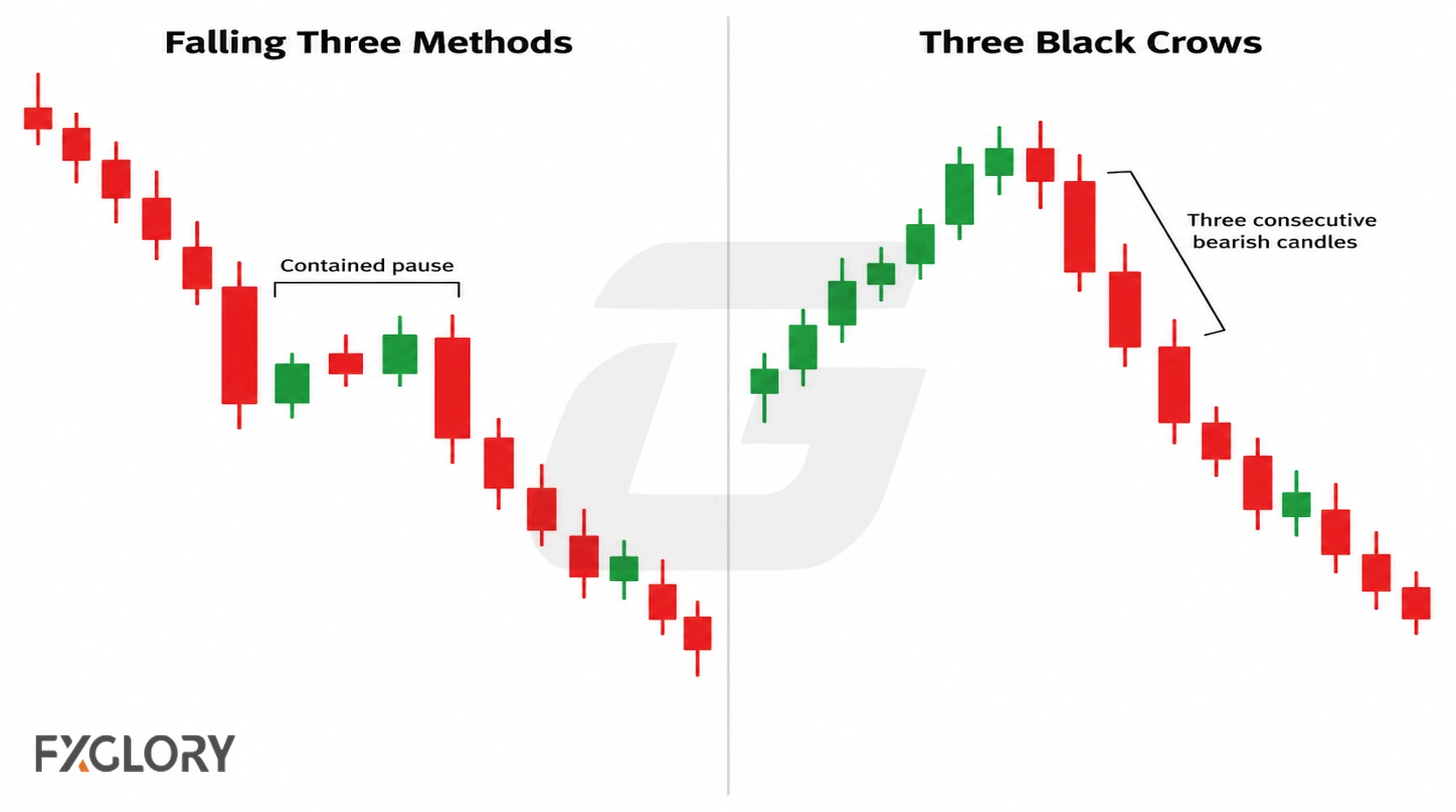
Three black crows has three consecutive bearish candles. Falling three methods has a strong bearish candle, a middle upward pause, and a final bearish response. The pause between the first and final bearish candles is the main difference.
| Pattern | Core Structure | Main Message | Deeper Guide |
|---|---|---|---|
| Falling three methods | Bearish candle, contained pause candles, bearish continuation candle. | Pause-and-resume structure inside a downtrend. | This page. |
| Three black crows | Three consecutive bearish candles. | Sustained seller response across three candles. | three consecutive bearish candles explained. |
This boundary matters because falling three methods is not just a run of bearish candles. It is a continuation sequence with a controlled interruption.
Falling Three Methods vs Evening Star
Falling three methods and evening star can both end with bearish pressure, but their market context is different.
Evening star is usually reviewed after buying pressure as a bearish reversal pattern. Falling three methods is usually reviewed after selling pressure already exists as a bearish continuation pattern.
| Pattern | Usually Appears After | Sequence Type | Deeper Guide |
|---|---|---|---|
| Falling three methods | An existing downward move. | Bearish continuation sequence. | This page. |
| Evening star | Buying pressure or an upward move. | Bearish reversal sequence. | bearish pause-and-response reversal sequence. |
The same bearish final candle can mean different things depending on what came before it. That is why the prior trend matters.
Falling Three Methods vs Inside Bar And Harami
The middle candles in falling three methods can look like compression, but the full pattern is not the same as an inside bar or harami.
An inside bar is defined by the second candle's full high-low range remaining inside the previous candle's range. A harami instead focuses on the second candle's real body fitting within the previous candle's real body. Falling three methods is a longer sequence: an initial bearish candle, a contained pause, and a final bearish candle.
| Pattern | Main Measurement | Core Difference |
|---|---|---|
| Falling three methods | Multi-candle sequence. | Uses a contained upward pause between two bearish pressure candles. |
| Inside bar | Full high-low range containment across two candles. | Only describes two-candle compression. |
| Harami | Body contraction across two candles. | Only describes two-candle inside-body contraction. |
For comparison, review two-candle range compression and two-candle inside-body contraction.
Falling Three Methods vs Marubozu And Engulfing
The first and final candles in a falling three methods pattern can sometimes look like strong body-pressure candles. That does not make the whole formation a marubozu or engulfing pattern.
Marubozu is a one-candle full-body pressure structure. Engulfing is a two-candle body-takeover structure. Falling three methods is a multi-candle continuation sequence that uses a pause between two bearish pressure areas.
| Pattern | Structure | How It Differs |
|---|---|---|
| Falling three methods | Strong bearish candle, contained upward pause, strong bearish candle. | Multi-candle continuation sequence. |
| Marubozu | One full-body candle with little or no wick. | One-candle pressure, not a sequence. |
| Engulfing | Second candle body overtakes the prior candle body. | Two-candle body takeover, not a five-candle pause-and-resume structure. |
For body-pressure comparisons, review full-body pressure candles and two-candle body takeover.
Falling Three Methods vs Dark Cloud Cover
Falling three methods and dark cloud cover can both be associated with bearish pressure, but they do not measure the same structure.
Dark cloud cover is a two-candle bearish pushback into a prior bullish body. Falling three methods is a multi-candle bearish continuation sequence inside an existing downward move.
| Pattern | Main Relationship | Core Difference |
|---|---|---|
| Falling three methods | Bearish pressure, contained upward pause, bearish response. | Multi-candle continuation structure. |
| Dark cloud cover | Second candle pushes into the prior bullish body. | Two-candle bearish pushback structure. |
For the two-candle bearish pushback structure, review dark cloud cover in forex.
Falling Three Methods Strength Filter: Stronger vs Weaker Readings
A falling three methods pattern does not carry the same value in every chart condition. A clean sequence inside an orderly downward move is easier to review than a similar-looking group of candles inside messy movement.
| Factor | Cleaner Reading | Weaker Reading |
|---|---|---|
| Prior trend | Visible downward move before the pattern. | No clear downtrend or choppy movement. |
| First candle | Strong bearish candle with clear body pressure. | Small or unclear first candle. |
| Middle candles | Small and contained inside the first candle range. | Large, messy, or breaking above the first candle high. |
| Final candle | Strong bearish response after the pause. | Weak close, small body, or unresolved candle. |
| Volatility | Sequence fits normal market rhythm. | Pattern forms around news, rollover, or thin liquidity. |
| Nearby support | No immediate lower-price obstacle is dominating the sequence. | Pattern forms directly into a level where price has reacted before. |
| Follow-up movement | Later price action keeps the continuation area relevant. | Price quickly cancels the sequence or returns into messy overlap. |
Falling Three Methods Forex Reading Table
The table below shows how falling three methods can be reviewed in different chart settings. It is a reading aid, not a trading instruction.
| Chart Situation | Possible Reading | What To Check Next |
|---|---|---|
| Orderly downtrend | Pattern may show a pause inside an existing downward move. | Check middle-candle containment and final candle quality. |
| After a very large bearish candle | Middle candles may only show a pause after expansion. | Check whether the first candle was news-driven or abnormal. |
| Middle candles stay contained | Upward pause remains controlled. | Check whether the final candle restores downward pressure. |
| Middle candles break above first candle high | Continuation structure weakens. | Review whether the pattern is still valid. |
| Final candle closes weakly | Continuation reading remains unclear. | Check later candles before giving the sequence more weight. |
| Pattern forms near support | Bearish continuation reading may face a lower-price reaction area. | Review whether the level changes the candle context. |
| Pattern forms in a range | Sequence may be ordinary overlap. | Check whether there is a clear trend to continue. |
How To Read Falling Three Methods In Forex
A structured workflow helps keep the pattern from being forced onto any group of five candles. Confirm the trend first, then review the candle sequence.
- Start with the prior move: Check whether price was already moving downward before the pattern formed.
- Review the first candle: Look for a clear bearish candle that creates the structure for the pause.
- Check the middle candles: Confirm that the pause candles are smaller and remain controlled.
- Watch containment: In the cleaner version, the middle candles stay inside the first candle's high-low range.
Review the final candle: Apply the chosen recognition rule consistently: check the final close against the first candle's close, or against its low for a stricter definition.
- Check chart location: Review whether the pattern forms in an orderly downtrend, into support, or inside a messy range.
- Review volatility conditions: Consider spread, rollover, session changes, liquidity, and scheduled news.
- Watch follow-up movement: See whether later candles respect the continuation structure or cancel it.
Some traders compare continuation patterns with technical indicators for context. For example, ATR can help review whether the candles are unusually wide or quiet, and RSI can add momentum context around the downward move. These tools can support chart review, but they do not remove trading risk.
False Falling Three Methods Readings
A false falling three methods reading happens when a candle sequence looks like bearish continuation but later price action does not support that idea. This can happen when the middle candles are too large, the final candle is weak, or the broader chart is not actually trending downward.
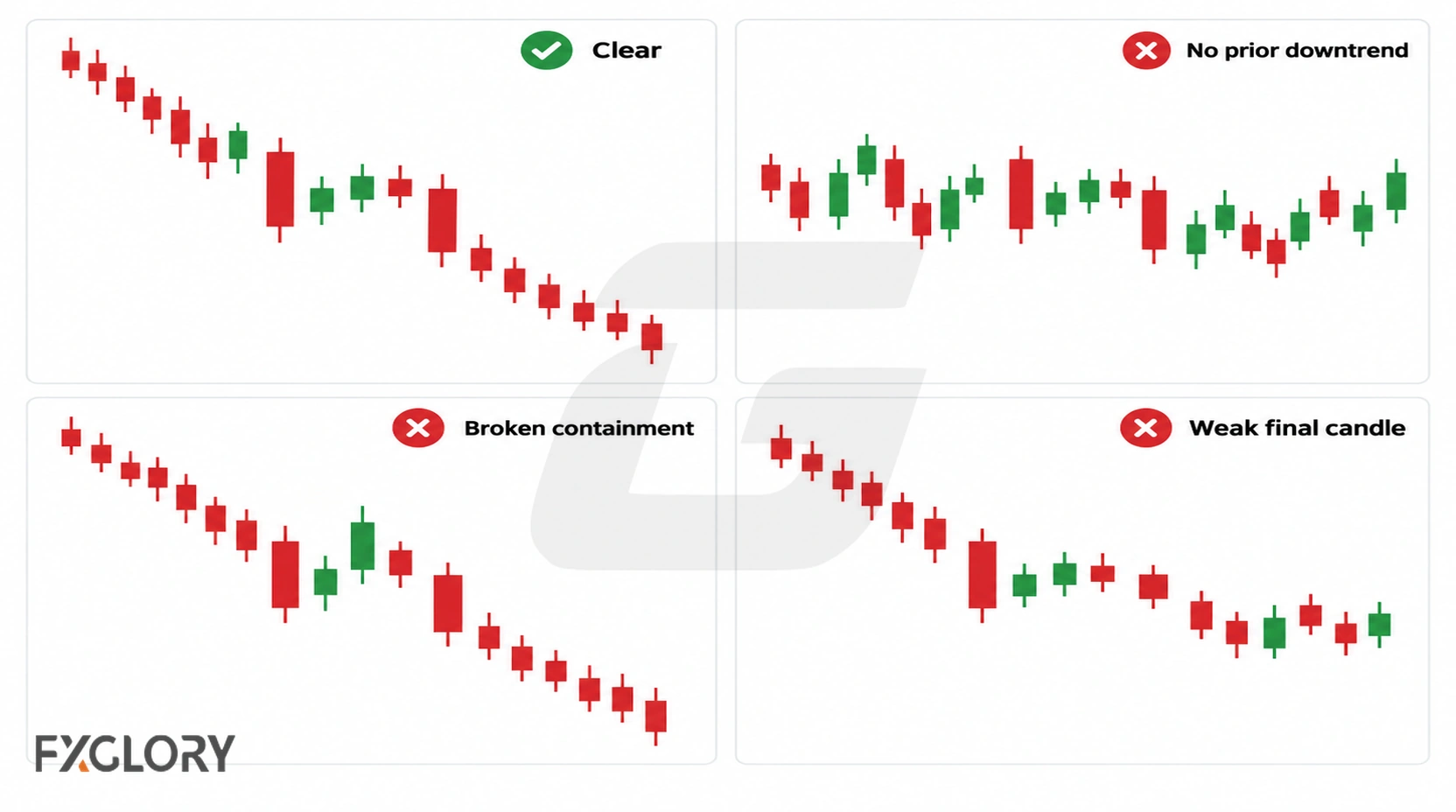
The pattern can also be misleading when it forms during abnormal volatility. A large first candle during a news event may create a range that makes the following candles look contained, even though the structure is not part of a clean trend.
Falling three methods should not be forced onto ordinary candle clusters. Some historical pattern studies describe the formation as relatively rare, which is another reason to treat clean structure as more important than simply finding five nearby candles.
| False-Reading Type | What Happens | Safe Reading |
|---|---|---|
| No prior downtrend | The sequence appears in sideways movement. | Continuation logic is weak. |
| Middle candles break containment | The pause moves above the first candle's high. | The controlled-pause structure weakens. |
| Weak final candle | The final candle does not close below the first candle's close or restore downward pressure. | The pattern remains unresolved. |
| News-driven first candle | The first candle is unusually wide because of fast movement. | Treat the structure as volatility first. |
| Immediate recovery after completion | Later candles cancel the continuation area quickly. | The pattern did not hold its reading. |
| Support reaction | The final candle pushes into a lower-price area where price has reacted before. | Support context may weaken a simple continuation reading. |
- Do not force five candles into a pattern: The sequence needs downtrend context and controlled middle candles.
- Watch the first candle: If it is abnormal or news-driven, the whole structure may be harder to read.
- Do not ignore the middle candles: A strong upward recovery is not the same as a controlled pause.
- Check the final candle: Continuation logic weakens when the final candle does not show clear downward response.
Common Mistakes With Falling Three Methods In Forex
Falling three methods can be easy to mislabel because traders may focus on the five-candle count and ignore the sequence quality. The shape matters, but the trend and containment matter more.
- Ignoring the prior downtrend: The pattern is a continuation structure, so it needs a downward move to continue.
- Counting any five candles: A random five-candle group is not falling three methods.
- Ignoring middle-candle containment: The pause should remain controlled inside the first candle's structure in the cleaner version.
- Confusing it with three black crows: Three black crows has consecutive bearish candles, while falling three methods has a pause phase.
- Confusing it with evening star: Evening star is a bearish reversal sequence, while falling three methods is a bearish continuation sequence.
- Confusing it with inside bar: Inside bar is a two-candle range-compression pattern, not a full continuation sequence.
- Confusing it with dark cloud cover: Dark cloud cover is a two-candle bearish pushback into a prior bullish body.
- Overvaluing volume references: Spot forex volume data can vary by source, so candle structure and price context should remain central.
- Ignoring news and volatility: A sequence around abnormal volatility may be harder to interpret.
- Reading before the final candle closes: The pattern is incomplete until the final candle finishes.
- Replacing risk planning with pattern confidence: A continuation pattern does not replace risk limits, position sizing, or a clear invalidation area.
What To Study After Falling Three Methods
After learning falling three methods, compare it with nearby bearish continuation, bearish pressure, and bearish reversal structures. This keeps the page focused on pause-and-resume continuation rather than every bearish candle sequence.
For the bullish opposite, review rising three methods in forex. For bearish pressure without a pause phase, review three consecutive bearish candles. For a bearish reversal sequence after buying pressure, review the evening star guide. For contained two-candle structures, review inside-bar range compression and harami body contraction. For the broader library, return to forex candlestick pattern groups.