What Is a Triple Top Pattern in Forex?
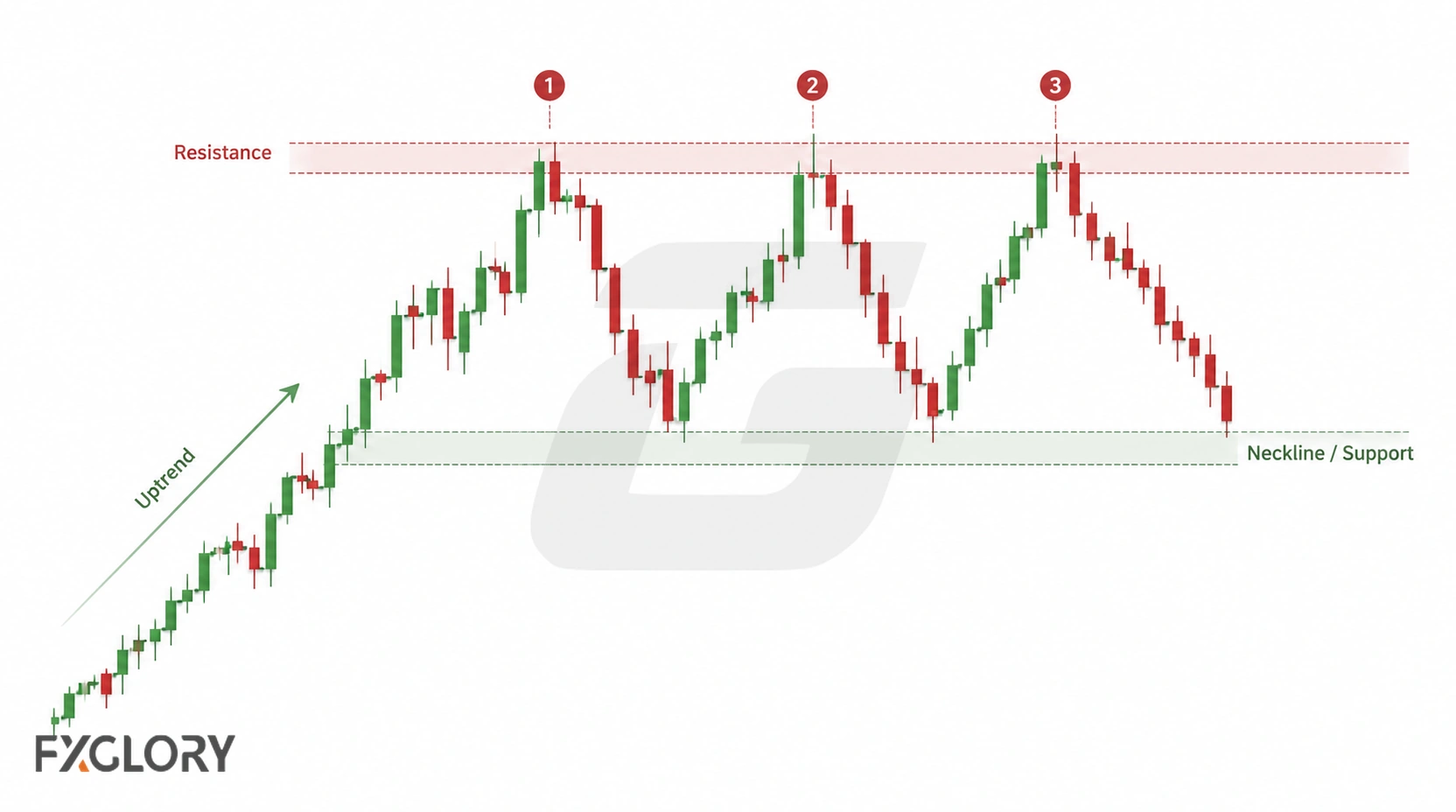
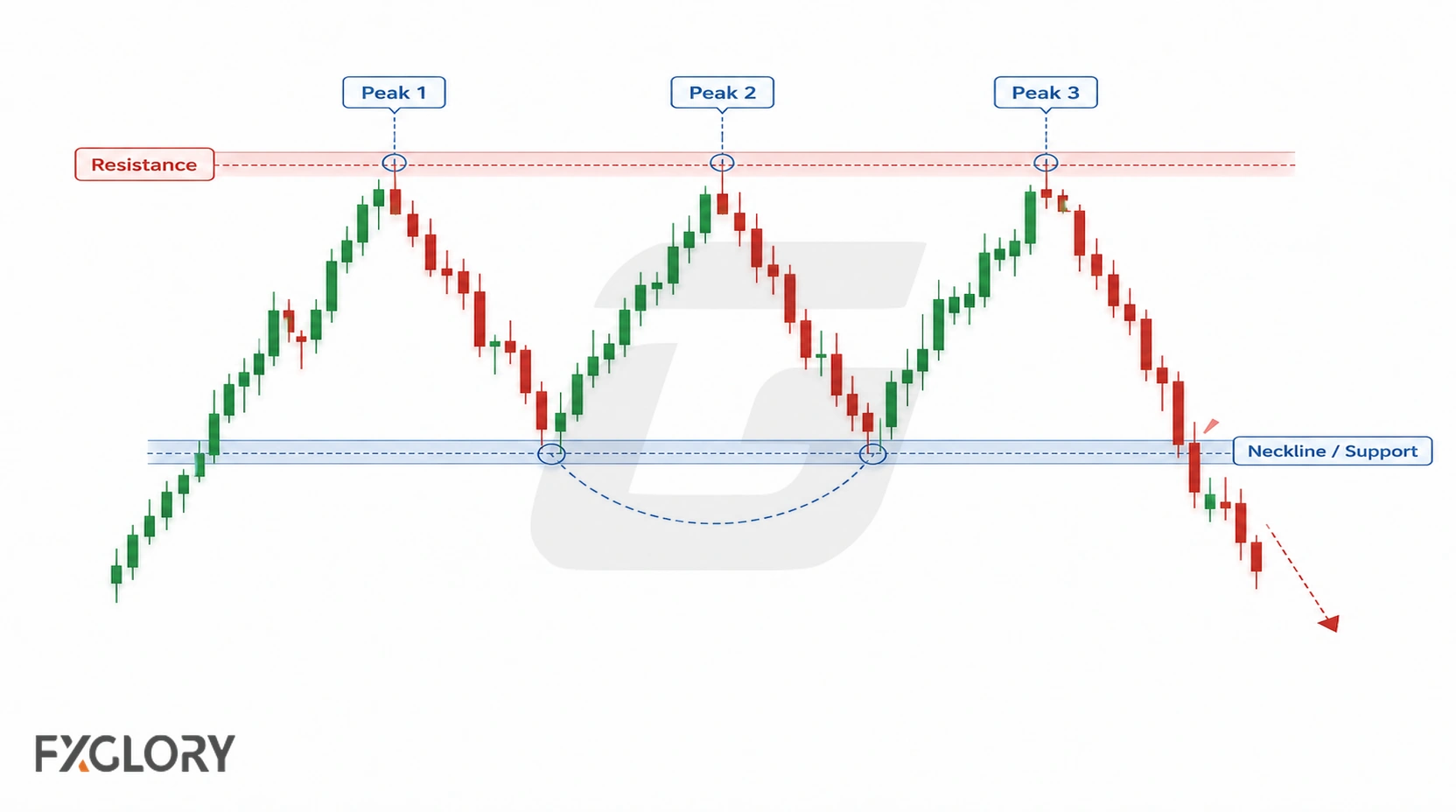
A triple top pattern in forex is a bearish reversal candidate that may form after an upward move when price fails around a similar resistance area three times. Each peak shows another attempt to move above the resistance area, and each failure may suggest that upward pressure is weakening.
The three peaks do not need to match perfectly. Forex charts often include wicks, spread effects, and short-term volatility. The important idea is repeated resistance around the same area, not mathematically identical highs.
A triple top is not complete just because three highs appear. The support or neckline area between the peaks matters because it shows whether sellers can push price below the structure. In forex, this neckline is often better treated as a support zone rather than one exact price. For broader reversal context, review the trend-exhaustion guide.
How Triple Top Patterns Form
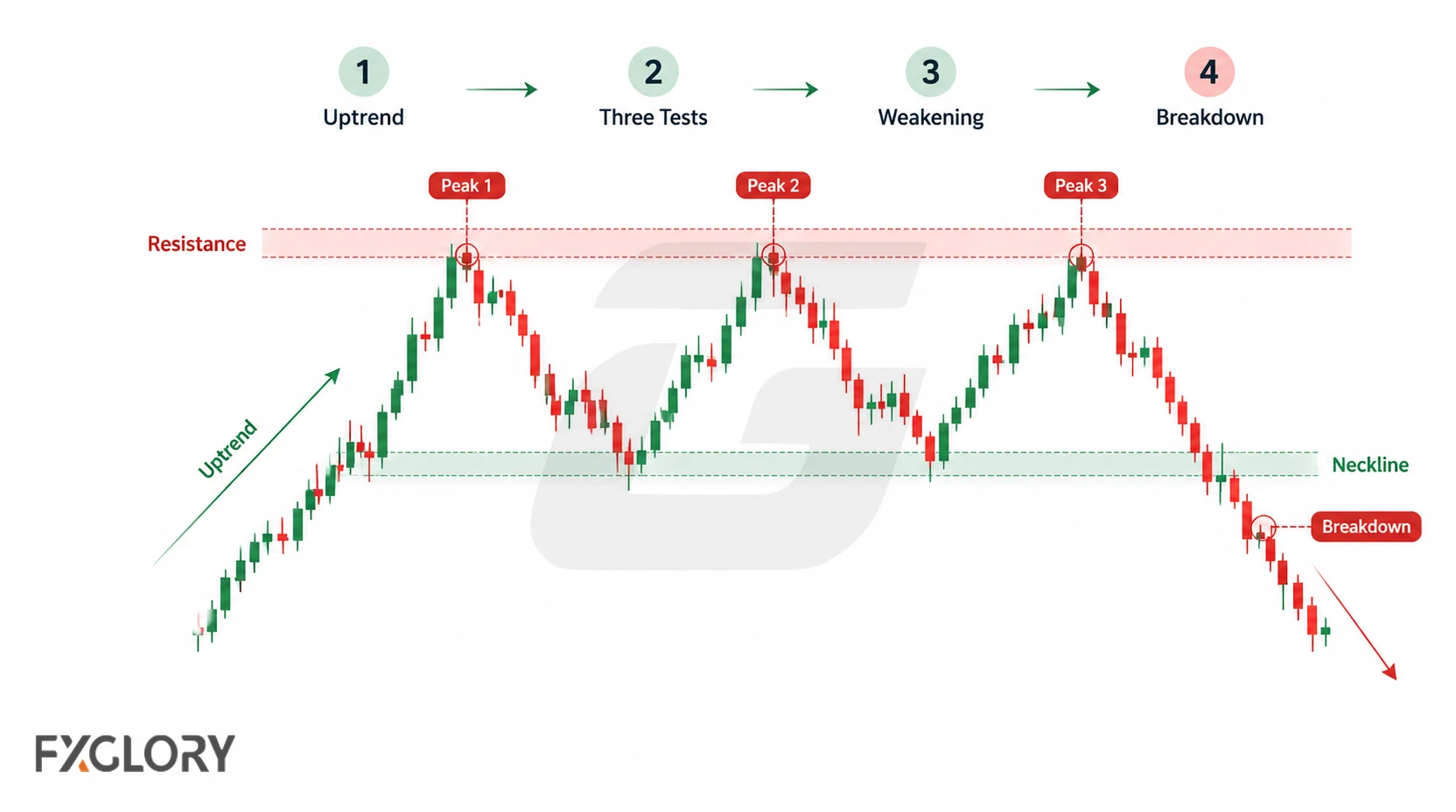
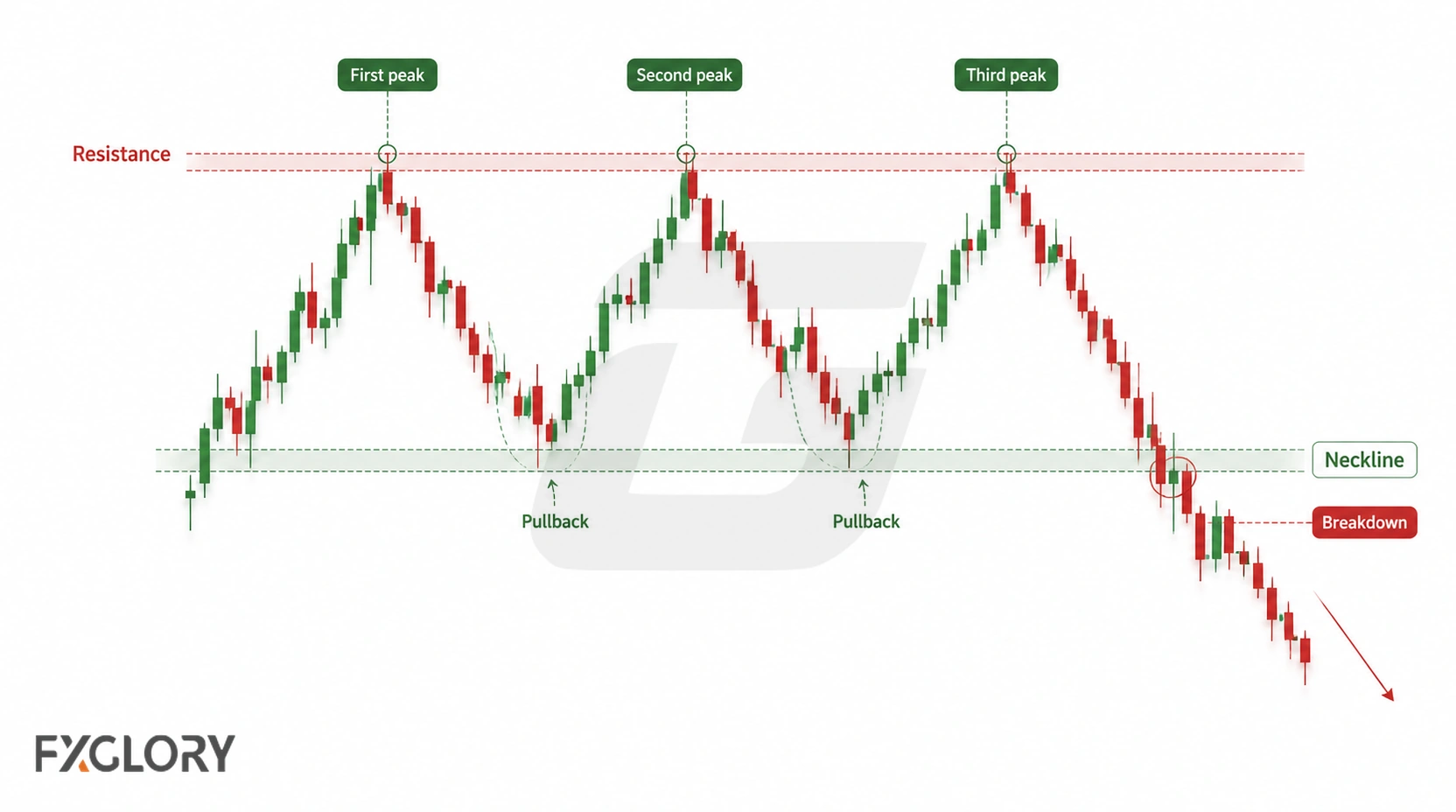
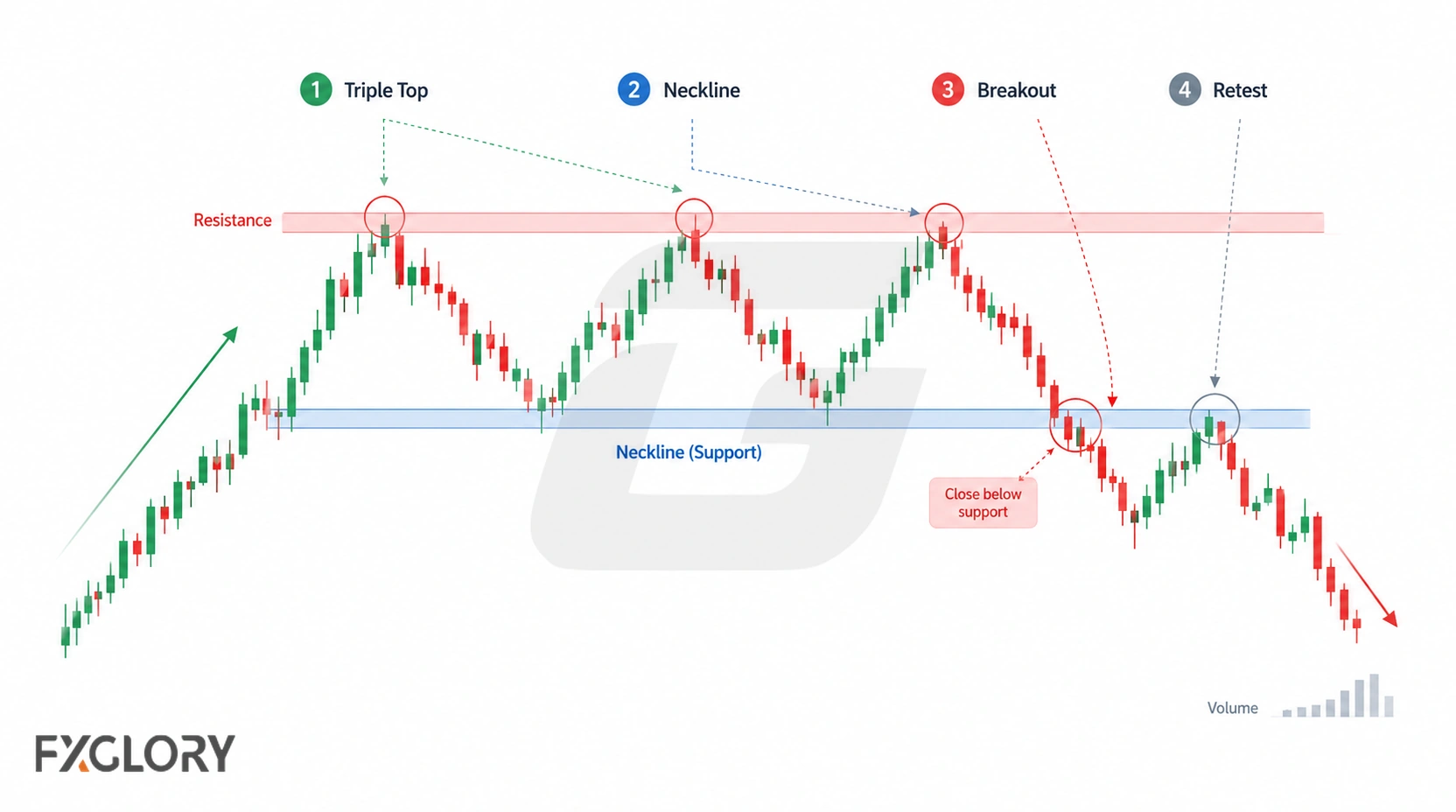
A triple top usually starts with an upward move. Price reaches resistance, pulls back, returns to the same area, fails again, pulls back again, and then makes a third attempt near the same resistance zone.
After the third resistance failure, traders watch the support or neckline area created by the pullbacks between the peaks. If price breaks below that area and holds, the bearish reversal scenario becomes more developed. If price stays inside the structure or breaks above resistance, the triple top idea may weaken.
- Prior upward move: The pattern usually needs an uptrend or upward swing before it forms.
- First peak: Price reaches resistance and pulls back.
- Second peak: Price returns near the same resistance and fails again.
- Third peak: Price tests the resistance area a third time.
- Neckline or support: The pullback lows between the peaks help define the downside confirmation area.
- Break or failure: Price either breaks support, keeps ranging, or invalidates the idea by breaking resistance.
A triple top becomes easier to read when the prior move, resistance area, three peaks, neckline, and invalidation point are clear without forcing the chart.
Triple Top Pattern Anatomy
A forex triple top pattern is built around repeated resistance, pullback support, and neckline behavior.
| Part | What It Means | Why It Matters |
|---|---|---|
| Prior move | The upward move before the structure forms | A triple top is usually read as a reversal candidate after buying pressure has already moved price higher |
| First peak | The first failed move near resistance | Creates the first visible resistance reaction |
| Second peak | The second failed move near the same area | Can make the structure look like a double top before the third peak forms |
| Third peak | The third failed move near resistance | Adds another resistance test, but still needs neckline behavior |
| Troughs | The pullback lows between peaks | Help form the support or neckline area |
| Neckline zone | The support area watched after the third peak | A break below this area is often used to study whether the bearish scenario is developing |
| Invalidation | The condition that makes the triple top idea wrong | Stops the pattern from becoming an open-ended bearish assumption |
Triple Top Pattern Map
Use the quick map below to separate a real triple top candidate from random resistance reactions.
| Stage | Visual Cue | What It Means | Risk Check |
|---|---|---|---|
| 1. Upward move | Price rises before the structure | The market creates the context for a possible bearish reversal | Without a prior move, the pattern may be only a range |
| 2. First resistance test | Price fails near an upper area | Resistance begins to appear | One peak alone is not a pattern |
| 3. Second resistance test | Price fails near the same area again | The structure may look like a double top | It is not a triple top yet |
| 4. Third resistance test | Price fails near resistance a third time | The triple-top candidate becomes clearer | The neckline still matters |
| 5. Neckline test | Price moves toward support between the peaks | The bearish scenario is tested | A break can still become false |
| 6. Hold or failure | Price holds below, retests, or returns above support | The pattern either develops or weakens | A return above the neckline can invalidate the idea |
Triple Top Candidate vs Confirmed Pattern
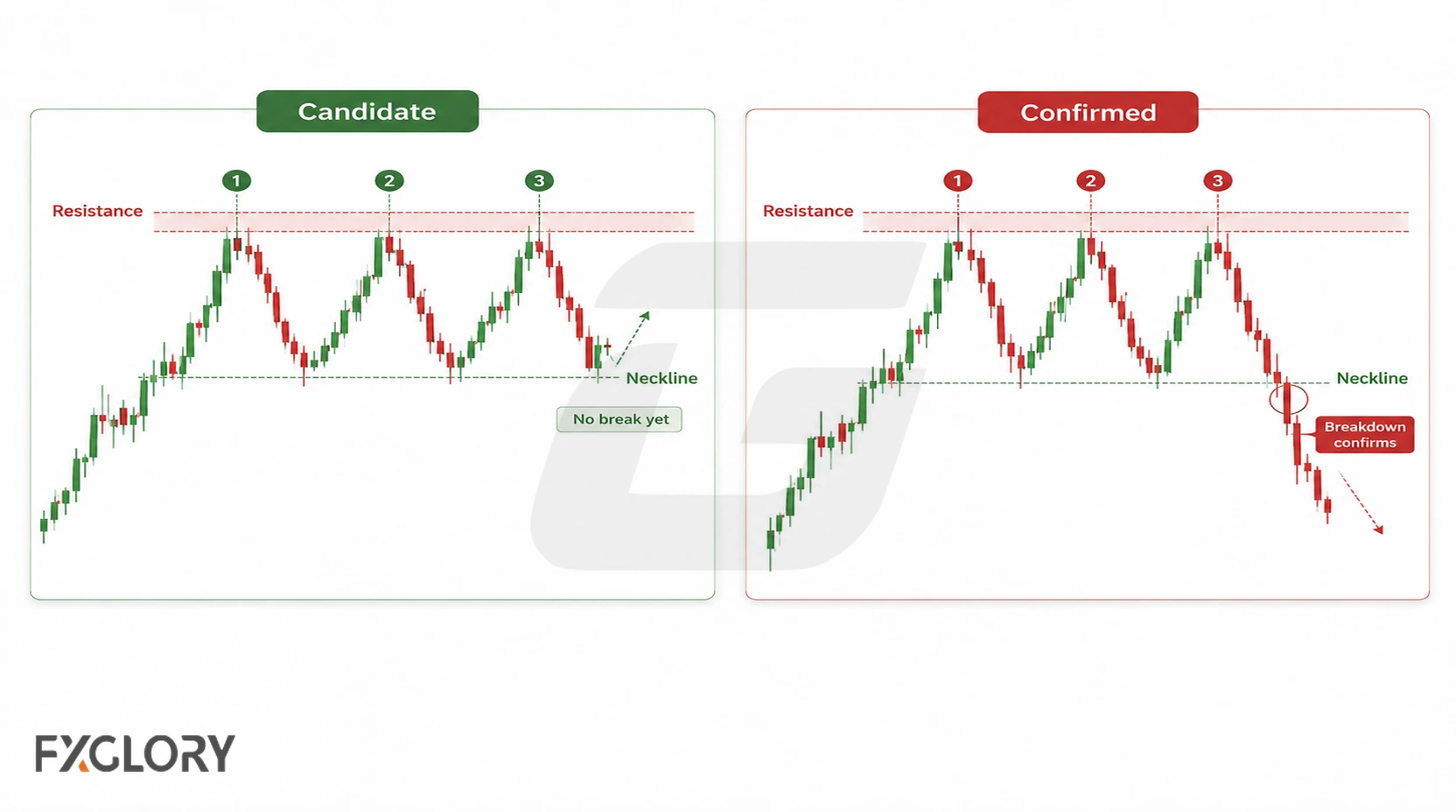
A triple top candidate appears when price has made three resistance tests near the same area. A more developed triple top scenario appears only when price also challenges the neckline or support area after the third peak.
| Stage | What Is Visible | Careful Reading |
|---|---|---|
| Early structure | One or two peaks near resistance | This may become a double top, range, or another structure |
| Candidate triple top | Three peaks near a similar resistance area | The pattern is still incomplete without neckline behavior |
| Developed scenario | Price breaks below support or neckline after the third peak | The break still needs follow-through, hold, or retest behavior |
| Failed scenario | Price returns above the neckline or breaks above resistance | The bearish triple-top reading weakens or becomes invalid |
The Third Top Is Not Confirmation
The third top can be the most tempting part of the pattern because the chart now appears to show three resistance failures. That does not confirm the bearish scenario by itself.
Price can still break above resistance after the third top, continue ranging between resistance and support, or briefly break the neckline and return back inside the structure. The third top shows another failed attempt near resistance; the neckline zone shows whether the structure is actually changing direction.
Neckline and Support in a Triple Top
The neckline in a triple top is the support area created by the pullbacks between the three peaks. It may be drawn through the troughs, or treated as a support zone when the lows are not perfectly aligned.
In forex, treating the neckline as an area is often more practical than treating it as one exact line. Wicks, spread, fast movement, and short-term volatility can make exact-line interpretation unreliable.
| Neckline Behavior | What It May Show | Careful Use |
|---|---|---|
| Support holds | Price does not break below the neckline | The triple top remains unconfirmed or may keep ranging |
| Clean break | Price moves below support with stronger follow-through | The bearish scenario becomes more developed but still carries risk |
| Retest | Price returns toward the broken support area | The retest can support or weaken the breakdown idea |
| Return inside | Price breaks below then moves back above support | The breakdown may be false |
| Neckline unclear | The troughs do not form a usable area | The pattern may be too messy to rely on |
How Equal Should the Three Peaks Be?
The three peaks in a triple top should be close enough to show repeated resistance around the same area. They do not need to be perfectly equal, and small differences are normal on forex charts.
Peak spacing also matters. If the peaks are crowded into a very small area, they may be short-term noise or wick behavior rather than three separate resistance attempts. If the peaks are very far apart, the structure may be part of a broad range, rectangle, or longer consolidation rather than a clean triple top.
The structure weakens when the peaks are far apart, when each peak needs a different resistance line, or when the middle peak is clearly higher than the others. In that case, another pattern may be a better fit.
| Peak Quality | Cleaner Triple Top | Weaker Triple Top |
|---|---|---|
| Resistance area | All three peaks react near a similar zone | Each peak needs a different resistance level |
| Peak shape | The highs show repeated failure around resistance | The peaks are random spikes with little structure |
| Time spacing | The three tests are separated enough to show attempts | The peaks are crowded noise or part of a much wider range |
| Middle peak | The middle peak is not clearly dominant | A much higher middle peak may suggest head and shoulders instead |
| Neckline | The pullbacks create a usable support area | The troughs are too messy to define support |
Triple Top vs Double Top
A triple top can look like a double top before the third peak forms. The difference is the number of resistance tests and how the market behaves after those tests.
| Comparison | Double Top | Triple Top |
|---|---|---|
| Resistance tests | Two peaks near resistance | Three peaks near resistance |
| Early appearance | The structure may complete with two tests | The structure is not visible until a third test forms |
| Confirmation area | Neckline or support between the two peaks | Neckline or support formed by the pullbacks between three peaks |
| Main risk | Assuming reversal before support behavior confirms | Assuming the third peak guarantees reversal |
| Careful reading | Two resistance failures need confirmation | Three resistance failures still need confirmation |
When the chart shows only two resistance reactions, the M-shaped resistance reaction may be the closer structure.
Triple Top vs Head and Shoulders
A triple top can be confused with a head and shoulders pattern because both may include three upper swings and a neckline. The difference is the shape of the peaks.
| Comparison | Triple Top | Head and Shoulders |
|---|---|---|
| Peak shape | Three peaks around a similar resistance area | A higher middle peak between two lower shoulders |
| Main message | Repeated resistance around the same area | Buyer exhaustion after a final higher peak |
| Neckline | Support between the repeated peaks | Support connecting the reaction lows around the shoulders and head |
| Main confusion | Forcing a three-swing top into equal peaks | Calling every three-peak structure head and shoulders |
| Careful reading | Check whether the middle peak is clearly higher | Check whether the shoulder-head-shoulder structure is actually visible |
When the middle peak is clearly higher than the other two, the neckline-based reversal structure may be the better comparison.
Triple Top vs Rectangle and Ascending Triangle
Three highs near resistance do not always create a triple top. They can also appear inside a rectangle, range, or ascending triangle.
| Structure | What It Looks Like | Careful Reading |
|---|---|---|
| Triple top | Three resistance failures after an upward move, followed by neckline pressure | Needs support break behavior before the bearish scenario develops |
| Rectangle | Price keeps rotating between horizontal support and resistance | If the range keeps holding, the structure may be a rectangle rather than a completed triple top |
| Ascending triangle | Resistance stays similar while lows rise underneath | Rising lows can show pressure building upward instead of bearish reversal |
| Ordinary range | Price moves sideways without clear reversal pressure | The market may simply be balanced or waiting for new information |
If price keeps moving between horizontal boundaries, horizontal range behavior may be the closer structure. If the lower side keeps rising into resistance, ascending-triangle pressure may deserve closer attention.
Triple Top vs Triple Bottom
A triple bottom is the mirror version of a triple top, but it forms around repeated support instead of repeated resistance. A triple top is usually studied after an upward move as a bearish reversal candidate; a triple bottom is usually studied after a downward move as a bullish reversal candidate.
This page stays focused on the triple top. The key point is simple: triple top asks whether repeated resistance can lead to a neckline break. Triple bottom asks the opposite question around repeated support and resistance-break behavior.
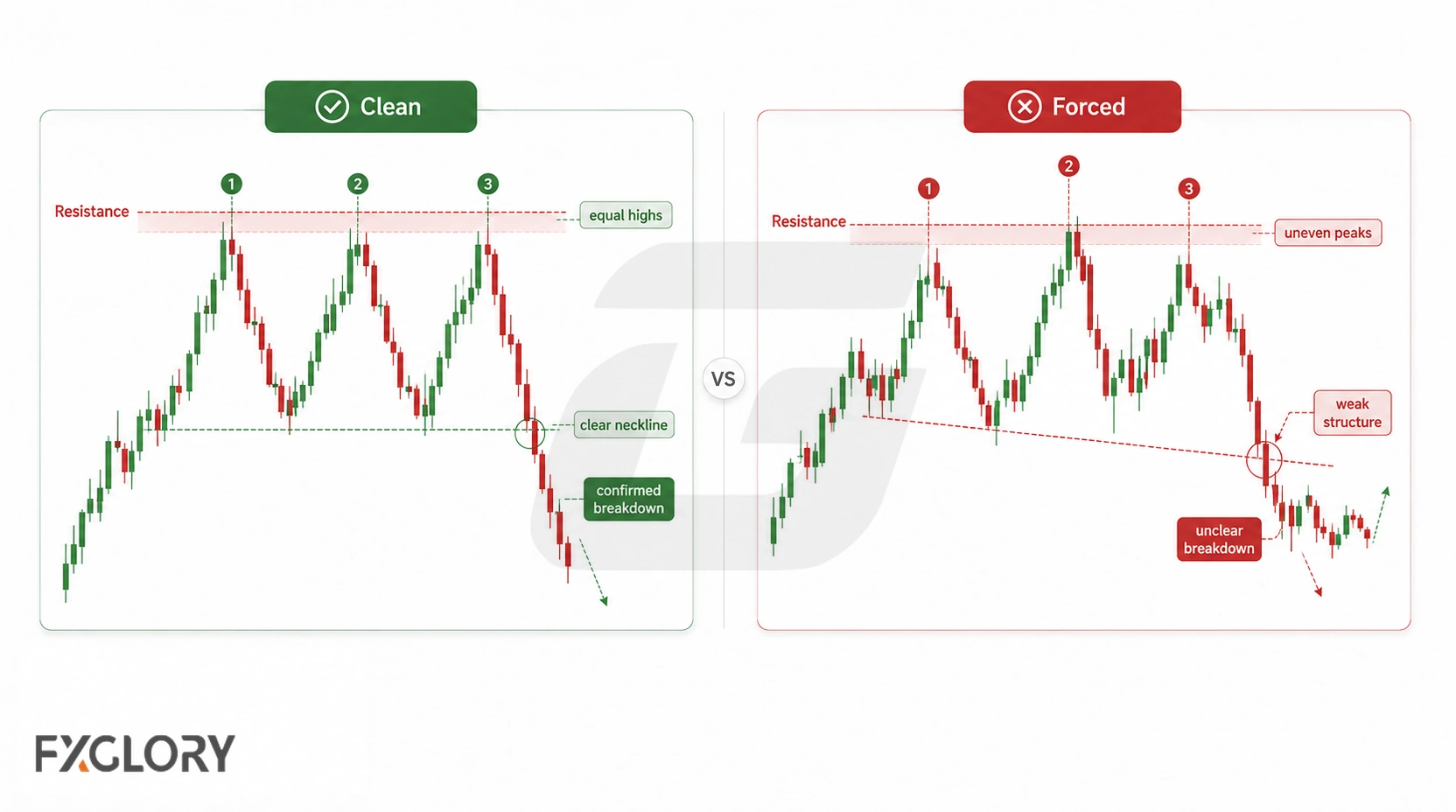
Clean vs Forced Triple Top Patterns
A clean triple top has a visible prior upward move, three resistance tests near the same area, usable pullback lows, and a clear support or neckline area. A forced triple top depends on drawing lines around random highs.
| Chart Factor | Cleaner Triple Top | Forced Triple Top |
|---|---|---|
| Prior move | Price has moved upward before the pattern | The structure appears in random sideways movement |
| Resistance | The three peaks react near a similar area | Resistance must be redrawn to include each peak |
| Troughs | The pullbacks create a usable neckline or support zone | The troughs are too messy or unrelated |
| Third peak | The third test shows another resistance failure | The third high is chosen only to complete the label |
| Breakdown behavior | Price challenges support after the third peak | The pattern is assumed before support is tested |
| Context | The structure fits the broader trend and levels | The pattern ignores higher-timeframe support or resistance |
How to Confirm a Triple Top Pattern in Forex
Confirmation helps separate a visible triple top candidate from a more developed bearish reversal scenario. It does not prove that price will continue lower, but it gives more information than the three peaks alone.
- Start with the prior move: Did price rise before the resistance structure formed?
- Check the resistance area: Are the three peaks close enough to show repeated failure?
- Mark the troughs: Do the pullback lows create a usable support or neckline area?
- Wait for the third test: Do not label the structure triple top before the third resistance failure appears.
- Watch the neckline: Does price break below support after the third peak?
- Check the close or hold: Does price stay below the neckline or quickly return above it?
- Watch the retest: If price returns to the neckline, does the area still matter?
- Use supporting context: Momentum, volatility, candles, and broader trend context may support or weaken the scenario.
- Define invalidation: Decide what price behavior cancels the triple top idea.
Confirmation can include a break below support, a close below the neckline, a failed retest, a lower-high structure after the break, or price holding below the broken area. None of these removes risk.
Invalidation: When the Triple Top Idea Fails
Invalidation is the condition that shows the triple top idea is no longer useful. It should be defined before the trader focuses on any possible measured move or bearish continuation scenario.
- Resistance break: Price breaks above the three-peak resistance area and holds there.
- No neckline break: Price fails to break support after the third peak and keeps ranging.
- False breakdown: Price breaks below the neckline, then returns above it and holds.
- Unclear peaks: The highs are too uneven or too forced to show repeated resistance.
- Pattern transformation: The structure behaves more like a rectangle, ascending triangle, or ordinary range.
- Higher-timeframe conflict: The breakdown idea forms directly into stronger support or a larger bullish structure.
- News-driven shift: A high-impact event changes volatility and overwhelms the pattern.
- No clear wrong point: The trader cannot explain where the triple top idea becomes invalid.
False Triple Top Patterns
A false triple top happens when the chart appears to form three peaks near resistance, but the structure does not confirm bearish reversal or quickly invalidates the idea.
| False Signal | What It Looks Like | Careful Reading |
|---|---|---|
| No prior uptrend | Three highs appear inside random sideways movement | The structure may be a range, not a reversal pattern |
| Peaks too uneven | The highs are far apart or need separate resistance lines | The repeated-resistance idea weakens |
| No neckline break | Price keeps holding support after the third peak | The triple top remains unconfirmed |
| False breakdown | Price breaks support briefly and returns above it | The bearish scenario may have failed |
| Resistance breakout | Price breaks above the three peaks | The triple top idea may be invalid |
| Rectangle behavior | Price keeps rotating between support and resistance | The structure may be a rectangle rather than a completed triple top |
| Ascending lows | The lows rise under flat resistance | The structure may be closer to an ascending triangle |
| News distortion | A fast event-driven move breaks the structure suddenly | Wait for structure to rebuild before judging the pattern |
Triple Top Scanner and Automation Caution
Some traders use scanners or automated tools to identify triple top candidates. These tools may help surface possible structures, but they should not replace manual validation.
A scanner can misread unequal highs, redraw resistance levels, mark a candidate before the third peak or neckline behavior is complete, or ignore higher-timeframe support, news conditions, spread, and slippage. A detected triple top still needs a prior upward move, three visible resistance tests, usable neckline support, confirmation behavior, invalidation, and risk control.
Triple Top Measuring Principle
Some triple top methods use the height between the resistance area and the neckline to estimate a possible move after a confirmed breakdown. The basic idea is to measure the distance from the peak area to the neckline, then use that distance as a reference below the neckline.
This can help organize a scenario, but it should not be treated as a target guarantee. Price may move only part of the way, retest the neckline, return above support, range again, reverse, or fail immediately.
| Step | What It Does | Careful Use |
|---|---|---|
| Measure height | Estimate the distance between resistance and neckline | The range depends on clean peaks and a usable neckline |
| Watch neckline behavior | Identify whether price breaks below support | A break can still fail |
| Use as reference | Project the height below the neckline area | The projection is only a scenario, not a promise |
| Check invalidation | Define where the idea becomes wrong | Invalidation should come before target focus |
Forex Context: Sessions, News, Spread, Slippage, and Timeframes
Forex triple top patterns should be read with market conditions because currency pairs trade across global sessions. A neckline break that looks clean during quiet movement may behave differently during a session overlap, economic release, or fast volatility shift.
- Session behavior: Resistance tests and neckline breaks during active sessions may behave differently from moves during thin liquidity.
- News events: Economic releases and central-bank comments can overpower a triple top structure quickly.
- Spread and slippage: Fast movement around resistance, neckline, retest, or invalidation areas can affect execution and risk.
- Pair behavior: Different currency pairs may trend, stall, retest, and break from triple tops differently.
- Timeframes: A lower-timeframe triple top can conflict with stronger higher-timeframe support, resistance, or trend.
- Volatility shift: A quiet structure can become unstable if movement expands suddenly.
A triple top becomes more useful when the trader can explain the prior move, resistance area, neckline, confirmation condition, invalidation, and market conditions before considering any trade decision.
Volume and Tick Activity in Forex Triple Tops
Many triple top discussions mention volume fading near peaks or increasing during the neckline break. In spot forex, this needs caution because there is no single centralized exchange volume figure for the entire market.
Some traders use tick activity as a supporting clue around resistance, the neckline, or a retest. This can add context, but it should not be treated as proof of reversal. When volume-style context matters, tick-volume reading in forex should stay secondary to structure, confirmation, and risk.
Using Indicators and Candles With Triple Top Patterns
Indicators and candlestick reactions can support triple-top analysis, but they should not replace price structure. The pattern still needs a prior upward move, three resistance tests, neckline behavior, confirmation, and invalidation.
| Tool Type | What It Can Help Read | Careful Use |
|---|---|---|
| Momentum indicators | Whether buying pressure is weakening near repeated resistance | Momentum can fade before price confirms a breakdown |
| Trend-strength indicators | Whether the prior upward move is losing strength | They may lag during reversals or false breakdowns |
| Volatility indicators | Whether movement is expanding around the neckline | High volatility can make false breaks more common |
| Candlestick reactions | Short-term rejection near resistance or the neckline | One candle is not the same as triple top confirmation |
| Tick activity | Activity around peaks, neckline break, or retest areas | It is supporting context, not centralized market volume |
When movement size changes around the neckline, ATR-based volatility context can help frame conditions. When candle reaction matters near resistance or support, candlestick behavior around key areas can add short-term detail. For broader momentum or trend context, indicator-based chart context may help organize the reading.
Example: Reading a Triple Top Pattern on EUR/USD
Suppose EUR/USD moves upward, then fails near a similar resistance area three times. A trader may first describe the market as a triple top candidate, without assuming that reversal has already been confirmed.
If price later breaks below the support or neckline between the peaks and holds, that may create one bearish reversal scenario to study. If price breaks the neckline and quickly returns above it, the breakdown idea may weaken. If price breaks above the three-peak resistance area, the triple top idea may be invalid.
The useful questions are simple: Was there a prior upward move? Are the three peaks near the same resistance area? Is the neckline clear? Does price confirm below support or return inside the structure? Where is the triple top idea wrong?
Common Mistakes With Forex Triple Top Patterns
Triple-top mistakes often happen when traders focus on the three peaks but ignore the support area below them.
- Calling it too early: The trader labels the pattern before the third peak and neckline behavior are visible.
- Treating the third top as confirmation: The trader assumes reversal as soon as the third peak appears.
- Forcing equal highs: Resistance is adjusted around random peaks to create the pattern.
- Ignoring peak spacing: Crowded wick noise or very wide range behavior is treated as a clean triple top.
- Ignoring the prior move: Three highs inside sideways movement are treated as a reversal pattern.
- Ignoring the neckline: The trader assumes bearish reversal before support is tested or broken.
- Confusing it with double top: A two-peak structure is called triple top before the third test forms.
- Confusing it with head and shoulders: A higher middle peak is treated as a triple top instead of a different structure.
- Confusing it with rectangle or triangle: Range behavior or ascending pressure is ignored.
- Overtrusting scanners: A detected candidate is treated as a confirmed triple top.
- Ignoring false breakdowns: Price breaks the neckline briefly, then returns above it.
- Missing higher-timeframe context: A lower-timeframe breakdown forms directly into larger support.
- Overusing volume assumptions: Volume-style clues are treated as if spot forex had one centralized exchange volume figure.
- No invalidation: The trader knows the expected bearish direction but not the point where the idea is wrong.
Beginner Workflow for the Triple Top Pattern
A clear process helps keep triple top patterns from becoming simple resistance-line guesses.
- Start with the prior move: Check whether price moved upward before the structure formed.
- Mark resistance: Identify whether price failed near a similar area three times.
- Check peak quality: Decide whether the highs are close enough without forcing them.
- Check peak spacing: Decide whether the peaks show three separate tests or only noisy wicks inside a range.
- Mark the neckline: Identify the support zone created by the pullbacks between peaks.
- Check pattern alternatives: Decide whether the chart looks more like a double top, head and shoulders, rectangle, or ascending triangle.
- Wait for evidence: Look for a neckline break, close, hold, retest, or supporting context.
- Watch for false breakdowns: Check whether price returns above the neckline after breaking it.
- Define invalidation: Mark where the triple top idea becomes wrong.
- Check forex conditions: Consider session, news, spread, slippage, volatility, and pair behavior.
- Review the outcome: Whether the idea works or fails, check if the triple top structure was actually clear.
This process keeps the focus on prior trend, resistance quality, neckline behavior, confirmation, invalidation, and risk instead of treating three peaks as an automatic reversal signal.
A Safer Way to Read Triple Top Patterns in Forex
The triple top pattern helps traders organize a possible bearish reversal scenario after price fails around the same resistance area three times. The three peaks show repeated resistance, but the neckline zone shows whether the structure is actually developing into a reversal scenario.
The strongest triple top ideas usually have a prior upward move, three visible resistance tests, a usable neckline zone, confirmation below support, and a defined invalidation point. If these parts are missing, the pattern may not be ready for a trading decision.
Triple-top analysis becomes more useful when it is read with context. Session behavior, news, spread, slippage, volatility, timeframe alignment, pair behavior, position size, and account risk still matter.
Frequently Asked Questions
What is a triple top pattern in forex?
A triple top pattern in forex is a bearish reversal candidate that may form after an upward move when price fails around a similar resistance area three times and later tests neckline or support behavior. The phrase triple top forex pattern usually refers to the same structure.
Is a triple top pattern always bearish?
No. A triple top is usually studied as a bearish reversal candidate, but it is not automatically bearish. Price still needs confirmation, and the pattern can fail, continue ranging, or break above resistance.
Do the three highs in a triple top need to be equal?
The three highs do not need to be perfectly equal. They should be close enough to show repeated resistance around the same area. If the highs are far apart or forced, the structure may not be a clean triple top.
When is a triple top pattern confirmed?
A triple top is usually treated as more developed after price breaks below the support or neckline area between the peaks and shows follow-through, a hold, or a meaningful retest. A quick break can still become a false breakdown.
What invalidates a triple top pattern?
A triple top idea may weaken or fail if price breaks above the resistance area, returns above the neckline after a breakdown, loses clear support structure, or turns into a range, rectangle, or another pattern.
What is the difference between a triple top and a double top?
A double top has two resistance tests, while a triple top has three. The third test gives more information about resistance, but it does not guarantee reversal.
What is the difference between a triple top and head and shoulders?
A triple top usually has three peaks around a similar resistance area. A head and shoulders pattern usually has a higher middle peak, called the head, between two lower shoulders.
Can a triple top turn into a rectangle?
Yes. If price keeps rotating between horizontal support and resistance without a confirmed neckline break, the structure may behave more like a rectangle or range than a completed triple top.
Can indicators confirm a triple top pattern?
Indicators may help traders read momentum, volatility, trend strength, or tick activity around a triple top. They should be used as supporting context, not proof that price will reverse.
Should beginners trade triple top patterns alone?
Beginners should not treat a triple top as a complete trade signal. The pattern should be studied with prior trend, resistance quality, neckline behavior, confirmation, invalidation, position size, and risk control.
Related Contents
Practice Reading Triple Top Patterns Before Trading Live
Use an FXGlory demo account to practice identifying triple top structures, testing neckline and false-break scenarios, placing demo orders, and reviewing decisions before using real money.
Open a Demo Account