
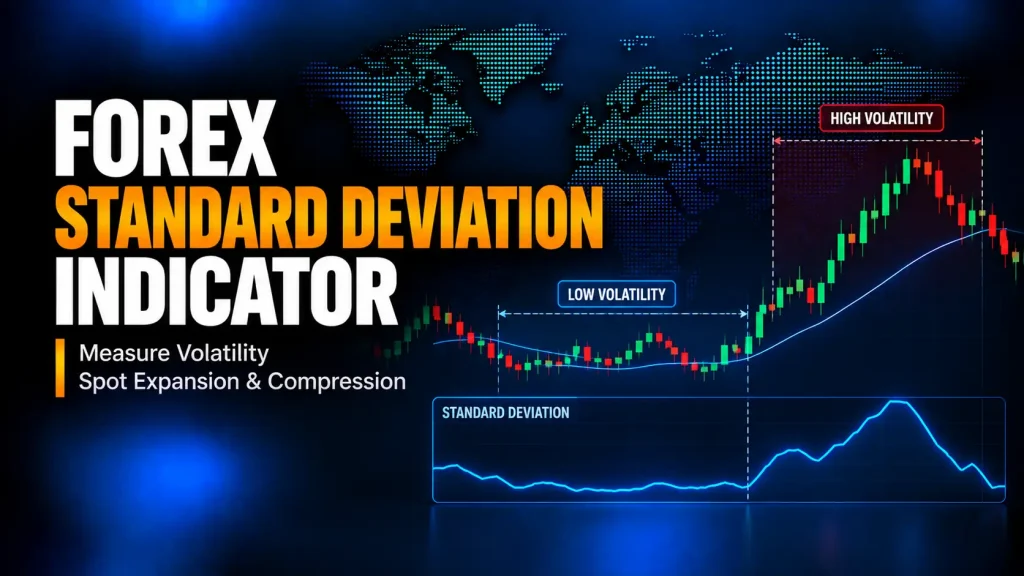
What Is the Standard Deviation Forex Indicator?
The Standard Deviation forex indicator measures how widely price values spread around an average. When price values move farther from the average, standard deviation rises. When price values stay closer to the average, standard deviation falls.
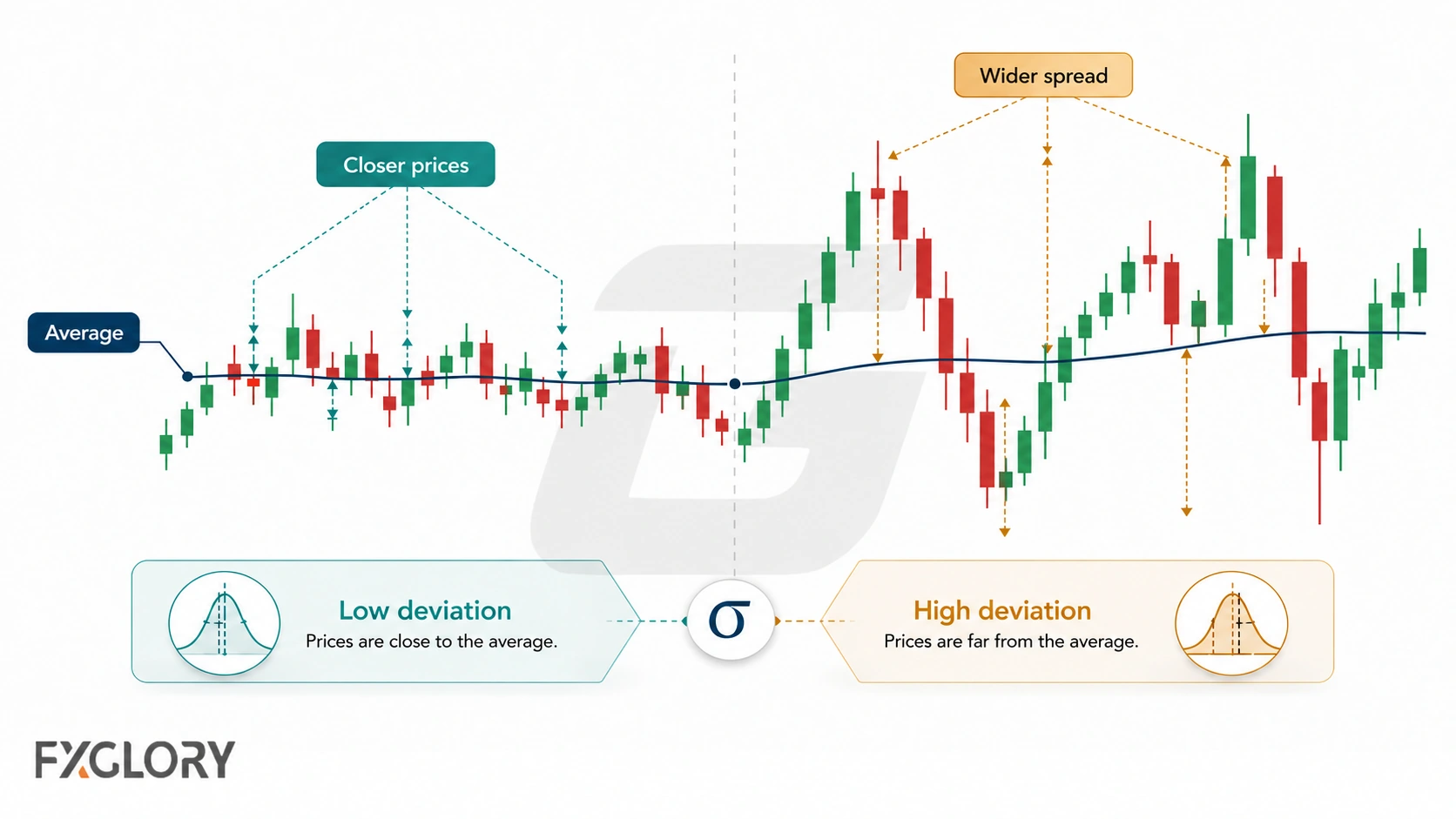
This makes Standard Deviation a volatility indicator. It does not show whether a currency pair should move up or down. It shows whether price movement is wider, quieter, expanding, or compressing compared with the selected period and settings.
Standard Deviation belongs with technical indicators used to measure price behavior. It can help traders read volatility, but it should not replace price action, trend structure, support and resistance, or risk planning.
Standard Deviation Indicator vs Other Meanings of Deviation
The word deviation has several meanings in forex. This page focuses on the Standard Deviation indicator, not every use of the word.
- Standard Deviation indicator: Measures how far price values spread around an average.
- Price deviation: Describes price moving away from a benchmark such as a moving average.
- Indicator deviation setting: Controls how some tools display distance from an average, such as Bollinger Band width.
- Execution deviation: Refers to order-price tolerance in MT4/MT5-style execution settings.
For the broader meaning, including price deviation and execution tolerance, review different meanings of deviation in forex.
How Standard Deviation Is Calculated
Standard deviation compares each selected price value with the average, measures how far those values are from the average, and turns that distance into one volatility reading.
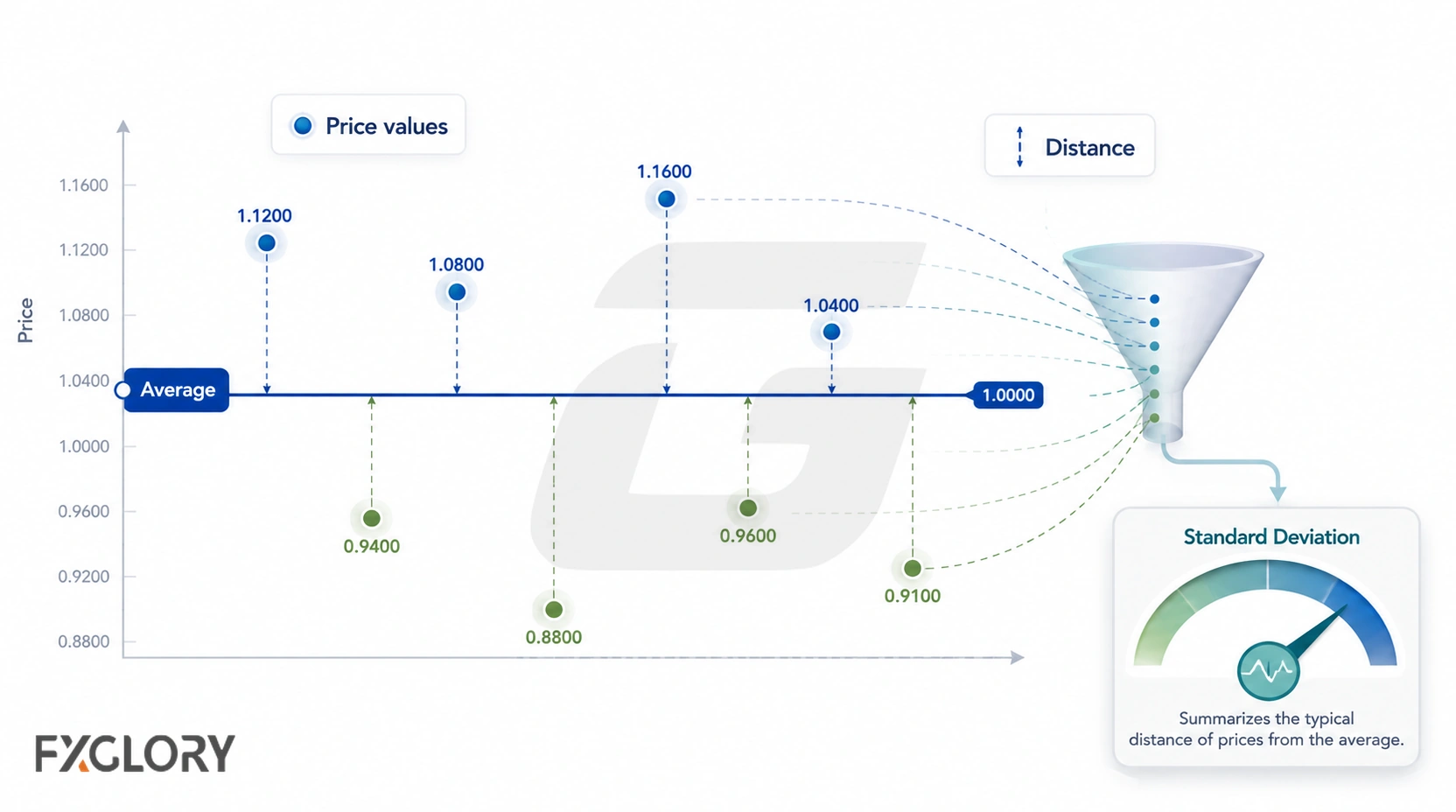
The simplified idea is:
Standard Deviation = typical distance of price values from their average
In simple terms, the indicator finds the average price for the selected period, measures how far each price value is from that average, squares those differences, averages them, and then takes the square root. A larger result means price values are more spread out from the average. A smaller result means price values are closer to the average.
Most platforms calculate this automatically. The trader usually chooses settings such as period, method, applied price, and timeframe. The indicator then updates as new price data appears.
- Choose a period: The platform reviews a selected number of candles or price values.
- Find the average: The indicator calculates the average for that selected data.
- Measure distance: Each price value is compared with the average.
- Square and average the differences: Squaring turns negative and positive differences into comparable distances.
- Take the square root: The final value becomes the standard-deviation reading shown by the indicator.
How to Read Higher, Typical, and Lower Standard Deviation
A Standard Deviation reading is usually read by comparing the current value with its recent behavior on the same chart. A high value on one pair or timeframe may not mean the same thing on another pair or timeframe.
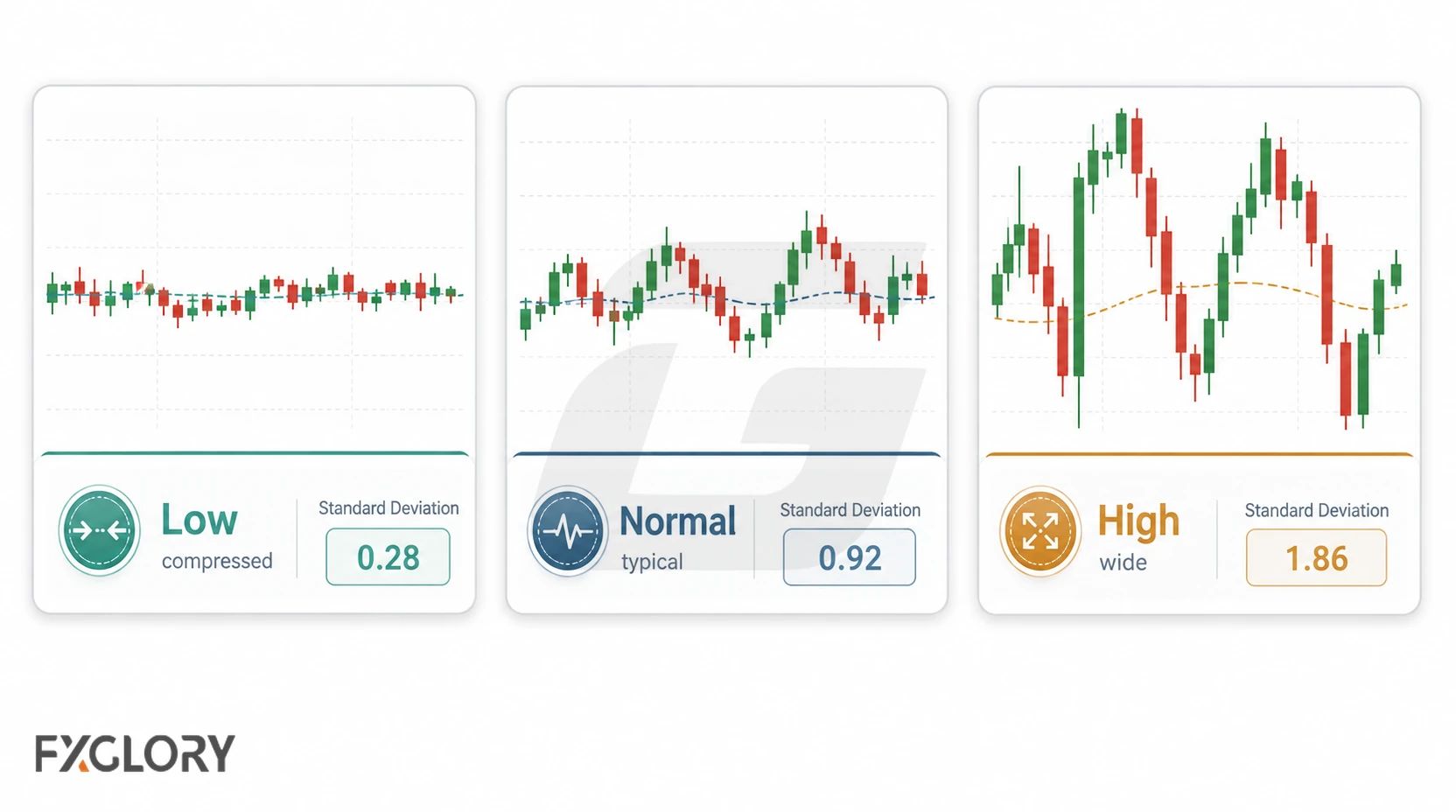
- Higher relative reading: Price movement is wider or more variable around the average than its recent behavior.
- Typical relative reading: Price dispersion is close to its recent behavior, without clear volatility expansion or contraction.
- Lower relative reading: Price movement is quieter or more compressed around the average than its recent behavior.
- Rising standard deviation: Volatility may be expanding.
- Falling standard deviation: Volatility may be contracting.
A higher relative reading can appear during strong trends, fast breakouts, news movement, or disorderly volatility. A typical relative reading means price dispersion is close to recent behavior. A lower relative reading can appear during quiet ranges, pauses, or consolidation. None of these readings is a trade signal by itself.
Volatility Expansion and Contraction
Standard Deviation is often used to study volatility expansion and contraction. Expansion means price values are spreading farther from the average. Contraction means price values are staying closer to the average.
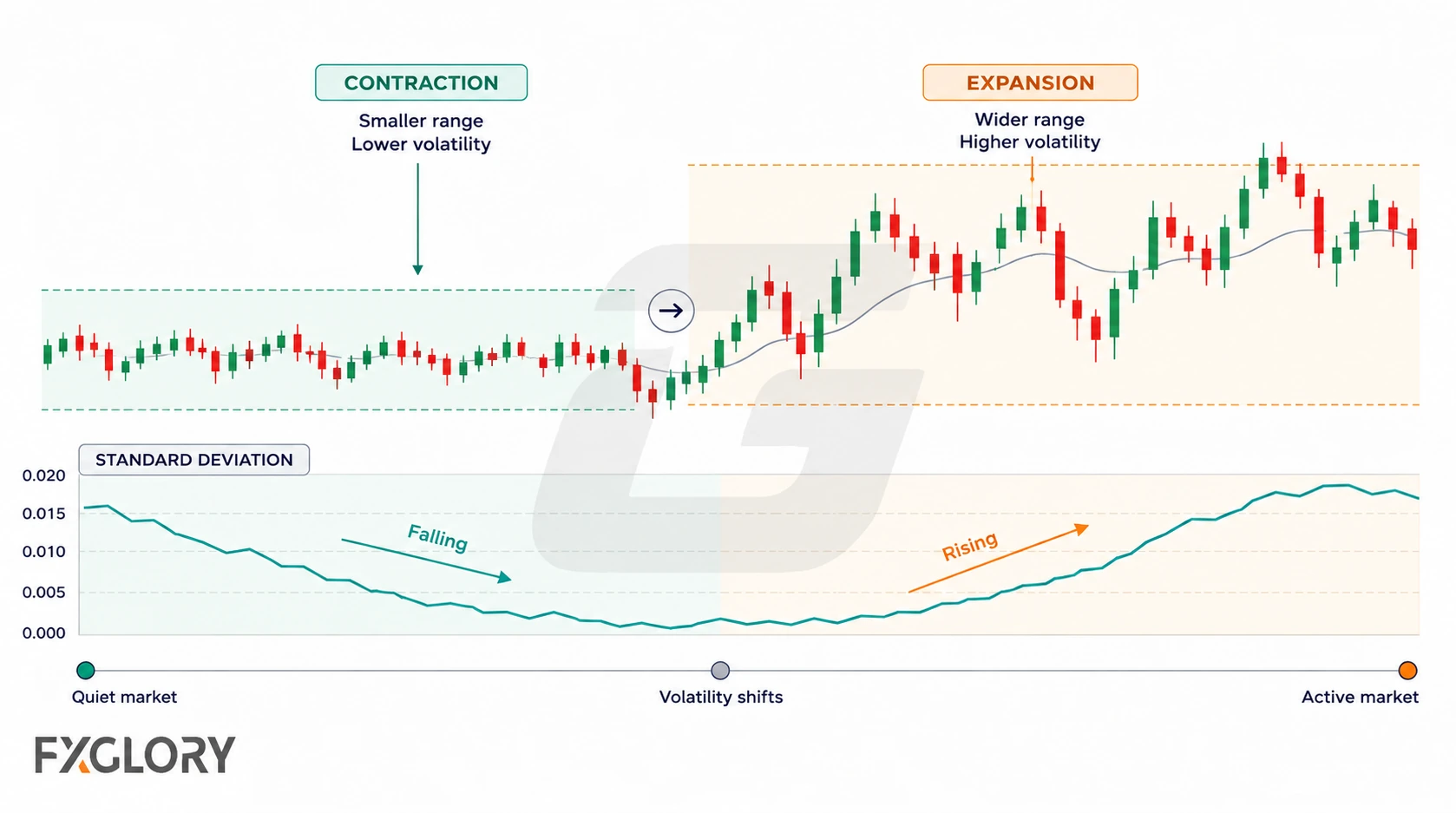
During expansion, candles may become larger, ranges may widen, or price may move faster. During contraction, candles may become smaller, price may move sideways, or the market may wait for new information.
This connects Standard Deviation with volatility tools used in forex analysis. The indicator helps describe the movement environment, but it does not decide direction.
- Expansion after compression: May show that quiet conditions are changing.
- Expansion during a trend: May show stronger movement, but also wider risk.
- Contraction after a move: May show pause, consolidation, or reduced activity.
- Repeated contraction: May show a quiet market where spread and timing still matter.
Standard Deviation Indicator Settings
Settings control how sensitive the Standard Deviation indicator is. A shorter period reacts faster to recent price changes, while a longer period usually gives a smoother reading.
- Period: Controls how many candles or price values are included in the calculation.
- Applied price: May use close, open, high, low, median, typical, or weighted price depending on platform options.
- Moving-average method: Some platforms allow different methods for the average used in the calculation.
- Timeframe: A reading on a 5-minute chart can differ from a reading on a daily chart.
- Symbol and data feed: Different feeds, broker sessions, and symbol settings can change displayed values.
No setting is automatically best for every trader, pair, or market condition. The setting should match the timeframe being studied and should remain consistent during review.
Standard Deviation and Bollinger Bands
Bollinger Bands are one of the clearest uses of standard deviation in forex technical analysis. The middle band is usually based on a moving average, while the upper and lower bands are placed a selected number of standard deviations away from that average.
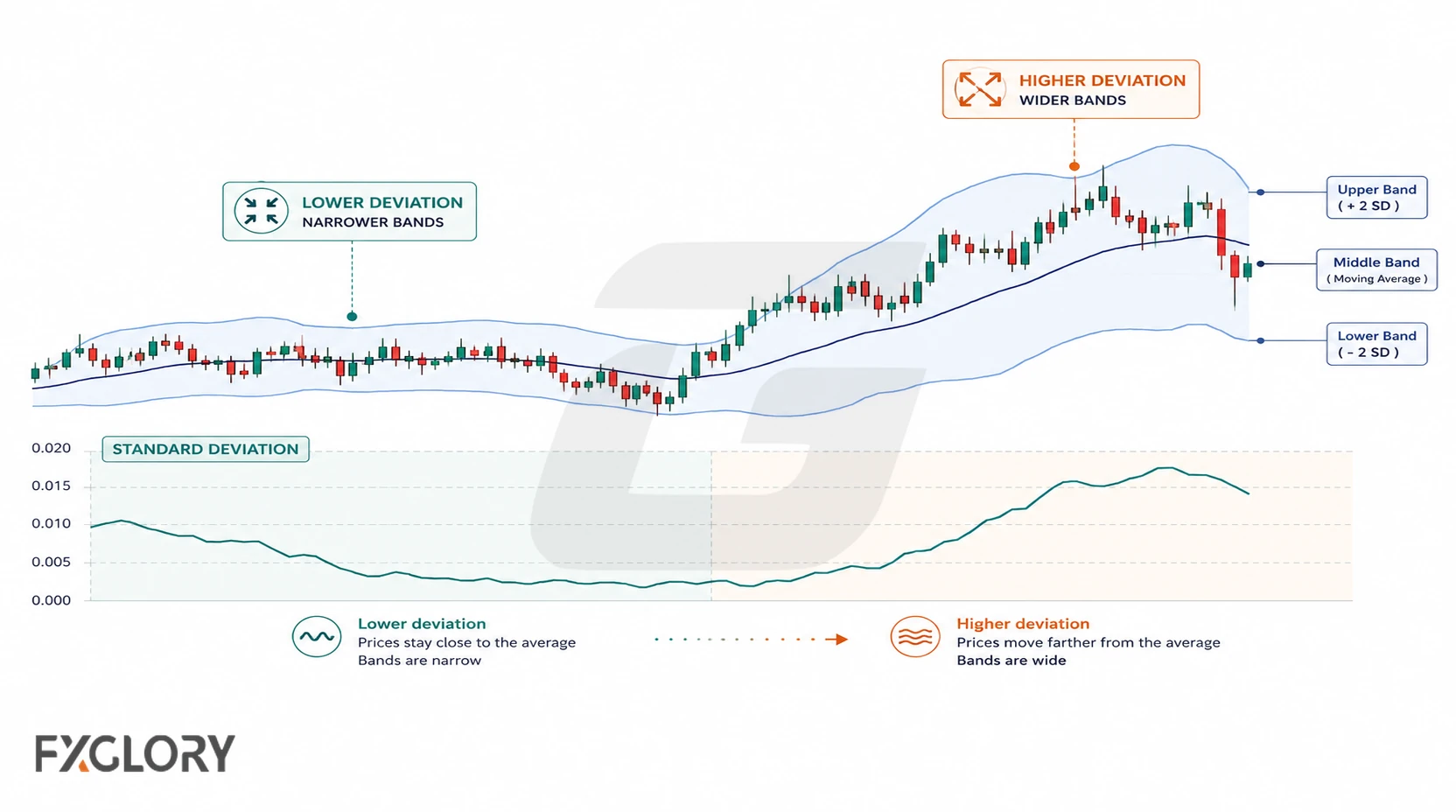
When standard deviation rises, the bands widen. When standard deviation falls, the bands narrow. This is why Bollinger Bands can visually show changing volatility around price.
Traders who need the full Bollinger framework can review how Bollinger Bands use standard deviation to set band width.
- Wider bands: Standard deviation has increased, so price movement is more spread out.
- Narrower bands: Standard deviation has decreased, so price movement is more compressed.
- Band touch: Price reaching a band is not a reversal signal by itself.
- Band squeeze: Compression may show quiet conditions, but it does not guarantee the next direction.
Standard Deviation vs ATR and ADR
Standard Deviation, ATR, and ADR all relate to volatility or range, but they answer different questions.
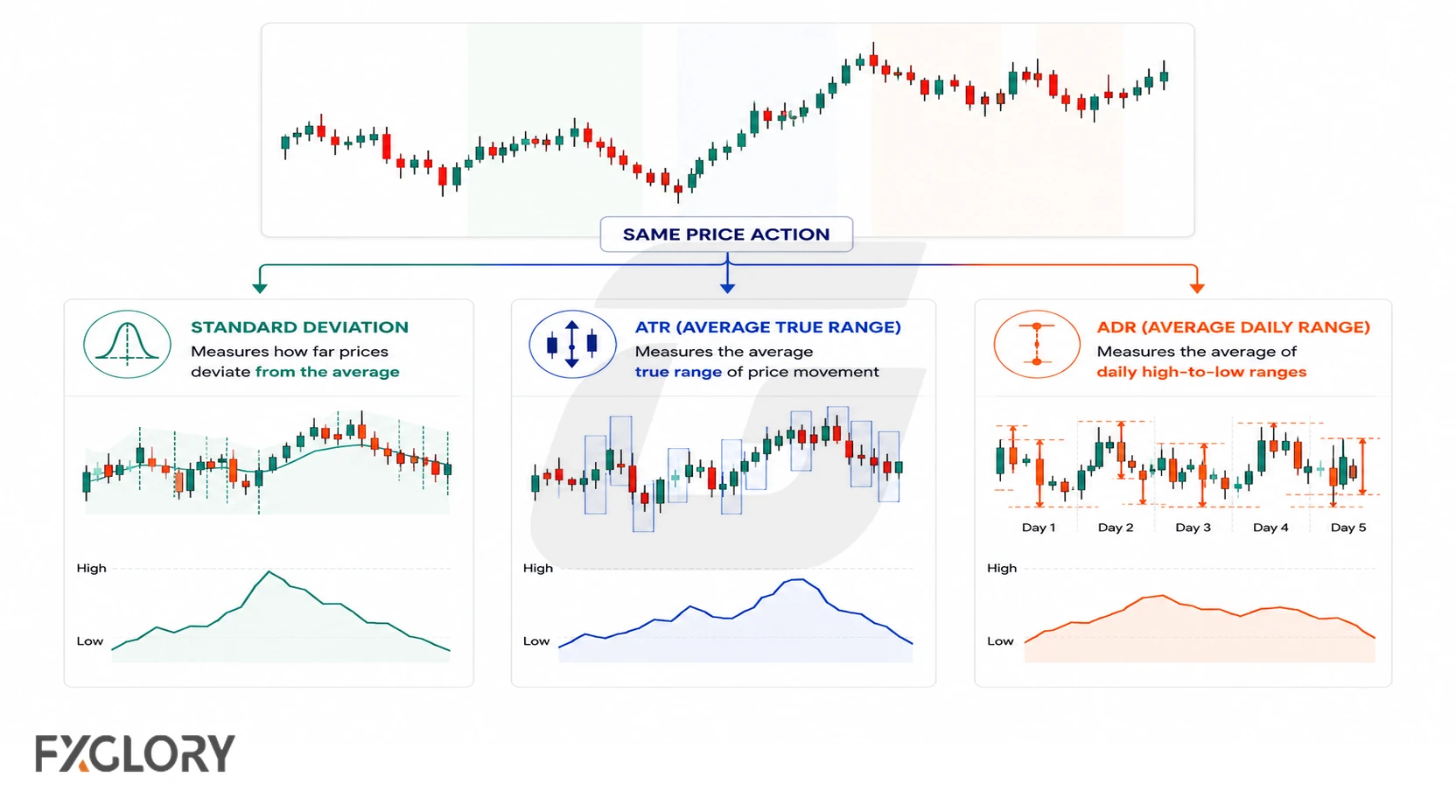
- Standard Deviation: How far are price values spread around their average?
- ATR: How much true-range volatility is the market showing over the selected period?
- ADR: How far does the pair usually move in a trading day?
Standard Deviation is useful for reading dispersion around an average. ATR is often stronger for true-range volatility and stop-distance context. ADR is often better for daily range expectation with ADR.
How Traders Use Standard Deviation in Forex
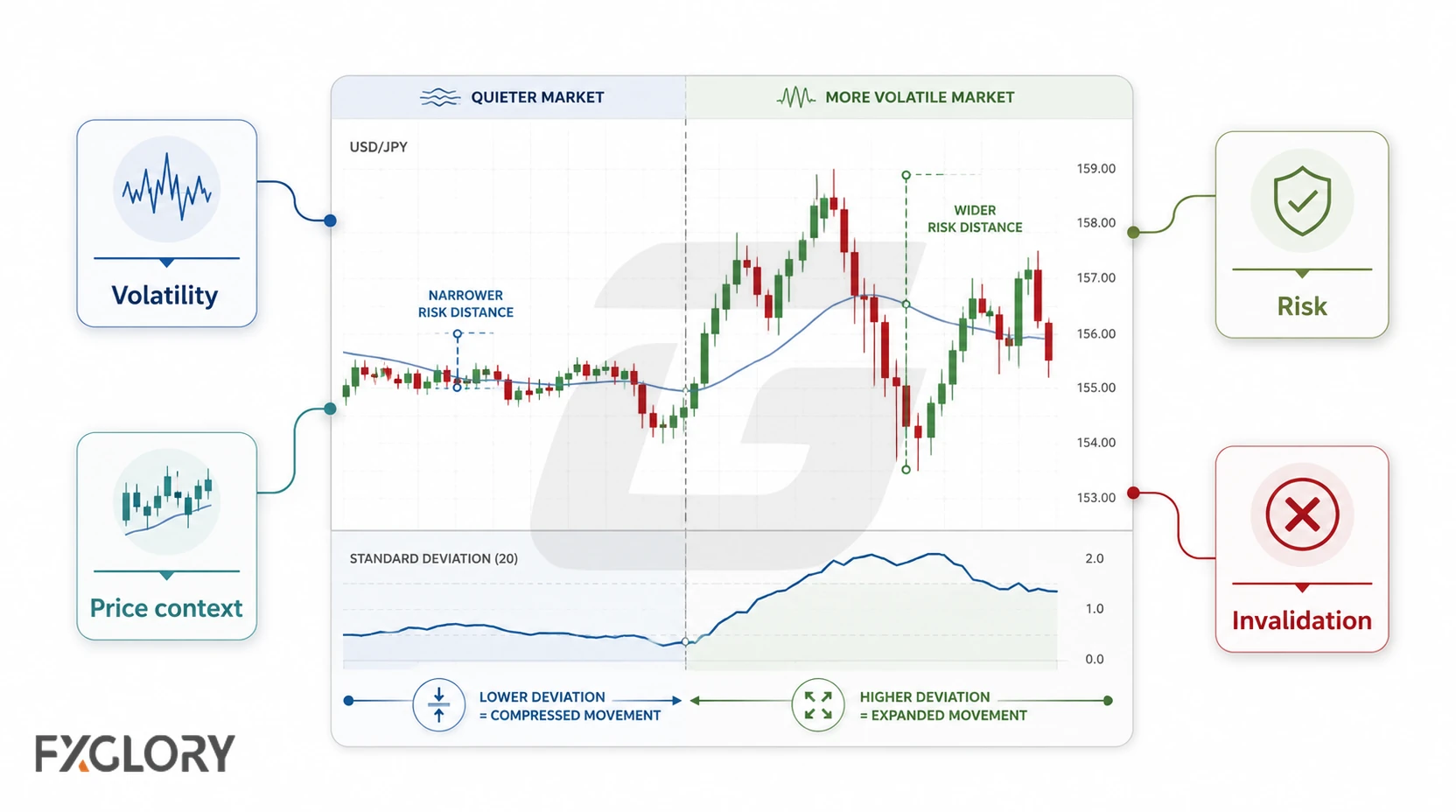
Standard Deviation can help traders understand the volatility environment before making decisions. It can show whether price movement is expanding, compressing, or becoming more variable than before.
Reading Market Conditions
A rising Standard Deviation reading can show that volatility is increasing. A falling reading can show that price movement is becoming quieter. This can help traders decide whether the market environment matches their plan.
Checking Risk Context
When standard deviation is high, price movement may be wider and faster. This can affect stop distance, position size, and execution comfort. When standard deviation is low, price may be quieter, but sudden expansion can still happen.
Adding Confirmation Carefully
Standard Deviation can add volatility context to price action, support and resistance, or another indicator. It should answer a specific question: is volatility expanding or contracting?
Example: Reading Compression and Expansion
Suppose Standard Deviation has been falling while price moves sideways. That may show that the market is compressing. If the reading then rises while candles expand, volatility may be increasing. That still does not decide direction; price structure must confirm whether the expansion is meaningful.
Standard Deviation Across Trading Platforms
Standard Deviation tools can appear differently depending on the platform, symbol, data feed, and settings. Before comparing readings, check the period, calculation method, applied price, timeframe, and instrument settings.
- Indicator settings: Check period, calculation method, applied price, timeframe, and symbol settings before comparing readings.
- Custom tools: Some implementations may show z-scores, deviation channels, bands, or volatility overlays instead of a simple Standard Deviation line.
- Data differences: Session times, candles, feeds, and symbol settings can produce different displayed readings across platforms.
Common Mistakes and Limits
The Standard Deviation indicator is useful, but it becomes risky when traders treat volatility as direction. A volatility reading can describe the market environment, but it does not decide where price should go next.
- Using it as a direction signal: Standard Deviation measures dispersion, not bullish or bearish direction.
- Assuming high deviation means reversal: Price can stay volatile during strong trends or news.
- Assuming low deviation means breakout: Compression can continue longer than expected.
- Ignoring timeframe: A high reading on a short timeframe may not matter on a higher timeframe.
- Changing settings too often: Constant changes make readings hard to compare.
- Confusing it with execution deviation: The indicator is not the same as order-price tolerance.
- Ignoring spread and slippage: High-volatility conditions can affect execution and risk.
When Standard Deviation Is Less Useful
Standard Deviation is less useful when the trader needs direction, exact support and resistance, order-execution tolerance, or a complete trade plan. It is also less useful when market conditions change suddenly and the indicator has not yet adjusted.
- Do not use Standard Deviation as a standalone trading system.
- Do not assume volatility expansion means a safe entry.
- Do not use it to ignore news, spread, or position size.
- Do not compare readings across different settings without checking them first.
Final Thoughts on the Standard Deviation Forex Indicator
The Standard Deviation forex indicator is most useful when it is treated as a volatility-reading tool. It helps traders see whether price values are spreading away from their average or staying compressed around it.
Good use of Standard Deviation starts with the right question: is volatility expanding or contracting, and does that environment match the trader’s plan?
The indicator does not predict direction, reversals, or breakouts. It gives volatility context, and that context becomes more useful when combined with price action, technical structure, platform awareness, and risk control.