
What Is the Average Daily Range Forex Indicator?
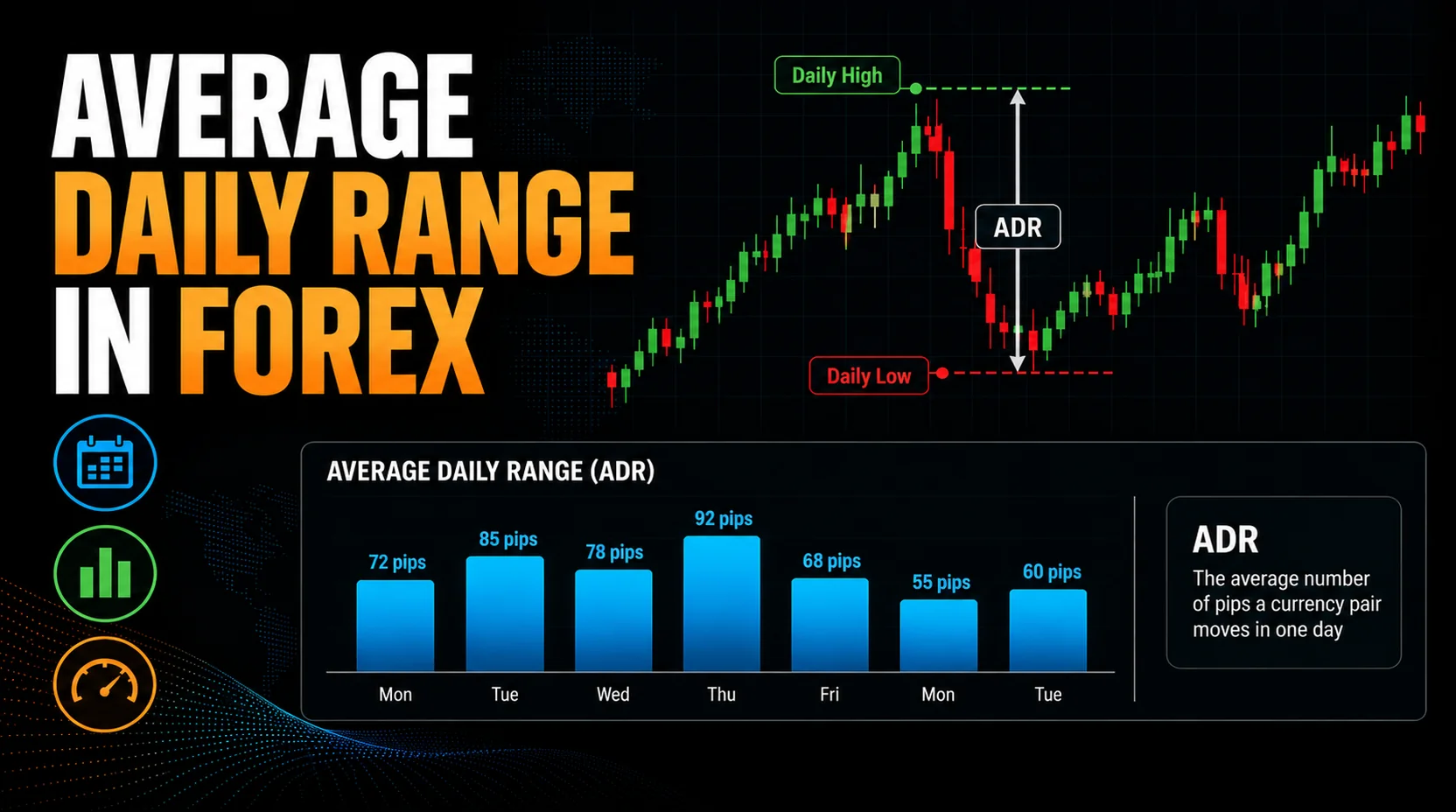
The Average Daily Range forex indicator, often shortened to ADR, measures how far a currency pair usually moves in one trading day. It focuses on the daily distance between the high and low over a selected number of past days.
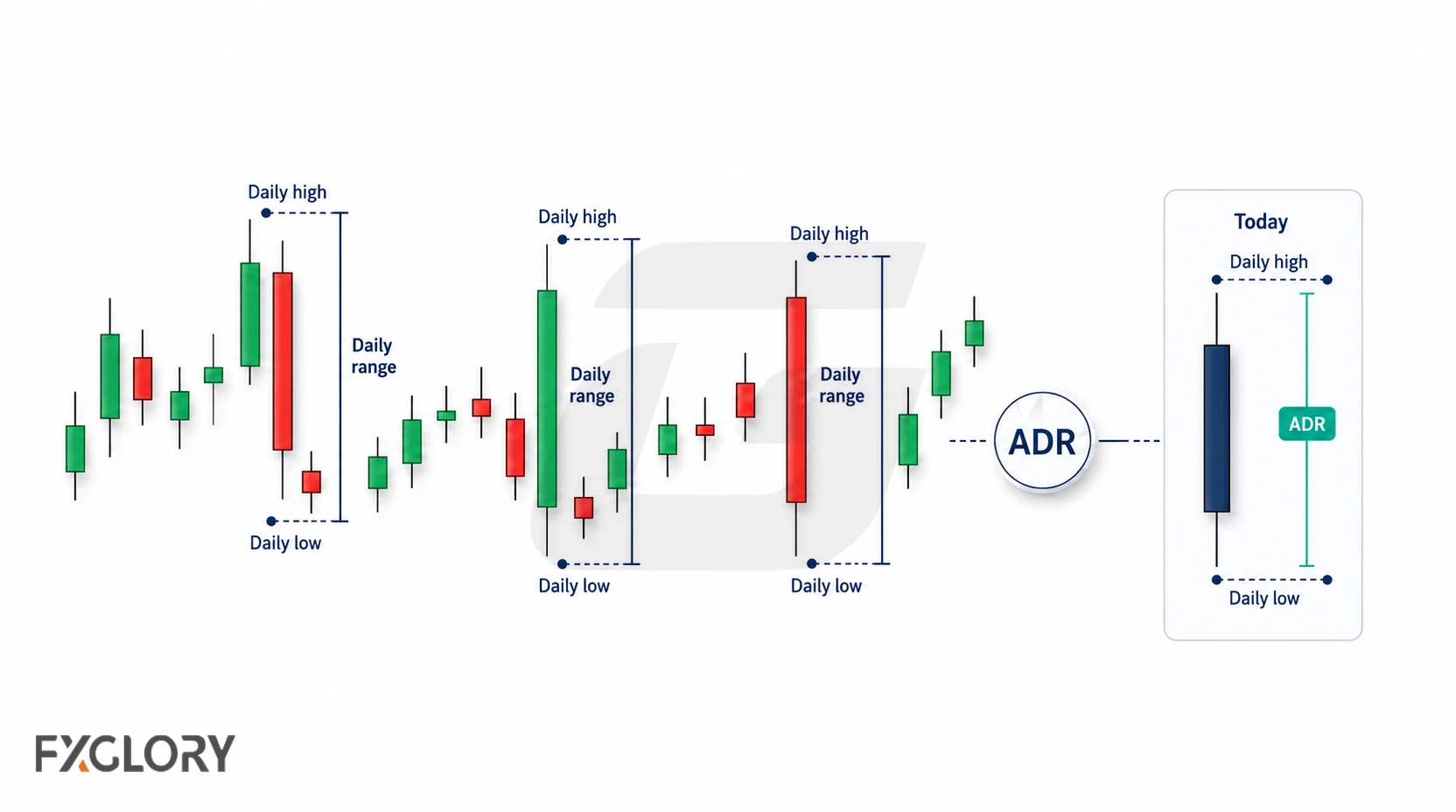
ADR summarizes past daily high-low movement to provide a comparable range benchmark. An 80-pip ADR, for example, is a historical average, not a prediction that today will finish at 80 pips.
On an intraday chart, comparing today’s developing high-low span with ADR can help distinguish an ordinary range day from one that has already expanded beyond recent conditions.
ADR belongs with technical indicators used for volatility and range analysis. It should not replace price action, support and resistance, trend structure, or risk planning.
Average Daily Range Formula
A common ADR calculation starts with the daily range:
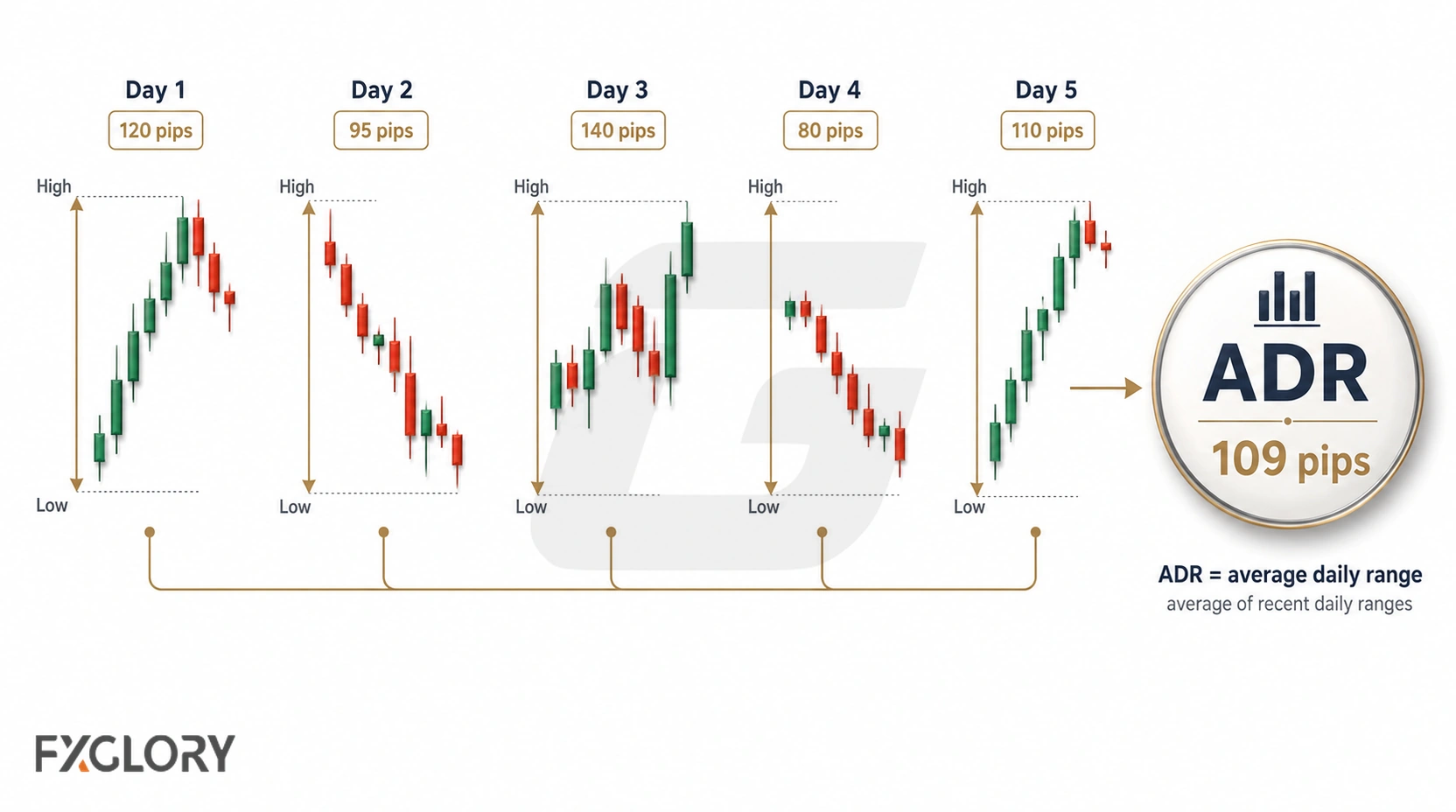
Daily Range = Daily High - Daily Low
Then the indicator averages those daily ranges over a selected number of days:
ADR = Sum of Daily Ranges over N completed days / N
A five-day sample of 60, 75, 90, 65 and 80 pips gives an ADR of 74 pips. This is an illustrative calculation, not a live quote.
ADR can be shown in pips, points, or percentage terms depending on the platform and market. In forex education, it is often discussed in pips because traders commonly compare currency-pair movement that way.
How ADR Works on a Forex Chart
On a chart, ADR may appear as a number, a percentage of range used, or projected upper and lower range areas. The purpose is to compare current price movement with the pair’s normal daily movement.
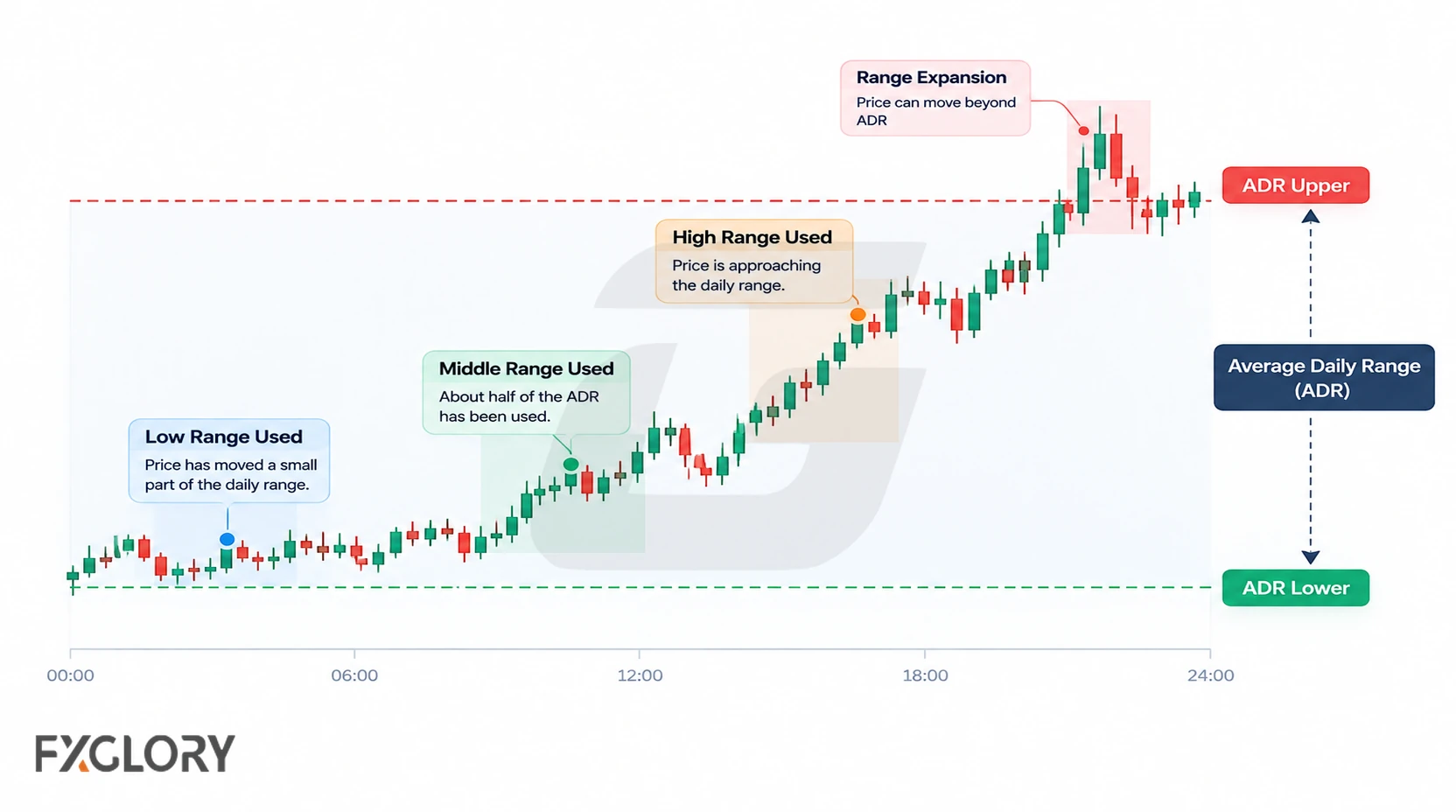
Some ADR tools project levels from the daily open; others calculate possible upper or lower areas from the day’s high or low. Those projections are not interchangeable: a projected line is not necessarily a boundary on today’s total high-low span. Check the tool’s construction before interpreting it.
Price can exceed ADR when the current day is more volatile than the lookback average. An indicator boundary therefore describes a comparison with past range rather than a limit on current movement.
For broader background, traders can compare ADR with other tools used for reading range expansion and contraction.
ADR Settings: 5, 10, 14, and 20 Days
The ADR period controls how many previous daily ranges are included in the average. A shorter setting reacts faster to recent volatility, while a longer setting smooths the reading.
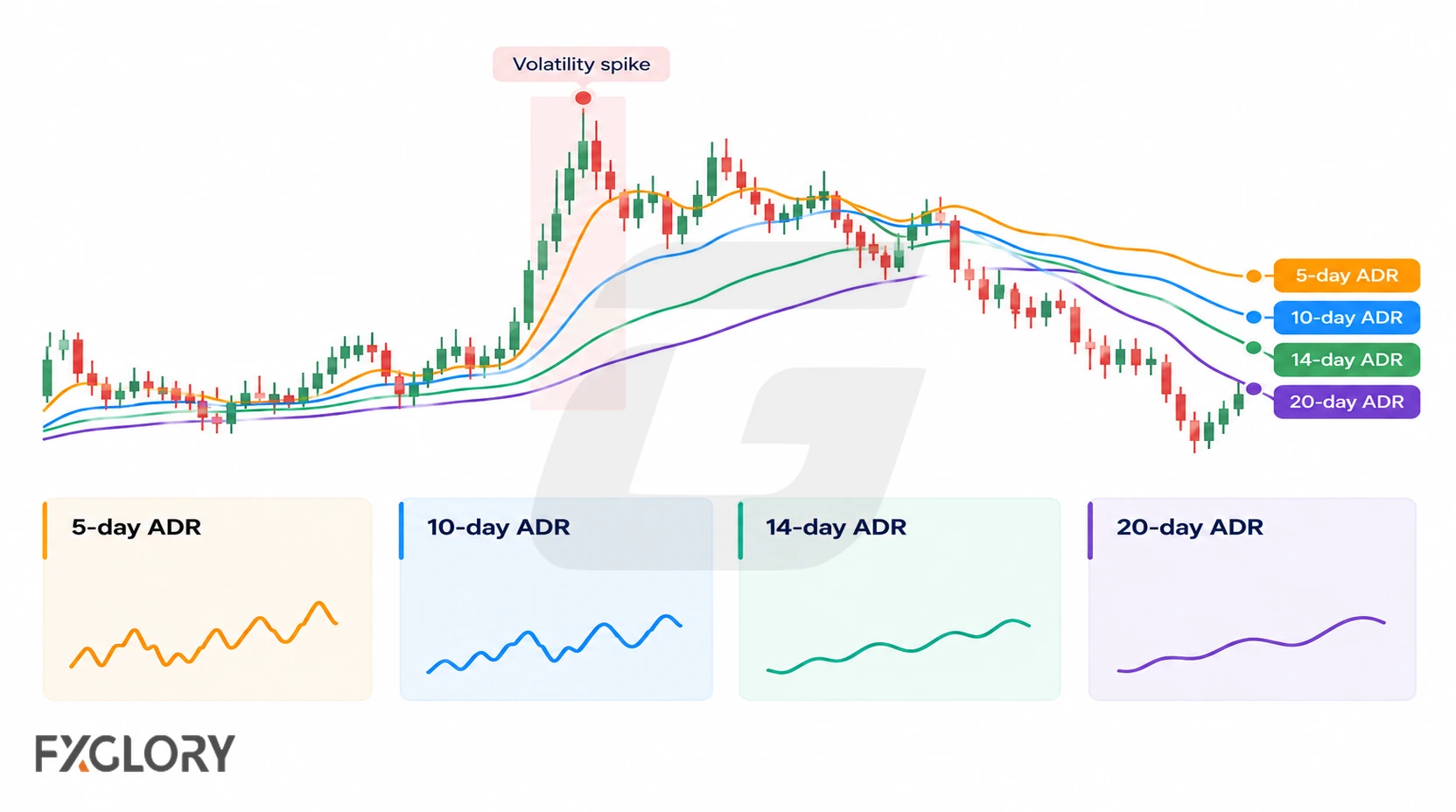
- 5-day ADR: Reacts quickly to the most recent week of trading. It can adapt fast but may be more sensitive to one unusual day.
- 10-day ADR: Gives a short-term view that many intraday traders find easier to compare with recent conditions.
- 14-day ADR: Offers a balanced setting that sits close to common volatility-indicator lookback periods.
- 20-day ADR: Gives a smoother view of roughly one trading month of daily movement.
Use a consistent lookback for comparisons and examine whether an exceptional daily range is pulling the average higher. Short lookbacks adjust quickly after a volatility change; longer lookbacks retain more of the prior regime.
How Much of Today’s ADR Has Price Used?
One of the most practical ADR questions is how much of the day’s normal range has already been used. This can be estimated by comparing the current day’s high-low range with the ADR value.
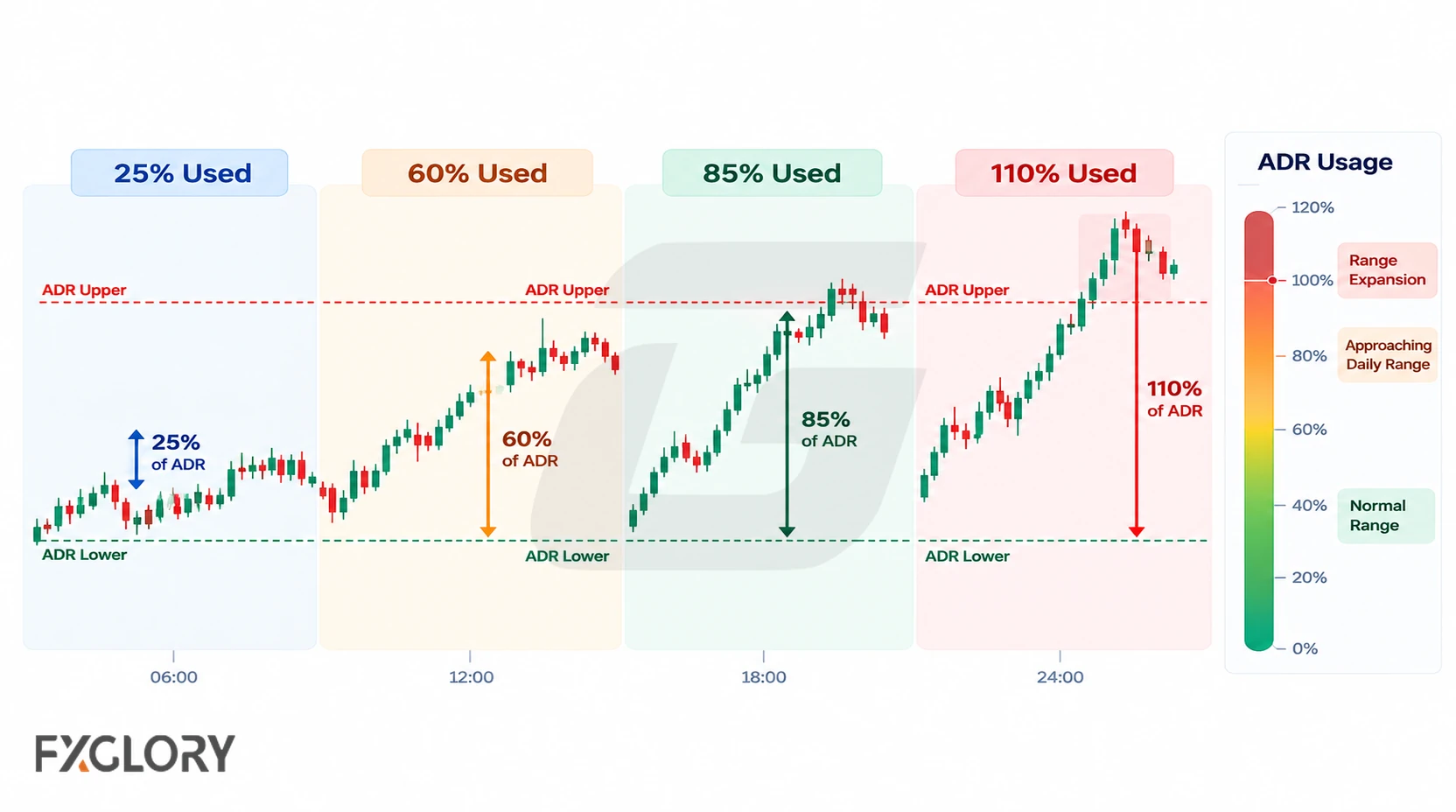
Range Used % = Current Day Range / ADR × 100
If ADR is 90 pips and today’s high-low span is 75 pips, range used is approximately 83%. That does not mean 17% of movement remains: ADR is an average of daily spans, not a daily allowance. Price may extend either extreme or keep fluctuating within the existing span.
Use this percentage to describe how unusual the developing range is compared with recent days. Assess targets separately against price structure, volatility and the time remaining in the session.
Using ADR for Targets, Stops, and Range Exhaustion
ADR can put a proposed price objective in the context of recent daily movement, but it does not generate a target or determine the correct stop distance.
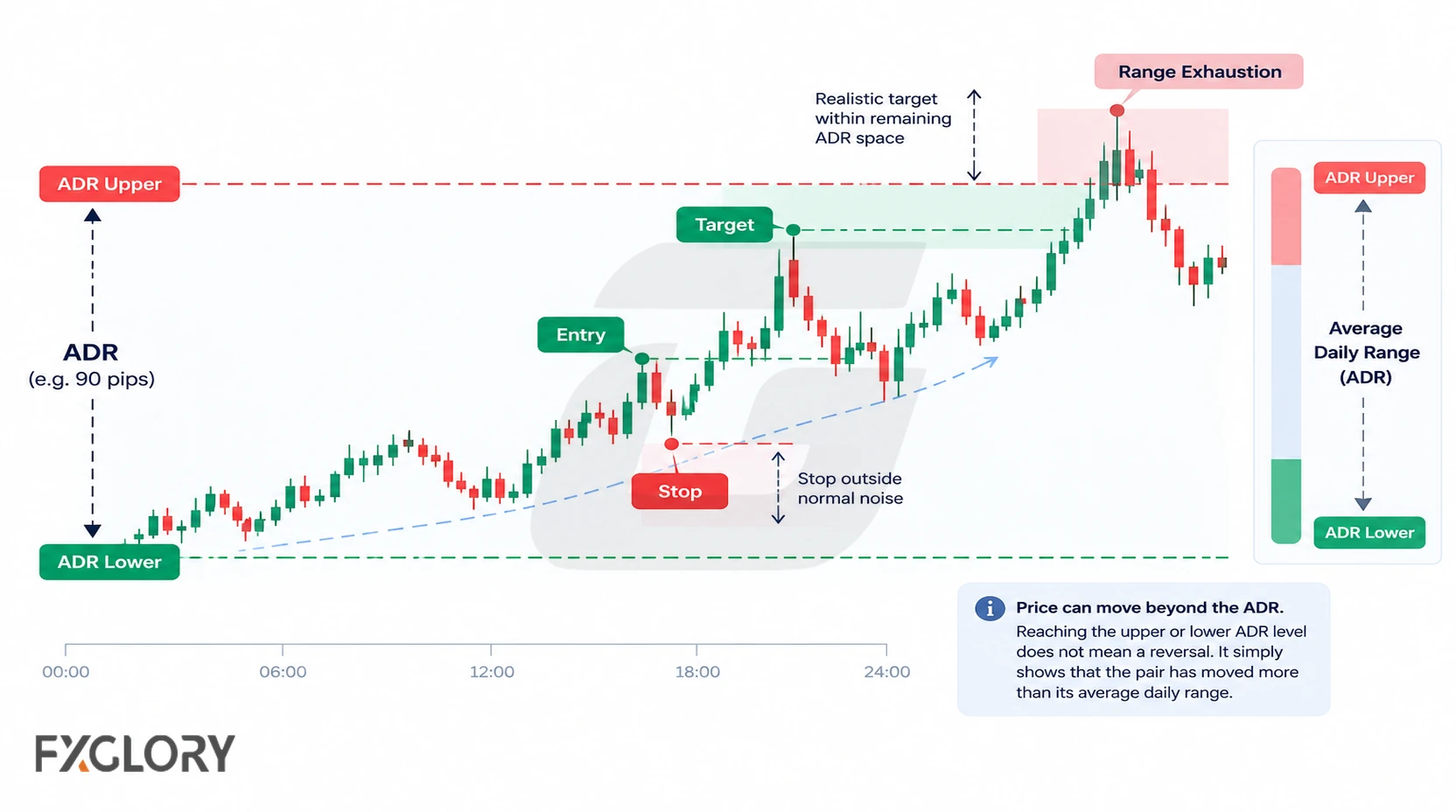
ADR and Intraday Targets
If a pair has already moved close to its average daily range, a far target in the same direction may need fresh momentum, news, or volatility expansion to remain realistic. If the pair has used only a small part of its ADR, there may be more room for movement, but the trader still needs direction, structure, and confirmation.
ADR and Stop Distance
Place a stop according to the setup’s invalidation level and execution conditions, not at an arbitrary fraction of ADR. Then size the position using the stop distance, instrument pip value and predetermined account risk. ADR describes broader daily range context; ATR provides a different volatility measurement, but neither indicator alone sets an appropriate stop.
ADR and Range Exhaustion
When today’s range approaches or exceeds its recent average, traders sometimes watch for slower movement, consolidation or a fresh breakout. These are different possibilities; judge them from price behavior rather than assuming the historical average predicts a turning point.
ADR boundaries can also overlap with other references. For example, daily levels that may overlap with ADR boundaries can create an area to watch, but the overlap still needs reaction and invalidation.
ADR vs ATR: What Is the Difference?
ADR averages daily high-low distances. ATR averages true range, which for each bar is the greatest of high minus low, the absolute difference between high and the previous close, and the absolute difference between low and the previous close.
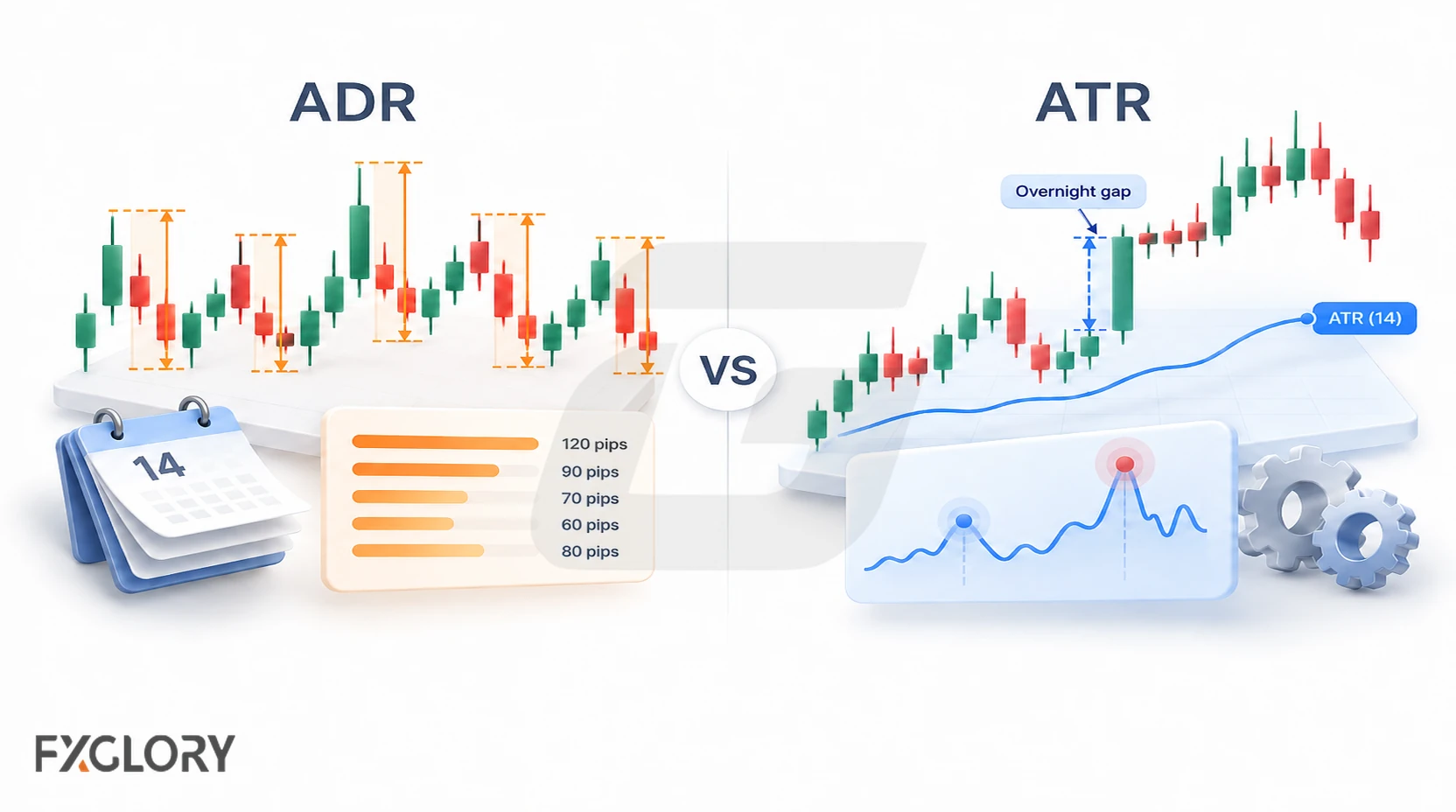
On daily bars without gaps, the underlying ranges can be similar; when the previous close lies outside the current day’s high-low span, true range captures that gap. Compare indicators using the same timeframe and lookback before drawing conclusions. For more detail, see the ATR indicator guide.
ADR on TradingView, MT4, and MT5
TradingView provides an ADR indicator with configurable length and display settings. On MT4 and MT5, ADR is commonly supplied through custom indicators or scripts. Before comparing outputs, verify each tool’s definition of a trading day, handling of incomplete days, lookback, units and data feed.
Average Daily Range by Currency Pair
To compare ADR across currency pairs, calculate each from the same number of completed days, with consistent daily candle cutoffs and market-data conventions. Record the observation date and units; for crosses with different pip values, a pip count alone does not compare cash exposure.
For instance, a 70-pip ADR on one pair and a 100-pip ADR on another describes different historical pip ranges. It does not establish which pair will trend today or how wide a trade’s stop must be. Stops follow the setup’s invalidation level; position size follows the chosen stop distance, pip value and risk limit.
Current market conditions can be checked alongside EUR/USD technical readings, but those readings do not themselves supply a standardized multi-pair ADR comparison.
Common ADR Mistakes and Limits
ADR remains a valid historical calculation even when the current day differs sharply from the average. The main errors come from interpreting it as a cap, treating incomparable measurements as equivalent, or using a stale lookback as though volatility were unchanged.
- Volatility regime change: A major event or prolonged expansion can make an older lookback less representative of current daily movement.
- Incomplete or inconsistent sessions: Different daily cutoffs, missing bars or weekend treatment can distort cross-platform comparisons.
- Mixed instruments and units: Forex pips and gold price-point movements should not appear in a single currency-pair ranking without clear instrument and unit labels.
- Targets mistaken for capacity: Reaching 100% ADR does not establish that no additional movement is possible.
- Execution conditions: Spread and slippage influence the feasibility of a trade, though they are not components of the ADR formula.
When Historical ADR Needs Caution
After an abrupt volatility change, the selected ADR lookback may describe earlier conditions more than the current session. Recalculate using consistent completed-day data and compare shorter and longer lookbacks when the regime has changed. A strong trend does not make the ADR measurement invalid; it may simply produce daily spans above the historical average.
Final Thoughts on the Average Daily Range Forex Indicator
ADR is a historical daily-range benchmark. Calculate it consistently, compare today’s high-low span with the chosen average, and use current price action and independent risk rules for decisions that ADR cannot make.