What Is Deviation in Forex?
Deviation in forex means a difference from a reference point. The reference point can change depending on the situation. It may be an average price, a moving average, the mean of a data set, an indicator setting, or the requested price of an order.
This is why the word can confuse beginners. A trader reading a chart may use deviation to describe price moving away from an average. A trader using an indicator may mean standard deviation. A trader placing an order may mean the maximum price difference allowed during execution.
Before using deviation in analysis or order settings, identify which meaning applies. For broader vocabulary, review basic forex trading terms that sound similar.
The Main Meanings of Deviation in Forex
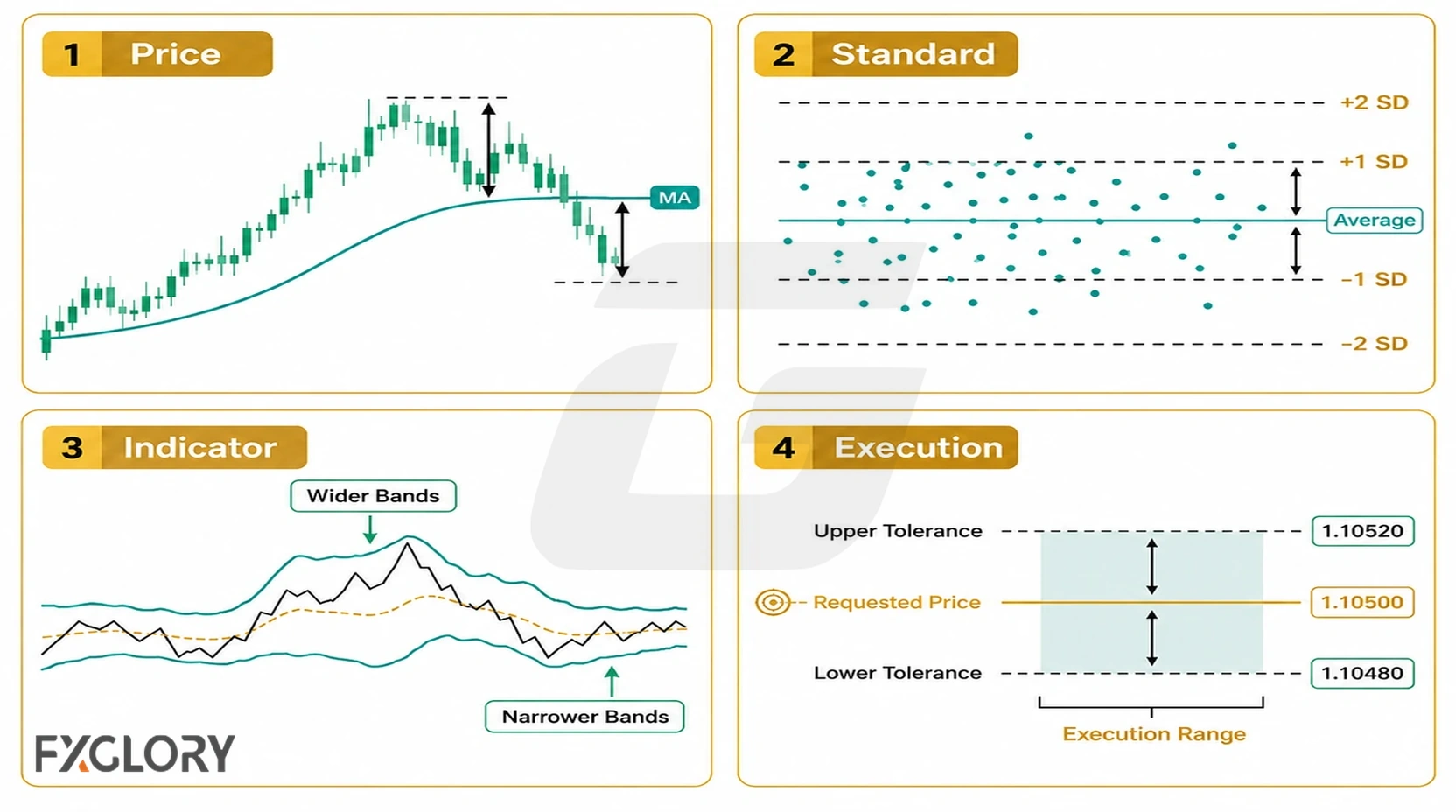
Deviation is not one single trading concept. It appears in chart analysis, volatility measurement, indicator settings, and platform execution settings.
- Price deviation: Price moves away from a benchmark such as a moving average, expected value, or recent average level.
- Standard deviation: A statistical measure of how spread out prices are from an average.
- Deviation indicator: A technical tool or indicator setting based on deviation, often linked with volatility tools or Bollinger Bands.
- Execution deviation: The allowed difference between requested order price and execution price.
- Maximum deviation: A platform setting that can limit how much price movement is accepted during order execution.
These meanings overlap because they all describe distance from a reference point, but they are used for different jobs. Mixing them can lead to poor analysis or wrong order settings.
Price deviation helps describe chart movement. Execution deviation helps control how much price difference may be accepted when an order is processed. They should not be treated as the same thing.
Price Deviation From an Average
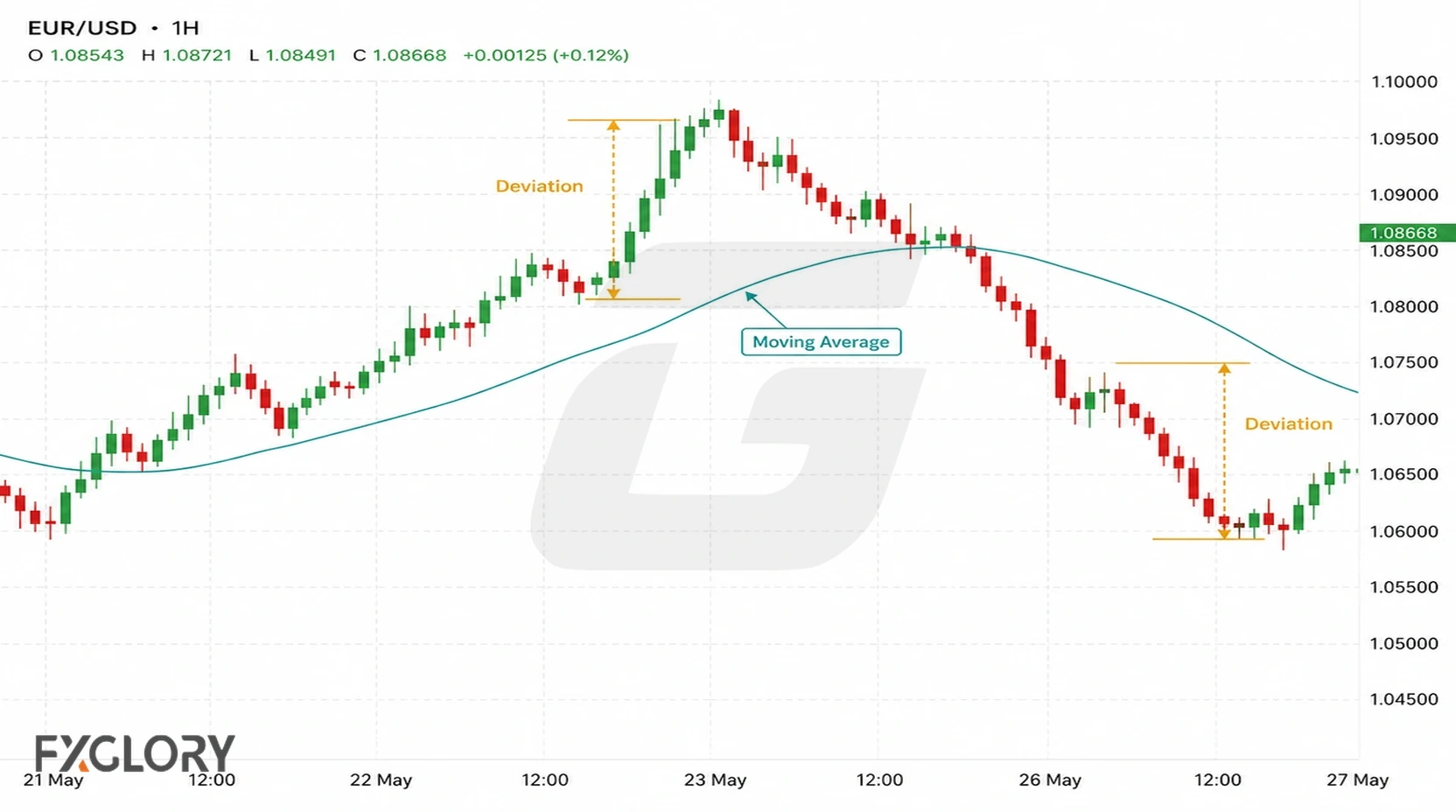
Price deviation usually describes how far current price has moved away from a reference level. That reference level may be a simple moving average, exponential moving average, recent average price, or another benchmark used by the trader.
If price moves far above an average, the pair may look stretched compared with recent behavior. If price moves far below an average, the move may also look stretched in the opposite direction. This does not mean price must return immediately. Strong trends, news, and volatility can keep price away from an average longer than expected.
Price deviation can help traders avoid chasing after a move has already extended far from its reference point. It can also help traders notice when price is still close to its average and movement has not yet expanded.
Standard Deviation in Forex
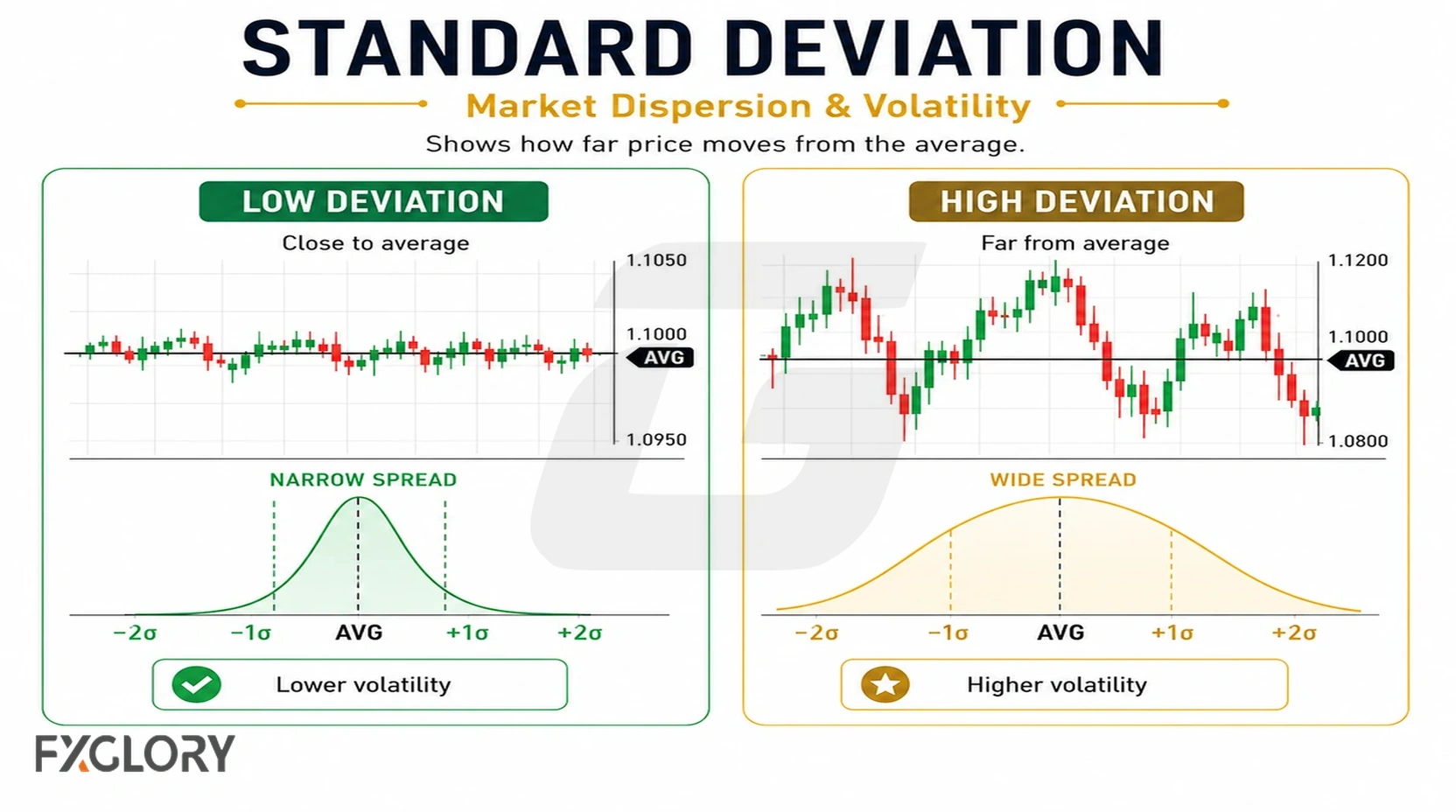
Standard deviation measures how spread out prices are around an average. When standard deviation is higher, price movement is usually wider or more variable. When standard deviation is lower, price movement is usually quieter or more compressed.
This connects deviation with price movement and volatility context. A high standard-deviation reading may show that the market is moving more aggressively than usual. A low reading may show that movement is compressed or quieter.
This page explains the basic meaning. For the deeper chart tool, settings, readings, and limitations, see standard deviation as a forex volatility indicator.
- Higher standard deviation: Price values are more spread out from the average.
- Lower standard deviation: Price values are closer to the average.
- Rising standard deviation: Volatility may be expanding.
- Falling standard deviation: Volatility may be contracting.
Deviation Indicator and Bollinger Band Settings
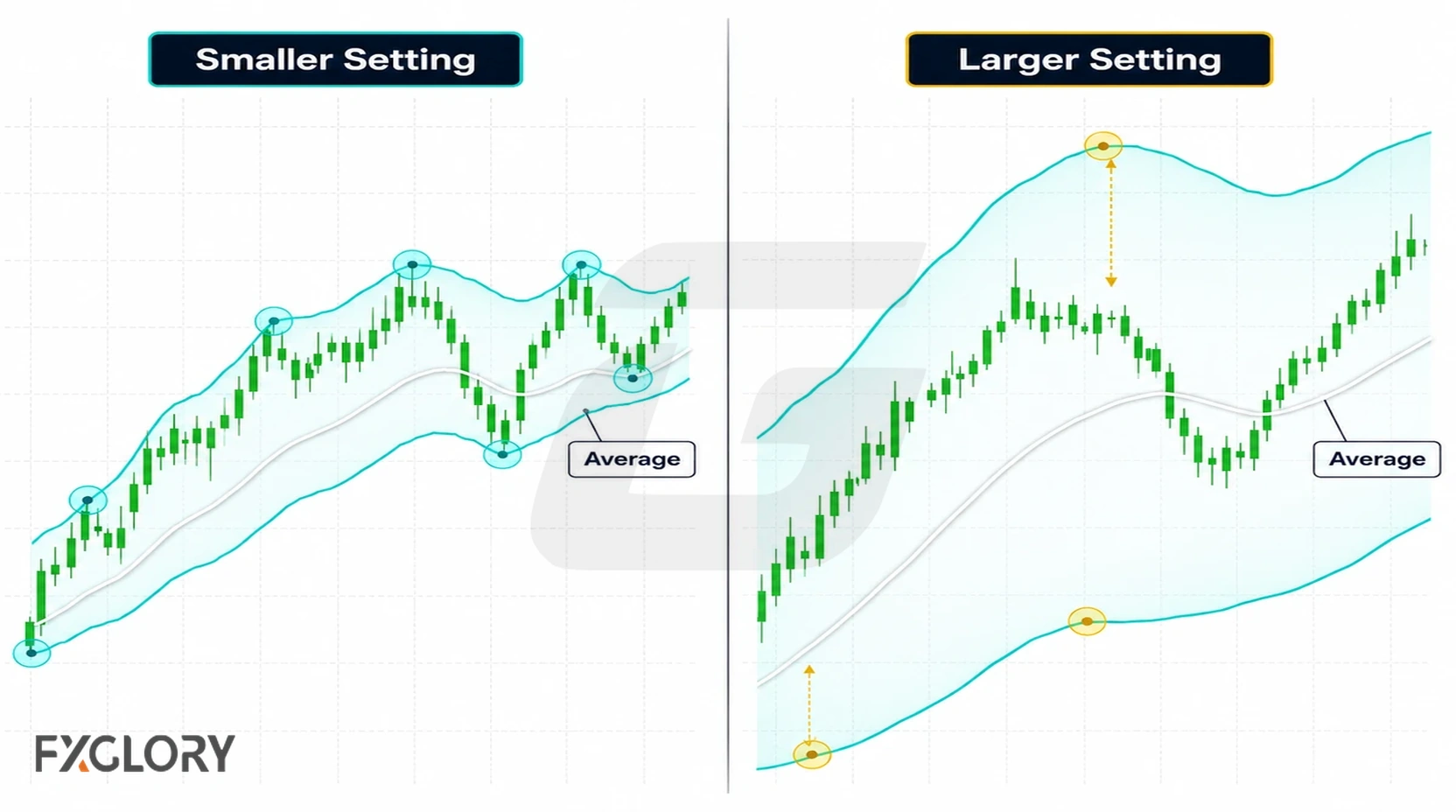
In technical analysis, deviation often appears inside indicators. Some tools use standard deviation to measure volatility or create dynamic bands around price. This connects deviation with technical tools that measure price behavior.
Bollinger Bands are one of the clearest examples. The middle band is usually based on a moving average, while the upper and lower bands are placed a selected number of standard deviations away from that average. A larger deviation setting places the bands farther from the average. A smaller deviation setting places them closer.
Traders who want the full Bollinger explanation can review band width based on standard deviation.
MT4/MT5 Maximum Deviation and Order Execution
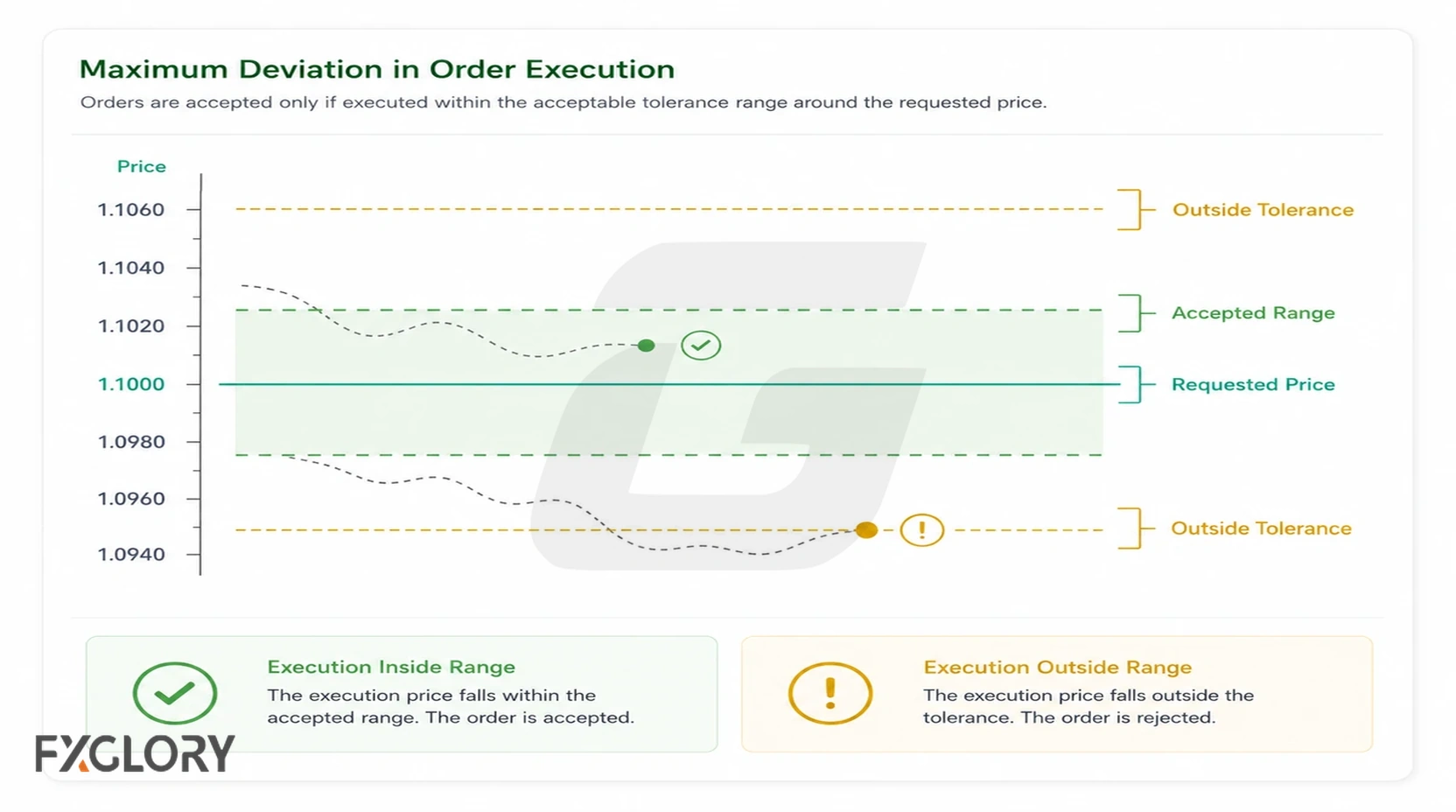
Deviation can also appear in order execution settings. In MT4 or MT5-style order windows, maximum deviation usually means the largest price difference the trader is willing to accept between the requested price and the execution price.
If the market moves beyond the allowed deviation before the order is processed, the order may be rejected, requoted, or not filled depending on the platform, order type, and execution conditions. If the allowed deviation is wider, the order may be more likely to execute, but the final price may be farther from the requested price.
A wider maximum deviation may improve the chance of execution, but it can also increase the chance that the final price differs from the requested price.
The setting may be shown in points or discussed in pips, depending on platform display and symbol digits. Traders should check how their platform displays the value before changing it.
- Very low maximum deviation: May reduce unwanted price difference, but can increase rejected orders or requotes during fast movement.
- Moderate maximum deviation: May balance execution flexibility with price control, depending on market conditions.
- Very high maximum deviation: May allow execution during fast movement, but can increase the risk of a worse-than-expected price.
High Deviation vs Low Deviation
High and low deviation mean different things depending on context. A high standard-deviation reading is not the same as a high maximum-deviation order setting.
- High price deviation: Price is far from the chosen benchmark, such as a moving average.
- Low price deviation: Price is close to the chosen benchmark.
- High standard deviation: Price movement is wider or more volatile around the average.
- Low standard deviation: Price movement is quieter or more compressed.
- High execution deviation: The platform may allow a wider difference between requested and executed price.
- Low execution deviation: The platform may allow less price difference, but orders may be more sensitive to fast movement.
The same phrase can therefore mean price stretch, market volatility, indicator width, or order-execution tolerance. The safest reading comes from the context in which the word appears.
Deviation, Slippage, Spread, and Volatility
Deviation becomes more important when markets move quickly. Volatility can make price change between the moment an order is placed and the moment it is processed. That difference may lead to slippage or rejected execution, depending on the order setup.
Slippage is the actual difference between the expected price and the final executed price. Execution deviation is the tolerance setting that may control how much difference is accepted. Spread is another factor because it is part of the cost and execution environment around the trade. Traders can review spread as a trading cost around execution when studying order conditions.
For volatility-based stop planning, traders may also compare deviation with volatility-based stop-distance context. ATR and standard deviation are not the same tool, but both can help traders think about changing market movement.
Common Mistakes With Forex Deviation
Deviation becomes risky when traders use the word without checking what it refers to. A chart-reading meaning and an execution-setting meaning should not be treated as the same thing.
- Confusing standard deviation with execution deviation: One describes price dispersion; the other relates to order tolerance.
- Assuming price deviation predicts reversal: Price far from an average can keep moving during strong trends or news.
- Changing maximum deviation without understanding points and pips: Platform display can differ by symbol and broker setup.
- Using a very tight execution tolerance in fast markets: Orders may be rejected or requoted more often.
- Using a very wide execution tolerance carelessly: The final execution price may be farther from the requested price.
- Treating indicator deviation as a signal: A deviation setting changes the indicator display; it does not create a trade plan by itself.
- Ignoring spread and volatility: Execution conditions can change quickly around news, session opens, or low-liquidity periods.
A Safer Way to Understand Deviation in Forex
Deviation in forex is easiest to understand as distance from a reference point. For chart analysis, the reference may be an average. For standard deviation, the reference is the mean. For Bollinger Bands, it affects band width. For execution settings, it controls tolerance around the requested order price.
Good use of deviation starts with the right question: is the trader measuring price stretch, volatility, indicator width, or execution tolerance?
Once the meaning is clear, deviation can support better analysis or cleaner order planning. It should still be combined with market context, platform settings, spread awareness, volatility, invalidation, and account risk control.
Frequently Asked Questions
What is deviation in forex?
Deviation in forex can mean price moving away from an average, standard-deviation volatility, an indicator setting, or the maximum price difference allowed during execution. The correct meaning depends on the context.
What does price deviation mean in forex?
Price deviation usually means the distance between current price and a benchmark such as a moving average, expected price, or recent average level. A larger distance may show that price is stretched, but it does not guarantee a reversal.
What is standard deviation in forex?
Standard deviation measures how widely prices are spread around an average. Higher standard deviation usually means wider price movement, while lower standard deviation usually means quieter movement.
Is deviation the same as volatility?
Not always. Standard deviation is one way to measure volatility, but deviation can also refer to price distance from an average or maximum execution deviation in a trading platform.
What is maximum deviation in forex trading?
Maximum deviation usually refers to the largest price difference a trader allows between the requested order price and the executed price. If price moves beyond that tolerance, the order may be rejected, requoted, or not filled depending on platform and execution conditions.
What is MT4 deviation in forex?
In MT4-style order settings, deviation can refer to the allowed execution tolerance around the requested price. It may be displayed in points or discussed in pips, so traders should check how their platform and symbol display the setting.
What does high deviation mean in forex?
High deviation can mean stronger price movement away from an average, higher volatility, wider Bollinger Bands, or a wider execution tolerance, depending on context. It should not be read as a signal by itself.
What does low deviation mean in forex?
Low deviation can mean price is close to an average, volatility is quiet, indicator bands are narrow, or execution tolerance is tight. It may also mean orders are more likely to be rejected if price moves quickly beyond the allowed tolerance.
Is execution deviation the same as slippage?
No. Execution deviation is usually the allowed tolerance before or during order execution. Slippage is the actual difference between the expected price and the final executed price.
Can deviation be used as a trading signal?
Deviation should not be treated as a complete trading signal by itself. It can add context about price stretch, volatility, indicator width, or order execution, but traders still need price behavior, market context, invalidation, and risk control.
Related Contents
Practice Order Settings on Demo
Use an FXGlory demo account to practice reading price deviation, reviewing volatility, and testing order settings before using real funds.
Open a Demo Account