
How to Trade Gold in Forex: The Quick Answer
To trade gold in forex, first understand the XAU/USD quote (gold priced in US dollars), then check the GOLD contract specifications on your trading platform. Decide what would invalidate your trade idea, calculate the position size from that distance and your risk budget, and practise entering and managing an order on a demo account. Gold is a precious metal, not a currency pair, even though it is often traded through forex platforms.
On FXGlory, the market page calls this instrument GOLD and describes it as spot gold against the US dollar. The steps below focus on learning to trade it responsibly rather than predicting its next move. See the GOLD live chart and current trading conditions before relying on specifications or placing an order.
What Is XAU/USD in Forex Trading?
XAU is the common market code for one troy ounce of gold, while USD is the US dollar. An XAU/USD quote of $4,100 therefore means that one troy ounce of gold is priced at $4,100 in this purely hypothetical illustration. If the quote increases, gold has become more expensive in dollar terms; if it falls, gold has become cheaper in dollar terms.
When you buy a gold price-tracking contract, your directional view is that gold will rise relative to USD. When you sell one, your view is that it will fall. Either side can lose money. FXGlory labels its precious-metal symbol GOLD; other platforms may display XAUUSD, XAU/USD or a suffixed symbol. The label alone does not identify the legal product or guarantee identical specifications.
| Part of quote | Meaning | Illustrative interpretation |
|---|---|---|
| XAU | Gold, measured in troy ounces | 1 ounce of gold |
| USD | Quote currency | Price expressed in US dollars |
| XAU/USD = 4,100 | Gold price in dollars per ounce | $4,100 per ounce, not a live price |
Trading a broker's gold contract is also different from buying a physical gold bar or an exchange-traded fund. A price-tracking derivative generally offers exposure without delivery of bullion. Product structures vary, so read the forex-versus-CFD explanation and your specific instrument terms before assuming how the contract is settled or financed.
How Gold Quotes, Lots and Price Movements Work
A chart displays a price, but an order is placed in a trade volume. Your profit or loss depends on both. A bid is generally the price at which you can sell, while the ask is generally the price at which you can buy; the difference is the spread. The spread can change, and the platform's quoted price may not be the price at which an order finally executes.
FXGlory's public GOLD specifications currently list a contract size of 100 units per lot, a minimum volume of 0.01 lot, a 0.01-lot step, and a point size of 0.01. Those are published product-page figures, not a promise that every account has the same trading conditions. Always confirm the live symbol specification and account type before using them.
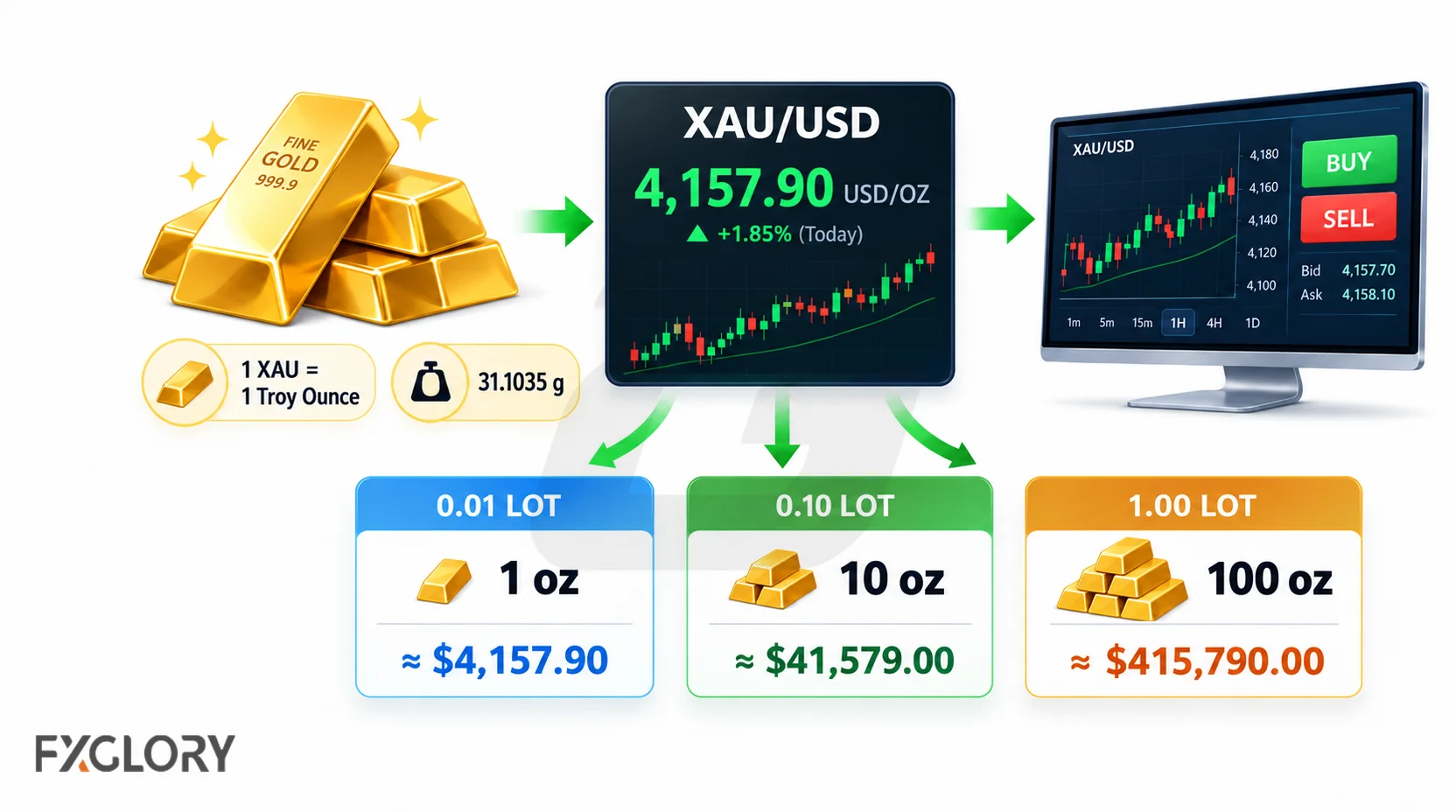
| GOLD volume | Illustrative ounces exposed | Gross P/L for a $1 price change | Gross P/L for a $10 price change |
|---|---|---|---|
| 0.01 lot | 1 oz | $1 | $10 |
| 0.10 lot | 10 oz | $10 | $100 |
| 1.00 lot | 100 oz | $100 | $1,000 |
The general calculation for a USD-denominated account is gross P/L in USD = price change in USD per ounce × ounces exposed. For other account currencies, conversion rates and account conventions can affect the displayed result. These values exclude spreads, commissions, financing, and slippage.
If lot size is unfamiliar, review what a lot size means in forex. The crucial gold-specific lesson is that a seemingly small 0.01-lot trade may still gain or lose approximately one dollar for every one-dollar gold price move, before costs.
How to Trade Gold on MetaTrader 4: Step by Step
MetaTrader 4 (MT4) combines quotes, charts, order entry and open-position management. FXGlory provides MetaTrader 4 access and platform information. The steps below describe the common desktop MT4 workflow; menu names, order controls and account permissions can differ by build, device and broker server.
| MT4 area | What to check |
|---|---|
| Market Watch | Find the actual gold symbol and current bid/ask quotes |
| Specification | Review contract size, tick values, minimum volume, spread, stops and trading hours |
| New Order | Enter volume, order type, stop loss and take profit where permitted |
| Terminal / Trade | Review open exposure, floating P/L, margin and orders |
- Start with demo access. Set up an FXGlory demo account and sign in to the appropriate MT4 server. Confirm whether the GOLD instrument is available in that demo environment; FXGlory notes that its demo Market Watch may not contain every instrument.
- Find GOLD in Market Watch. Open Market Watch (usually Ctrl+M on desktop). Right-click and use Symbols or Show All to look for the broker's gold symbol. Do not assume its displayed name is XAUUSD.
- Inspect the contract. Right-click the symbol and select Specification. Check the live contract size, trading session, digits/point, tick size and value, minimum lot, volume step, margin and any minimum stop distance. If these are unclear, do not trade yet.
- Open a chart and form a scenario. Review the timeframe, recent volatility, support/resistance and upcoming economic events. Identify the price level or condition that would make the idea invalid. A chart is context, not a prediction.
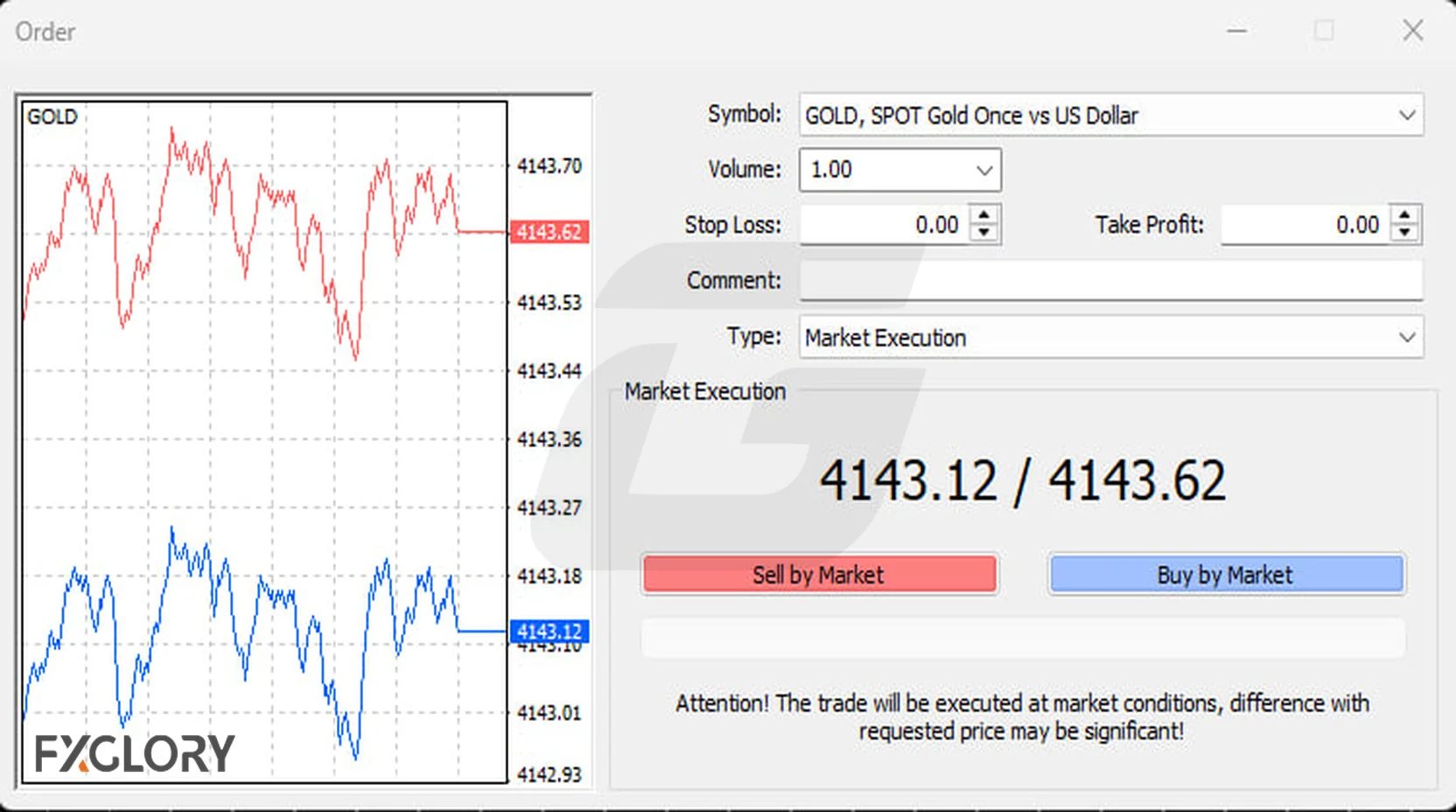
- Prepare the order. Open New Order (often F9 with the symbol selected). Choose a volume allowed by the platform, then confirm whether you need a market order or a pending order. Where available, enter a stop loss and possible take profit based on your plan.
- Review execution and monitor. Recheck the bid/ask and estimated risk before submitting. After entry, use the Trade tab to inspect filled price, order status, margin and exposure. Practise modifying or closing a demo position, then record the result.
Practise the workflow in order: find the symbol, read its Specification window, calculate the trade, then review the result in the Trade tab. Do not assume settings shown in general MT4 tutorials match your FXGlory account.
Gold Trading Example: Calculate Risk Before Entry
Suppose a trader has $2,000 of account equity and chooses an illustrative risk budget of 1% ($20) for one trade. The trader considers buying GOLD at a hypothetical $4,100 per ounce, with an invalidation level at $4,080. That leaves a $20-per-ounce stop distance. These prices are examples for learning the arithmetic, not real-time quotes or recommendations.
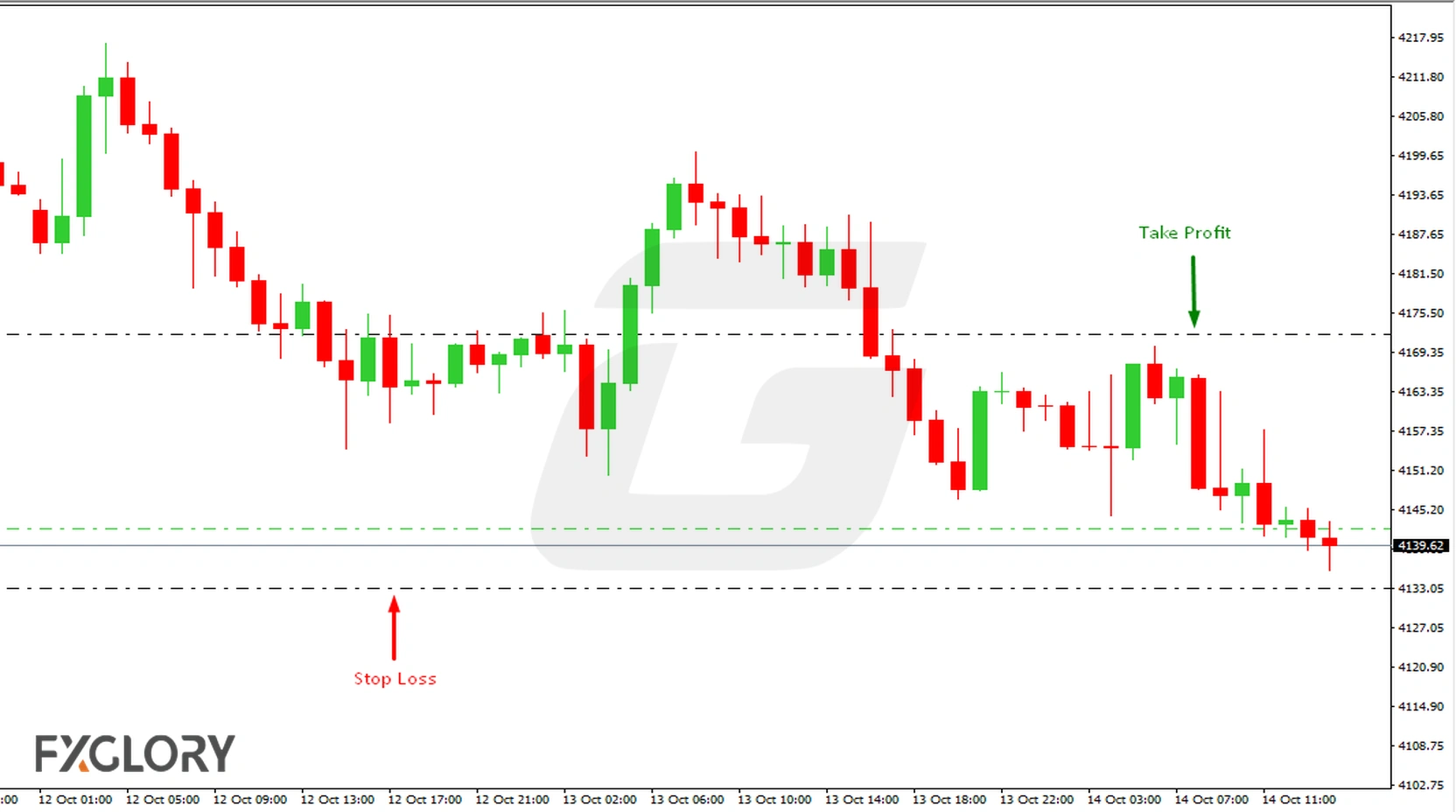
| Illustrative level | Price | Gross movement for 0.01 lot (1 oz) |
|---|---|---|
| Possible take-profit level | $4,140 | +$40 from entry |
| Hypothetical buy entry | $4,100 | $0 starting reference |
| Planned stop-loss level | $4,080 | −$20 from entry |
With a 100-ounce standard contract, the calculation is lots = planned USD risk ÷ (stop distance in dollars per ounce × 100 ounces per lot). Here, $20 ÷ ($20 × 100) = 0.01 lot, equal to one ounce of exposure. The possible $40 upside is $40 per ounce multiplied by one ounce. This is arithmetic, not an estimate of the probability of reaching either level.
The example is deliberately aligned with the currently published 0.01-lot minimum. A smaller account or a wider stop might require less than the minimum tradable size to keep the same percentage risk. In that case the sensible conclusion can be not to place the trade, rather than to increase risk or use an unjustifiably tight stop.
For a general framework covering position sizing, drawdown and maximum exposure, use FXGlory's forex risk management strategy guide. On a real account, confirm the platform's own tick value and profit calculation rather than treating the illustration as a contract guarantee.
What Moves Gold Prices?
Gold does not pay interest or a dividend, so traders often compare its opportunity cost with yields on other assets. Yet no single indicator controls XAU/USD. Several forces may reinforce or offset one another, sometimes within the same trading session.
| Driver | Why traders watch it | Important limitation |
|---|---|---|
| US dollar strength | Gold is widely quoted in USD, so dollar changes can affect global purchasing power and demand | Gold and the dollar do not always move in opposite directions |
| Real interest rates and Fed expectations | Higher inflation-adjusted yields can raise the opportunity cost of holding a non-yielding asset | Inflation, growth and risk sentiment can outweigh the usual relationship |
| Inflation and economic data | CPI, employment and economic growth can shift expectations for policy and the dollar | A surprise may cause an initial move that later reverses |
| Central-bank and investment demand | Reserve purchases, fund flows and portfolio allocations influence demand | Not every flow is observable in real time |
| Geopolitical risk and market stress | Some investors seek gold during uncertainty | Gold is not guaranteed to rise during every crisis |
The World Gold Council research on gold drivers explains why gold is influenced by currencies, rates, market risk, investment flows and demand. For a practical gold trading plan, check what events are approaching, the market's expectations, and whether price has already moved substantially. An economic release gives context; it does not provide a guaranteed buy or sell instruction.
Three Ways Traders Analyse XAU/USD
There is no universally best gold forex trading strategy. A useful method begins with a market condition, identifies possible confirmation, and sets a clear invalidation level. The scenarios below are ways to structure chart analysis, not verified profitable systems or ready-made signals.
1. Trend-following after a pullback
Start by identifying whether a higher timeframe shows a sequence of higher highs and higher lows, or the opposite. Wait for a pullback into an area that matters, then review whether the market resumes the earlier direction. Confirmation might be a break of a minor countertrend structure; invalidation might be a decisive move below the pullback low for a long idea. A sharp news reversal or late entry after an extended move can make the setup unattractive.
2. Support-and-resistance reaction
Mark zones where price has repeatedly paused or reversed, then wait for price behavior near a zone rather than assuming the first touch must hold. A rejection followed by a shift in structure may be more informative than a single candle wick. The idea fails when price accepts beyond the zone in a way that contradicts the original premise. Use FXGlory's support and resistance guide for the underlying concepts rather than treating a horizontal line as certain protection.
3. Breakout and retest
Identify a clearly defined range or consolidation. A breakout idea asks whether price can move outside that structure and, if it retests the former boundary, maintain the break. False breaks are common, particularly when spreads widen or volatility accelerates around economic announcements. A return into the prior range can invalidate the idea. Entering after a very large breakout candle without considering the stop distance may create poor reward-to-risk.
| Method | Question to ask | Reason to stand aside |
|---|---|---|
| Trend pullback | Is the prior direction still supported by structure? | The trend has broken or the stop would be impractically wide |
| Support/resistance | Is there a meaningful reaction at an established zone? | Price is chopping through the zone or news is imminent |
| Breakout/retest | Has price demonstrated acceptance beyond the range? | Thin liquidity, false-break behavior or an overstretched move |
Volatility context also matters. Average True Range (ATR) can help compare a contemplated stop distance with recent gold movement, but ATR does not predict direction and should not mechanically decide the stop. Keep notes on setup conditions, costs, the outcome and mistakes before judging any method.
What Is the Best Time to Trade Gold?
Gold is followed globally, but its trading activity is not uniform. London and New York participation can bring more trading interest, particularly when their business hours overlap. Major US economic releases and Federal Reserve announcements can also trigger very fast movement. Greater activity may improve price discovery, but it can also increase execution risk; there is no universally profitable hour.
Beginners should check three clocks: the broker's published GOLD trading session, the local times of relevant economic releases, and daylight-saving changes affecting London and New York. FXGlory's GOLD page publishes weekday trading hours plus weekend closure; the actual server time and any holiday adjustments must be verified before ordering. Do not assume gold trades continuously or that a scheduled news event is safe to trade.
The guide to forex trading sessions provides wider session context. For gold specifically, compare the current spread, recent candle ranges and news calendar with your plan. If the order requires a very tight stop while gold is moving unusually quickly, choosing not to trade is a valid decision.
Gold Trading Costs: Spreads, Leverage and Margin
A position can have a correct directional idea and still produce a disappointing result because of costs or leverage. Before placing a GOLD order, review the following separately:
| Item | What it means for a gold trade | Where to verify |
|---|---|---|
| Spread | Gap between bid and ask; may widen, especially around events or quieter sessions | Live Market Watch quotes and account-specific conditions |
| Commissions | Some account structures charge transaction fees in addition to or instead of wider spreads | Account terms and order history |
| Overnight financing / swap | Holding a position across rollover may create a debit or credit under the applicable contract rules | Symbol specification and swap schedule |
| Margin | Collateral needed to open and maintain the position; not the maximum possible loss | Platform margin preview or broker calculator |
| Leverage | Controls how much nominal exposure can be opened relative to required collateral | Current instrument and account-specific leverage conditions |
| Execution and stop constraints | Slippage, stop-distance rules and fill limitations can affect entry or exit | Platform specification and order ticket |
FXGlory's public GOLD page shows a 0.01 point size, account-dependent maximum leverage, and a typical spread expressed in pips. Because the displayed spread and margin can vary, this guide intentionally does not promise a fixed live spread, trading fee, margin requirement or maximum leverage. Review the current GOLD trading conditions and your account before calculating costs.
For example, a 0.01-lot trade could expose you to approximately one ounce of gold using the published contract size. At an illustrative $4,100 quote, that is about $4,100 of nominal gold exposure; it does not mean you must deposit exactly $4,100 in margin, or that you can lose only the initial margin. The applicable leverage and product rules determine margin, while market movement and execution determine losses. Read how leverage works and how swaps and overnight financing work for the general mechanics.
Common Gold Trading Mistakes and When Not to Trade
The errors below are especially costly when gold's recent movement range is large relative to the account size.
| Mistake | Better decision |
|---|---|
| Using forex pip-value rules for gold | Calculate exposure from GOLD contract size, point/tick information and volume |
| Choosing a lot size before the stop distance | Identify invalidation first and size from the planned loss |
| Assuming a stop guarantees exactly that loss | Allow for spread changes, gaps, slippage and broker rules |
| Entering just because gold is moving sharply | Wait for an explainable setup or stand aside |
| Confusing leverage with a risk-management tool | Measure full exposure and worst-case outcomes separately from margin |
| Copying a gold signal without checking your contract | Confirm symbol, costs, risk and whether the trade suits your account |
A reasonable no-trade decision may follow when the required volume is below the platform minimum, the stop has no clear rationale, the expected price movement is too small relative to costs, an important news release is imminent, the instrument is unavailable, or the account would have insufficient margin. Avoiding a trade is part of the trading process.
Your First Gold Demo Trade: Practice Checklist
Use this short checklist during a demo session; the goal is a correctly understood order, not a profitable screenshot.
- Verify the market: Confirm the demo account actually includes GOLD, note the exact symbol and check the session is open.
- Read the specification: Record contract size, minimum lot, point/tick information, spread, stop limits and margin requirements.
- Explain the idea: Write the timeframe, price structure, upcoming news and reason for considering a buy or sell.
- Define the invalidation: Choose a stop location based on the idea being wrong, rather than a desired cash amount alone.
- Size the position: Estimate gross loss and execution costs, and confirm the resulting trade volume is allowed.
- Practise execution: Use the order ticket, double-check bid/ask, submit only if the planned parameters make sense, and monitor the Trade tab.
- Review the record: Compare planned and actual entry/exit, costs, slippage, emotional decisions and any rule violations.
The most useful result of practice is understanding which decisions you can repeat and which mistakes you can prevent. Because FXGlory states that its demo environment can omit instruments and differs from live trading, use it to learn workflows—not to assume live execution or profitability will match.