
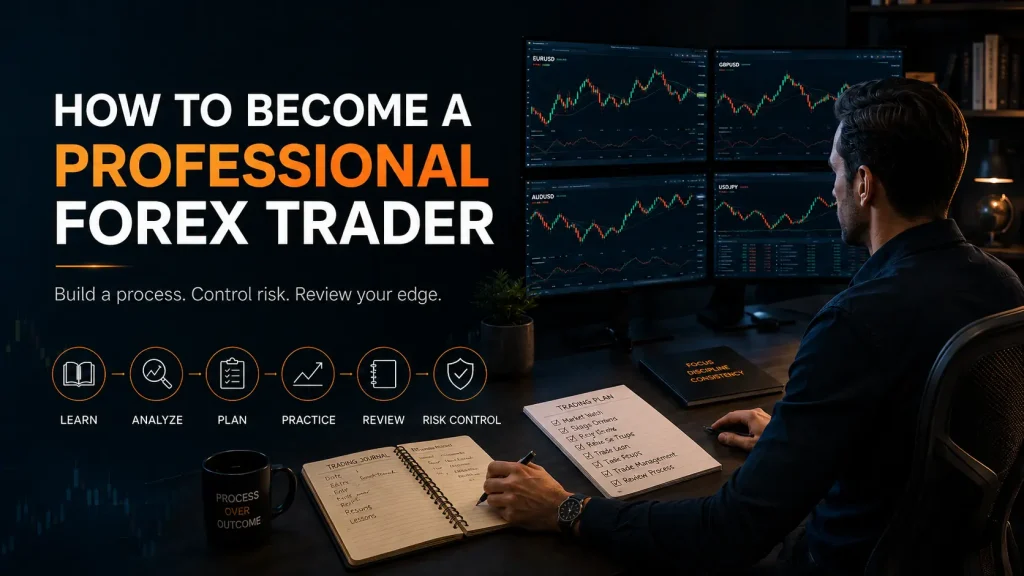
How Do You Become a Professional Forex Trader?
Becoming a professional forex trader starts with a repeatable process, not a larger account or a short profitable streak. Learn market mechanics and analysis, define written trading and risk rules, practice execution, keep a journal, review a meaningful sample of trades, and decide whether your goal is independent trading or an institutional finance career.
Professional-style trading means knowing the reason for a trade, the point that invalidates it, the amount at risk, the conditions that would keep you out of the market, and how the decision will be reviewed afterward.
If you are still learning the basic path into trading, start with the beginner forex trader roadmap. This guide focuses on the standards used to move from basic participation toward a more structured trading or career process.
What Does Professional Forex Trader Really Mean?
The phrase professional forex trader is used in several ways. It may describe an independent trader who applies professional-style rules to personal capital, an employed trader working for a bank, fund, broker, corporation, or trading firm, or a broader FX professional working in analysis, risk, operations, brokerage, education, or technology.
These meanings are related but not interchangeable. A retail trader can improve process quality without becoming an institutional trader, and a professional-client or account classification can have a separate regulatory meaning. For a deeper comparison, review how retail and professional trader labels differ in practice.
Professional vs Beginner Forex Trader
The clearest difference is how decisions are made and reviewed. Professional-style behavior is organized around repeatable rules rather than a particular indicator, account size, or number of trades.
| Area | Beginner Or Amateur Behavior | Professional-Style Behavior |
|---|---|---|
| Trade decision | Enters because price looks ready to move or a signal appears. | Uses a defined setup, market context, invalidation point, and pre-defined risk. |
| Position size | Changes size after wins, losses, or strong emotions. | Sizes the trade from the risk plan before entry. |
| Loss response | Chases the loss or immediately trades again to recover. | Stops when required, records the trade, and reviews whether the process was followed. |
| Method evaluation | Switches strategies after a few outcomes. | Reviews a meaningful sample and separates process quality from short-term results. |
| Evidence | Relies on memory or account balance alone. | Keeps records of setup quality, risk, execution, rule-following, and mistakes. |
Psychology matters because a sound plan is only useful if it can still be followed after losses, missed trades, or a profitable streak. The forex trading psychology guide covers common emotional triggers behind rule breaks.
Independent Trader vs Institutional Forex Career
Before choosing a professional path, define the destination. Independent trading and institutional trading both require market knowledge, but the capital source, work environment, qualifications, and accountability are different.
| Path | Main Goal | Typical Preparation | Accountability |
|---|---|---|---|
| Independent retail trader | Trade personal funds with a structured process. | Market education, platform practice, written rules, risk controls, and recordkeeping. | Personal capital, self-imposed limits, and self-review. |
| Institutional forex trader | Trade or execute within a bank, fund, corporation, broker, or trading firm. | Often finance or quantitative education, internships or experience, employer training, and role-specific compliance. | Desk limits, supervision, employer policies, and performance expectations. |
| Forex-related professional | Work in research, analysis, risk, operations, brokerage support, or technology. | Role-specific market, data, communication, technical, or compliance skills. | Employer standards and responsibilities that may not involve discretionary trading. |
Income also works differently. Independent traders have variable trading results rather than a fixed market salary, while employed roles may combine salary and performance-based compensation. See the separate forex trader salary guide for that topic.
Step-By-Step Path to Professional-Style Forex Trading
A useful way to structure development is as a sequence of gates. The purpose of each gate is to prevent the next level of exposure from arriving before the underlying behavior is ready.
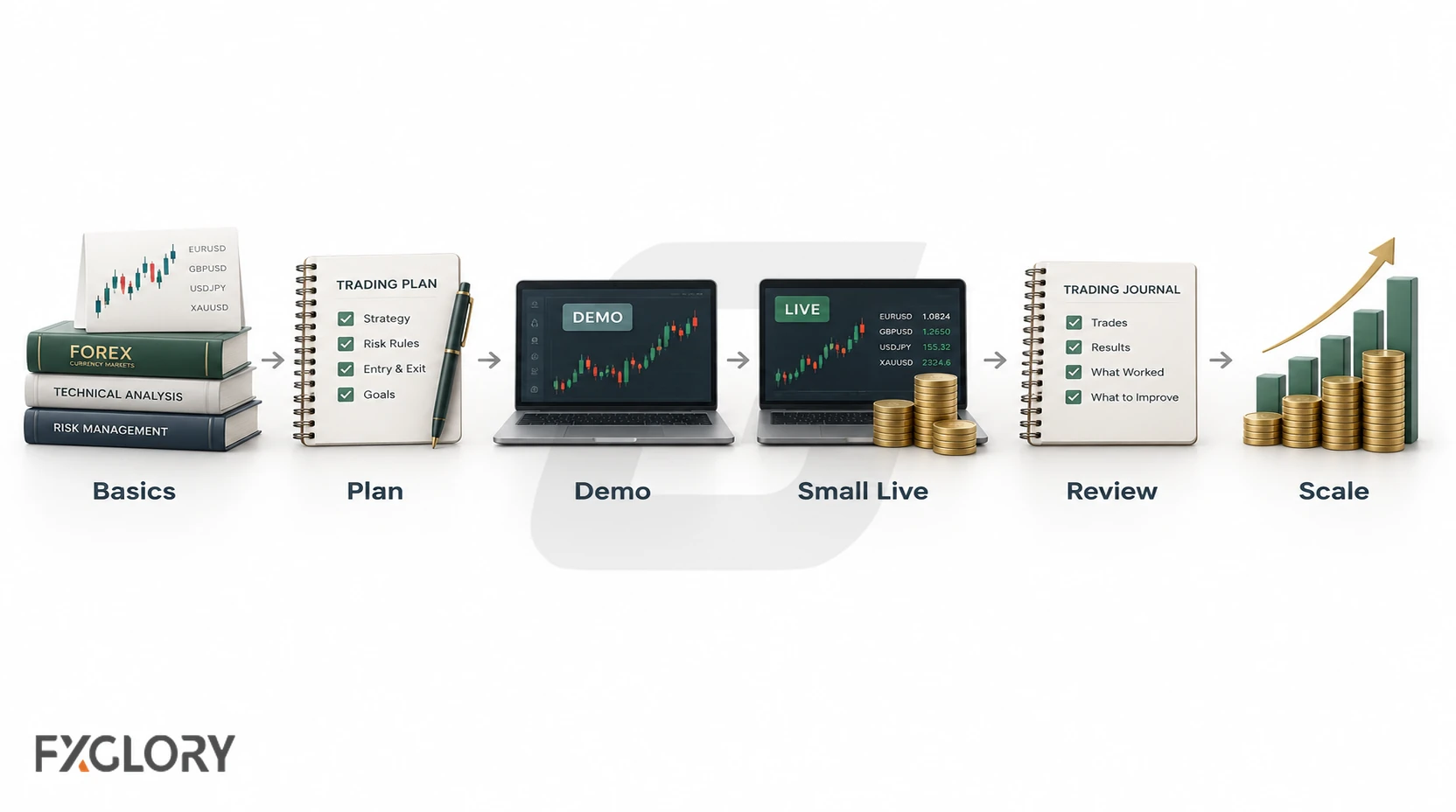
- Define the path: Decide whether you are building an independent trading process, pursuing an institutional role, or exploring another FX career.
- Confirm market mechanics: Understand currency pairs, pip movement, lot size, notional exposure, spread, leverage, margin, order types, swap, volatility, and trading sessions before taking live risk.
- Develop an analysis framework: Learn how technical structure, economic drivers, central banks, sentiment, liquidity, and scheduled news can affect a trade idea.
- Choose a style that fits your time: Match timeframe and decision speed to the hours you can realistically monitor the market. Compare approaches in types of forex traders.
- Write the plan: Define setups, invalidation, position-sizing rules, maximum loss limits, trade management, news rules, and review criteria.
- Practice the process in demo: Test order execution, rule-following, and journaling without live capital risk.
- Use small live exposure as a behavior test: If demo discipline is consistent, introduce limited real-money risk and observe whether emotion changes execution.
- Review before scaling: Use journal evidence to identify repeated strengths and errors before increasing exposure or pursuing a larger career step.
For platform practice without real-money exposure, FXGlory provides an open demo account path.
Skills Professional Forex Traders Need
Professional-style trading combines market knowledge with risk control and self-review. Strength in one area does not compensate for consistently poor decisions in another.
| Skill | Why It Matters | Practical Evidence |
|---|---|---|
| Market mechanics | Position size, notional exposure, margin, leverage, spread, and price movement affect the trade in different ways. | You can explain the planned risk and required margin before entry, while recognizing that slippage can make the realized loss differ from the plan. |
| Technical analysis | Charts can organize trend, range, levels, volatility, and timing. | Your setup and invalidation rules are written before the outcome is known. |
| Fundamental awareness | Rates, inflation, central banks, employment data, risk sentiment, and geopolitical events can change currency conditions. | You check relevant scheduled events and know when your plan calls for reduced or no exposure. |
| Risk management | Losses are unavoidable; uncontrolled exposure can make ordinary losses disproportionately damaging. | Position size follows a defined risk budget rather than recent emotion. |
| Recordkeeping | Improvement requires evidence rather than selective memory. | Your journal captures setup, risk, execution, outcome, and rule-following. |
| Emotional discipline | Fear, overconfidence, boredom, and revenge can override a valid plan. | You can stop trading after a limit or rule breach instead of trying to recover immediately. |
Education, Degrees, and Certifications
You do not need a university degree simply to trade your own retail forex account. Independent traders still need market knowledge, risk literacy, platform competence, and a process for reviewing decisions.
Institutional roles can have different expectations. Finance employers commonly recruit from finance, economics, business, mathematics, statistics, computer science, and other quantitative or market-related backgrounds, and internships or related experience can be important.
Credentials should be matched to the role rather than treated as proof of trading skill. The CFA can support investment-analysis and broader finance paths, the FRM is relevant to risk-focused work, and technical or quantitative study may support specialized roles. In the United States, the Series 34 is an NFA Retail Off-Exchange Forex examination administered by FINRA for applicable forex-related registrations; requirements depend on the activity and jurisdiction.
| Education Or Credential | Where It May Help | What It Does Not Prove |
|---|---|---|
| Bachelor's degree | Institutional trading, analyst, risk, bank, fund, or corporate treasury roles. | That the holder can trade personal capital profitably. |
| Finance, economics, mathematics, statistics, computer science | Market, quantitative, data, and decision-making foundations. | That academic knowledge will automatically translate into disciplined execution. |
| CFA | Investment analysis, research, portfolio, and broader finance careers. | A shortcut to profitable short-term trading. |
| FRM | Risk management and risk-focused careers. | Immunity from trading losses. |
| Series 34 (U.S.) | Applicable retail off-exchange forex registration pathways. | A universal license for every trader or every jurisdiction. |
Build a Professional Trading Plan
A written plan should define what qualifies as a trade before market pressure changes the decision. Include the markets and timeframes you trade, setup conditions, entry logic, invalidation, position-sizing method, maximum loss limits, trade management, news-event rules, and the conditions that require you to stop trading.
The plan also needs a review schedule so rules can be evaluated against evidence. Use the forex trading plan template for structure and the forex risk management strategy guide for loss-control principles.
Demo-to-Live Readiness Gates
Moving from demo to live trading should depend on observable behavior rather than excitement or a deadline. If a gate is not met, the next stage adds risk without fixing the underlying process.
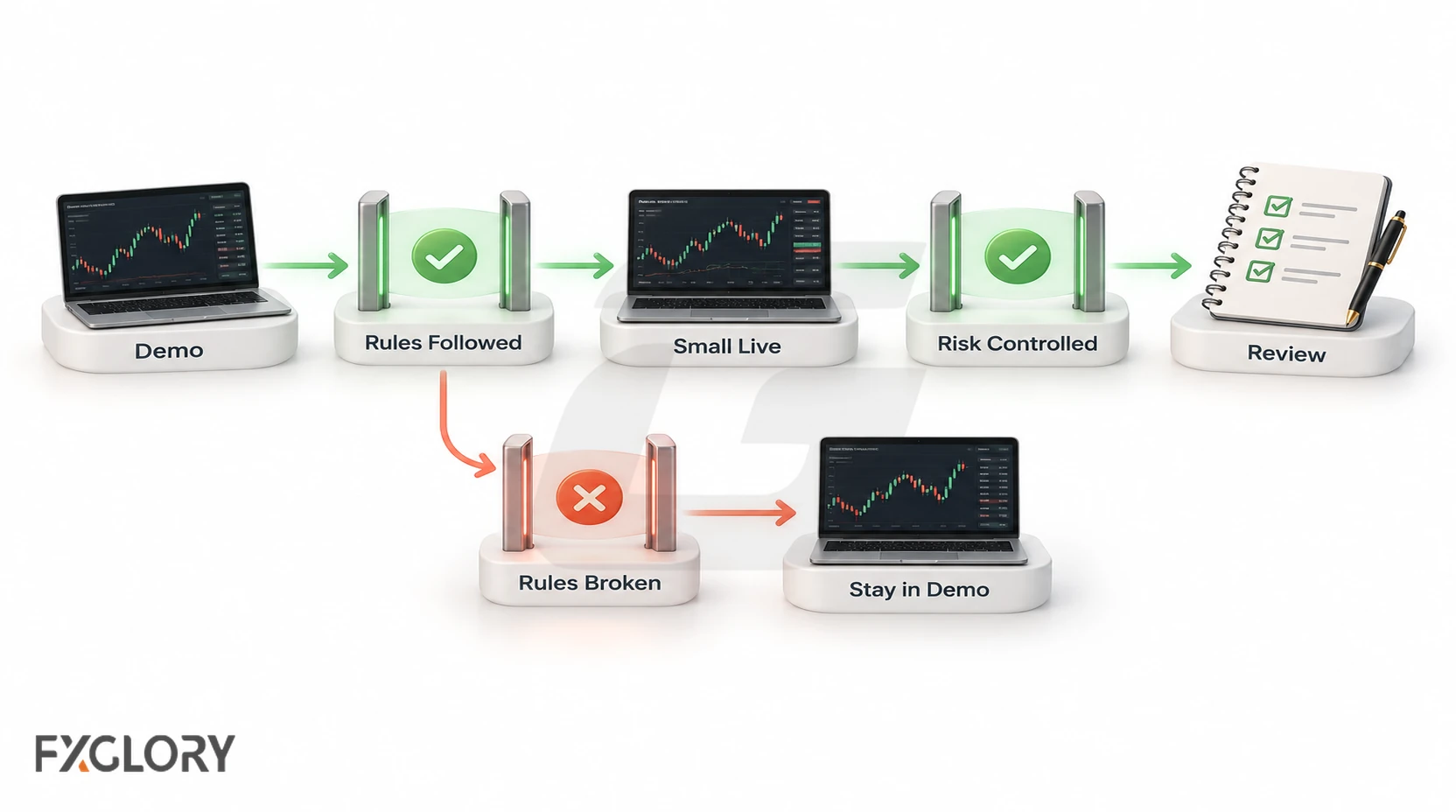
| Stage | Goal | Readiness Evidence |
|---|---|---|
| Learn basics | Understand market mechanics and trade risk. | You can explain position size, required margin, stop distance, and planned risk before entry. |
| Demo practice | Test execution, setups, risk rules, and journal workflow. | You follow the plan without random trades or emotional resizing. |
| Small live test | Observe how real money affects behavior while exposure remains limited. | You respect stop and loss limits even when the outcome is frustrating. |
| Review phase | Evaluate patterns across a meaningful sample. | Your journal shows repeated behaviors that can be kept, changed, or tested further. |
| Scaling decision | Decide whether more exposure or another career step is justified. | The decision is supported by process evidence rather than a single profitable period. |
Before a live order, verify the trade's mechanics. FXGlory's margin calculator can help estimate required margin, while the leverage conditions page explains available leverage conditions. Margin is the capital required to support a position; it is not the same as the amount you can lose.
Risk Management Standards for Professional Behavior
Risk planning begins before the order. The objective is not to eliminate losing trades but to keep routine losses within limits the account and the trader can tolerate.
| Risk Area | Professional-Style Standard | Warning Sign |
|---|---|---|
| Risk per trade | Define the planned risk before entry and size the position from that risk limit and the stop distance. | Choosing lot size first and calculating risk afterward. |
| Maximum loss limits | Set session, daily, or weekly stop rules before trading begins. | Continuing because the account is down and you want to get back to even. |
| Leverage and exposure | Judge risk from actual position size and exposure, not from the maximum leverage available. Higher available leverage does not make the market move more; it can allow more exposure to be controlled with less margin. | Increasing exposure simply because more leverage is available. |
| Stop logic | Place the invalidation point where the trade thesis is no longer valid, then size the position to the accepted risk. | Moving the stop farther away to avoid realizing a loss. |
| Combined exposure | Review correlated positions together when they depend on the same currency or market view. | Treating several similar positions as unrelated risks. |
| Trading costs | Include spread, swap, and expected execution conditions when evaluating whether a strategy is viable. | Ignoring costs because the planned price target looks large enough. |
Review spread conditions when evaluating a strategy, especially when expected price moves are small relative to transaction costs.
Journaling and Performance Review
A journal should record enough information to separate a good decision from a lucky outcome. At minimum, capture the instrument, date and session, setup, market context, entry, stop, exit logic, position size, planned risk, result, rule-following, and relevant emotional notes.
Review on a schedule. Frequent review can catch execution errors, while a larger sample is needed before drawing conclusions about a setup or changing a strategy. Avoid redesigning the method around one unusual win or loss.
For a deeper structure, use the forex trading journal guide or the trading journal template.
Capital, Salary, and Income Reality
Independent trading should not be treated as a guaranteed salary. Results vary with strategy, market conditions, costs, risk, execution, and trader behavior, and even a disciplined process can experience losing periods and drawdowns.
Capital requirements therefore cannot be reduced to one universal account balance. The amount needed depends on the monetary risk created by the chosen position size and stop distance, expected trading costs, drawdown tolerance, and whether the person expects trading to supplement or replace other income.
Pressure to pay immediate bills from trading can distort decisions. Keep essential living money separate from trading capital, and use the forex trader salary guide for a separate discussion of employed compensation and independent trading income.
Broker, Platform, and Trading Conditions
A trading plan has to work under the actual conditions of the account being used. Before live trading, confirm platform workflow, available instruments, spreads, margin requirements, leverage conditions, order behavior, funding procedures, and any account rules that affect execution or risk planning.
FXGlory's trading platforms overview, trading instruments list, account types, and trading account conditions provide the relevant account and platform information to review before placing a trade.
Mistakes and Red Flags That Block Progress
Many traders stall because they add exposure faster than they improve process. Watch for these patterns:
- Going live before the rules are stable: Demo profit is not useful evidence if the trader cannot follow the same plan consistently.
- Using available leverage as a target: Maximum leverage describes what may be available, not how much exposure is appropriate for a trade.
- Changing methods after a handful of outcomes: Small samples make it difficult to distinguish strategy behavior from normal variance.
- Trading to recover losses or meet an income target: Recovery pressure can lead to larger size, lower-quality entries, and broken stop rules.
- Copying signals without independent risk logic: An entry is incomplete if the trader cannot explain invalidation, position size, and exit conditions.
- Treating a course, funded challenge, or short winning streak as proof of professionalism: Progress should be supported by repeatable behavior and records over time.
- Believing guaranteed-return or “low risk, high return” claims: No trading method, platform, signal, or account type can guarantee market outcomes.
For the boundary between structured trading and gambling-like behavior, see when forex trading starts to resemble wagering rather than a process.
When You Should Not Try to Trade Professionally
Professional development should pause when the conditions needed for controlled decision-making are missing. The next step may be more education, more demo work, smaller live testing, or a different FX career path rather than greater exposure.
| Situation | Why It Matters | Better Next Step |
|---|---|---|
| You need trading profits for immediate bills | Income pressure can override risk limits and encourage recovery trading. | Separate essential living money from trading capital. |
| You cannot stop after losses or rule breaches | A written plan has little value if stop rules are repeatedly ignored. | Return to demo or reduce exposure while addressing the behavior. |
| You cannot explain leverage, margin, position size, and planned risk | Actual exposure may be different from what you think you are risking. | Study the mechanics and calculate the trade before entering. |
| You have no usable records | Without evidence, scaling becomes a decision based on memory and recent outcomes. | Build a journal sample before increasing risk. |
Choosing not to trade is part of risk control. A missed trade does not create a financial loss; an unplanned trade can.
A 90-Day Professional Development Plan
Ninety days can be used as a structured review window, not as a promise that a trader will be ready or profitable by the end of it. The goal is to build routines and collect enough evidence to decide what should happen next.
| Period | Focus | Output |
|---|---|---|
| Days 1-30 | Market mechanics, risk basics, trading-style selection, platform practice, and plan design. | A written plan, watchlist, risk checklist, and journal format. |
| Days 31-60 | Demo execution, rule-following, trade recording, and scheduled review. | A sample of trades with clear categories for process strengths and repeated errors. |
| Days 61-90 | Refine the plan and test small live risk only if demo discipline is consistent; otherwise continue practice. | A documented decision to continue demo, begin limited live testing, pause, or address a specific process gap. |
The useful outcome is a better decision about readiness, not a deadline for increasing risk.
Sources Used for Career and Risk Context
For retail forex risk context, the CFTC and NASAA warn that off-exchange forex trading by retail investors is extremely risky and caution against high-return, low-risk claims: CFTC/NASAA forex investor alert.
For institutional career context, CFA Institute's forex trader career overview states that a bachelor's degree is required for most entry-level forex trader positions and lists finance-related and quantitative fields as useful preparation: CFA Institute forex currency trader career overview.
For U.S. exam context, FINRA lists the Series 34 Retail Off-Exchange Forex Exam among the NFA exams it administers: FINRA qualification exams.
Regulatory, employment, and exam requirements vary by jurisdiction and role. Check the rules that apply to the specific activity and location before relying on a credential path.