
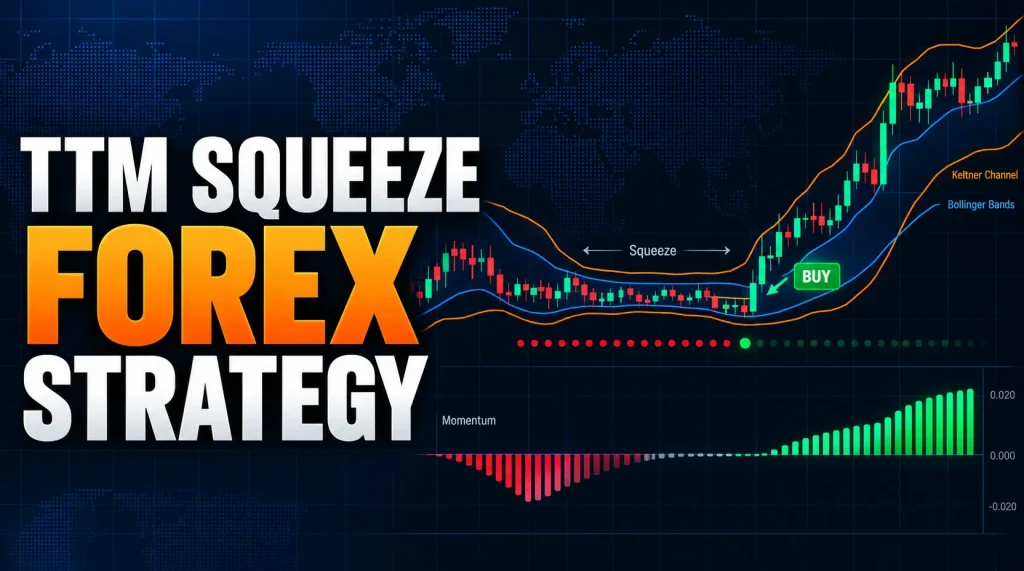
What Is A TTM Squeeze Strategy?
A TTM squeeze strategy examines a volatility-compression condition, the transition out of that condition, and a separately calculated momentum reading. A common implementation compares Bollinger Bands (BB) with Keltner Channels (KC) to identify compression.
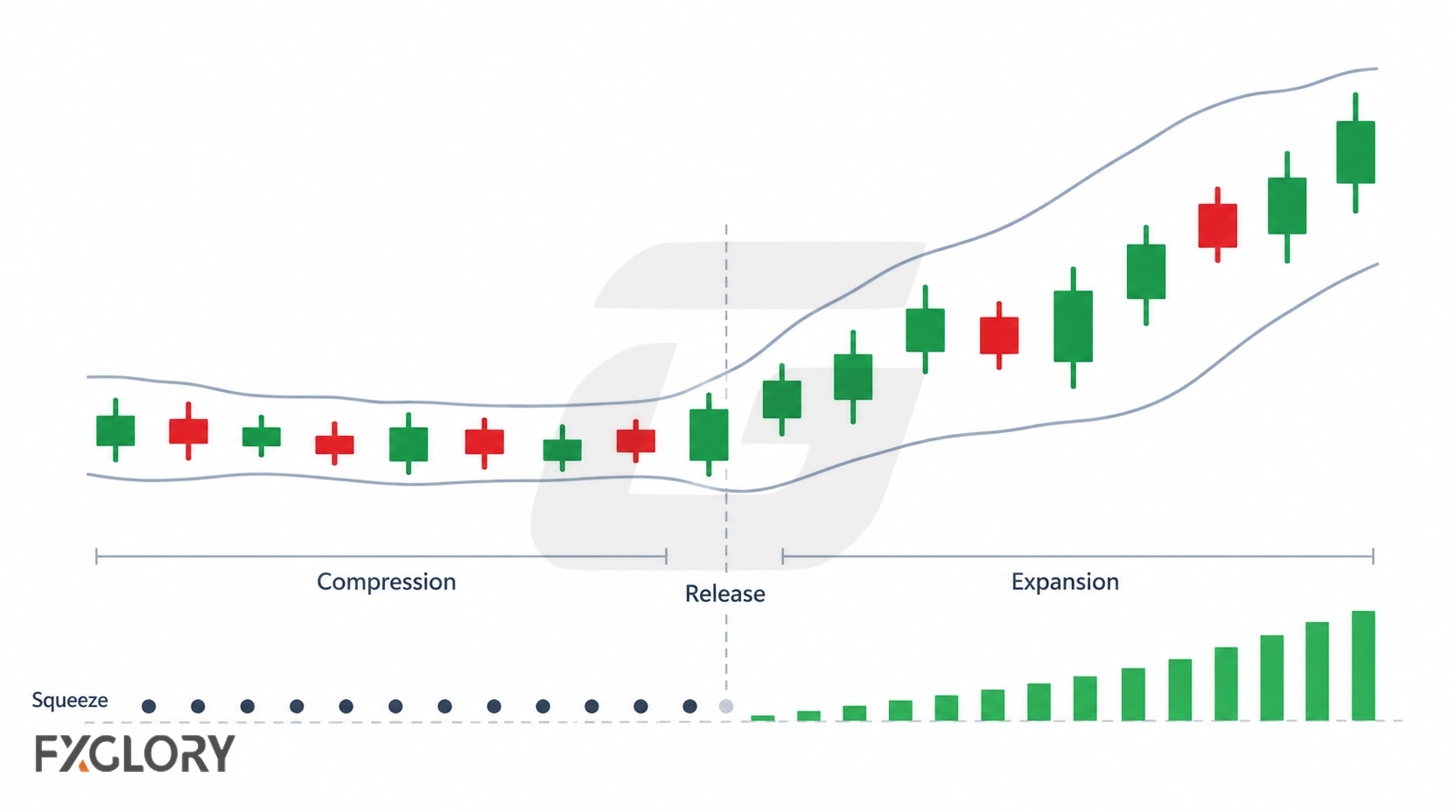
The squeeze condition describes the relationship between two envelopes. A release does not prove that price has broken a trading range, and the direction of a later price move is not determined by that state change.
For standard Bollinger-only compression, see Bollinger Band squeeze strategy rules. To examine the comparison envelope, see Keltner Channel forex strategy rules. The wider context is covered in forex indicator strategies.
TTM Squeeze Signal vs Full Forex Strategy
Indicator states, market observations, and trade decisions should be kept separate. A squeeze-state transition can occur without the price-breakout condition required by a particular strategy.
| Layer | Observable Condition | Separate Decision Needed | Common Mistake |
|---|---|---|---|
| Compression | BB/KC relationship satisfies the selected squeeze-on rule | Specify whether a range or trend context is required | Predicting breakout direction from compression |
| Release | The squeeze-on condition changes to off on a completed bar | Define whether a price close beyond a marked level is also required | Equating release with a confirmed breakout |
| Momentum | Histogram sign and change under the documented formula | Choose whether and how it filters a setup | Interpreting histogram values as direct buyer/seller activity |
| Trade setup | Entry and invalidation conditions are satisfied | Evaluate stop distance, spread, slippage, size, margin, and exits | Entering without a complete, executable plan |
The forex trading setups guide covers how to turn conditions into defined trade rules.
How TTM Squeeze Is Built
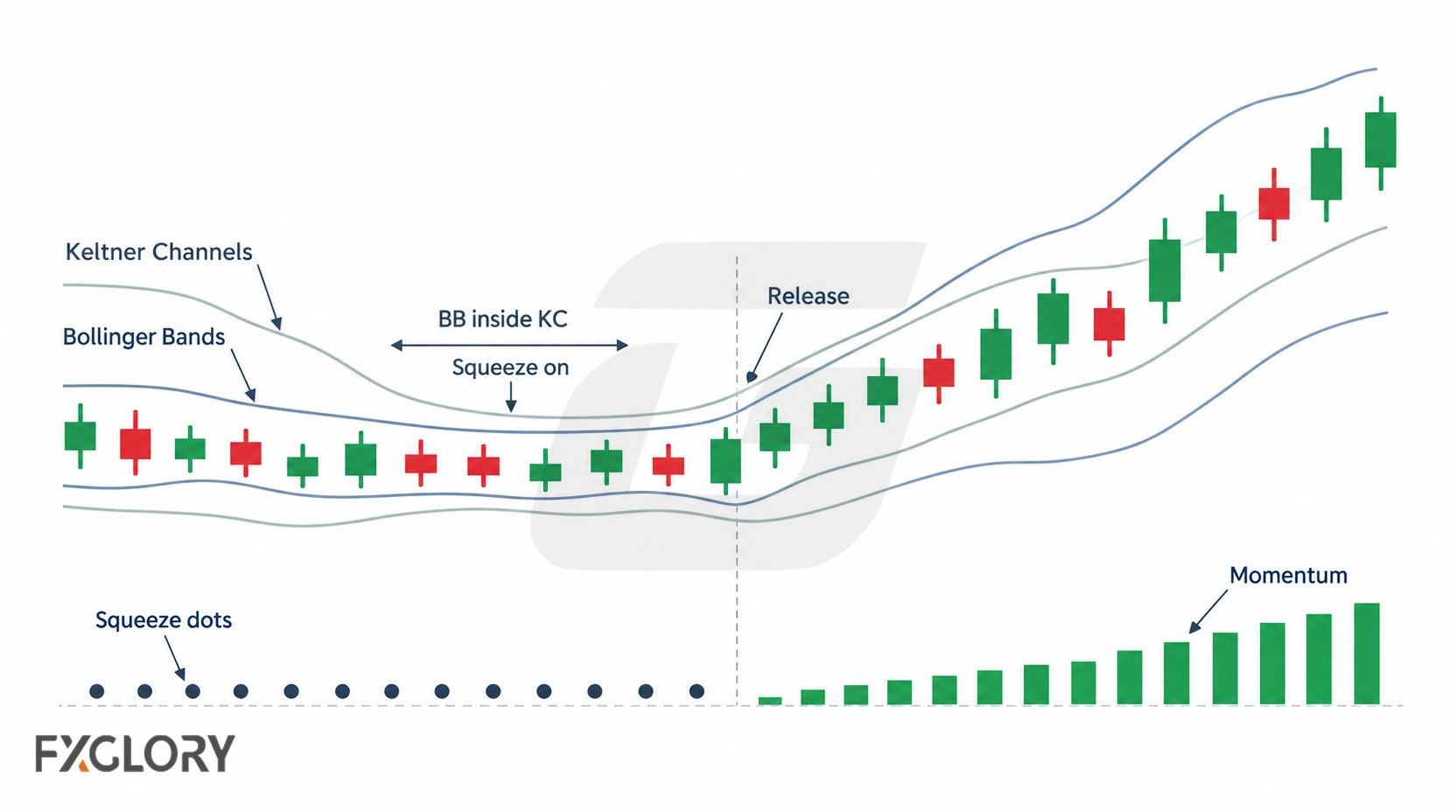
Many TTM-style indicators combine standard-deviation-based Bollinger Bands, a Keltner Channel envelope, and a momentum calculation. The squeeze state comes from comparing the two envelopes; the histogram is calculated separately. Some Keltner implementations use ATR-based widths while others use different range inputs.
| Component | Common Calculation Or Role | What To Document | Limit |
|---|---|---|---|
| Bollinger Bands | Moving-average center with standard-deviation bands | Price source, length, deviation factor, and average type | Band narrowing alone gives no direction |
| Keltner Channels | Centerline with a range-based envelope, often EMA and ATR-based | Centerline, range measure, lengths, and multiplier | Different formulas produce different squeeze states |
| Squeeze state markers | Display whether the selected BB/KC containment rule is satisfied | Containment, equality treatment, completed-bar updates, and color legend | A marker is not a price breakout |
| Momentum histogram | Tool-specific oscillator or regression-derived series | Formula, zero baseline, sign, slope, and bar timing | Not a direct measurement of buying or selling volume |
For related mechanics, see Bollinger Bands as volatility and price-location context, EMA and ATR channel behavior, and the Forex Moving Average guide.
Squeeze On vs Squeeze Fired
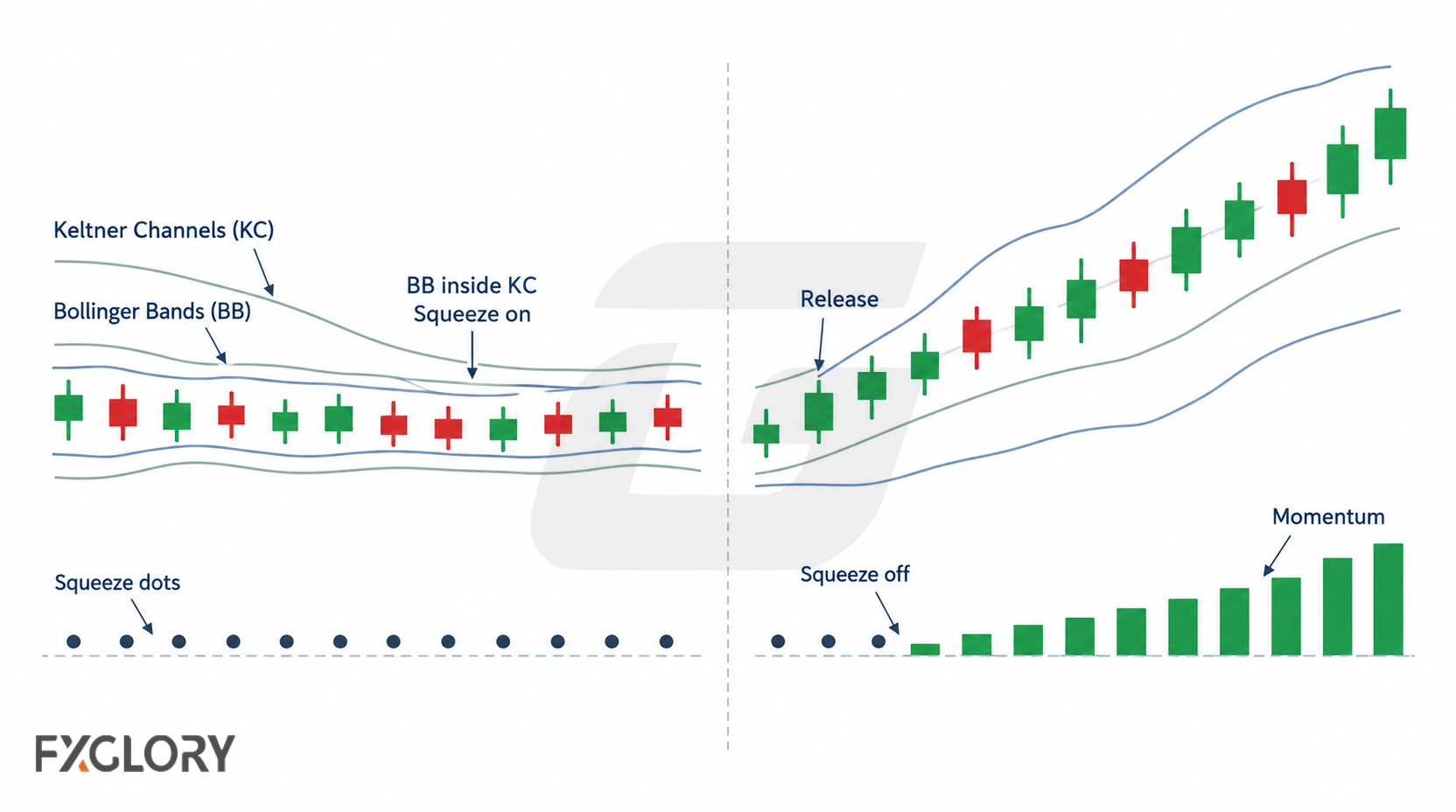
For a common BB/KC rule, squeeze on occurs when the upper Bollinger Band lies below the upper Keltner boundary and the lower Bollinger Band lies above the lower Keltner boundary. Some implementations handle touching boundaries differently. A fired/released event is the transition from an on-state bar to an off-state bar, not every subsequent bar that remains off.
| State Or Event | Band Relationship | What It Establishes | Does Not Establish |
|---|---|---|---|
| Squeeze on | Both Bollinger boundaries lie inside their corresponding Keltner boundaries under the selected rule | Compression condition is true on that bar | Breakout direction or trade entry |
| First release (fired) | Current completed bar is off after a completed squeeze-on bar | The selected containment condition has ended | Realized volatility expansion or price-structure breakout |
| Continuing no-squeeze state | Current and previous bars are off | No new on-to-off transition occurred | A new release signal on each bar |
| Consecutive squeeze-on dots | Each completed bar satisfies the squeeze-on rule, if the tool plots one marker per bar | Duration of that condition in completed bars | A larger or more successful subsequent move |
Hypothetical band example: On one completed bar, KC boundaries are 1.0950 and 1.1050, while BB boundaries are 1.0965 and 1.1035. Both BB boundaries are inside the KC envelope, so the condition is on. Suppose the next completed bar has KC boundaries of 1.0950 and 1.1050 and BB boundaries of 1.0960 and 1.1054. The upper BB now exceeds the upper KC: under a rule that switches off when full containment ends, this bar is the first release. It does not establish a price break beyond a separately marked trading range. These are invented values solely to demonstrate the calculation.
TTM Squeeze Momentum Histogram
The histogram is an independent computed series that can be checked during compression, at the release transition, and on subsequent bars. Interpret its zero line and slope according to the specific formula. A sign change or a declining bar is not automatically a price breakout, trend reversal, or measure of participant pressure.
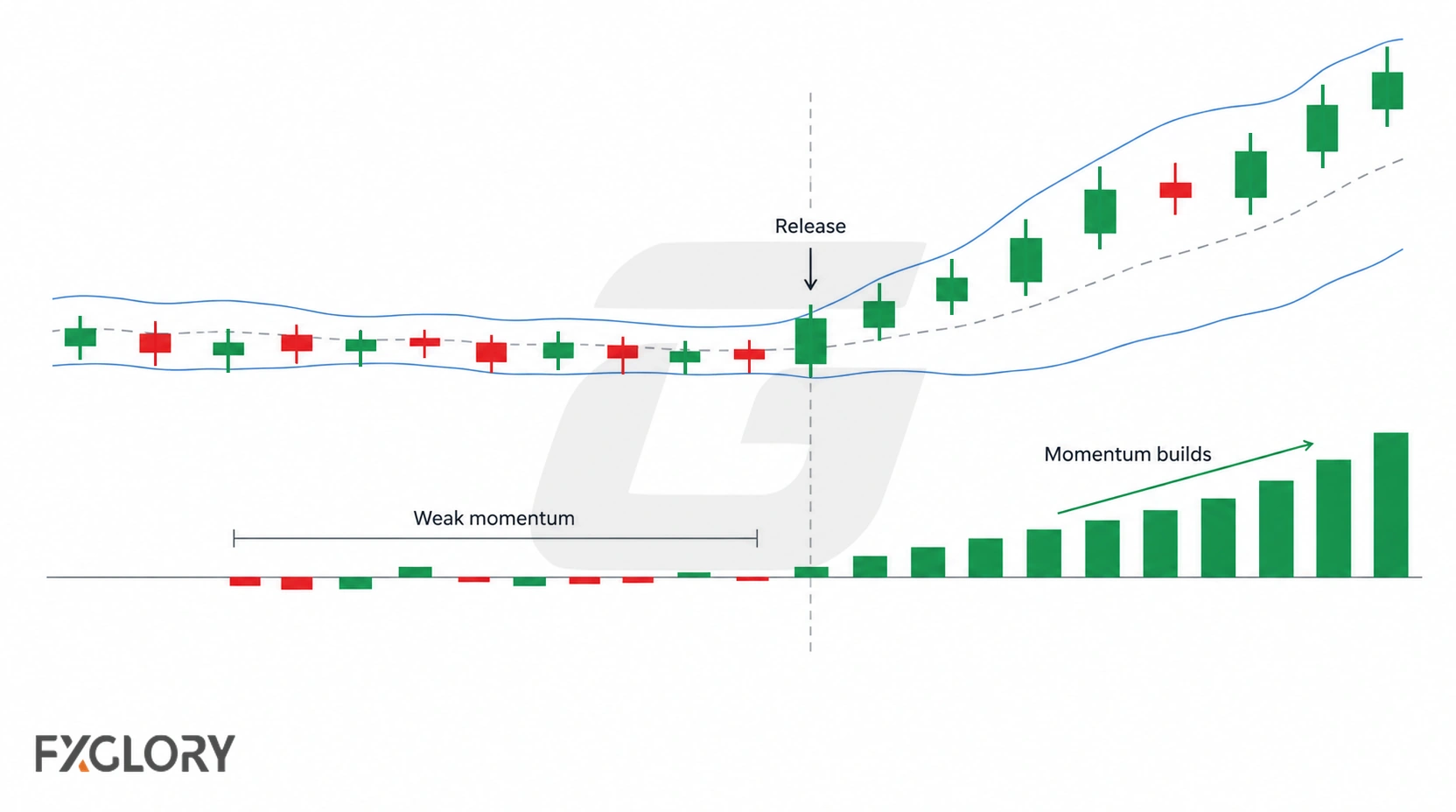
| Histogram Observation | Meaning Under A Defined Zero-Baseline Oscillator | Further Check | Misreading To Avoid |
|---|---|---|---|
| Above zero | Computed value is positive relative to its baseline | Does the strategy separately require a price close beyond resistance? | Assuming proven buying pressure |
| Below zero | Computed value is negative relative to its baseline | Does the strategy separately require a price close below support? | Assuming proven selling pressure |
| Value rising | Current histogram value exceeds the prior value | Check whether it remains positive, is becoming less negative, or crosses zero | Equating every rise with bullish confirmation |
| Value falling | Current histogram value is below the prior value | Check its sign and any written management rule | Calling a falling positive bar a negative reading or a failed squeeze |
| Zero cross | The series changes sign relative to its defined baseline | Check formula, completed-bar behavior, and any price trigger | Assuming the cross is an executable entry |
For other momentum approaches, see RSI forex strategy rules; for a separate measure of trend strength, review ADX as a trend-strength filter.
Managing A Squeeze After Release
Once a plan’s entry condition is met, management depends on its separately written price, momentum, and risk rules. An oscillator losing height does not undo a prior BB/KC state transition. A release without a qualifying breakout is different from a breakout that qualifies and then fails.
| After-Release Observation | What It Means | Possible Rule To Specify |
|---|---|---|
| Price meets the defined breakout condition | A price-structure event has occurred in addition to the squeeze-state release | Document entry, initial stop, costs, and position size |
| Histogram value deteriorates | Momentum measurement changes under the selected formula | Apply a momentum-based exit only if written into the plan |
| Price later closes back inside the broken range | A previously confirmed range breakout may fail its continuation condition | Apply the stated structural invalidation or exit test |
| New entry would require an excessive stop | Proposed loss or margin may exceed account limits | Reduce size where feasible or skip the new trade |
TTM Squeeze Strategy Decision Chain
Use this as a decision framework, not a mandatory order in which information becomes available. The squeeze must be on before it can transition off, but momentum and price structure can be monitored before, during, and after that transition. Set the definitions before reviewing outcomes.
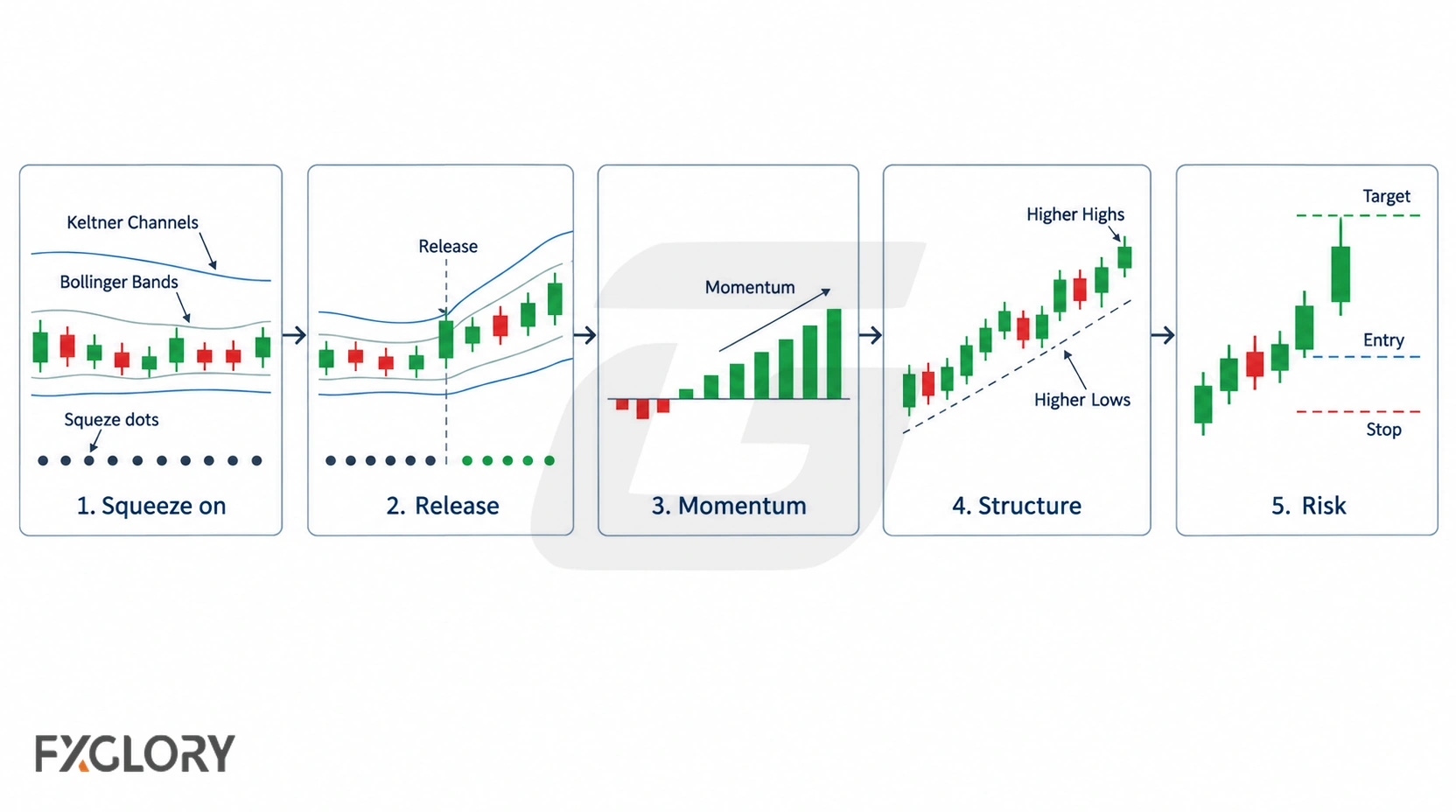
| Review | Question | Evidence To Record | Decision |
|---|---|---|---|
| Implementation | Which completed-bar BB/KC and histogram formulas are used? | Settings, equality rule, source, colors, and marker timing | Proceed only with a reproducible definition |
| Compression and release | Was squeeze on, and did the on-to-off transition occur? | Recorded band boundaries and state on successive completed bars | Classify state without assuming direction |
| Momentum and context | What are the histogram sign and changes, and where is price? | Chosen momentum rule, prior range, trend, support, or resistance | Apply the defined filter or skip condition |
| Price confirmation and failure | What completed-candle event would qualify or invalidate a breakout? | Predefined boundaries, close, optional retest, and separate failure criterion | Distinguish a candidate from a confirmed setup |
| Execution and risk | Do costs, stop distance, size, margin, and exits fit the plan? | Spread, slippage allowance, entry/stop prices, loss limit, and no-trade rule | Accept, delay, adjust size, or skip |
TTM Squeeze Strategy Types
The following are illustrative rule families, not five independently proven profitable strategies. State detection, subsequent price confirmation, and trade-risk acceptance should be kept distinct for each.
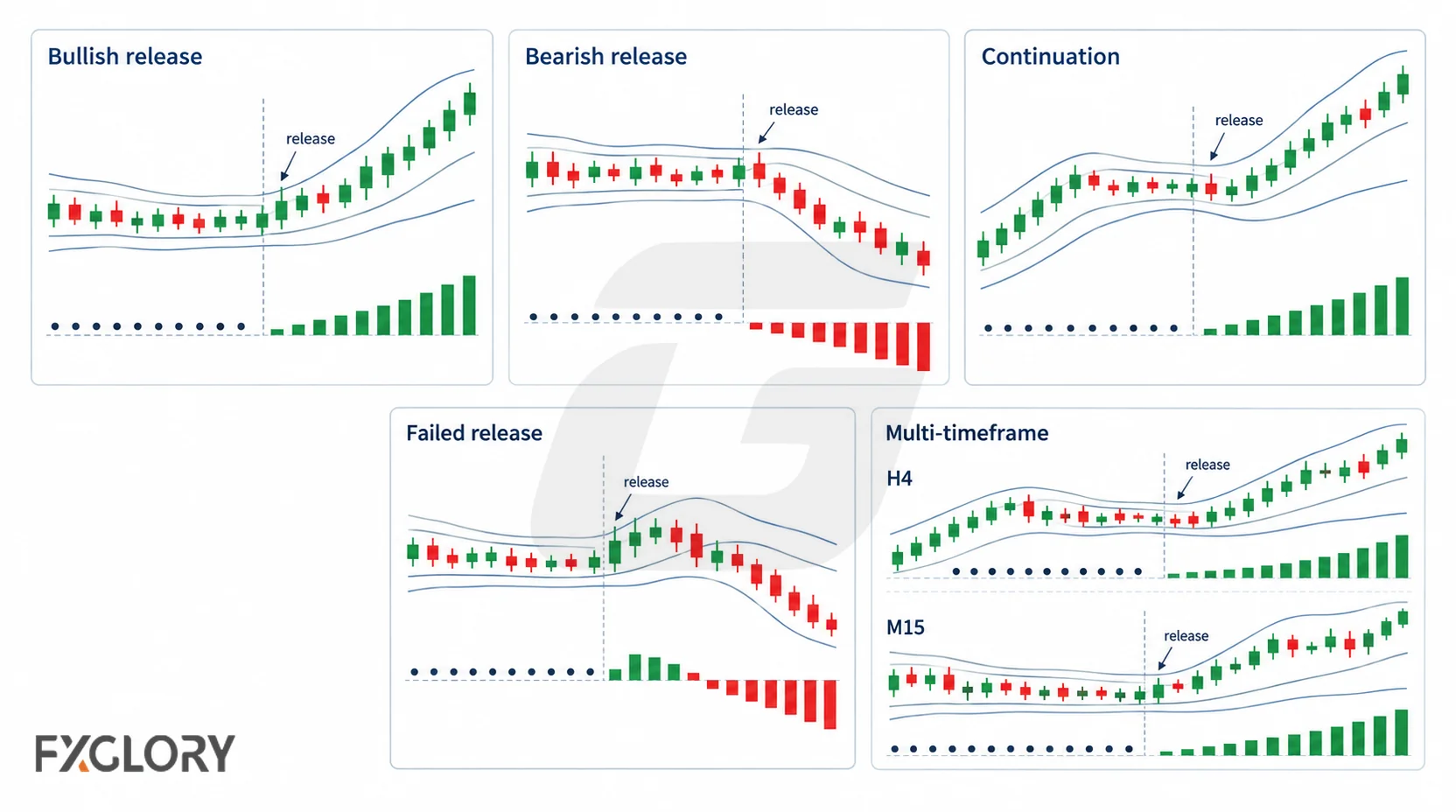
Bullish Squeeze Release
One bullish example combines a completed on-to-off transition with an optional positive histogram filter and a separately defined completed close above an earlier range high. Neither the histogram sign nor the state transition alone proves buying pressure.
- Context: A previously marked resistance level or range high.
- TTM role: Identify compression and its release, with momentum read according to the selected formula.
- Trigger: For this example, a completed close above the marked high.
- Price invalidation: A later completed close back inside that range, if the plan defines that as failure of the breakout premise.
- Skip rule: No qualifying close, unverifiable indicator rule, or unacceptable stop distance after costs.
Bearish Squeeze Release
A bearish example uses a completed release and, if specified, a negative histogram reading, but requires a separate completed close below an earlier support boundary. These conditions describe a testable setup, not a forecast.
- Context: A previously marked support level or range low.
- TTM role: Identify state change and evaluate the defined momentum reading.
- Trigger: For this example, a completed close below the marked low.
- Price invalidation: A subsequent completed close back inside the range, if that is the chosen breakout-failure rule.
- Skip rule: No qualifying price break or risk and costs outside stated limits.
Continuation Squeeze
Compression may form during an established trend, but a further directional move does not necessarily follow. First specify the trend structure, such as rising swing highs and lows, and then define a separate continuation trigger.
- Context: A documented pre-existing trend and a subsequent consolidation.
- TTM role: Record the BB/KC condition within that context.
- Trigger: An expressly defined continuation close through the consolidation boundary or another tested condition.
- Invalidation: The chosen continuation structure fails its stated price rule.
- Skip rule: Trend criteria are not met or risk cannot be bounded.
Failed Squeeze Release
The term needs a precise failure rule. A BB/KC squeeze may release without price ever meeting a separately required breakout condition; that is an unconfirmed breakout scenario. If price first meets a completed-candle breakout rule and later violates its specified continuation or invalidation test, that is a failed confirmed breakout. Momentum fading alone does not make the historical squeeze transition false.
- Context: Observe whether the initial price breakout condition actually occurred.
- TTM role: Record the genuine indicator state transition separately.
- Trigger: No entry on a state change alone; a failure-trading strategy would require its own entry rules.
- Invalidation: For an example breakout plan, a completed close back inside the prior range after a qualifying close outside.
- Skip rule: No prewritten rule distinguishing unconfirmed, failed, and still-active scenarios.
Multi-Timeframe Squeeze Review
Comparing timeframes can provide additional structure but also different or conflicting indicator states. A higher-timeframe disagreement is a possible filter, not automatic structural invalidation of a completed lower-timeframe pattern.
- Context: Define the higher and lower timeframes and the role of each.
- TTM role: Compare independently calculated state and momentum readings.
- Trigger: A price condition defined on the execution timeframe.
- Invalidation: Use that setup’s explicit price or risk rule, not mere indicator disagreement unless predeclared.
- Skip rule: No documented priority rule when timeframe criteria conflict.
TTM Squeeze vs Related Squeeze Tools
Closely named tools can differ in what they calculate. Distinguish the role of each before combining their signals or comparing backtests.
| Tool Or Concept | Main Focus | How It Helps | What To Check |
|---|---|---|---|
| Bollinger Band Squeeze | Bollinger Band narrowing, sometimes BandWidth | Studies compression without necessarily using Keltner containment | Width threshold, price-break criteria, and costs |
| Keltner Channel | Centerline plus range-based envelope | Supplies comparison boundaries in BB/KC variants | Centerline type, range formula, lengths, and multiplier |
| BB/KC Squeeze | Containment of BB within KC | Defines compression and its state transition | Both band comparisons and release definition |
| Squeeze Momentum | State markers plus script-specific momentum | Provides a displayed oscillator alongside compression | Histogram formula, baseline, and update timing |
| TTM Squeeze Pro or script variations | Tool-specific states, alerts, or multiple squeeze levels | May extend the basic display | Source documentation and reproducibility of each plotted state |
Confirmation Tools For TTM Squeeze Setups
Additional tools are useful when each contributes a distinct test. None automatically validates a price break or replaces independently defined risk limits.
| Tool Or Context | Question It Helps Answer | Limit |
|---|---|---|
| Support and resistance | Which previously identified boundary would price need to cross or defend? | Zones and precise crossing rules must be specified |
| Higher timeframe | What larger swing or range structure surrounds the setup? | Different timeframes can give conflicting signals |
| ADX | Is measured trend strength rising or falling? | ADX alone does not specify direction |
| RSI | How does a separate momentum oscillator behave? | Oscillator thresholds must be defined and tested |
| ATR stop-distance review | How large are recent ranges relative to a proposed stop? | ATR measures range variation, not the correct position size or price direction |
| Volume-style tools | How does feed-reported volume or tick activity change? | Retail spot-forex feeds generally do not represent consolidated market volume |
For chart levels, review support and resistance in forex. For volatility-based distance considerations, see ATR as volatility and risk support.
Settings, Timeframes, And Platform Caution
Define the indicator version and inputs before testing. BB and KC calculations, marker handling, and histogram baselines can vary even when tools share a similar name.
| Setting Or Display | Why It Matters | What To Record |
|---|---|---|
| Bollinger Band inputs | Changes width and containment events | Price source, average type, length, and deviation multiplier |
| Keltner Channel inputs | Changes comparison envelope | Centerline, ATR or alternative range calculation, lengths, and multiplier |
| Containment and release logic | Determines the exact on-to-off transition | Boundary-equality rule, bar-close requirement, and alerts |
| Momentum calculation | Changes histogram values and zero-line meaning | Formula, baseline, slope rule, and whether bars can revise |
| Timeframe | Changes the intervals sampled and transaction-cost significance | Execution timeframe and any higher-timeframe filters |
| Dot labels and colors | Display conventions differ | Legend and documented meaning for this version |
Preserve settings during evaluation; if parameters are optimized, assess them on a separate sample. Consult FXGlory trading platforms for charting and order-workflow options rather than assuming that a named study is available identically on each platform.
Day Trading And Scalping Considerations
Shorter chart intervals produce more completed bars over the same calendar period, but not necessarily more reliable squeeze opportunities. Spread, slippage, and execution timing can account for a substantial part of a small price move.
| Short-Term Issue | Why It Matters | What To Specify |
|---|---|---|
| Spread sensitivity | Cost consumes a larger share of a small projected move | Spread assumptions and net expected move |
| Breakout failure | A qualifying close beyond a boundary can later reverse inside it | Completed-candle failure and exit criteria |
| Late confirmation | Entry after a large candle can increase distance to the invalidation level | Maximum permissible planned loss and stop distance |
| Rapid range changes | Actual fill price can differ from a signal-bar close | Slippage and position-size assumptions |
| Platform alerts | Intrabar states may change before the bar closes | Whether execution uses provisional or completed-bar values |
Before testing these rules, review FXGlory spreads. For margin requirements, use the FXGlory margin calculator; margin and position risk are different calculations.
Worked Example: One TTM Squeeze, Four Outcomes
Consider a hypothetical forex range with a documented squeeze-on condition. Its eventual release can coexist with different price outcomes; none of the scenarios below represents backtested results.
| Observation | Classification | Next Check | Decision Risk |
|---|---|---|---|
| First release bar, positive chosen histogram reading, and completed close above resistance | Release plus a qualifying bullish price-break condition | Check the plan’s entry, invalidation, costs, and acceptable loss | Entry may be too far from the stop level |
| First release bar, negative chosen histogram reading, and completed close below support | Release plus a qualifying bearish price-break condition | Check the same separate execution and risk conditions | A later close may negate the breakout thesis |
| Price completes a qualifying close outside the range, then a later completed candle closes back inside | Previously confirmed price breakout fails this example’s continuation criterion | Apply prewritten failure and exit rules | Calling the initial squeeze-state transition itself false |
| Compression continues and price remains inside its range | No on-to-off release yet | Observe future completed bars without assuming direction | Trading an anticipated release that has not occurred |
When TTM Squeeze Strategies Fail
Failure mechanisms should be defined in terms of observable conditions rather than unsupported claims about how frequently a method fails. A strategy can have an indicator release yet lack a price entry, or can enter after its price rule is satisfied and later hit its invalidation or loss limit.
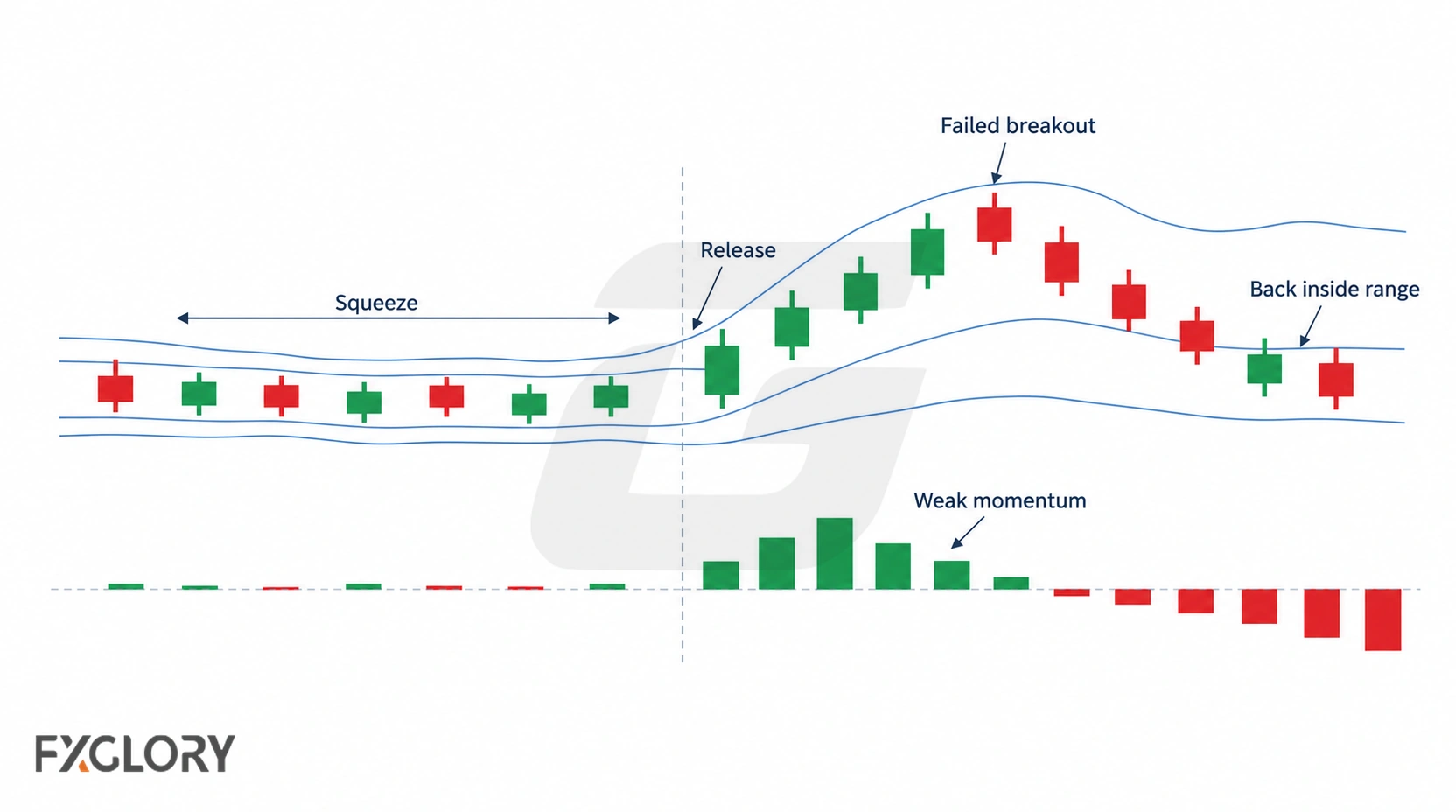
- State mistaken for price confirmation: The on-to-off transition occurs without the required completed close beyond a marked boundary.
- Histogram misinterpreted: Its sign or decline is treated as evidence about traders rather than a formula-dependent calculation.
- Unspecified breakout failure: No rule states what later completed price action invalidates the breakout premise.
- Late entry: Price has moved so far that the proposed stop distance or costs breach predefined limits.
- Incomplete execution model: Spread, slippage, stop handling, and fill timing are omitted.
- Platform mismatch: A backtest and live implementation use different channel, momentum, marker, or bar-close rules.
- Parameter overfitting: Inputs are repeatedly changed after viewing results, without an independent evaluation sample.
Testing A TTM Squeeze Strategy
Specify the full setup as reproducible rules before measuring outcomes. Include qualifying and nonqualifying release events rather than selecting only visually convincing examples.
- Which exact platform, indicator version, price feed, and currency pairs are used?
- What are the BB basis, length, deviation, and KC centerline, range formula, length, and multiplier?
- Is squeeze on determined by both band comparisons; how are equal boundaries treated?
- Does release mean the first completed off-state bar after an on-state bar?
- What is the histogram formula, zero-line reference, and any required sign or slope condition?
- Are signals read at bar close without using later data to make an earlier decision?
- What previously identified price structure and completed-candle condition qualifies the setup?
- What distinguishes no breakout from a confirmed breakout that later fails?
- What are the entry timing, stop/invalidation, exit, and position-sizing rules?
- How are spread, slippage, commissions (if applicable), margin, and maximum account loss modeled?
- Which late, conflicting, prolonged, or cost-prohibitive setups are recorded as skips?
- What are the sample dates, instrument/timeframe breakdowns, and number of qualifying events?
- Are settings selected on one sample and checked on a separate out-of-sample period?
- How do results change across sessions, instruments, and market conditions without mixing different test runs?
Review available currency pairs before applying identical settings across instruments. This is a research checklist, not a claim about performance.