

Best Forex Pairs for Beginners: Start With Major Pairs
Many beginners start with major currency pairs. Major pairs include the U.S. dollar and are among the most actively traded parts of the forex market. In liquid conditions, they often offer relatively high liquidity, competitive spreads, and more widely available analysis than many minor or exotic pairs.
Four major pairs that beginners commonly study are EUR/USD, GBP/USD, USD/JPY, and AUD/USD. Each behaves differently. Liquidity, volatility, spread conditions, active trading hours, and the economic drivers behind each pair all affect how it behaves from one session to another. Start with the forex basics for beginners guide if you are not yet familiar with how currency pairs work.
What Makes a Forex Pair Easier to Learn for Beginners?
Not every forex pair is equally straightforward to learn. Some pairs can have wider spreads, sharper or less familiar volatility, or economic drivers that require more specialized regional knowledge.
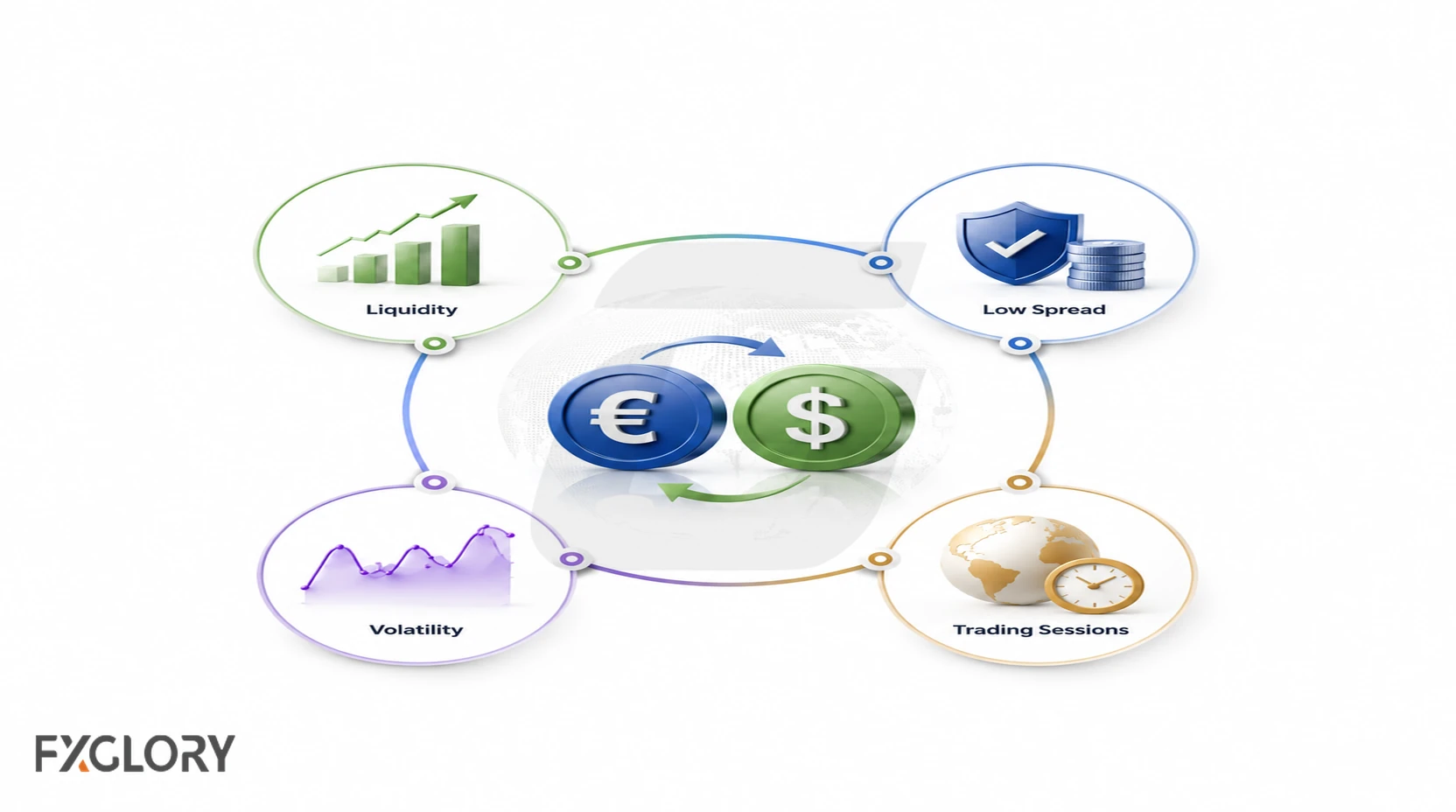
A pair that is easier for beginners to work with typically has the following characteristics.
- High liquidity: Deeper liquidity can support more consistent execution and may reduce slippage in normal conditions, especially during active market hours. Learn more in what is liquidity in forex.
- Competitive spreads: Narrower spreads reduce the entry cost of a trade. Actual spreads vary by broker, account type, session, and market conditions, so compare current terms rather than assuming a pair always has the lowest spread. See bid and ask price in forex to understand how spreads work.
- Clear reaction to widely reported events: Interest rate decisions, inflation data, and employment reports from major economies are widely covered. This makes it easier for beginners to understand why a pair moved.
- Plenty of available analysis: Major pairs are discussed extensively. Beginners can access multiple perspectives, charts, and educational content for these pairs.
- Widely watched price levels: Major pairs are followed by many market participants, so beginners can find abundant examples of support, resistance, trend, and breakout analysis. These patterns are not guaranteed to hold.
EUR/USD: A Common Starting Pair
EUR/USD represents the euro against the U.S. dollar and is one of the most heavily traded currency pairs. Its deep liquidity means it often has competitive spreads during active market hours, although the quoted spread depends on the broker, account type, and market conditions. You can view EUR/USD market data on FXGlory.

- Spread profile: Often relatively narrow in liquid conditions. Check the broker’s current spread table and account terms rather than assuming a fixed ranking.
- Volatility profile: Often lower than GBP/USD, but it can still move sharply around major Eurozone or U.S. data and central-bank decisions.
- Active trading hours: Activity is often strongest during London hours and into the London-New York overlap.
- Main drivers: European Central Bank and U.S. Federal Reserve interest rate decisions, Eurozone and U.S. CPI data, and employment reports from both economies.
For beginners, EUR/USD is often a practical starting pair because it combines deep liquidity with extensive educational and market coverage. Outside peak hours or around major news, liquidity and spread conditions can change. Beginners should pay attention to session timing and understand how to read forex quotes correctly before placing any trade.
GBP/USD: Higher Volatility To Understand Early
GBP/USD, often called Cable, represents the British pound against the U.S. dollar. It is a heavily traded major pair and often shows wider intraday swings than EUR/USD. You can view GBP/USD market data on FXGlory.

- Spread profile: Often competitive in liquid conditions, though it may be wider than EUR/USD depending on the broker and account type.
- Daily volatility: Medium to high. Daily ranges can be wide, especially during UK economic releases and the London session.
- Active trading hours: Activity is often strongest during London hours and into the London-New York overlap.
- Main drivers: Bank of England interest rate decisions, UK CPI data, UK employment reports, and U.S. Federal Reserve policy.
GBP/USD can help beginners observe how a faster-moving major pair behaves. Its wider price swings mean a trader should base stop placement on the setup and calculate position size from the chosen stop distance rather than simply using the same lot size as on another pair. Some beginners may prefer to study EUR/USD first before adding GBP/USD.
USD/JPY: Yen Quoting and Macro Drivers
USD/JPY is a major pair involving the Japanese yen. It can be influenced by U.S.-Japan interest-rate expectations, U.S. bond yields, Bank of Japan policy, Japanese data, and shifts in global risk sentiment. The yen is often described as a safe-haven currency, but that relationship is not automatic in every risk-off episode. You can view USD/JPY market data on FXGlory.

- Spread profile: Often relatively narrow in liquid conditions, but the exact spread varies by broker, account type, and market conditions.
- Volatility profile: Can range from subdued to sharp, especially when rate expectations, bond yields, or Bank of Japan policy shift.
- Active trading hours: Trading can be active during Asian hours and again when U.S. markets and data become the focus.
- Main drivers: U.S. Federal Reserve and Bank of Japan interest rate decisions, U.S. bond yields, global risk sentiment, and Japanese economic data.
USD/JPY can be useful for learning how interest-rate expectations and bond yields affect currencies. Yen pairs are quoted differently from many non-yen majors, so beginners should confirm the platform’s pip convention and pip value before calculating position size. Learn how pips work in what is a pip in forex trading.
AUD/USD: Commodities, China, and Rate Expectations
AUD/USD represents the Australian dollar against the U.S. dollar. “Aussie” is primarily a nickname for the Australian dollar (AUD), although traders sometimes also use it when referring to AUD/USD. The pair can be sensitive to commodity prices, especially iron ore, as well as Chinese economic conditions, Reserve Bank of Australia and Federal Reserve expectations, broader risk sentiment, and U.S.-dollar moves. You can view AUD/USD market data on FXGlory.

- Spread profile: Often competitive during liquid periods, but the quoted spread depends on the broker, account type, session, and market conditions.
- Daily volatility: Medium.
- Active trading hours: AUD/USD can be active during Sydney and Asian hours and can also move materially when U.S. data or Federal Reserve expectations shift.
- Main drivers: Reserve Bank of Australia and Federal Reserve expectations, Australian and U.S. inflation and employment data, Chinese economic conditions, risk sentiment, and commodity markets such as iron ore and gold.
For beginners studying fundamentals, AUD/USD can provide useful examples of how several forces interact: monetary-policy expectations, Chinese growth data, commodity markets, risk sentiment, and broad U.S.-dollar strength can all matter at the same time. Beginners trading AUD/USD should understand how leverage affects position risk before using real capital.
Beginner Forex Pairs: Comparison Table
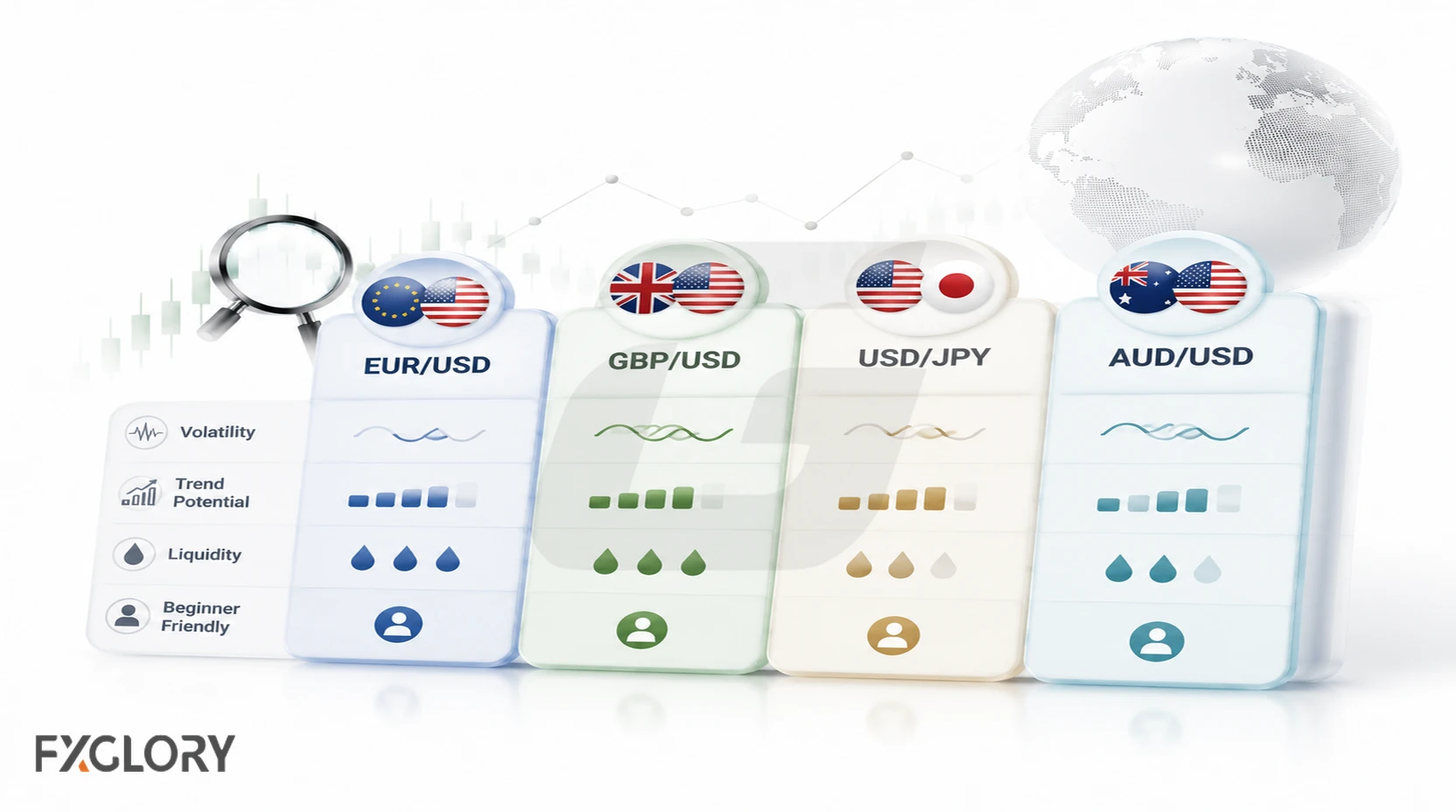
This table compares four major pairs that beginners commonly study. Spread and volatility descriptions are relative, not guaranteed; check current FXGlory spread tables and current trading conditions for account-specific terms.
| Pair | Typical Spread | Daily Volatility | Liquidity | Best Session | Beginner Notes |
|---|---|---|---|---|---|
| EUR/USD | Often relatively narrow | Low–Medium | Very high | London / NY overlap | Common first pair to study because of deep liquidity and broad market coverage. |
| GBP/USD | Often competitive | Medium–High | Very High | London / overlap | More volatility than EUR/USD. Better suited after building experience on a calmer pair. |
| USD/JPY | Often relatively narrow | Low–Medium | Very High | Tokyo / NY sessions | Useful for studying yen quotation conventions, rates, yields, and macro drivers. |
| AUD/USD | Often competitive | Medium | High | Sydney / Asian hours | Useful for studying commodities, China, rates, risk sentiment, and U.S.-dollar moves. |
Best Forex Pairs for Small Accounts: What Matters Most
Beginners with small accounts often search for the cheapest or easiest pair to trade. Pair choice matters, but account terms and position sizing usually matter more than a simple 'lowest spread' ranking.
Any of these major pairs may be available on a small account, but the usable position size depends on the account’s minimum lot size and other trading conditions. Some accounts allow 0.01-lot positions while others require a larger minimum, so check the current account terms before planning risk. Learn more in what is a lot size in forex. To understand what a realistic starting balance looks like, see how much you need to start trading forex.
- Compare current spreads: EUR/USD and USD/JPY often quote relatively narrow spreads in liquid conditions, but there is no permanent cheapest pair across every account type and market condition. On a small balance, trading cost relative to planned risk can matter materially.
- Be cautious with wider-spread pairs: Wider spreads increase transaction cost relative to a small account balance and should be included in the trade’s risk and cost calculation.
- Check minimum lot size: A 0.01-lot position may be available on some account types, while others can require a higher minimum. Use the smallest permitted size only if it fits the trade’s stop distance and risk limit.
- Know your risk per trade: Decide the maximum percentage of the account you are willing to lose on a single trade before choosing a pair or position size.