

Best Forex Pairs To Trade For Beginners: Start With The Majors
The best forex pairs to trade for beginners are major currency pairs. Major pairs all include the U.S. dollar and are the most traded pairs in the forex market. They tend to have higher liquidity, tighter spreads in normal conditions, and more publicly available analysis than exotic or minor pairs.
For most beginners, the four pairs that appear consistently on shortlists are EUR/USD, GBP/USD, USD/JPY, and AUD/USD. Each has different characteristics. Liquidity, typical volatility, spread cost, and the economic drivers behind each pair affect how a beginner will experience trading them day to day. Start with the forex basics for beginners guide if you are not yet familiar with how currency pairs work.
What Makes A Forex Pair Easy To Trade For Beginners?
Not every forex pair is equally suitable for beginners. Some pairs have wide spreads, unpredictable volatility, or require knowledge of specific regional economies that most beginners have not yet developed.
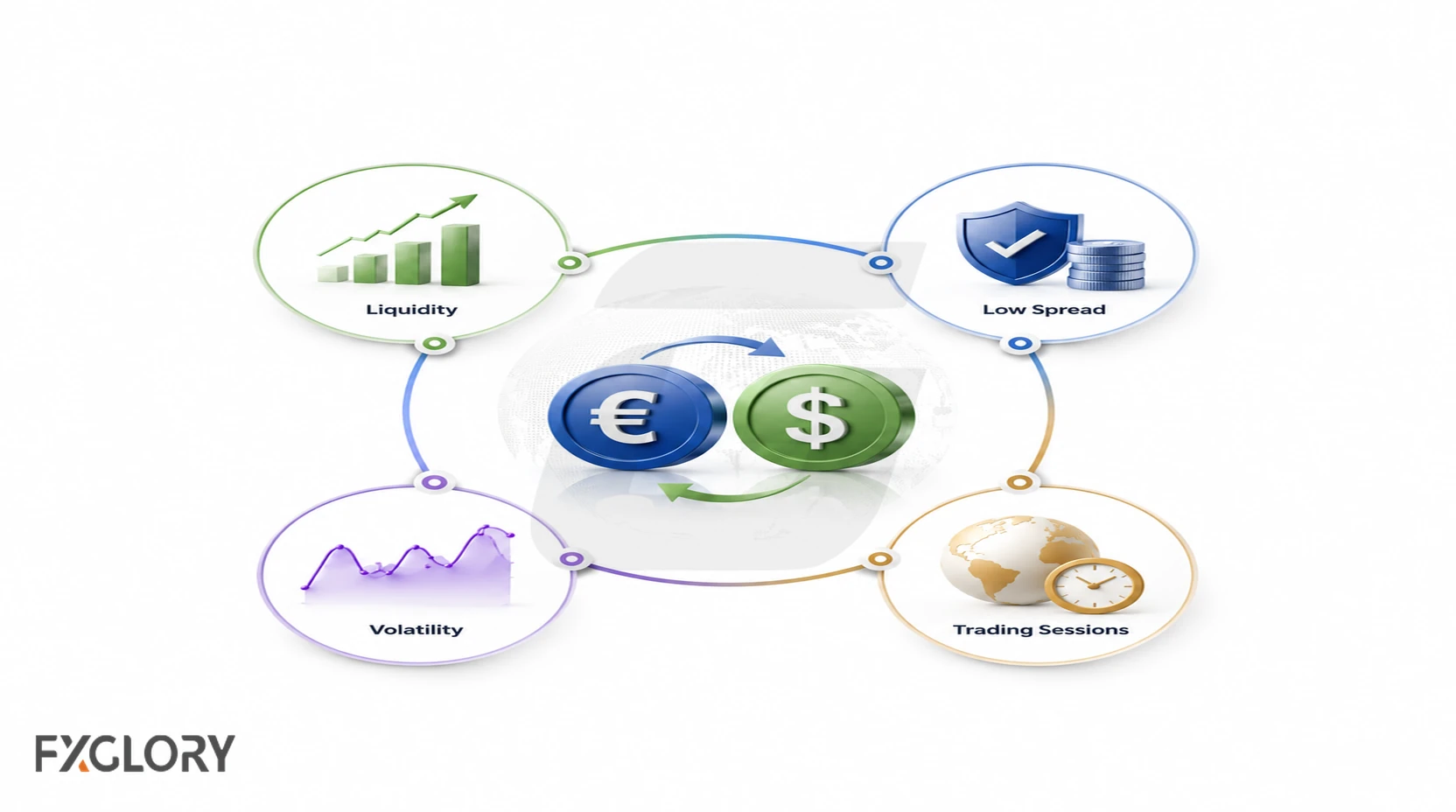
A pair that is easier for beginners to work with typically has the following characteristics.
- High liquidity: Orders are filled close to the expected price, and slippage is generally lower. High liquidity is especially important when entering or exiting during active market hours. Learn more in what is liquidity in forex.
- Tight spreads: Trading costs are lower. This matters more when a beginner is still learning position sizing and when account sizes are small. See bid and ask price in forex to understand how spreads work.
- Clear reaction to widely reported events: Interest rate decisions, inflation data, and employment reports from major economies are widely covered. This makes it easier for beginners to understand why a pair moved.
- Plenty of available analysis: Major pairs are discussed extensively. Beginners can access multiple perspectives, charts, and educational content for these pairs.
- Consistent technical behavior: Support and resistance levels on major pairs are watched by many participants. This can make technical setups more reliable to study when learning chart analysis.
EUR/USD: The Most Traded Forex Pair
EUR/USD is the most traded forex pair in the world. It represents the euro against the U.S. dollar. The pair accounts for the largest share of global forex volume, which means it typically has the tightest spreads and strongest liquidity during active sessions. You can view EUR/USD market data on FXGlory.

- Typical spread: Usually the tightest of any pair, especially on ECN or raw-spread accounts.
- Daily volatility: Low to medium compared to GBP/USD or cross pairs.
- Most active session: The London session and the London-New York overlap.
- Main drivers: European Central Bank and U.S. Federal Reserve interest rate decisions, Eurozone and U.S. CPI data, and employment reports from both economies.
For beginners, EUR/USD is often the natural starting pair because of its consistency, tight spread, and the volume of educational material available specifically for this pair. Outside peak hours, spreads can widen and liquidity drops. Beginners should pay attention to session timing and understand how to read forex quotes correctly before placing any trade.
GBP/USD: Higher Volatility To Understand Early
GBP/USD, often called Cable, represents the British pound against the U.S. dollar. It is one of the most traded pairs in the world and typically moves more each day than EUR/USD. You can view GBP/USD market data on FXGlory.

- Typical spread: Low to medium, slightly wider than EUR/USD in most conditions.
- Daily volatility: Medium to high. Daily ranges can be wide, especially during UK economic releases and the London session.
- Most active session: The London session and the London-New York overlap.
- Main drivers: Bank of England interest rate decisions, UK CPI data, UK employment reports, and U.S. Federal Reserve policy.
GBP/USD can be useful for beginners who want to observe how faster-moving pairs behave. However, its higher volatility means stop losses need to be wider, and position size must be calculated carefully to avoid over-risking the account. It is generally more suitable after a beginner has built experience on a lower-volatility pair like EUR/USD.
USD/JPY: Clear Trends And Safe-Haven Behavior
USD/JPY is the most traded pair involving the Japanese yen. It is driven by the interest rate difference between the United States and Japan, by risk sentiment in global markets, and by Bank of Japan policy. When global uncertainty rises, the yen often strengthens because it is treated as a safe-haven currency. You can view USD/JPY market data on FXGlory.

- Typical spread: Very tight, similar to EUR/USD on many platforms.
- Daily volatility: Low to medium, with a tendency to trend for extended periods.
- Most active session: Tokyo and New York sessions.
- Main drivers: U.S. Federal Reserve and Bank of Japan interest rate decisions, U.S. bond yields, global risk sentiment, and Japanese economic data.
USD/JPY can be a good learning pair for beginners who want to study trending behavior. However, the pip calculation is different from EUR/USD. Because the yen is quoted to two decimal places on most platforms, one pip equals 0.01 rather than 0.0001. Beginners should confirm pip values before calculating position size. Learn how pips work in what is a pip in forex trading.
AUD/USD: Commodity Connections And Fundamental Learning
AUD/USD, often called the Aussie, represents the Australian dollar against the U.S. dollar. It is closely linked to commodity prices, particularly iron ore and gold, and to economic conditions in China because Australia exports heavily to China. You can view AUD/USD market data on FXGlory.

- Typical spread: Low to medium, slightly wider than EUR/USD.
- Daily volatility: Medium.
- Most active session: The Sydney and Asian sessions, though it also moves during the New York session when U.S. data is released.
- Main drivers: Reserve Bank of Australia decisions, Chinese economic data, commodity prices (iron ore, gold), and U.S. Federal Reserve policy.
For beginners who want to learn how fundamental factors drive currency prices, AUD/USD provides clear examples. Its connection to commodity prices and Chinese economic data makes the reasoning behind price moves more visible than on some other major pairs. Beginners trading AUD/USD should understand how leverage affects position risk before using real capital.
Beginner Forex Pairs: Comparison Table
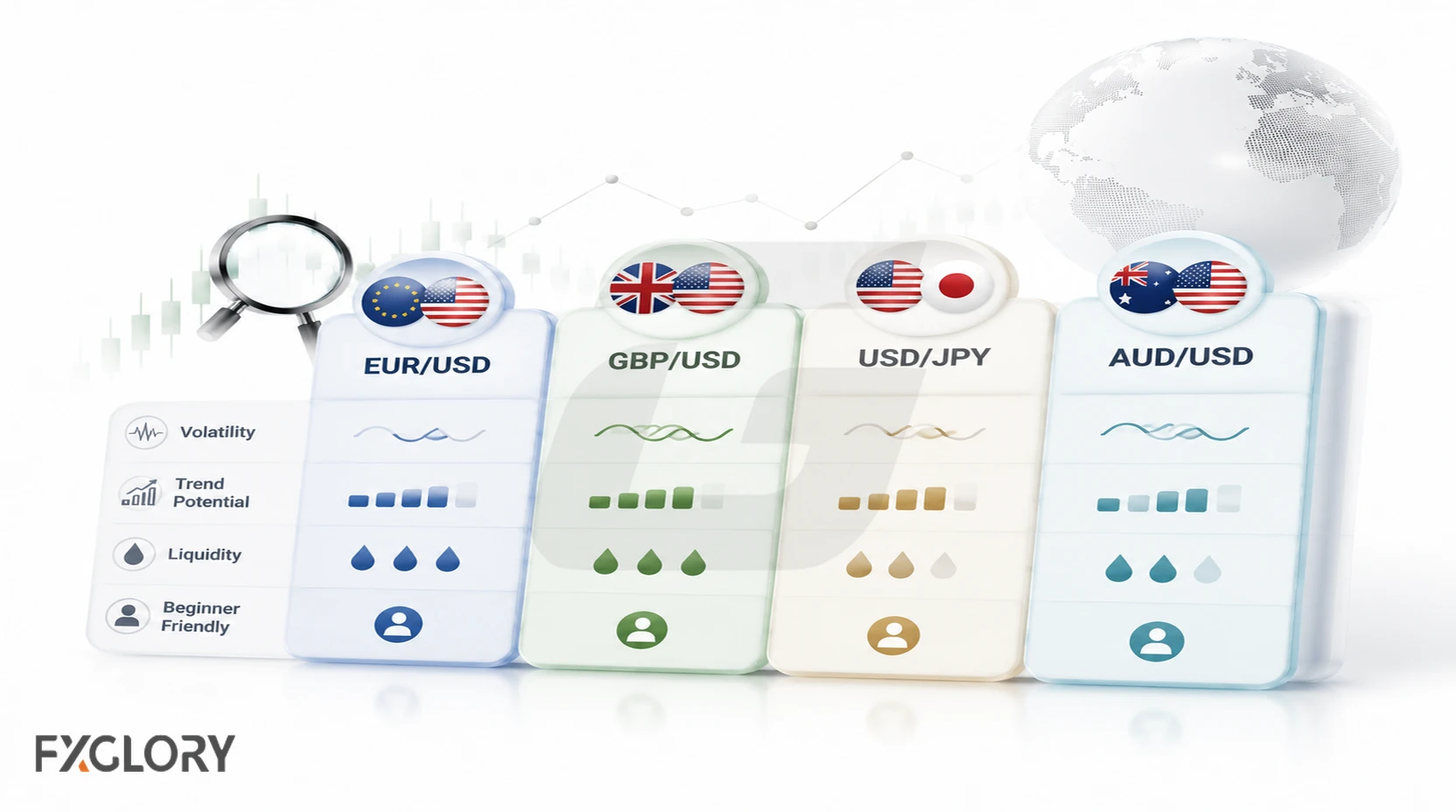
This table summarizes the key differences between the four most commonly recommended forex pairs for beginners. Spreads and volatility vary by broker, account type, and market conditions.
| Pair | Typical Spread | Daily Volatility | Liquidity | Best Session | Beginner Notes |
|---|---|---|---|---|---|
| EUR/USD | Tightest of all pairs | Low–Medium | Highest | London / NY overlap | First pair for most beginners. Tight spread, consistent behavior, high liquidity. |
| GBP/USD | Low–Medium | Medium–High | Very High | London session | More volatility than EUR/USD. Better suited after building experience on a calmer pair. |
| USD/JPY | Very tight | Low–Medium | Very High | Tokyo / NY sessions | Good for trend study. Pip calculation differs from EUR/USD — confirm before sizing. |
| AUD/USD | Low–Medium | Medium | High | Sydney / Asian sessions | Good for learning fundamentals. Moves with commodity prices and Chinese economic data. |
Best Forex Pairs For Small Accounts
Beginners with small accounts often ask which pair is cheapest or safest to start with. The answer depends less on the pair and more on how position size is calculated.
Any of the four major pairs can be traded on a small account when position size is correct. A micro lot (0.01 of a standard lot) allows risk to be controlled in very small increments, which is important when the account balance is limited. Learn more in what is a lot size in forex. To understand what a realistic starting balance looks like, see how much you need to start trading forex.
- EUR/USD and USD/JPY are generally the cheapest pairs to trade because of their tight spreads. On a small account, spread cost relative to risk matters more than on a large account.
- Avoid exotic pairs with wide spreads. The cost of entering and exiting is proportionally much higher, which makes profitability harder to achieve on a small balance.
- Use micro lots: A micro lot limits the pip value to a small fraction of a standard lot, allowing beginners to risk only a small portion of the account per trade.
- Know your risk per trade: Decide the maximum percentage of the account you are willing to lose on a single trade before choosing a pair or position size.