

What Is A Forex Entry And Exit Strategy?
A forex entry and exit strategy is a written rule set for opening and closing a trade. It connects the setup, entry trigger, invalidation point, stop-loss placement, target logic, exit rule, risk check, and review process before the trade is placed.
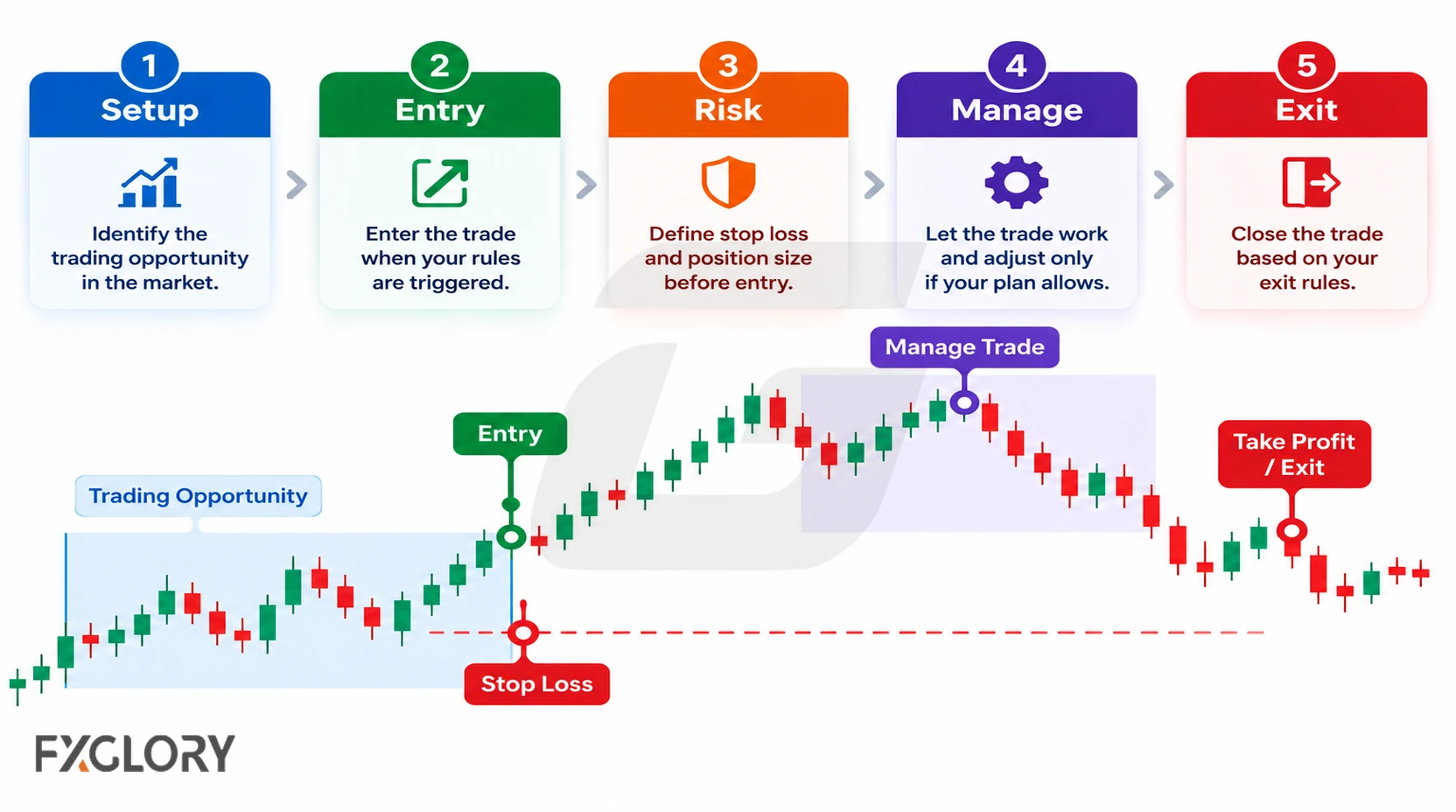
This page is not a list of exit methods and not a list of indicators. For dedicated exit-method selection, use the forex exit strategy framework. For broader setup structure, use the trading setup framework.
The trade is not ready if the entry trigger is known but the invalidation point, stop distance, exit condition, and risk check are still undefined.
Setup vs Signal vs Trigger vs Exit
A signal may be a candle pattern, moving-average cross, RSI reading, breakout, or price touch. A trade plan needs more: the background condition, the entry trigger, the invalidation point, the exit rule, and the risk check.
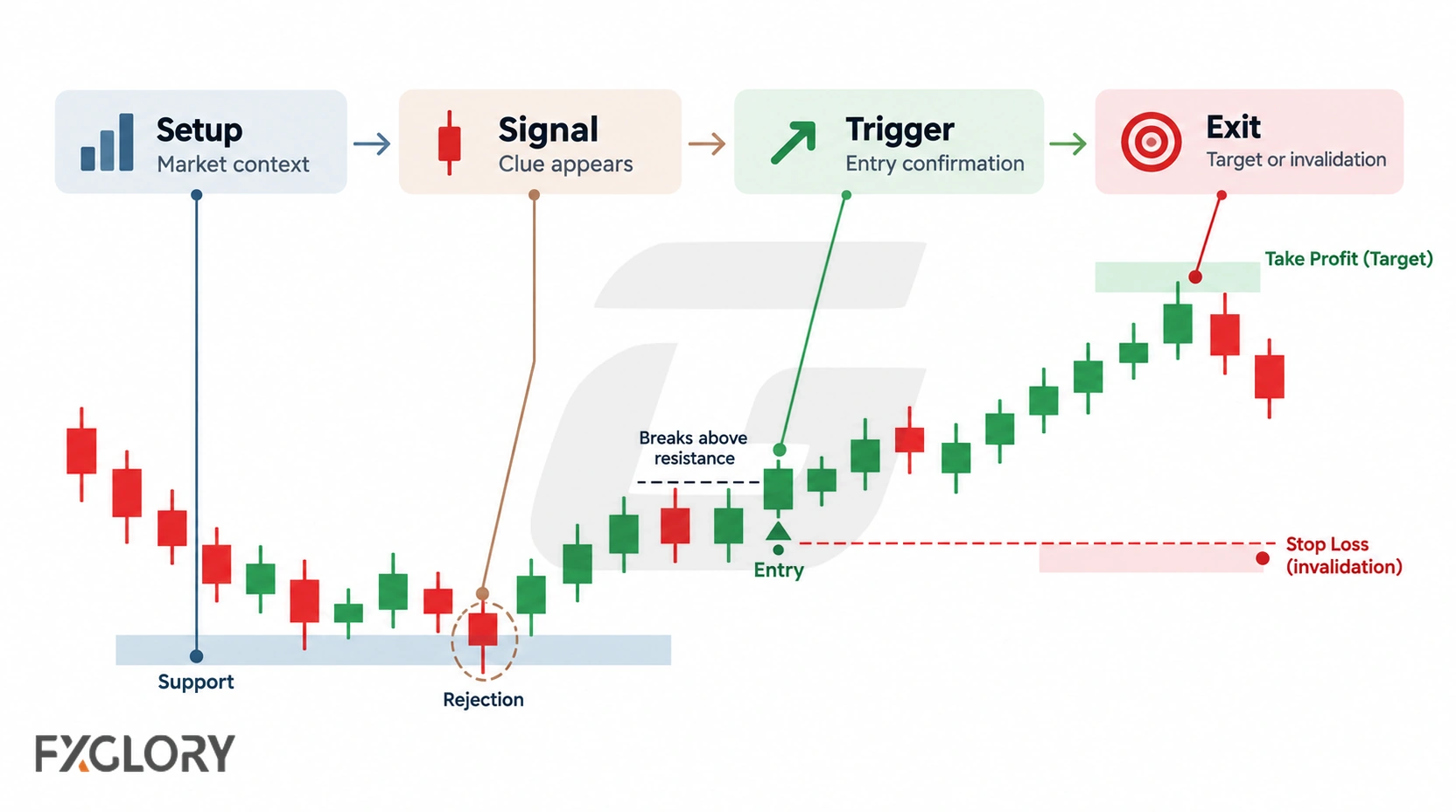
| Part | What It Answers | Weak Version | Better Version |
|---|---|---|---|
| Setup | Why might this trade exist? | RSI is high or low | Price is reacting at a planned level inside a defined market condition |
| Signal | What caught attention? | A candle changed color | A candle reaction appears at the level already marked in the plan |
| Trigger | What allows entry now? | Enter because price moved | Enter only after the planned confirmation appears |
| Invalidation | Where is the idea wrong? | Exit if it feels bad | Exit if price breaks the structure that supported the setup |
| Exit | How is the trade closed or managed? | Take profit when it looks enough | Use a planned target, trailing rule, time rule, or exit condition |
| Review | Can the trade be judged later? | Only record profit or loss | Record whether the entry, stop, exit, and risk rules were followed |
For full setup construction, use context, trigger, invalidation, exit, and review rules.
Entry Rule vs Entry Order
An entry rule explains why the trade may be opened. An order workflow is the practical process used to place or manage the trade. The rule should come first. The order workflow should follow the platform, account conditions, spread, stop distance, and risk plan.
For example, enter after a confirmed retest reaction at the planned level is an entry rule. The order type, position size, stop placement, and trade-management process should be checked before live trading.
The Entry-And-Exit Pairing Test
The entry and exit should be tested as one chain. The entry trigger should point to a clear invalidation condition, and the exit rule should match the reason for entry.
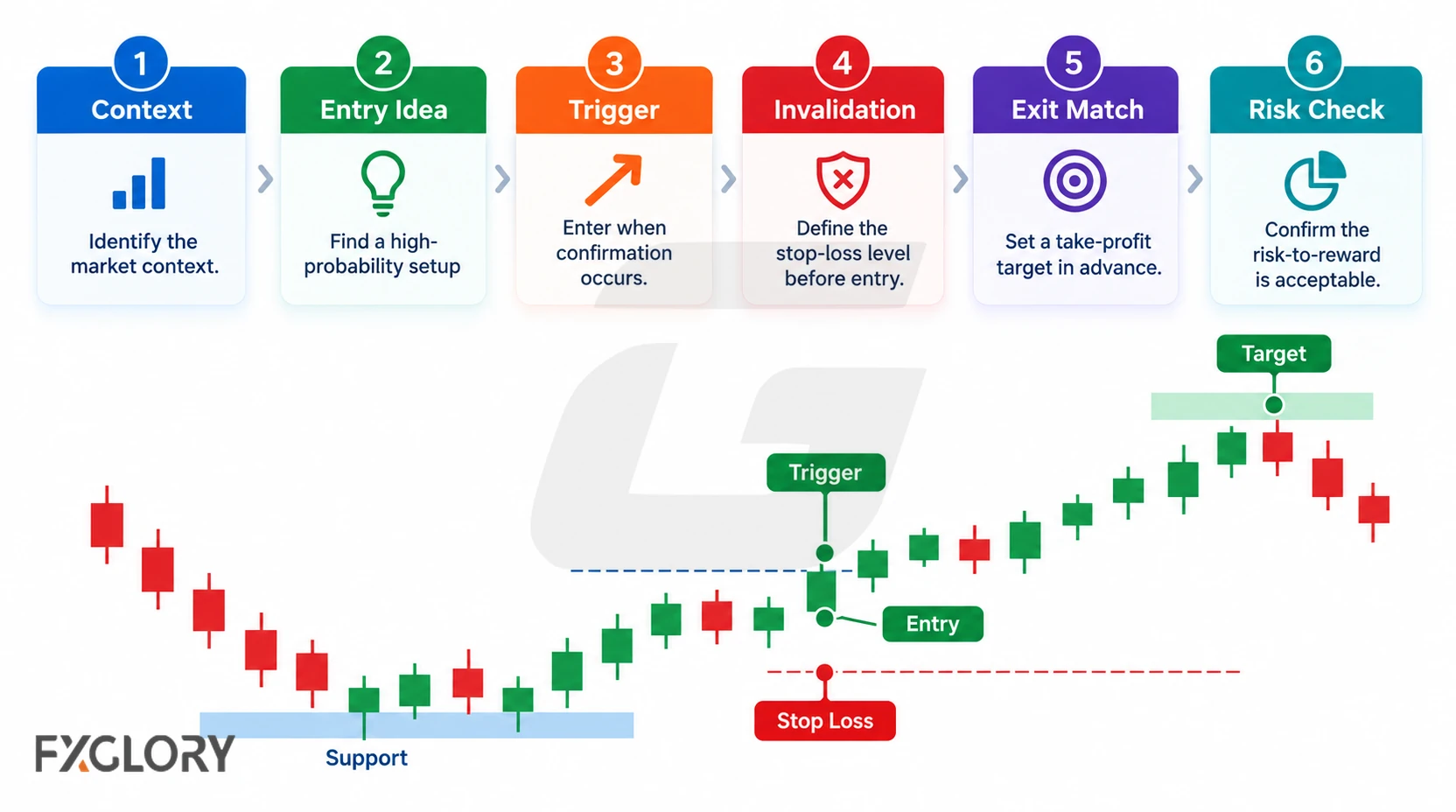
| Pairing Step | Question | Pass Condition | Fail Condition |
|---|---|---|---|
| 1. Market context | What condition is the market in? | Trend, range, compression, breakout, or unclear condition is identified | The background condition cannot be explained |
| 2. Entry reason | Why does this trade idea exist? | There is a planned level, pattern, pullback, breakout, or condition | The only reason is fear of missing the move |
| 3. Entry trigger | What allows entry now? | The planned trigger appears at the planned area | Entry is based on a late reaction or random candle |
| 4. Matching invalidation | What proves the entry idea wrong? | The stop or exit condition is connected to the entry reason | No clear stop or invalidation point exists |
| 5. Matching exit | How is the trade closed or managed? | Target, trailing rule, time exit, or management rule fits the setup | The trader will decide after entry |
| 6. Risk check | Does the entry-exit pair fit the account? | Spread, stop distance, position size, margin, and risk are checked | The trade size is chosen before the stop is known |
When An Entry Is Valid Enough To Consider
An entry can be considered only after the setup and trigger agree. The setup gives the background reason. The trigger gives the timing condition. Entry should not be earlier than the rule and should not be forced after the move has already become extended.
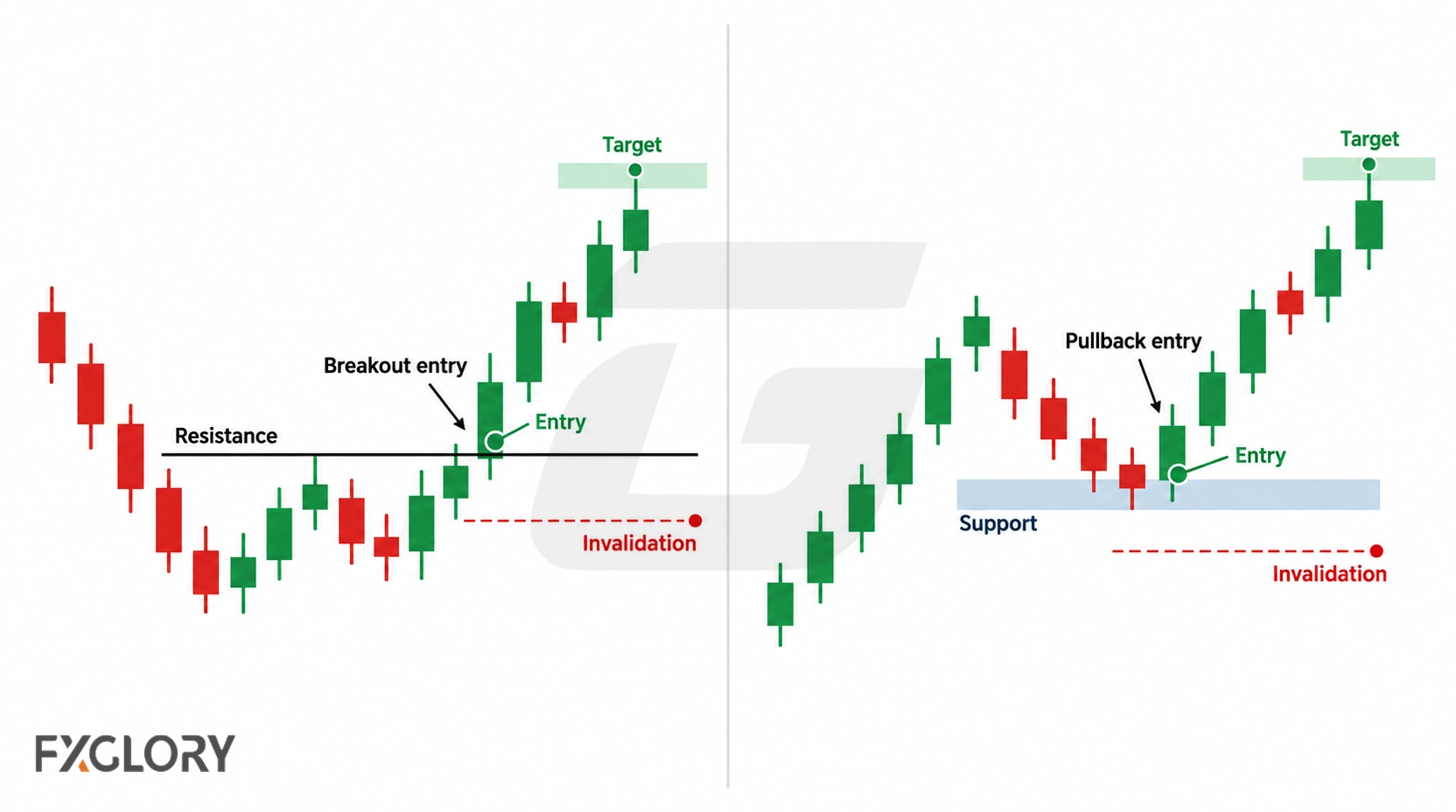
Common entry triggers include a confirmed breakout, a retest reaction, a pullback rejection, a candle close beyond a planned level, a failed break back inside a range, or an indicator confirmation that supports existing price context.
| Entry Method | What Must Exist First | Possible Trigger | Main Risk |
|---|---|---|---|
| Breakout entry | Clear support, resistance, range edge, or compression area | Close beyond the level, retest, or continuation trigger | Entering after an extended breakout or during abnormal spread |
| Pullback entry | Trend context and planned pullback area | Reaction candle, lower-timeframe trigger, or structure hold | Buying or selling a pullback that has already broken the trend structure |
| Range entry | Defined range support and resistance | Rejection at the planned range boundary | Entering a range trade while price is breaking out |
| Retest entry | Broken level that price returns to test | Retest holds and price reacts in the planned direction | Assuming every retest will hold |
| Indicator-supported entry | Price context that already supports the idea | Indicator confirms momentum, trend, volatility, or reversal context | Treating the indicator as the full trade |
For support and resistance entry zones, use support and resistance planning. For chart-role separation, use multiple-timeframe analysis.
When Not To Enter A Forex Trade
A no-trade rule prevents a valid-looking signal from becoming a position when the stop, spread, timeframe, event risk, or exit condition does not fit.
- No clear invalidation: The trader cannot define where the idea is wrong.
- Late entry: Price has already moved far from the planned trigger area.
- Spread problem: The target is too small after trading cost.
- Unclear market condition: Trend, range, compression, or breakout context is not readable.
- Conflicting timeframes: The context chart and trigger chart disagree without a written rule.
- Event risk: A scheduled event may change spread, volatility, or execution conditions.
- No target or management rule: The trader knows where to enter but not how to close.
- Position size chosen first: The trade size is selected before stop distance and margin are checked.
- Emotional reason: The trade exists because of revenge, boredom, or fear of missing out.
For session timing before short-term entries, use trading-window selection. Before using short-target entries, check FXGlory spreads.
How The Exit Must Match The Entry
The exit should match the reason for the entry. If the trade was opened because of a breakout, a failed breakout is a logical review point. If the trade was opened because of a pullback inside a trend, a break of the pullback structure may be the invalidation point.
Exit rules can include stop loss, take profit, trailing stop, partial close, time-based review, session close, news-risk exit, or a technical invalidation rule. The dedicated forex exit strategies guide covers those exit types in detail. This page focuses on matching the exit to the entry setup.
| Exit Question | What It Controls | Example Rule |
|---|---|---|
| Where is the trade wrong? | Initial stop loss or invalidation | Exit if price breaks the level or structure that supported the setup |
| Where is profit planned? | Take-profit logic | Exit near the next opposing level or planned target area |
| What if price moves in favor? | Trade management | Trail only after the planned condition occurs |
| What if price goes nowhere? | No-progress rule | Review after a planned number of candles or before session close |
| What if conditions change? | Event and volatility risk | Review before scheduled news, low liquidity, or abnormal spread |
Entry And Exit Rules By Setup Type
Each setup type needs its own entry and exit pairing. A breakout trade should not use the same logic as a range trade. A trend pullback should not be managed like a random reversal attempt.
| Setup Type | Possible Entry Rule | Matching Exit Rule | Skip If |
|---|---|---|---|
| Trend pullback | Enter after price reacts from a planned pullback area in the trend direction | Exit if the pullback structure breaks, trend context fails, or target is reached | The pullback becomes a trend break |
| Breakout | Enter after price closes beyond a key level or after a valid retest | Exit if price returns inside the old range, fails the retest, hits stop, or reaches target | The breakout happens after a large extended move |
| Range reaction | Enter after price rejects the planned range boundary | Exit near mid-range, opposite boundary, or if the range breaks | The range boundary is no longer respected |
| Break and retest | Enter after the retest holds and price reacts | Exit if price closes back through the retested level or reaches the next planned area | The retest is unclear or spread is too wide |
| Indicator-supported setup | Enter only when the indicator supports existing price context | Exit when price invalidates the idea or the planned indicator review condition appears | The indicator is the only reason for entry |
| Day-trading setup | Enter during the planned session after context and trigger align | Exit by target, stop, no-progress rule, or end-of-session rule | The trade would become an unplanned overnight position |
For intraday structure, use the day-trading workflow. For strategy selection across market conditions, use method selection by style and risk.
Entry And Exit Rules By Trading Style
Trading style changes the entry and exit design. A scalping entry needs a tighter spread check and faster exit logic. A swing trade may need wider stop distance and more room. A position-style trade may need broader structure and larger exposure review.
| Trading Style | Entry Focus | Exit Focus | Main Check |
|---|---|---|---|
| Scalping | Fast trigger near a planned level during active conditions | Small target, tight invalidation, or fast no-progress exit | Spread compared with expected move |
| Day trading | Session, pair, context chart, setup chart, and trigger chart | Target, stop, time exit, or end-of-session rule | Whether the trade fits the session plan |
| Swing trading | Higher-timeframe setup and planned entry zone | Structure target, wider stop, trailing rule, or multi-day review | Stop distance and margin exposure |
| Position trading | Broad market context and long-horizon level | Major invalidation, larger target area, or periodic review | Whether risk fits the account and holding plan |
For timeframe selection, use chart timeframe planning.
Entry And Exit Indicators: Support Only
Indicators can support entry and exit timing only when each indicator has a defined role. This section explains indicator roles inside an entry-and-exit plan. For a more detailed comparison of indicator-based entry and exit timing, see our guide to forex entry and exit indicators.
| Tool | Entry Support | Exit Support | Weak Use |
|---|---|---|---|
| Moving average | Trend direction, slope, price position, pullback area | Trend failure, close beyond the average, trailing context | Entering every crossover without market context |
| RSI | Momentum review, exhaustion, divergence, reversal context | Momentum fading, failed continuation, overextension review | Buying or selling every level touch |
| ADX | Trend-strength review before trend entries | Trend-strength fade or weak-trend warning | Using ADX as direction by itself |
| ATR | Volatility and stop-distance review before entry | Trailing distance, target realism, abnormal movement review | Using ATR as a buy or sell signal |
| Bollinger Bands | Price location, volatility compression, range reaction | Band walk failure, range reaction, squeeze-release review | Trading every band touch as a signal |
For indicator role separation, use the indicator-strategy framework.
Stop Loss, Take Profit, And Risk-Reward Before Entry
Stop loss, take profit, and risk-reward should be checked before entry. If the stop is too wide for the account, the trade may not fit. If the target is too close after spread, the trade may not give enough room. If the target ignores structure, the reward plan may be unrealistic.
| Rule | Purpose | Better Question |
|---|---|---|
| Stop loss | Defines the planned loss point | Where is the trade idea wrong? |
| Take profit | Defines the planned profit area | Where can price reasonably go before a reaction? |
| Risk-reward | Compares possible loss with possible reward | Is the target realistic after spread and stop distance? |
| Position size | Connects risk to account exposure | Does the size still fit after the stop distance is known? |
| Trade management | Defines what happens after entry | Will the stop stay fixed, trail, move, or trigger review? |
For stop, target, trailing, partial, and time-based exit rules, use the exit-method framework.
Spread, Margin, And Platform Checks Before Entry
A chart setup can fail the plan if spread, stop distance, position size, or margin exposure no longer fit after the entry level is defined.
Entry timing is not the same as trading-session timing. A session may be active, but the trade still needs its own setup, trigger, invalidation, and exit rule.
- Check whether the expected move is large enough after spread.
- Check whether the stop distance fits the planned position size.
- Check whether margin requirements fit the account before entry.
- Check whether the platform and account workflow fit the planned entry, stop, target, and management process.
- Check whether scheduled events or low-liquidity periods can affect the entry or exit plan.
Before short-term entries, review FXGlory spreads. Before connecting stop distance and position size, use the FXGlory margin calculator. For charting and order workflow, review FXGlory trading platforms.
Common Entry And Exit Mistakes
- Entering from a signal without context: The trader sees a trigger but has no full setup.
- No invalidation point: The trader knows where to enter but not where the idea is wrong.
- Exit planned after entry: Stop loss, target, and management rules are invented under pressure.
- Target ignores structure: The target is placed beyond a clear support or resistance obstacle without a reason.
- Stop moved emotionally: The original risk is changed because price moves against the position.
- Timeframe conflict: The context chart and trigger chart disagree, but the trade is entered anyway.
- Spread ignored: A small-target trade has too little room after trading cost.
- Indicator stacking: More indicators are added, but no clear role is assigned to each one.
- No skip rule: The trader feels required to trade whenever a setup almost appears.
- No review notes: The trader cannot tell whether the entry, exit, or risk rule caused the result.
Forex Entry And Exit Strategy Checklist
Before opening a forex trade, answer these questions.
- What market condition is present?
- What setup makes the trade idea possible?
- What exact trigger allows entry now?
- What price or condition proves the idea wrong?
- Where will the stop loss be placed or reviewed?
- Where is the planned target or profit-management area?
- What happens if price moves in favor?
- What happens if price does not move after entry?
- What happens near session close or scheduled news?
- Is spread acceptable relative to the expected move?
- Does stop distance fit position size, leverage exposure, and margin?
- What condition cancels the trade before entry?
- Can this trade be reviewed later from written rules?
Backtesting Notes For Forex Entry And Exit Strategy
This hypothetical educational model uses one daily entry-and-exit pairing rule: a 15-candle compression range, completed-candle breakout entry trigger, ATR-based stop placement, fixed 1.5R target comparison, matched invalidation exit, no-progress exit, time exit, and spread/slippage sensitivity. It does not test pullback entries, range entries, indicator entries, multi-timeframe triggers, scalping entries, trailing stops, partial exits, discretionary management, or every exit method from the exit-strategy page.
The model reviewed EURUSD, GBPUSD, USDJPY, AUDUSD, USDCAD, and USDCHF on daily candles using public yfinance OHLC data where available. The entry context, trigger, invalidation level, stop, target, no-progress condition, and holding limit are defined before the simulated entry.
| Rule Area | Educational Model Rule |
|---|---|
| Strategy type | Daily entry-and-exit pairing model using completed-candle compression breakout trigger |
| Entry context | Previous 15 completed daily candles define range high and range low |
| Range width | At least 0.80 ATR(14) and no more than 3.50 ATR(14) |
| Compression filter | Previous 5 completed candles have a combined high-low range no more than 0.70 of the 15-candle range width |
| Long entry trigger | Completed daily close 0.10 to 1.00 ATR(14) above the range high, with close in the upper 40% of the candle range |
| Short entry trigger | Completed daily close 0.10 to 1.00 ATR(14) below the range low, with close in the lower 40% of the candle range |
| Entry | Next daily open after the completed signal candle |
| Stop | Beyond the breakout signal candle extreme with a 0.25 ATR(14) buffer |
| Target comparison | Fixed 1.5R target from entry |
| Matched invalidation exit | Long exits at daily close below the old range high; short exits at daily close above the old range low |
| No-progress exit | After 5 holding candles, exit if maximum favorable movement has not reached 0.50R and price closes back through the breakout candle midpoint |
| Maximum holding review | 15 daily candles after entry |
The review records trade count, win rate, average win in R, average loss in R, expectancy in R, profit factor, maximum drawdown in R, worst losing streak, average holding period, pair-level behavior, direction-level behavior, exit reasons, and spread/slippage sensitivity.
| Cost Input | Assumptions Used |
|---|---|
| Spread | 0.5, 1.5, and 3.0 pips |
| Slippage | 0.1, 0.5, and 1.0 pips per side |
| Baseline comparison | 1.5-pip spread and 0.5-pip slippage per side |
| Swap and rollover | Not included |
Educational Sensitivity-Test Results
The hypothetical backtest used public yfinance daily OHLC data from 2016-06-29 through 2026-06-29 where available. The baseline cost assumption used a 1.5-pip spread and 0.5-pip slippage per side. The baseline result was negative, with expectancy of -0.1968R and total net result of -9.6432R.
| Metric | Baseline Result |
|---|---|
| Number of trades | 49 |
| Win rate | 24.49% |
| Average win | 1.396R |
| Average loss | -0.7134R |
| Expectancy | -0.1968R |
| Profit factor | 0.6347 |
| Maximum drawdown | -11.02R |
| Worst losing streak | 7 |
| Average holding period | 1.57 daily candles |
| Median holding period | 1 daily candle |
| Total net result | -9.64R |
Pair-Level Baseline Results
| Pair | Trades | Win Rate | Expectancy | Profit Factor | Max Drawdown | Total Net Result |
|---|---|---|---|---|---|---|
| AUDUSD | 10 | 40% | 0.2209R | 1.641 | -1.2279R | 2.2085R |
| EURUSD | 8 | 50% | 0.3816R | 2.2791 | -1.188R | 3.0532R |
| GBPUSD | 5 | 20% | -0.2657R | 0.5272 | -1.7482R | -1.3285R |
| USDCAD | 6 | 16.67% | -0.3524R | 0.3997 | -3.3206R | -2.1142R |
| USDCHF | 11 | 18.18% | -0.3328R | 0.4307 | -4.0947R | -3.6604R |
| USDJPY | 9 | 0% | -0.8669R | 0 | -6.7385R | -7.8018R |
Spread And Slippage Sensitivity
| Spread (pips) | Slippage/Side (pips) | Trades | Win Rate | Expectancy | Profit Factor | Max Drawdown | Total Net Result |
|---|---|---|---|---|---|---|---|
| 0.5 | 0.1 | 49 | 28.57% | -0.1362R | 0.7262 | -8.1365R | -6.6719R |
| 0.5 | 0.5 | 49 | 26.53% | -0.1631R | 0.6835 | -9.4165R | -7.9925R |
| 0.5 | 1 | 49 | 24.49% | -0.1968R | 0.6347 | -11.0166R | -9.6432R |
| 1.5 | 0.1 | 49 | 26.53% | -0.1699R | 0.6734 | -9.7365R | -8.3227R |
| 1.5 | 0.5 | 49 | 24.49% | -0.1968R | 0.6347 | -11.0166R | -9.6432R |
| 1.5 | 1 | 49 | 24.49% | -0.2305R | 0.59 | -12.6166R | -11.294R |
| 3 | 0.1 | 49 | 24.49% | -0.2204R | 0.603 | -12.1366R | -10.7988R |
| 3 | 0.5 | 49 | 24.49% | -0.2473R | 0.5691 | -13.4167R | -12.1193R |
| 3 | 1 | 49 | 24.49% | -0.281R | 0.5296 | -15.0167R | -13.7701R |
Exit Reason Counts
| Exit Reason | Baseline Count |
|---|---|
| matched invalidation close | 15 |
| stop first same bar | 3 |
| stop loss | 19 |
| target 1.5R | 12 |