

What Is A Forex Trading Setup?
A forex trading setup is a specific market condition that makes a currency pair worth watching. It may involve a pullback, breakout, retest, range reaction, candle rejection, indicator confirmation, or another chart condition. The setup is the reason to pay attention, not the full reason to enter.
A chart condition becomes useful only when it is connected to a trigger, invalidation point, position risk, exit logic, and review rule. Without those parts, the trader may have an interesting chart idea, but not a complete trade decision.
This page explains the structure inside a single trade idea. For the broader list of methods, use the parent guide to forex trading strategies. For choosing which method fits a situation before building the setup, use the guide to the best forex trading strategy by market, style, and risk.
Forex Setup vs Signal vs Strategy vs Trading Plan
These terms are often mixed together. Separating them helps prevent forced entries and unclear trade management.
| Term | What It Means | Example |
|---|---|---|
| Setup | The market condition worth watching | Price pulls back in an existing trend |
| Signal or trigger | The event that allows entry | Price rejects the pullback area and closes back with the trend |
| Strategy | The broader method behind the setup | Trend pullback strategy with risk and exit rules |
| Trading plan | The wider routine for markets, schedule, risk limits, and review | Written rules for pairs, timeframes, risk per trade, and journaling |
A single chart condition can appear inside different strategies. A retest can be part of a breakout strategy, a price-action method, or an intraday approach. The difference is the rule set around it.
When the trade idea needs to become part of a wider routine, use a forex trading plan template to document markets, schedule, risk limits, and review habits.
The 7-Part Forex Setup Framework
A complete forex trade setup should be built in a fixed order. This keeps the trade idea connected to context before any entry decision is made.
- Market context: Is the pair trending, ranging, compressing, reacting to news, or unclear?
- Timeframe check: Does a higher timeframe support the context, or is the lower-timeframe idea fighting the broader picture?
- Setup condition: What makes the market worth watching now?
- Entry trigger: What exact event allows the trade?
- Invalidation: Where or when is the idea wrong?
- Risk check: Does stop distance, position size, spread, and margin still make sense?
- Exit and review: How will the trade be closed, reduced, trailed, or reviewed after the result?
Common Forex Trading Setup Types
The examples below are setup categories, not guarantees. Each one still needs confirmation, invalidation, risk control, and review.
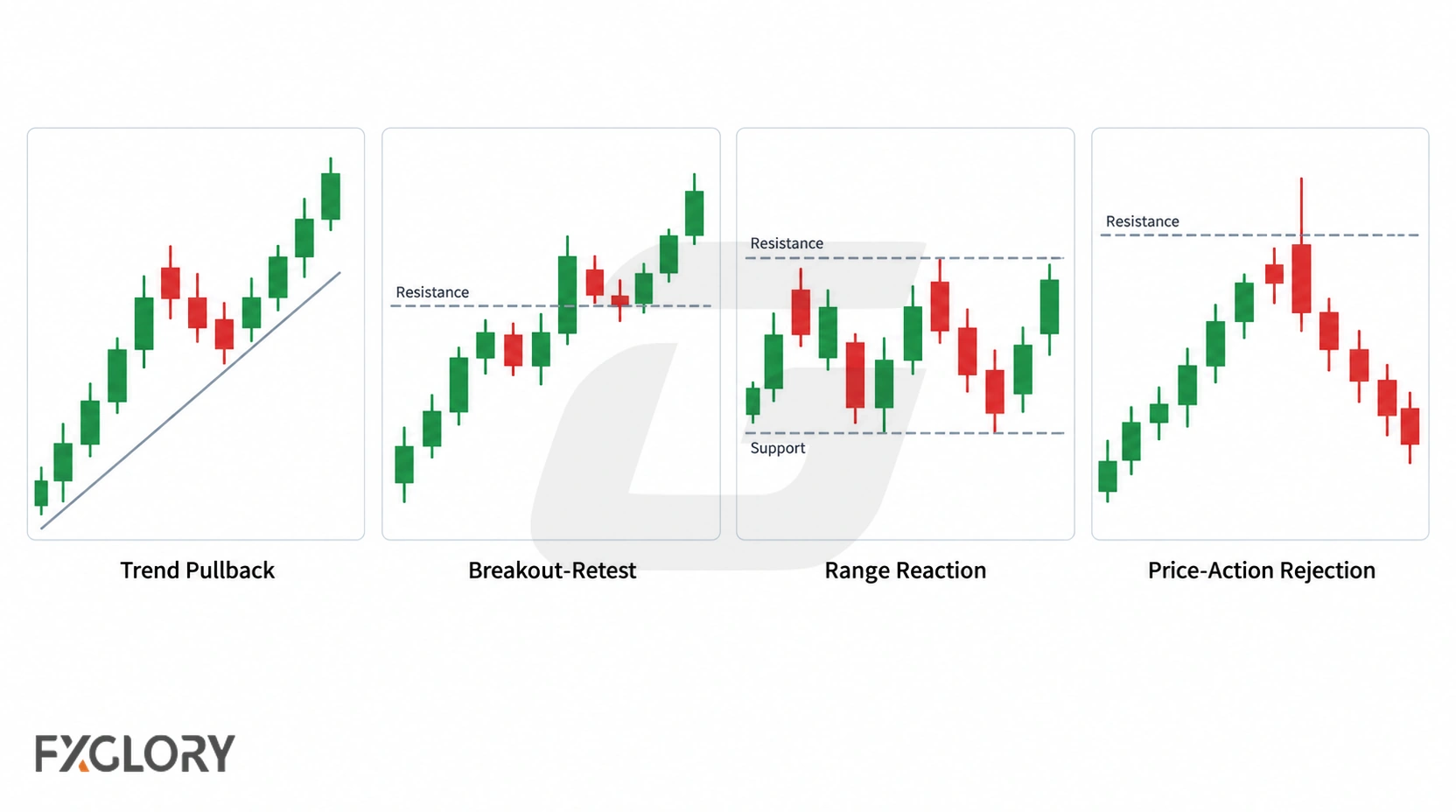
Trend Pullback Setup
In a trend pullback setup, the chart condition is the pullback against an existing direction. The trade idea is not valid until the trend context, trigger, and invalidation are clear.
- Context: The market shows visible directional structure.
- Watch area: Prior structure, trendline, moving average area, or former breakout zone.
- Trigger: Price begins moving back with the trend after the pullback.
- Invalidation: Price breaks the structure that supported the trend idea.
Review forex trend behaviour before using trend continuation as the setup context.
Breakout-And-Retest Setup
In a breakout-and-retest setup, price leaves a level or range, then returns to test the broken area. The retest gives the trader a place to evaluate whether the old level still matters from the other side.
- Context: Price has left a clear range, support, resistance, or compression area.
- Watch area: The broken level after price returns to it.
- Trigger: Price respects the retest area and moves back in the breakout direction.
- Invalidation: Price returns inside the old structure or the retest fails clearly.
Range-Reaction Setup
A range-reaction setup appears when price approaches the edge of a range and reacts near support or resistance. This condition is easier to review when the boundary is visible and the invalidation area is clear.
- Context: Price has rotated between visible support and resistance more than once.
- Watch area: The range boundary, not the middle of the range.
- Trigger: Price reacts at the boundary and confirms that the range may still matter.
- Invalidation: Price breaks and holds beyond the boundary.
Use support and resistance in forex as background for level-based setups.
Price-Action Rejection Setup
A price-action rejection setup appears when price tests an important area and fails to continue through it. The candle or reaction is only useful when the level, context, trigger, and invalidation are already defined.
- Context: Price reaches a meaningful level or structure area.
- Watch area: Support, resistance, trend structure, or previous swing area.
- Trigger: Price rejects the area and confirms the reaction.
- Invalidation: Price moves through the level and removes the rejection idea.
For the underlying concept, review price action in forex.
Indicator-Confirmed Setup
An indicator-confirmed setup uses a technical indicator to support the chart condition. The indicator should have one role, such as confirming trend, momentum, volatility, or timing. It should not replace context.
- Context: Price already shows a condition worth watching.
- Watch area: A chart area where the indicator adds confirmation.
- Trigger: The indicator supports the planned entry condition.
- Invalidation: Price action or structure invalidates the idea, even if the indicator remains delayed.
Use the forex technical indicators guide when the indicator mechanics need more background.
Forex Setup Quality Checklist
A trade idea should pass a quality check before it becomes an entry plan. This helps separate a structured opportunity from a pattern that only looks interesting.
| Check | Question | Weak Condition Sign |
|---|---|---|
| Context | Is the market trending, ranging, compressing, or unclear? | The idea is being forced into the wrong condition. |
| Timeframe | Does the higher timeframe explain or conflict with the lower-timeframe idea? | The trader is judging the chart from one timeframe only. |
| Location | Is price near a meaningful area? | The trade is being considered in the middle of nowhere. |
| Trigger | What exact event allows entry? | The entry is based on anticipation only. |
| Invalidation | Where is the idea wrong? | The trader cannot define where the condition fails. |
| Timing | Is the trade idea early enough to manage risk? | Price has already moved far from the risk area. |
| Spread | Does the target still make sense after cost? | The target is too small relative to spread. |
| Margin | Does the position size fit the account exposure? | The trade size is based on available leverage, not planned risk. |
| Review | Can the result be judged later? | The rules are too vague to review. |
Before testing small-target or short-term setups, review FXGlory spreads. When stop distance and position size need a margin check, use the FXGlory margin calculator.
Worked Example: One Level, Three Possible Setups
Assume a currency pair is moving near a visible resistance level. The same level can produce different trade ideas depending on how price behaves around it.
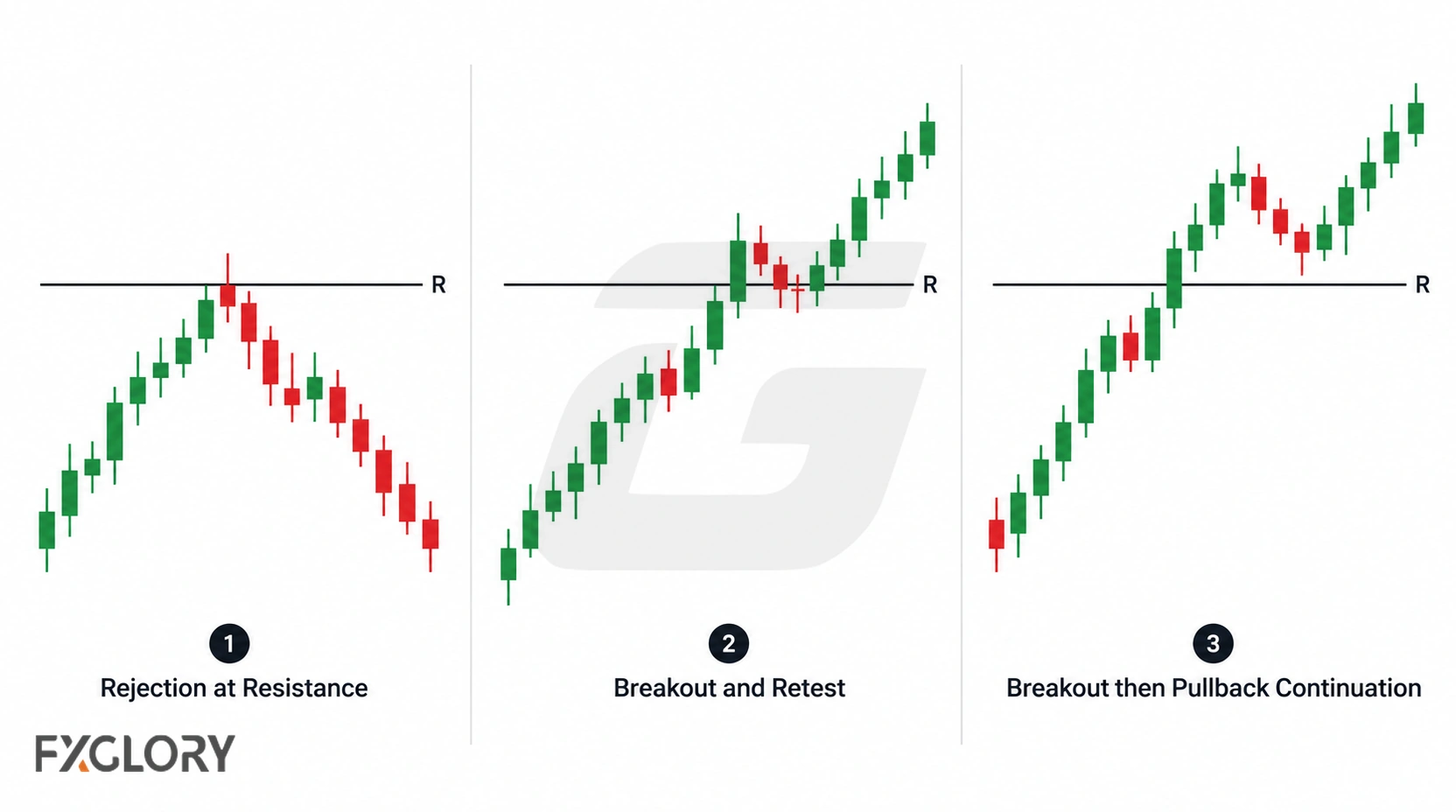
| What Price Does | Possible Setup | Trigger To Wait For | Skip If |
|---|---|---|---|
| Price rejects resistance and returns toward the range | Range-reaction setup | Confirmation that resistance still holds | The range is too narrow after spread or price breaks strongly |
| Price compresses below resistance, then closes above it | Breakout-and-retest setup | Retest holds and price moves back in the breakout direction | The breakout is only a spike or event-driven move |
| Price breaks resistance, pulls back, and continues upward | Trend pullback setup | Pullback holds above the broken area | Price is already too far from invalidation |
| Price moves violently through the level during news | No trade unless a news-specific plan exists | Risk and invalidation remain definable | Spread, slippage, or volatility makes the trade unclear |
When A Forex Trade Setup Should Be Skipped
A setup framework should explain when not to trade. Many weak trades come from trying to turn every chart condition into an entry.
- No clear context: The trader cannot say whether the market is trending, ranging, compressing, or reacting to news.
- Timeframe conflict: A lower-timeframe entry idea is fighting the broader chart context.
- No invalidation: The trader knows why the chart looks interesting but not where the idea is wrong.
- Late entry: Price has already moved far from the area where risk can be controlled.
- Middle-of-range entry: The condition appears where both target and invalidation are unclear.
- Spread problem: The target is too small after trading cost is considered.
- Margin problem: Position size is chosen from available exposure instead of planned risk.
- Event risk: News or abnormal volatility changes the trade environment before the position can be managed.
- Emotional entry: The trader is entering because of fear of missing out, not because the trigger occurred.
Review leverage conditions before using exposure as part of any trade decision. Leverage changes exposure; it does not make a weak setup stronger.
Compact Forex Setup Review Template
A review template makes a trade idea easier to test across many examples. Use the same fields for trades taken, trades skipped, and conditions that looked unclear.
| Field | What To Record |
|---|---|
| Pair and timeframe | The currency pair, chart timeframe, and higher-timeframe context. |
| Setup type | Trend pullback, breakout-retest, range reaction, price-action rejection, indicator-confirmed, or event-affected. |
| Context | Trend, range, compression, news, or unclear market. |
| Trigger | The exact event that allowed entry or would have allowed entry. |
| Invalidation | The level, condition, or behaviour that made the idea wrong. |
| Risk check | Stop distance, spread, position size, margin, and leverage exposure. |
| Exit plan | Target, trailing logic, partial exit, time-based exit, or review point. |
| Skip reason | Late entry, unclear context, spread issue, event risk, no invalidation, or emotional pressure. |
| Outcome | Win, loss, skipped, invalidated, unclear, or rule-breaking. |
| Review note | Whether the trade idea was valid and whether the rules were followed. |
Testing And Reviewing Forex Trading Setups
A setup should be reviewed as a repeated condition, not as one isolated trade. The review should include valid examples, skipped conditions, failed triggers, late entries, and unclear cases.
- Name the setup type: Trend pullback, breakout-retest, range reaction, price-action rejection, indicator-confirmed, or event-affected.
- Record the context: Trend, range, compression, news, or unclear market.
- Save the trigger: Note what allowed the entry or why the trade was skipped.
- Mark invalidation: Record where the idea became wrong.
- Check execution conditions: Spread, slippage, platform workflow, margin, and order timing.
- Use alerts when appropriate: If the trade idea depends on a level or trigger, alerts can help the trader wait for the condition instead of forcing an early entry.
- Separate outcome from process: A winning trade can still be poor if the rules were broken.
- Review a group of examples: Do not judge the setup from one clean chart or one frustrating loss.
Review FXGlory trading platforms when a setup depends on charting tools, indicators, alerts, order placement, or trade-management workflow. For pair selection, review available currency pairs before scanning too many markets at once.
Setup-Quality Test Notes For Forex Trading Setups
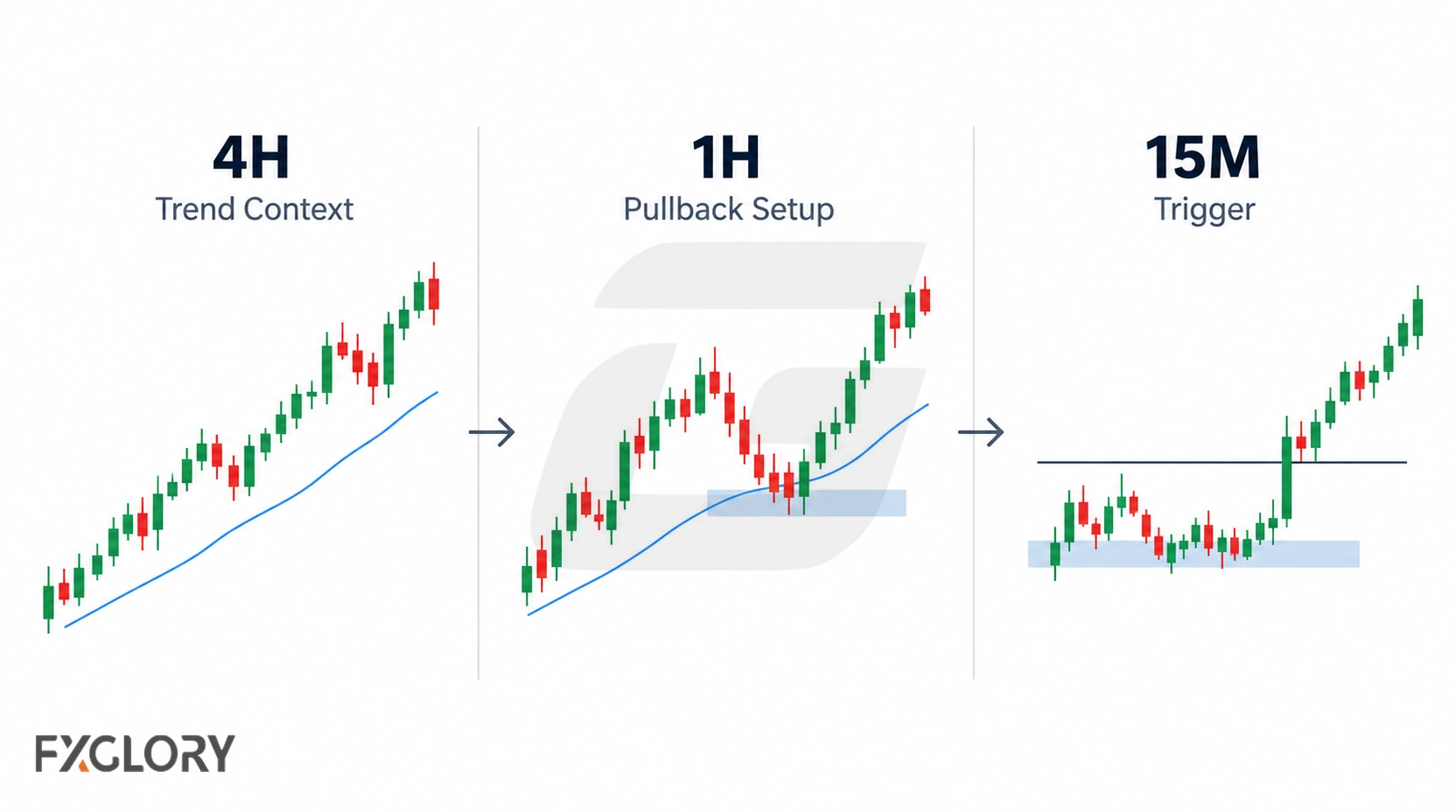
This hypothetical educational setup-quality test reviewed one setup workflow: 4H context, 1H trend-pullback setup, 15M trigger confirmation, setup invalidation, ATR-based stop placement, fixed 1.5R target, whipsaw exit, and spread/slippage sensitivity. It does not test every forex setup type, discretionary chart reading, range setups, breakout-retest setups, price-action setups, indicator setups, or a complete trading plan.
The model reviewed EURUSD, GBPUSD, USDJPY, AUDUSD, USDCAD, and USDCHF using public yfinance 15-minute OHLC data where available. The structured research record lists 2026-04-07 23:00 UTC as the first downloaded observation and 2026-06-30 08:30 UTC as the last for all six pairs. These are recorded data-availability timestamps, not verified first and last eligible trade times. The same record describes the requested 15-minute download period as 60d, although the listed observation timestamps span more than 60 calendar days; the original acquisition script and trade log are needed to reconcile that discrepancy. The 1H and 4H candles are resampled from the same 15-minute data so that each chart has a defined role.
| Rule Area | Educational Model Rule |
|---|---|
| Context chart | 4H EMA(20), EMA(50), and EMA(20) slope define long or short context |
| Setup chart | 1H EMA(20) pullback-and-confirmation candle defines setup direction and stop structure |
| Trigger chart | 15M break of the previous 6-candle trigger range refines entry timing only |
| Long context | 4H close above EMA(50), EMA(20) above EMA(50), and EMA(20) slope positive |
| Short context | 4H close below EMA(50), EMA(20) below EMA(50), and EMA(20) slope negative |
| 1H long setup | Pullback into EMA(20), bullish close, upper 40% close location, and no more than 0.75 ATR(14) above EMA(20) |
| 1H short setup | Pullback into EMA(20), bearish close, lower 40% close location, and no more than 0.75 ATR(14) below EMA(20) |
| 15M trigger | Break of the previous 6-candle 15M trigger range by at least 0.05 ATR(14), aligned with setup direction |
| Setup invalidation before trigger | Long setup fails on 15M close below the 1H setup candle low; short setup fails on 15M close above the 1H setup candle high |
| Entry | Next 15M open after the completed trigger candle |
| Stop | 1H setup candle extreme with a 0.25 ATR(14) buffer |
| Target comparison | Fixed 1.5R target from entry |
| Whipsaw exit | 15M close beyond the 1H setup candle extreme against the trade |
| Maximum holding review | 32 completed 15-minute candles after entry |
| Cost Input | Assumptions Used |
|---|---|
| Spread | 0.5, 1.5, and 3.0 pips |
| Slippage | 0.1, 0.5, and 1.0 pips per side |
| Baseline comparison | 1.5-pip spread and 0.5-pip slippage per side |
| Swap and rollover | Not included |
The review records setup candidates, triggered trades, accepted trades, rejected conditions, rejection reasons, trade count, win rate, average win in R, average loss in R, expectancy in R, profit factor, maximum drawdown in R, worst losing streak, holding time, pair-level behavior, direction-level behavior, whipsaw exits, exit reasons, trigger acceptance, setup rejection, and spread/slippage sensitivity.
Resampling verification: The recorded rules refer to completed 4H candles for trend context, but the research summary does not establish the 1H and 4H resampling boundaries or document whether each higher-timeframe input was available only after its candle closed. These timing details must be checked against the original backtest script to exclude look-ahead bias; this summary alone cannot verify the implementation.
Educational Setup-Quality Test Results
The baseline run was negative: -0.1575R expectancy and -24.0915R total net result across 153 trades. The test used a 1.5-pip spread and 0.5-pip slippage per side. These figures are hypothetical historical results from one educational setup-quality rule model, not proof of future live-trading performance.
| Metric | Baseline Result |
|---|---|
| Setup candidates | 431 |
| Triggered trades before overlap filter | 202 |
| Accepted trades | 153 |
| Rejected candidates | 278 |
| Setup rejection rate | 64.5% |
| Trigger acceptance rate | 46.87% |
| Win rate | 43.79% |
| Average win | 0.7949R |
| Average loss | -0.8994R |
| Expectancy | -0.1575R |
| Profit factor | 0.6885 |
| Maximum drawdown | -27.9028R |
| Worst losing streak | 11 |
| Average holding period | 313.14 minutes |
| Whipsaw exit rate | 8.5% |
| Rejected Condition | Count |
|---|---|
| Setup invalidated before trigger | 68 |
| No valid 15M trigger | 161 |
| Same-pair overlap | 49 |
Pair-Level Baseline Results
| Pair | Trades | Win Rate | Expectancy | Total Net | Max Drawdown | Worst Losing Streak | Whipsaw Exit Rate |
|---|---|---|---|---|---|---|---|
| AUDUSD | 27 | 51.85% | 0.0934R | 2.5229R | -5.3961R | 4 | 7.41% |
| EURUSD | 22 | 36.36% | -0.4035R | -8.8768R | -9.6341R | 4 | 13.64% |
| GBPUSD | 15 | 40% | -0.3075R | -4.6123R | -3.9253R | 2 | 26.67% |
| USDCAD | 40 | 52.5% | 0.0768R | 3.072R | -3.0082R | 3 | 0% |
| USDCHF | 21 | 33.33% | -0.3883R | -8.1545R | -8.2618R | 5 | 9.52% |
| USDJPY | 28 | 39.29% | -0.2872R | -8.0427R | -8.5112R | 6 | 7.14% |
Direction-Level Baseline Results
| Direction | Trades | Win Rate | Expectancy | Total Net | Max Drawdown | Worst Losing Streak | Whipsaw Exit Rate |
|---|---|---|---|---|---|---|---|
| Long | 101 | 45.54% | -0.0959R | -9.6848R | -13.9942R | 5 | 3.96% |
| Short | 52 | 40.38% | -0.2771R | -14.4067R | -16.9179R | 8 | 17.31% |
Exit Reason Counts
| Exit Reason | Count |
|---|---|
| stop first same bar | 1 |
| stop loss | 47 |
| target 1.5R | 30 |
| time exit | 62 |
| whipsaw 15m close beyond 1h setup extreme | 13 |
Spread And Slippage Sensitivity
| Spread Pips | Slippage Pips Per Side | Win Rate | Expectancy | Total Net | Max Drawdown |
|---|---|---|---|---|---|
| 0.5 | 0.1 | 47.71% | -0.0359R | -5.4937R | -14.1746R |
| 0.5 | 0.5 | 45.75% | -0.0899R | -13.7594R | -19.6149R |
| 0.5 | 1.0 | 43.79% | -0.1575R | -24.0915R | -27.9028R |
| 1.5 | 0.1 | 45.75% | -0.1034R | -15.8259R | -21.1383R |
| 1.5 | 0.5 | 43.79% | -0.1575R | -24.0915R | -27.9028R |
| 1.5 | 1.0 | 41.18% | -0.225R | -34.4236R | -37.7313R |
| 3.0 | 0.1 | 42.48% | -0.2047R | -31.324R | -34.7648R |
| 3.0 | 0.5 | 40.52% | -0.2588R | -39.5897R | -42.6755R |
| 3.0 | 1.0 | 37.91% | -0.3263R | -49.9218R | -52.6328R |
What This Setup-Quality Test Shows
This trend-pullback setup workflow produced negative baseline expectancy in the tested sample. The main review points were setup rejection, trigger selectivity, time exits, pair-level differences, cost sensitivity, and the gap between an interesting chart condition and a complete trade rule.
The setup filter found 431 candidates, but 278 conditions were rejected or filtered out. That supports the article framework: a setup is only a watch condition until a trigger, invalidation, risk rule, and exit rule are defined. The baseline drawdown and losing streak also show why a setup journal should include skipped conditions and failed triggers, not only completed trades.
The figures should stay tied to the exact public data source, resampling method, cost assumptions, context rule, setup rule, trigger rule, stop rule, target rule, and whipsaw-exit rule used in this run.
Forex Trading Setup Checklist
Before treating any forex setup as tradable, answer these questions.
- What market condition does the setup need?
- Which pair and timeframe are being reviewed?
- Does a higher timeframe support or conflict with the trade idea?
- Where is the setup located on the chart?
- What exact event triggers entry?
- Where is the idea invalid?
- Does the target still make sense after spread?
- Does position size fit the stop distance and margin requirement?
- What closes, reduces, or reviews the trade?
- What condition would make the setup a no-trade?
- Can the setup be reviewed later without guessing?
A forex trading setup is useful only when it can be written, tested, skipped when weak, and reviewed under realistic trading conditions.